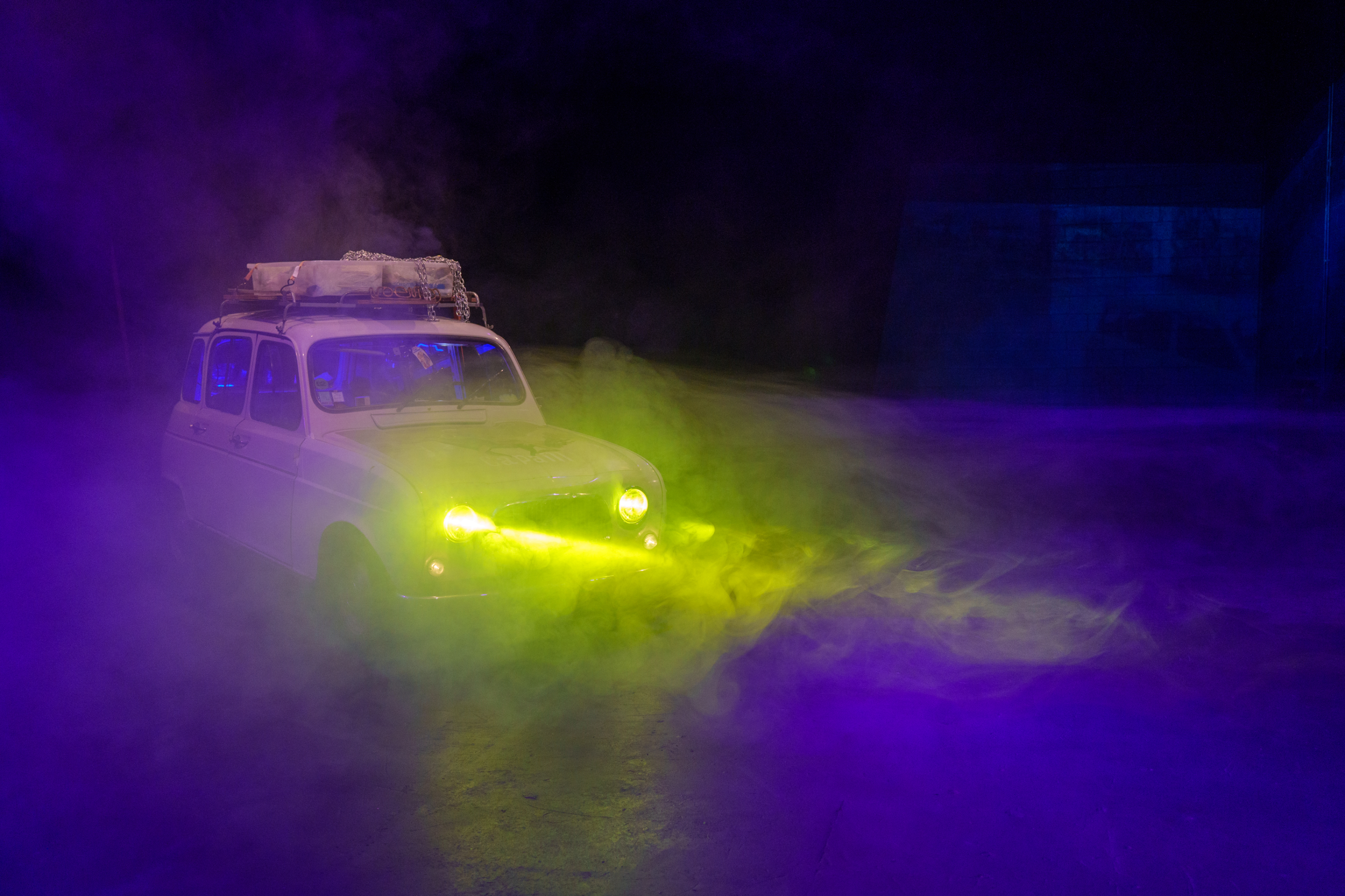
23.08.2025
The last day of tour de force,
At the wheel of Liliane’s late father’s Renault 4, tour de force is a celebration of culture and creativity in the format of a mapped adventure engaging with artists, musicians, mechanics, farmers, archaeologists, craftspeople, academics and aficionados over a series of pit stops all around Ireland…a summer 2025 ‘buddy movie’.
We’d been on the road for forty-six days and were making our way back from Rathlin along the Antrim coast road onto the A1, N1 and M1 into Dublin for one final event as part of the tour, arriving back with objects, images, stories, talismans, touchstones from an evolving, circuitous, meandering, labyrinthine trip around Ireland.
Donal Dineen’s iconic Backstory club night brings together people from all over, through music and dancing. In a city thats in constant flux, he creates a transient third space for encounter and movement, rhythmic consciousness, buzzing atmosphere and cathartic flow.
Our journey would finish out on the Backstory dance floor with responsive sets from Donal Dineen and Chicago-born, Dublin-based DJ, poet Governess as an immersive otherworldly art installation // dance party at The Depot; a repurposed refrigeration facility in the heart of the historic fruit market district of Dublin.
Chilling the objects, creating a suspended reality, preserving the Renault 4 indefinitely.
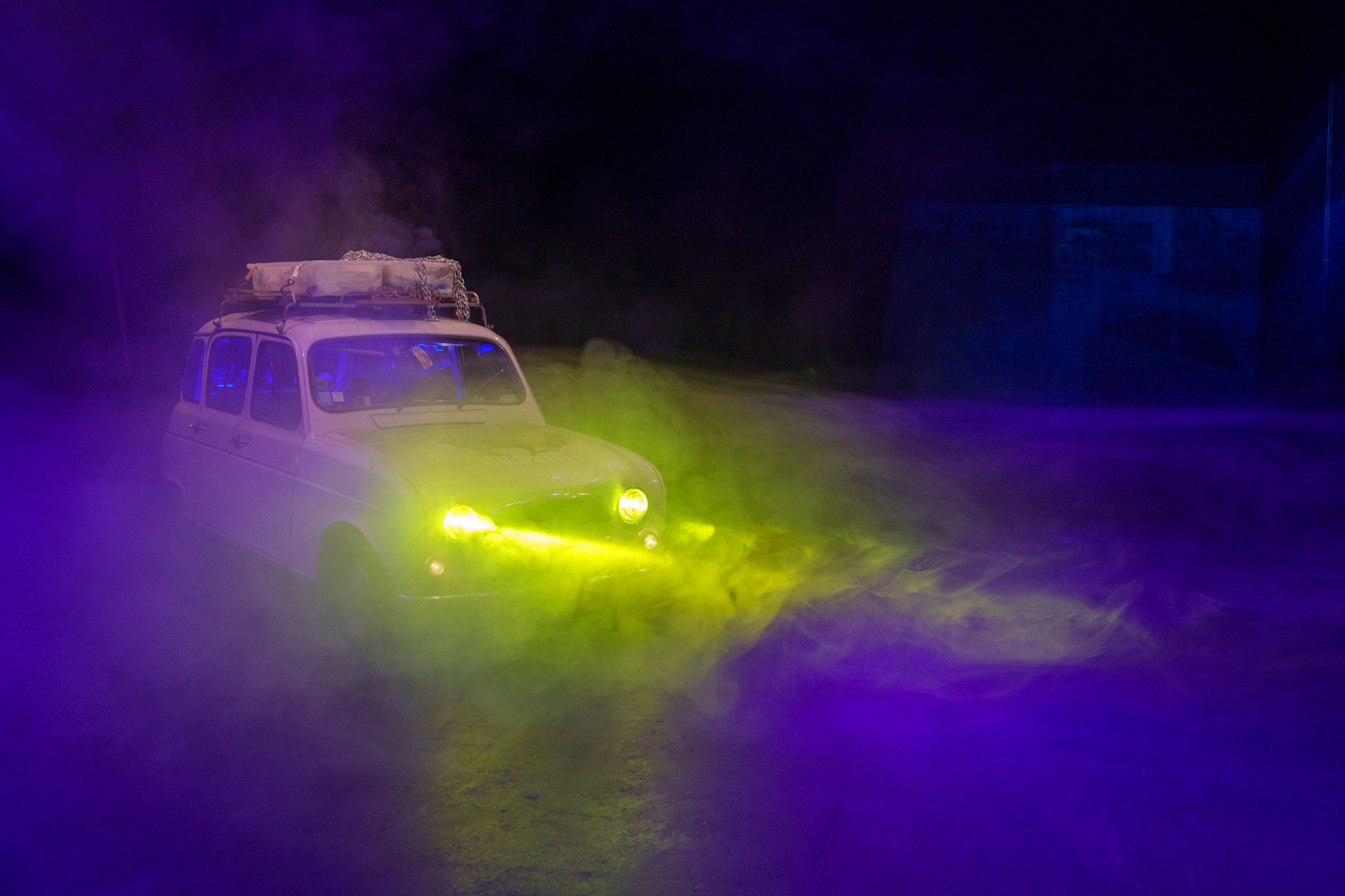
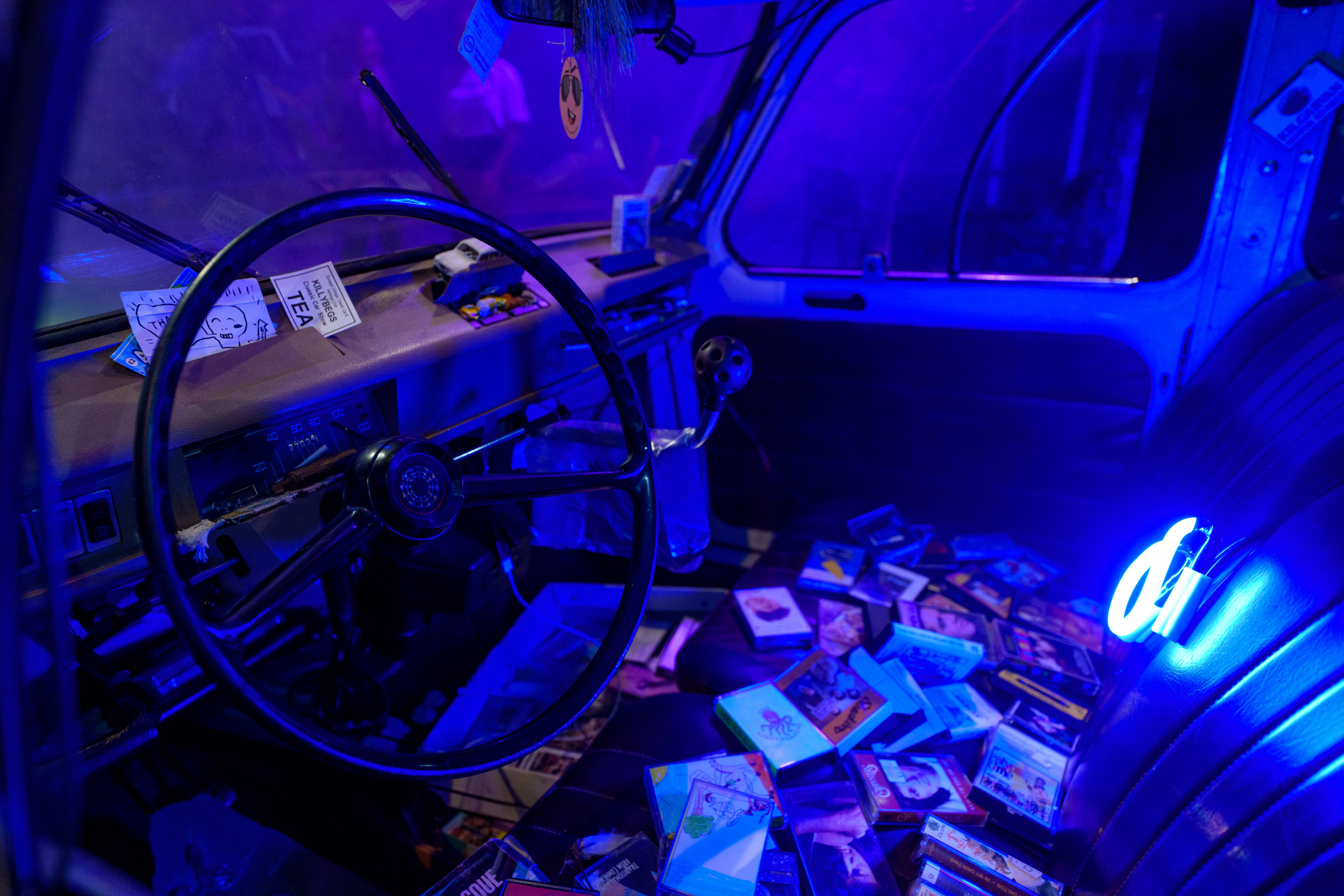
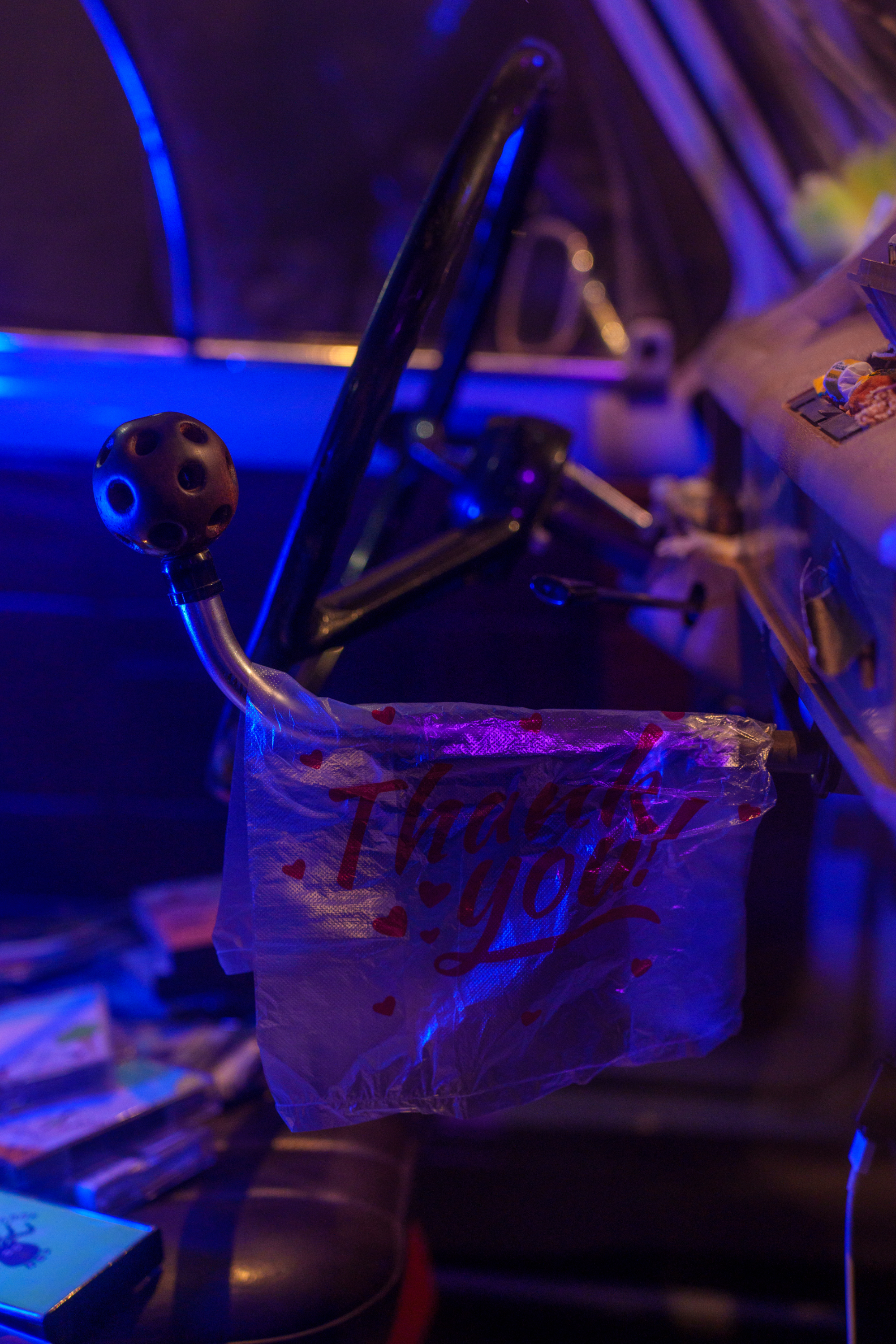
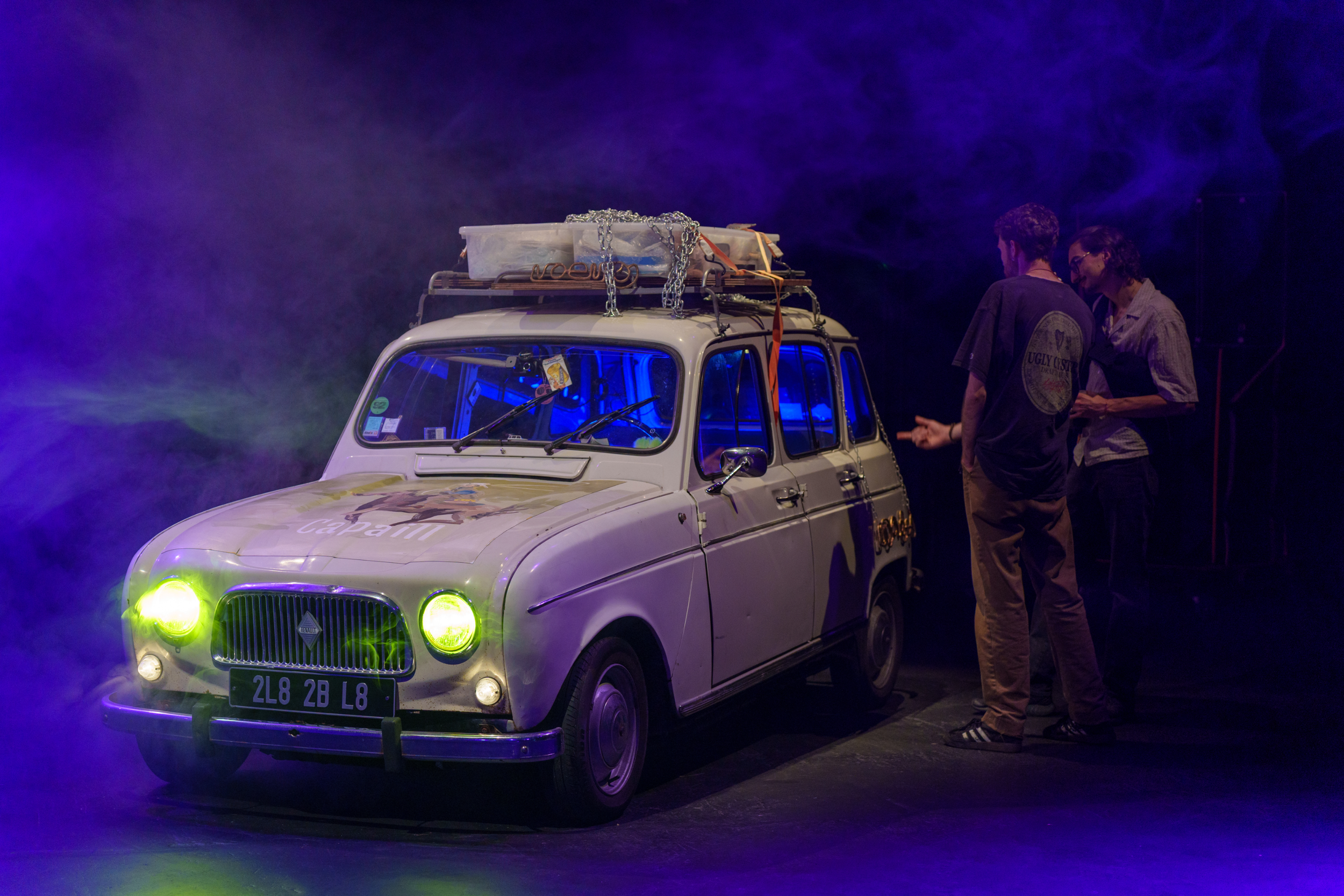
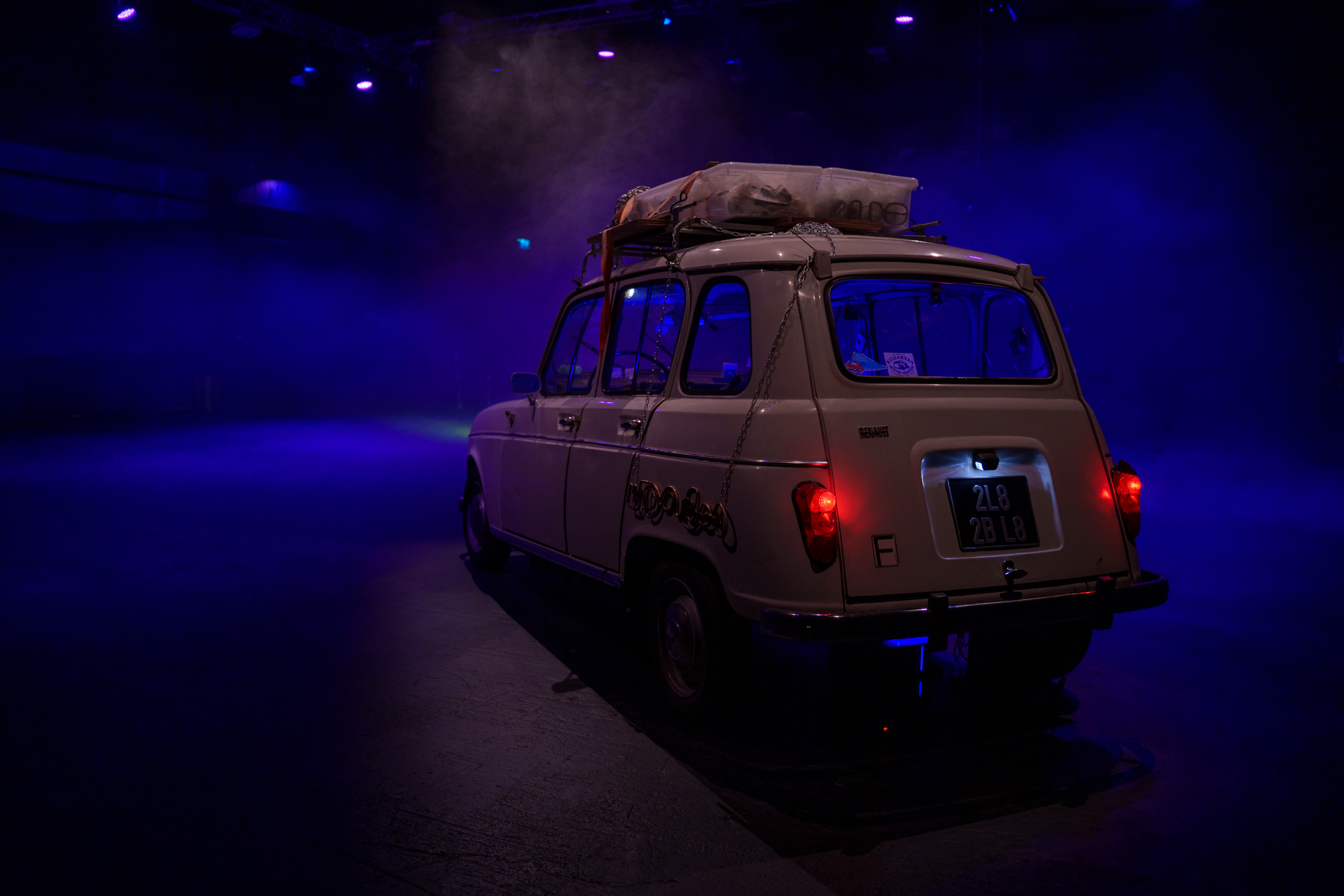
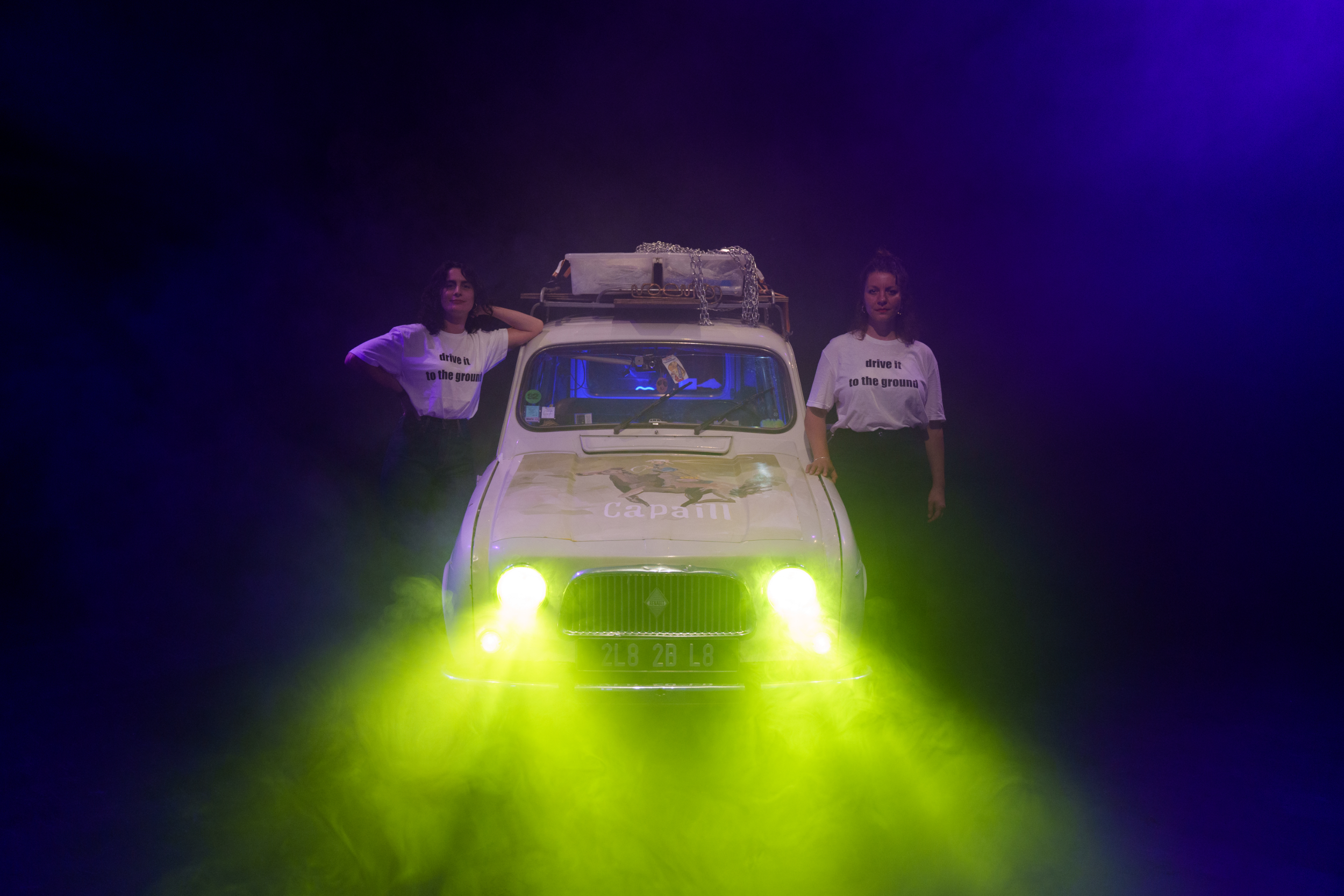
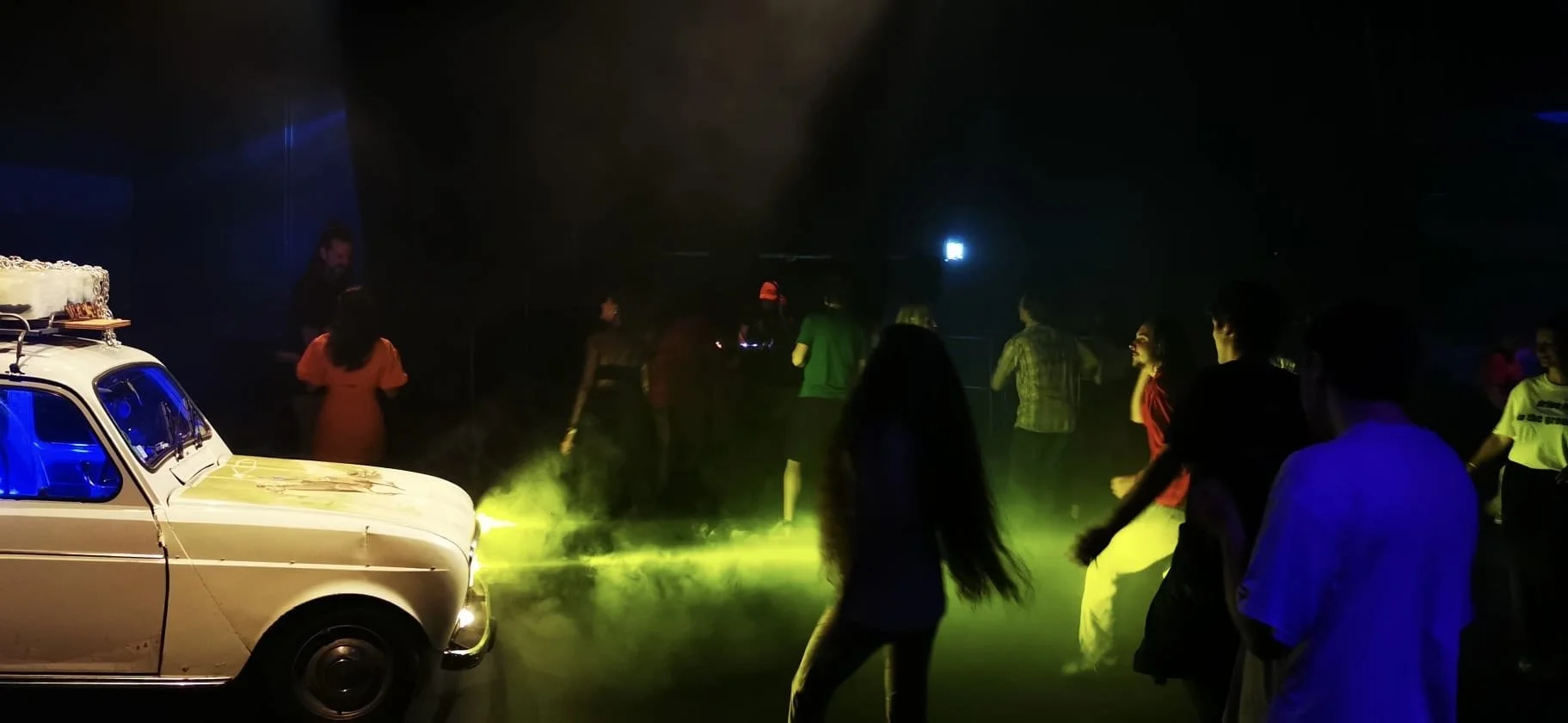
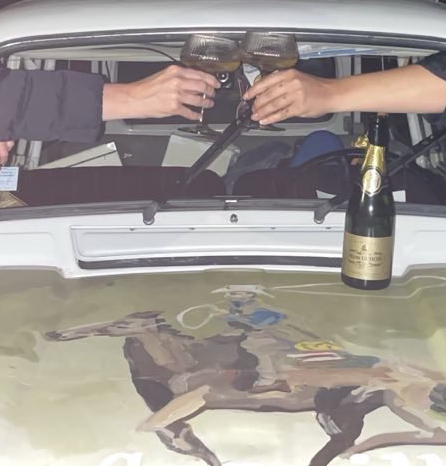
Photos credits: Serhii Shapoval, Caoimhe McCabe and tour de force
22.08.2025
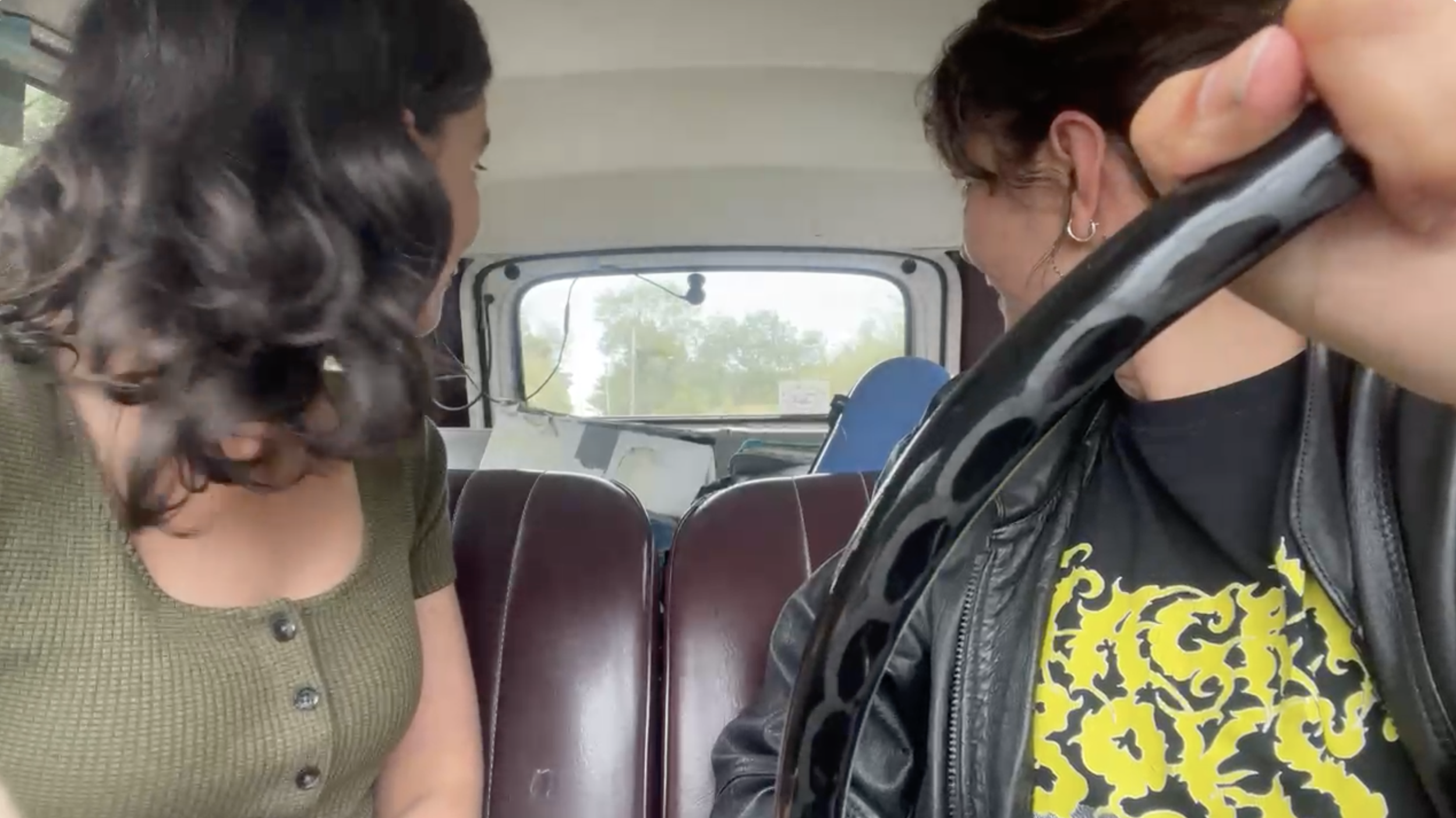
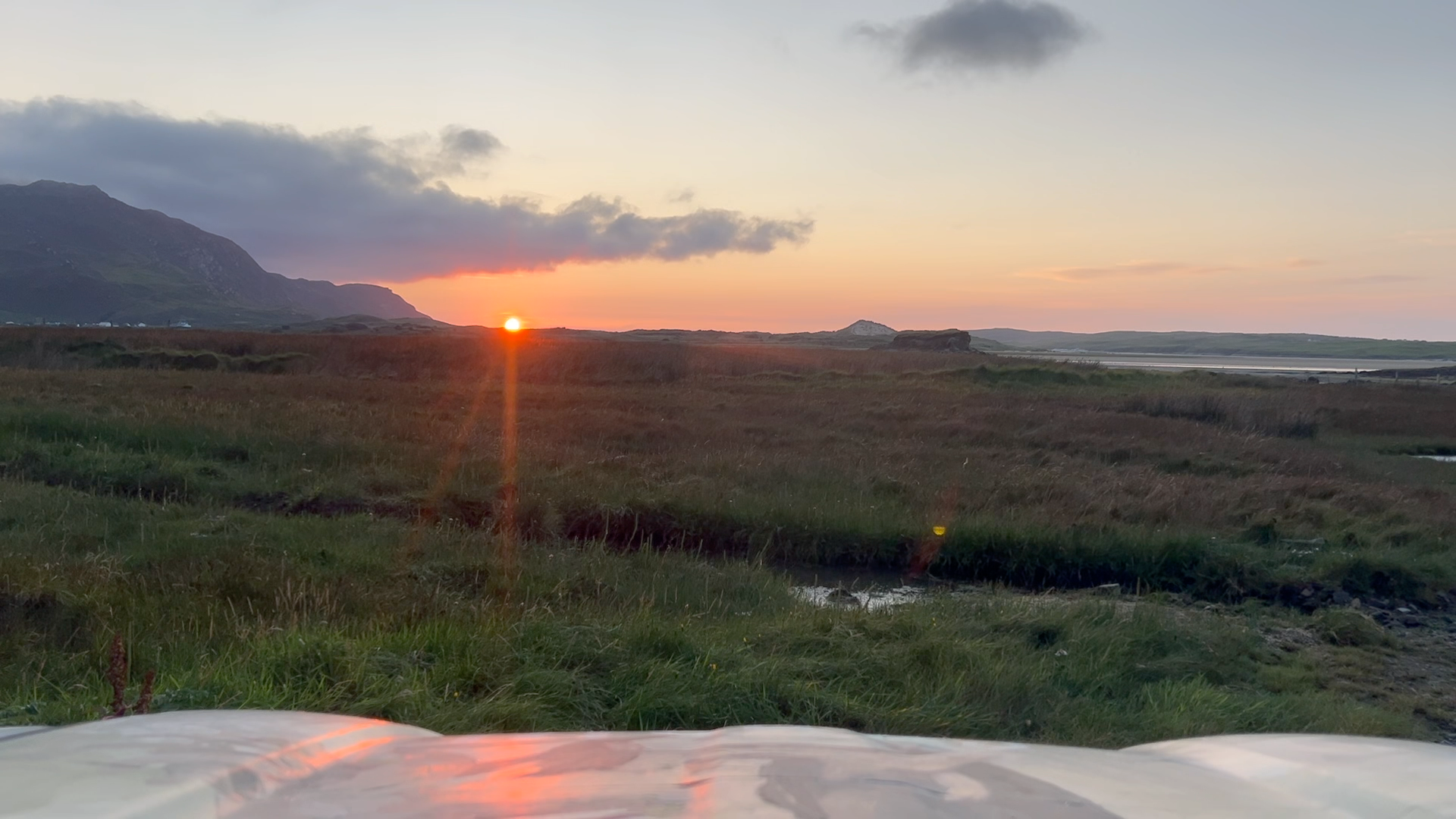
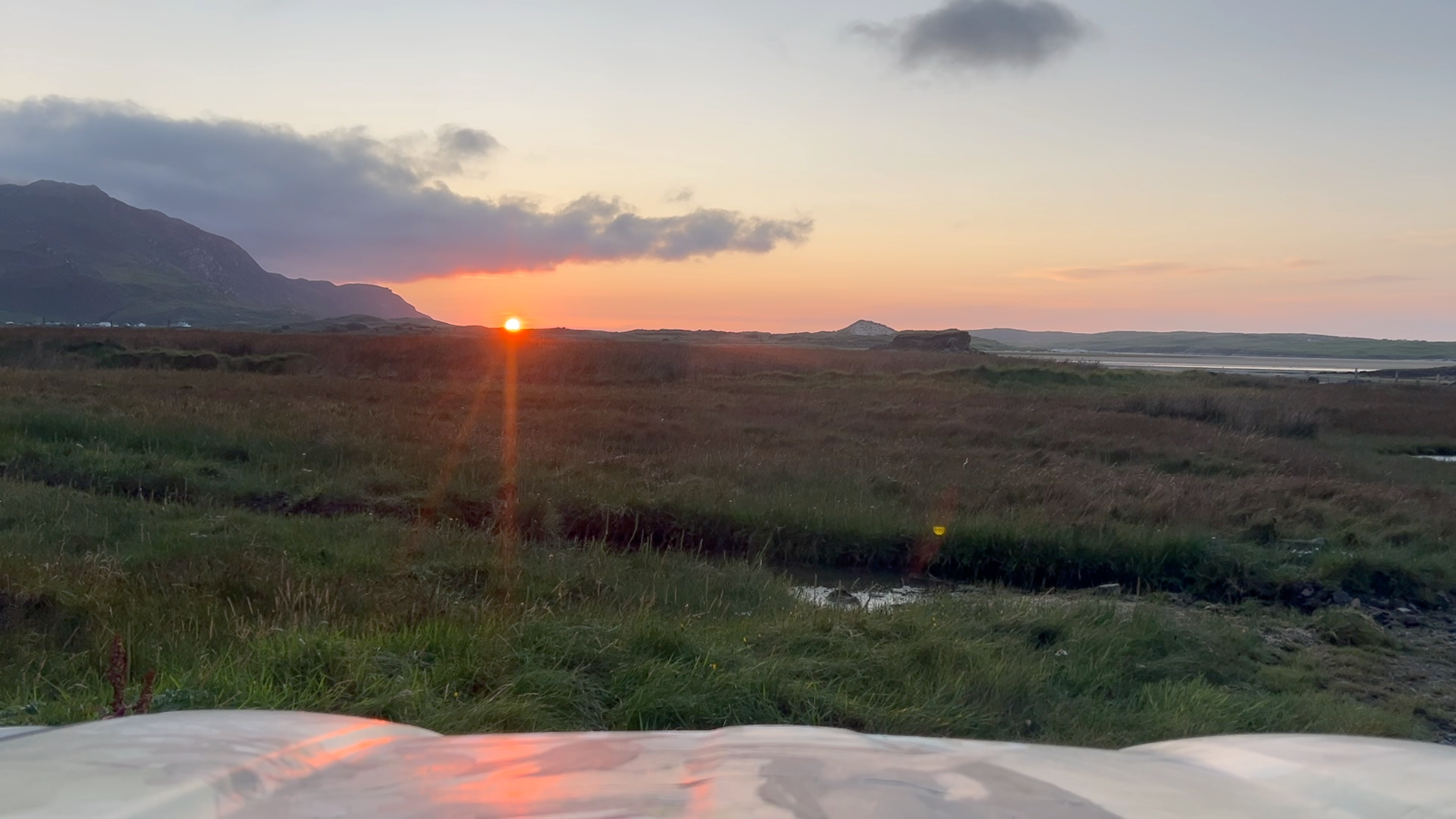
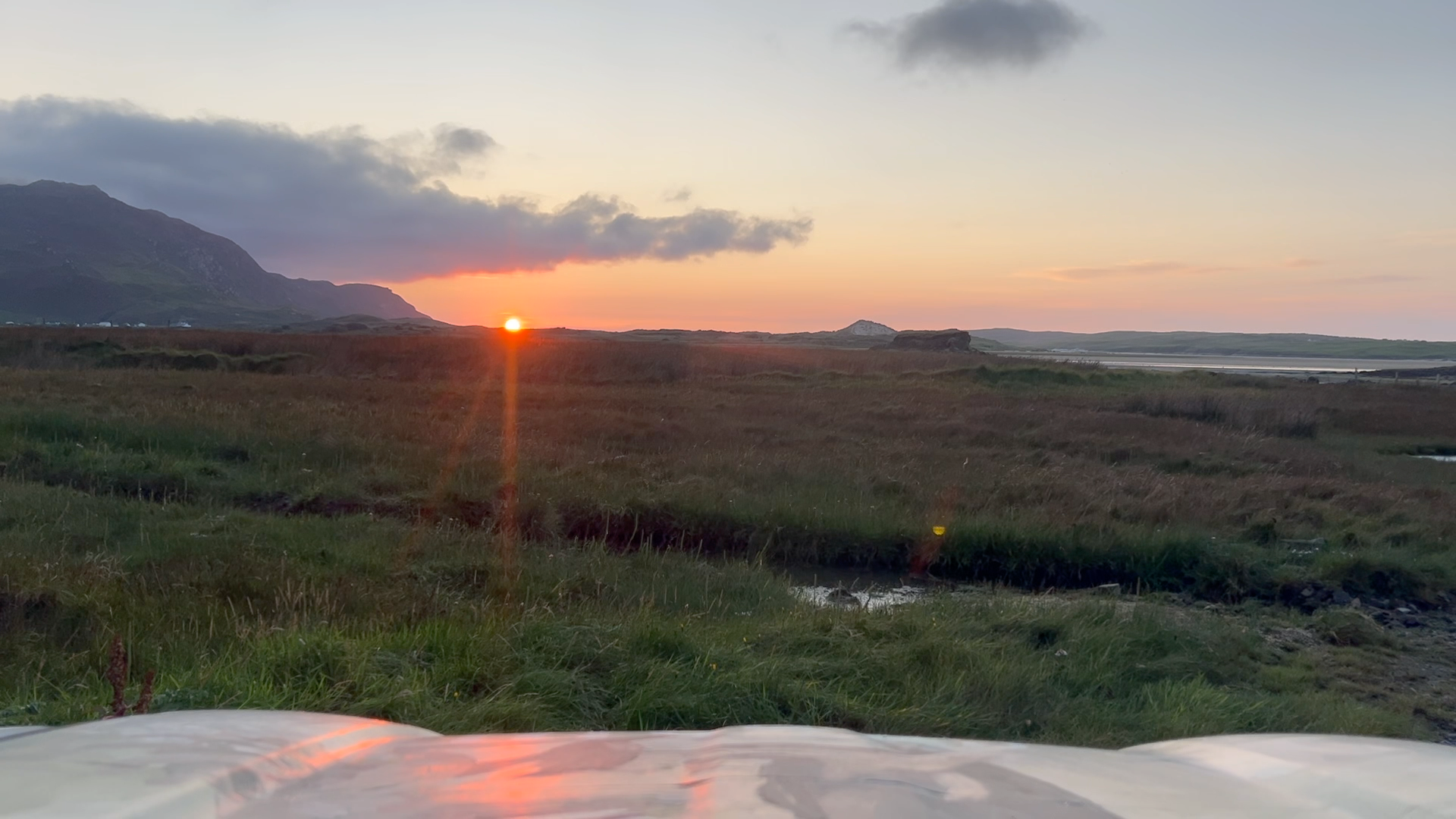
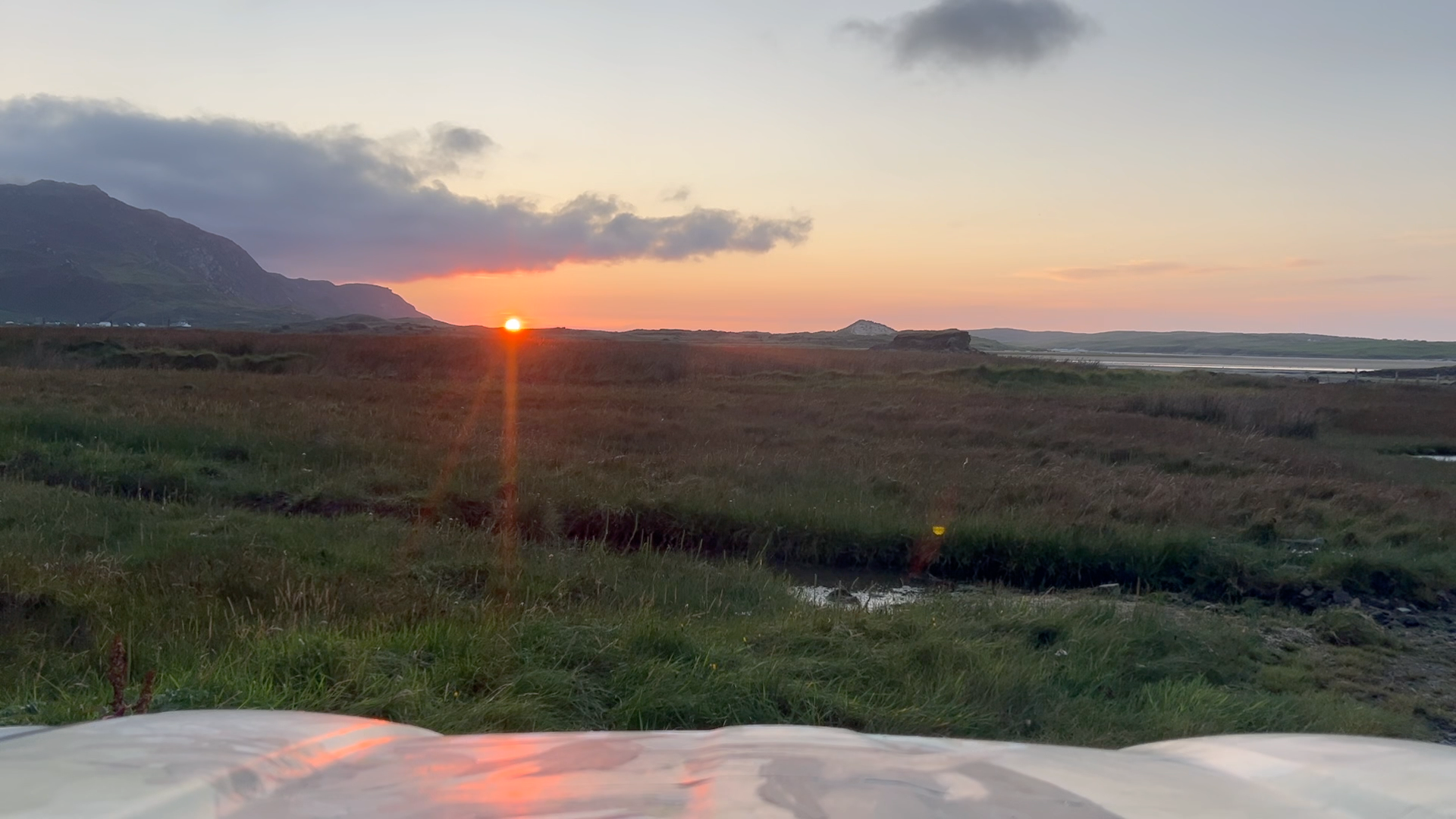
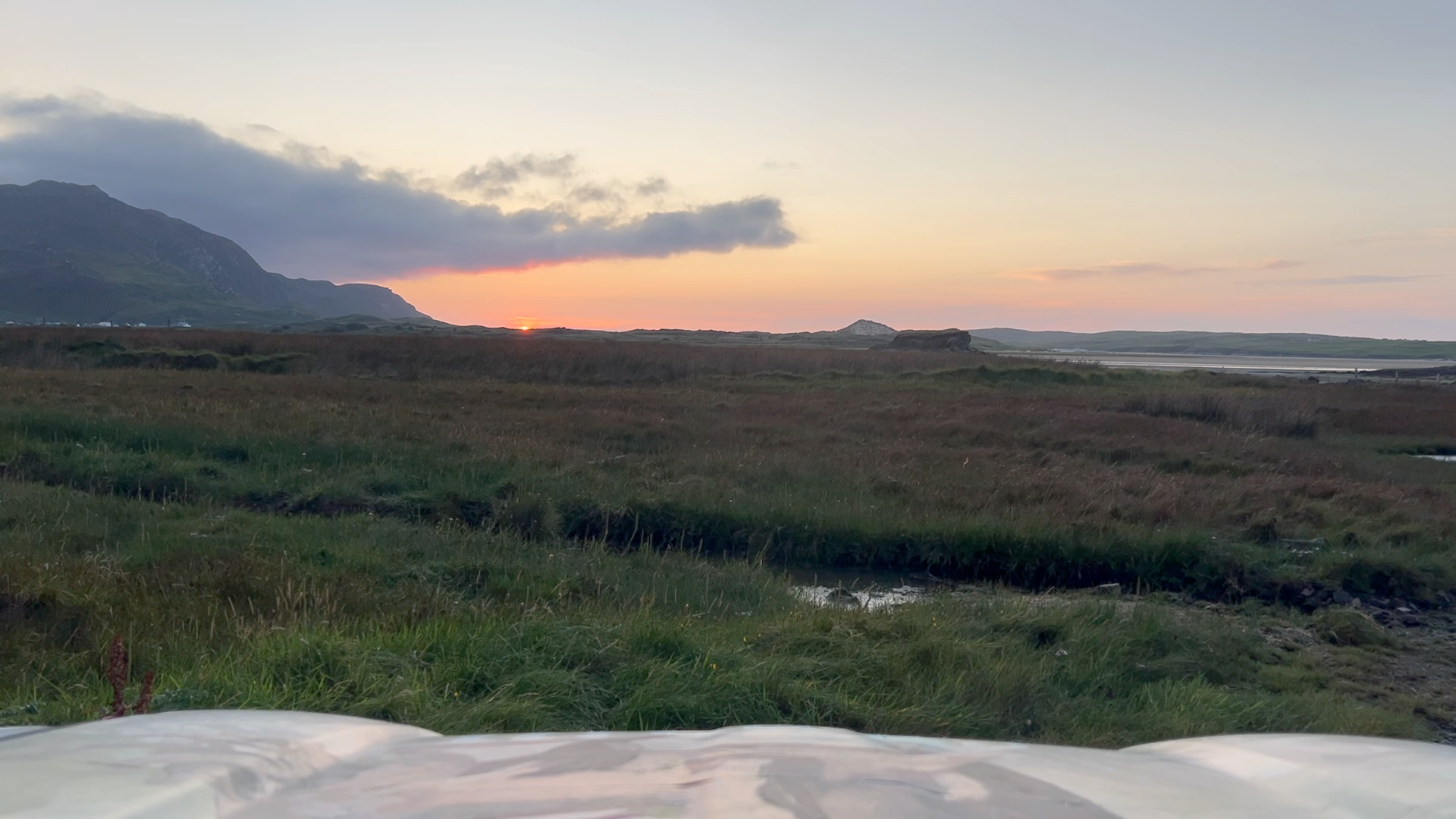
That tune I plucked - it’s the tarantella tune I mentioned before…named after the tarantula. It’s the melody that came from Italy and was washed into south west Donegal with a crew of shipwrecked Italian sailors, one of whom was taken in and stayed at the the Buchanan house in Doonalt. It’s often the first melody that comes to mind when I pick up the fiddle. I play it as a kind of call, un appel a French violinist friend of mine calls this; where you play fragments, meandering around; asking the surroundings to help you remember a tune. You noodle around until something arrives.
I heard it said before that there were three different tiers of fiddlers around south west Donegal in the old days; top-tier, renowned musicians who travelled from place-to-place sharing tunes, the middle tier who’d play for big nights - dances and so on and another tier of fiddlers who would play for the amusement of their friends and family. They might have only a few tunes and they’d hand the instrument to the next person who might also have just the one tune, or just a few tunes. I like that idea of there not being perfection or finesse towards performance, rather a collective meditation on the melodies as they arise.
This video at the ruins of a kelp house on Rathlin Island was not a performance but a practice, and as such tunes float around and are sometimes lost, arriving back later unexpectedly. Tension mounts and dissipates according to fleeting thoughts or images on the minds eye, a form of catharsis or a way to make sense of the world. Embarrassing to miss notes, squeak, whistle and blunder. Deanfaidh mé spáin nó millfidh mé adharc - either way something will come out of it, I’ll make a spoon or ruin a horn is what they used to say. Because the horns of farm animals would be gathered once a year to make kitchen utensils and after you started carving, there’d be only one of two outcomes.
This was myself and Liliane’s second last day of the six week tour and we were pensive, looking back. I was thinking, whilst playing the fiddle about how it is, that after a long journey you can get bogged down, start idling, go into the doldrums. A motionless place with the same thoughts each morning. Not leaving the house unless for work. Binge watching a sensationalised history of Norse kings or a drama about a women’s prison until they merge with each other - and your dreams, in the early hours of the morning. Setting alarms for 8am, 8.30am, 8.45am, 9am and snoozing them all.
Over the years I’ve spent most of my sleeping life in water or in the mountains or both. Travelling downstream, through ravines on foot and along rivers in a boat, wondering if it’s cut out for the open sea. Years ago, I wanted to make a huge painting of a woman diving into the sea, though in my mind, the shape of the figure was abstract and became part of a circular gesture of thickly applied paint. Splashes of water and disturbed sand, a vivid toothy smile and her eyes wide open despite the rush of water. I tried to push a thick globule of blue around the figure allowing some mossy greens and yellows to travel with it. It was more physical than I anticipated to make a big painting like that. Creating strands of detail in the gestured rush of the water, then flicking the brush around, incising the painted surface to bring forth the dried-out layers of red and yellow beneath. In his work I was completely absorbed and at ease. No doubt in my mind the world was all mixed up and not me. I set up a studio area by the window that some of the fumes from the oil paint could escape. It was not an effective method and I frequently awoke in the night with a throbbing headache. I barely felt the days going like that. Though, in what might be seen as contradictory, I imagined that this state was the closest thing to what might be described as happiness. The failed paintings are long since gone to the dump.
But the making of paintings for no reason, or the intention to play a melody as you remember it; to the best of your ability, to maintain its integrity as much as possible, play it as it was taught; such endeavours sharpen the wit. They create a heightened sense of awareness. This, I feel; leads to depths of appreciation and enjoyment in collaborating with artists, musicians, and hones your faculties when encountering new works of art by others.
Part 1
Part 2
21.08.2025
The landscape between here and there is similar. From Rathlin East Lighthouse, looking across at Mull of Kintyre, at a lighthouse built in 1788, they have the same jagged cliff face and craggy topography, with poor soil and resilient plants thriving miraculously out of sand, or pushing up through cracks in a rock. Purple heather, it loves the acid soil and the sea coats everything in a fine grit. If you look out while the lighthouse glares, you can see how the salt remembers pelted watermarks and drizzle on the windscreen.
After driving the Renault 4 across France in 2024, we’d visited a few independent record stores, choosing cassettes at random or on recommendation. Music to accompany us around the Arc de Triomphe, onto the ferry at Cherbourg, into Rosslare Harbour and towards the graving docks at Dublin Port. Those tapes, initially mysterious, became familiar after listening on loop and nowadays they conjure memories and moods from that trip. For tour de force, we commissioned Vera and Taf of BRRR BRRR BRRR to curate a mixtape to add to our cassette collection; A Trip Through the Ireland Underground; Records from the BRRR BRRR BRRR Collection - a selection of tracks from lesser-known musicians and labels based in Ireland. Music projects off the beaten track, on roads less travelled.
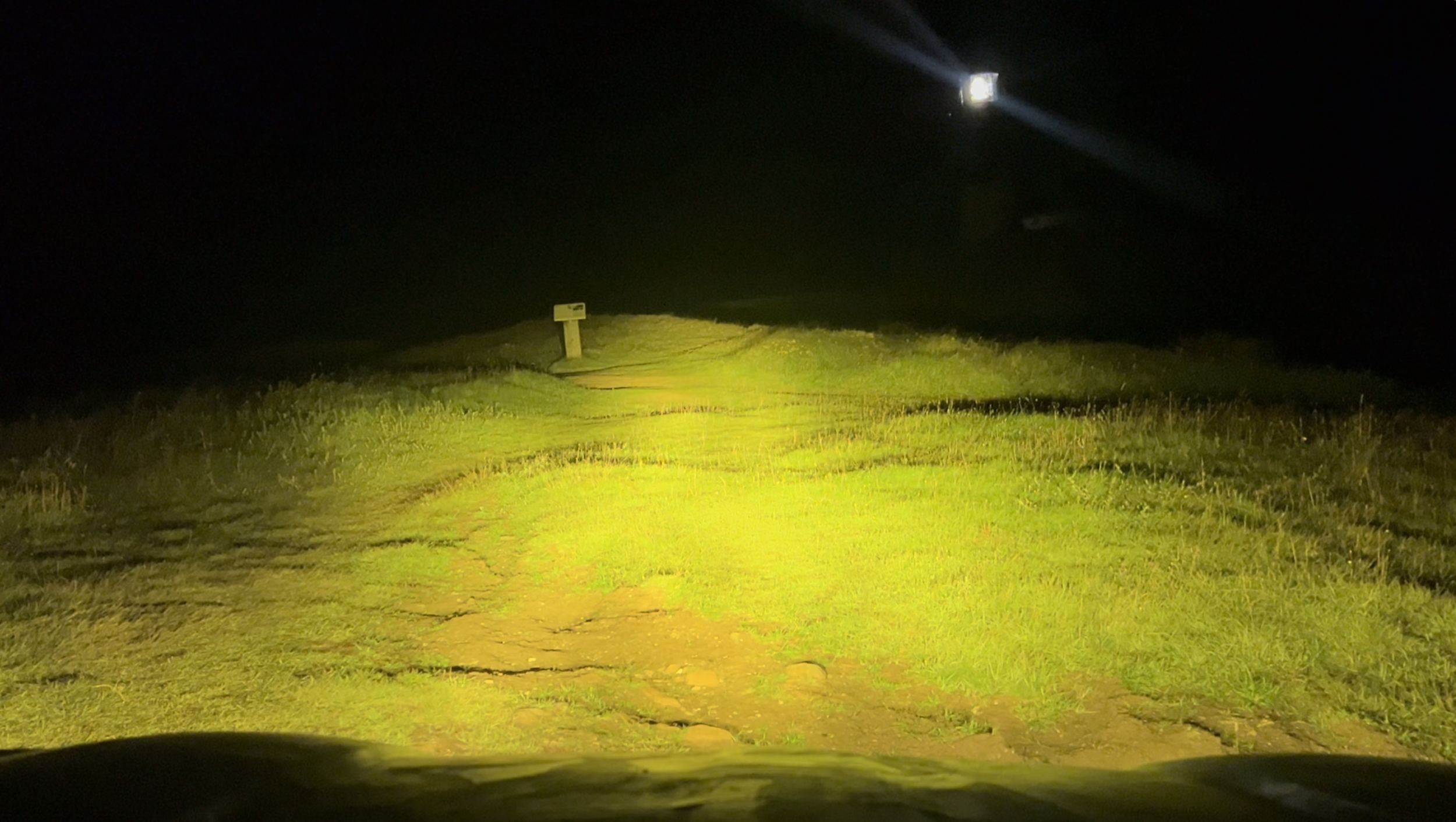
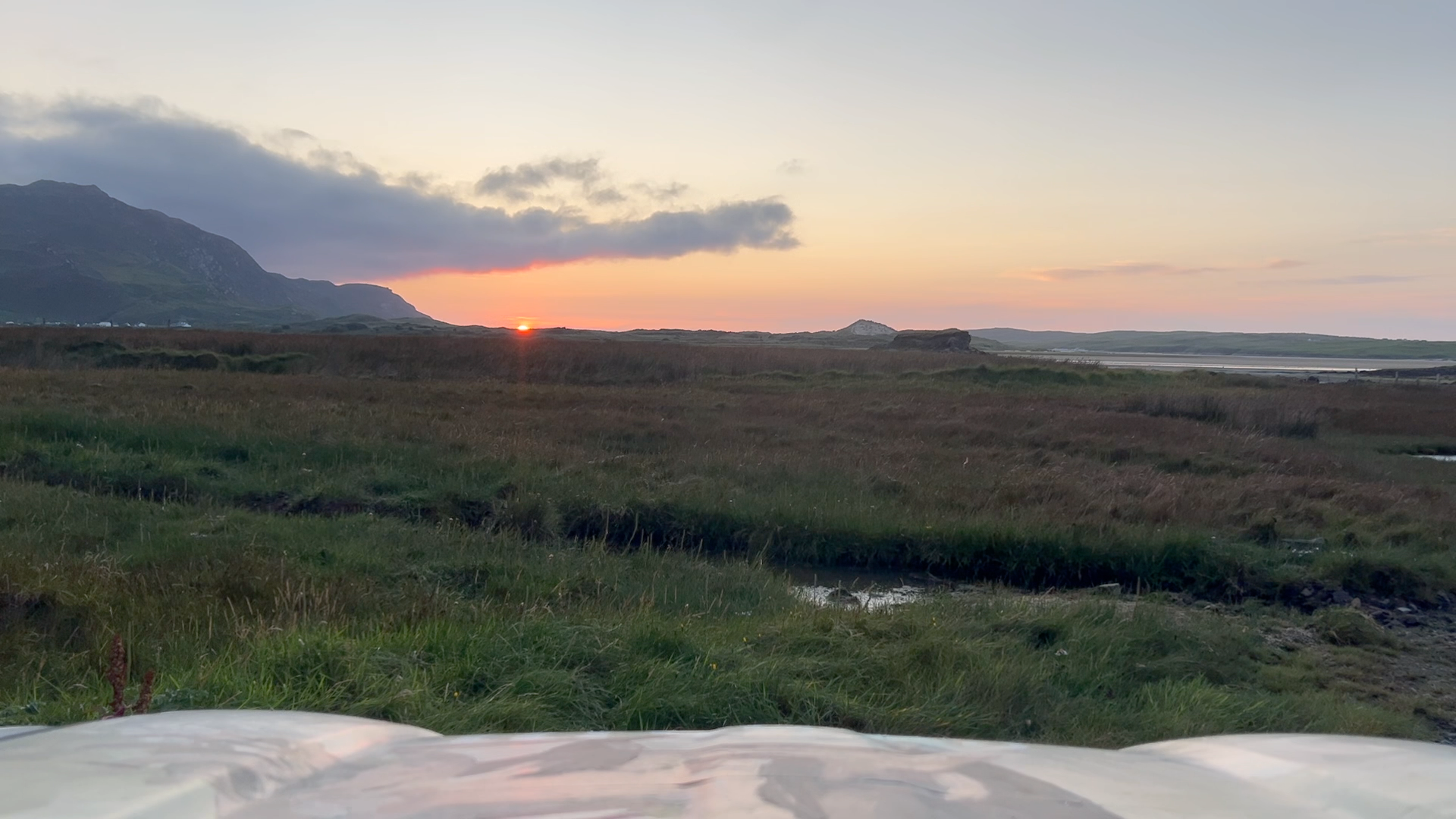
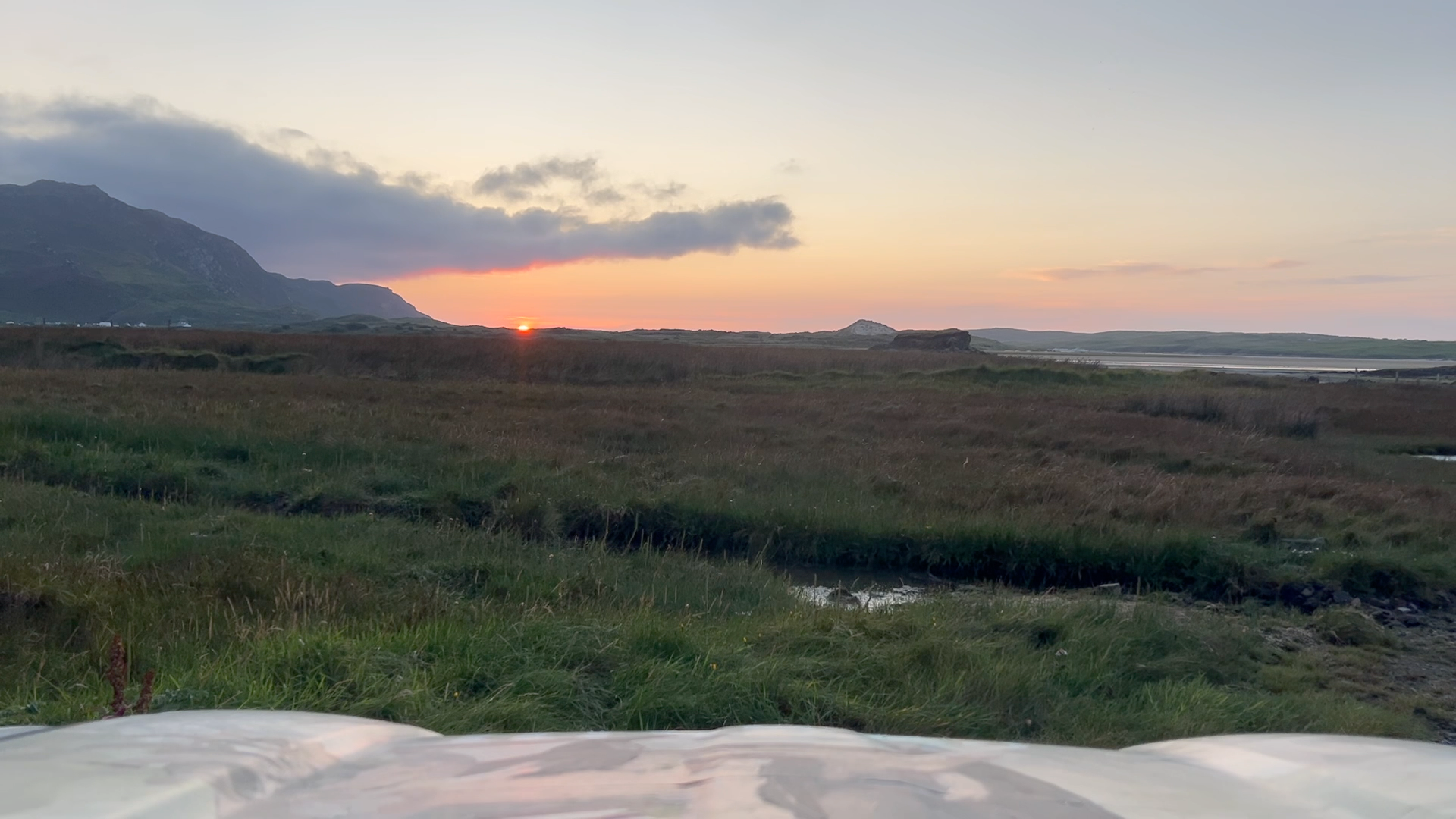
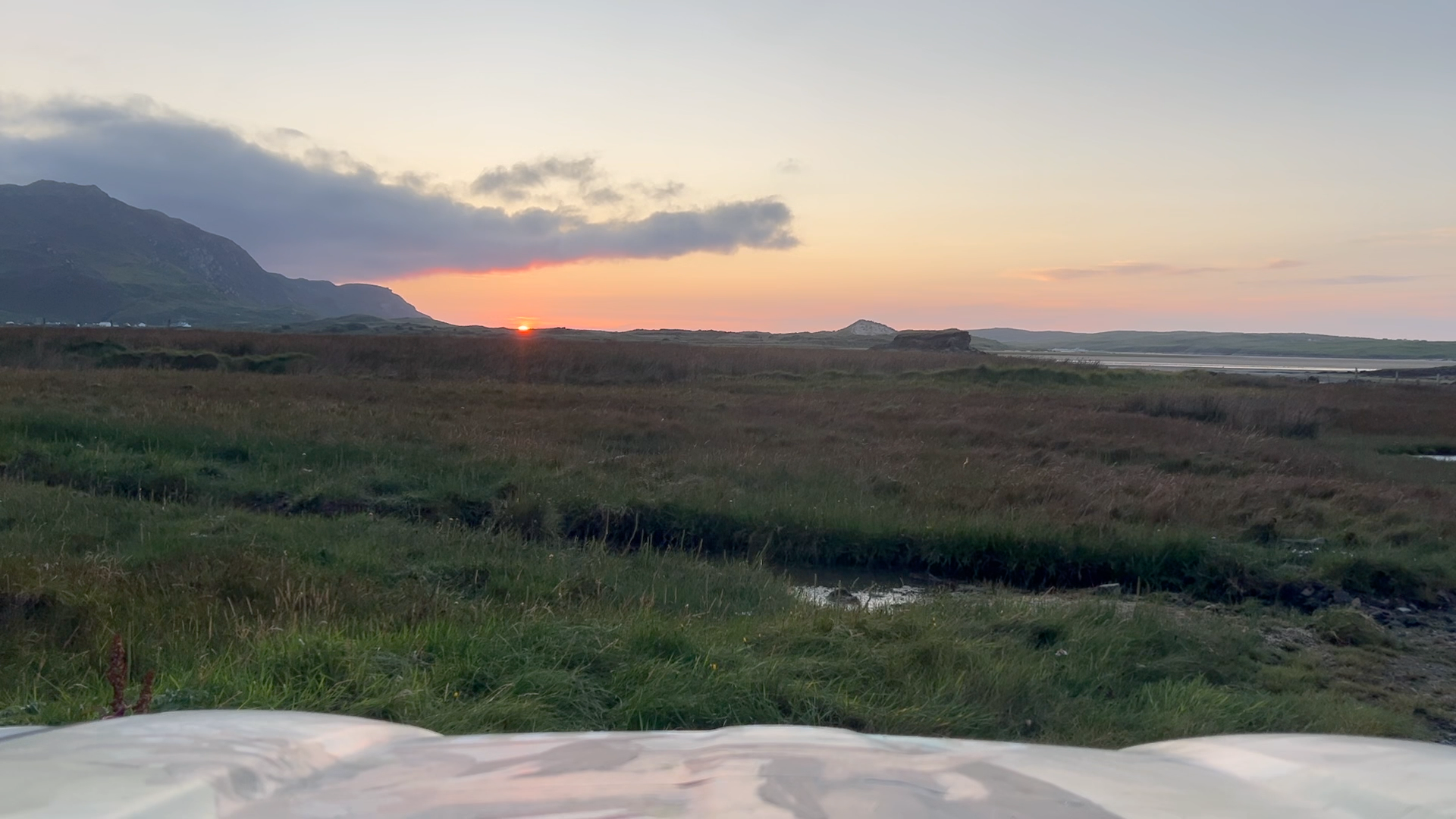
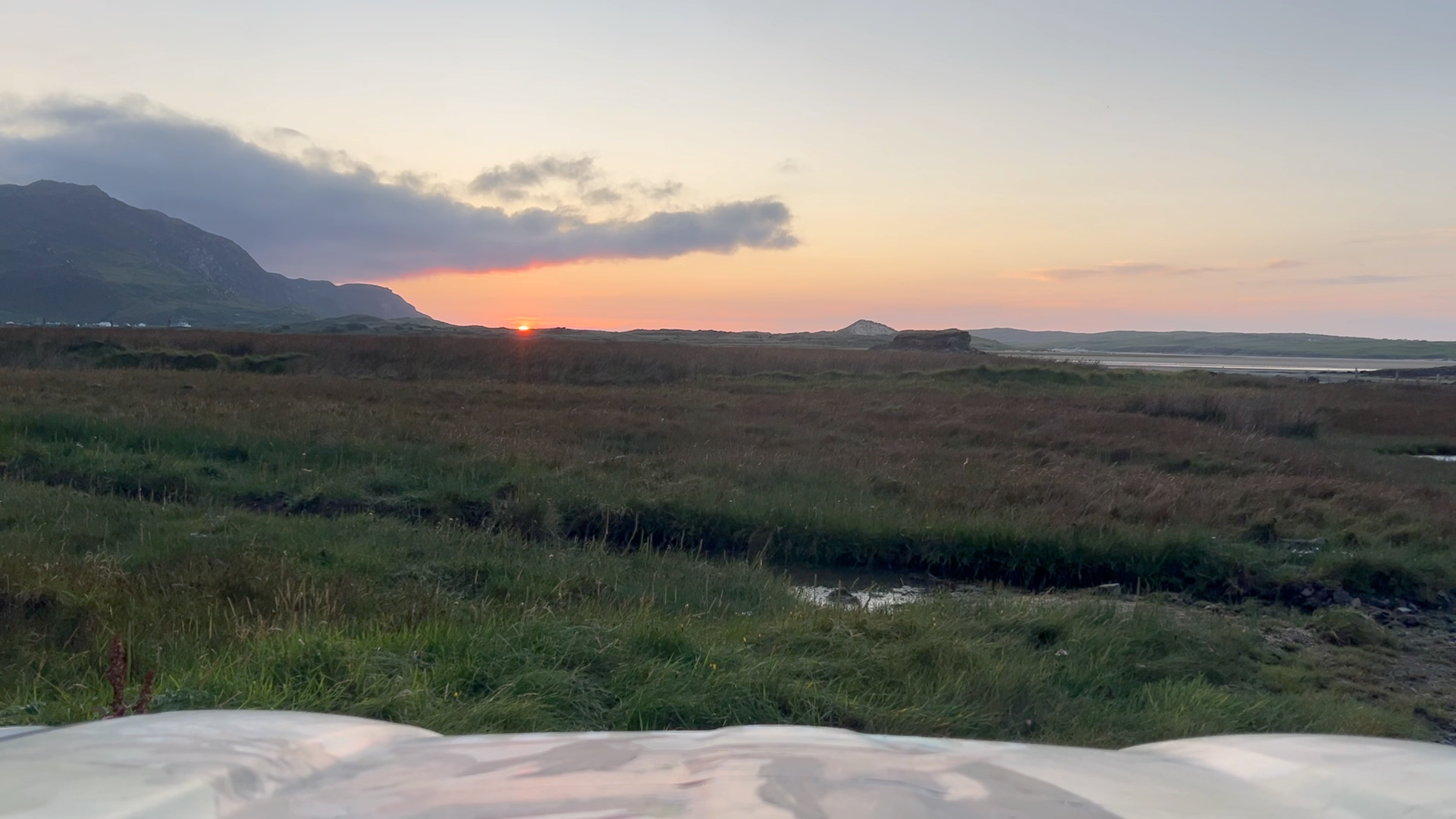
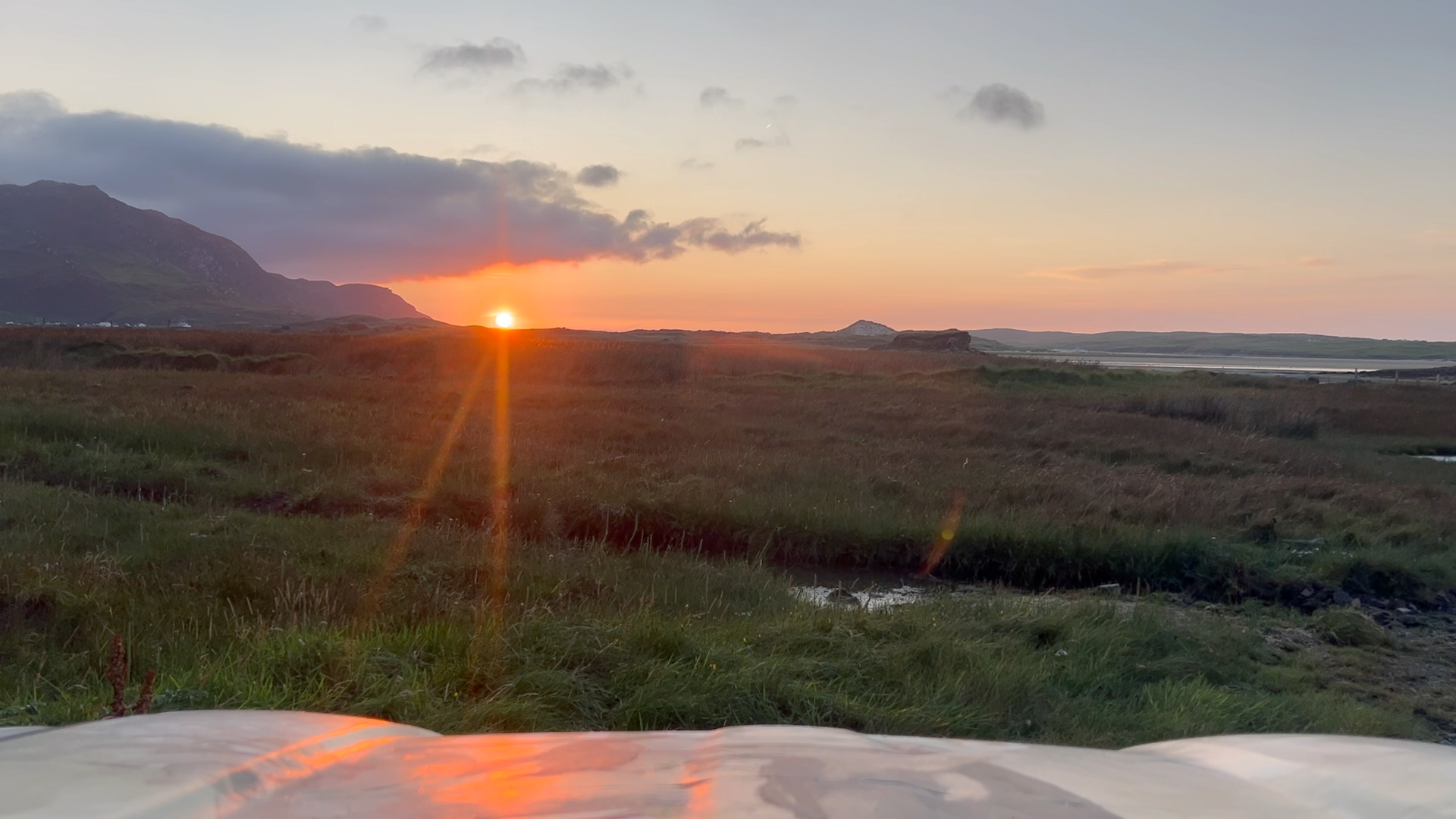
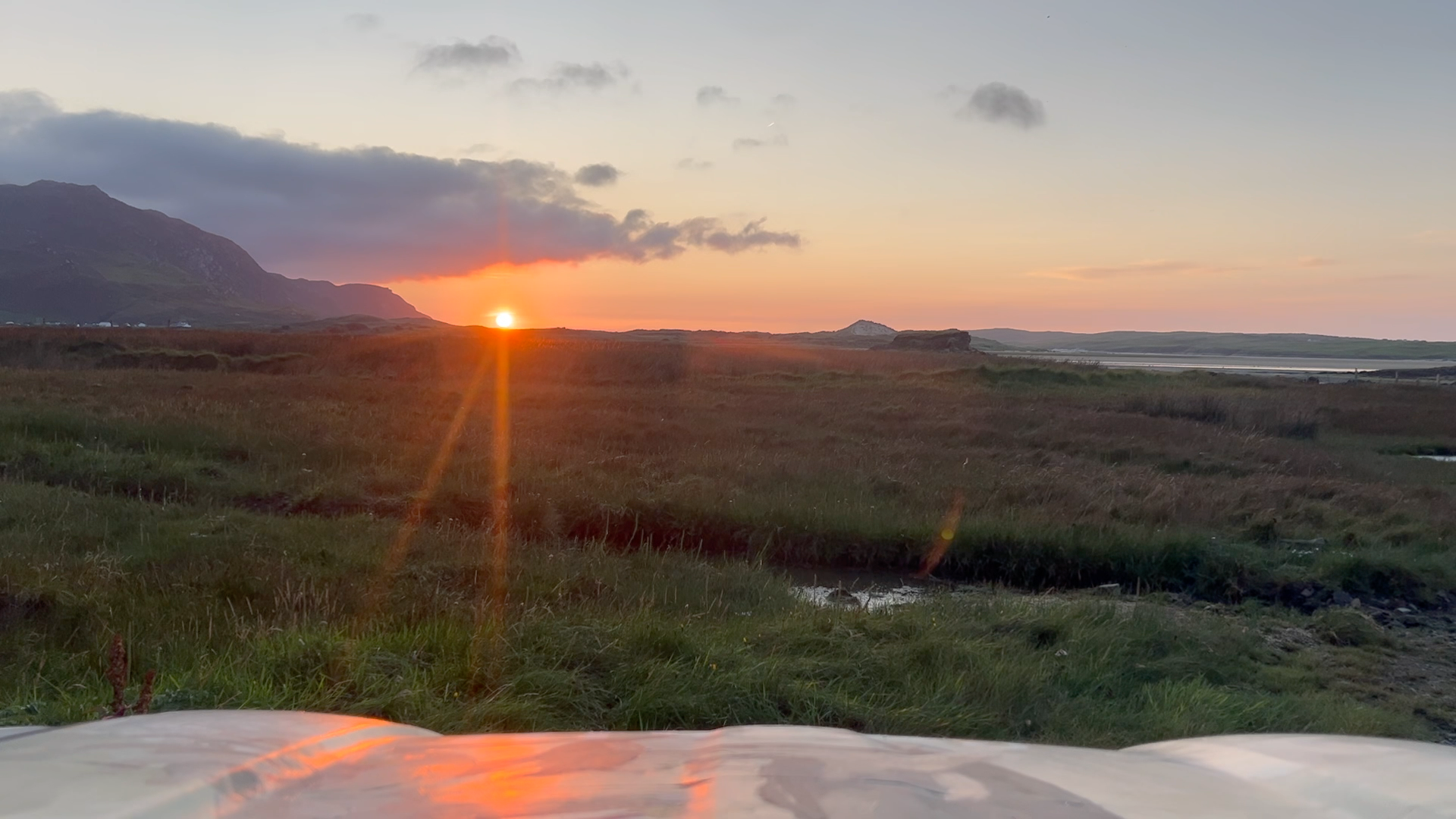
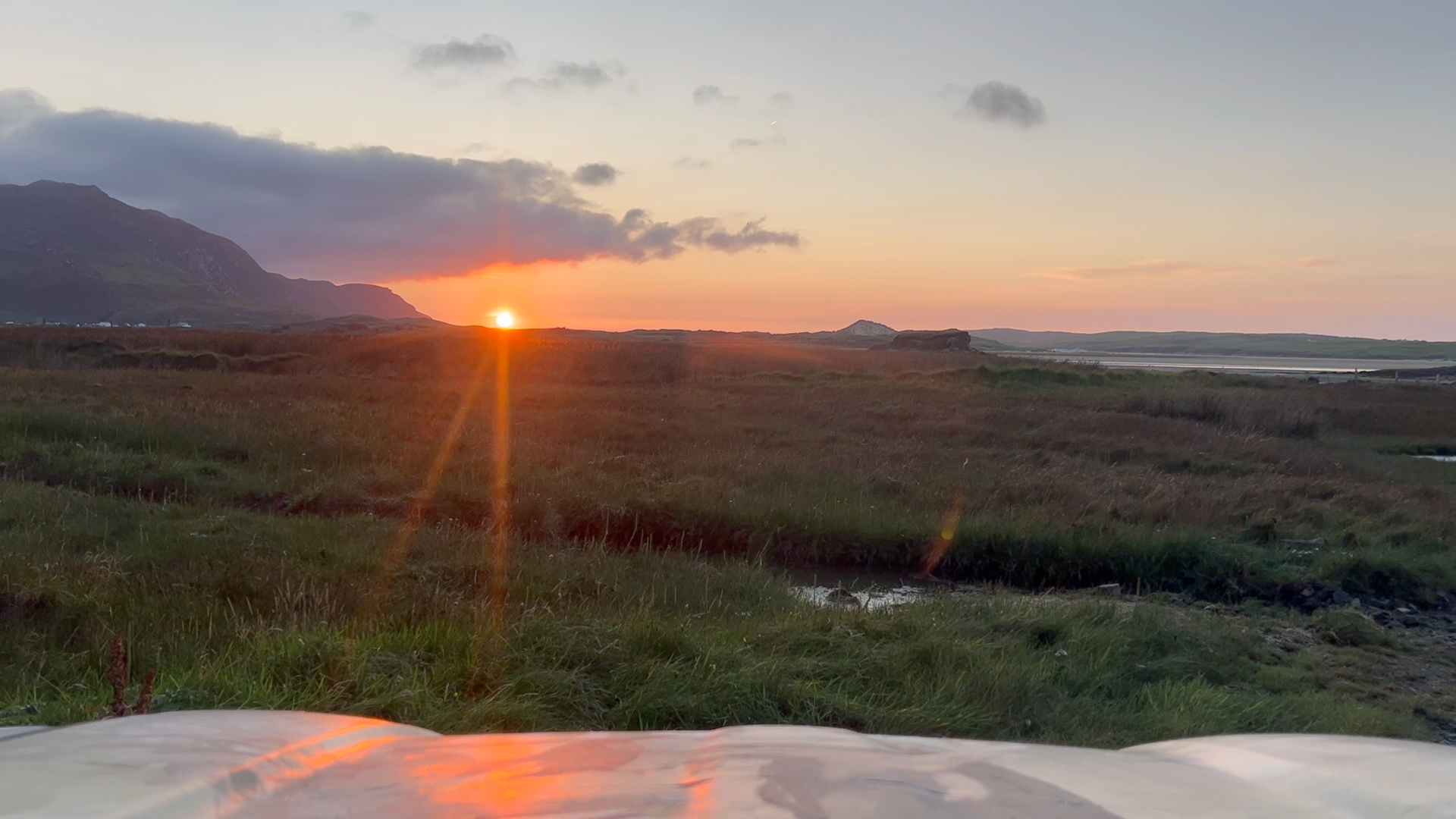
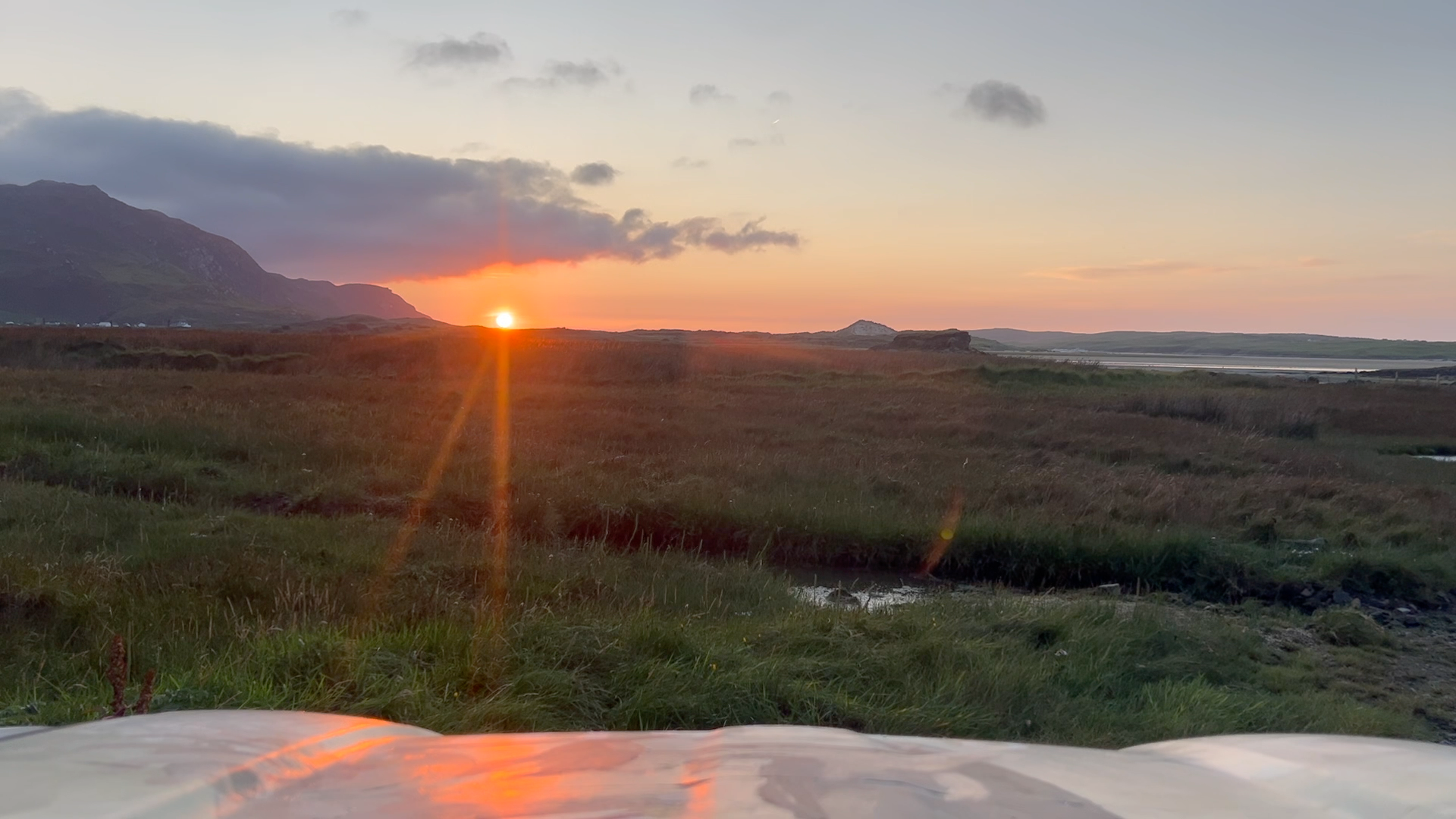
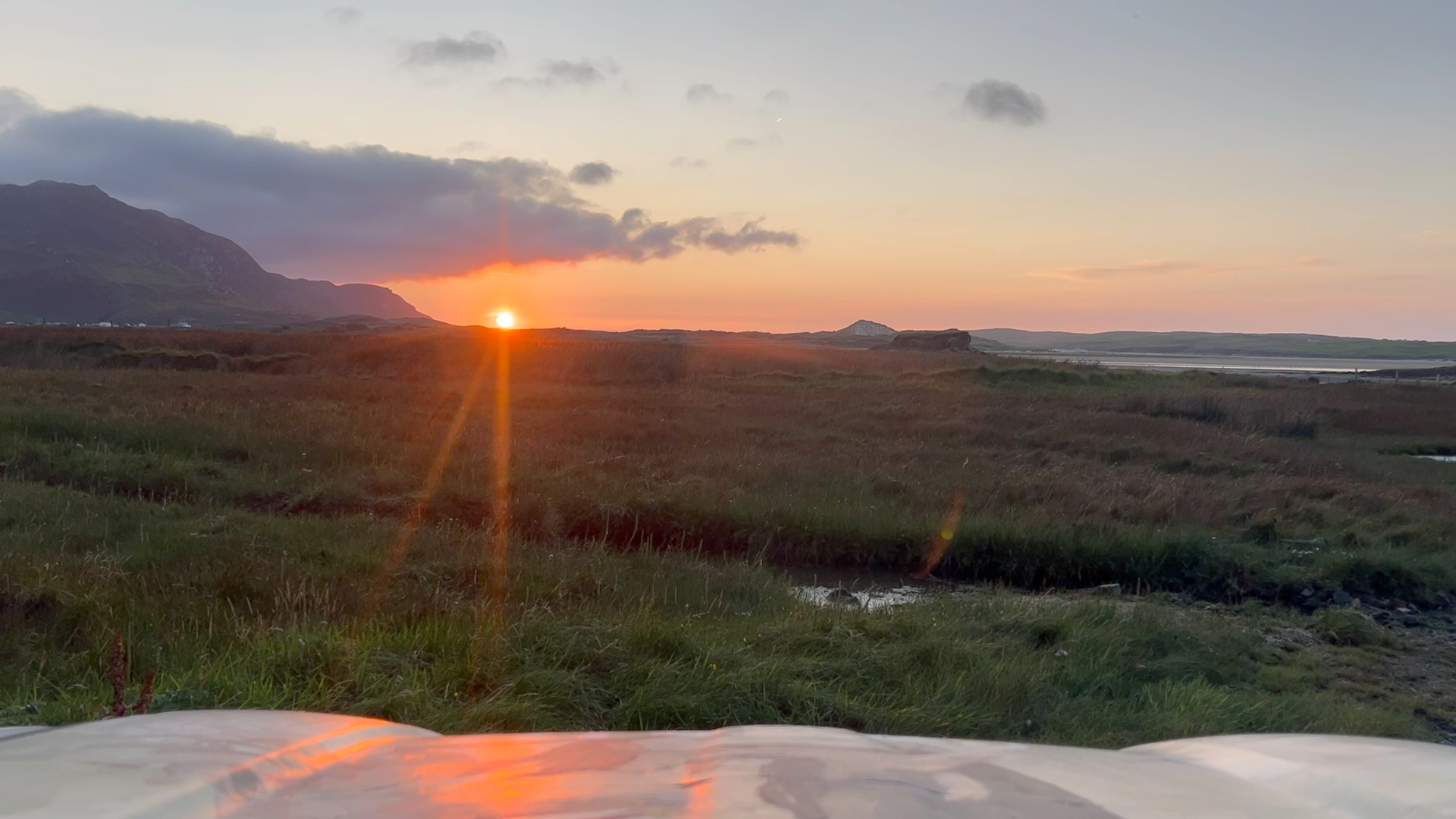
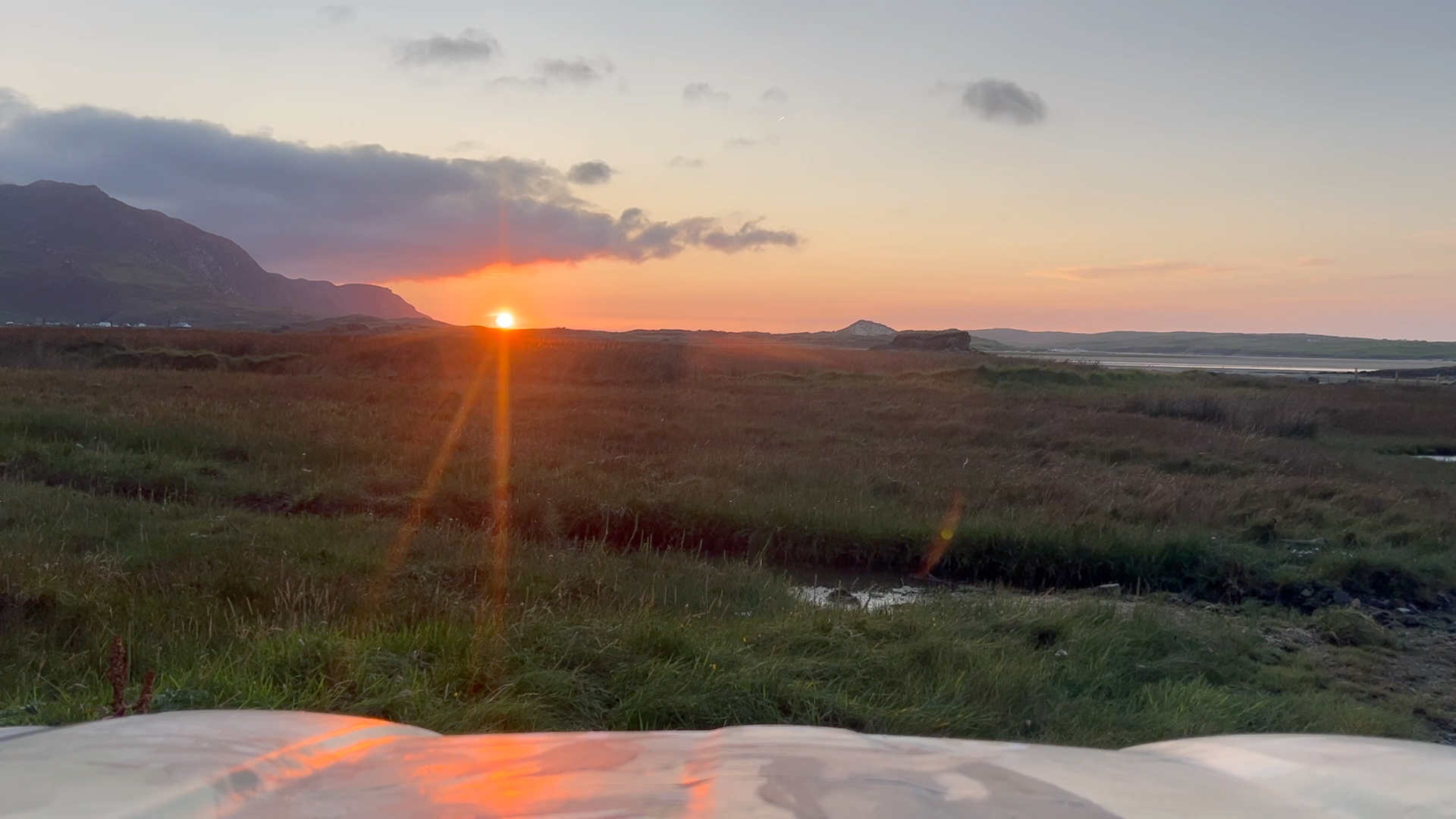
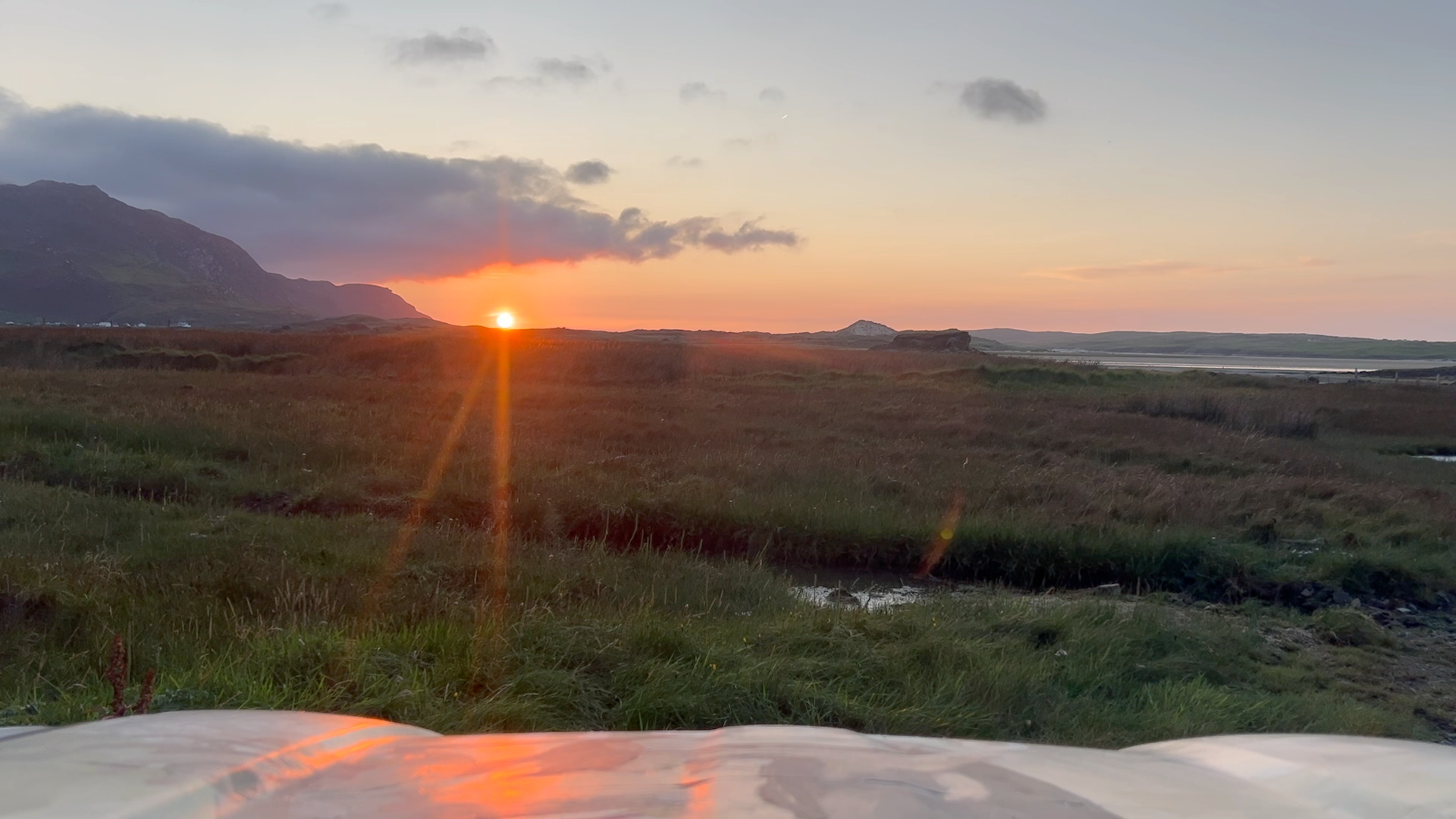
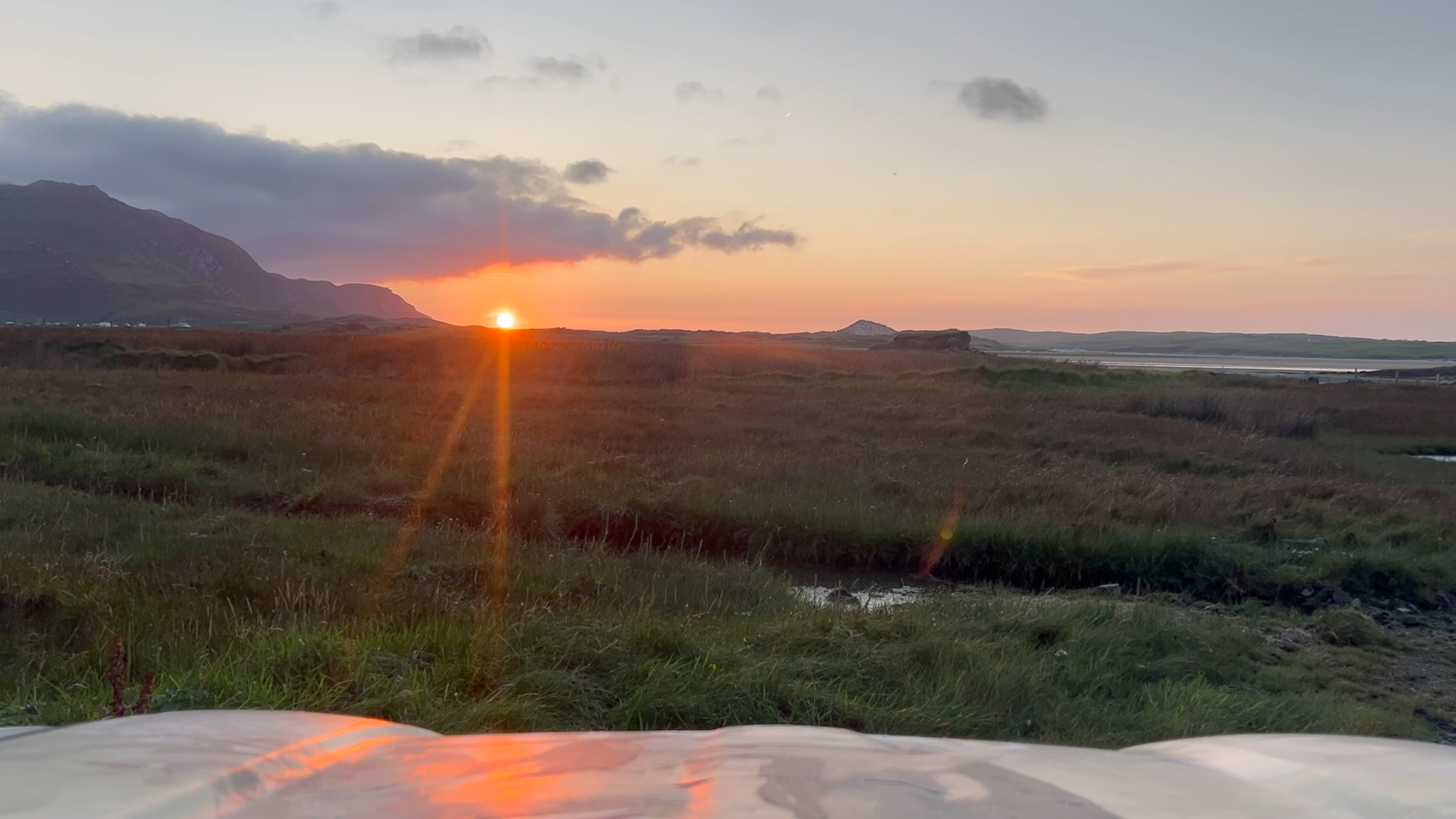
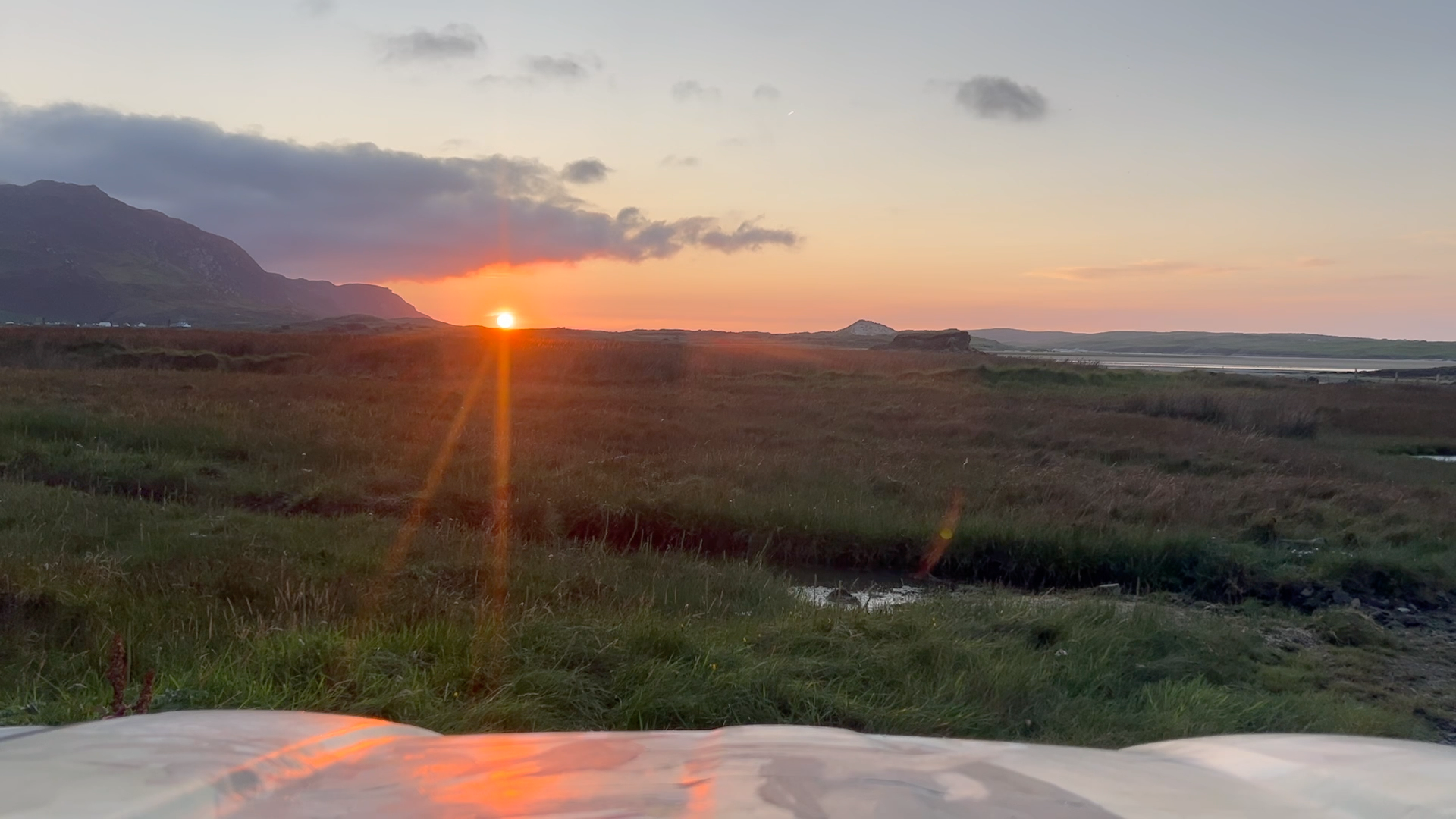
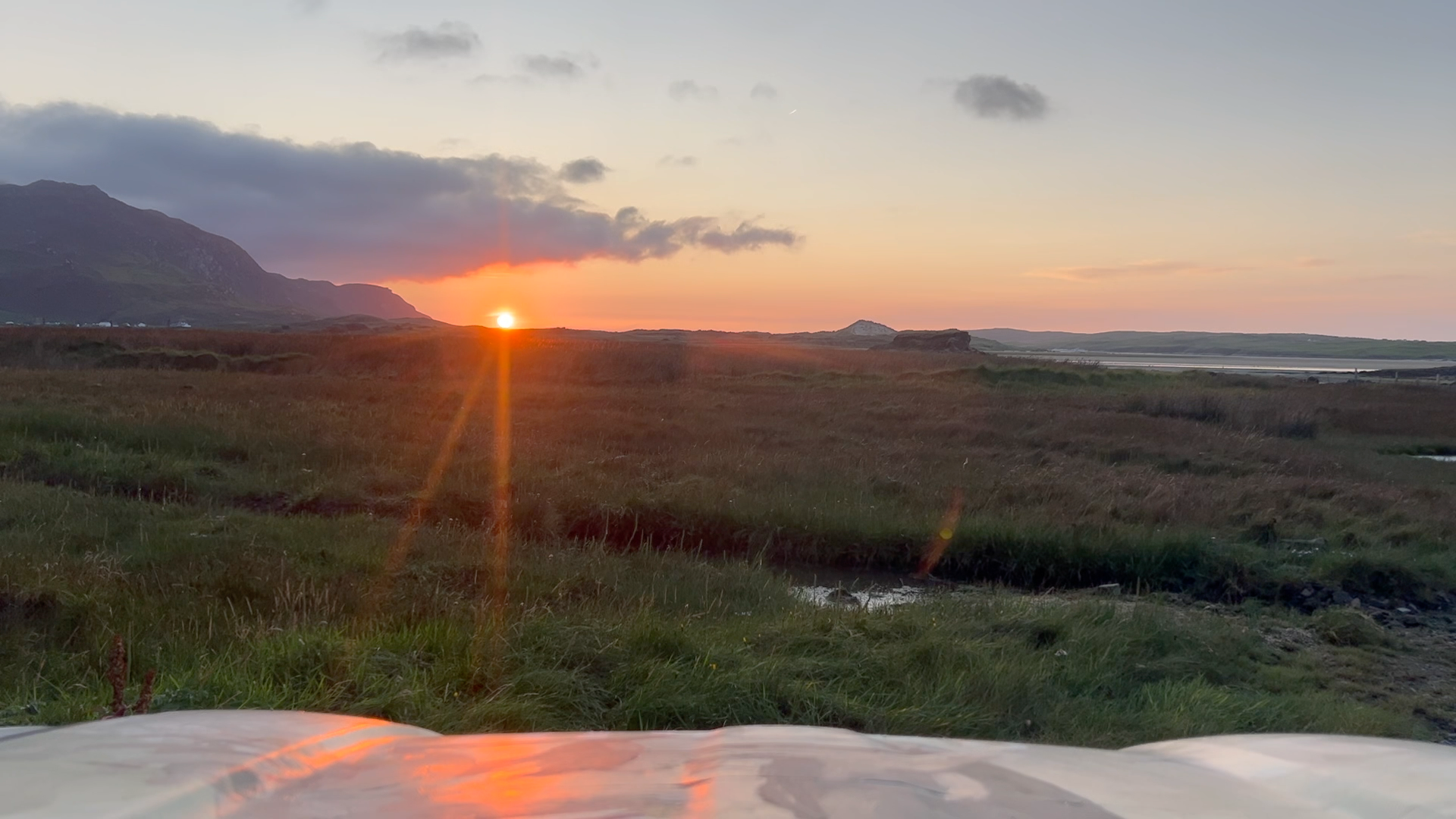
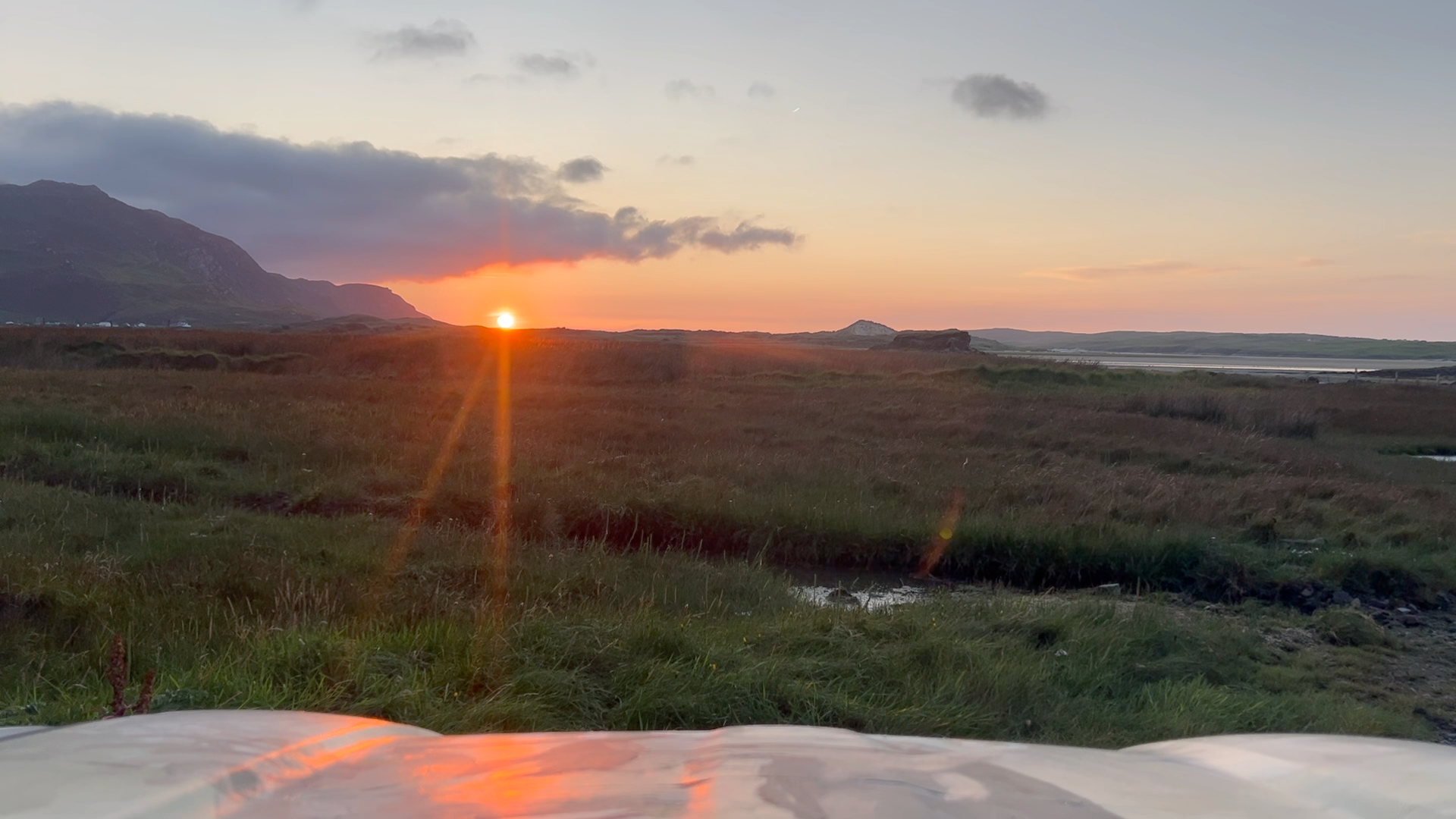
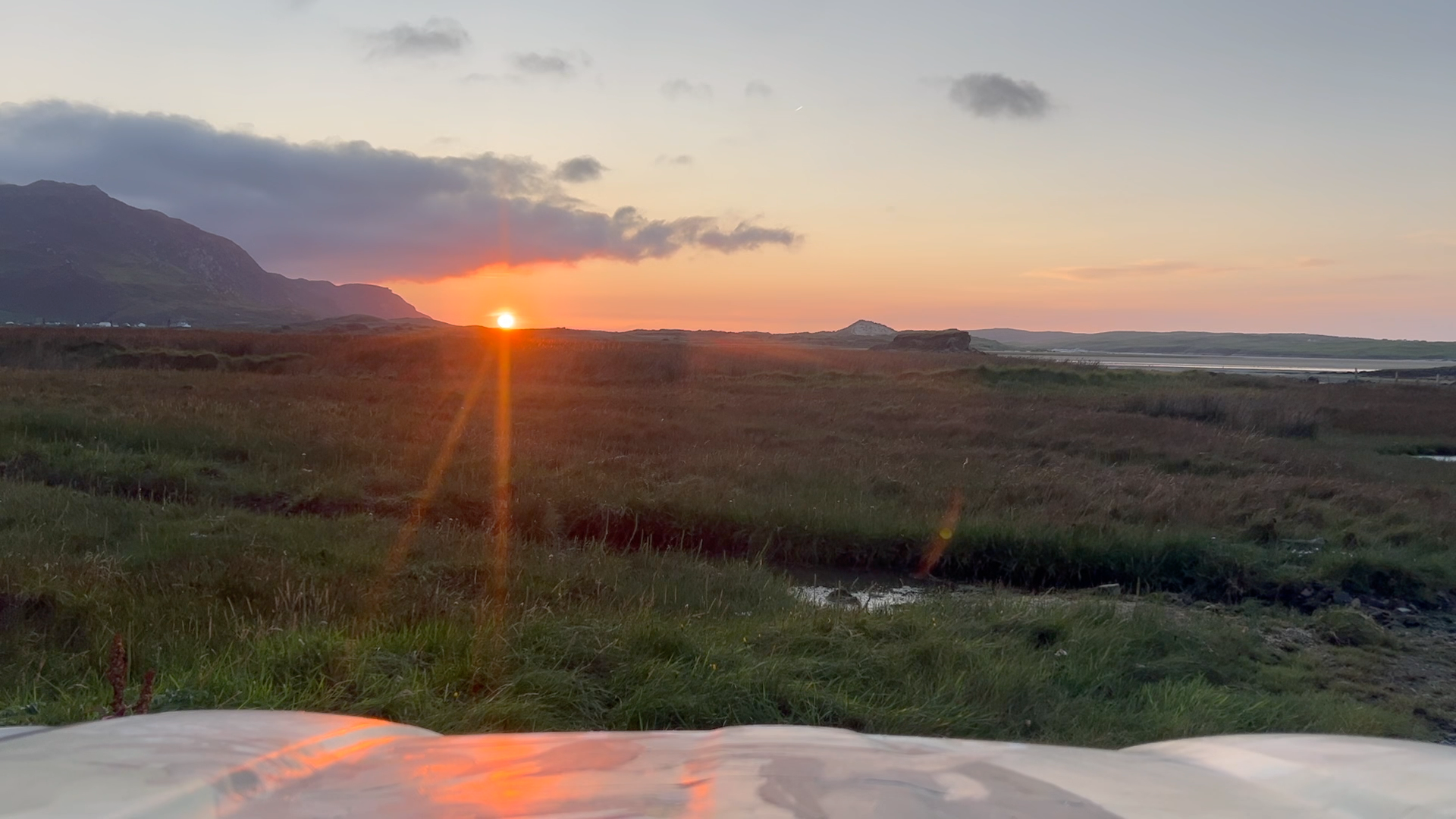
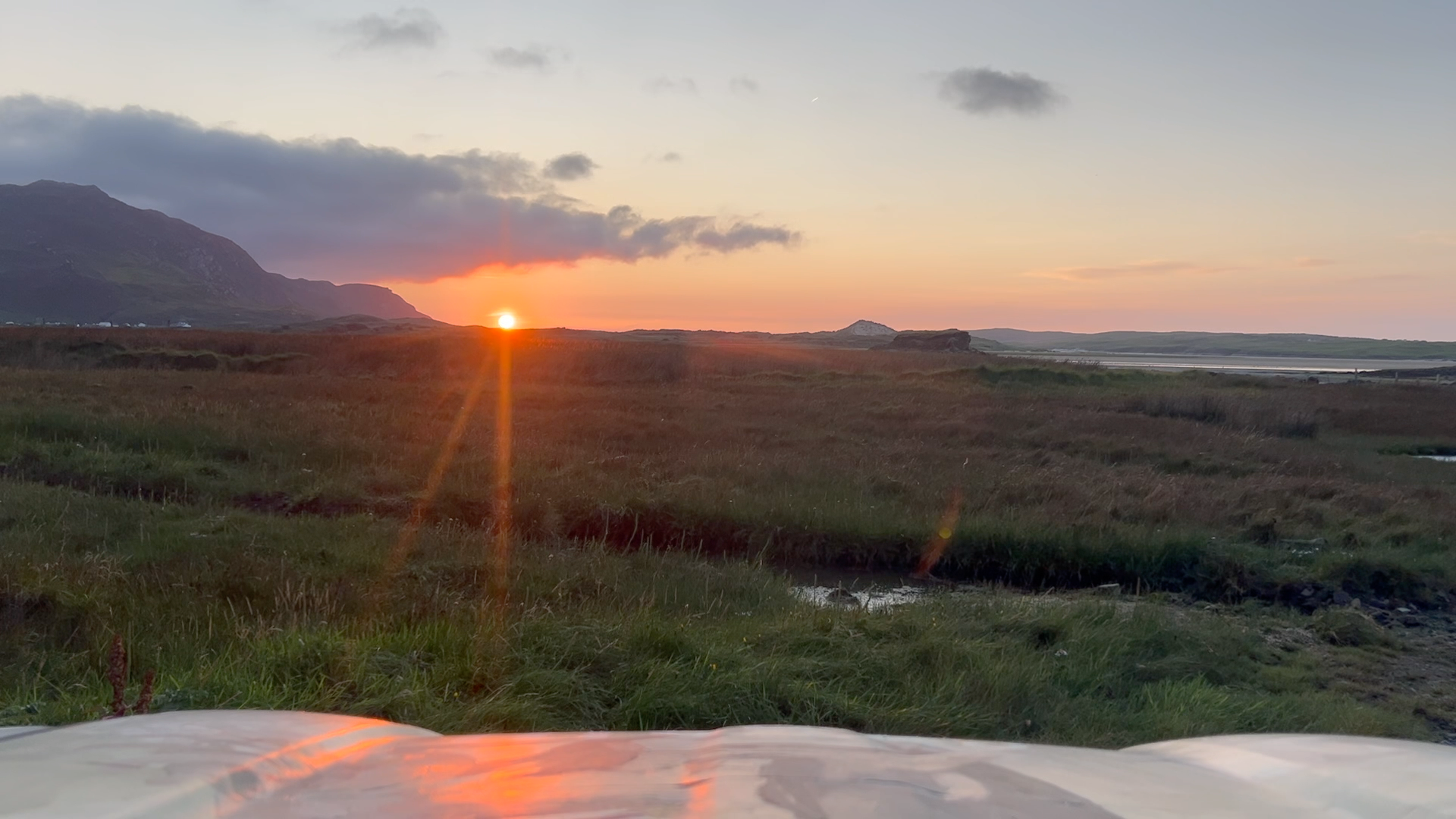
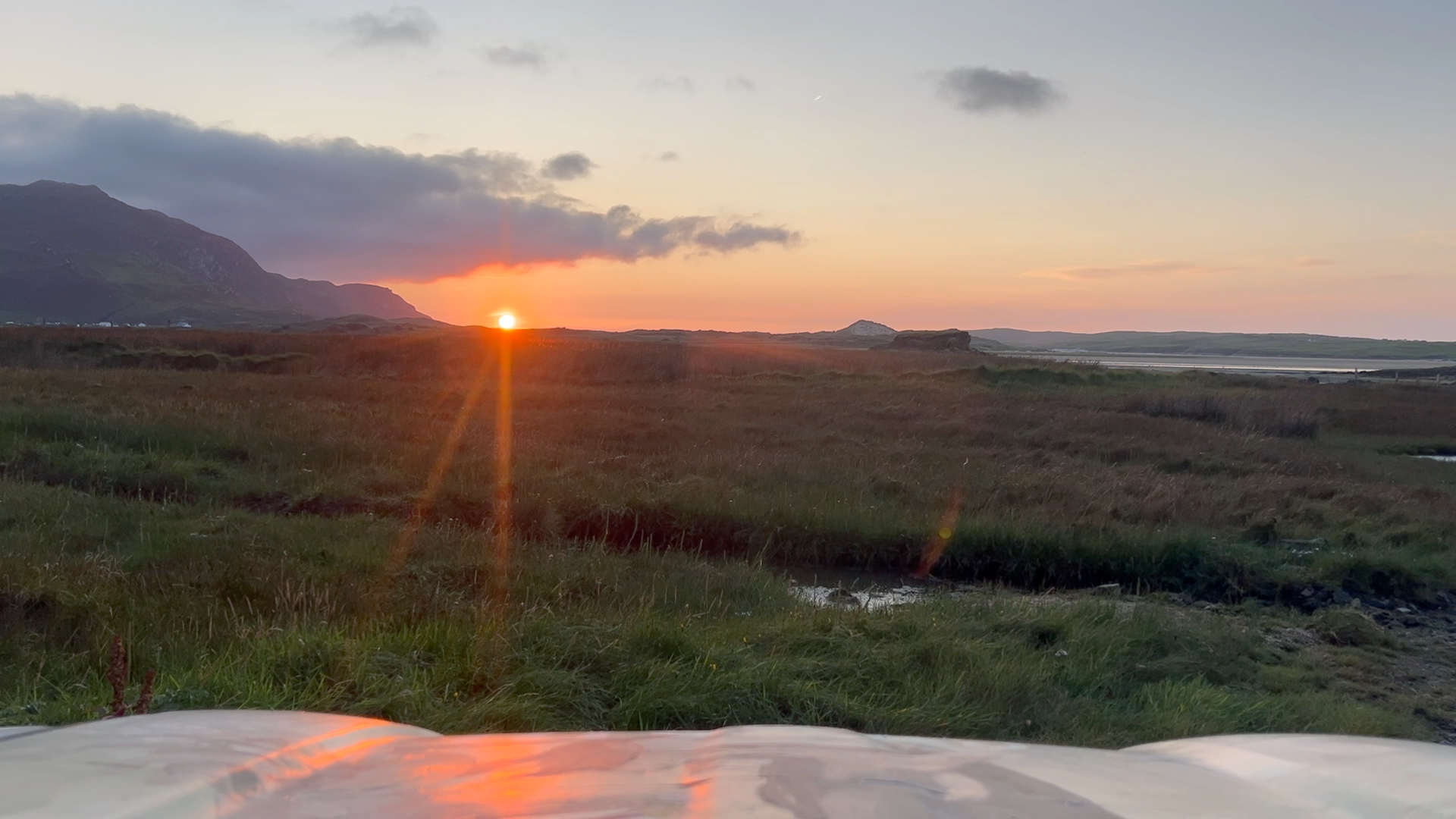
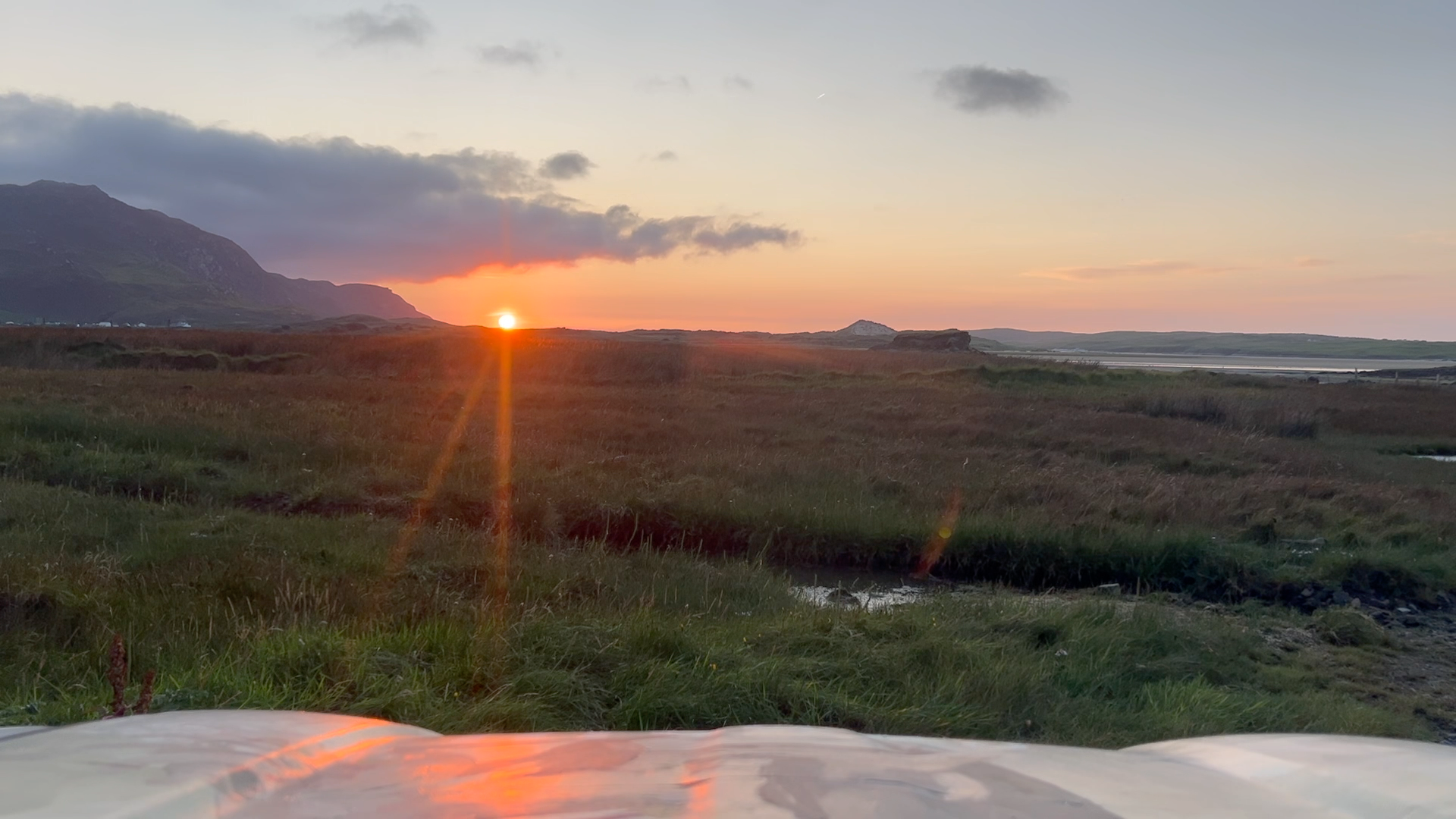
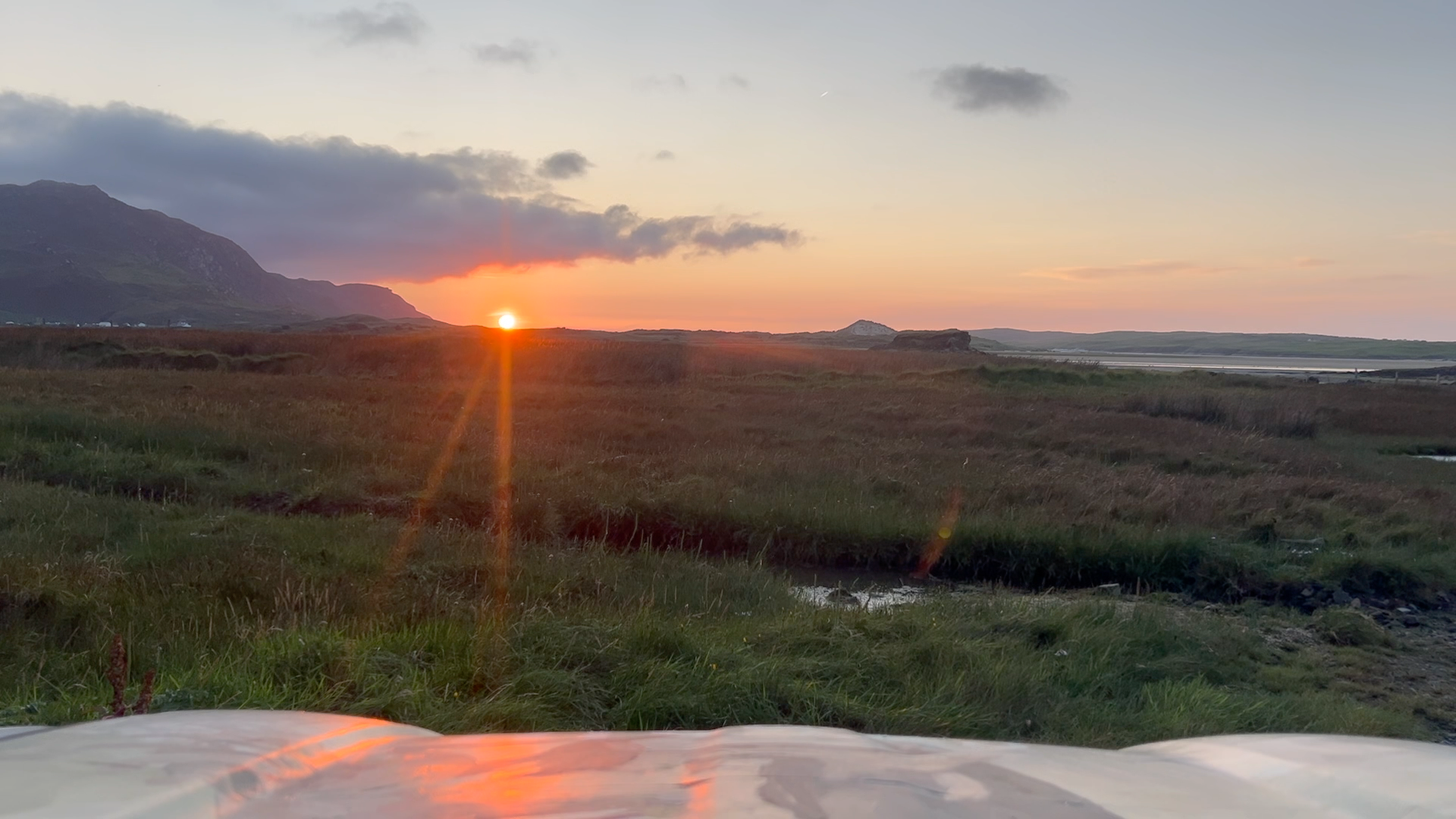
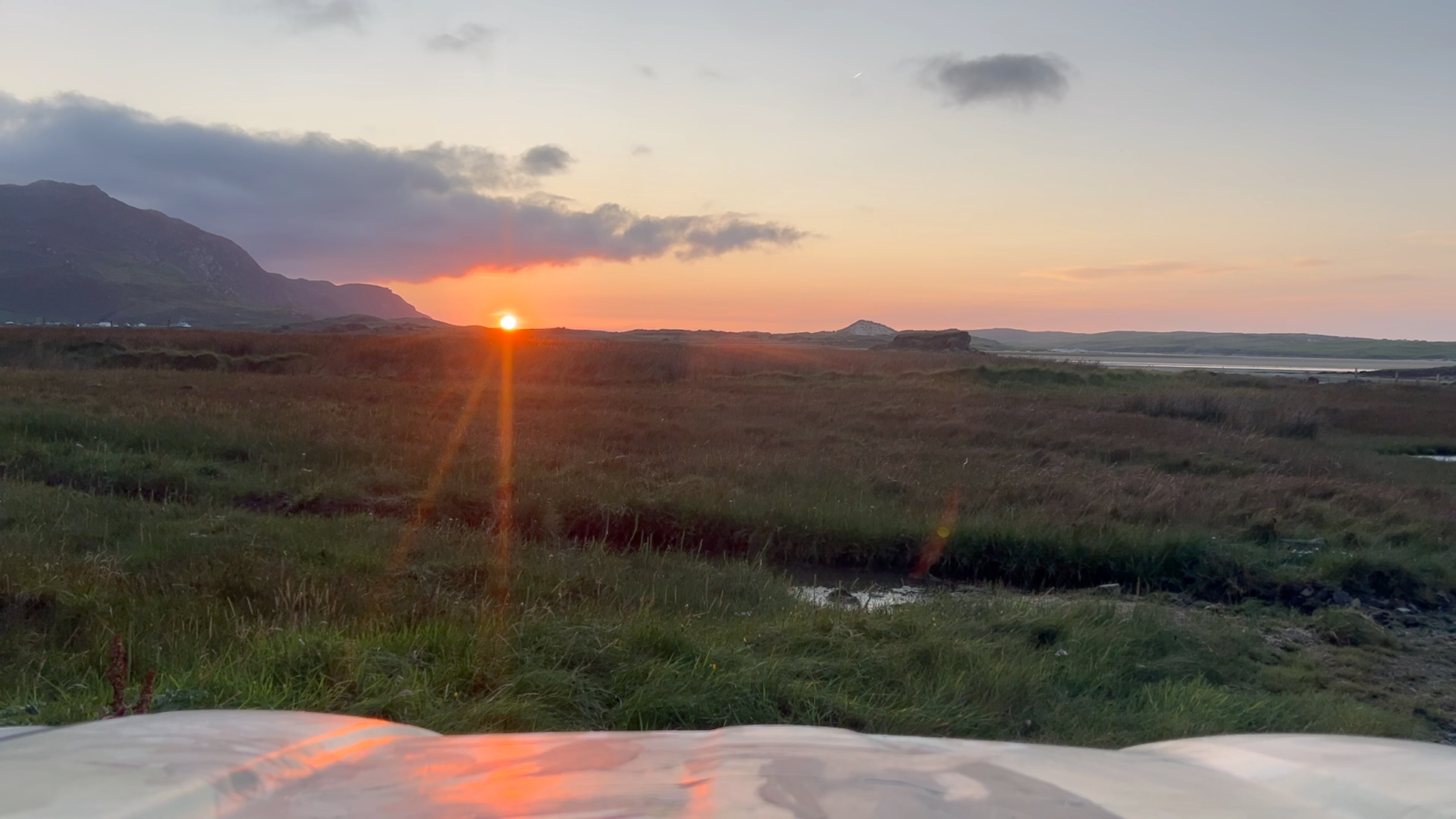
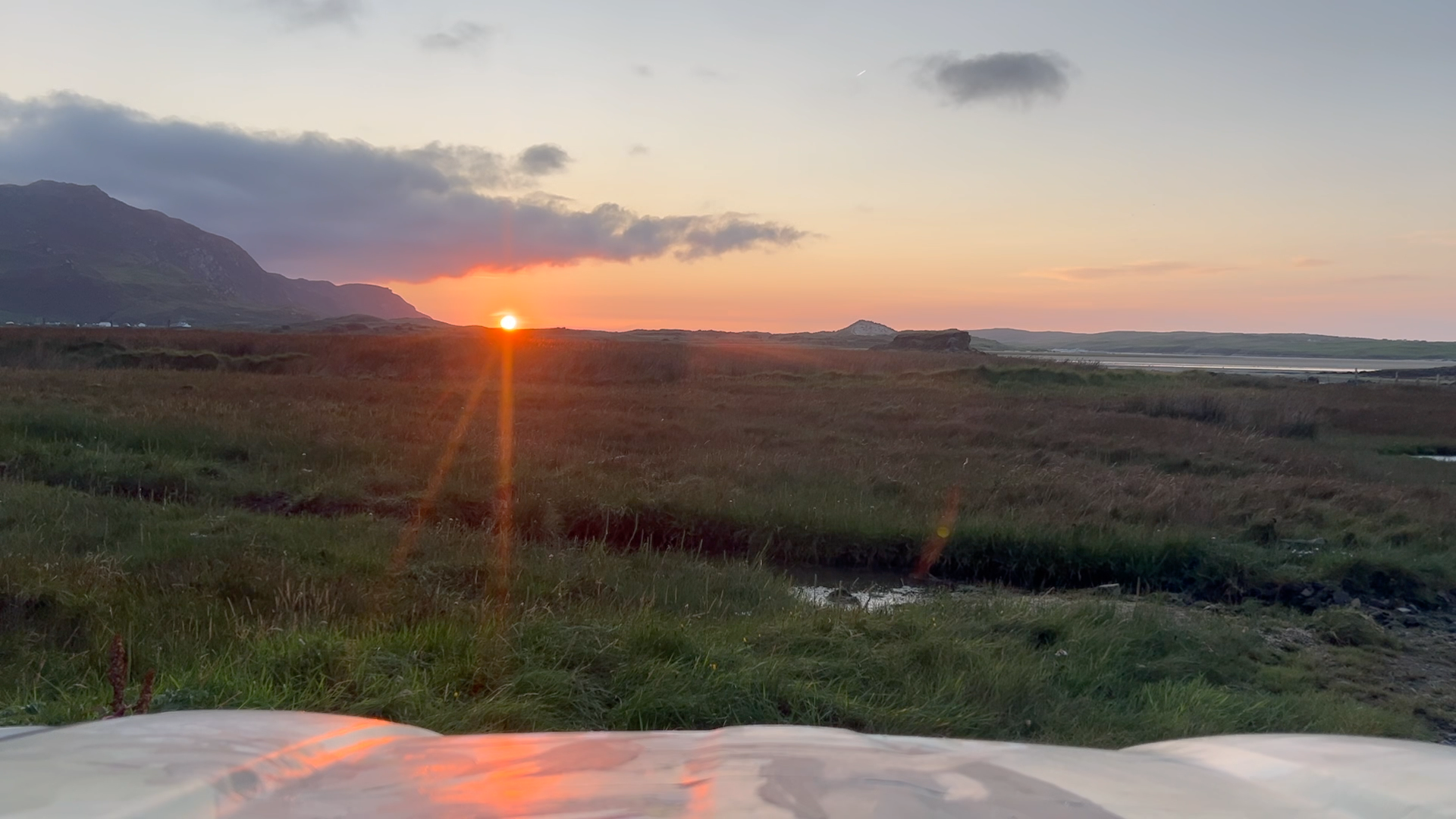
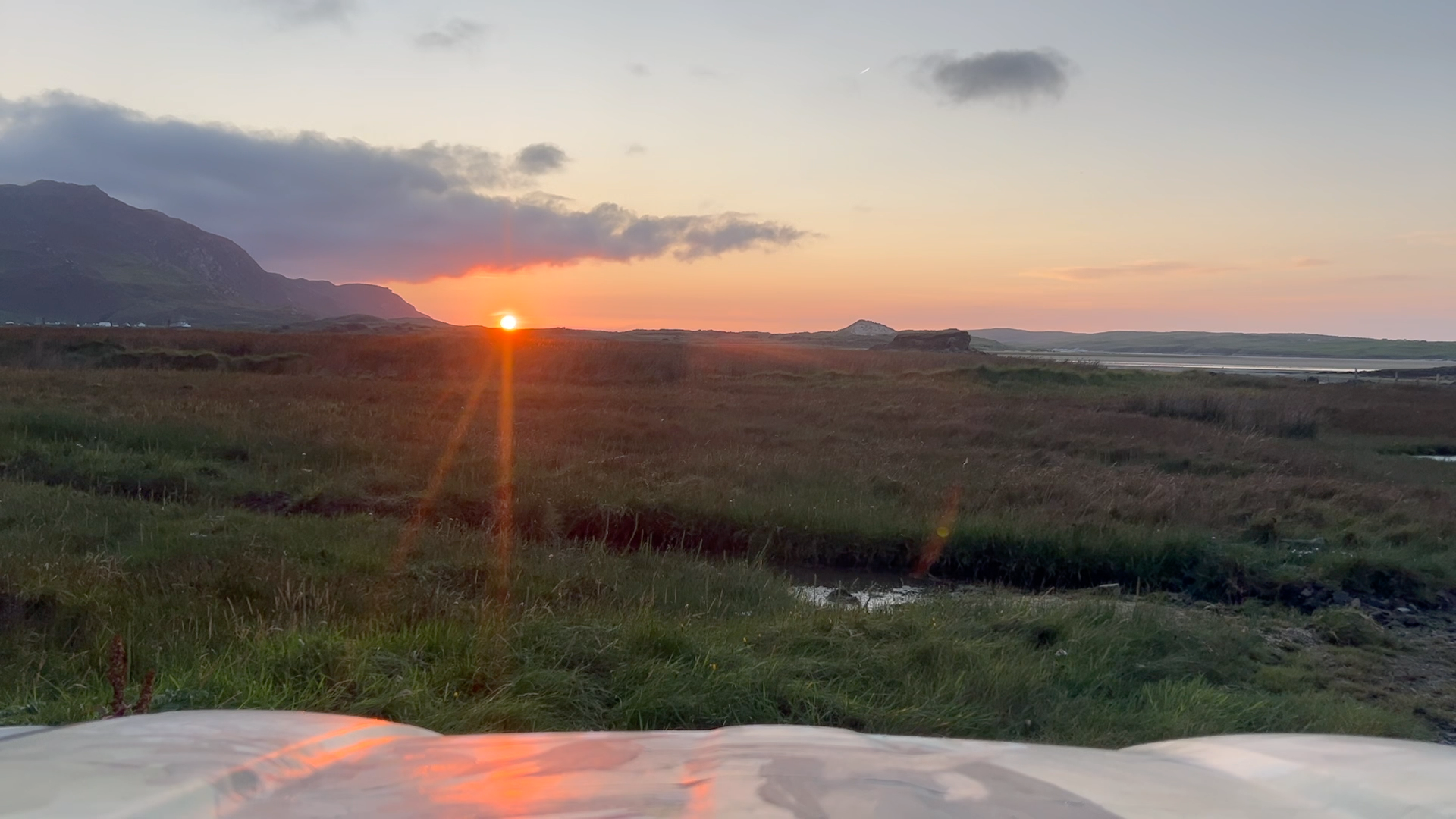
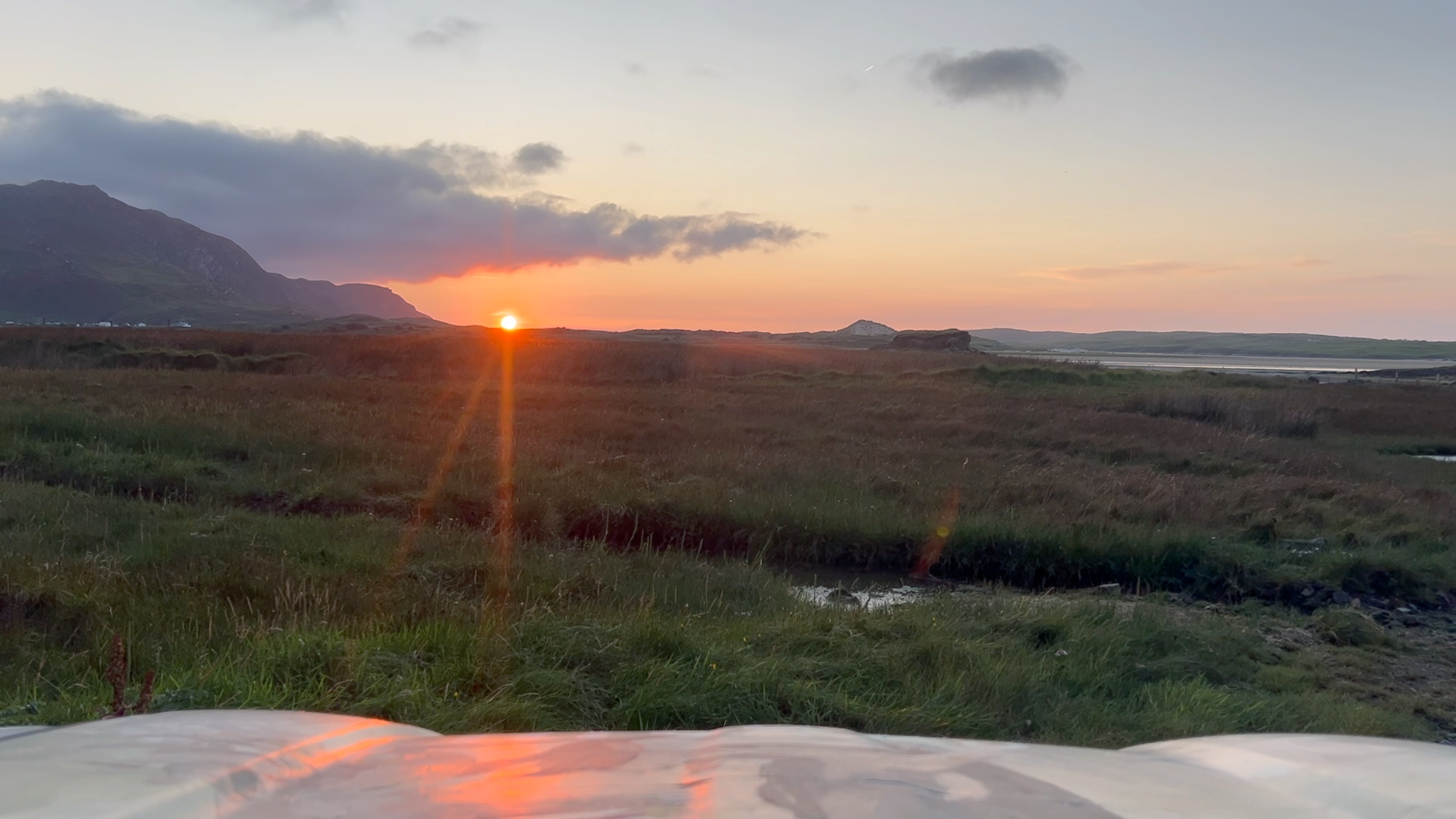
As a kind of listening party, to honour the discovery of new sonic artworks, we waited until nightfall and took off driving to the ends of the roads of Rathlin, listening for the first time to the specially made mixtape. We slotted the tape in on SIDE B at the Harbour and played it all the way through. Below is a video in four parts with the tape soundscaping the night drive.
Earlier that day we’d met with people living on the island who showed us car parts salvaged and put aside, repurposed as furniture or reused in other vehicles or farm equipment. We heard stories of a mythical car graveyard and were given co-ordinates to seek it out. There was talk of the first car on the island, belonging to the doctor; and where it had rusted into the ground, briars enshrouding it, mangling the parts over time. With no particular aim, we drove along Shore Road to the Central Track, a paved tarmac artery connecting the harbour area southward toward Craigmacaghan Lough. Pitch black now, we followed the head-lamp illuminated terrain in front of us, the beacon of a distant lighthouse flashing, and if we met the broad-beamed glare, we took a u-turn as the road would go no further.
A Trip Through the Ireland Underground:
Records from the BRRR BRRR BRRR Collection
SIDE B
1. ANDY HECK BOYD — SHE’S LOSING CONTROL
Blondie (2022) Krim Kram [Cork]
2. ELAINE HOWLEY — TO THE TEST
The Distance Between Heart And Mouth (2022)
Touch Sensitive Records [Belfast]
3. BURNING LOVE JUMPSUIT — GIRLY MEN
Hell Bank Note 1993-1995 (2024)
Nyahh Records [Leitrim]
4. AUTUMNS — PHONE ME
Dyslexia Sound Source (2024)
Touch Sensitive Records [Belfast]
5. T-WOC — CI VI
Pantangle (2020)
StrangeLoveMusic [Aotearoa/Wicklow]
6.TWO NICE CATHOLIC BOYS — DIALOGOS
Three Cheers for the Distant Observer (2023)
Bluestack Records [Donegal]
7. ROGER DOYLE — WE WHO LIVE UNDER HEAVEN PT 1
We Who Live Under Heaven (2025) Nyahh Records [Leitrim]
8. NATALIA BEYLIS & EIMEAR REIDY — POUR UPON THE SKY
She Came Through the Window to Stand by the Door (2023)
Nyahh Records [Leitrim]
9. Róis - Naci en Palestina ft. Emel Mathlouthi
Various Artists Vol. 3: Fáschoill (2025)
Faoi Thalamh Records [Clare]
SIDE A
1. AI MESSIAH — DUST SIMIAN
Sentience & Sapience (2018)
Touch Sensitive Records [Belfast]
2. T-WOC — LIFE IS ABOUT COLOR
Scenes, Journeys & Colors (2025)
Rudimentary Records [Belfast]
3. MAGIC POCKETS — LUNAR CAUSTIC
Volcano of the Bleeding Skies (2016)
Penske Recordings [Cork]
4. GROUP ZERO — SATURNINE ADORATIONS
Structures & Light (2017)
Touch Sensitive Records [Belfast]
5. TEN PAST SEVEN — 981
Long Live The Bogwalrus (2019)
Art For Blind [Sligo]
6. THE ALTERED HOURS — GREY ON BLUE
In Heat Not Sorry (2015)
Art For Blind/Penske Recordings [Sligo/Cork]
7. MARTIN RÖSSEL & THE DUM DUM BOYS — PABLO PICASSO
Cherrystones Presents Critical Mass Vol. 2 Hearts of Champions
Touch Sensitive Records (2020)
8. ELLLL — ROMANCE
Romance (2016)
Art For Blind [Sligo]
9. GODHATESDISCO — ANGEL OF THE LANES
Great Radio (2015)
Little Gem Records [Dublin]
10. MOHAMMAD SYFKHAN —
DO YOU HAVE A LOVER OR NOT?
I am Kurdish (2023) Nyahh Records [Leitrim]
Side B - Part 1
Side B - Part 2
Side A - part 1
Side A - Part 2
20.08.2025
The combination of driving and listening to music is one that’s hard to beat, a car windscreen frames everything cinematically. In the little Renault 4 flying through the landscape; fleeting visions of verdant meadows, snow-capped mountains, 24hr neon lit gyms, wheat fields, abandoned over grown villages, whirring mechanical monumental wind farms, Rosa 'Roseraie de L'Hay in full bloom, crumbling châteaux, dense forests, two wolves surprised to see us as we were to see them.
Cassettes in boxes under our feet, in the back seat or stacked into storage compartments on the dashboard are picked out accordingly and become the soundtrack to a landscape in flux, a script in real time, an ever-evolving adventure. How to gather, select, commission or compose music to accompany these varying visions; the graving docks at Dublin Port, an old garage – frozen in time - closed since the 80s, crowds gathering to see a spectacle, the sea from a cliff, cottages and castles, scrapyards and dumps, marram grass; pearly in the gales. Expansive images of the world outside contrast with the confined space of the car, its cubbies, nooks and crannies. Small spaces allow ideas to grow, movement allows the eye to wander and music orders the chaos of fragmentary images and experiences opening paths to new ways of thinking. Velocity and drive create points of convergence; associative links between seemingly incongruous narratives.
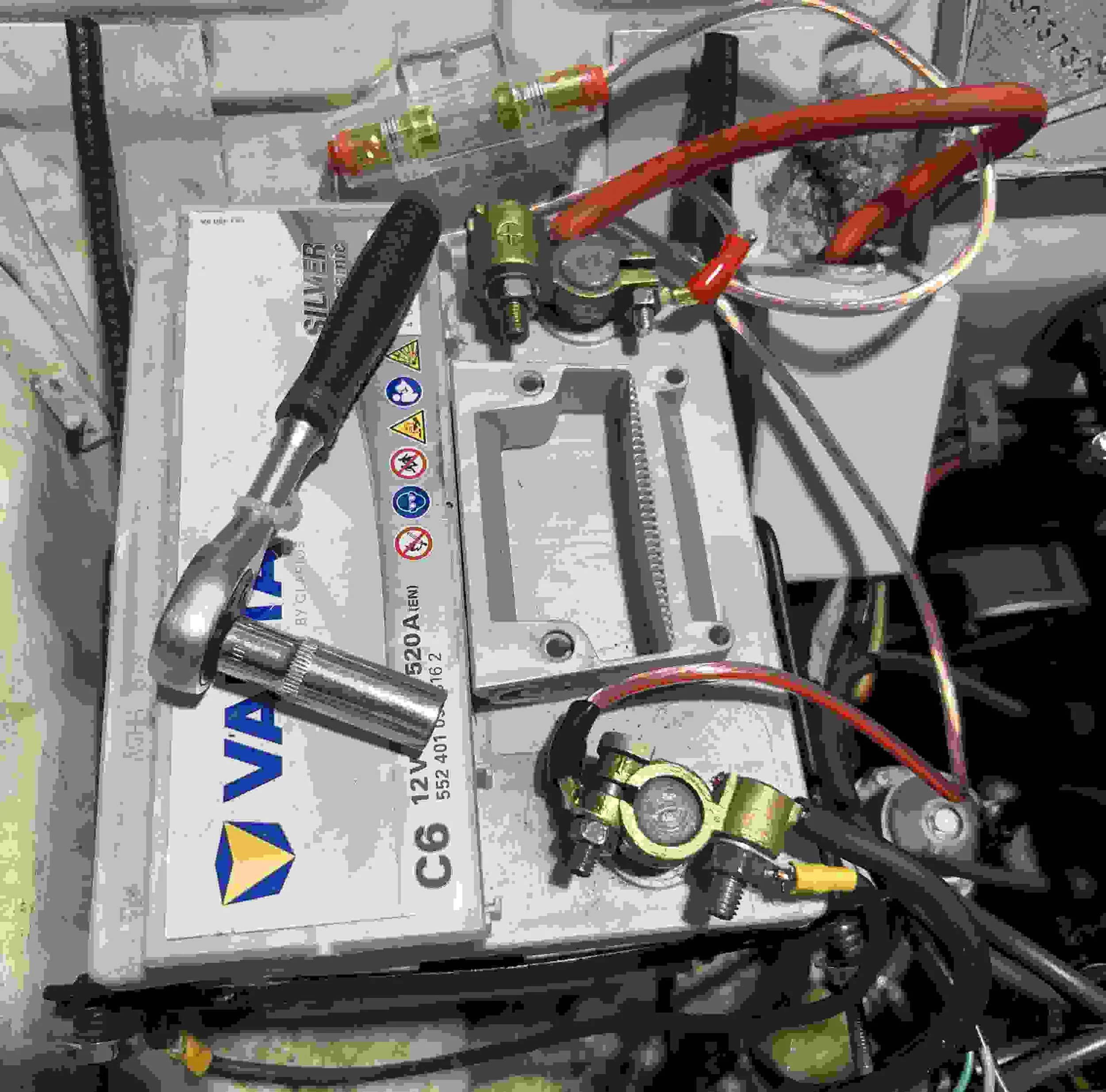
Going forward, we’ll have a monthly slot on éist Radio. The mixtape for our first instalment is a selection of tracks from the tour, or music we listened to working together in the studio. The intention is to transport you from day into night; in your car, on a train, flying, walking, on a boat, journeying. En route, the car becomes a mobile broadcasting unit with cassette tapes played from a Renault Blaupunkt Audio 3000; a visual and sonic journey originally live streamed on Twitch, where the Renault 4 is a character, a mechanical prop, a narrative device and a portal which brings us through invisible edges between reality and fiction, memory and desire, the past and the present.
Tracklist // tour de force // éist radio // Episode 1 // 20.08.2026
METAXU - Tuam Na Farraige (Opening theme)
NATTYMARI & GUMMYBEAR! - 100 MINUTES OF FOULNESS FOOL! Side A
Françoise Hardy - L'amitié
Nashpaints - Trip
METAXU - Tuam Na Farraige Side A (iii)
MARIETTA - Chewing your bones (Demeaux preset 2014 Reggea Mix)
NATTYMARI & GUMMYBEAR! - 100 MINUTES OF FOULNESS FOOL! Side B
TOUT BLEU - Sorcière
((PRESSURES)) - Nothing Ever
Asa Nisi Masa - Drunk With All My Friends
ascendant vierge - FAIRE ET REFAIRE
Dimitri Vegas, Basswell, The Moon, Robert Armani & DJ Ghost - Best Of BSMNT (Presented by Smash The House) - 01-12 Blow Up The Speakers vs. Hard One (Extended Mix)
ASSASSANI - THE STEEL ISN'T STRONG BOY, THEE FLESH IS STRONGER
METAXU - Tuam Na Farraige (Outro)
19.08.2025
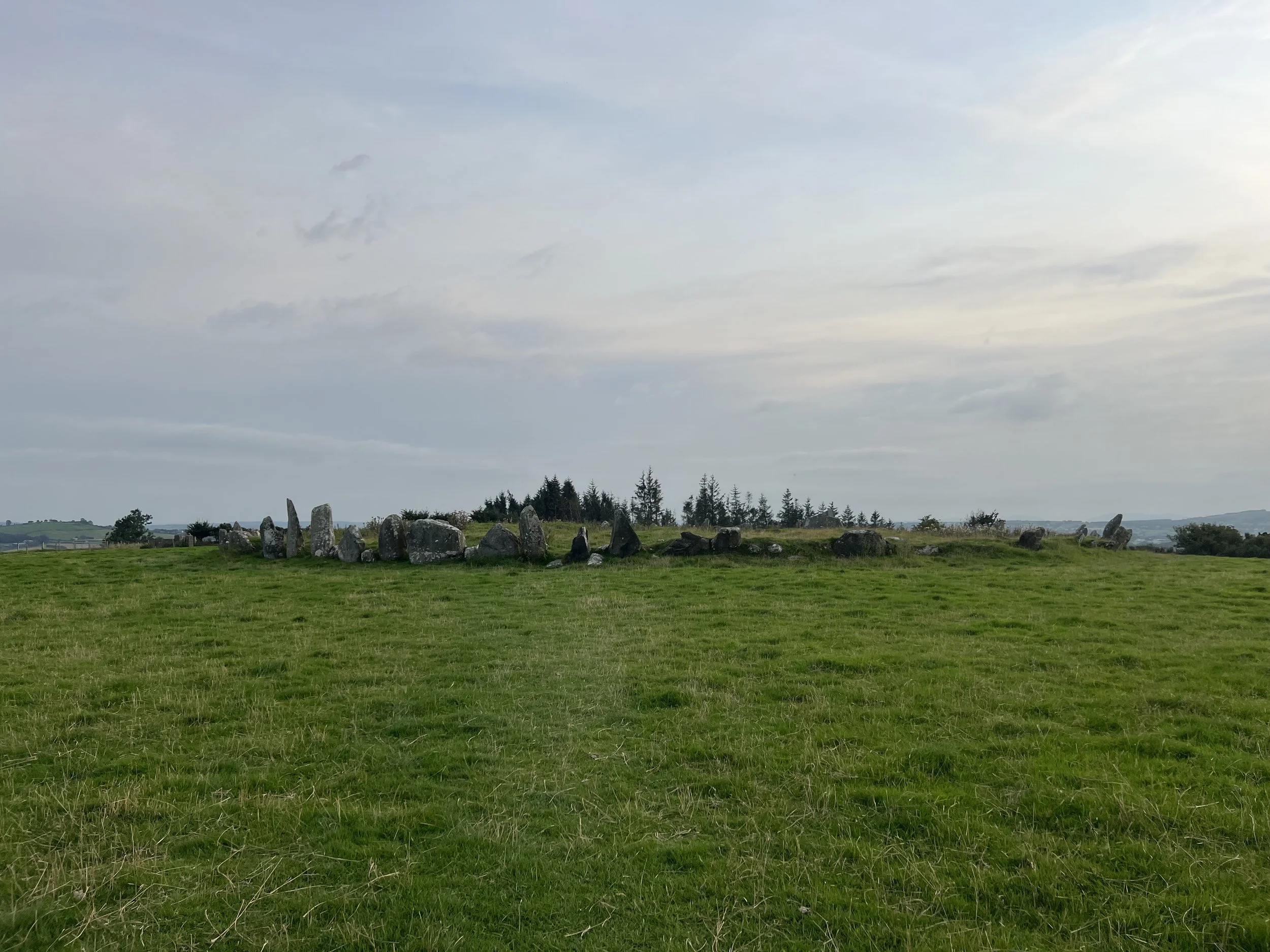
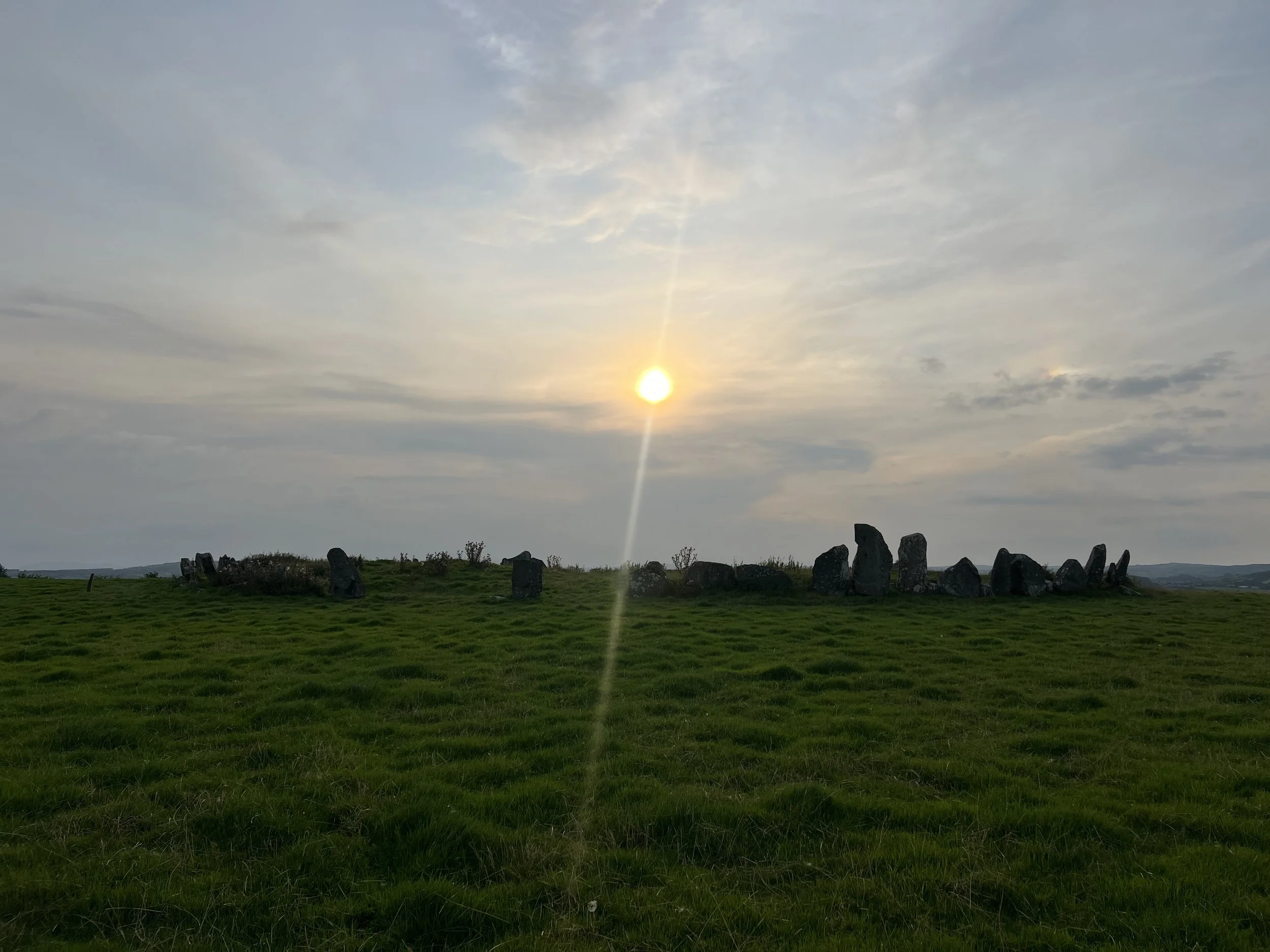
After ascending gradually we found ourselves looking out over Raphoe, Ráth Bhoth - ringfort of the huts and realised from small heritage markers on the roadside that we were very close to Beltany Stone Circle, from Bealtaine - one of the four main Gaelic seasonal festivals. Bealtaine a corruption of Baal tinné, the fire of Baal. We parked up at a small lay-by and walked a densely verdant trail uphill through an arch of hedgerow. Large fern fronds sprung from underneath loose stones laid for the path which was tangled with tree roots, stained with lichen and softened with moss. Puddles from a passing shower mirrored the sky behind a leafy canopy. At the summit we emerged from foliage onto a flat grass covered pasture with good views in all directions; right in front of us, with the sun directly above it, was an expansive megalith, a huge stone circle.
Apparently it’s one of the biggest stone circles in Ireland, composed of 64 stones, though it has diminished significantly over the centuries with large stones moved and a cairn; a mound of smaller stones in the middle; used to build walls or dwellings nearby. There is an alignment from the tallest stone at the south west of the circle to a triangular stone decorated with cup marks at east north east. The alignment points to another hill about 7km away known as Tullyrap, where the sun rises over its small summit on the first day of May.
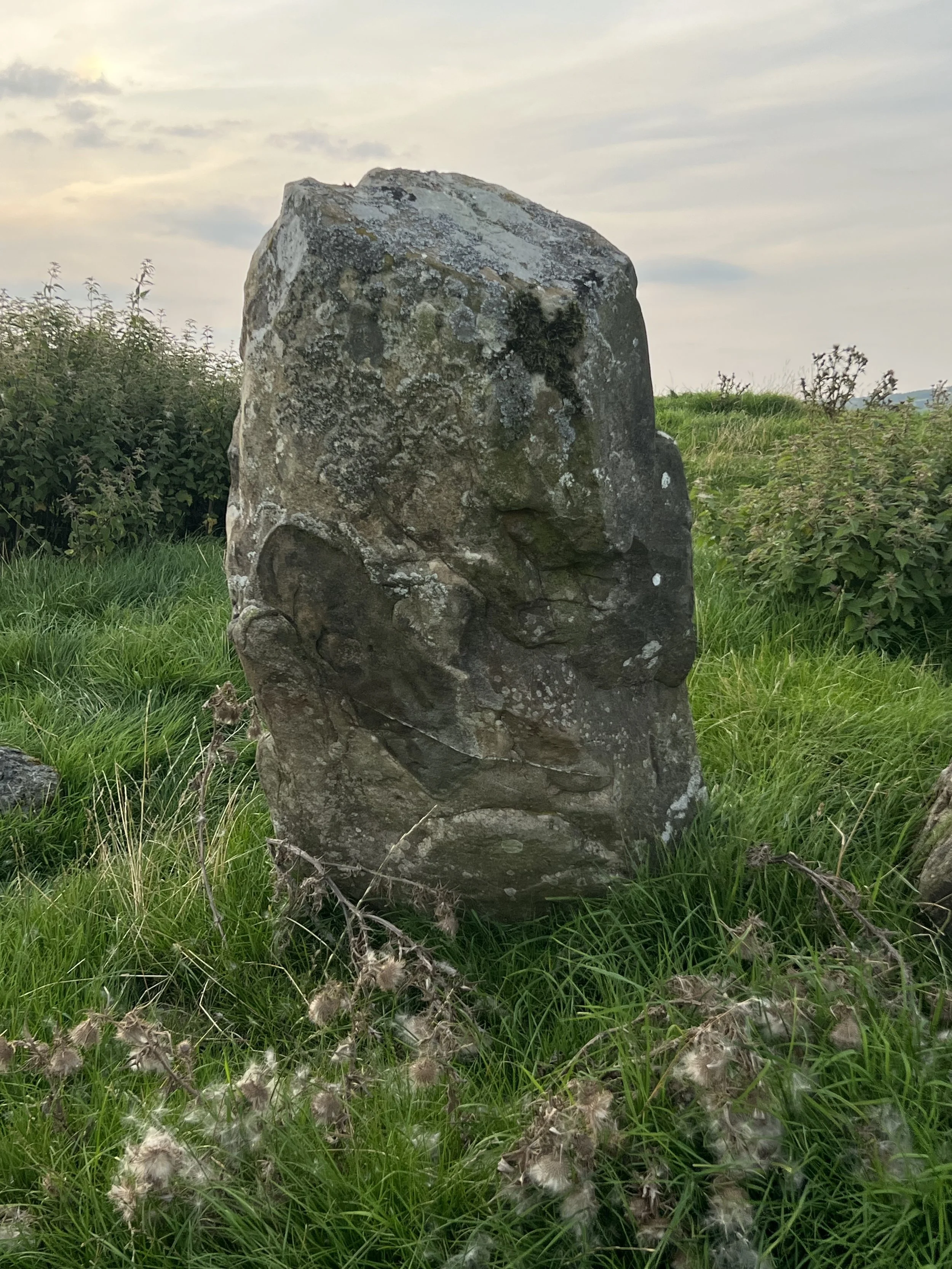
A stone that was once in situ but is now in a storage vault at the National Museum, is the Beltony Stone Head. About the size of a football; a Janus-style stone with double-faced symbolic carvings to look back at the past and into the future at the same time. It may have been used as a mold for mask making during the Bronze Age. One side is flat so it could have been placed on the ground and molten copper straight out of the blast furnace poured. We know that bonfires are associated with Bealtaine. The double face, the Janus represents liminality, beginnings and transitions, it signifies gates, passages and endings. Latitude: 54° 51′ 1.50″ N Longitude: 7° 36′ 16.80″ W
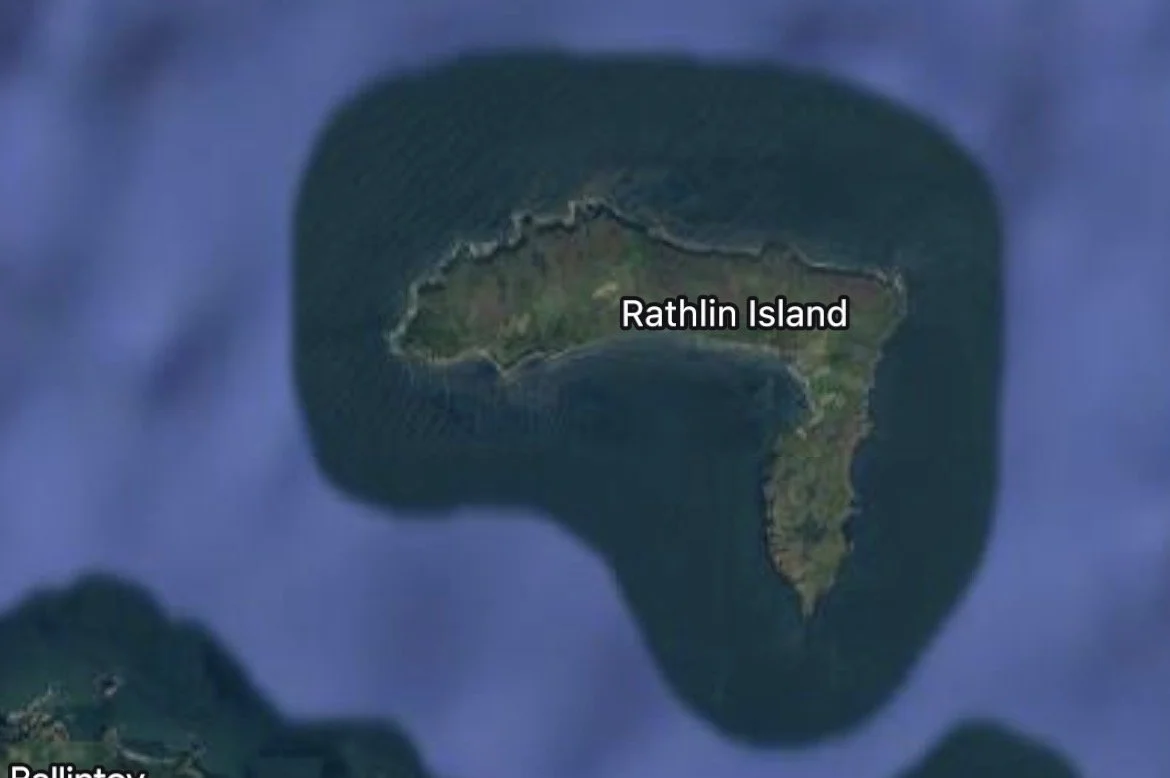
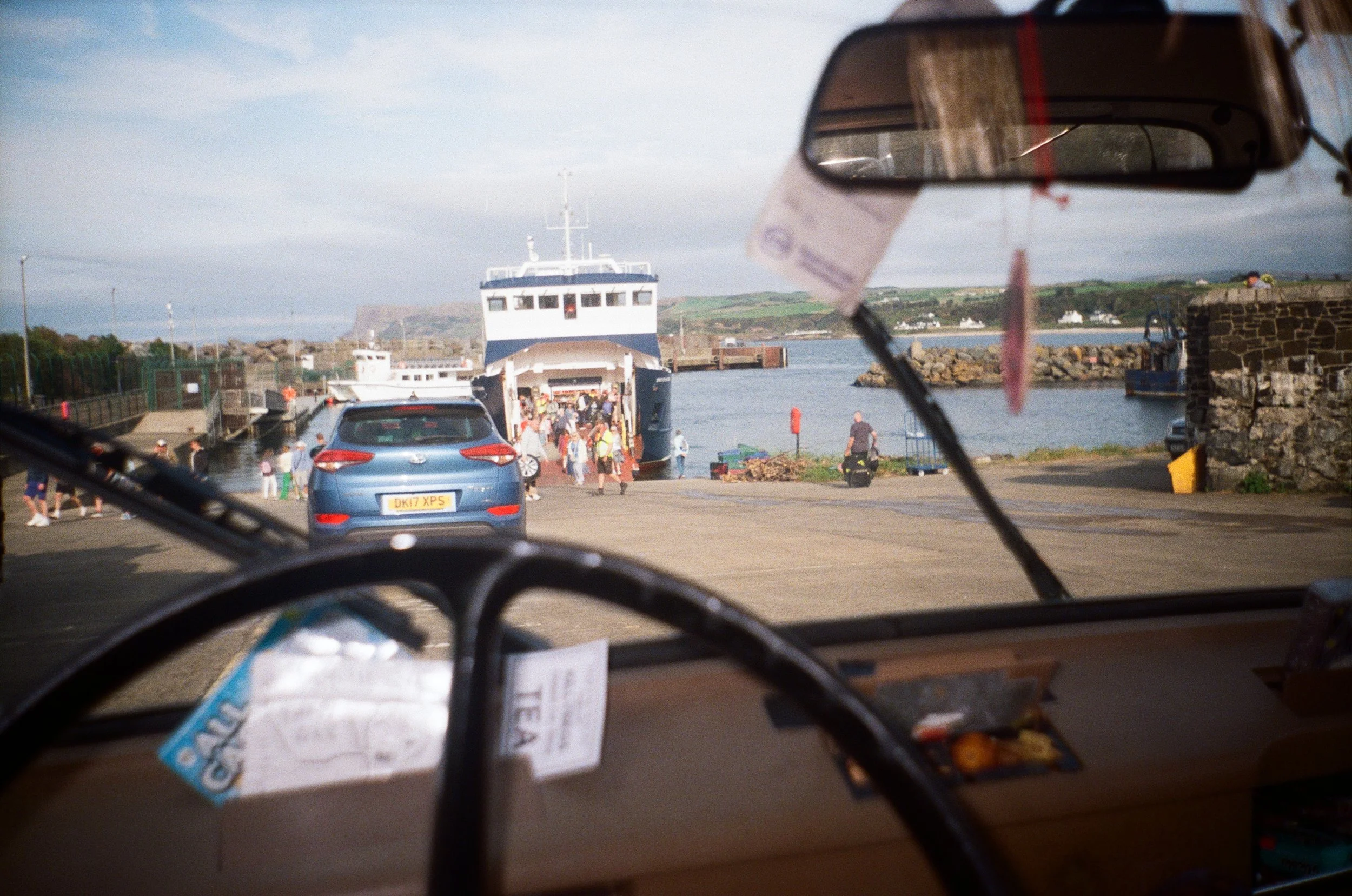
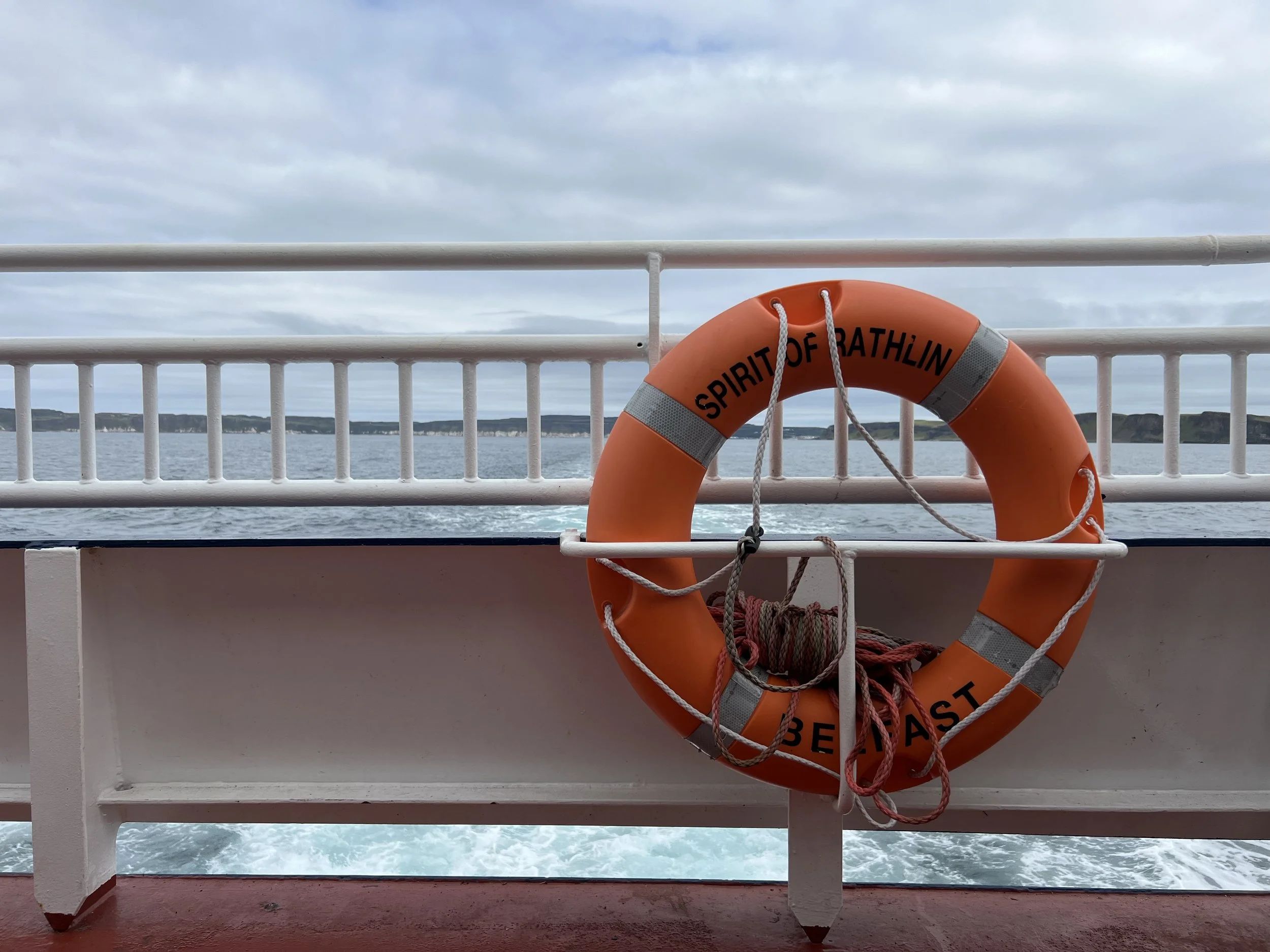
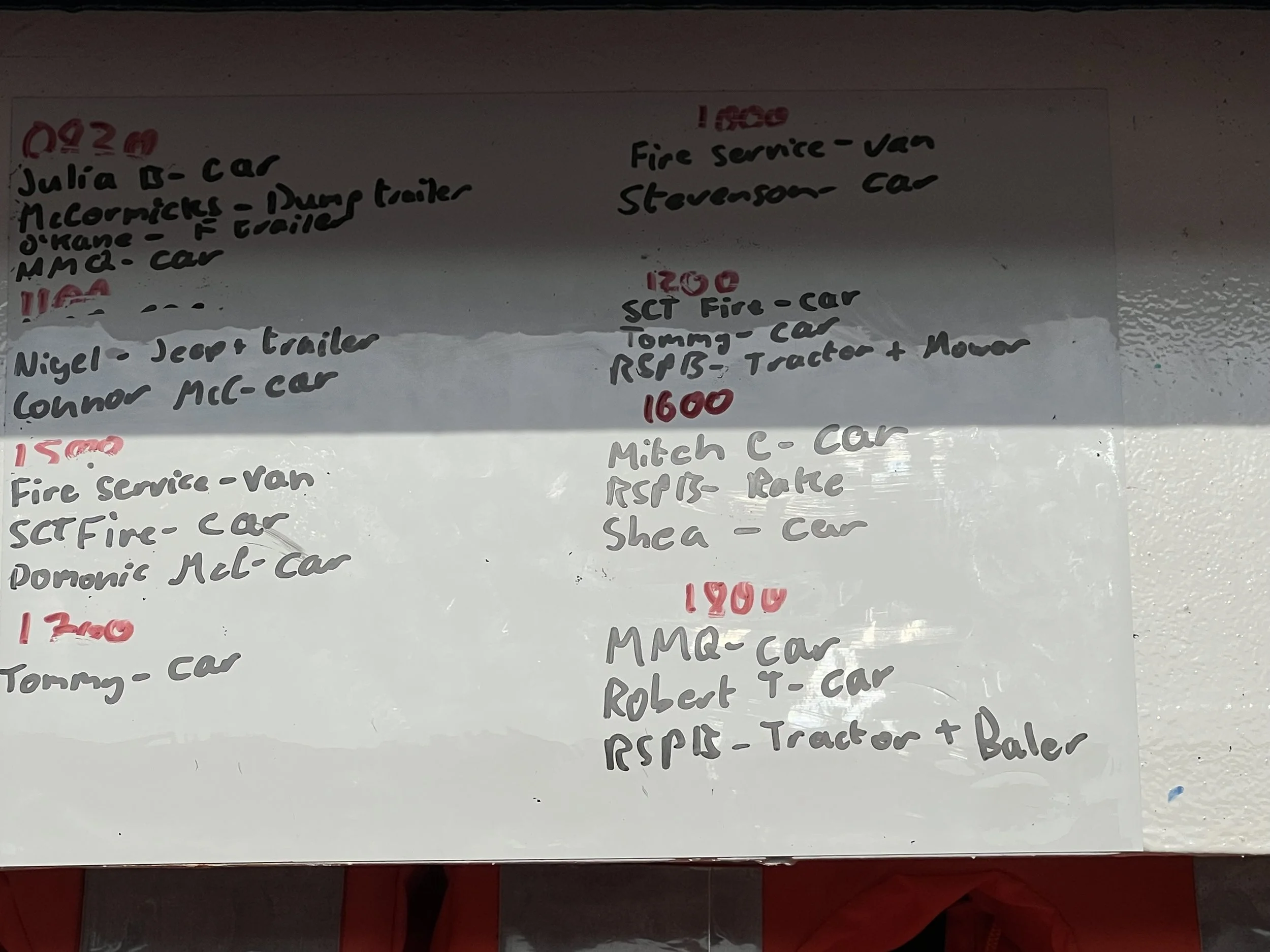
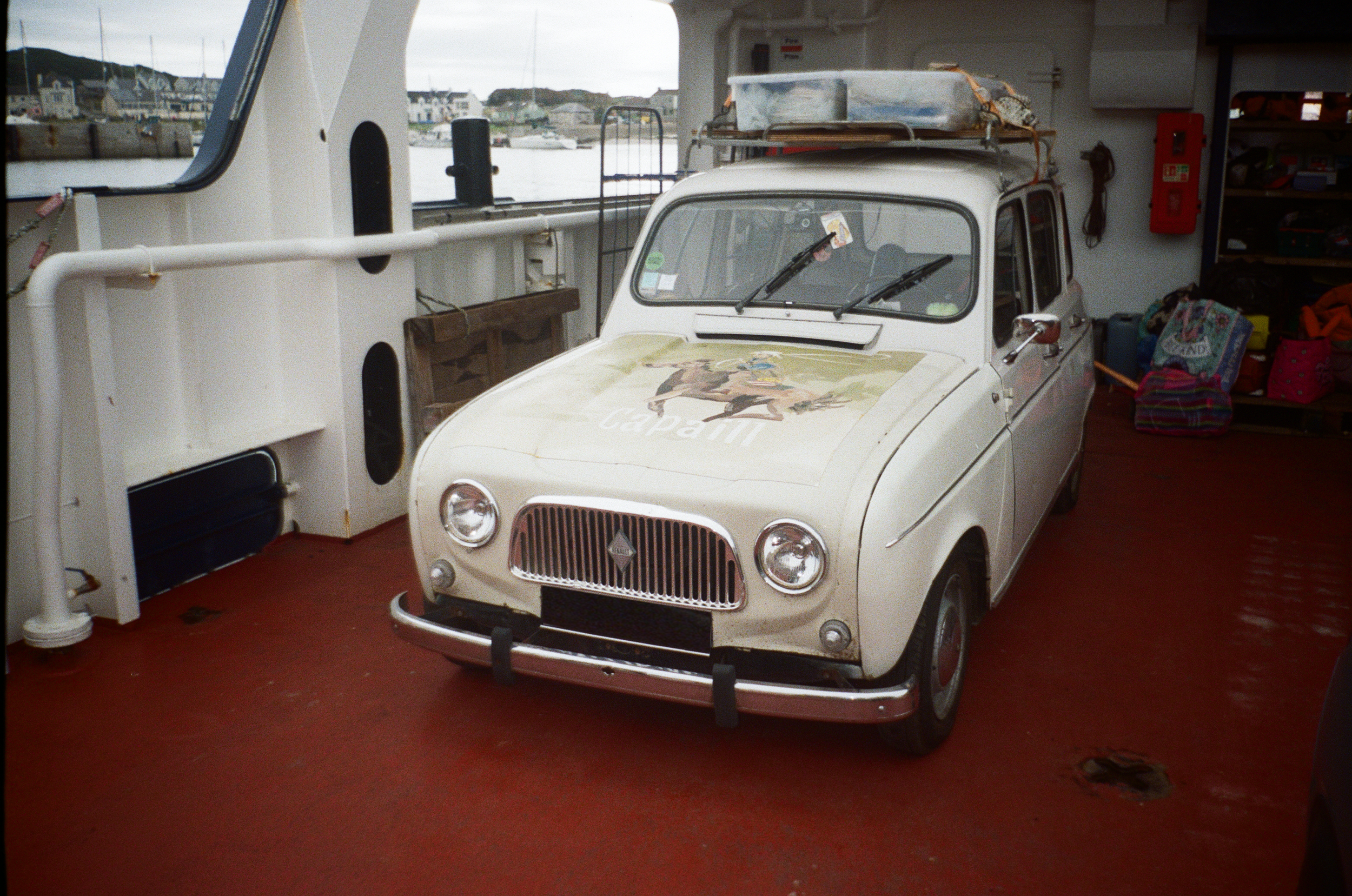
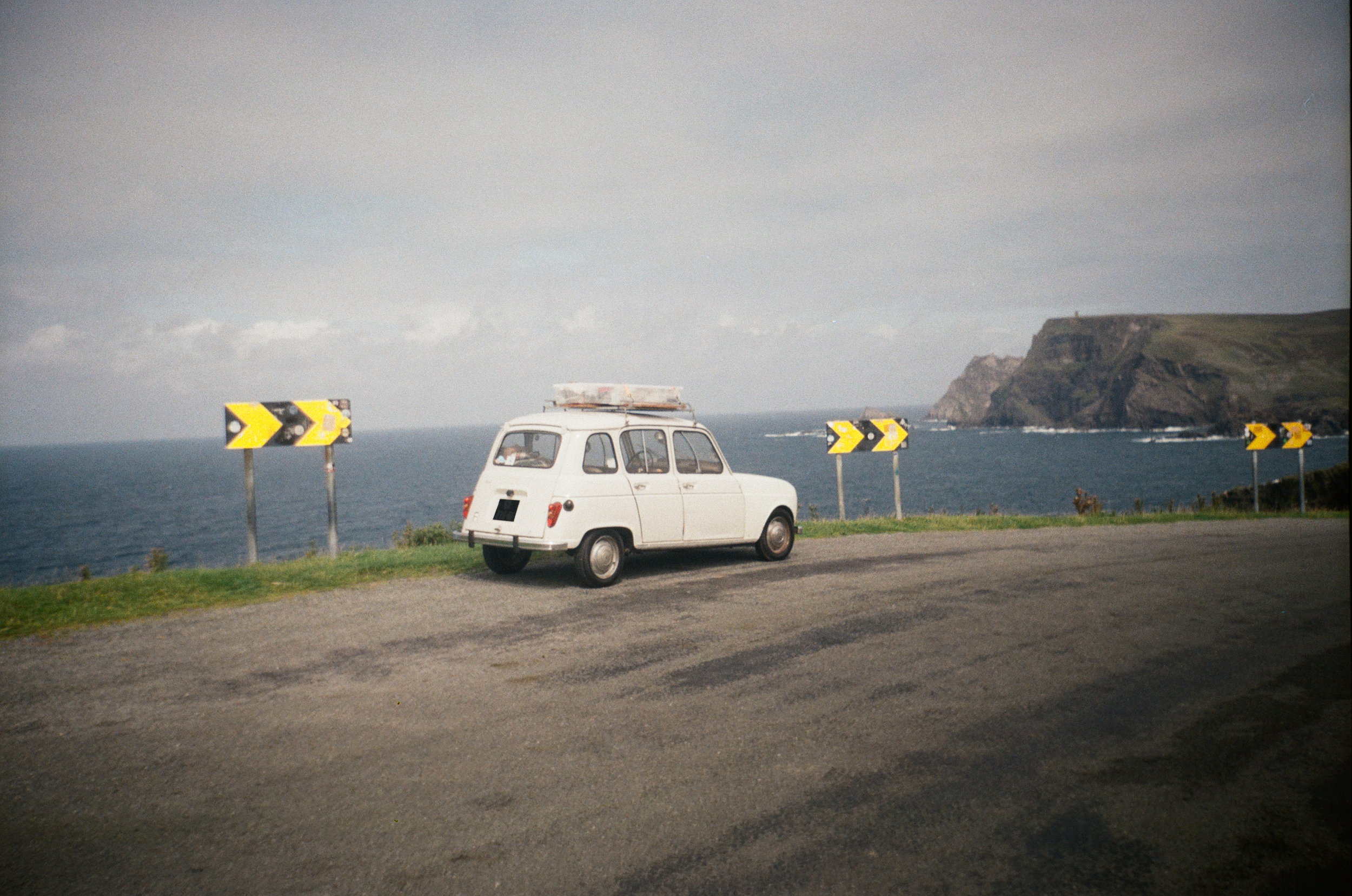
Time had simultaneously slowed down and sped up while we were at the stone circle so when we got back on the road we were running late to catch the ferry, the Spirit of Rathlin. This was the ferry that Renault 4 was prebooked on so we couldn’t miss it. Cars aren’t normally allowed on the island (we’ll come back to this in the coming days). Gaining some time in Coleraine, we headed north to take the Dunluce Road bordering the Antrim coast, past Causeway Head where we had no time to stop at the Giants Causeway and instead it was pedal to the metal all the way to Ballycastle. Arriving into the ferry car park with one minute until departure, we looked out to sea and saw the ferry docked further up by a different car park and by the time we drove out and back in, the Spirit of Rathlin had departed without us.
Perhaps we were finally learning a lesson about taking detours on time limits. The ferry can only take a few cars on each crossing and of course, is generally reserved for farm equipment and supplies for the island. We waited by the harbour, sitting in the Renault 4 while the next ferry arrived. It might be allowed on, they told us. We’d have to wait and see.
In the end we were allowed onboard with the car and managed to make the 10km crossing before nightfall.
Dreaming of Islands - whether with joy or in fear, it doesn't matter - is dreaming of pulling away, of being already separate, far from any continent, of being lost and alone-or it is dreaming of starting from scratch, recreating, beginning anew
-Giles Deleuze, Desert Islands.
18.08.2025
L, R: drive it to the ground
1,2,3,4,5,6: from hair pin to sweeper
Over Time Limit (OTL)
CKD*
*completely knocked down
+, -: sixth-gear sweeper, tightest bend
: pitstop collaboration // ham ham ham
40,50,60 ... 200: wheelspin
&: oil of a kind_
->:st control check//bodywork
Cr: heat for hire//K7 dans la 4L
Jmp: uphill downhill
/: breaktime//cease to strive
OC: off-camber No pressure
Slippy: oil of a kind
Grip: special stage
Care: fuel me once difficult road ahead
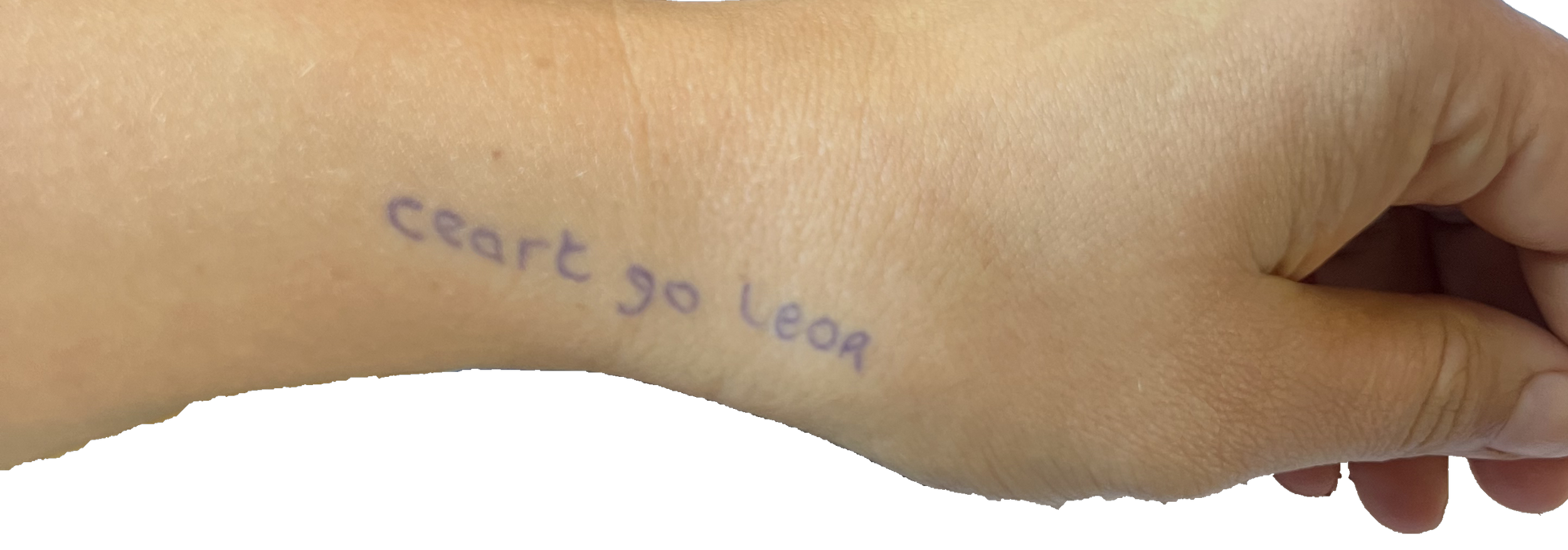
!: ceart go leor
!!: towards torr head
!!!: coming back from far
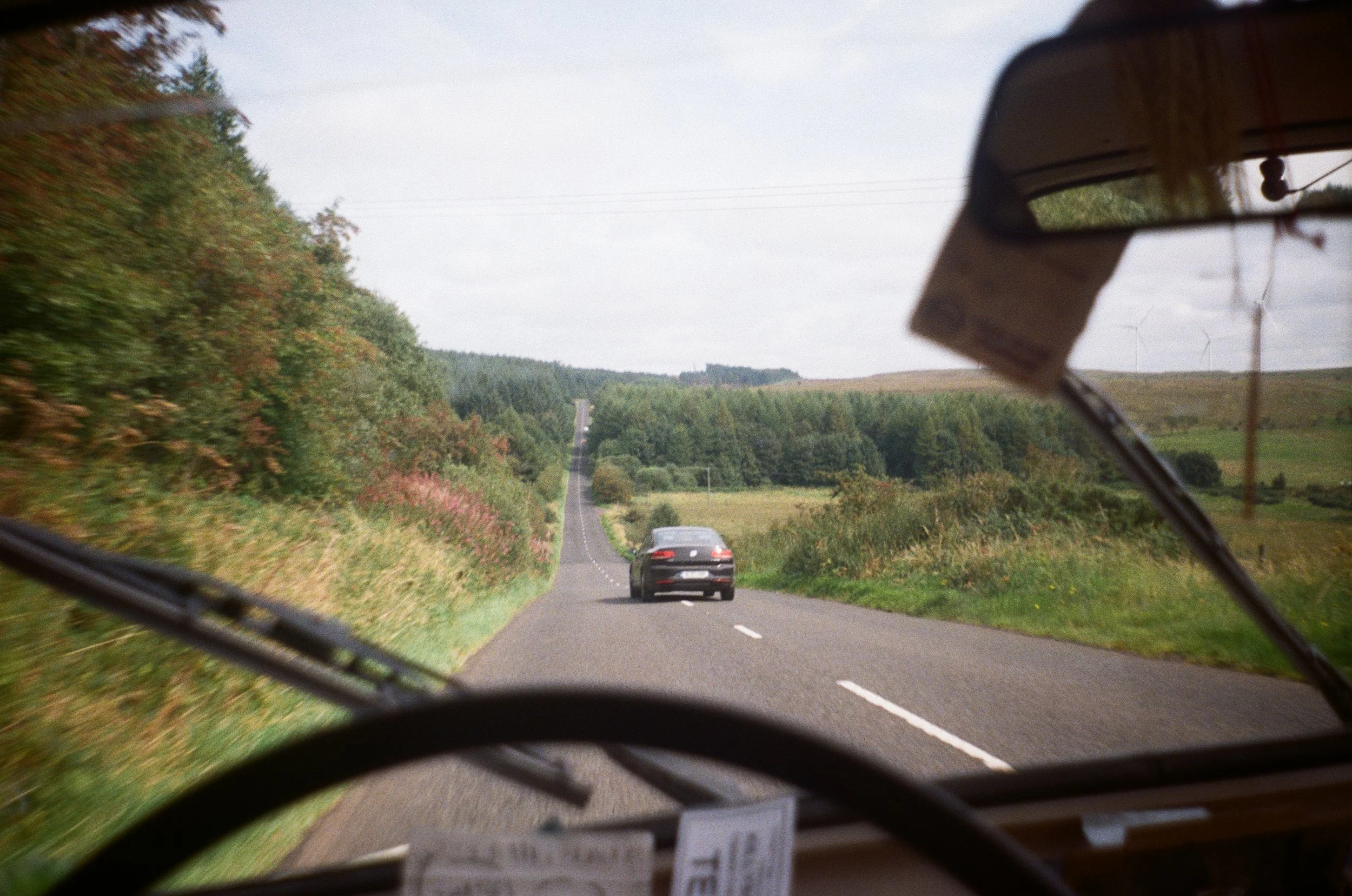
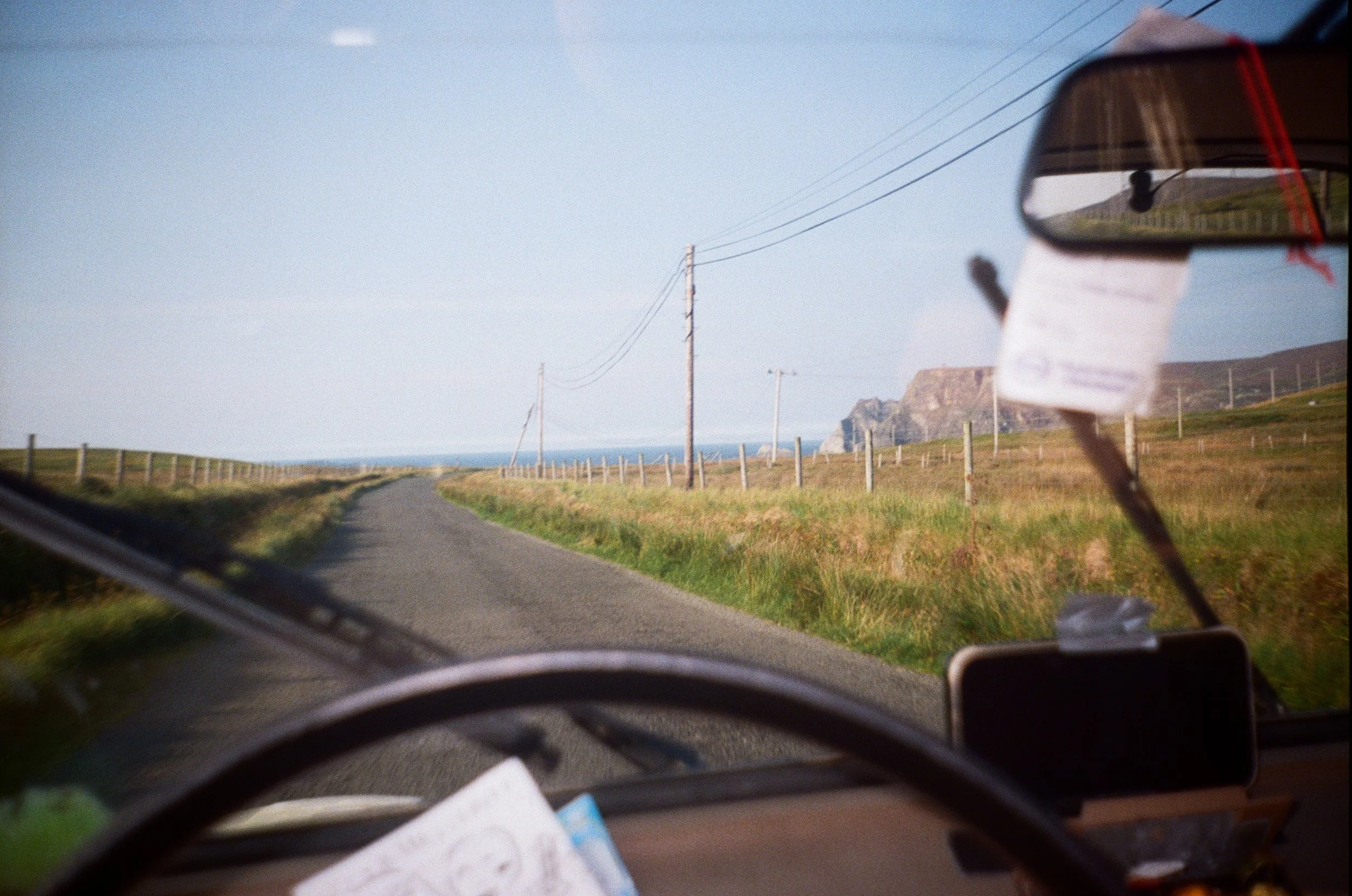
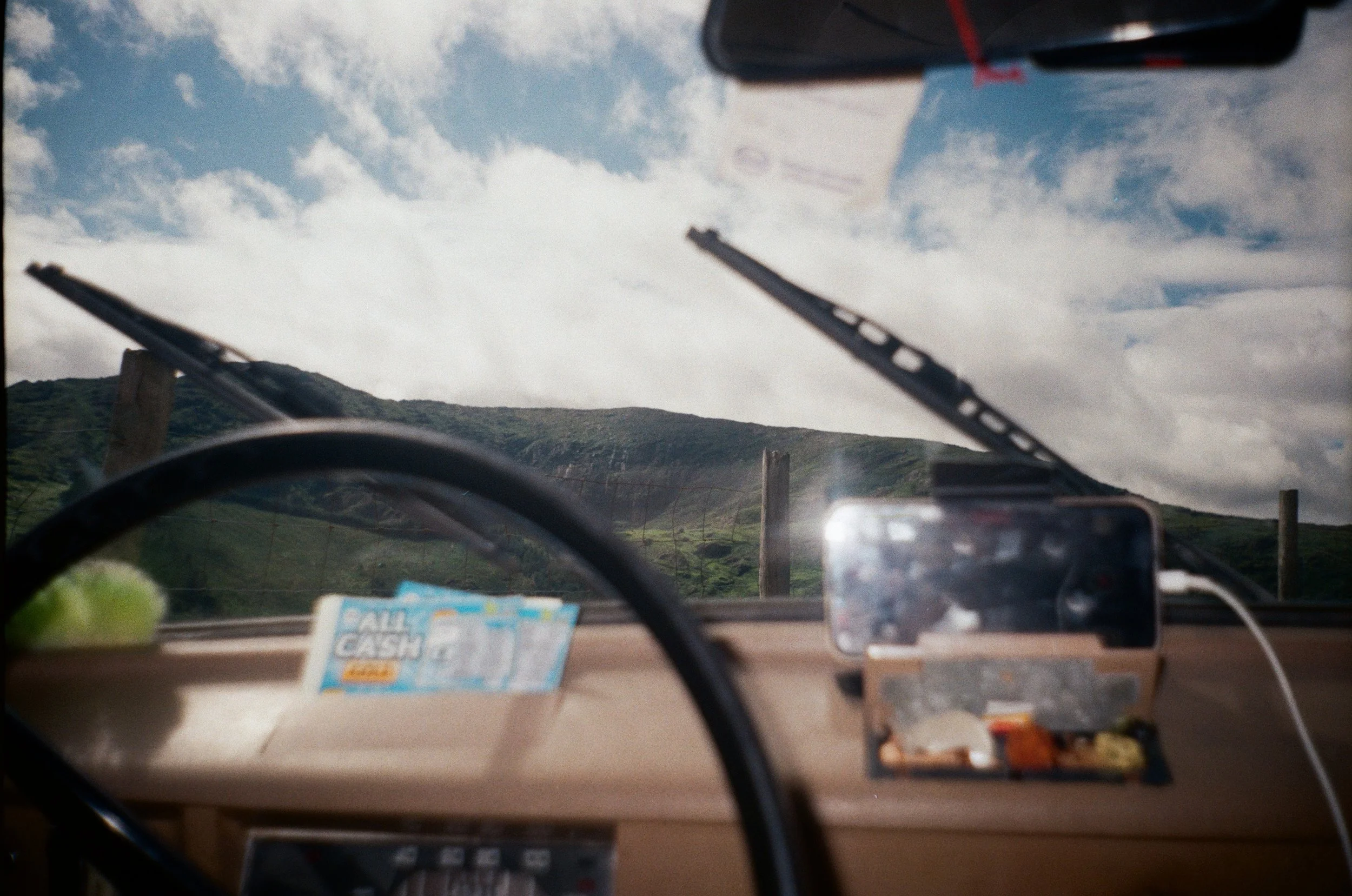
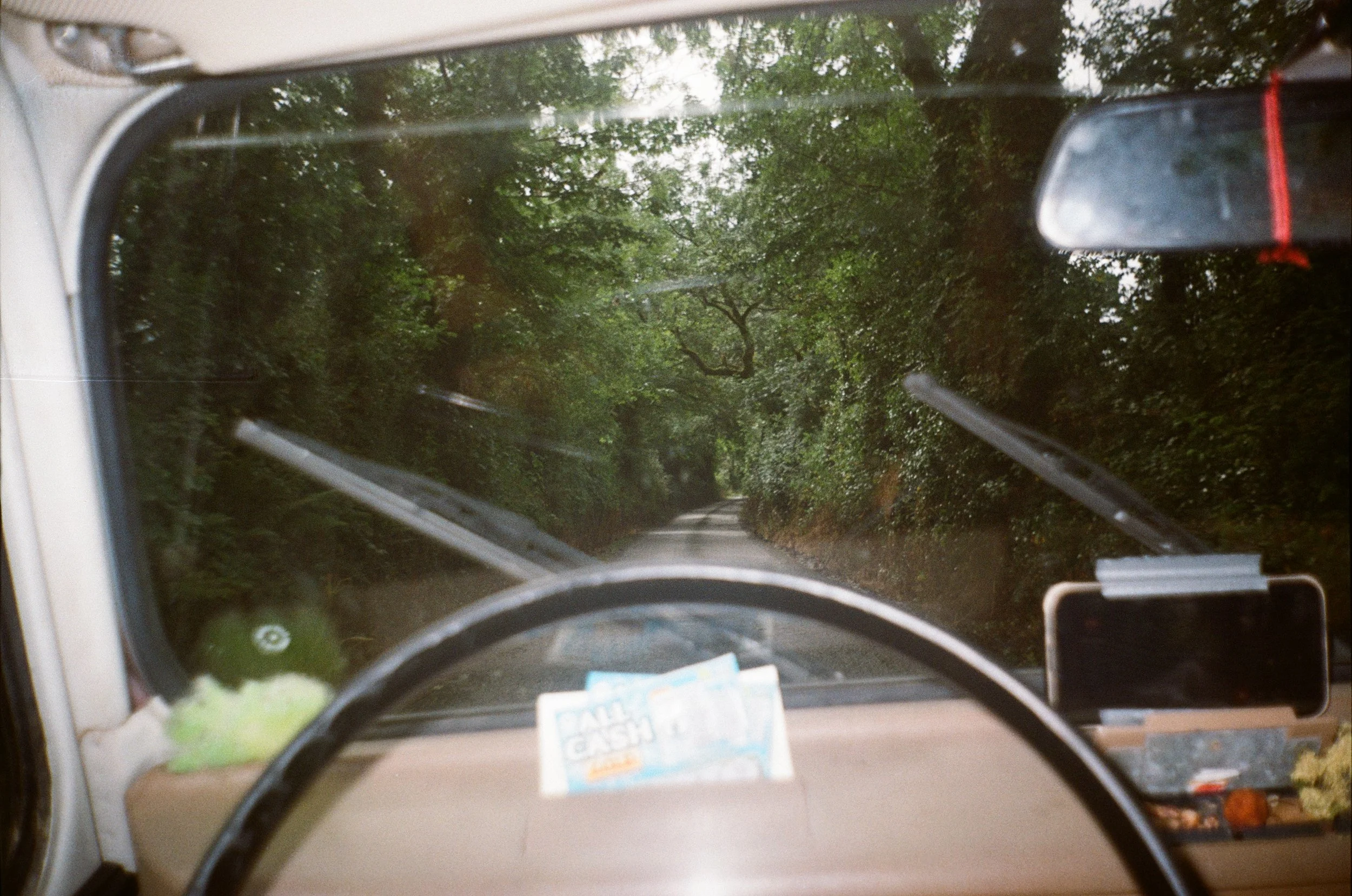
This time last year we are very much back on the road again, enroute to Rathlin Island via the backroads of Donegal and still planning some few detours including a large stone circle that caught our attention on the map. At this stage, we were beginning to understand that our detours were central to the concept behind the tour. With our heroe’s journey monomyth; referencing labyrinthine paths, challenges, obstacles, uphill downhill peaks and troughs, we were navigating the longest way around, which is the shortest way home according to James Joyce in his own referencing of the heroe’s journey monomyth.
In rally driving, pace notes are the co-driver’s script which they call out to the driver to close the gap between perception and action. The driver and co-driver often go out on a ‘recce’ (reconnaissance) ahead of a rally to tune the pace notes and this can give them the edge as they are better prepared to deal with terrain. During ‘recce’ the driver and co-driver progress through circuit stages at a relaxed speed. In the pace notes, they document every corner, road surface, every jump, crest and steep verge that might impose on their journey. While the general ideas and principles of these coded, shorthand notes are concrete and utilised in real rally - every individual driver, co-driver pair can tailor make their pace note style to suit their own preferences.
In the context of tour de force, where Liliane Puthod (visual artist) and myself (writer) teamed up to deliver this round the country tour, we might think of our initial meetings as ‘recce’ for pace notes. Each day for the month of January 2025 we workshopped possibilities for tour de force, scripting the journey down to the kilometers, then loosening it up again for divergences and tangents. These notes helped us during the six week tour, where we were navigating realms of artwork, art and work, friendship and collaboration.
17.08.2025
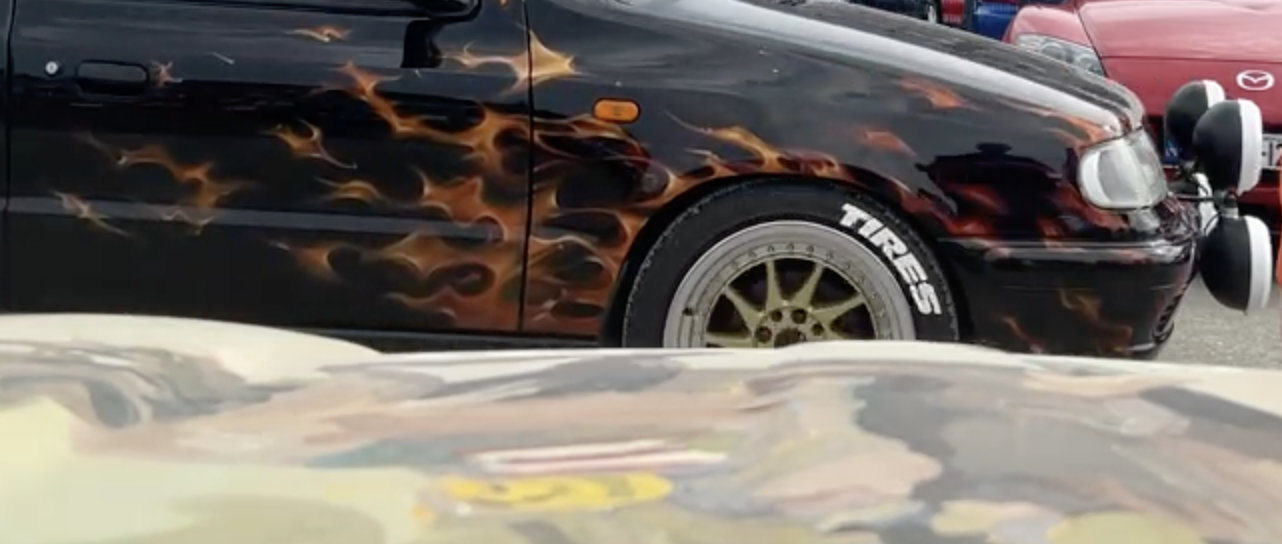
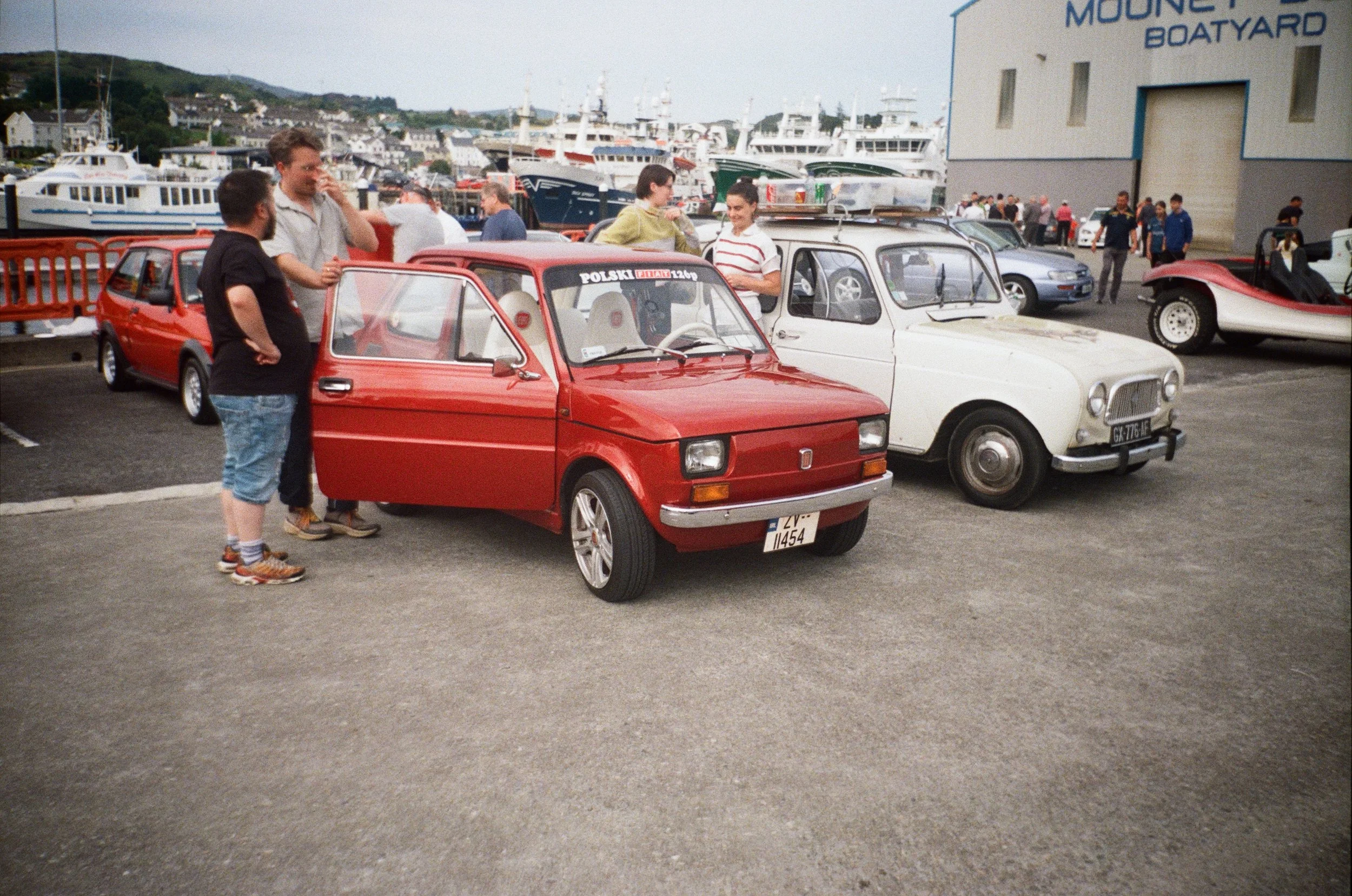
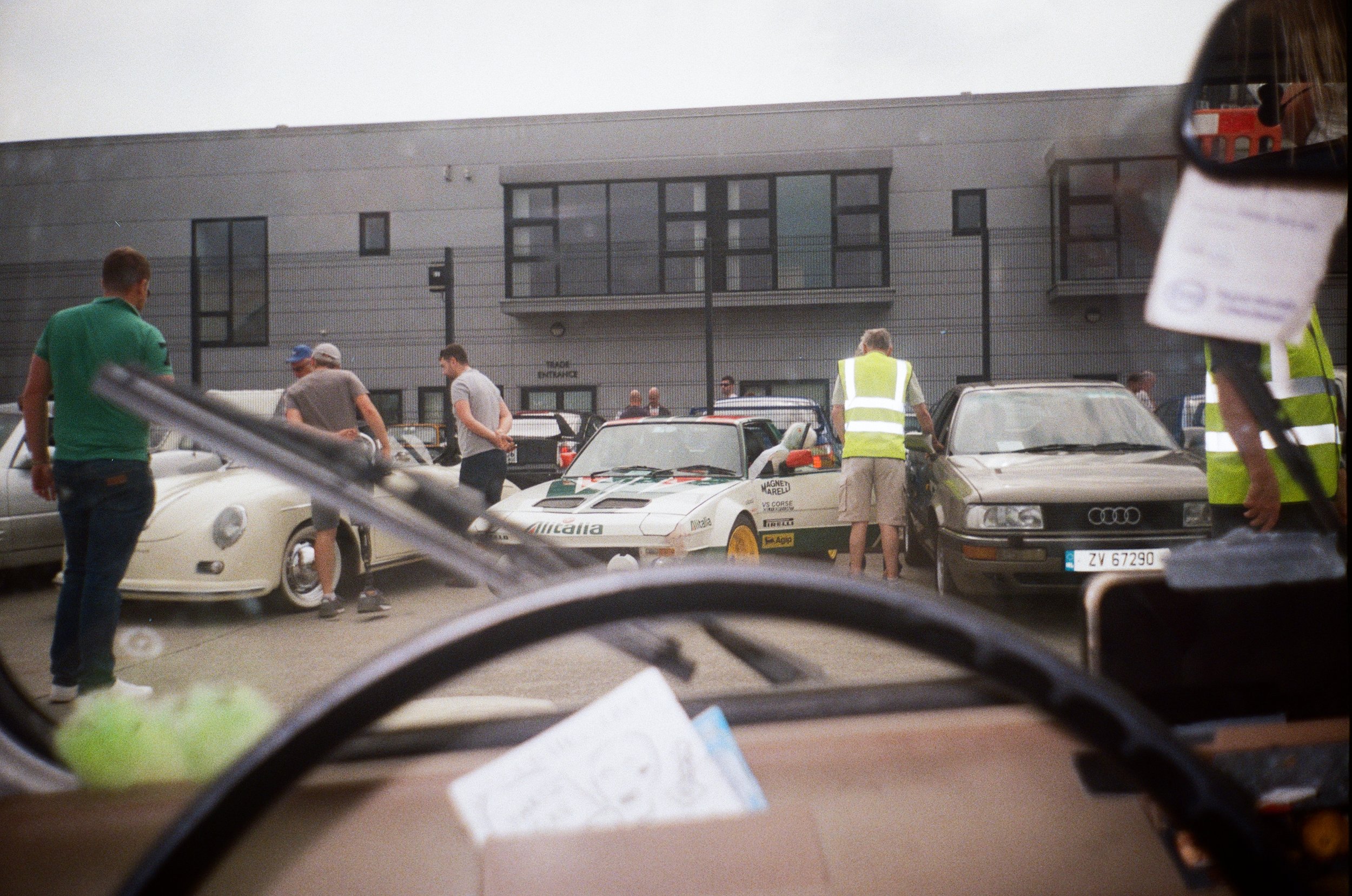
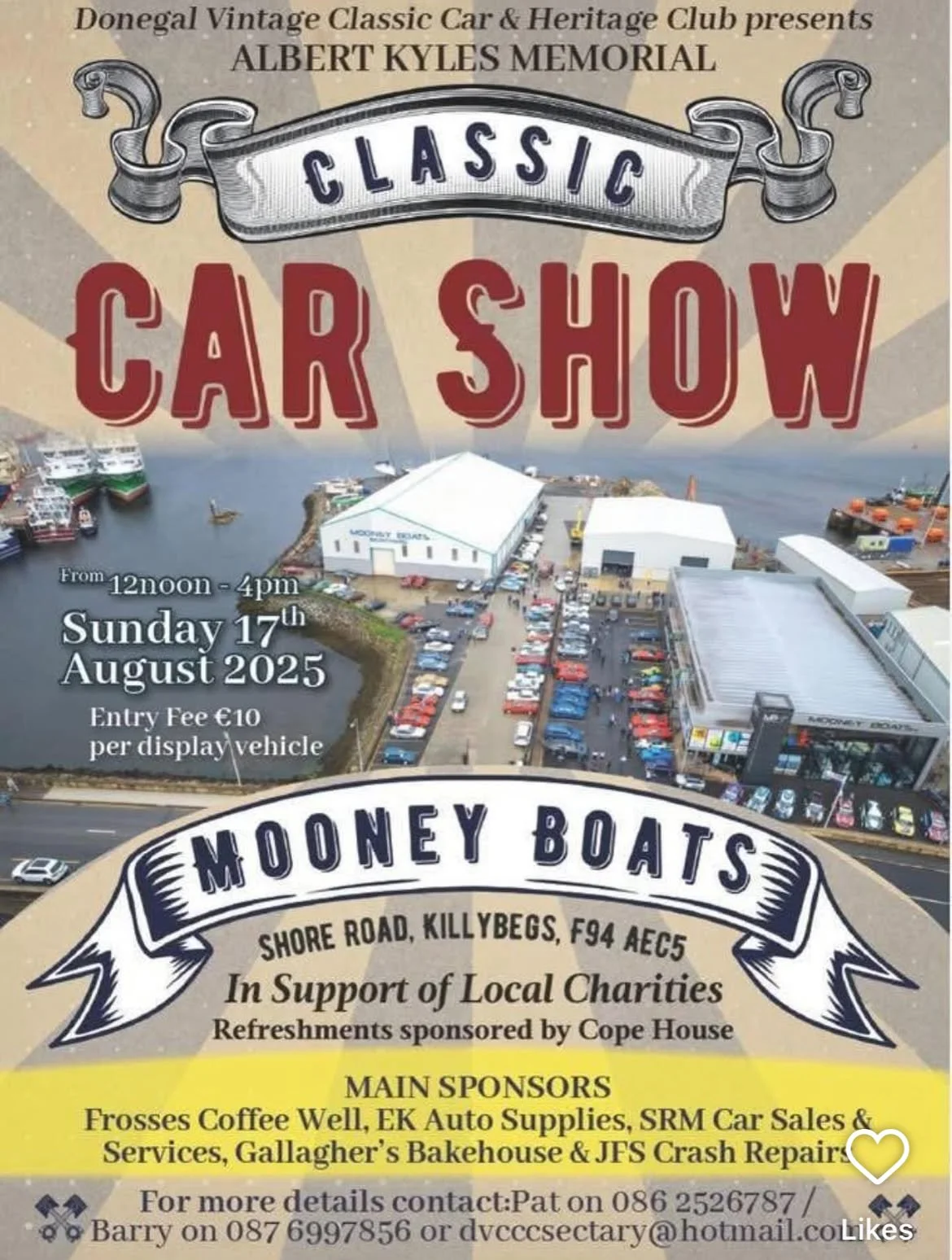
Along the promenade, there’s a slipway to your left as you leave the town heading west, past the marina towards the industrial area of the port where huge fishing trawlers are moored. At the end of the promenade; a large commercial vessel shipyard called Mooney’s Boat’s LTD, host the Killybegs Classic Car Show every year in mid August.
Killybegs is the largest fishing port in the country and on the island of Ireland. An unexpected industrial hub in rural Ireland where tradition and modernity overlap. Along the pier railings are coated with luminous orange paint and the colours of the boats from all over the world brighten the town - a place defined by cultural flow and circulation, as well as it’s history of storms and shipwrecks that have affected this fishing and sea faring community over hundreds of years. There’s an oak tree along the promenade that dates from the time of the Spanish Armada, a ship called La Girona anchored there 1588 with a damaged rudder. The crew were looked after and the ship repaired, with the help of the Irish chieftain MacSweeney Bannagh.
Each year a commemorative walking tour arrives into Killybegs after tracing the path of the survivors of La Duquesa Santa Ana who travelled on foot from Ardara to join the crew of La Girona. They assemble at an oak tree and wait for stragglers there, the guide begins a site-specific lecture, gesturing at a huge old oak tree that was a sapling during the Armada. The tour then makes its way along the promenade to the spot where the damaged rudder was taken out and repaired at what is now Mooney’s shipyard. The very spot where The Girona was taken apart and repaired in 1588, is the same spot designated for a faction of Subaru car owners to meet and hang out during the vintage car show. For a period of about 20 minutes each year, this corner of the shipyard becomes a shared space for Armada and Subaru aficionados alike.
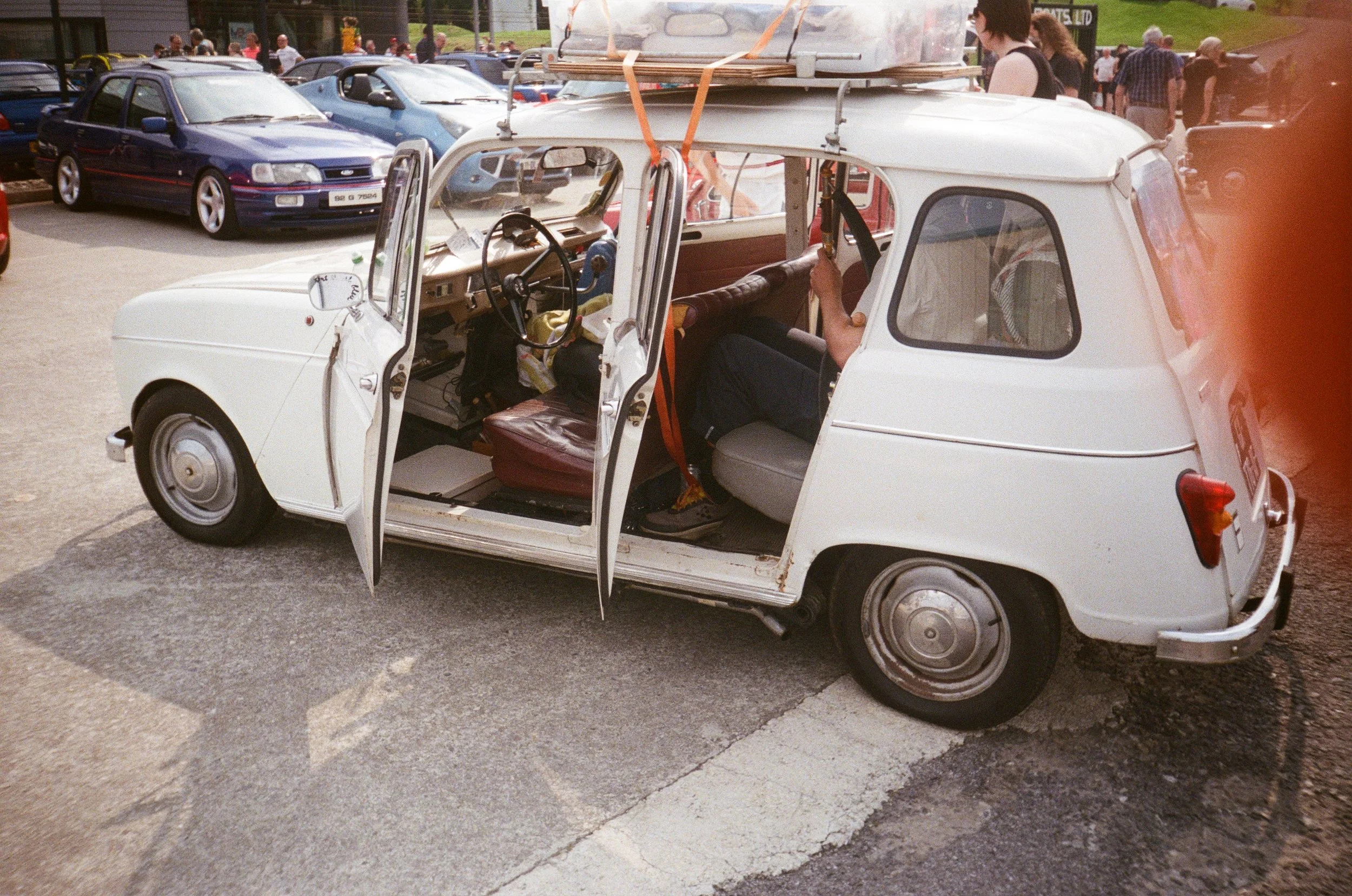
Parked at Killybegs Classic Car Show, this episode of K7 dans la 4L hosted visual artists Cliodhna Timoney and Paddy Joe Rickard to discuss their individual practices. The four of us sat in the stationary Renault 4 as vintage and classic cars passed by.
During the interview, Cliodhna Timoney reflects on the subculture surrounding the AE86, the Toyota Twincam in Donegal. Having grown up with close ties to an extended community of enthusiasts, drivers and mechanics she shares insights into her sculpture practice with a special focus on her recent installation Flashes of Light, a body of work reflecting on the zone of the farm, its edges and the interconnectedness of the structures, ecologies and beings found there.
Considering ideas of enclosure, access, dwellings, wildness and changing rhythms between rural and urban, Timoney uses archetypes, motifs and materials typical of the farm she grew up on, alongside references to nightlife and car culture, to subvert and challenge a permanent, unchanging idea of physical spaces.
Initially interested in trucker culture, truck modifications, Paddy Joe Rickard’s research began in 2019 where he started interviewing mechanics, part of clubs and groups who like to go banger racing on the weekends. Throughout this interview, Paddy gives insight into the particularities in trades, barters and codes in this hidden world. His research into material culture and folklore around broken, forgotten, rusted and reanimated cars has manifested in an essay about Irish bangers communities titled Wreckers and Crashers: the folklore of an Irish banger racing community, Folk Life: Journal of Ethnological Studies, Volume 60, 2022 - Issue 2.
Abstract: Banger racing is an extreme form of car racing, wherein manoeuvres akin to crashing, ramming and spinning are essential features of the races as well as the overall performances. This study is an ethnologic exploration of the emergent folk culture generated by a small banger racing community located in the Northside of Dublin, Ireland. The racing cars, or bangers, are individually constructed and customized for each race, using an array of car parts found and appropriated by both racers and mechanics. Such distinct social conditions and cultural practices, and the group’s position as a distinctive subgroup within the Irish car enthusiast community, facilitate the creation of its own culture and folklore. While this study outlines aspects of the group’s indigenous vernacular culture, it focuses especially on the ways in which folklore yields distinctive meanings as well as enhancing feelings of both collective and individual identity.
K7 dans la 4L is tour de force mobile broadcasting arts club, live streamed on Twitch with a curated series of artist’s talks, readings and interviews that were broadcast directly from the Renault 4. A forum for discourse and debate around contemporary culture, a chat room that was utilised to discuss art, landscape and tradition associatively and in a shared stream of consciousness.
15.08.2025
Much of what we know about Anna Nic an Luain (1884-1954) comes from stories told about her from a collector who spent time with her in the late 1940s. She never put pen to paper, but knew hundreds of songs and stories. Some of these stories lasted a full day into the night. Though she never left the foot of the Blue Stack Mountains, she had a kind of worldliness that drew people to her.
We can only surmise that her wisdom was gleaned from a daily life of keen observation, levity, wit; awareness in her surroundings. How did she come to know so many stories, where did she get them. Her first person narratives of otherworldly encounters, with fairies for example; is she telling a story that she heard or is she relaying first-hand experiences. People gathered to listen to her, transfixed. She sang, danced, wove buicidín dolls from straw. She taught games and rhymes to children. On her wedding day, the tune that was lilted for her was a three part polka; Mac Eoghin Sheáin, iníon John Chait and we know this from the fiddle player Jimmy Campbell whose uncle was present and passed the tune on to him. When Seán Ó hEochaidh encountered Anna Nic an Luain in 1947, he had this to say about her,
She is as wonderful a woman as I ever met. I wrote down about two hundred songs from her, and as regards stories, traditional lore and other short items, there is no knowing how much I wrote down from her. Often while I was writing from her, I was reminded of a well of clear water in a great summer drought. The well would run dry today and tomorrow morning it would be full to the brim again. Thus it was with Anna. I would spend, perhaps, a whole day writing and taking down pieces of folklore of some kind from her, and I would be finished with her, it would appear, and if I went back the following day she would be ready again, and the well of knowledge would be brimming over…
Seán Ó hEochaidh recorded a cumulative tale from her called, Spág ar an Bhac during one of his visits in 1947. It’s what is often called a chain tale where actions are repeated and linked until a picture forms. These kind of narratives require great skill as their tongue tying and labyrinthine structures depend on rhythm, cadence, repetition and sometimes melody, for their effect.
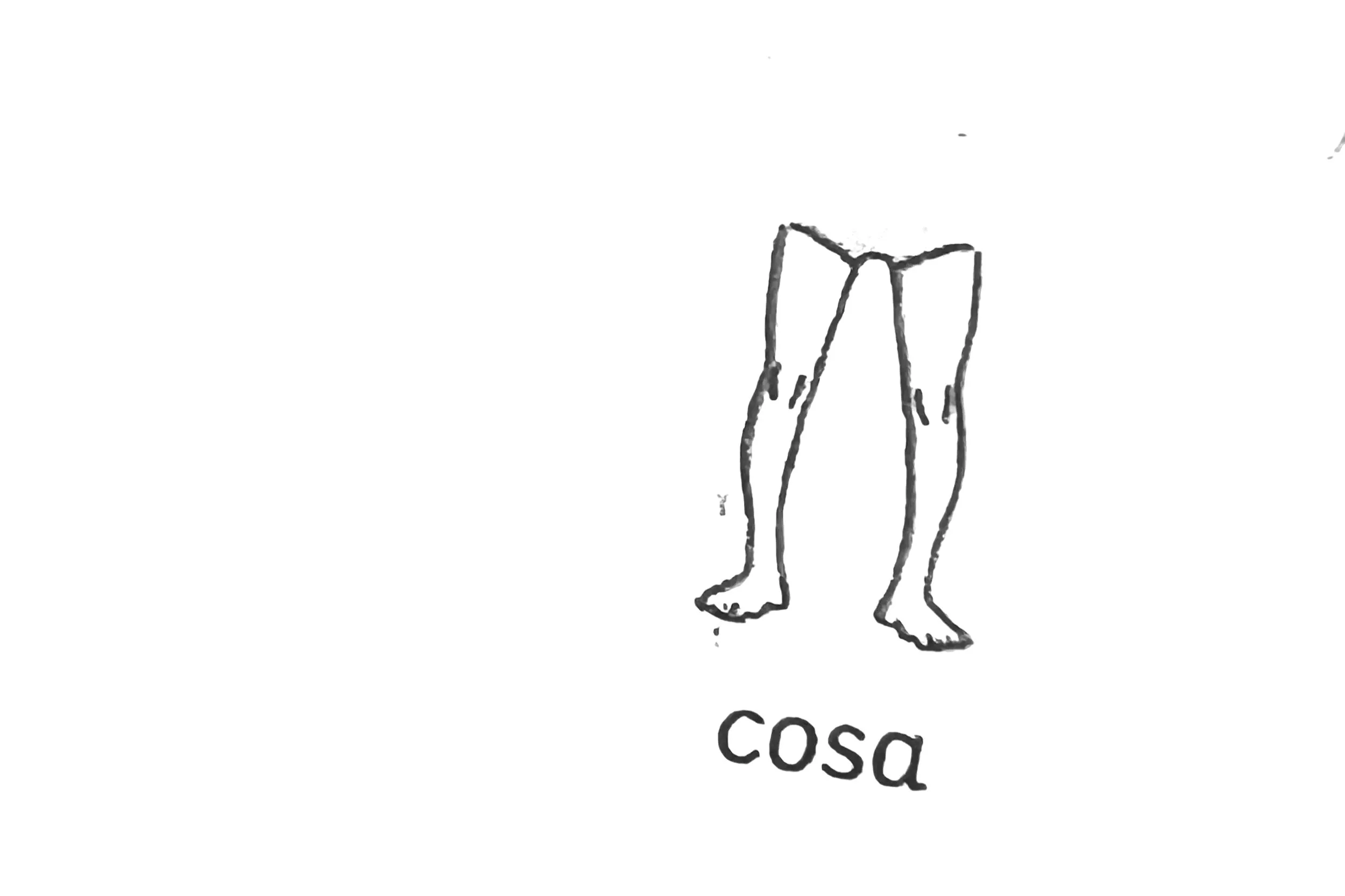
In the story of Spág ar an Bhac, a lonely woman is praying for company and gradually an apparition forms in front of her, beginning with the two feet; the two feet come and sit by the hearth. Then the two ankles come and sit on top of the two feet (the same two feet that are already on the hearth), then the two shins come in and sit on the two ankles…the two ankles that are sitting on the two feet on the hearth, and on it goes until finally; there is the full apparition.
In my mind, this poem could be considered alongside Samuel Beckett’s, Not I for its fragmented, disembodied stream of consciousness, dream logic. In Billie Whitelaw’s delivery of the monologue Not I, a single illuminated disembodied Mouth frantically whispers into the darkness. There a denial of self that is inherent in Beckett’s Not I and the Irish storytelling tradition as a whole. According to Anna Nic an Luain; songs, stories, riddles, games, dances, melodies that she shared came from other storytellers, her grandmother, the fire, fairies, animals…the otherworld.
RAINN
16.1. SPÁG AR AN BHAC
Tháinig an dá spág isteach agus shuigh siad ar an bhac. Tháinig an dá mhurnán isteach agus shuig siad ar an dá spág agus bhí an dá spág ar an bhac.
Tháinig an dá lorgán isteach agus
shuigh siad ar an dá mhurnán,
Shuigh an dá mhurnán ar an dá spág agus
shuigh an dá spág ar an bhac.
Tháinig an dá ghlúin isteach agus
shuigh siad ar an dá lorgán,
an dá lorgán ar an dá mhurnán,
an dá mhurnán ar an dá spág agus
shuigh an dá spág ar an bhac.
Tháinig an dá láirig isteach,
Shuigh an dá láirig ar an dá ghlúin,
an dá ghlúin ar an dá lorgán,
an dá lorgán ar an dá mhurnán,
an dá mhurnán ar an dá spág, agus
shuigh an dá spág ar an bhac.
Tháinig an dá leis isteach.
Shuigh an dá leis ar an dá láirig,
an dá láirig ar an dá ghlúin,
an dá ghlúin ar an dá lorgán,
an dá lorgán ar an dá mhurnán,
an dá mhurnán ar an dá spág agus
an dá spág ar an bhac.
Tháinig an tóin isteach.
Shuigh an tóin ar an dá leis,
an dá leis ar an dá láirig,
an dá láirig ar an dá ghlúin,
an dá ghlúin ar an dá lorgán,
an dá lorgán ar an dá mhurnán,
an dá mhurnán ar an dá spág agus
an dá spág ar an bhac.
Tháinig an droim isteach.
Shuigh an droim ar an tóin,
an tóin ar an dá leis,
an dá leis ar an dá láirig,
an dá láirig ar an dá ghlúin,
an dá ghlúin ar an dá lorgán
an dá lorgán ar an dá mhurnán,
an dá mhurnán ar an dá spág, agus
an dá spág ar an bhac.
Tháinig an dá shlinneán isteach.
Shuigh an dá shlinneán ar an droim,
an droim ar an tóin,
an tóin ar an dá leis,
an dá leis ar an dá láirig,
an dá láirig ar an dá ghlúin,
an dá ghlúin ar an dá lorgán,
an dá lorgán ar an dá mhurnán,
an dá mhurnán ar an dá spág, agus
an dá spág ar an bhac.
Tháinig an dá ghualainn isteach.
Shuigh an dá ghualainn ar an dá shlinneán
an dá shlinneán ar an droim
an droim ar an tóin,
an tóin ar an dá leis,
an dá leis ar an dá láirig,
an dá láirig ar an dá ghlúin,
an dá ghluin ar an dá lorgán,
an dá lorgán ar an dá mhurnán,
an dá mhurnán ar an dá spág, agus
an dá spág ar an bhac.
Tháinig an muineál isteach.
Shuigh an muineál ar an dá ghualainn
an dá ghualainn ar an dá shlinneán,
an dá shlinneán ar an droim
an droim ar an tóin,
an tóin ar an dá leis,
an dá leis ar an dá láirig,
an dá láirig ar an dá ghlúin,
An dá ghlúin ar an dá lorgán,
an dá lorgán ar an dá mhurnán,
an dá mhurnán ar an dá spág agus
an dá spág ar an bhac.
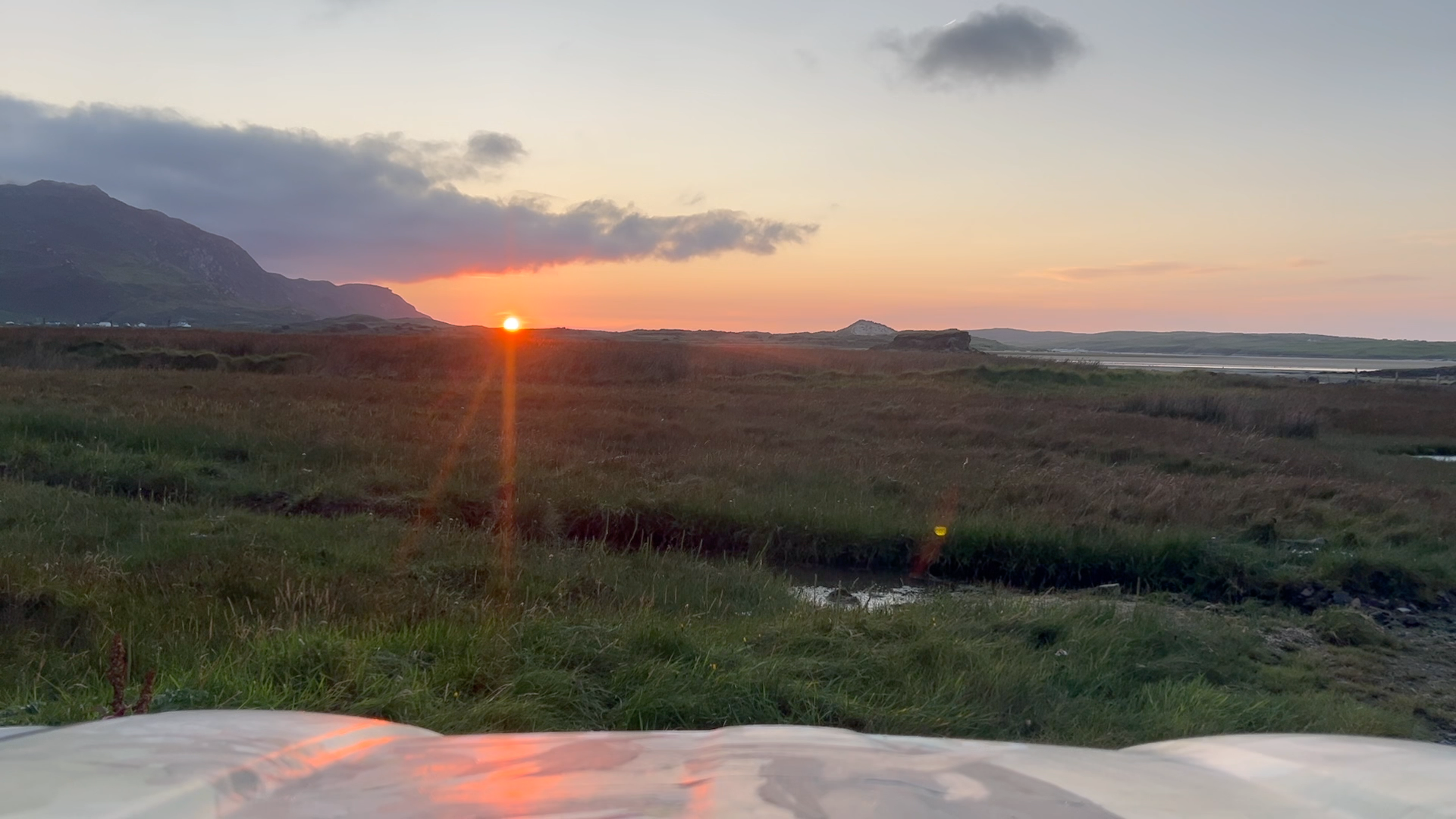
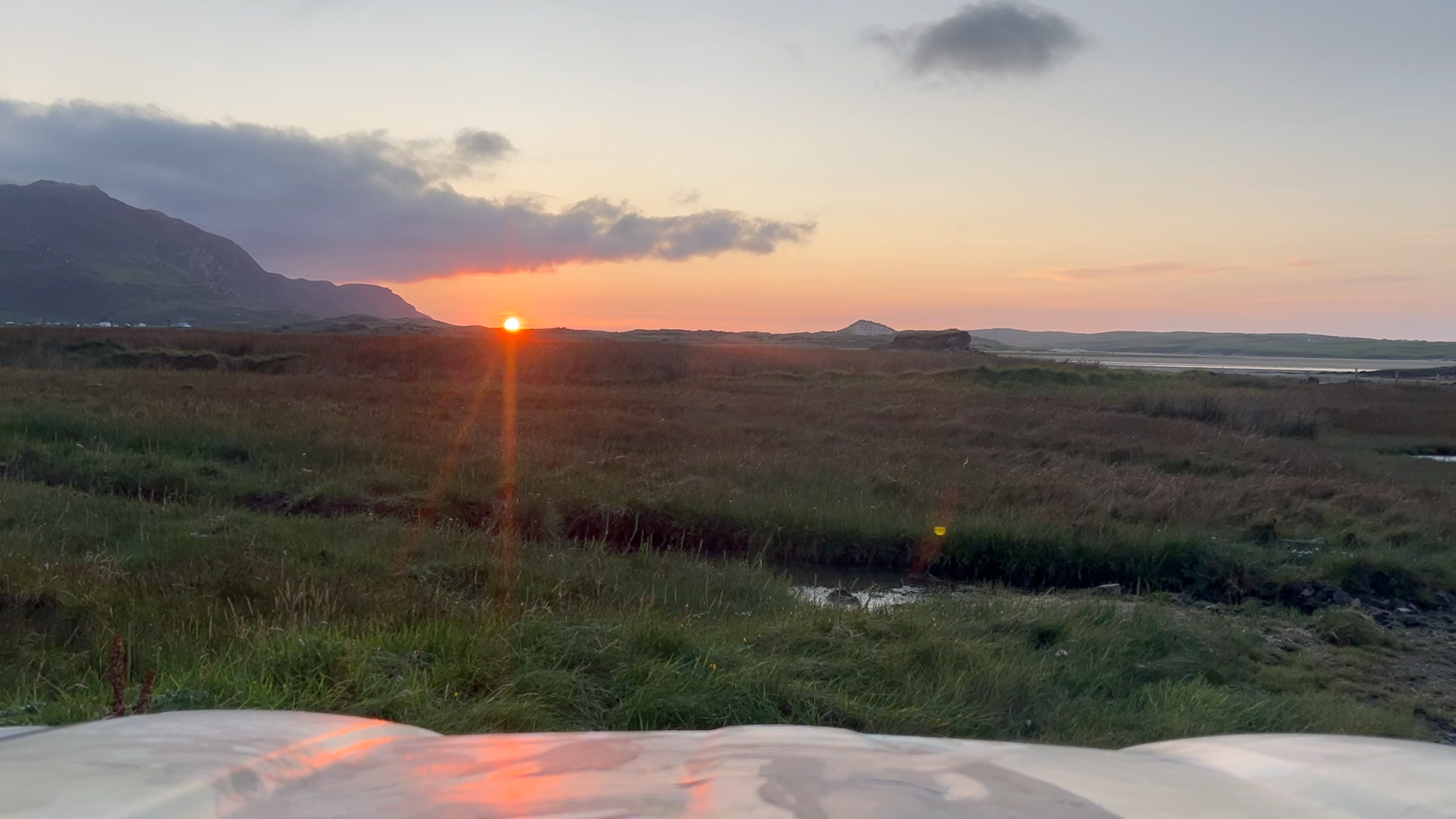
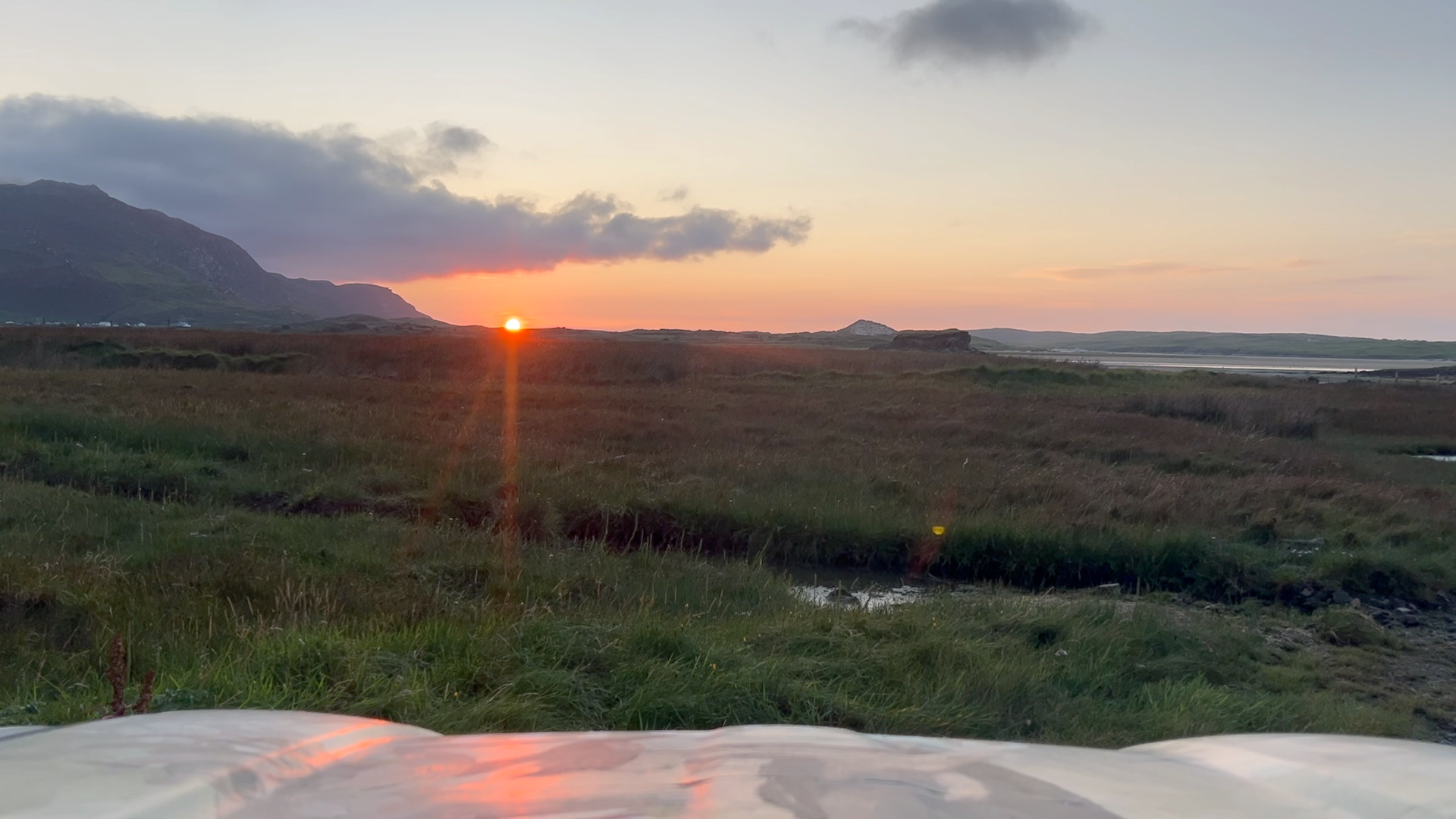
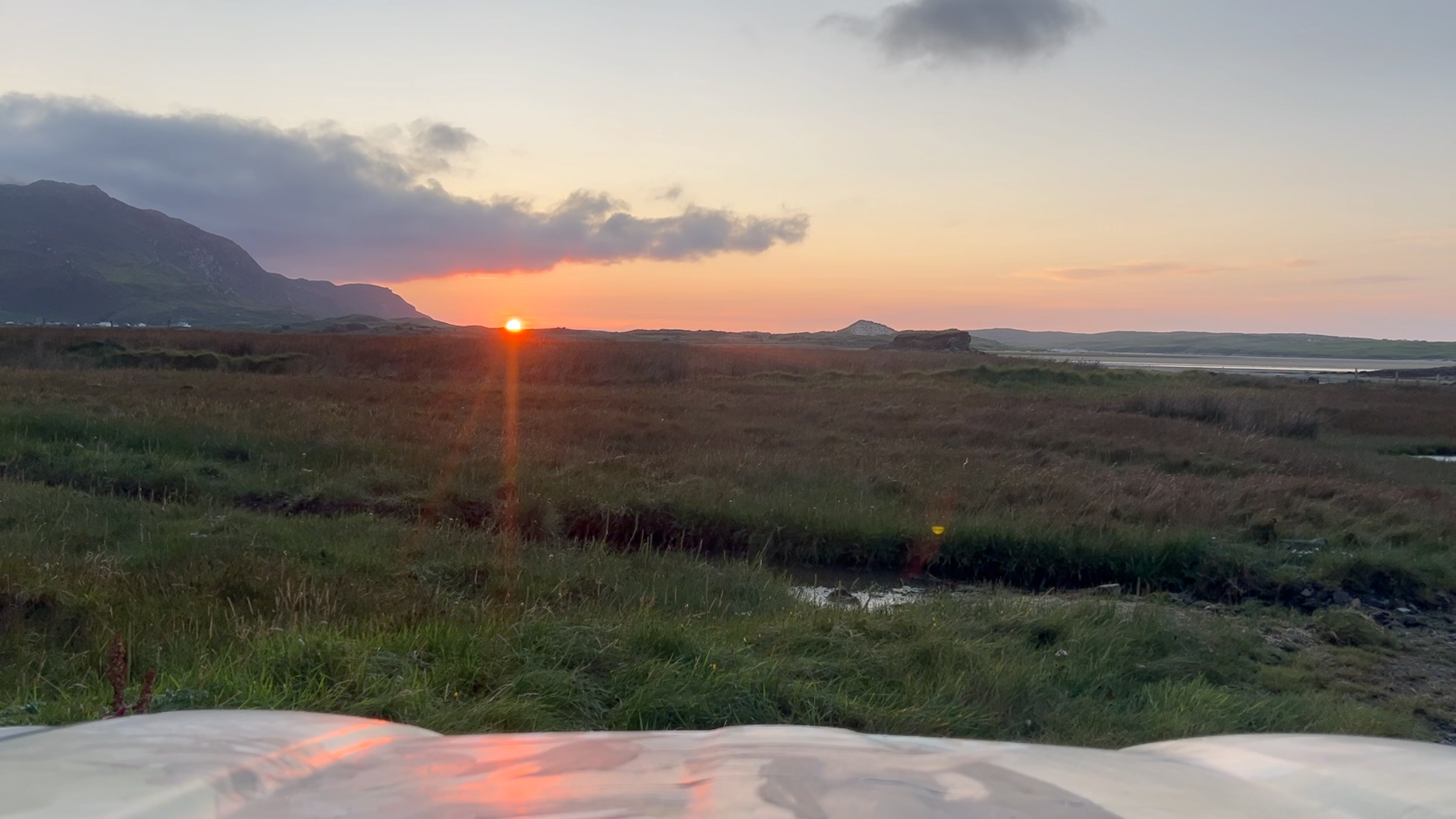
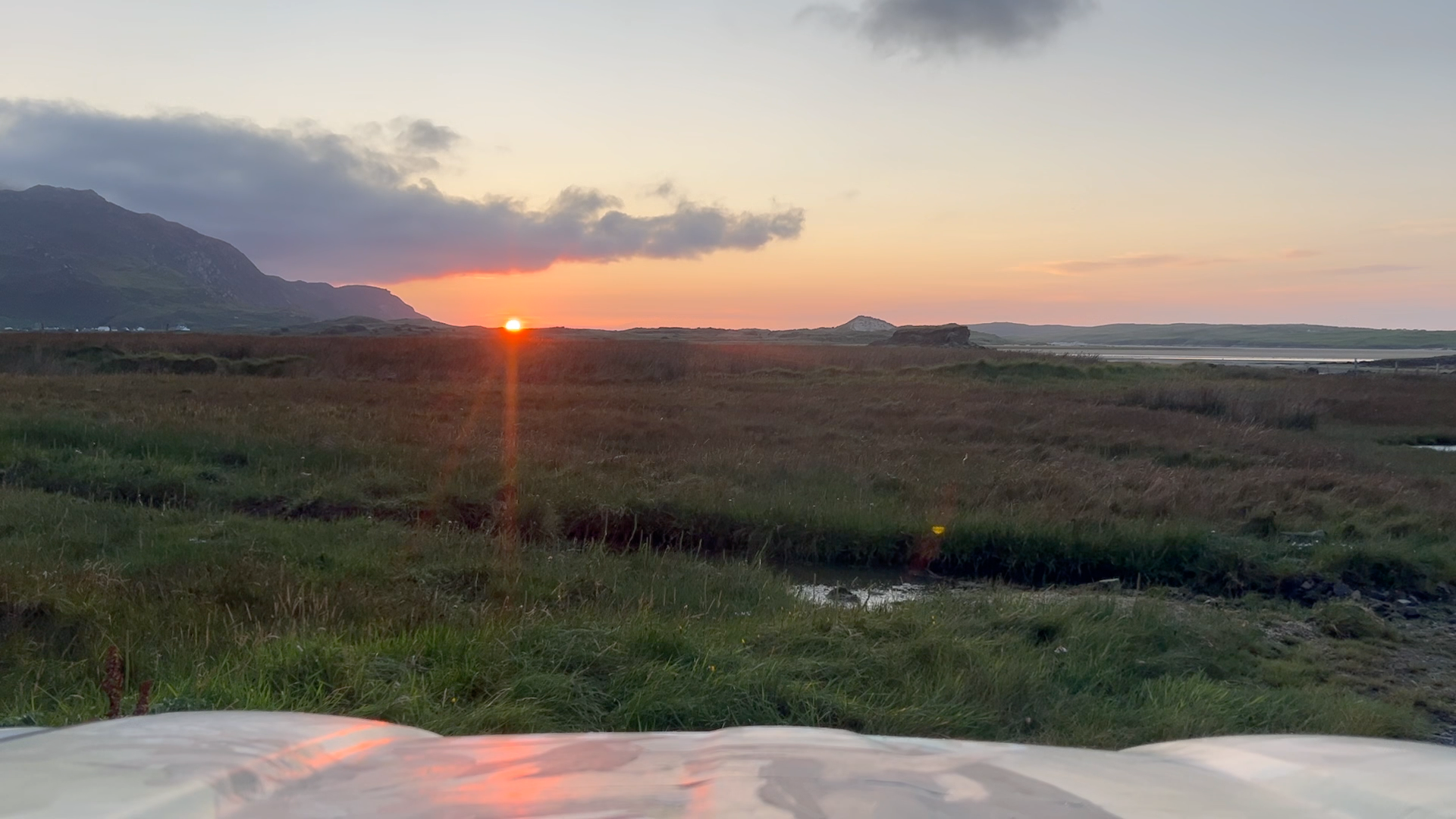
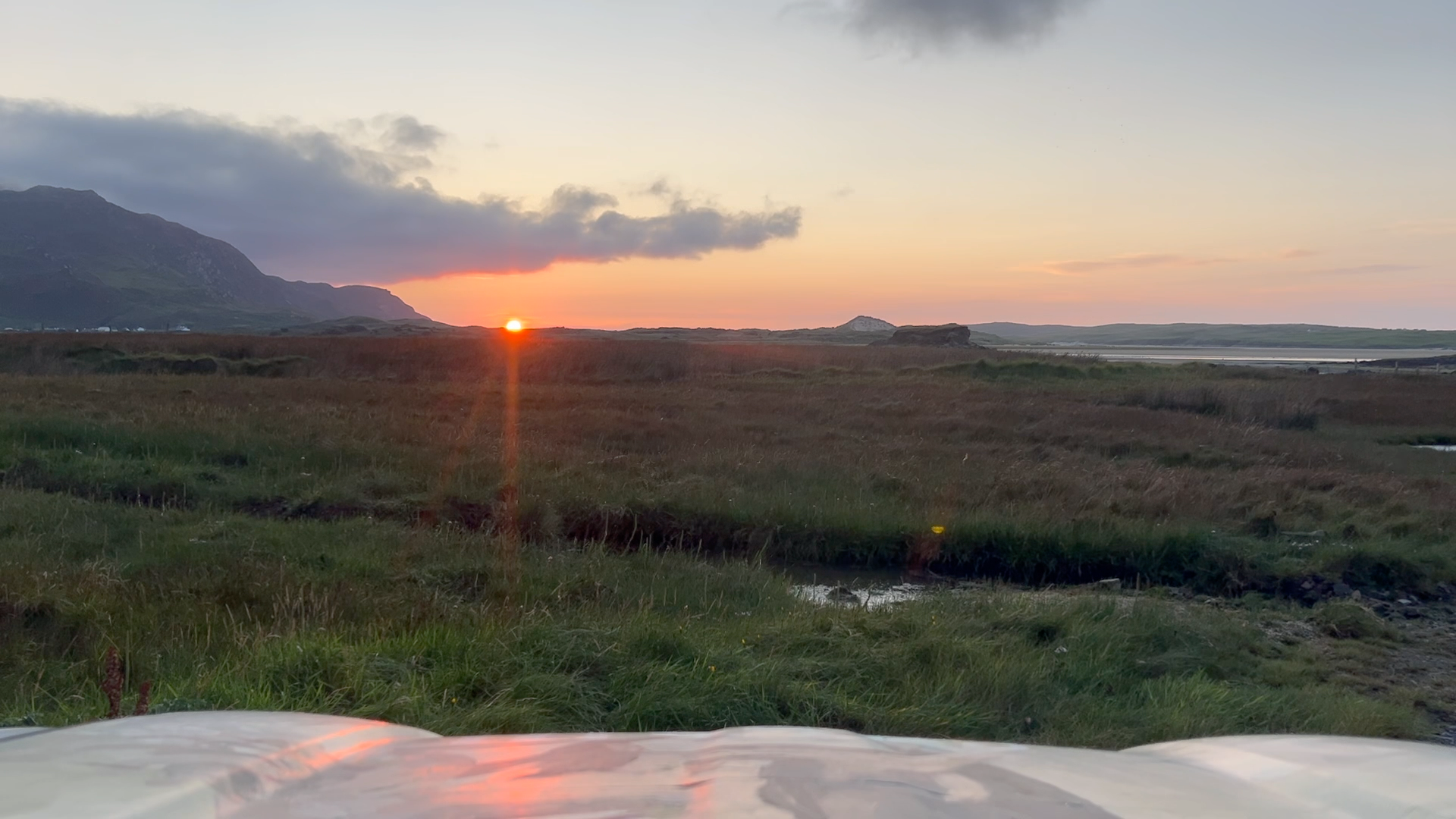
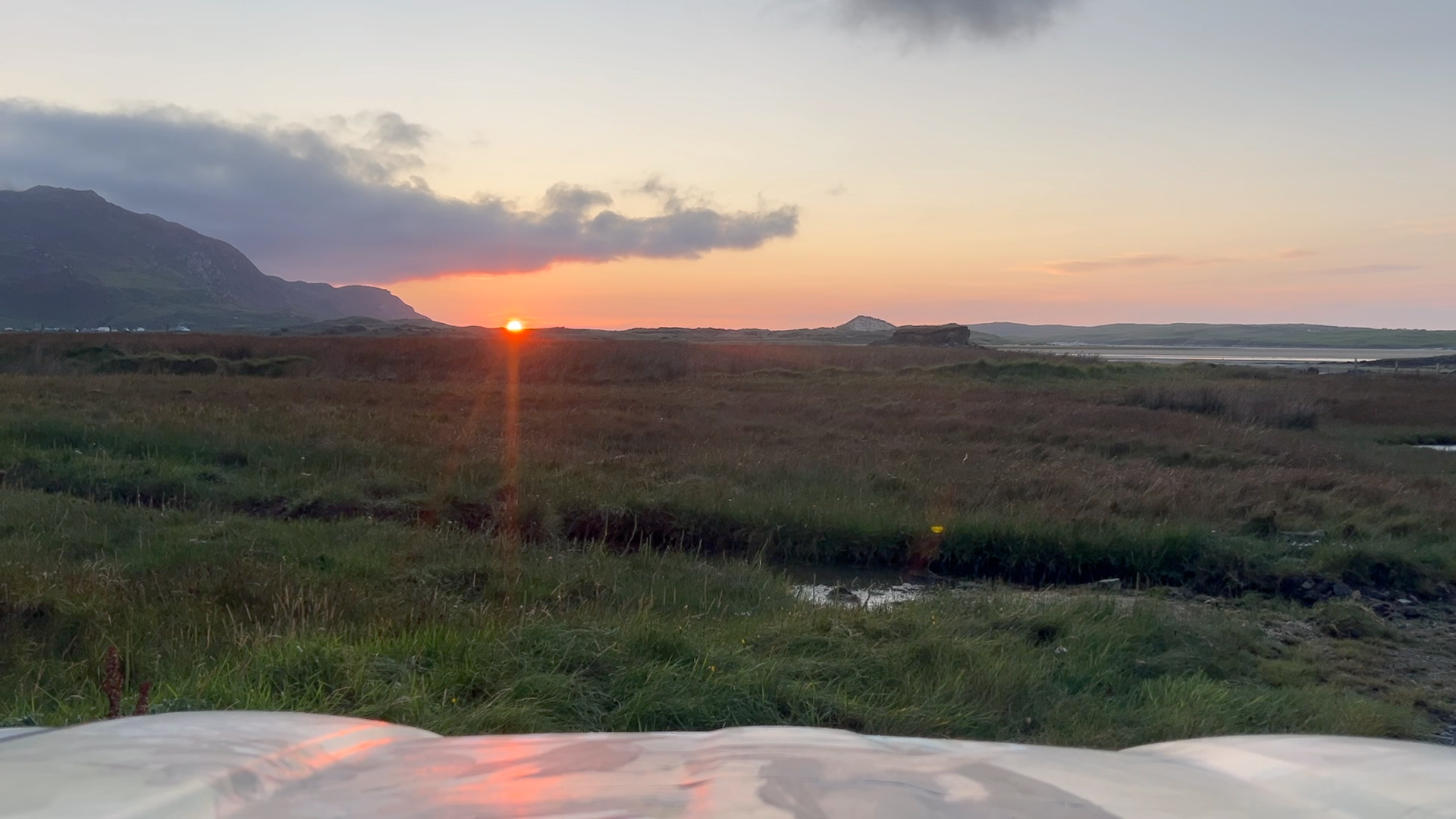
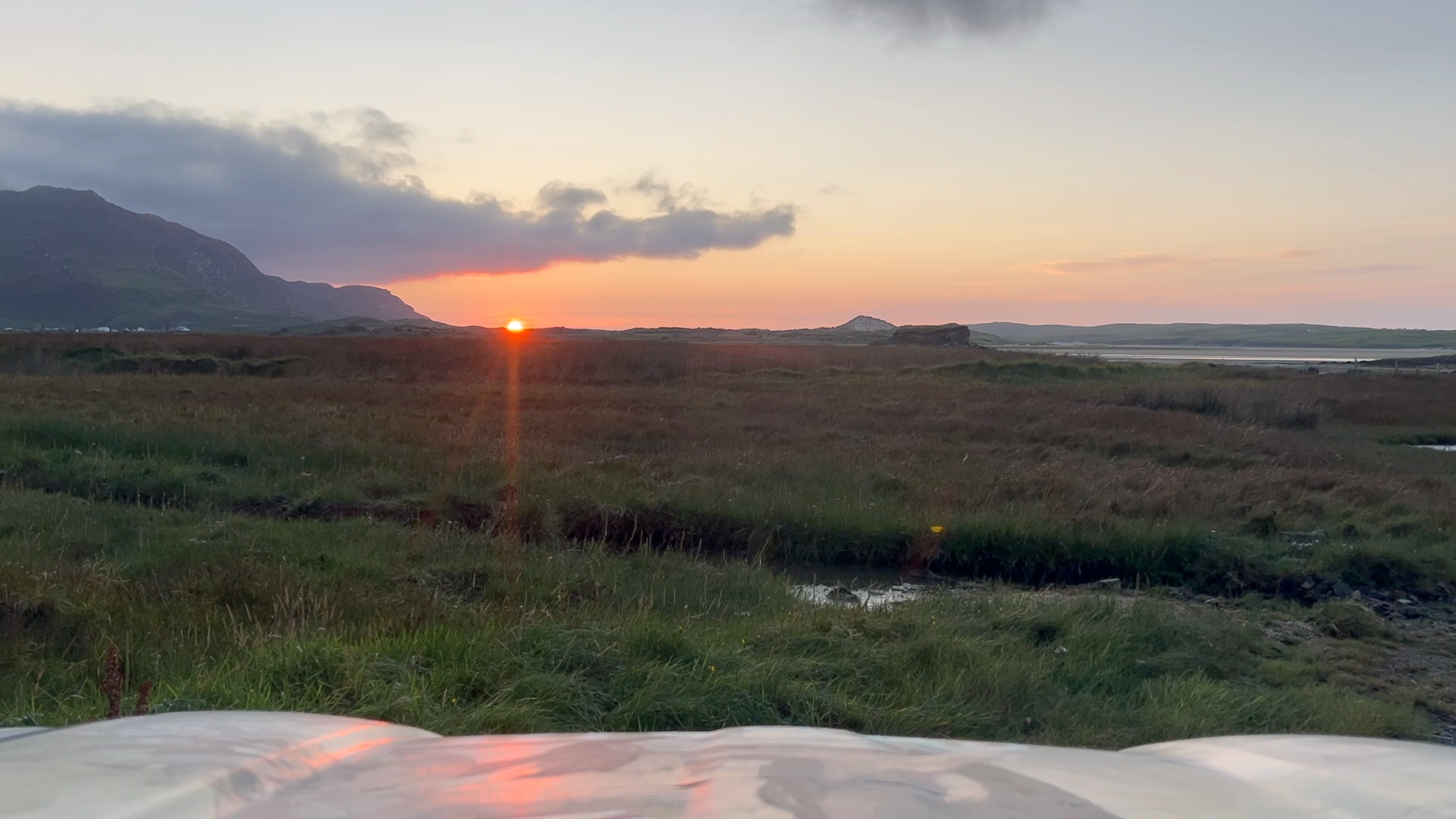
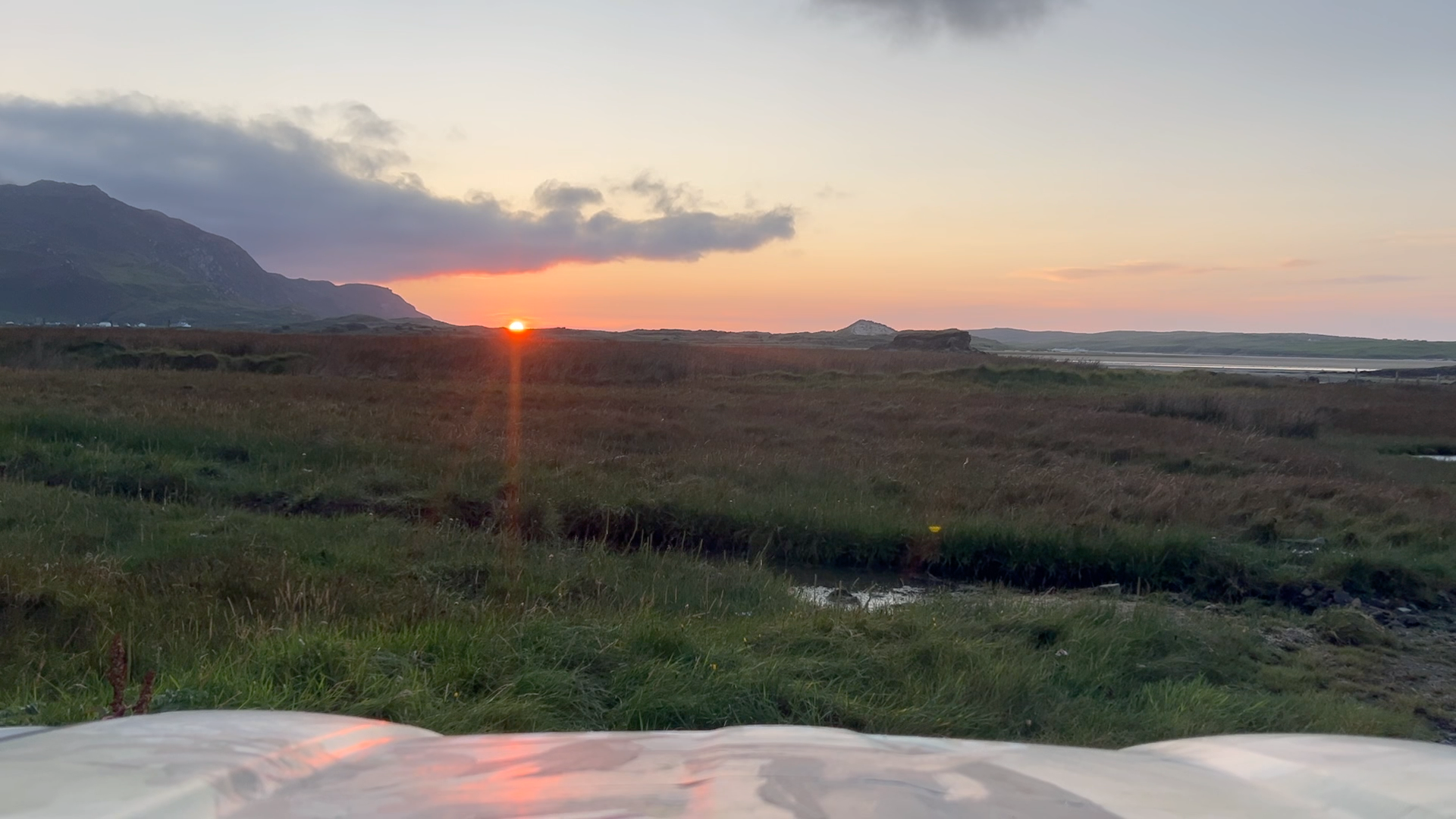
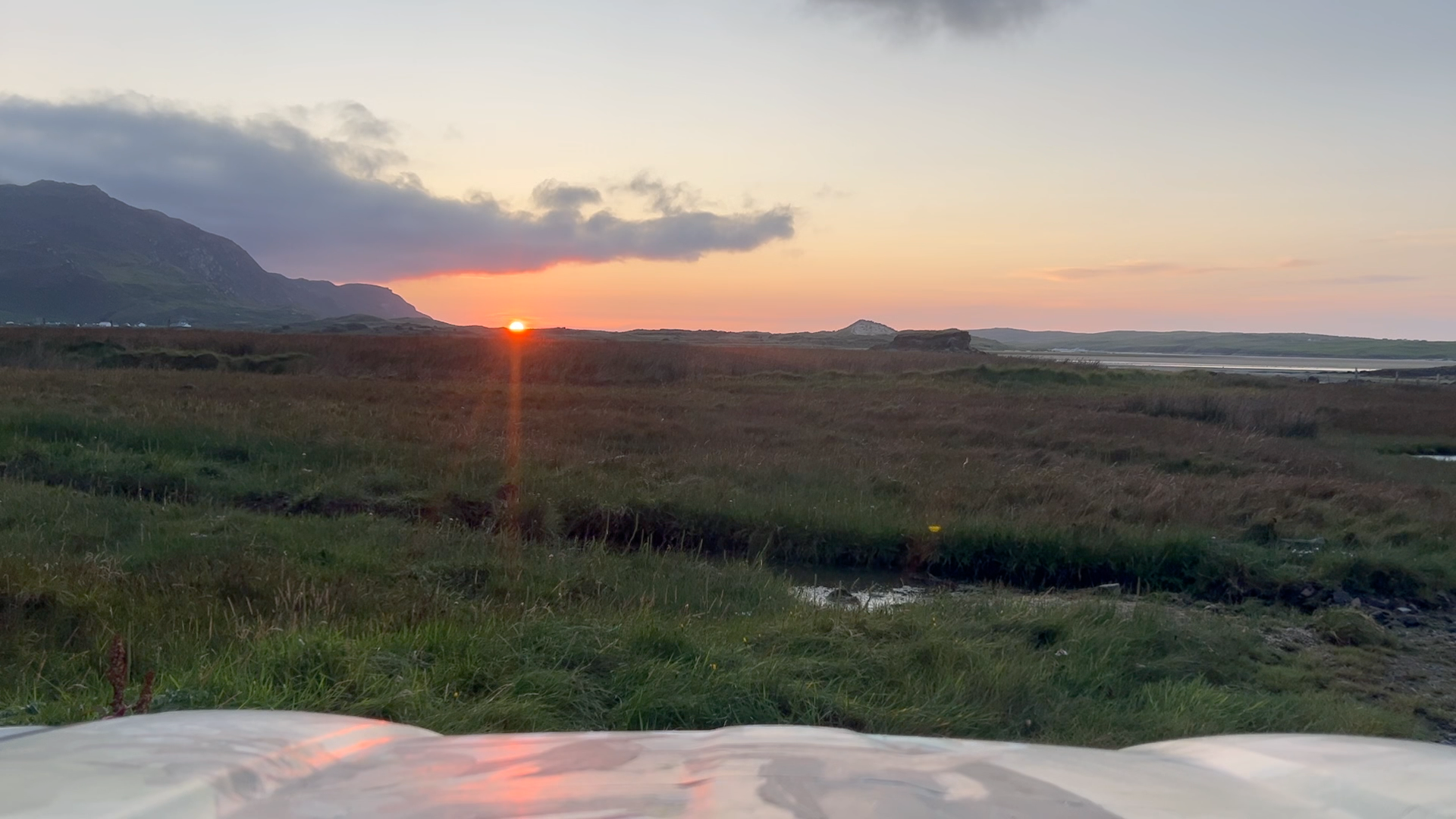
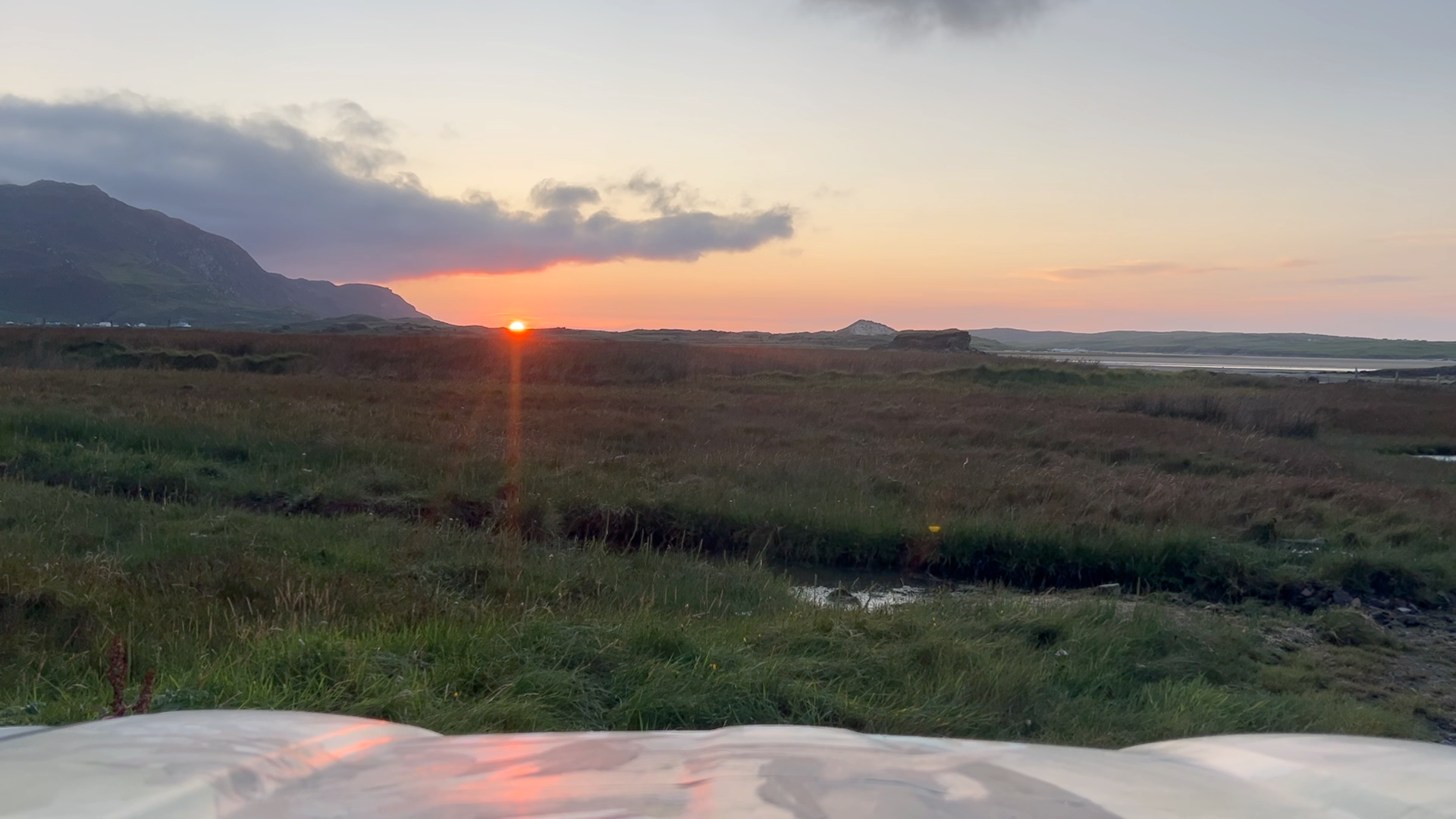
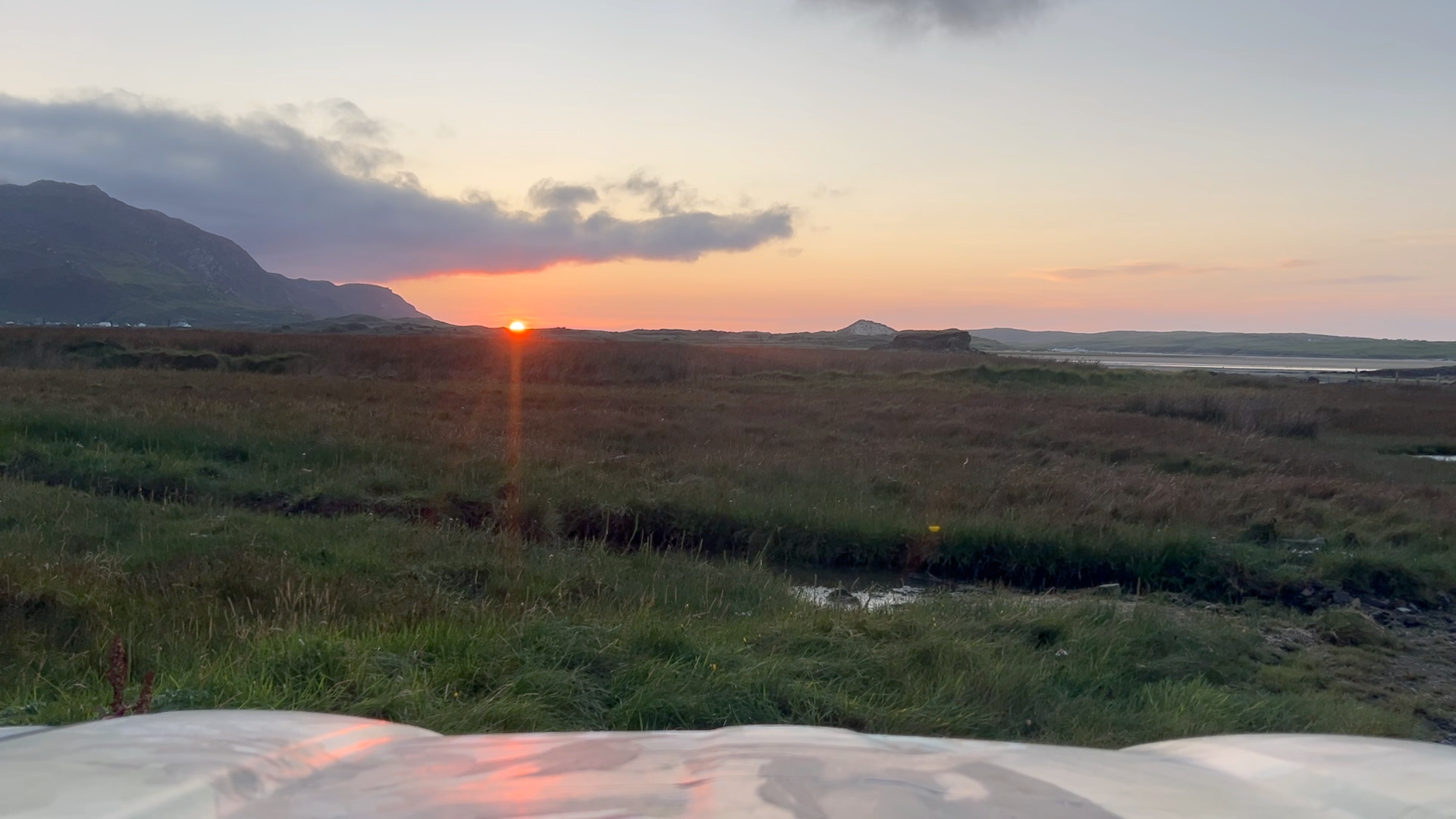
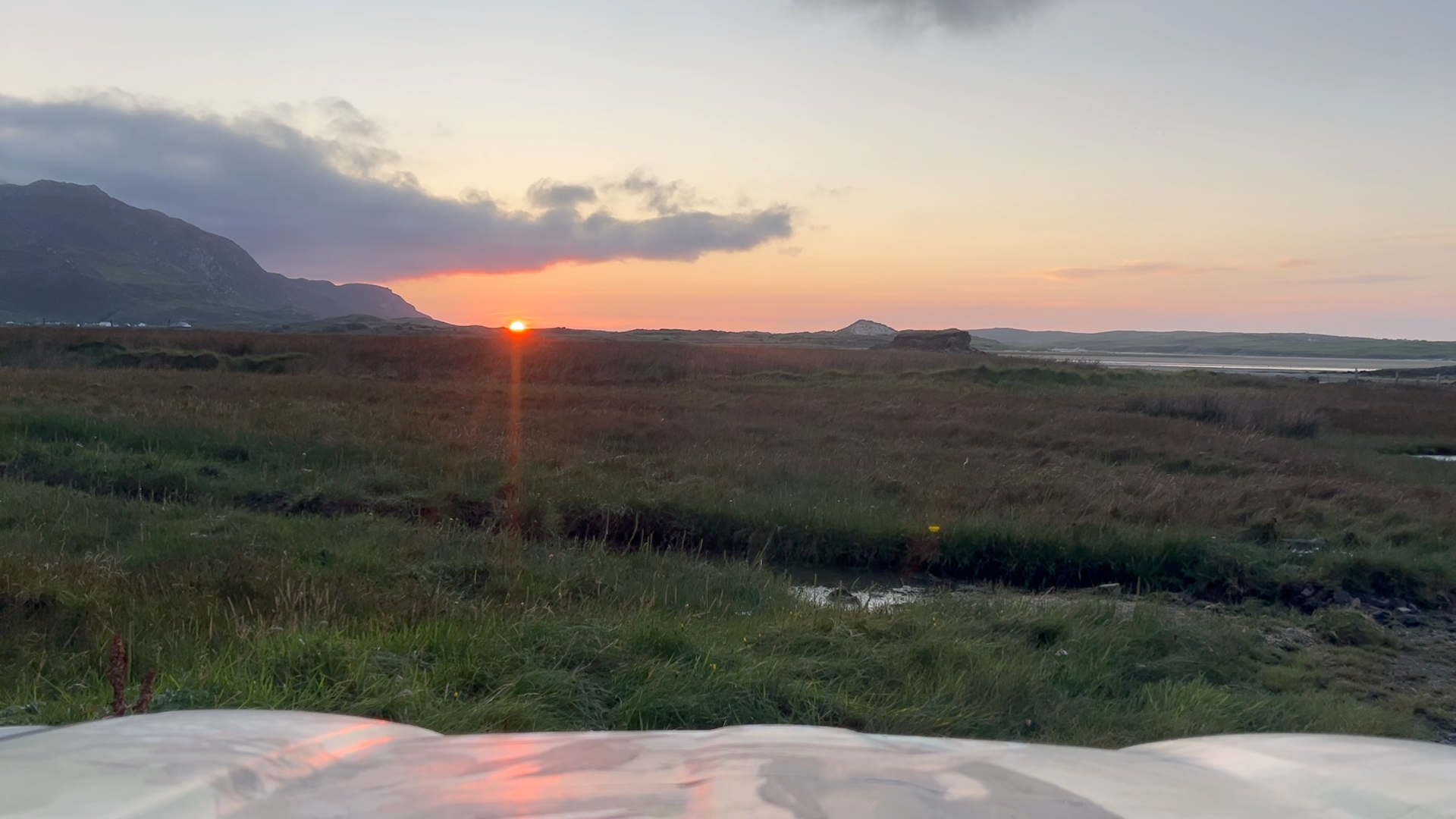
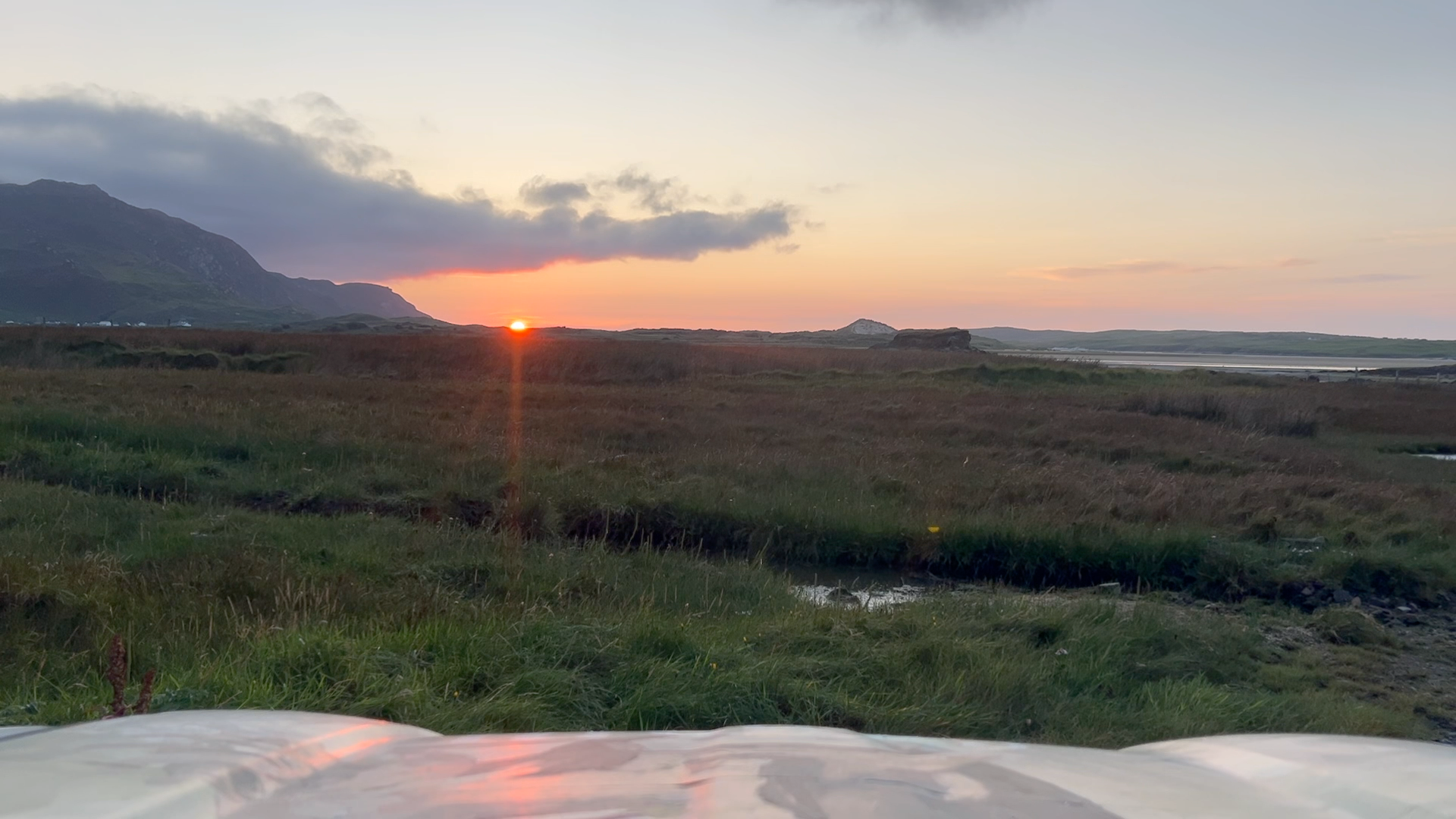
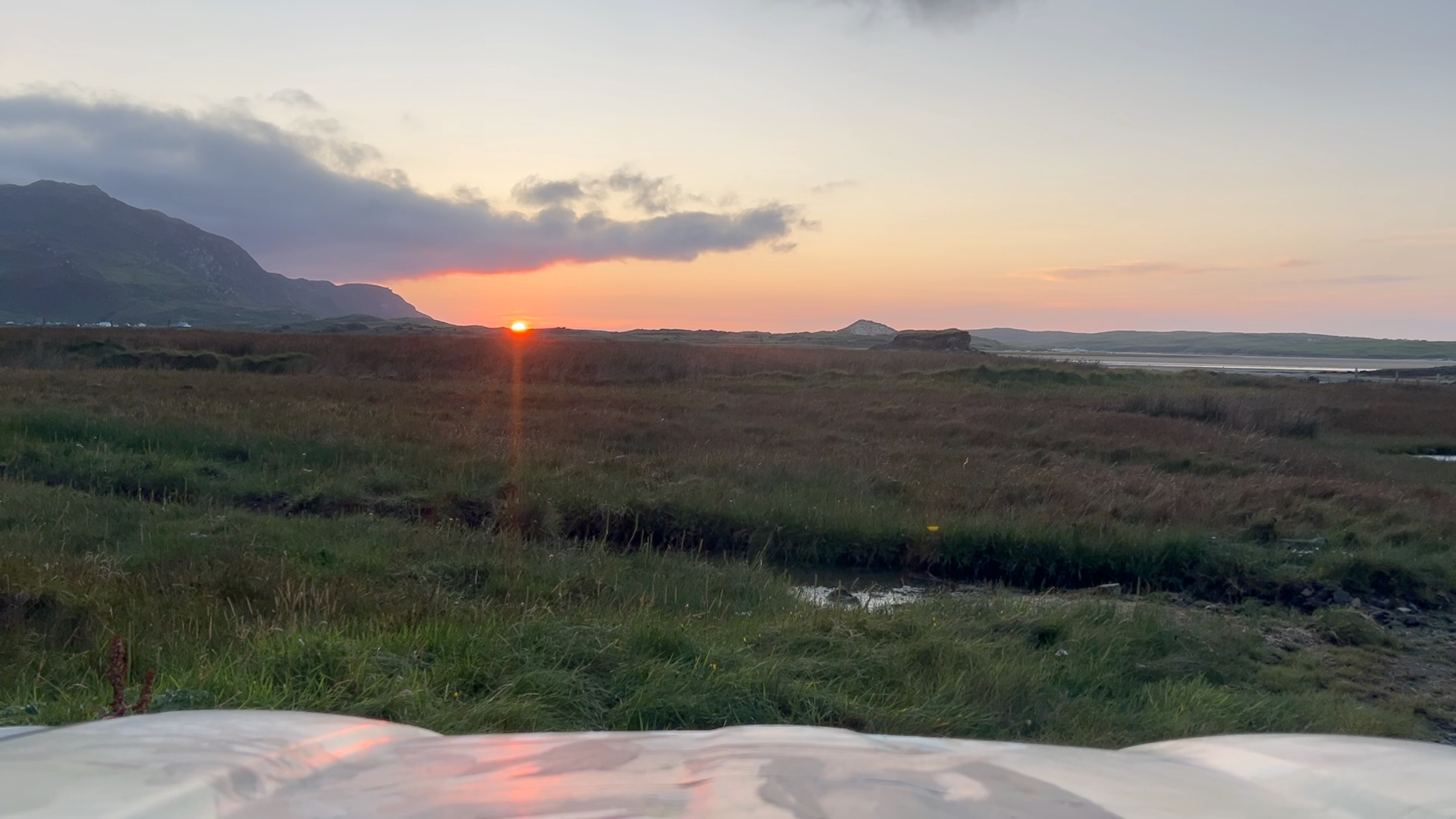
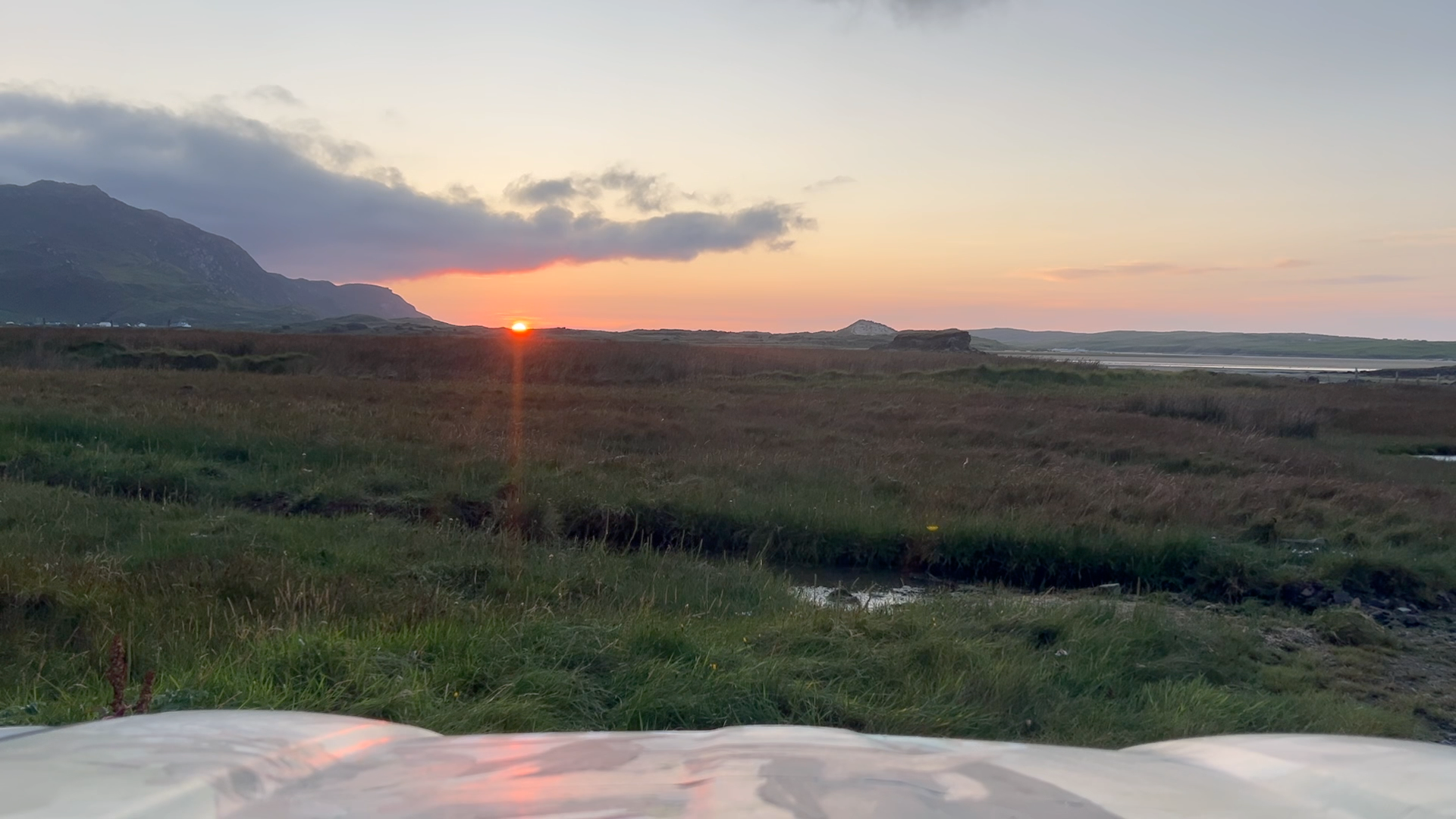
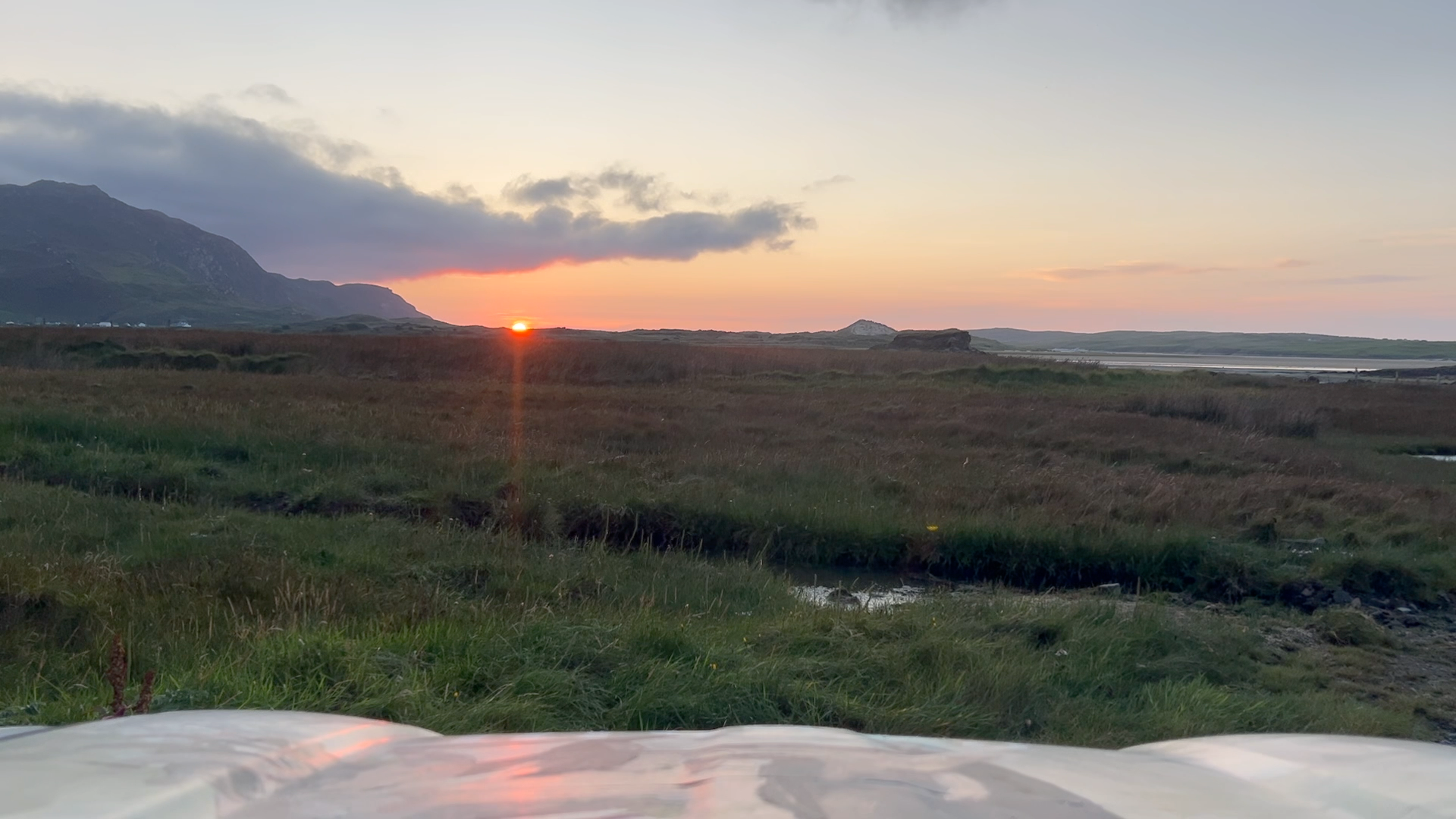
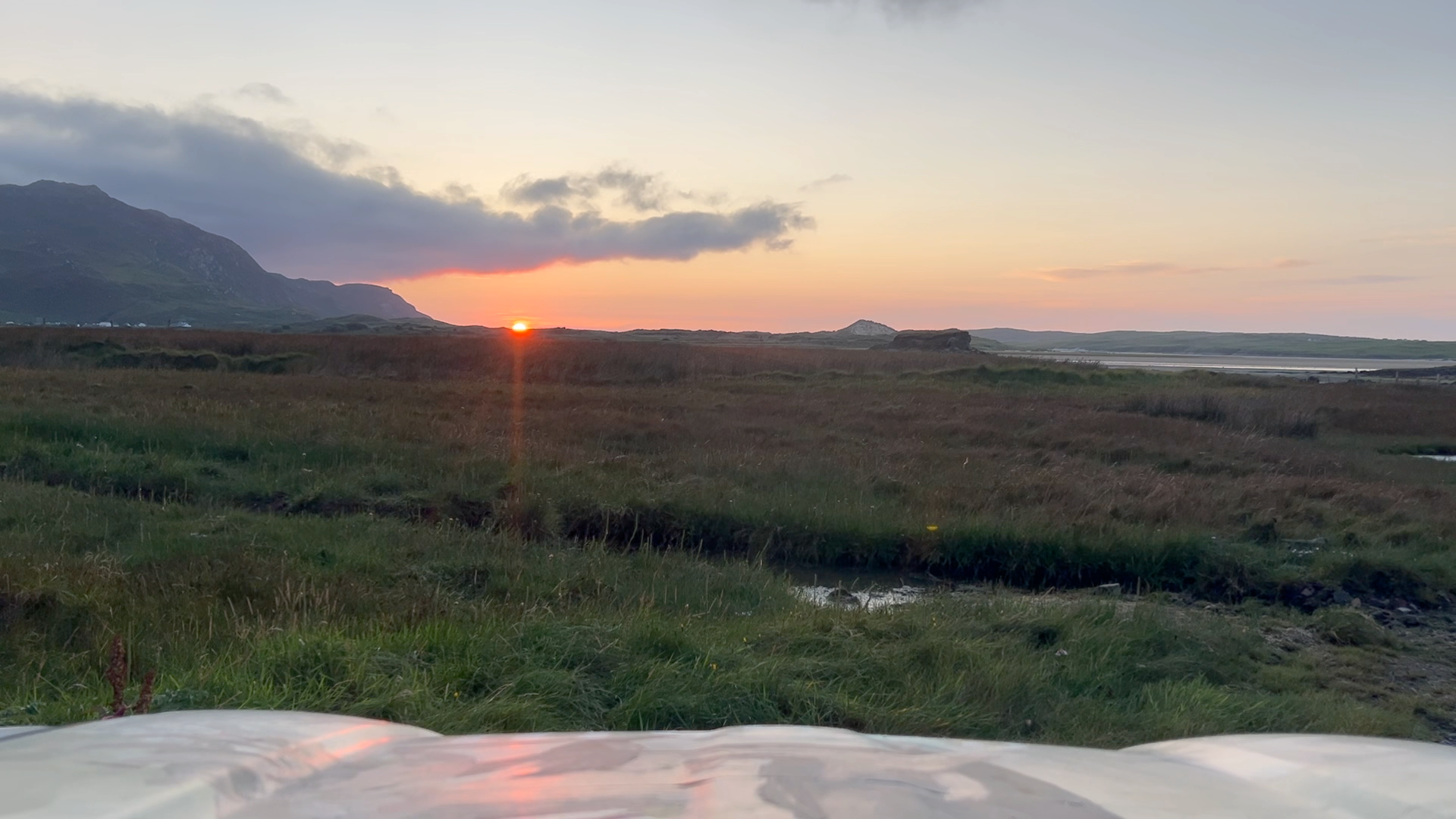
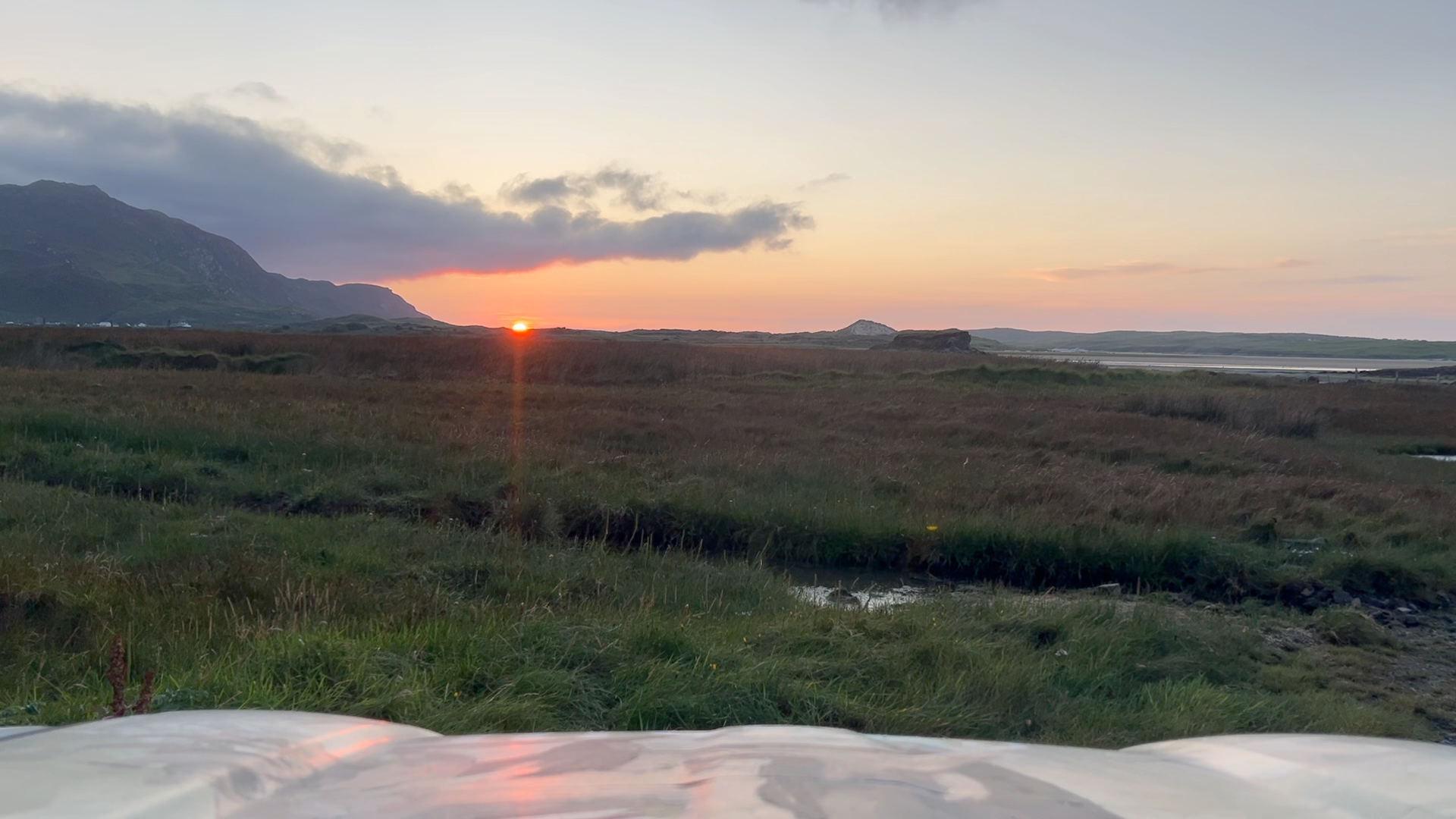
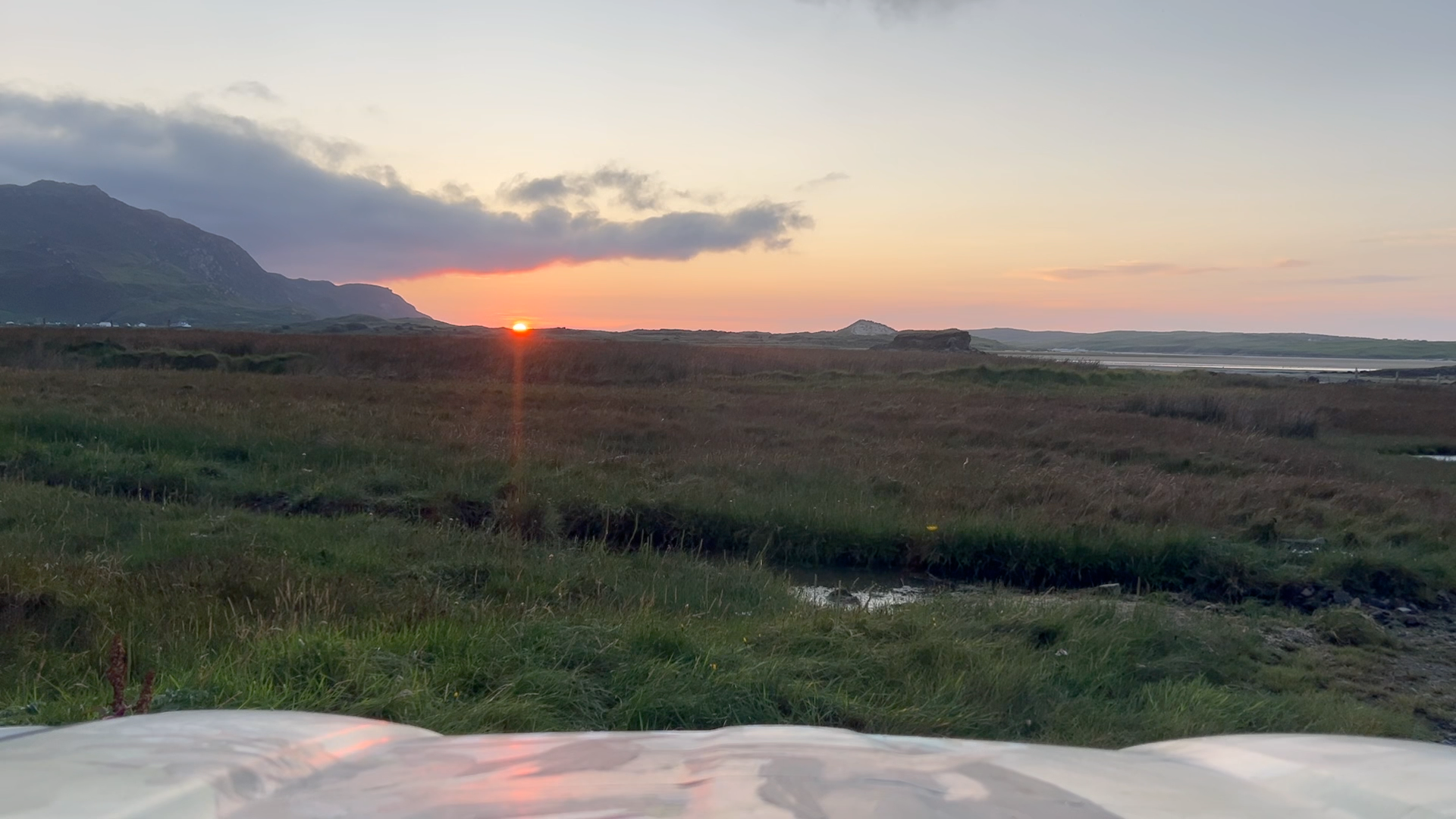
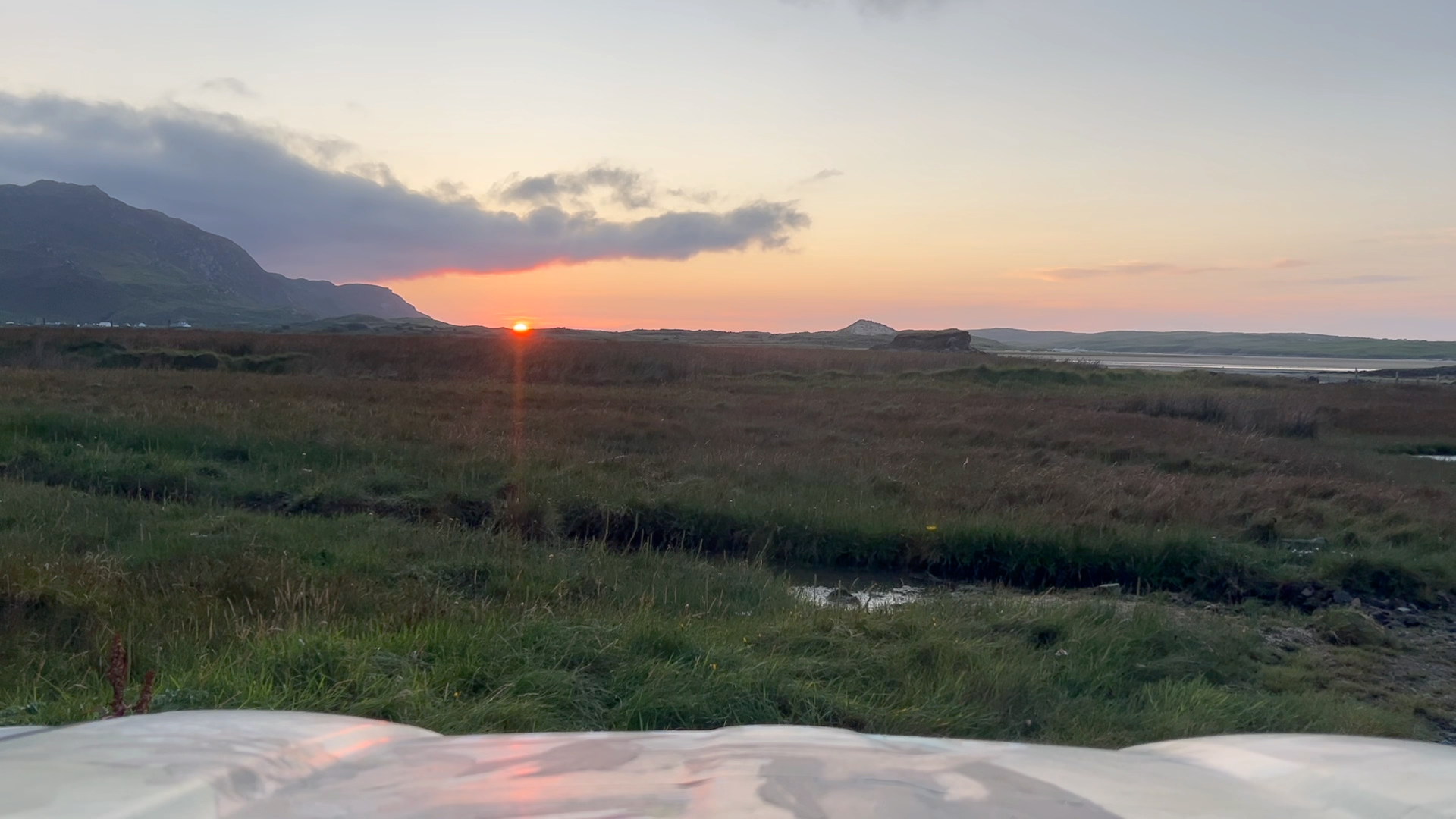
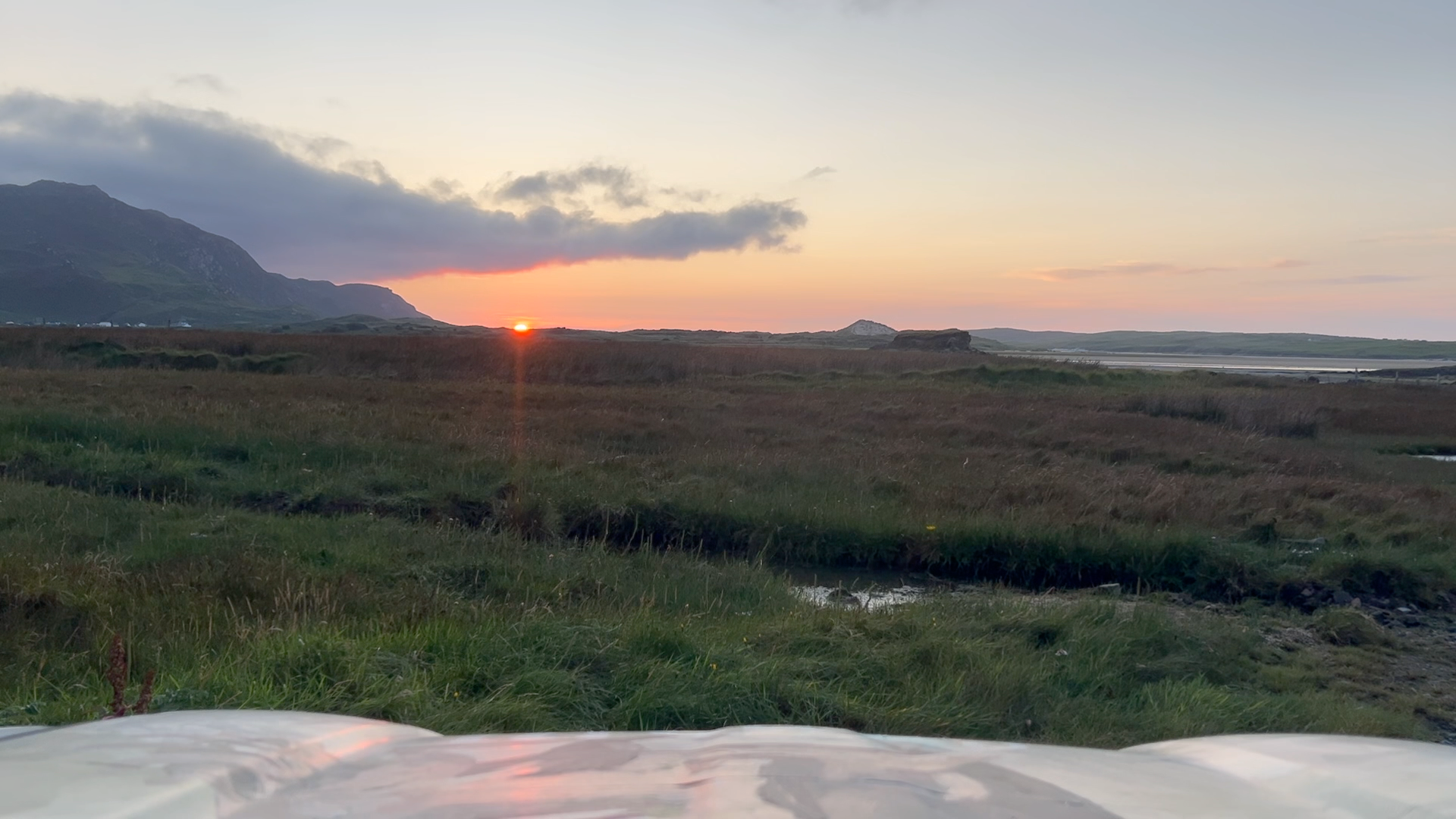
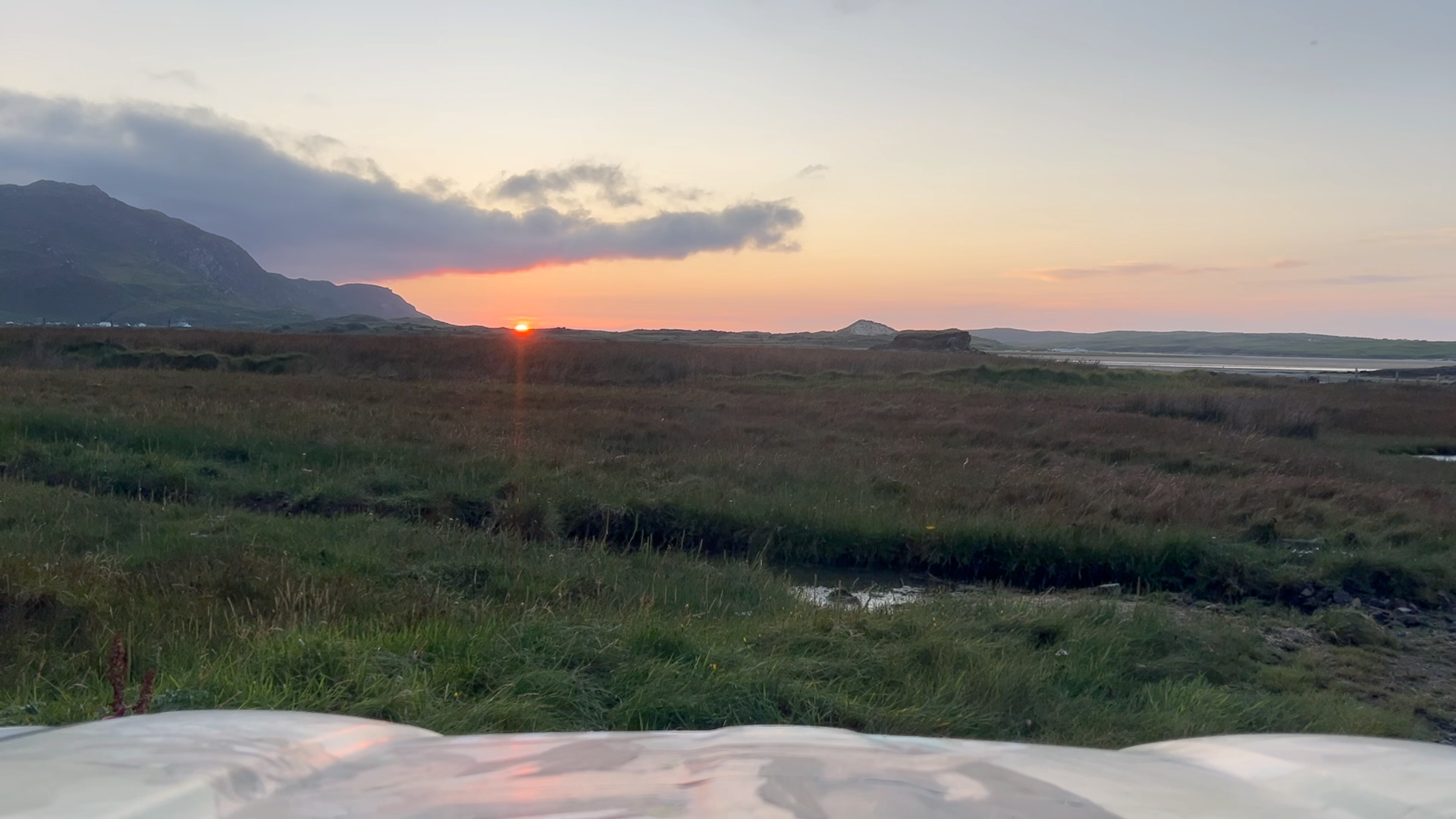
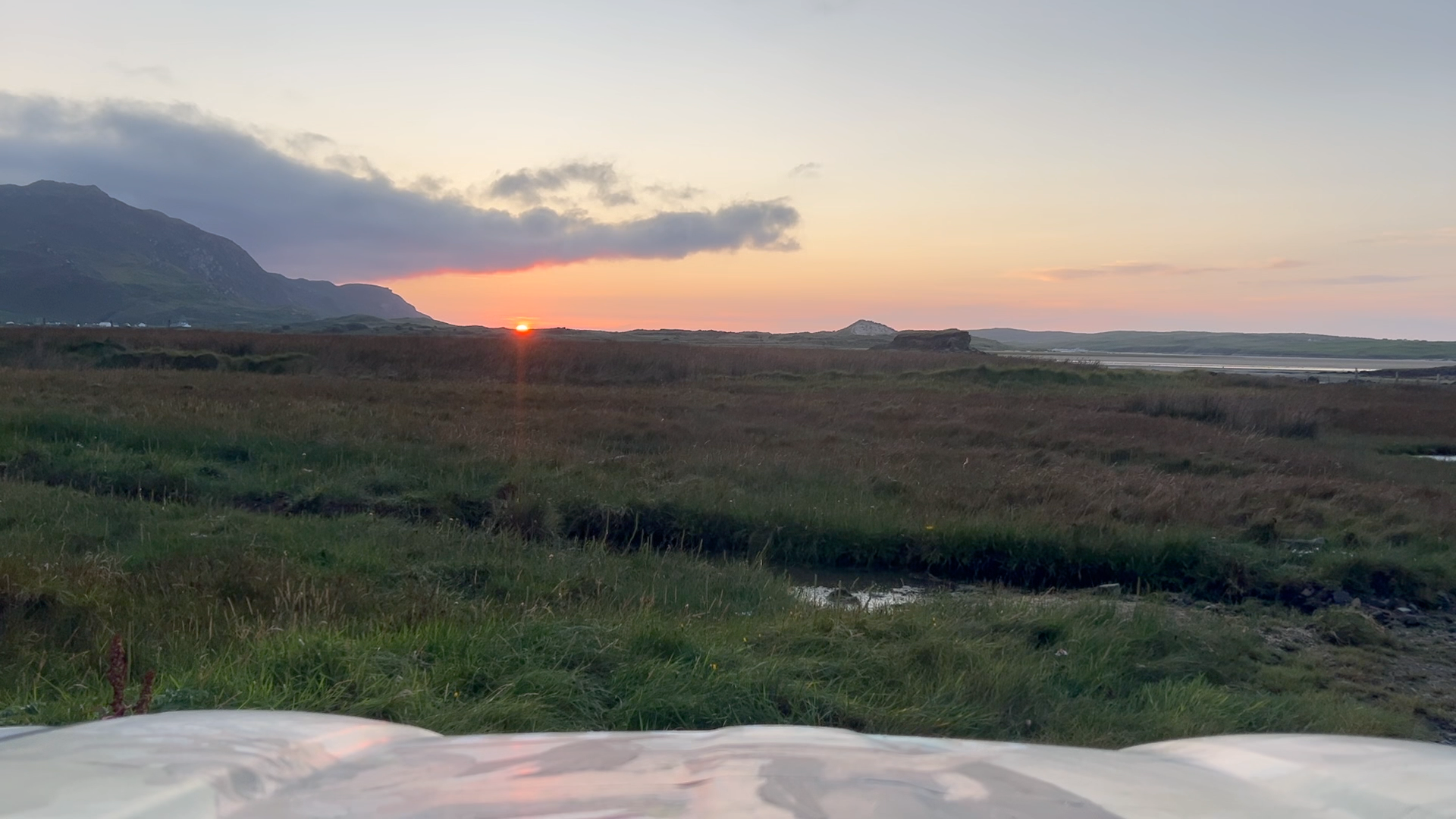
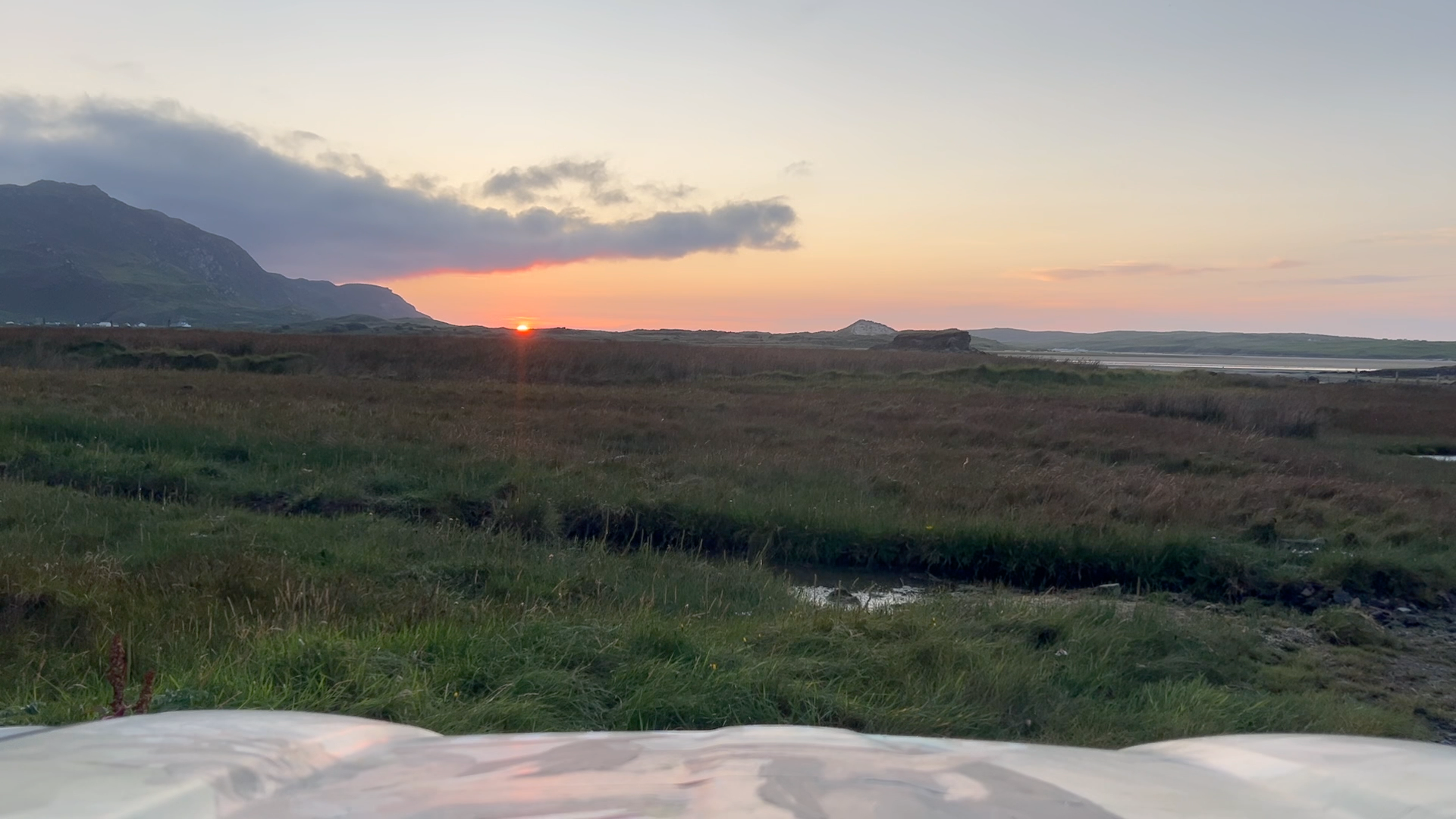
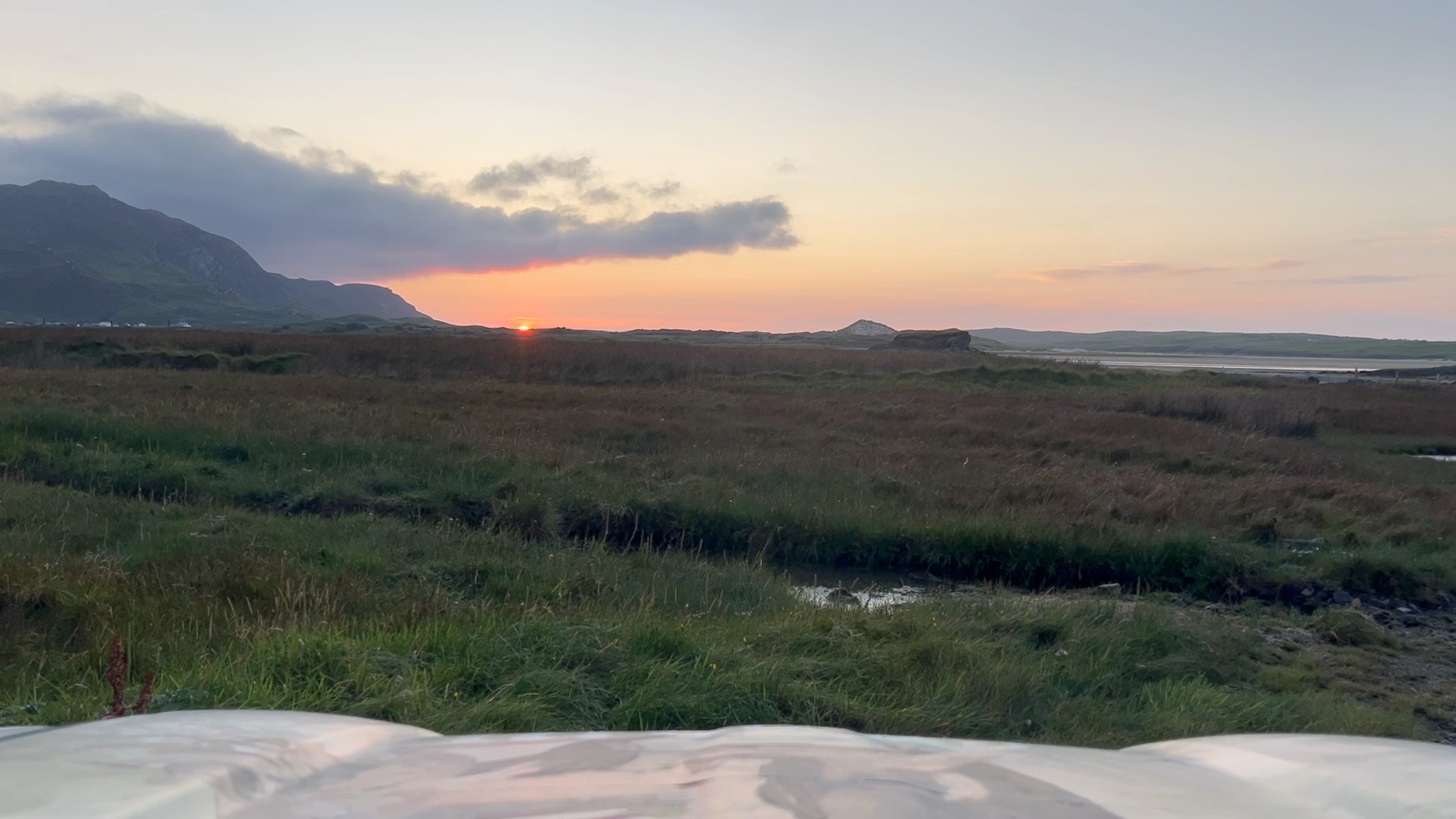
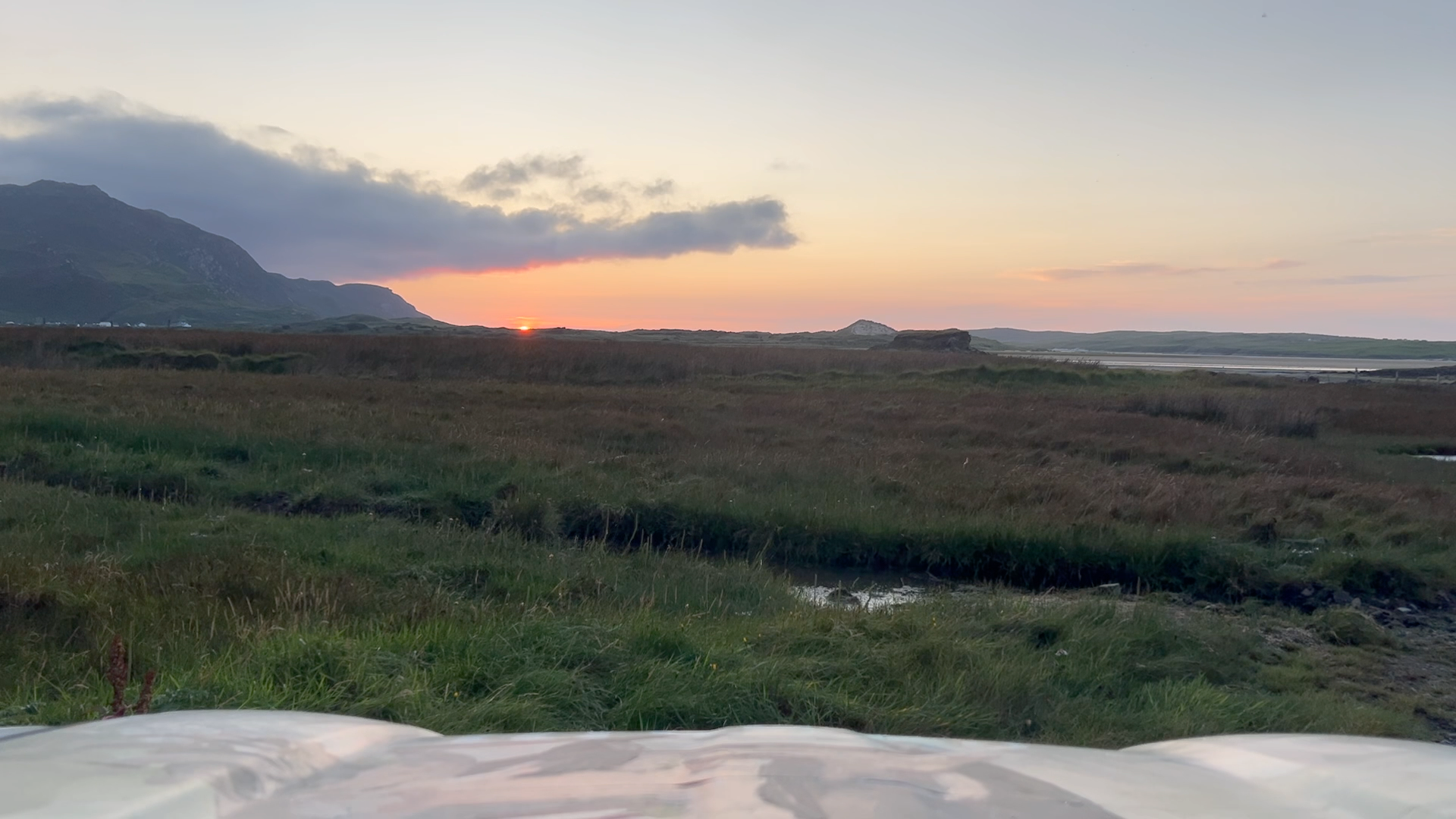
14.08.2025
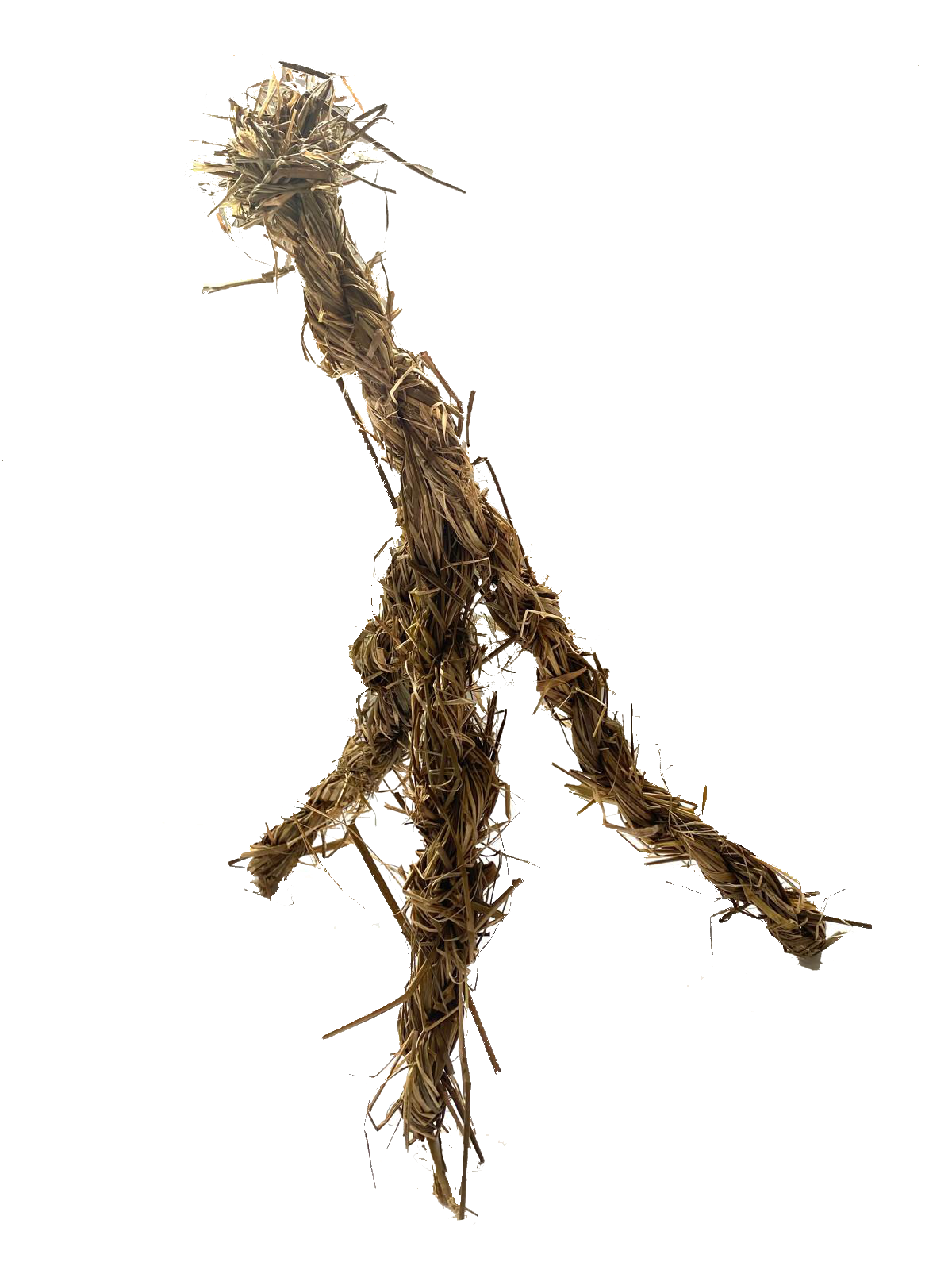
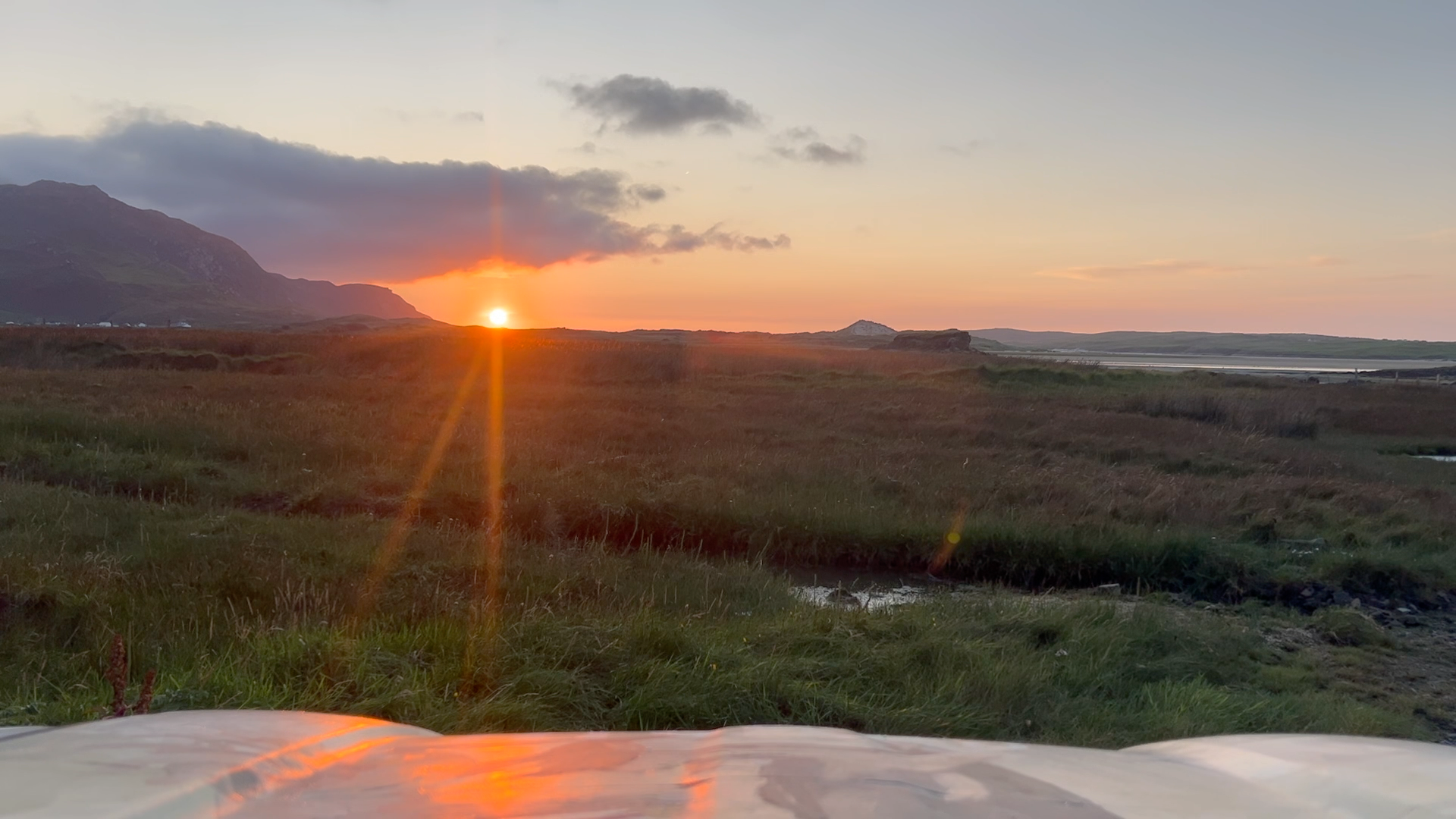
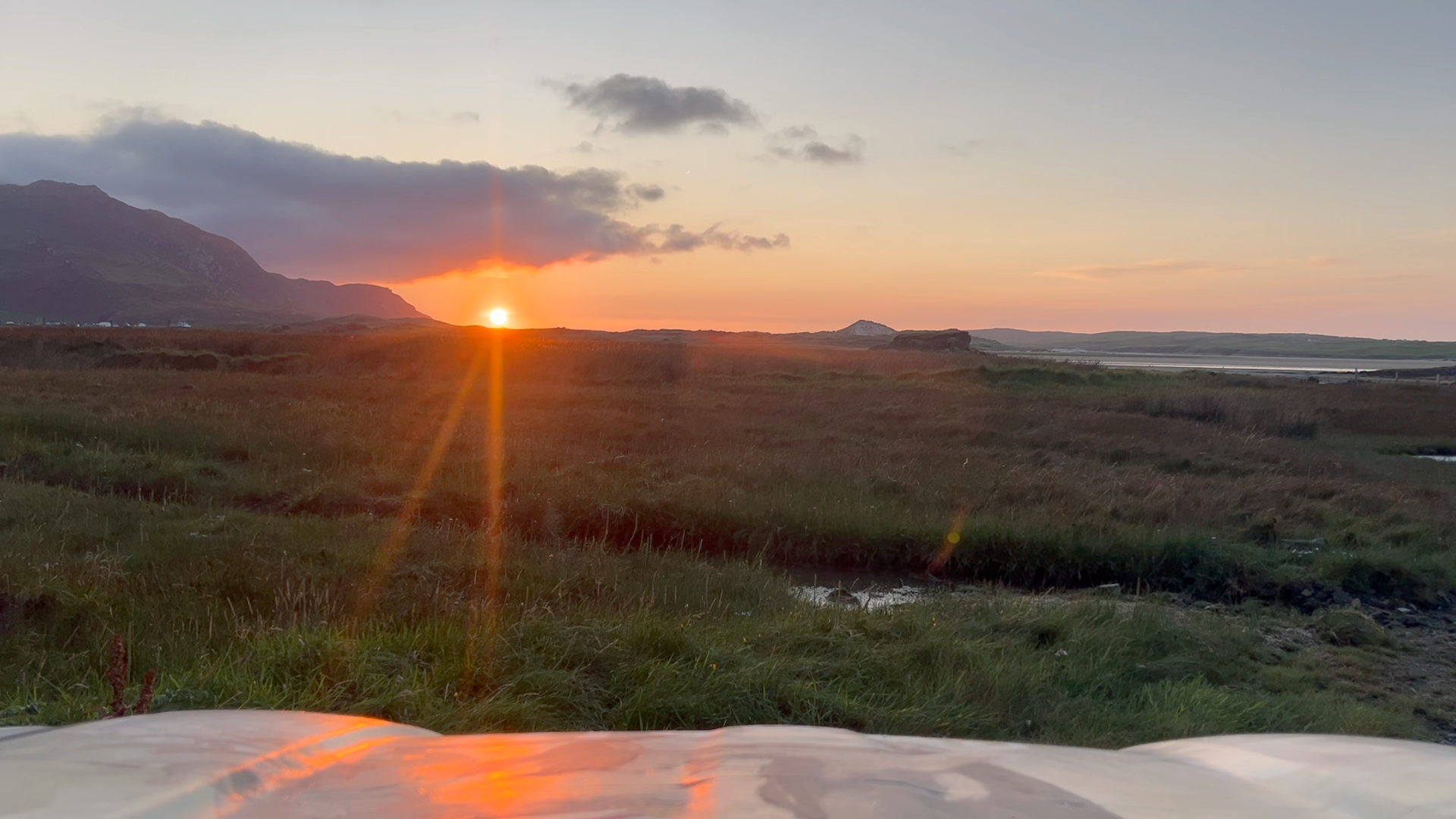
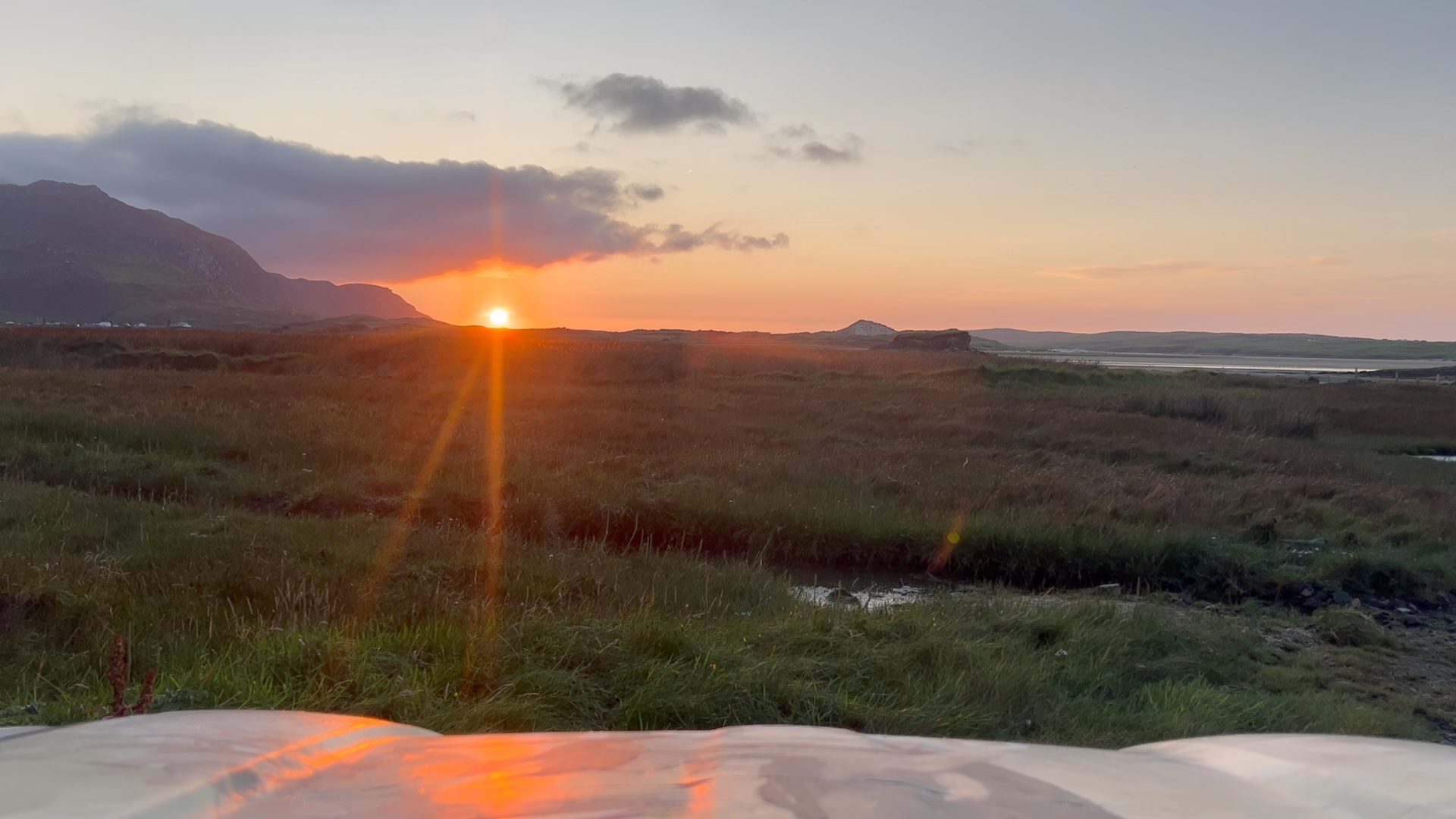
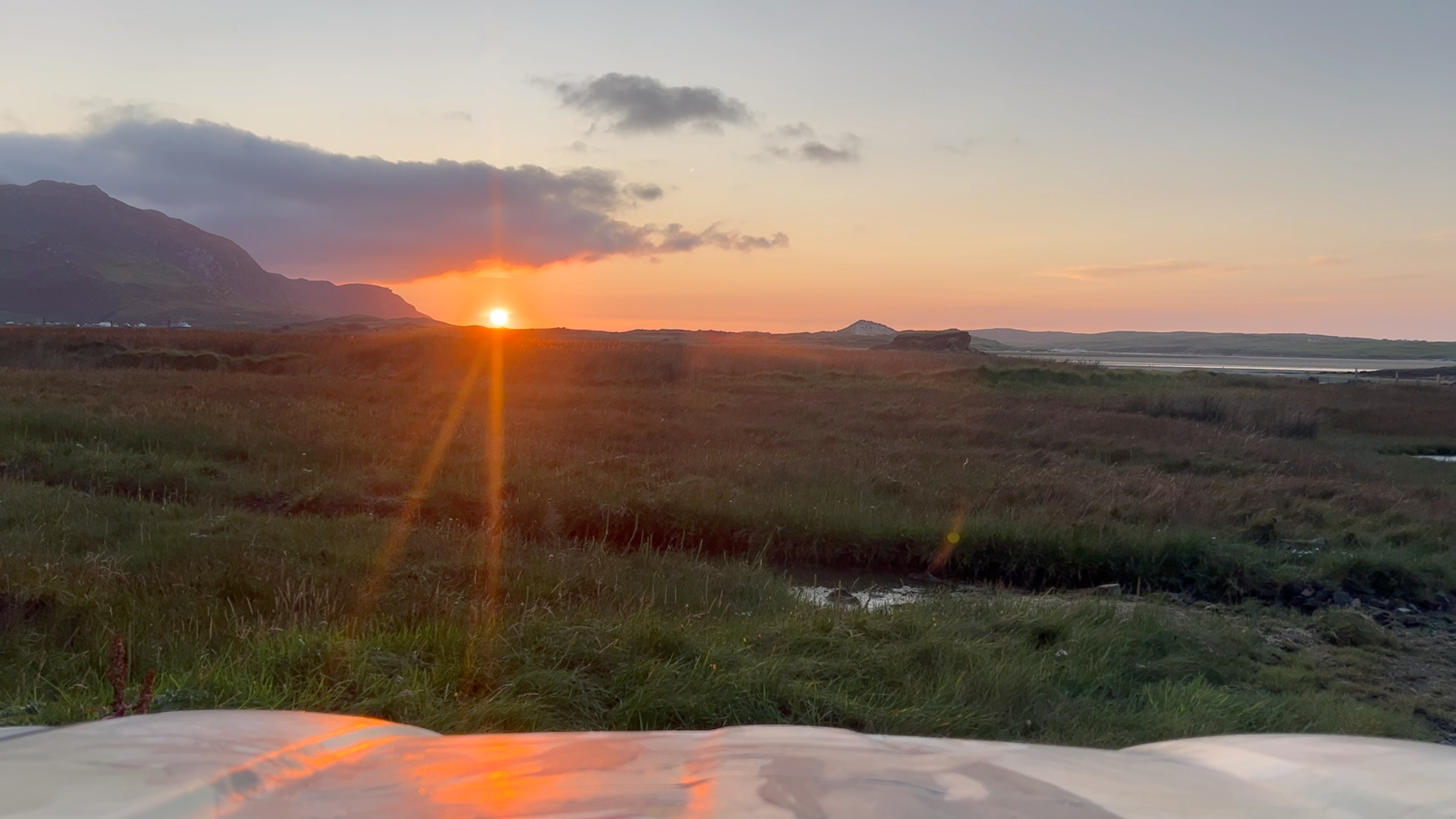
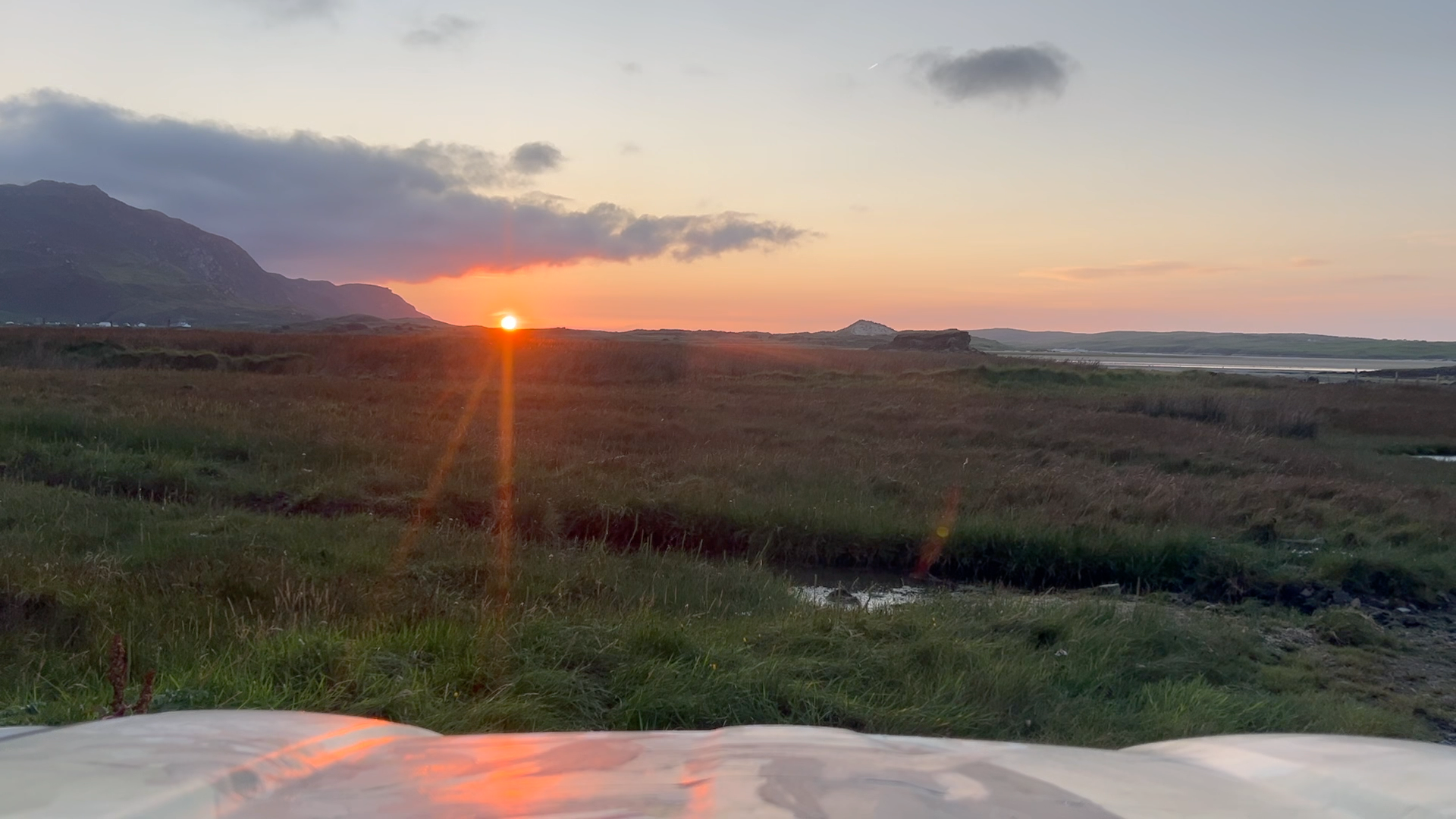
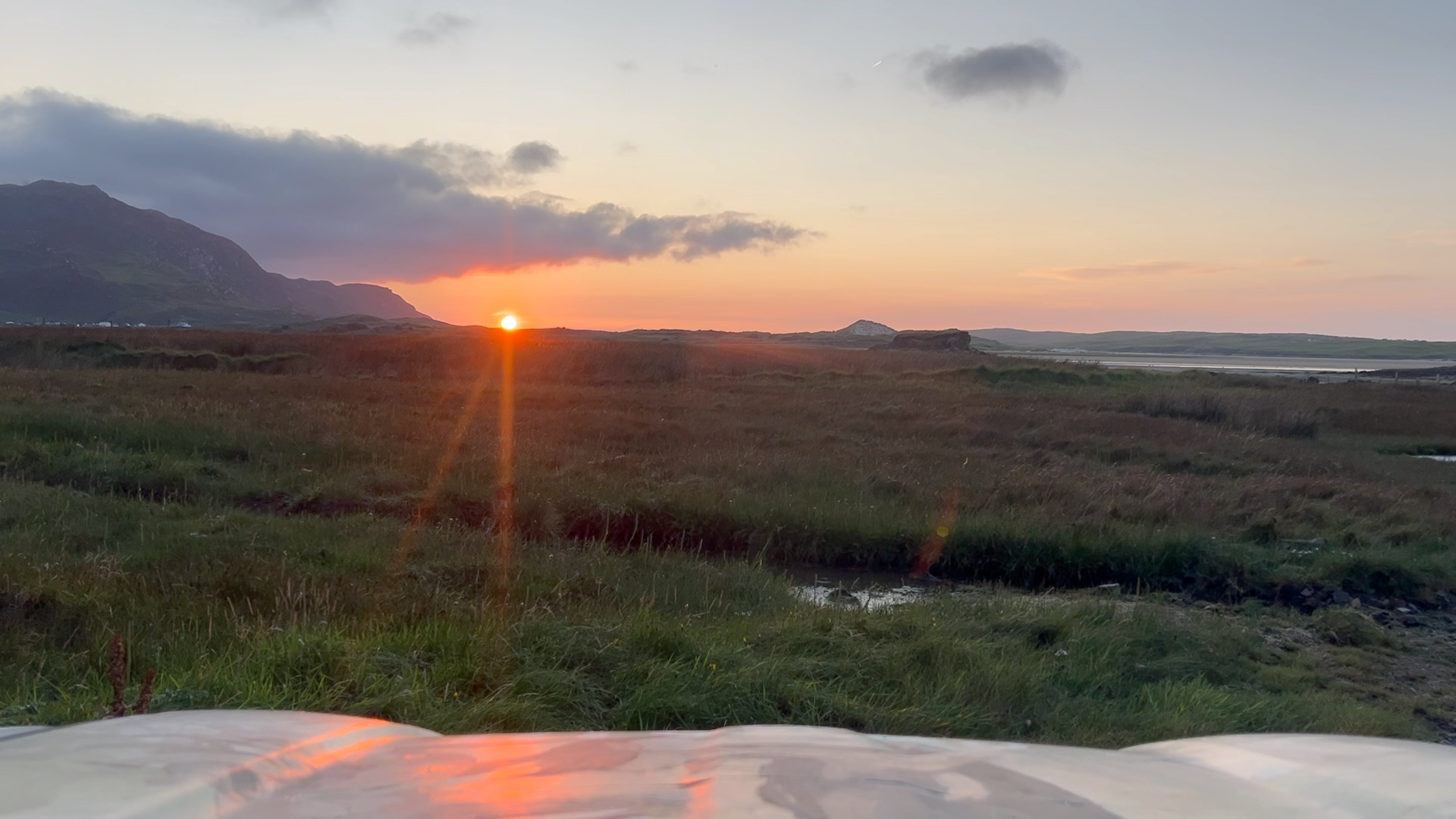
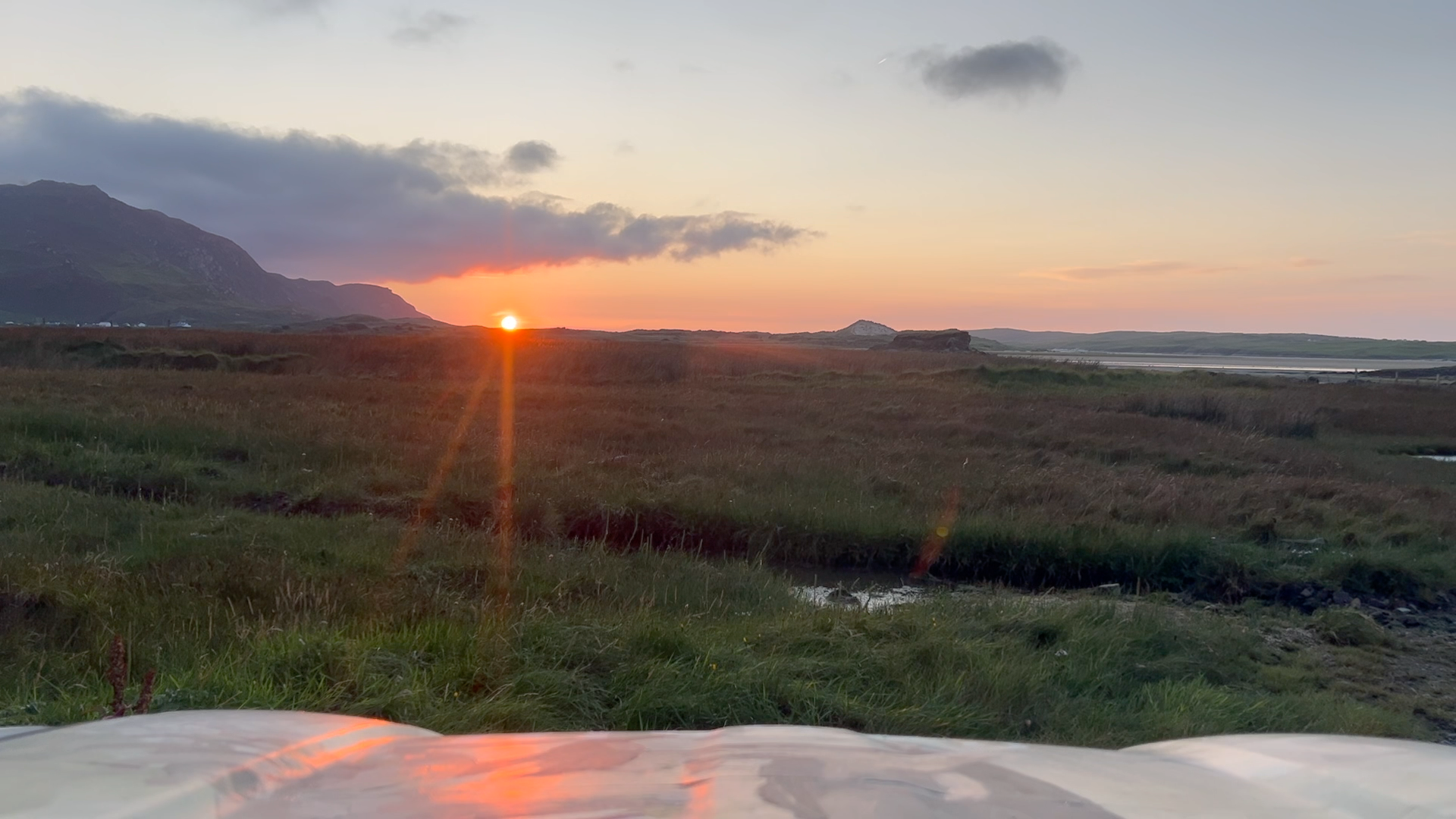
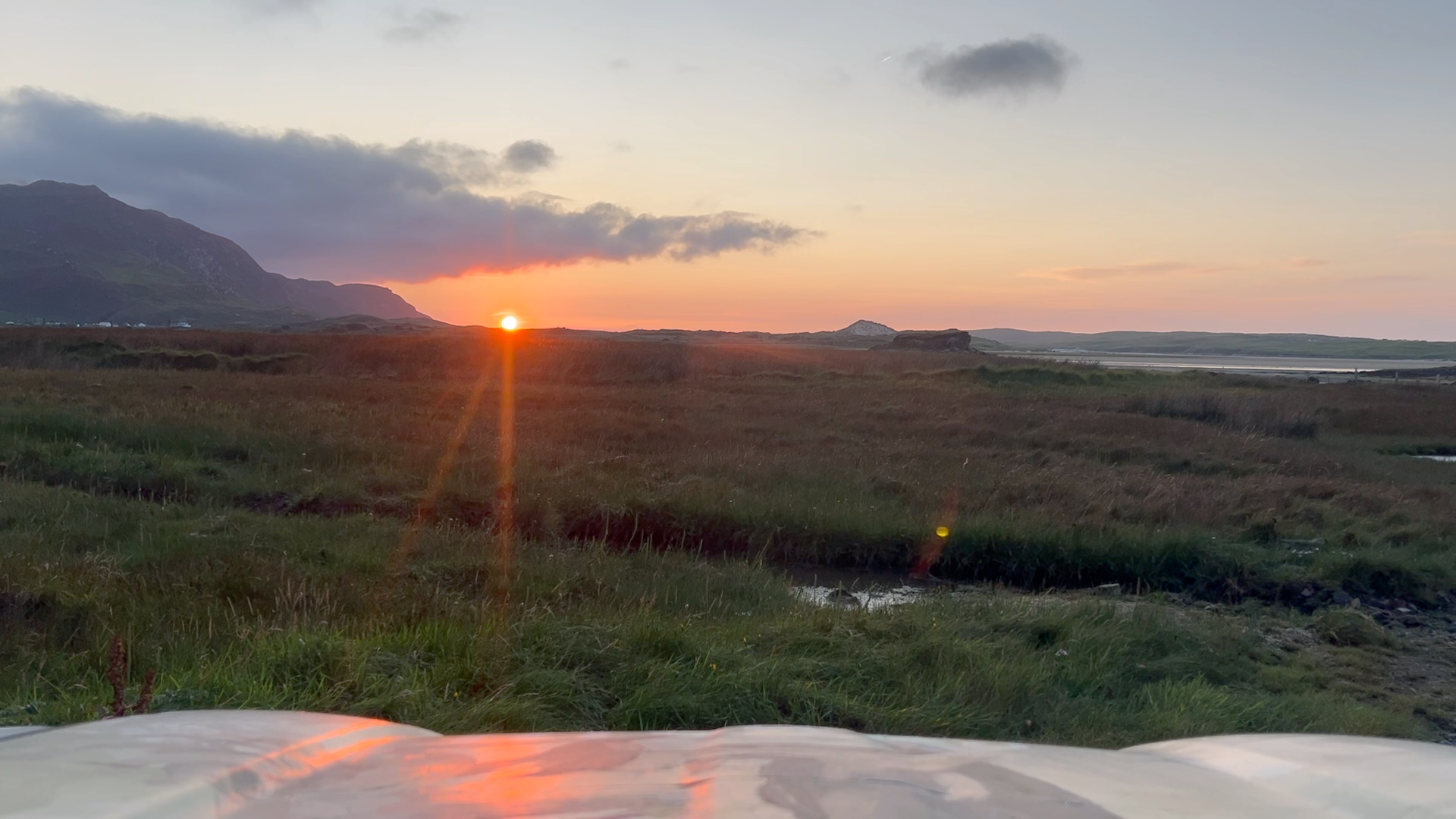
The weaving of the súgan, as an activity is analogous to the weaving of dialogue in storytelling. It can be twisted in sections and joined but there must always be two people. One twists and one feeds in the straw. An activity, that from a literary perspective serves as an embodiment of narrative, conversation and collaboration. The buicidín was often made with the ends of the súgan for play and leisure purposes or to entertain children. Every harvest fair day in Glenties, local storyteller and farmer Condy Campbell kept the age old tradition of súgan making alive, by giving a demonstration on how to do it. That’s the same Condy with the story of the ram on the cliff face who was great friends with Jimmy Carr of the Turas Colmcille. Condy was there every year to pass on his knowledge, songs stories and games; keeping the traditions and old ways of knowing alive. The buicidín pictured here was made by Condy shortly before he passed away in July 2025.
There’s a corresponding description from Anna Nic an Luain (who we spoke of yesterday) on how the buicidín game was played. ‘There was a pass time when we were children’, she begins, ‘where we’d take the buicidín a little straw doll made from the súgan’…. according to her account, you’d put the doll in the centre and each person would have a go at hopping on one leg around the buicidín three times. After you completed the third circle, you’d crouch down, still on one leg, and pick up the buicidín with your mouth. Anyone who could do it without loosing balance won the game. But everyone got a great laugh out of the activity.
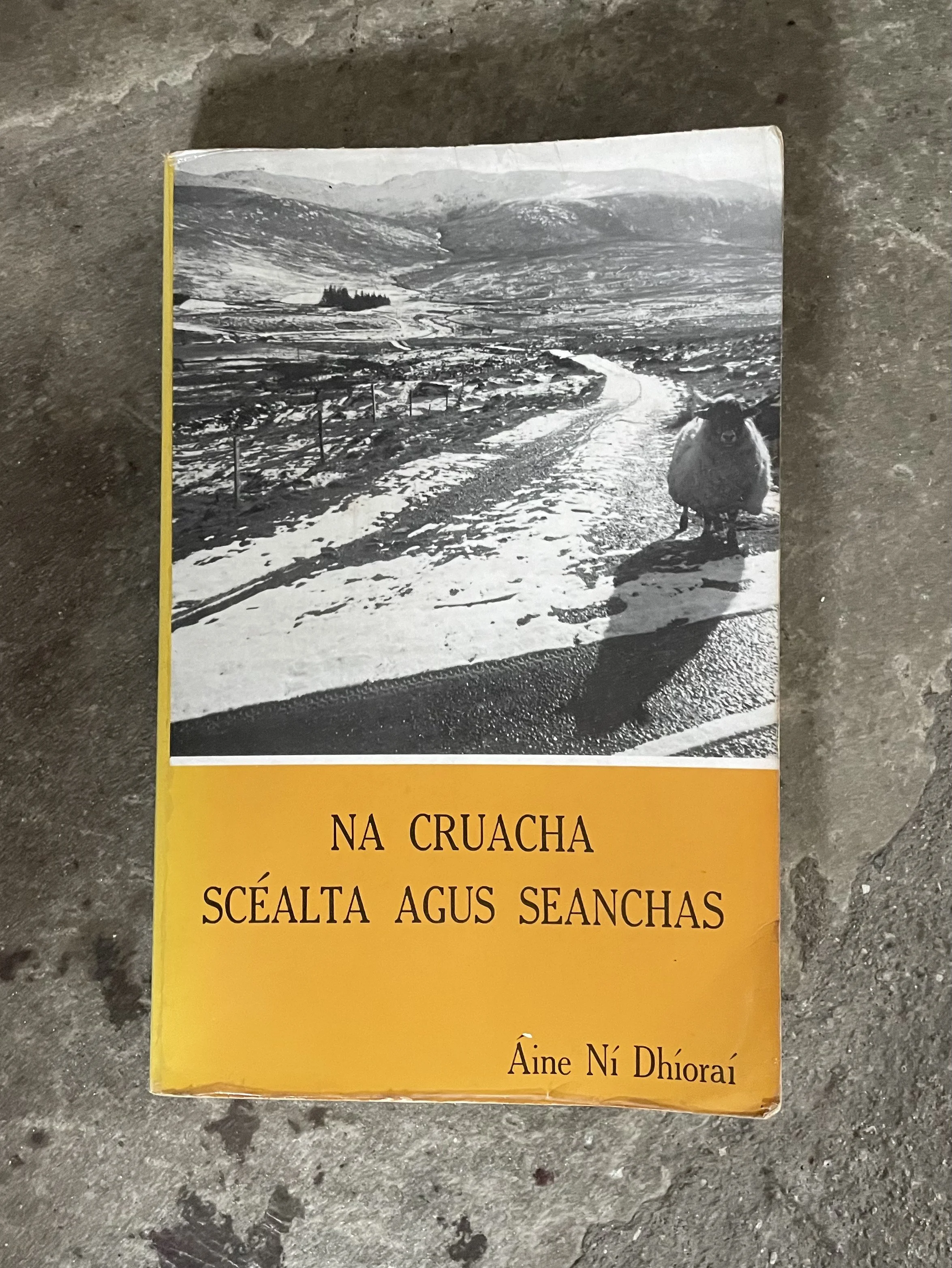
Anna Nic an Luain was born around 1884 and her childhood memories situate the buicidín as a popular game during the 1890s, though the ubiquity of straw as a material means the game was probably popular hundreds of years before this too. The account below was gathered by folklorist and fisherman Seán Ó hEochaidh (1913 – 2002) who was from Teelin, Co. Donegal. It is often said that because of him, Teelin is one of the most documented regions in Irish folklore, he made it his life's mission to meticulously record south west Donegal’s oral traditions. He documented Anna Nic an Luain’s description of the game the on the 4th of November 1947 at her home in Cruach Thiobraide about 60km east of Teelin by the old roads. This documentation of the game was then gathered from Ó hEochaidh by Áine Ní Dhíoraí’s for her 1985 book Na Cruacha; Scéalta agus Seanchas….
15.4. BUICIDÍN
Bhíodh caithimh aimsire againn inár bpáistí ag gabháil don bhuicidín. Rud beag cosúil le bréagán a bheadh ag páiste a bhí ins an bhuicidín agus é déanta d'fhéar nó de chochán—trí cosa beaga air ar an talamh agus ceann beag cruinn air. Chuirtí an buicidín seo ina sheasamh i lár an urláir ar na trí cosa. Chaithfeadh na páistí ansin—duine i ndiaidh an duine eile—breith ar leathchois dá guid féin agus a dhul thart trí huaire ar a leathchois eile agus an tríú huair a bheadh siad ag dul thart cromadh sos ar an bhuicidín lena méal agus a thógáil amach ón talamh. Bhíodh mórán acu a bhíodh tuirseach go maith nuair a bhíodh siad thart na trí huaire ar an bhuicidín ar an leathchois agus nuair a théadh siad a chrom-adh síos thiteadh siad ar an talamh agus ansin bhíodh ábhar mór gáire ag an chuid eile. Is minic nuair a bhí sinn inár bpáistí a chaith sinn leath-oíche ag dul don chleas seo agus chomh maith linn féin bhíodh greann mór ag ar muintir ag coimheád orainn.
15.1. Cluichi Páisti
RBE 1032, 406-408. S. Ó H. a bhailigh ó Anna Nic an Luain, Cruach Thiobraid, ar an 4.11.1947. Tá cuntas ar chluichí páistí tugtha ag An Seabhac, Béal. 12 (1942) 29-54.
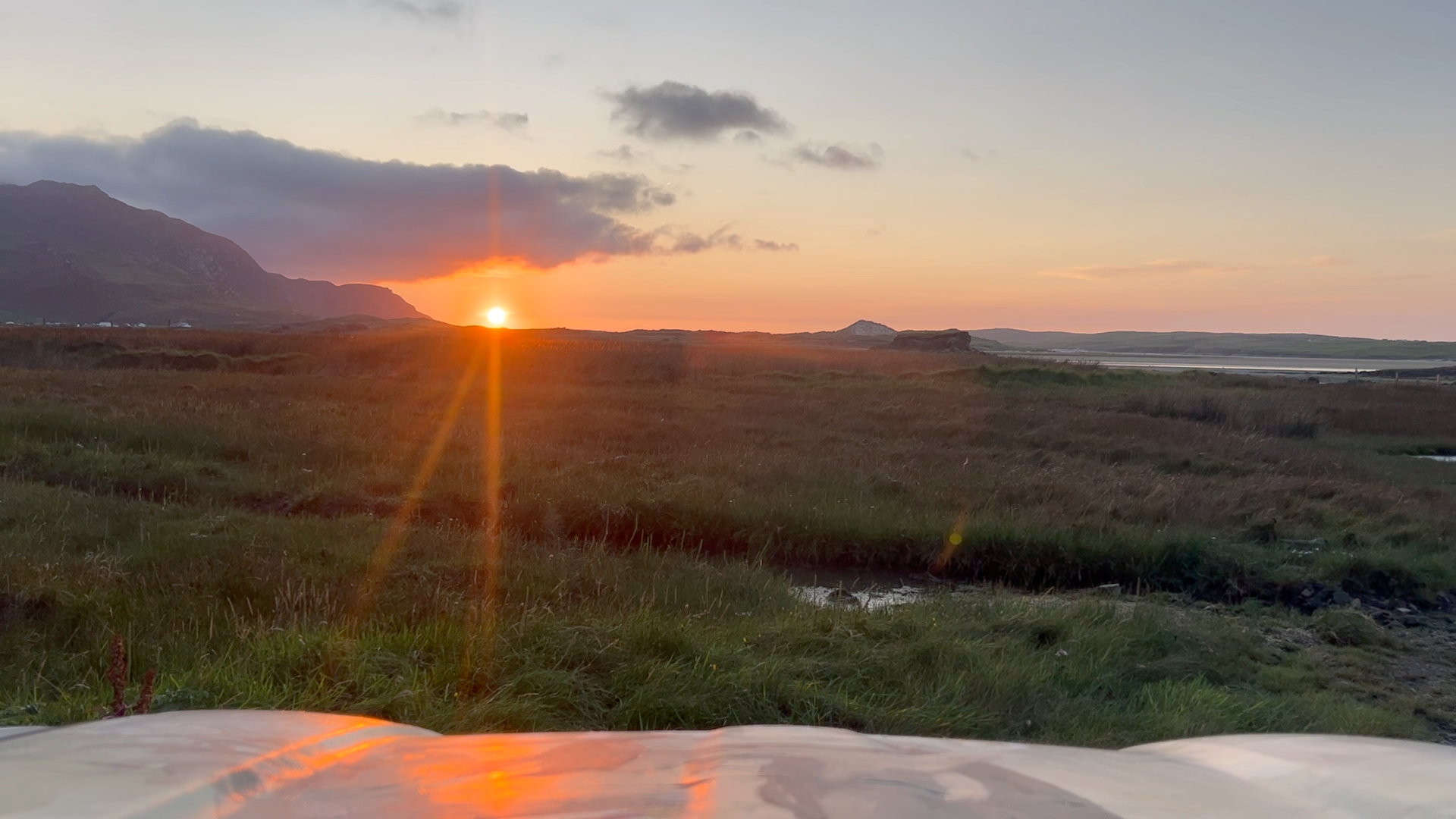
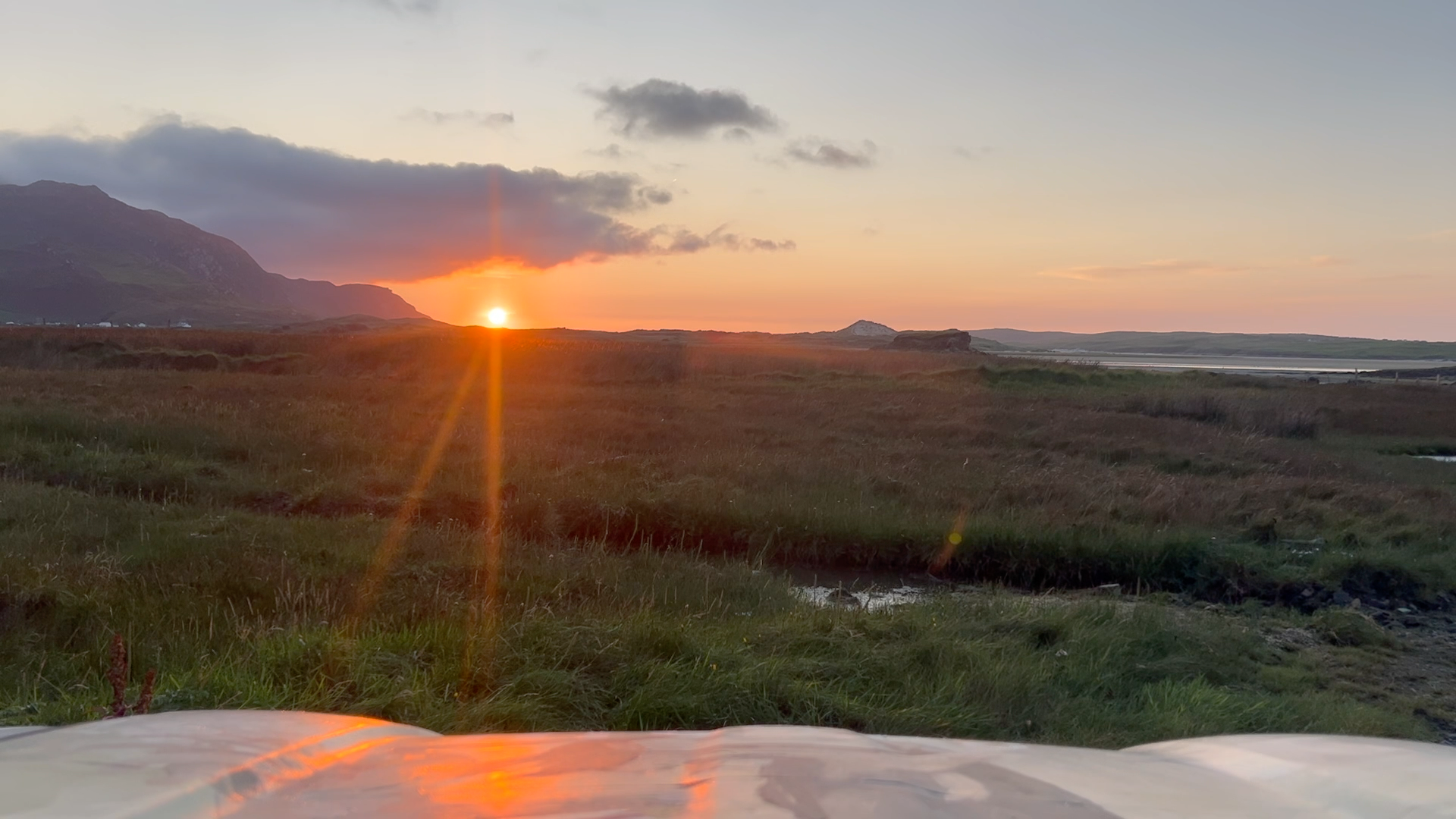
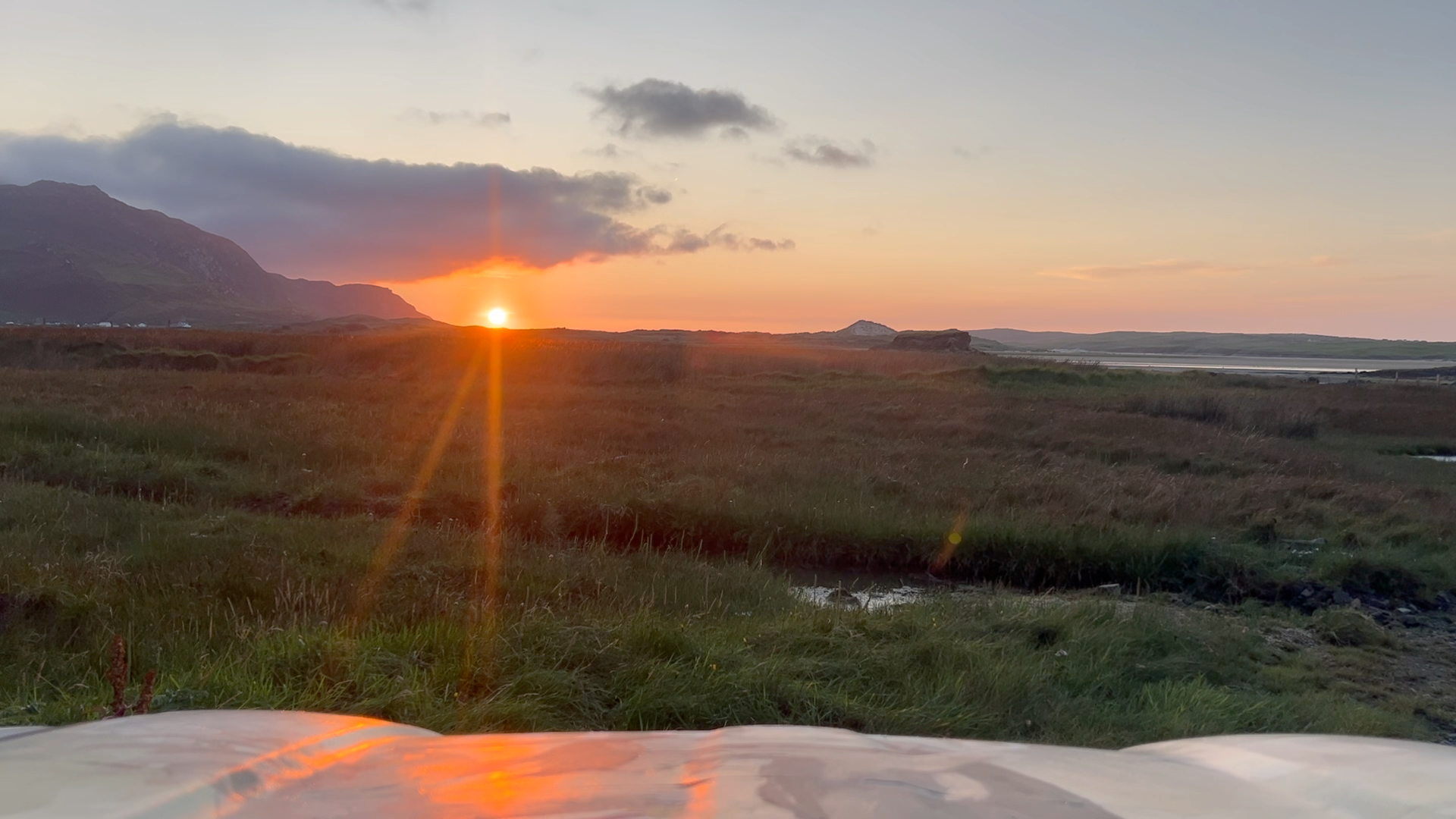
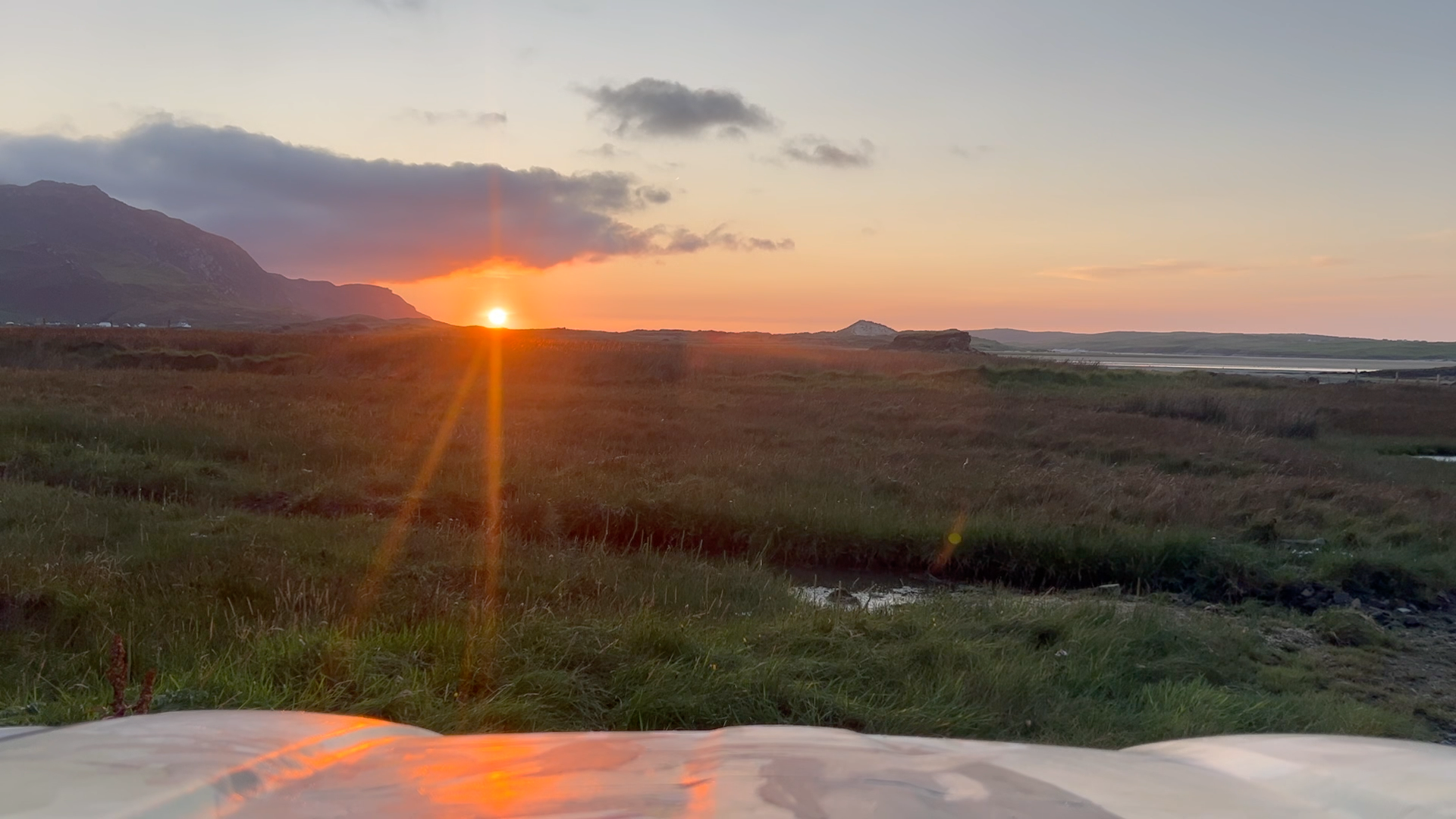
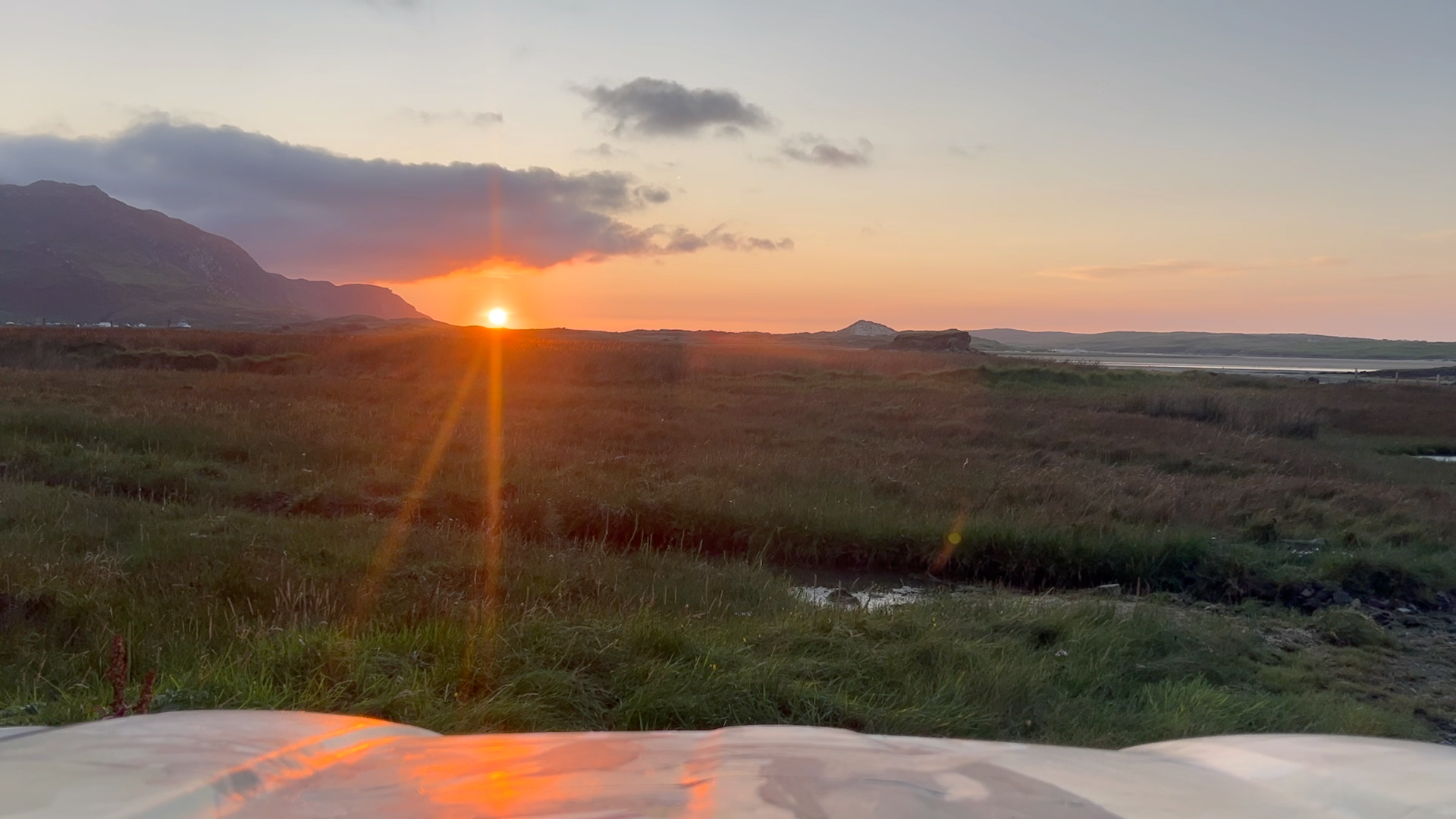
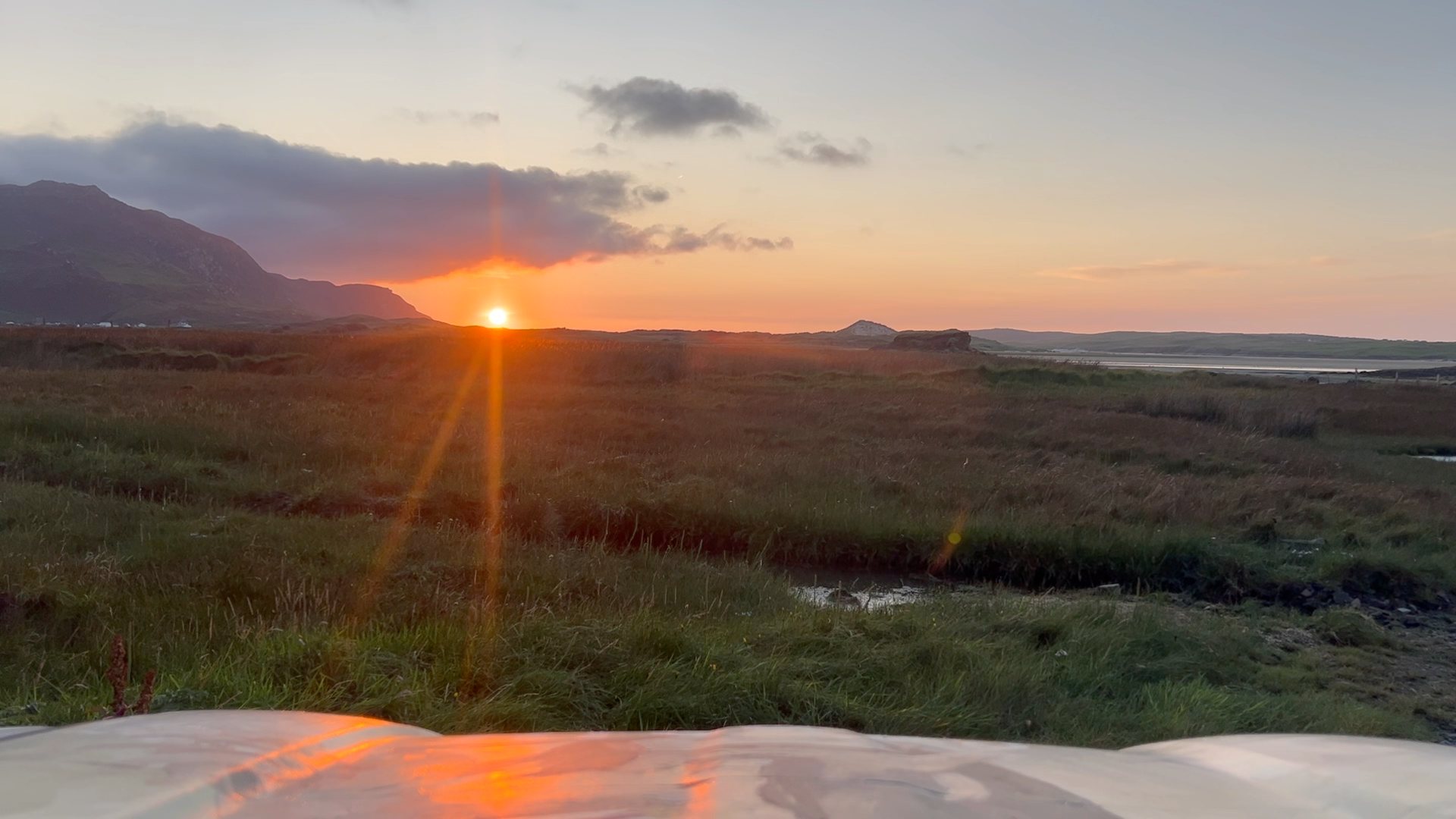
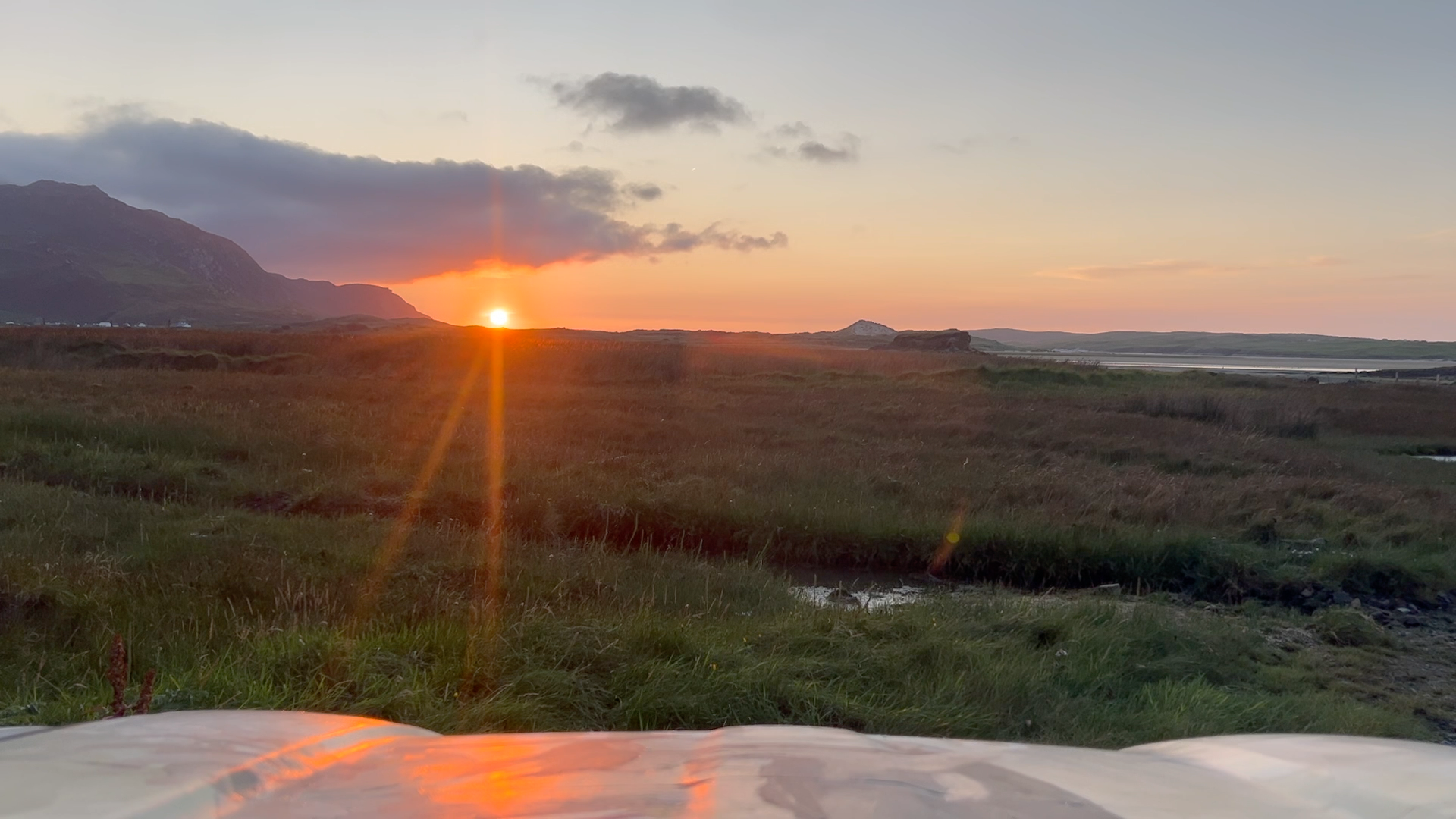
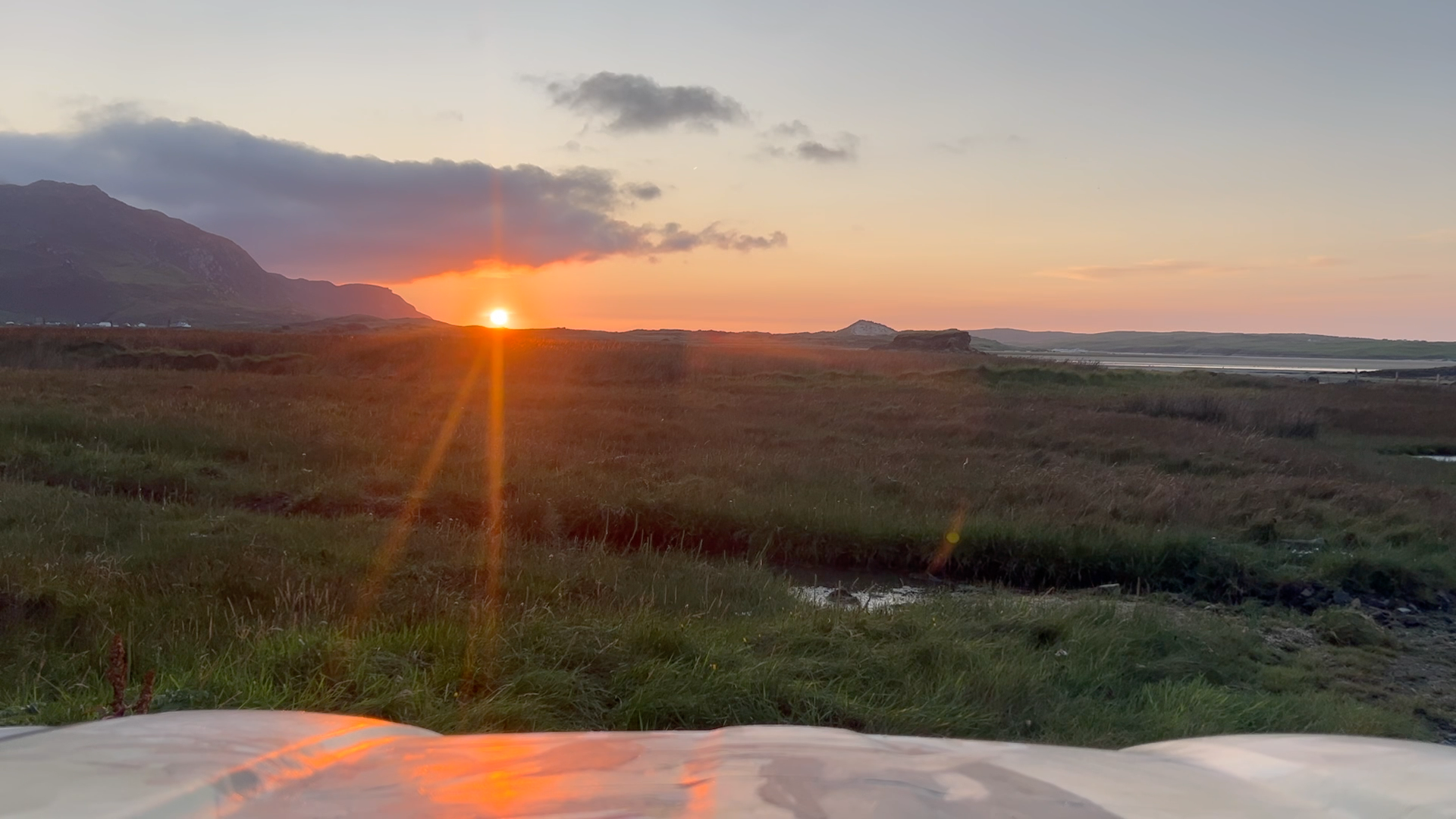
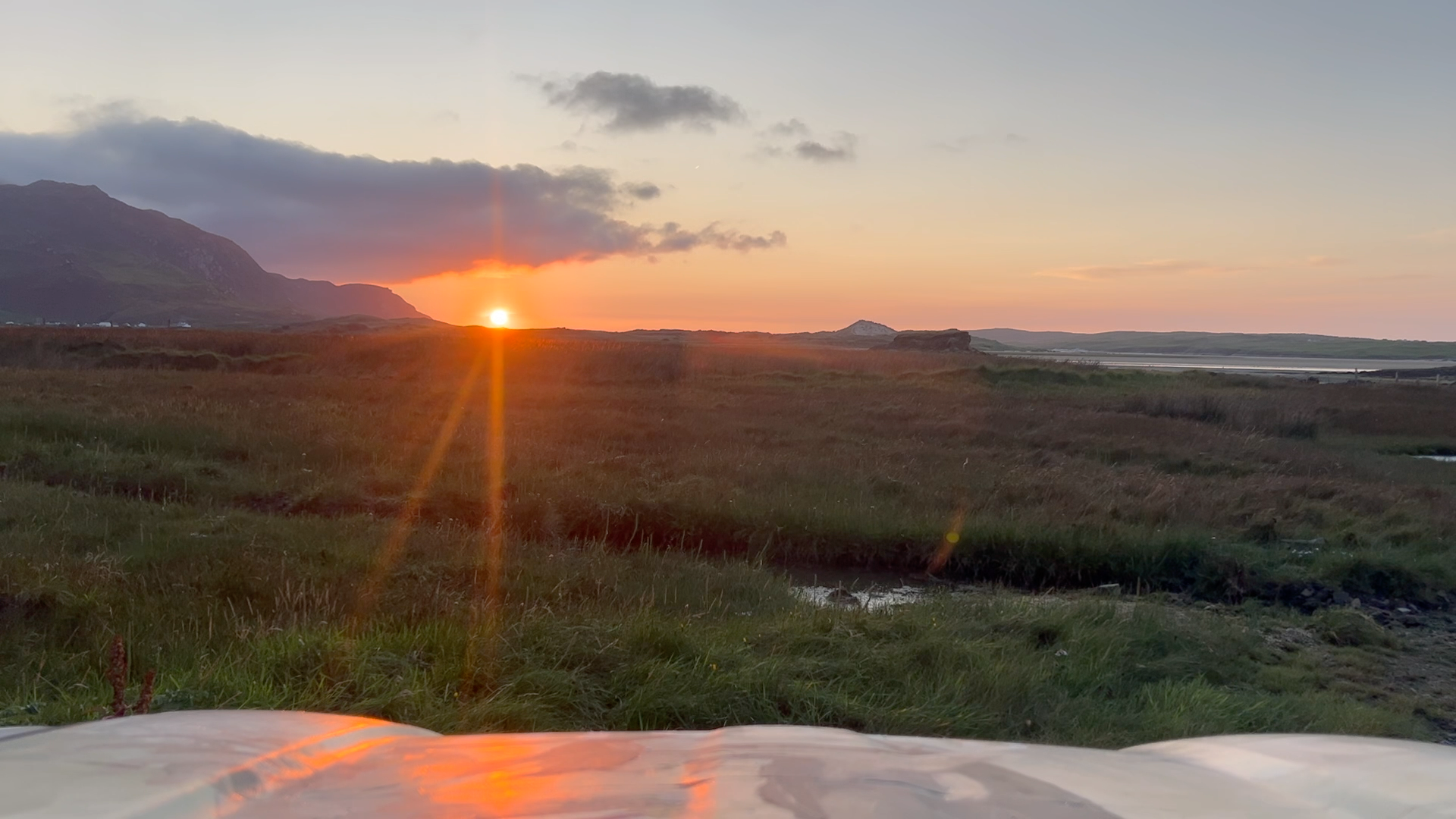
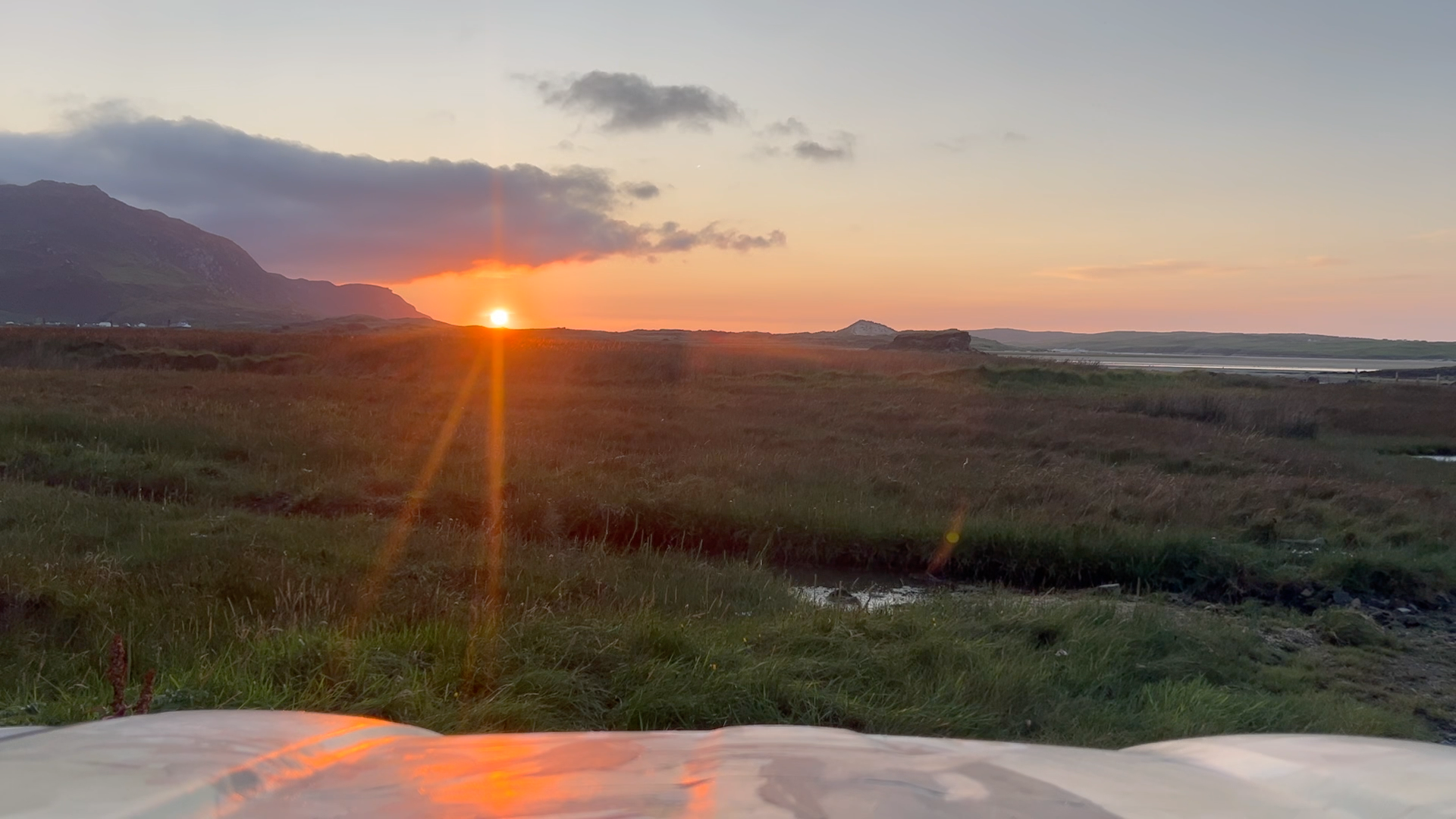
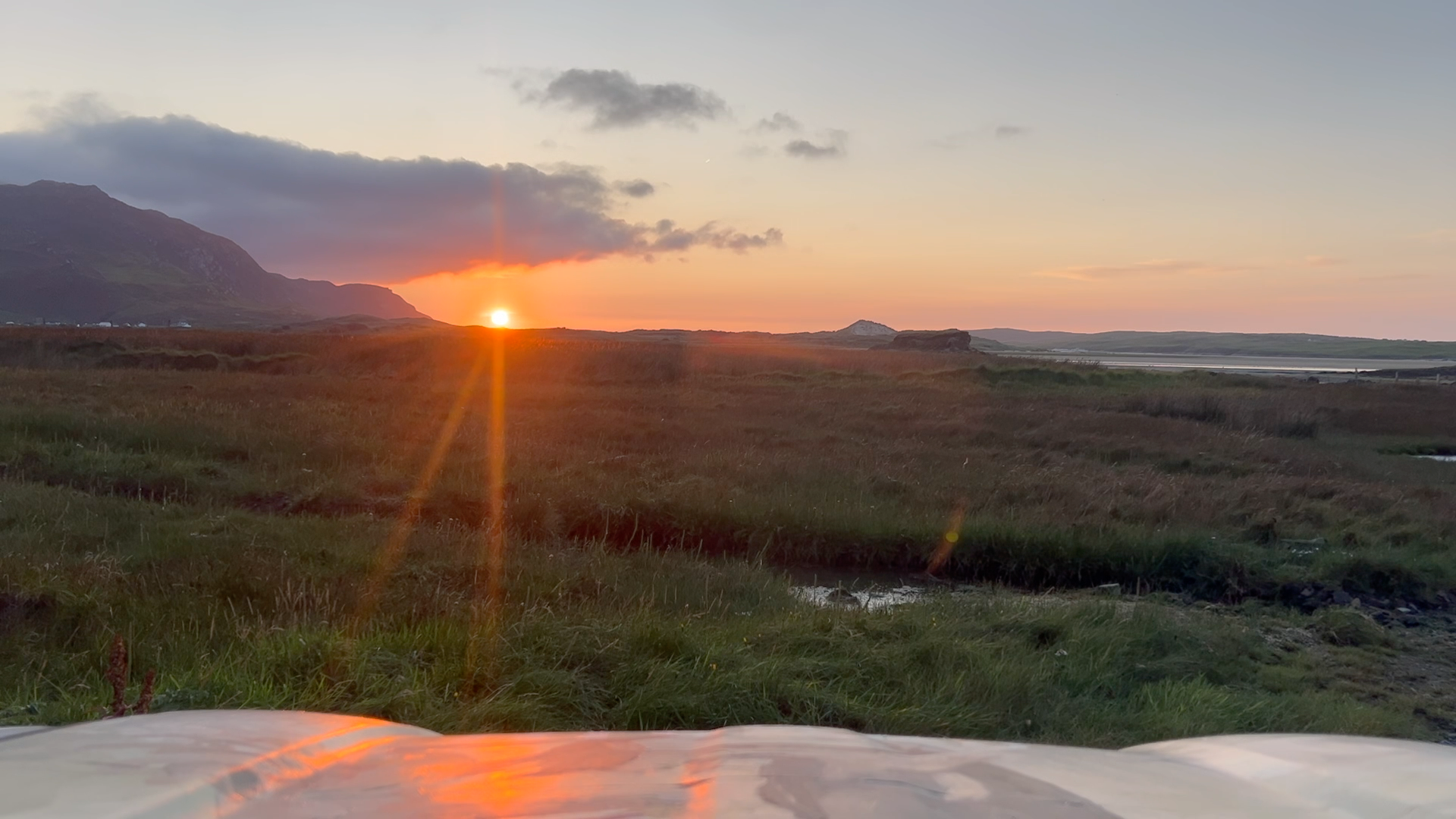
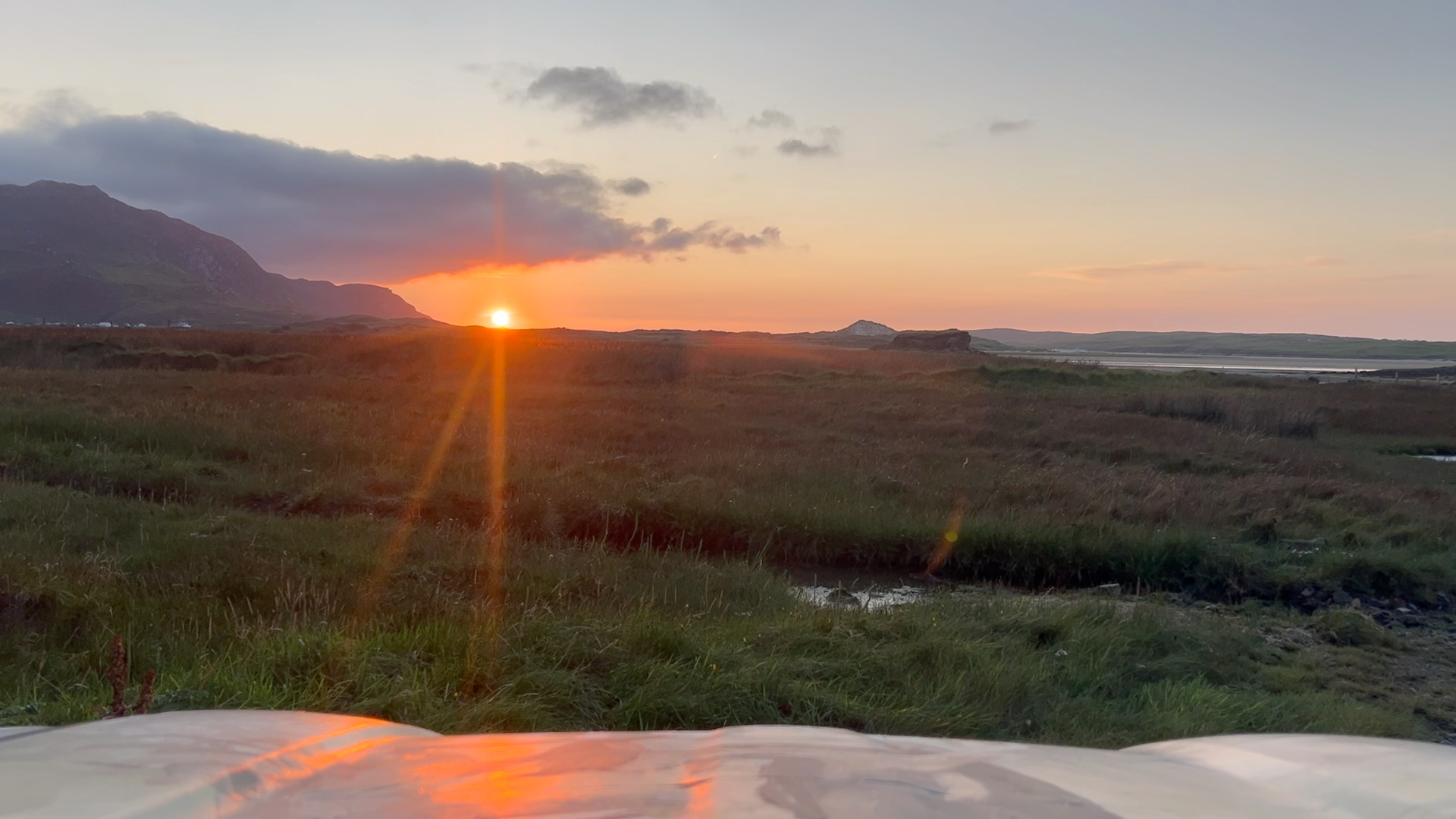
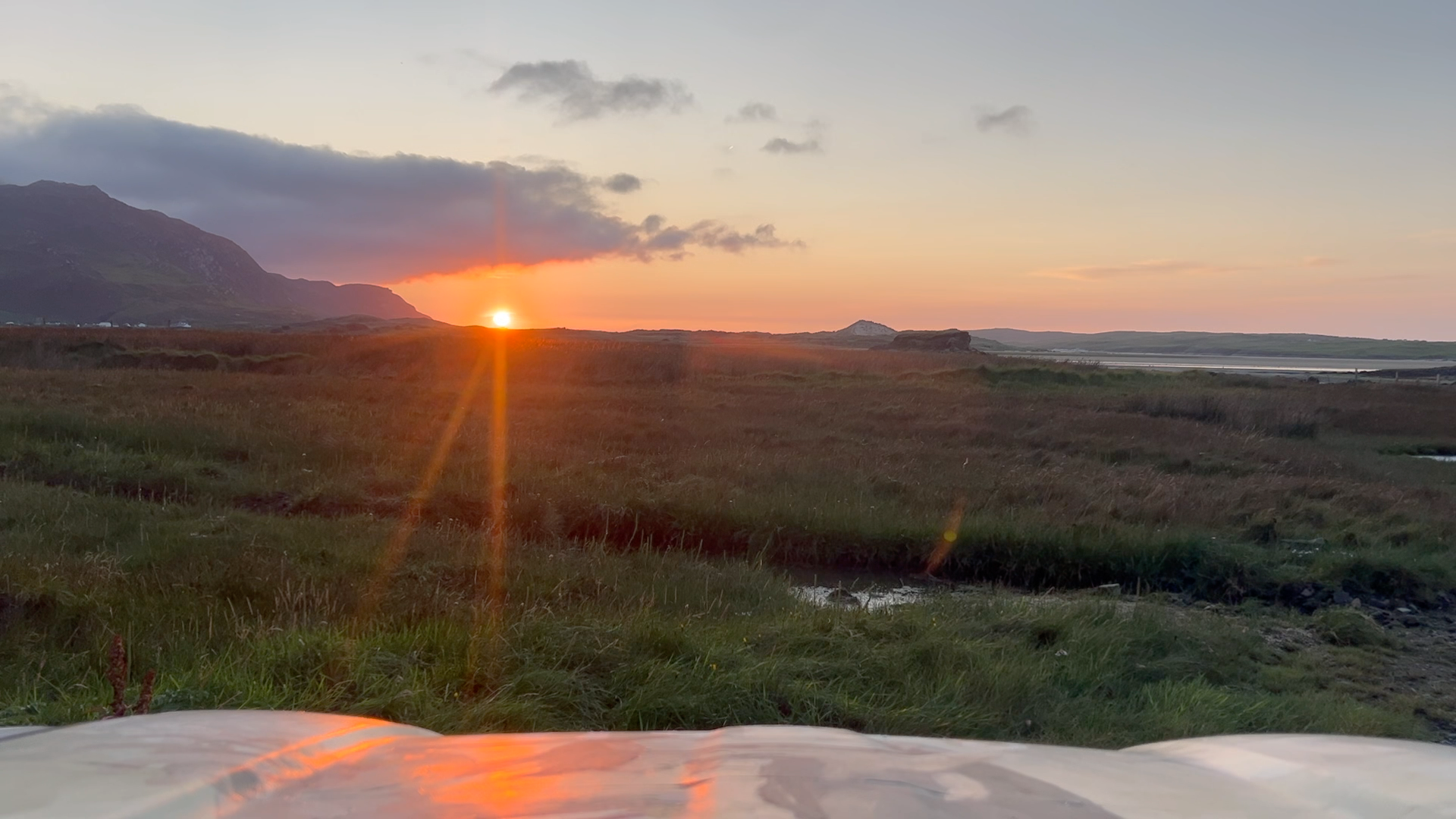
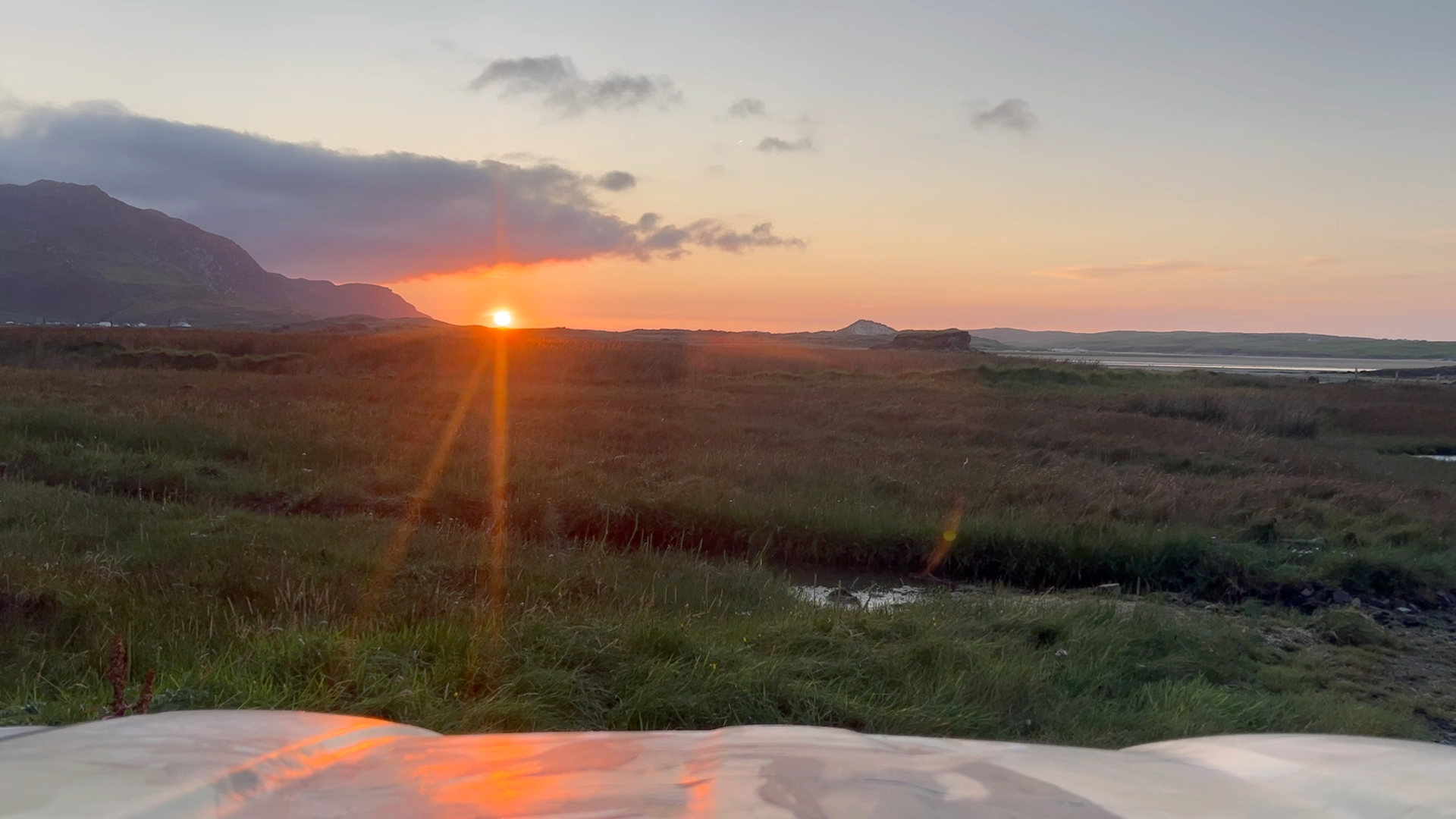
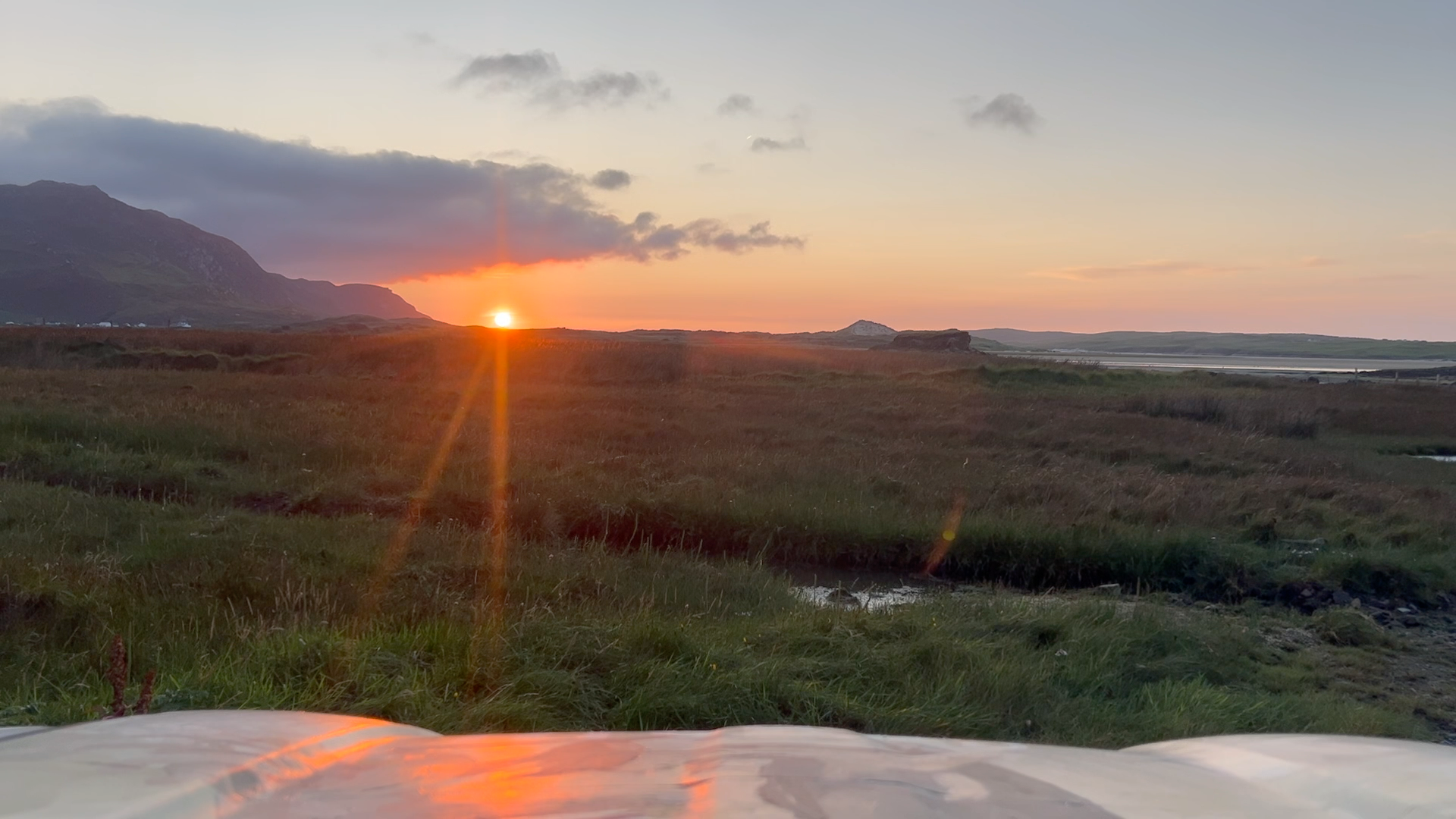
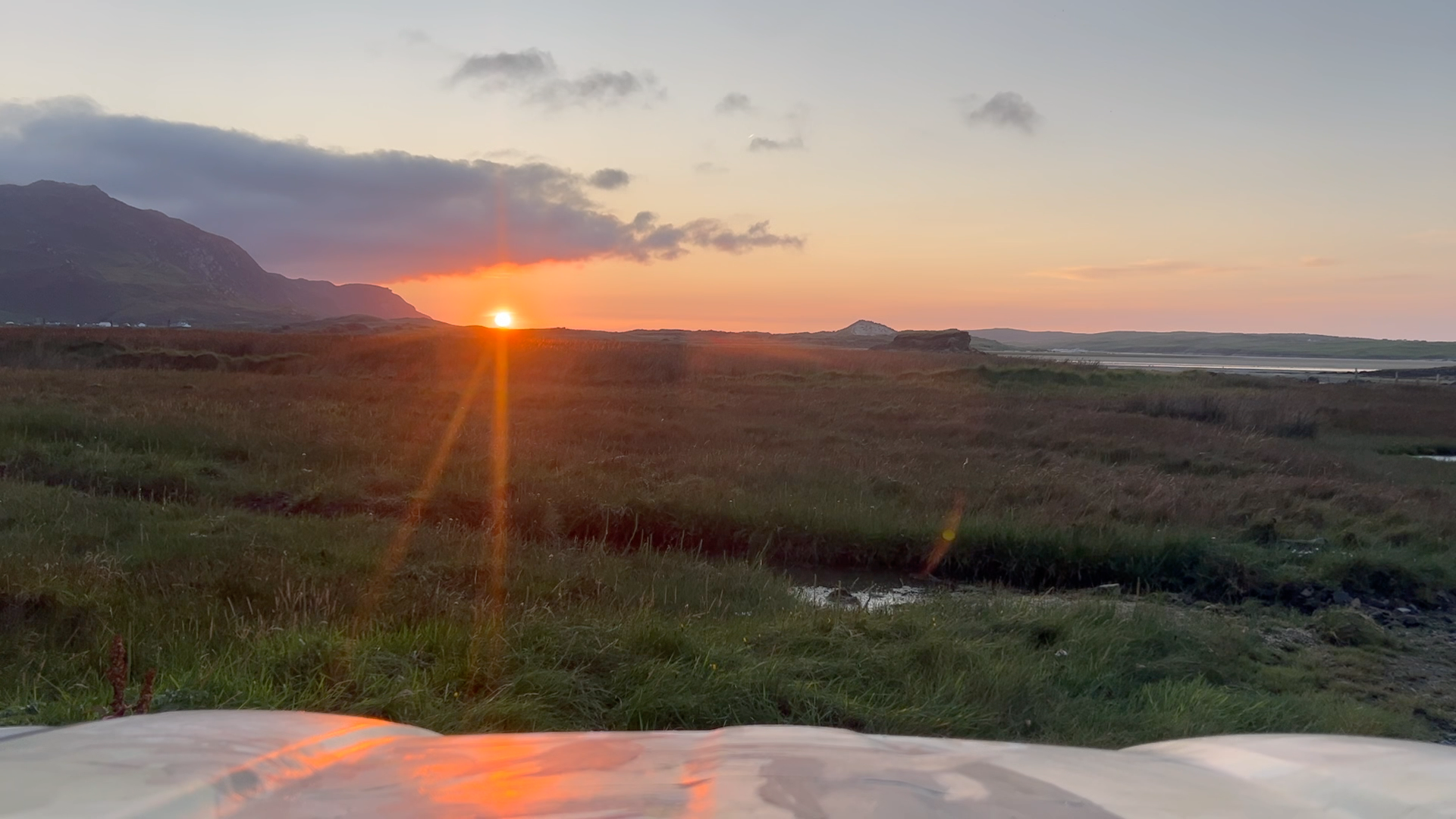
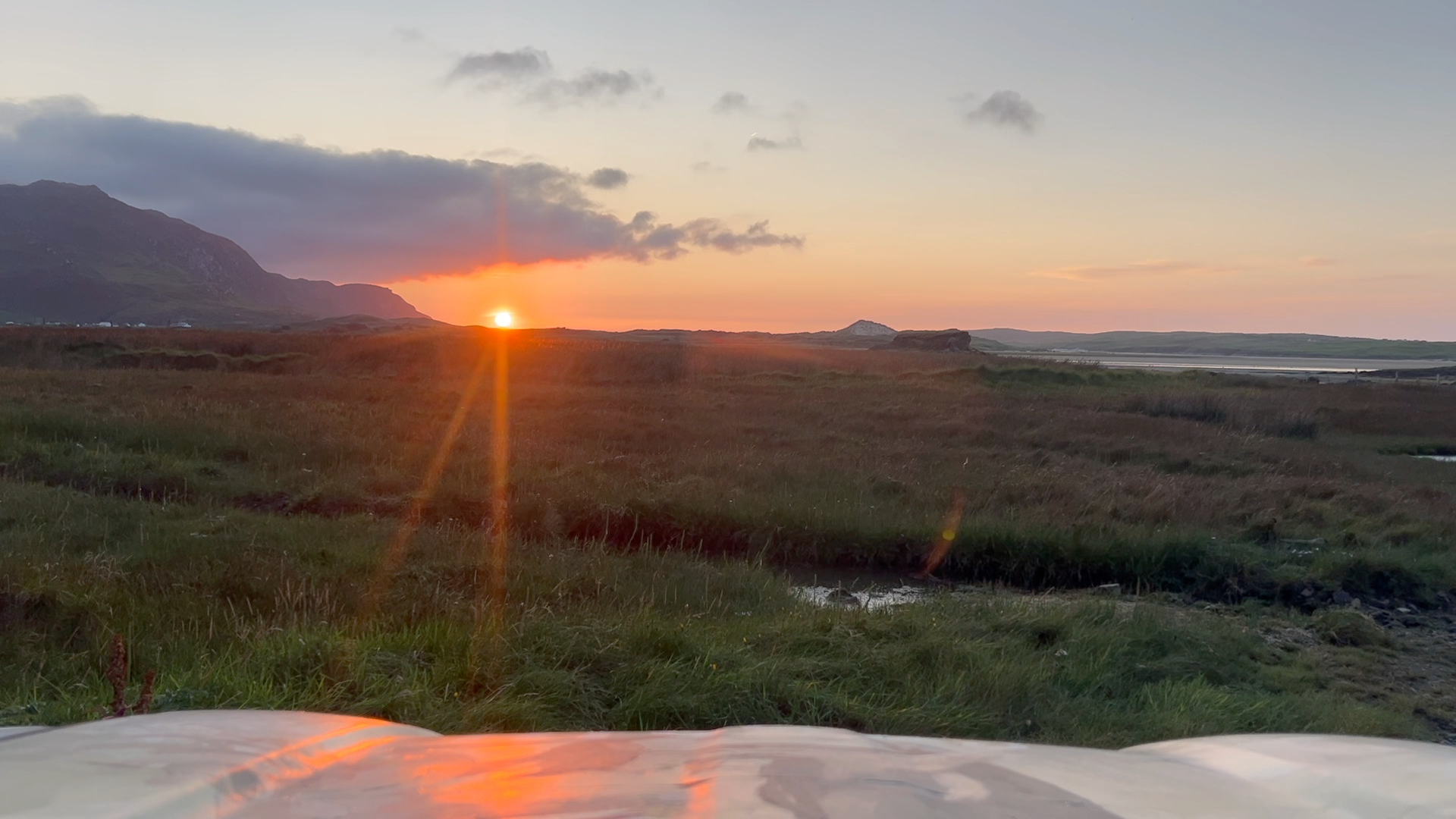
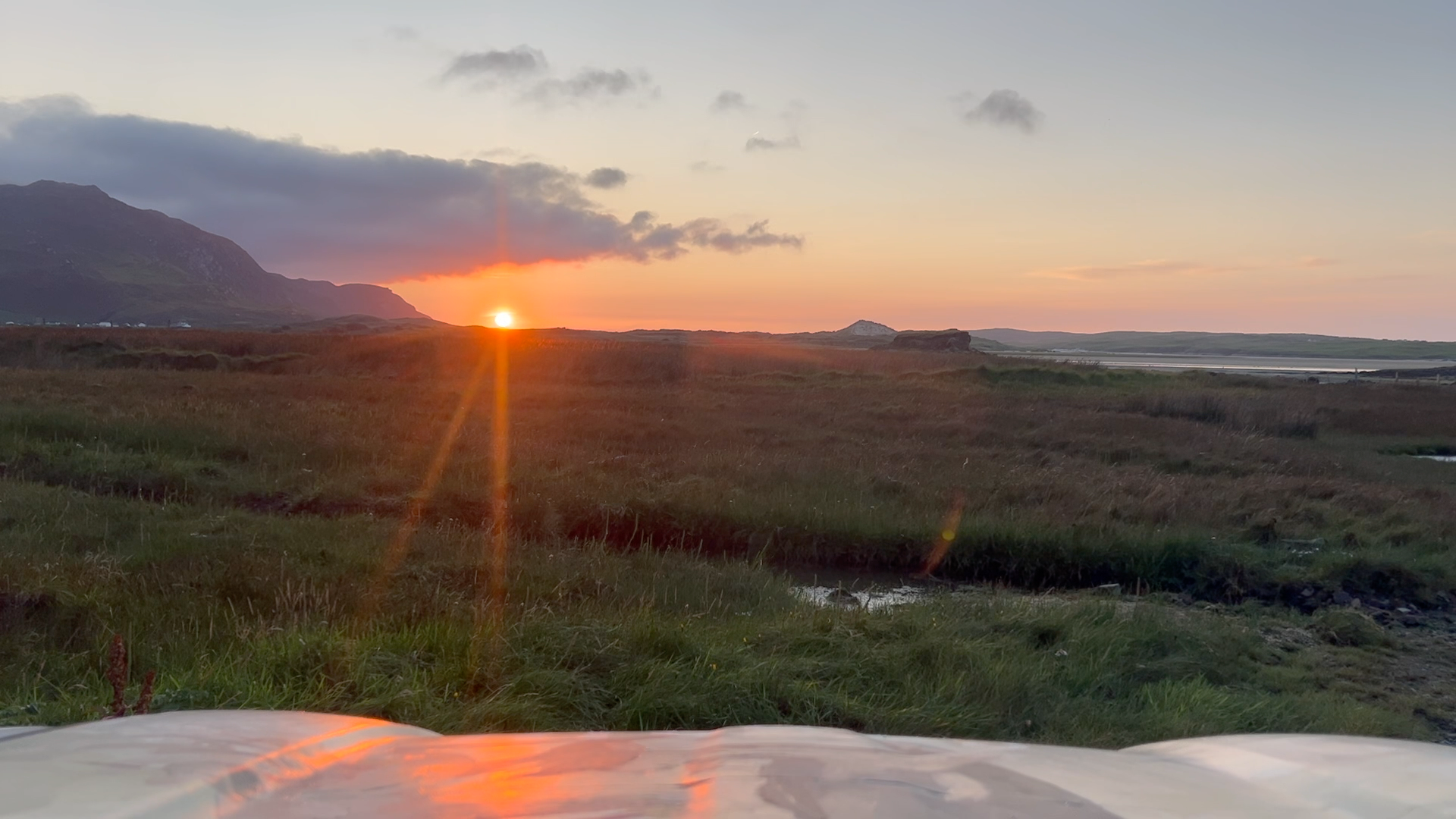
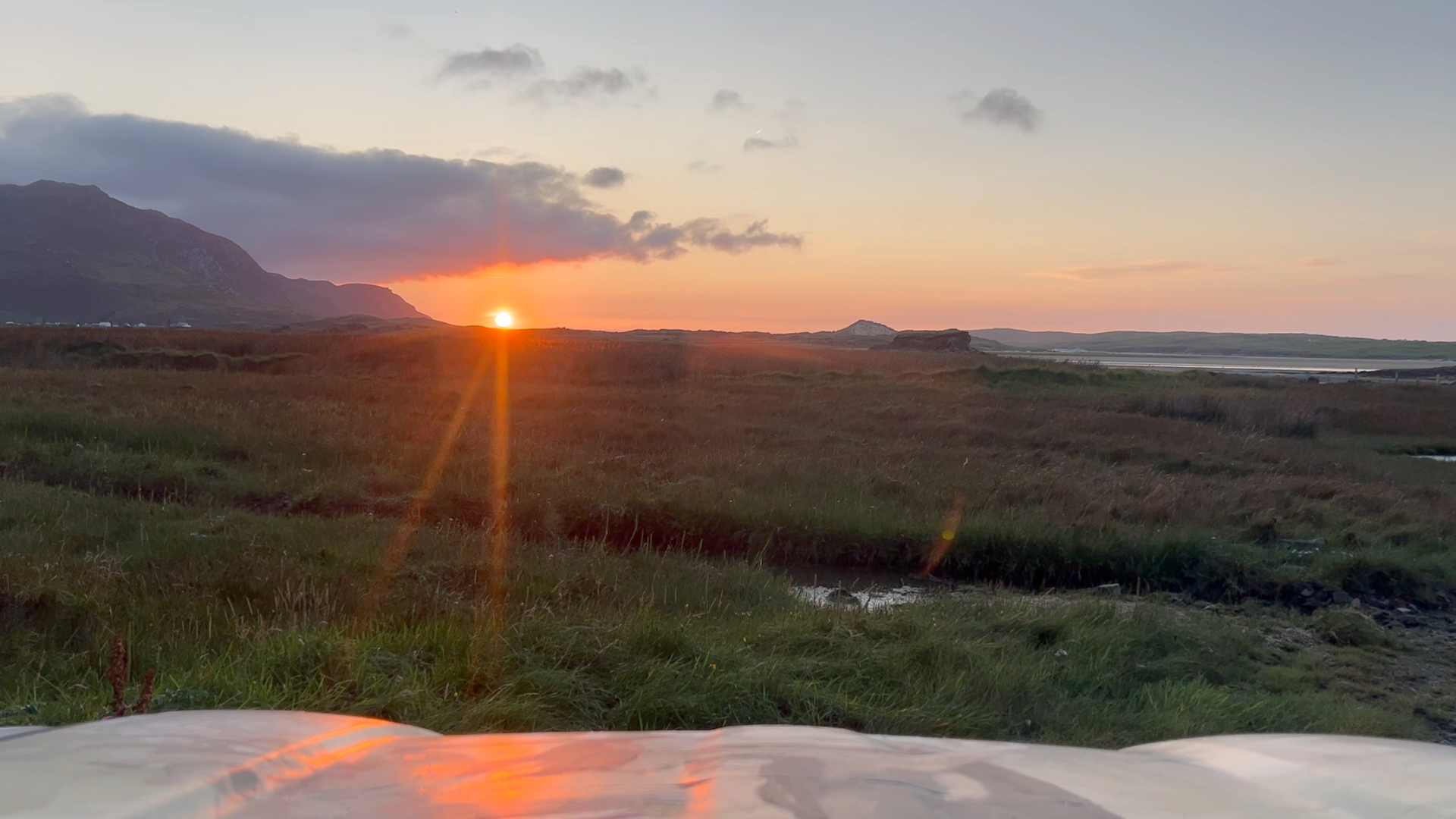
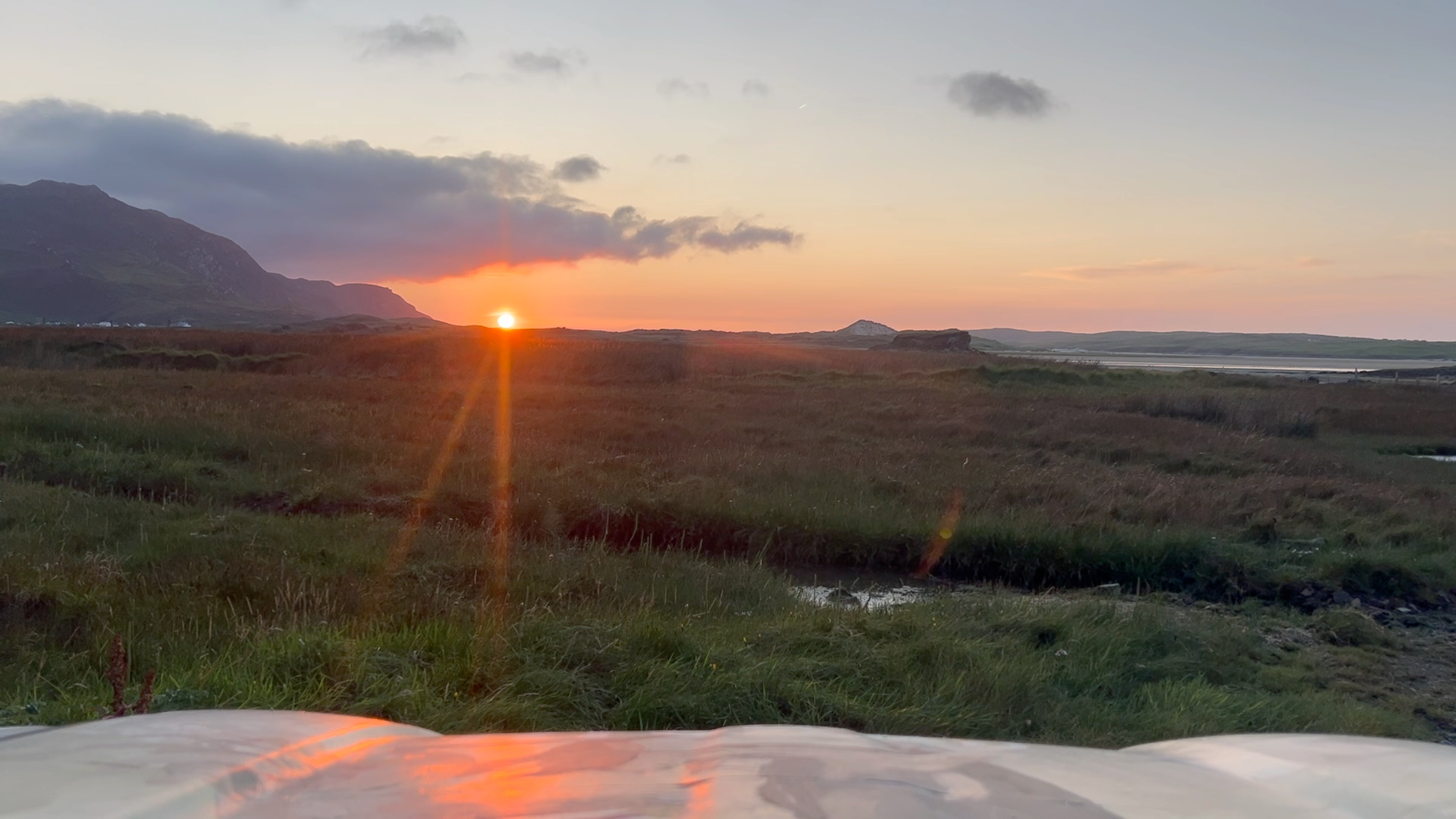
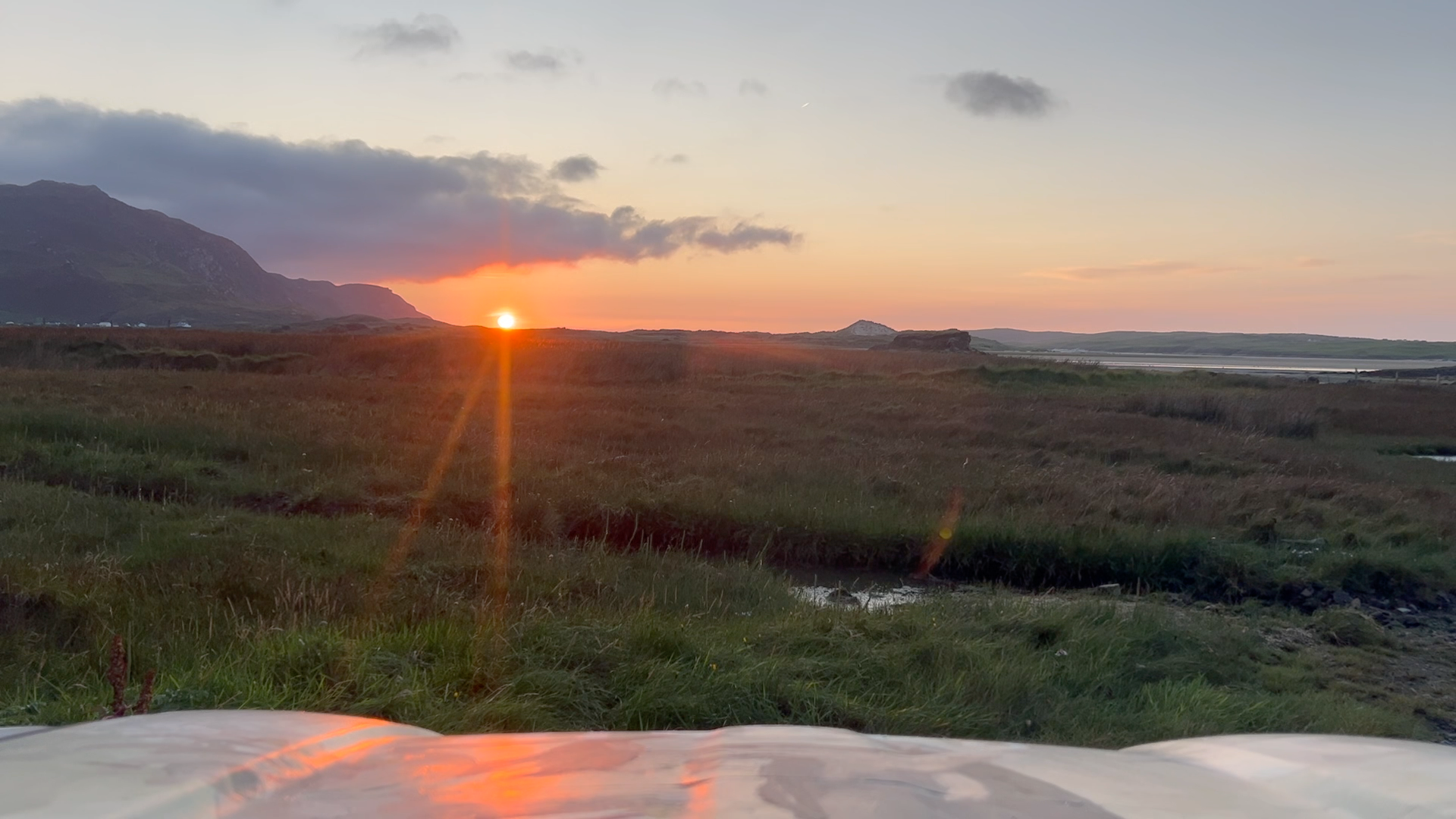
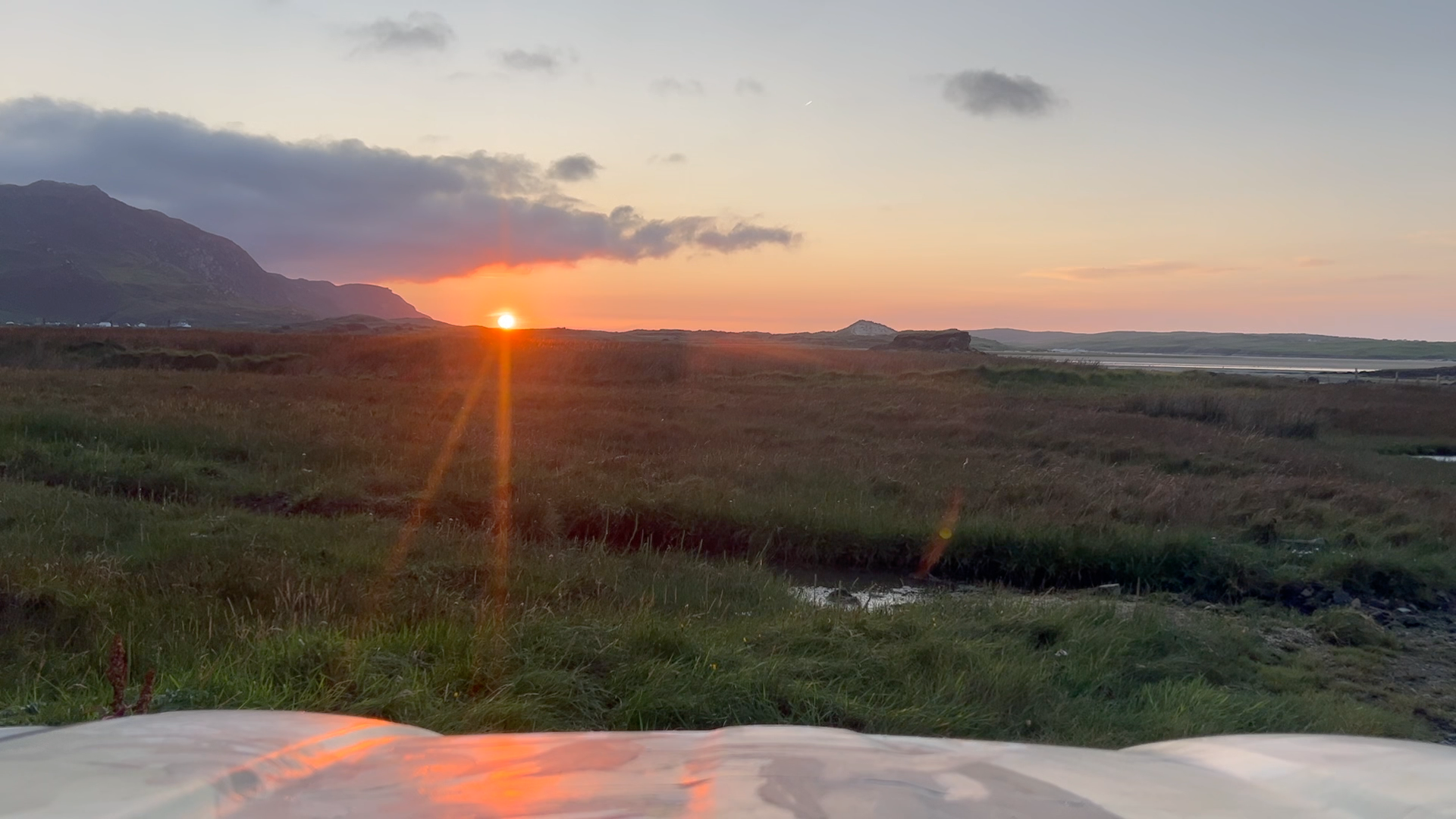
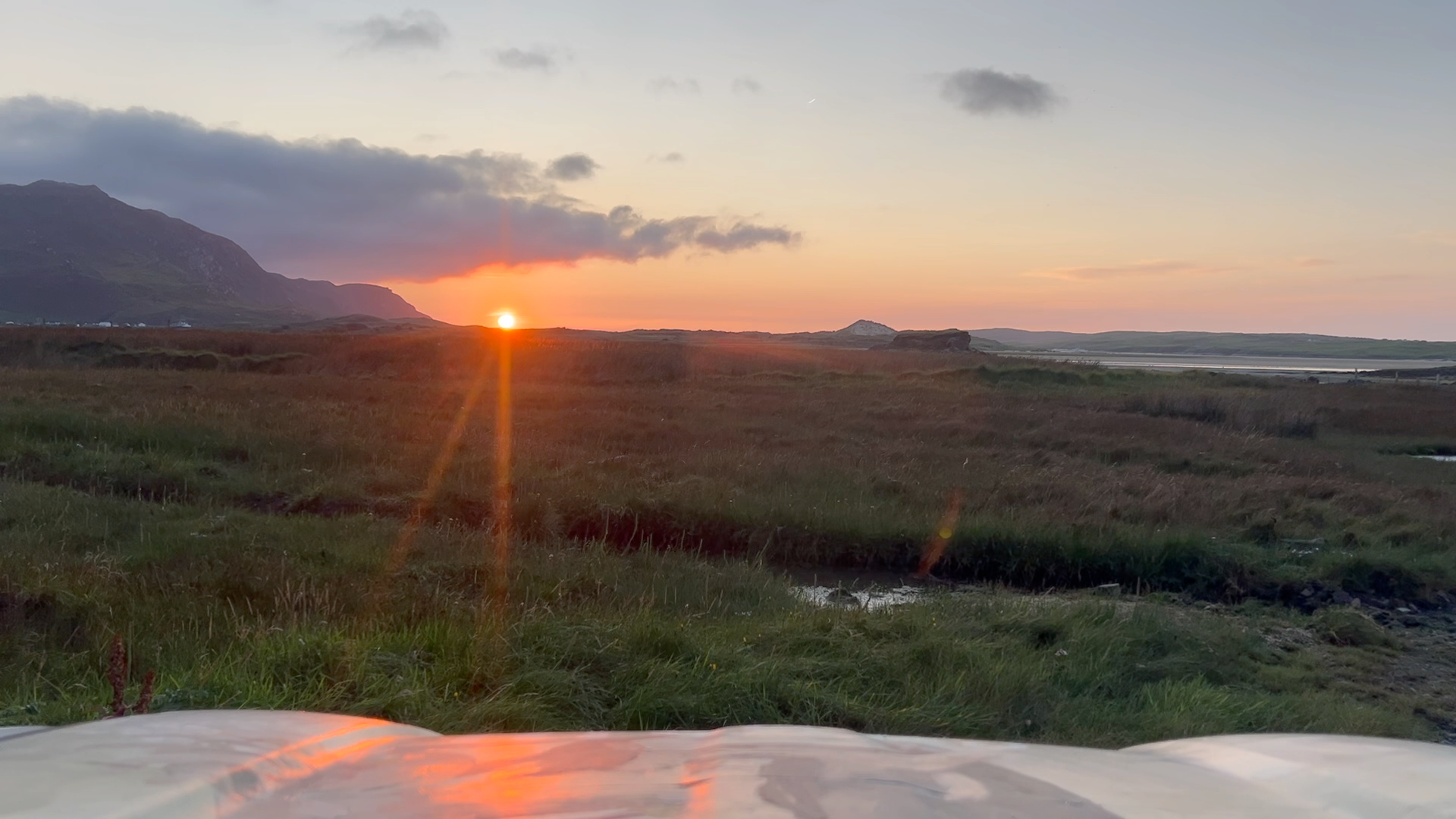
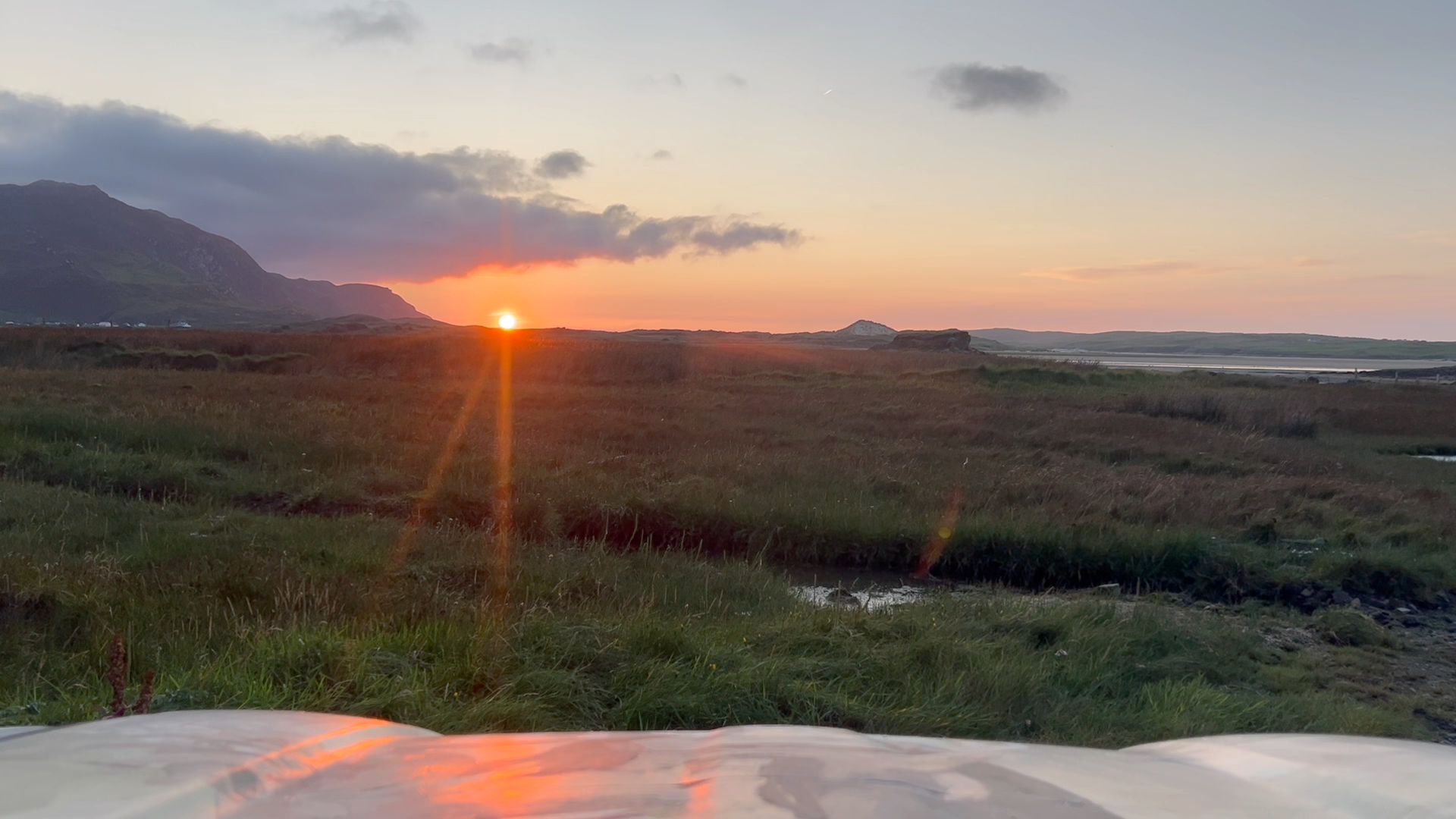
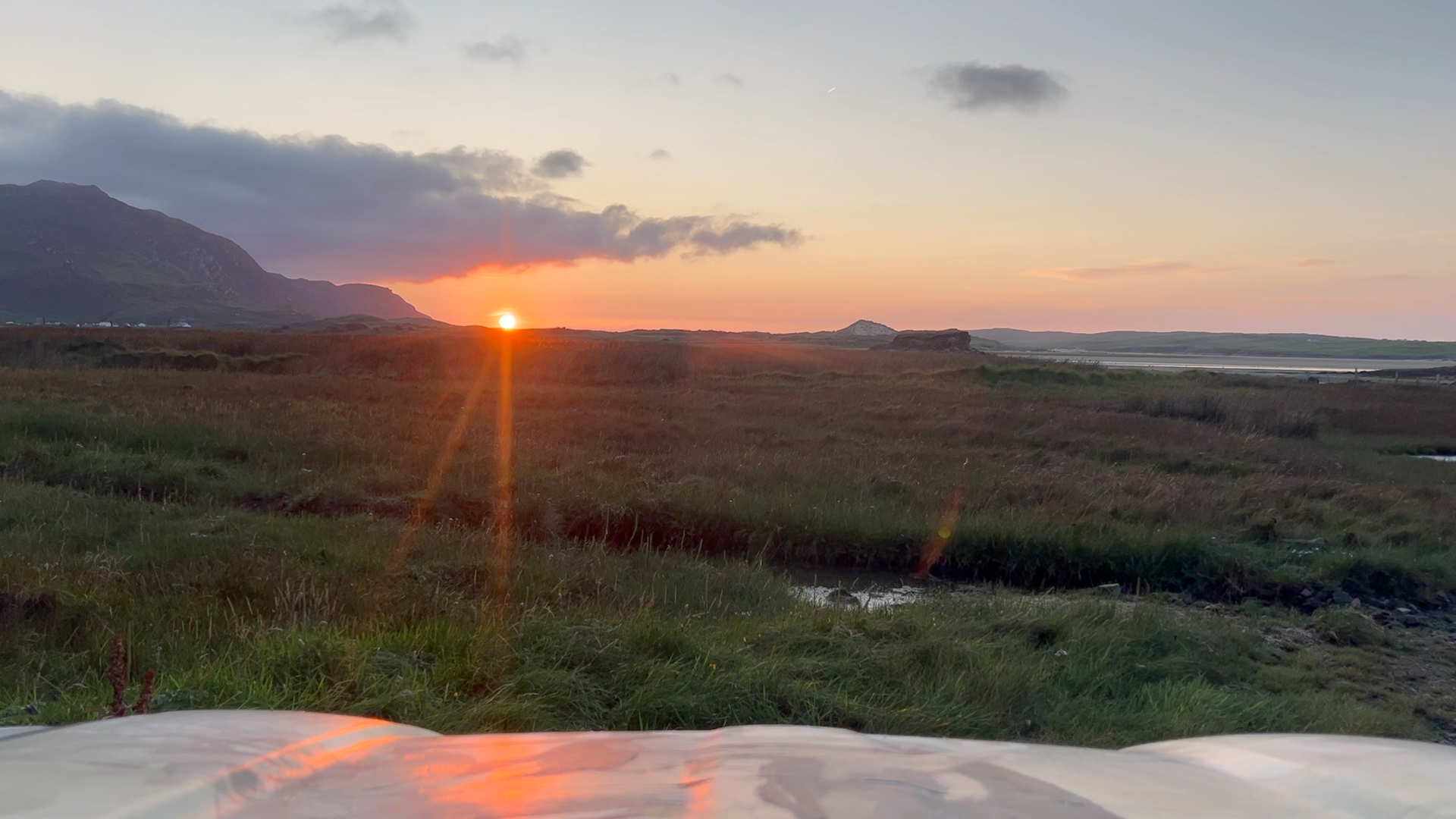
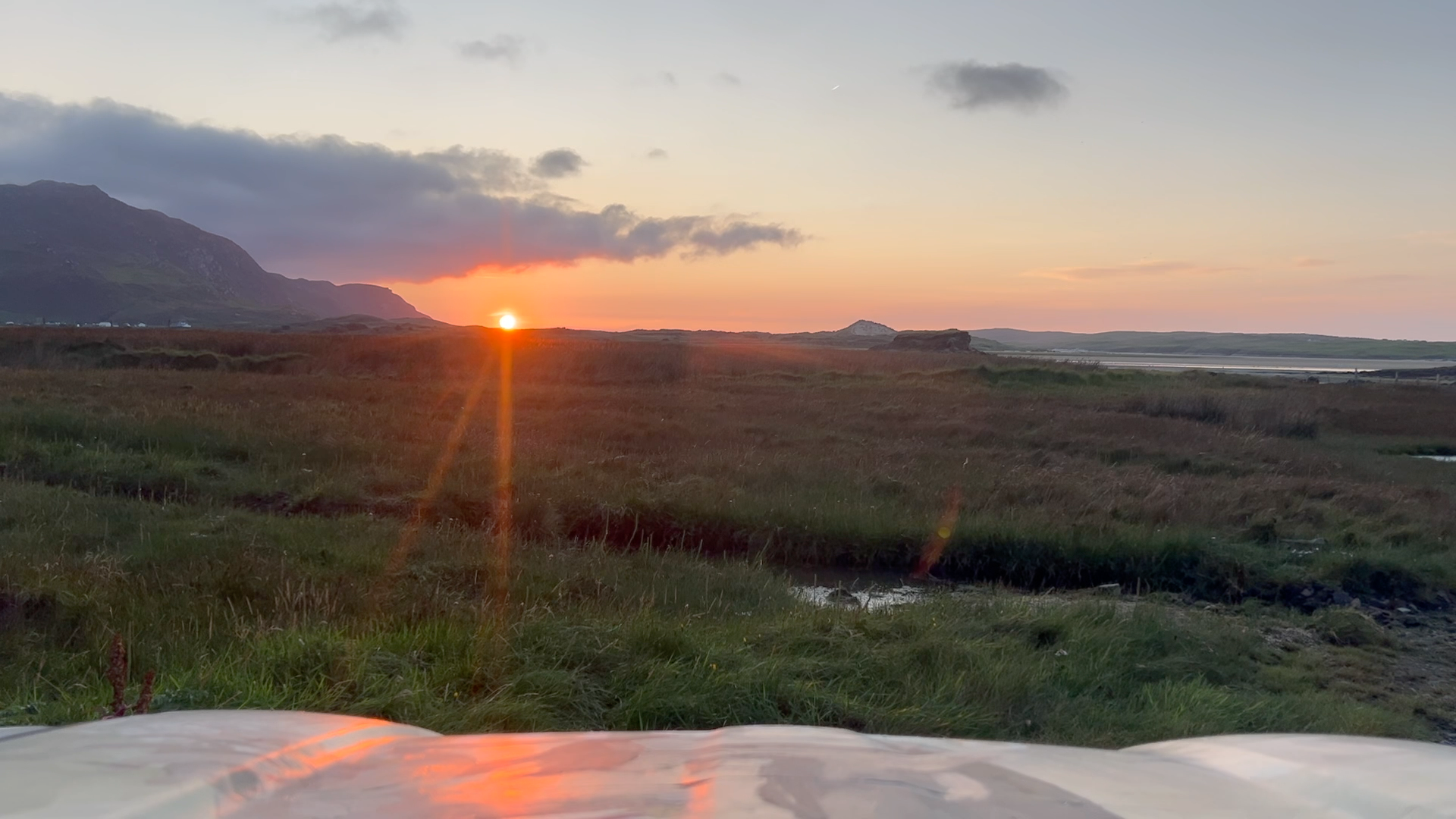
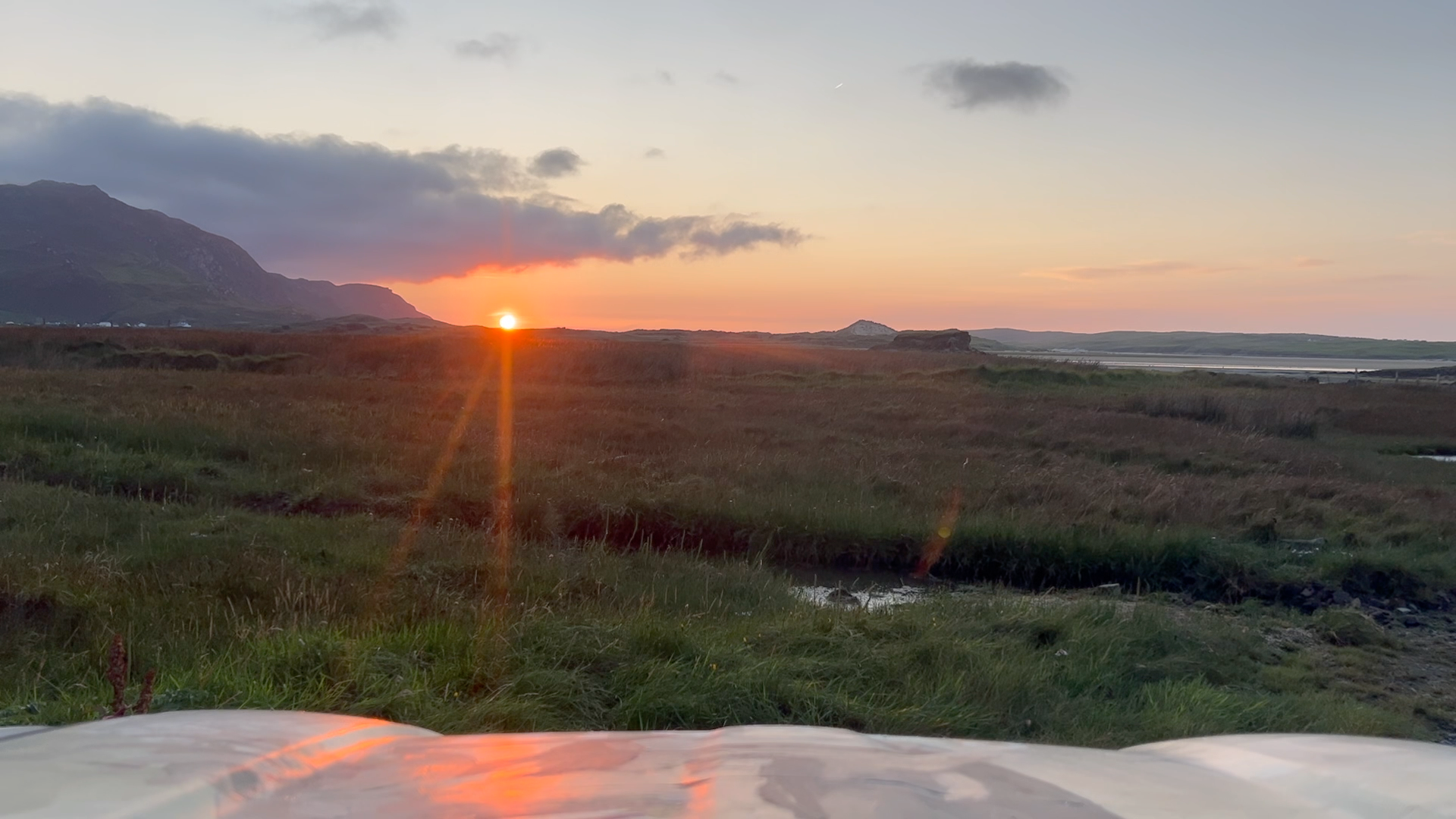
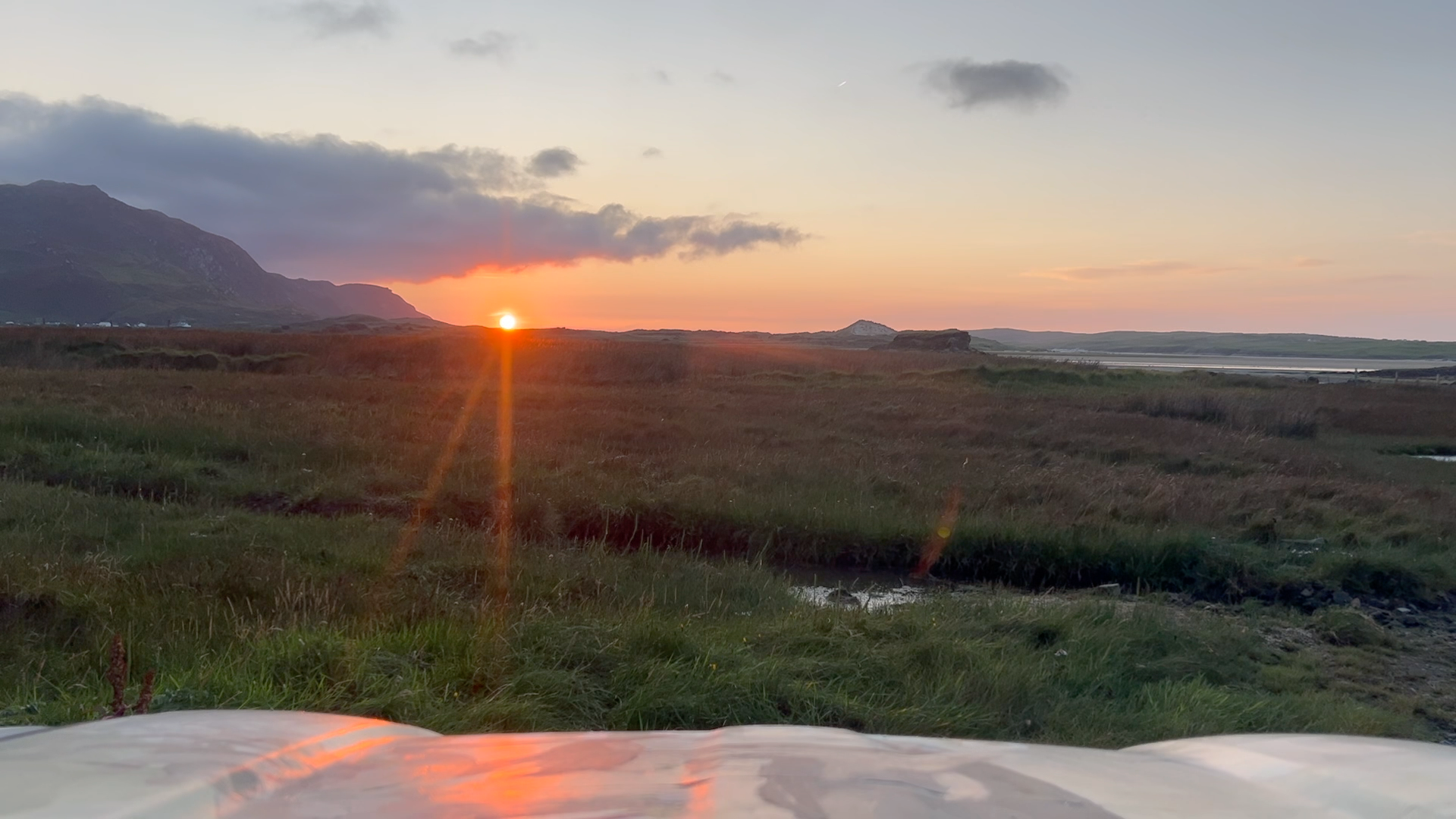
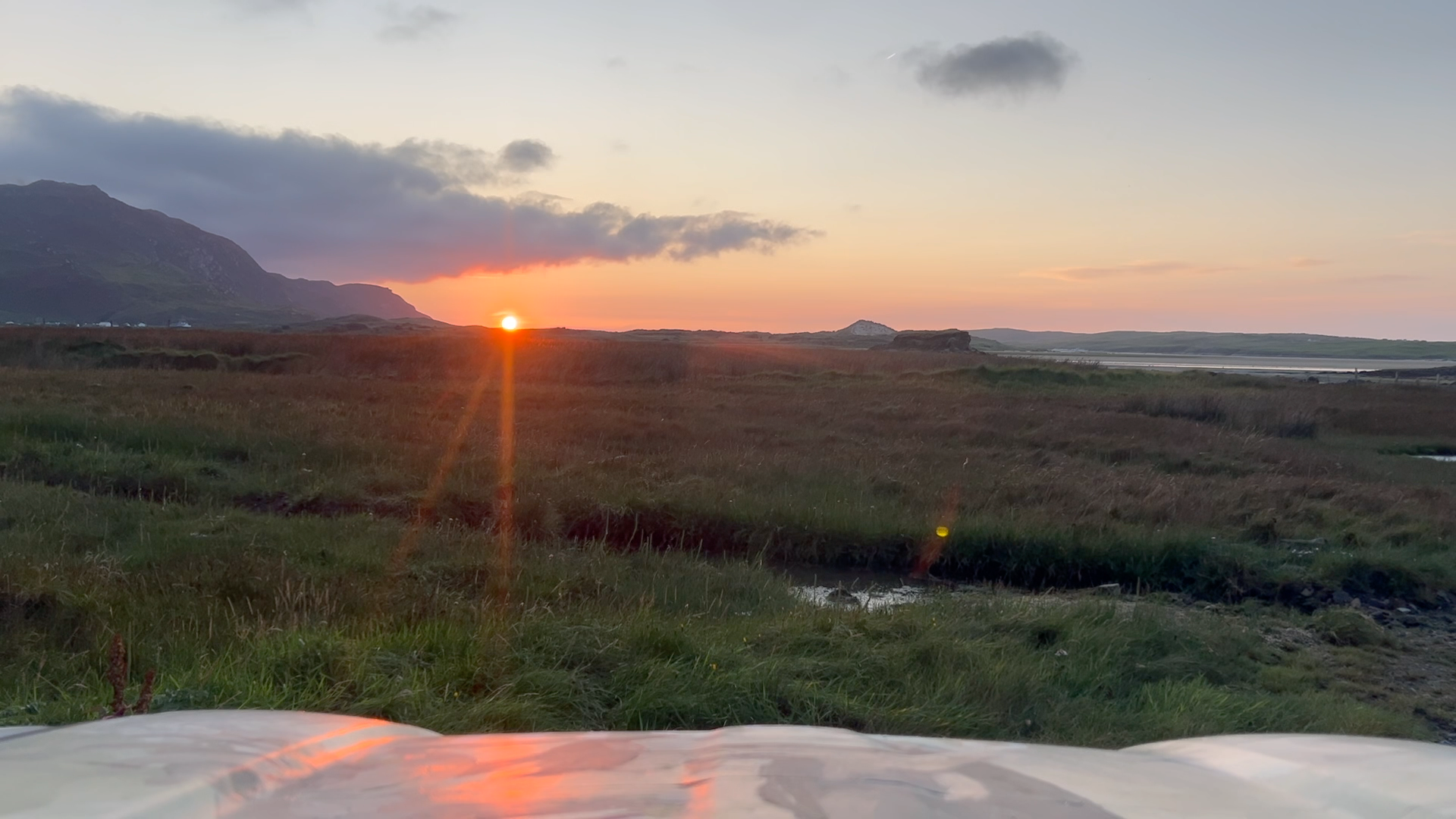
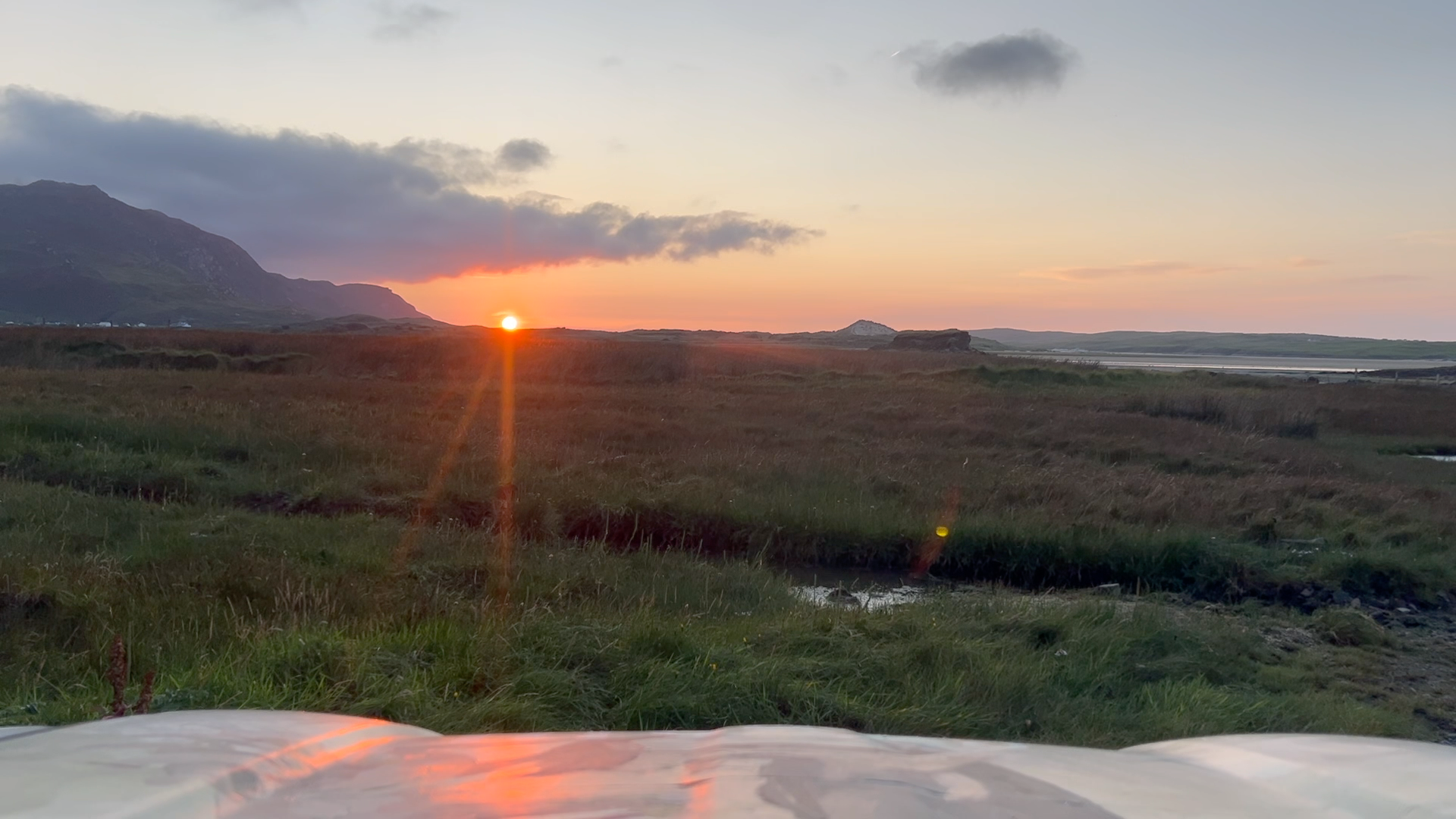
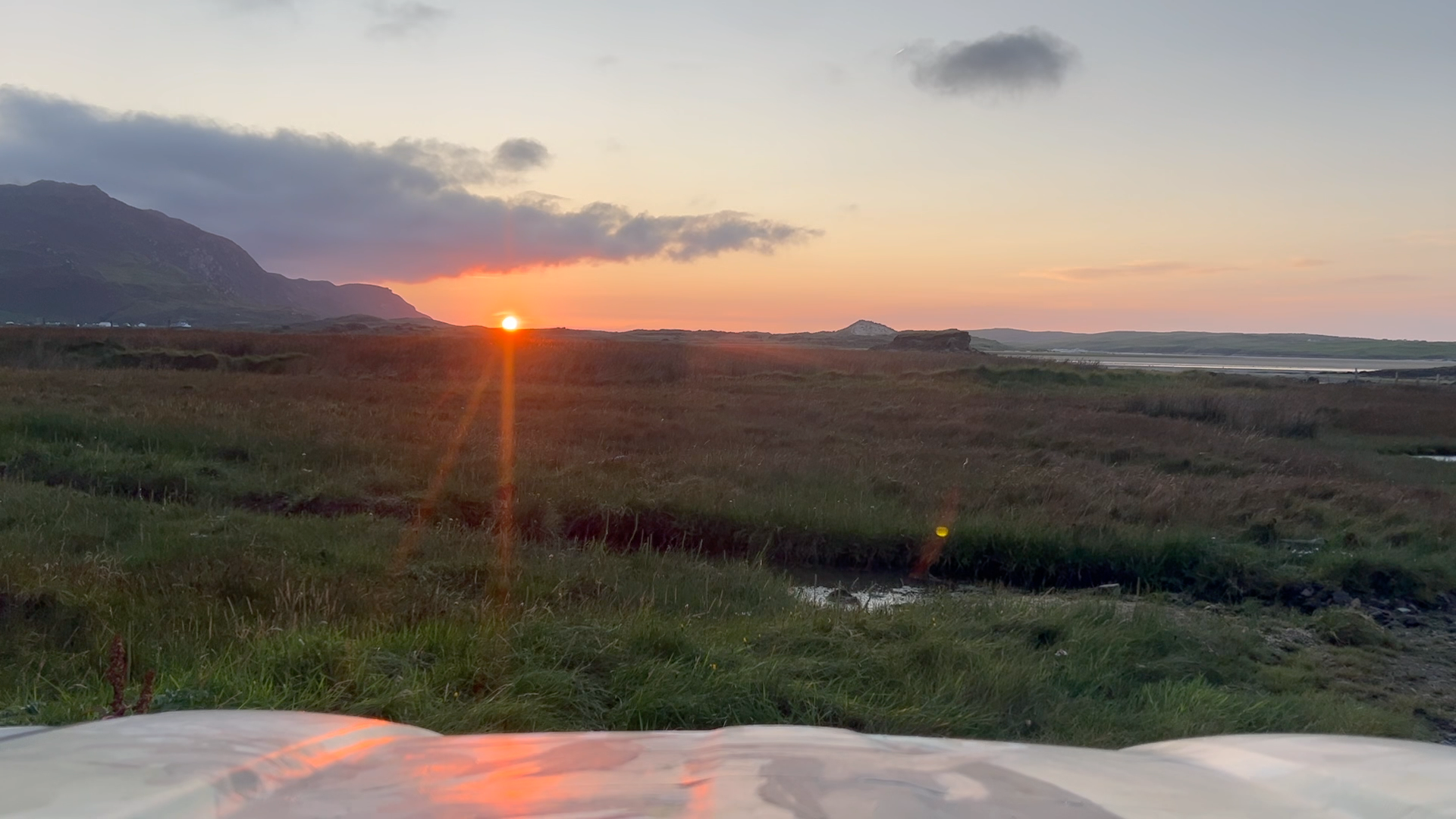
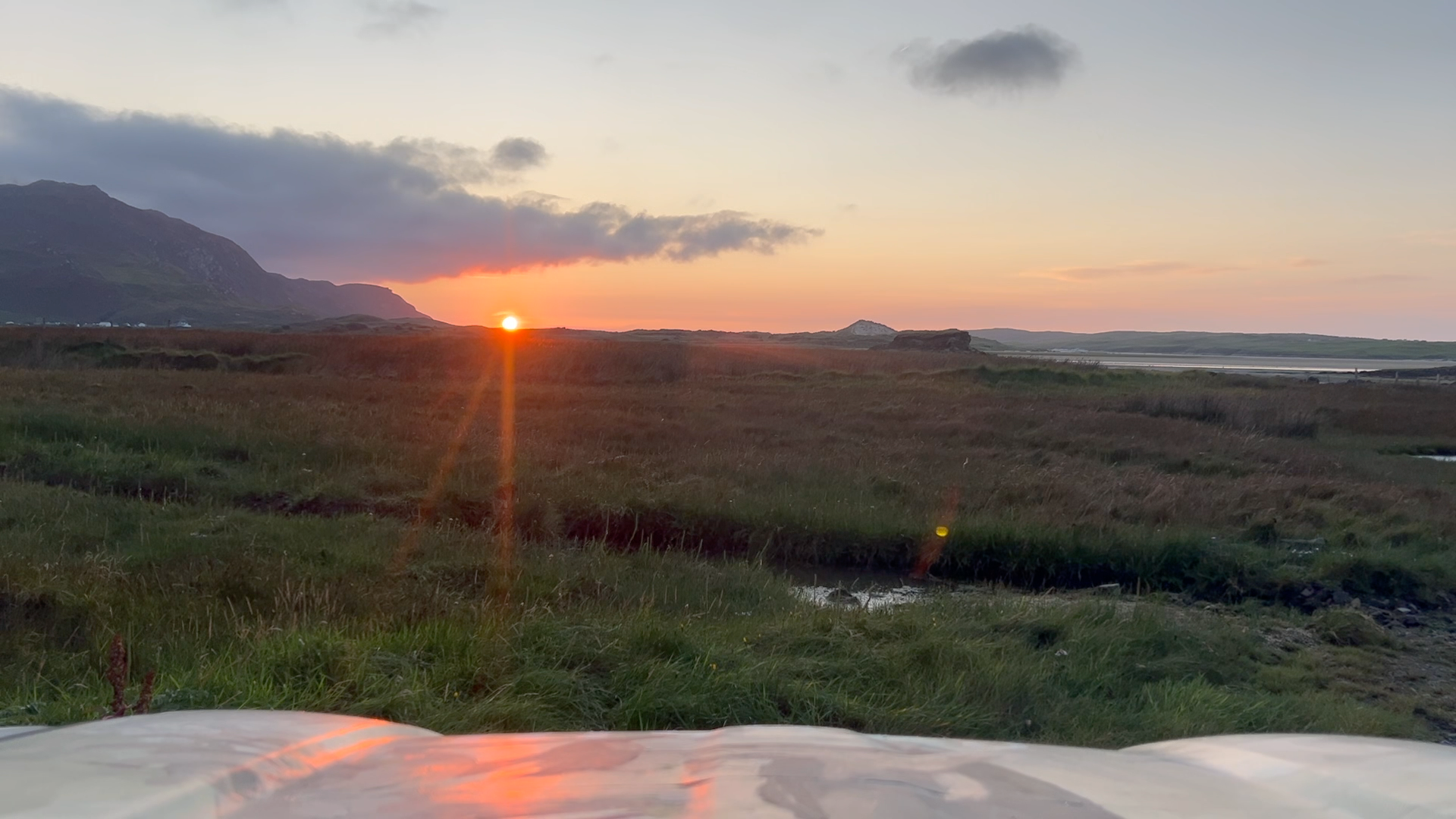
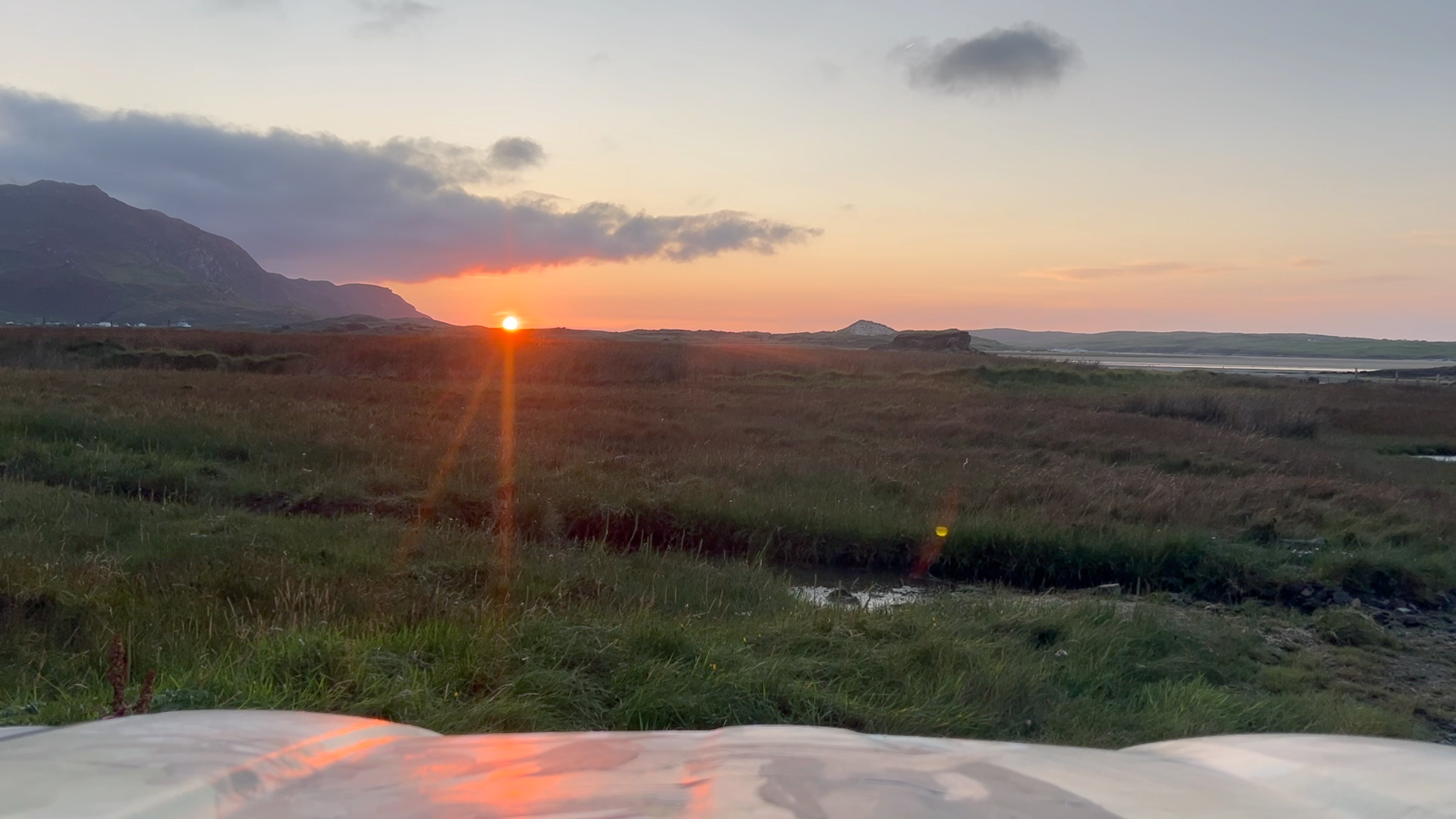
13.08.2025
This time last year we took a break, a reading week to peruse Áine Ní Dhíoraí’s 1985 book Na Cruacha, Scéalta agus Seanchas. As a native of Donegal, Ní Dhioraí’s specialised research interests are connected with the local landscape, its stories and folklore. For the book, Ní Dhioraí collected from a number of informants including Anna Nic an Luain, a celebrated traditional Irish-language storyteller and singer from Cruach Thiobraide in the Blue Stack Mountains. Ní Dhioraí describes her as follows,
She had a faithful and never forgetting memory. We of the present day have destroyed ours by reading and writing so much that we cannot understand anyone who has it. Anna has supplied the collectors of the Irish Folklore Commission with the texts of more than two hundred old and new folk-songs, caoins, poems and ballads, all from memory, some of them containing more than twenty stanzas. She has told more than fifty long stories and these take sometimes a full night. I worked with her for over eighteen months and she never repeated anything twice during that time. Her richness, welling up from unbelievably ancient sources is not yet at an end.
Below is an extract about a fairy wake collected from Anna Nic an Luain in 1977. A first person account of journeying along the road outside of Glenties in south west Donegal, through the Bluestack Mountains when the sound of keening, crying brings her to a sudden stop, a moment of disorientation in the landscape…
….Ag teacht aniar dúinn os coinne Chruach an Airgid mhothaigh mise an caoineadh a ba thruacánta a mhothaigh mé ariamh. Sheas mé go tobann agus d'éist mé agus nuair a sheas mé stad sé.
Shiúil mé liom agus d'fhiafraigh an cailín eile díom an bhfacaigh mé dadaidh.
' Ní fhacas ', arsa mise, 'ach chualaigh mé rud inteacht.
An gcualaigh tusa dadaidh? ' arsa mise.
‘Nior chualaigh' ,arsa sise, 'caidé a chualaigh tusa?'
'Chuala mé caoineadh, agus caoineadh truacánta! 'arsa mise.
Sin a raibh de sin. Shiúil muid linn agus ní theachaigh muid céad slat gur mhothaigh mise an rud céanna.
Stad sé ar ais agus nior mhothaigh sise é ach oiread. Bhí muid ag dul ó ghiota go giota agus ní raibh giota slat ar bith a raibh muid ag dul nach raibh mise ag éisteacht leis an chaoineadh. Sa deireadh tháinig muid aniar ar amharc an bhaile agus leis sin féin chuaigh an caoineadh thart fá fhad bata dúinn agus bhí mise ag éisteacht leis go dteachaigh sé suas taobh na Cruaiche Goirme agus i rith an ama níor chualaigh an bhean a bhí liom é…
8.12. Tórramh Sí
RBÉ 1033, 187-90. S. Ó H. a bhailigh ó Anna Nic an Luain, Cruach Thiobraid, ar an 15.1.48. Tá leagan den scéal seo i gló ag Ó hEochaidh,S., Ní Néill, M., O Catháin, S., Síscéalta ó Thír Chonaill (B.Á.C. 1977).
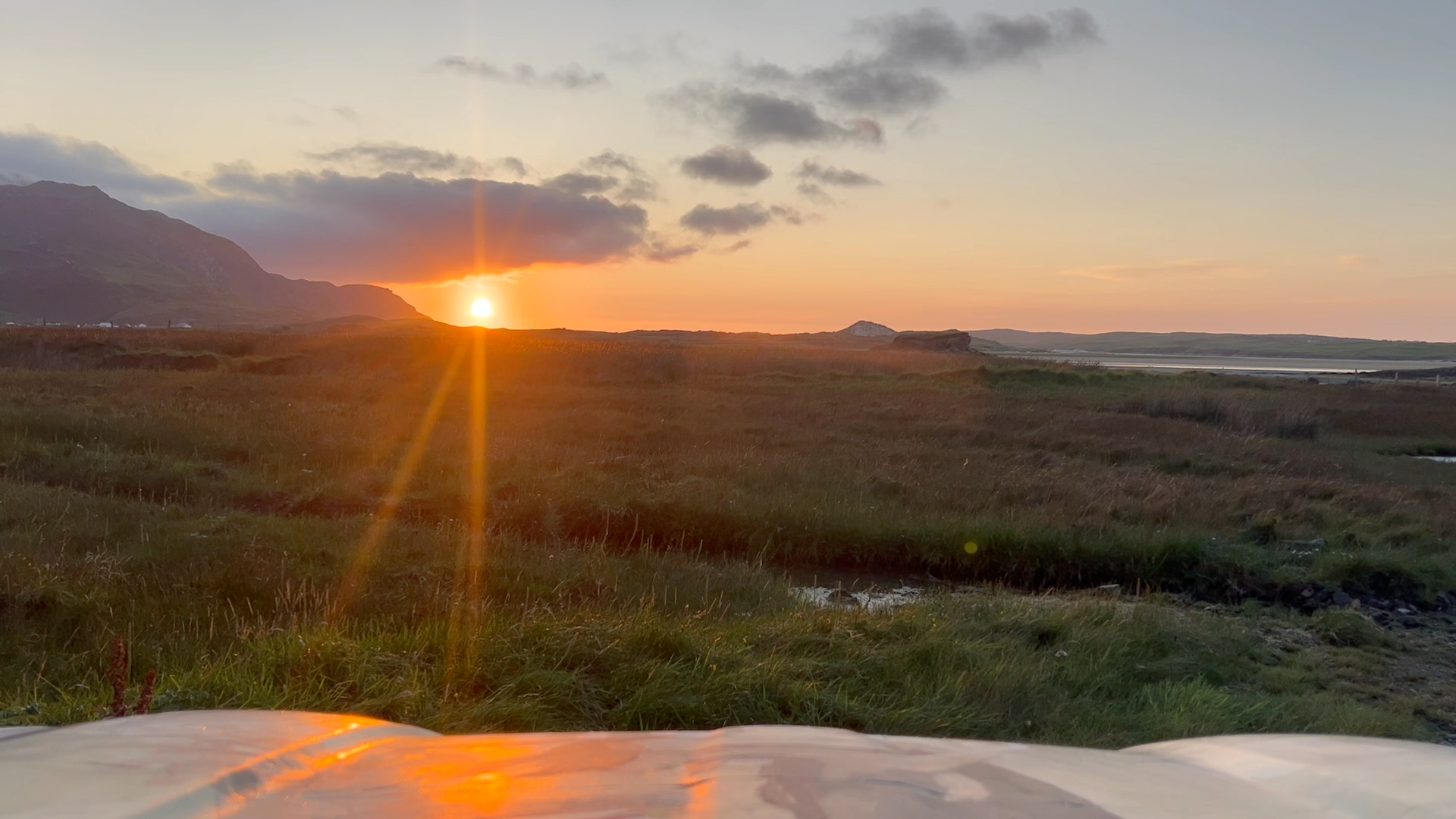
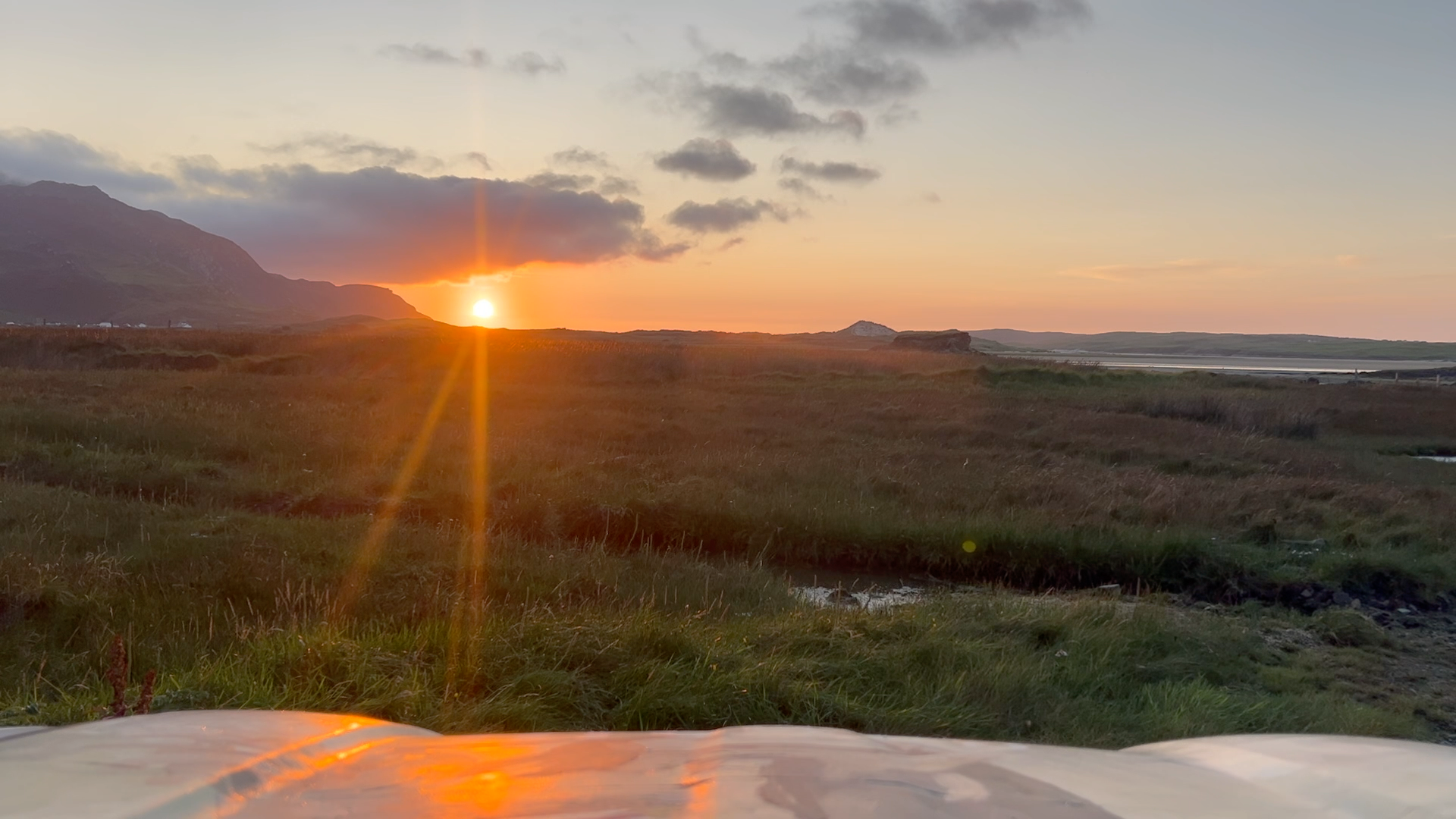
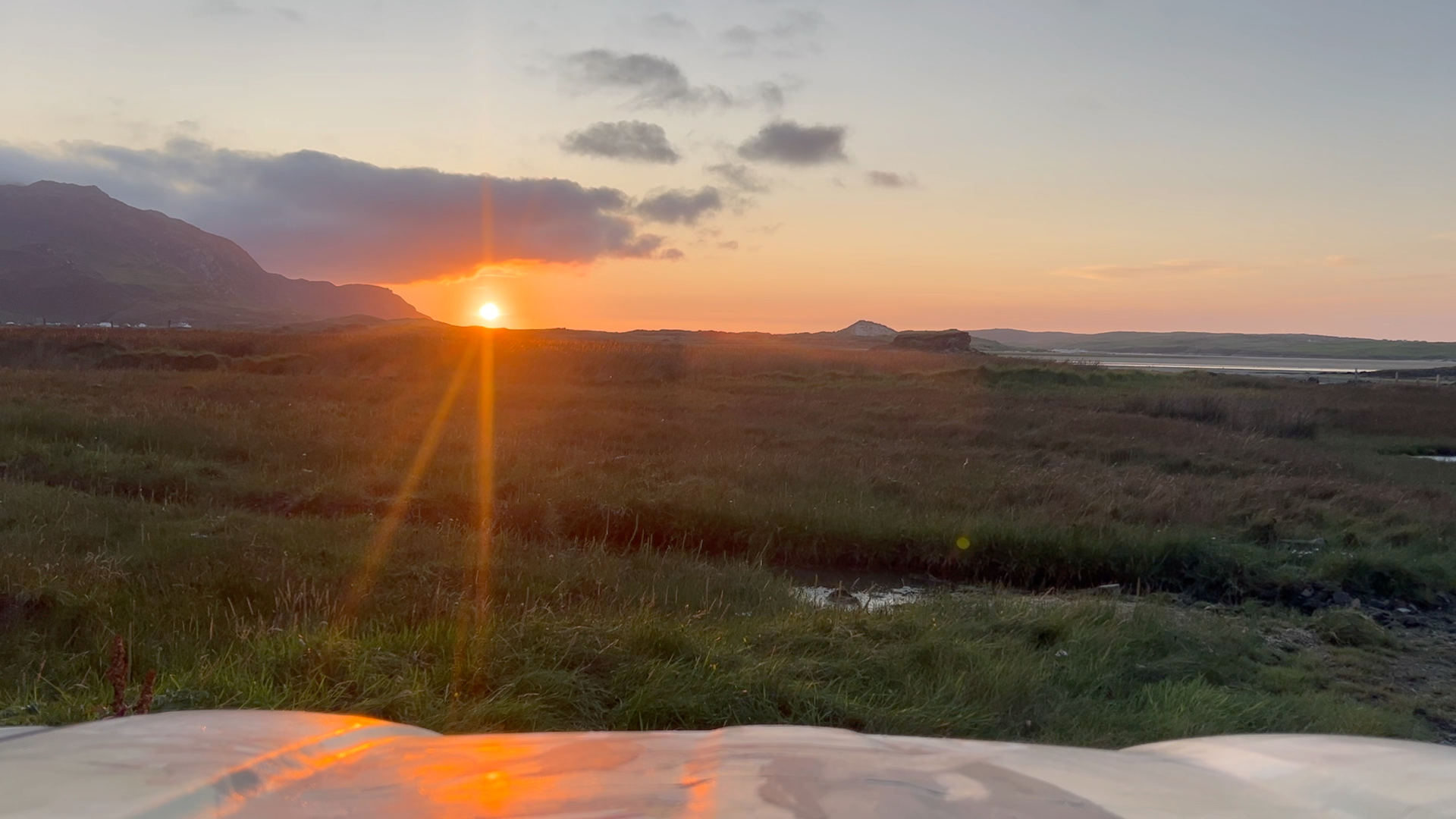
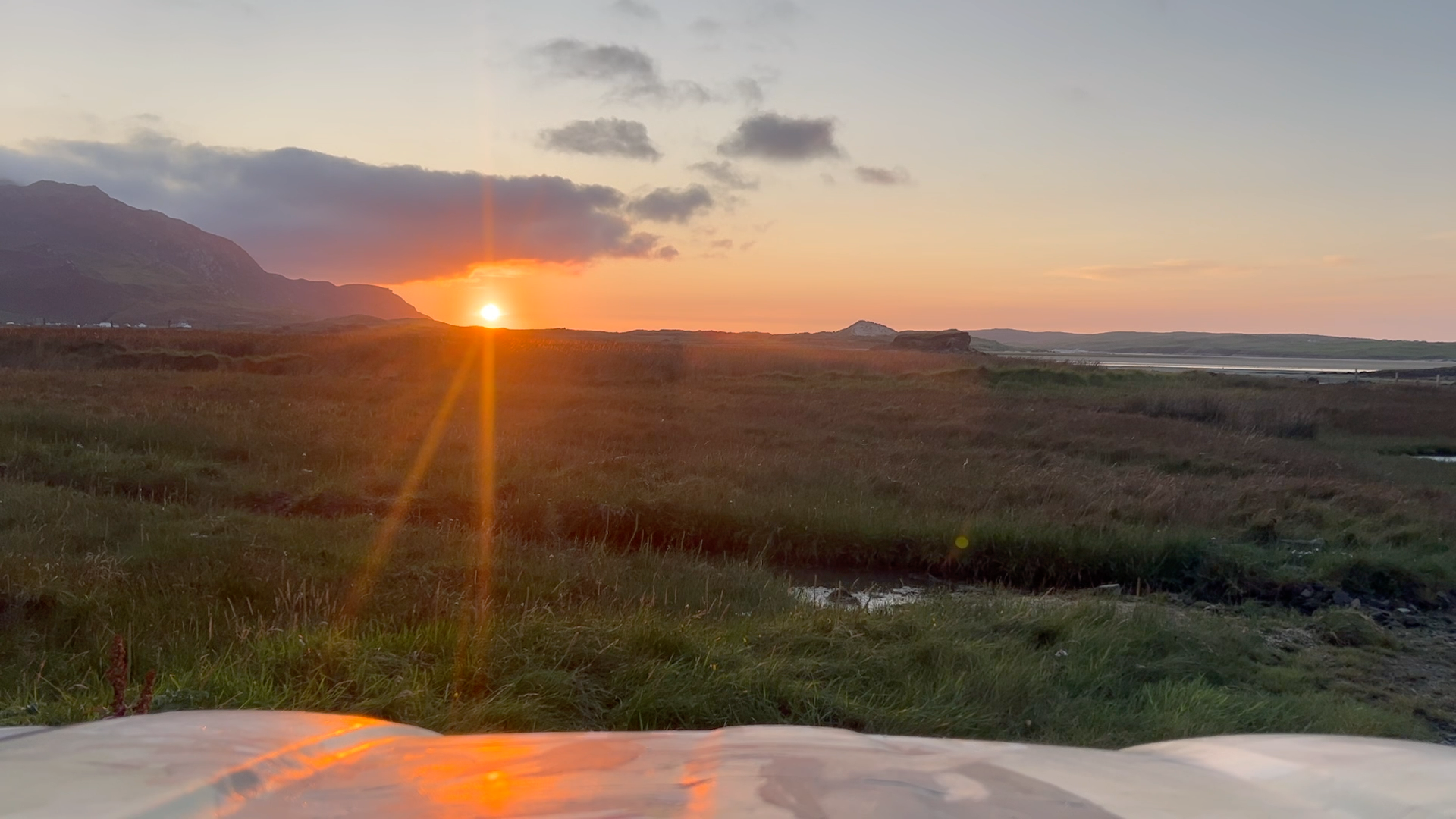
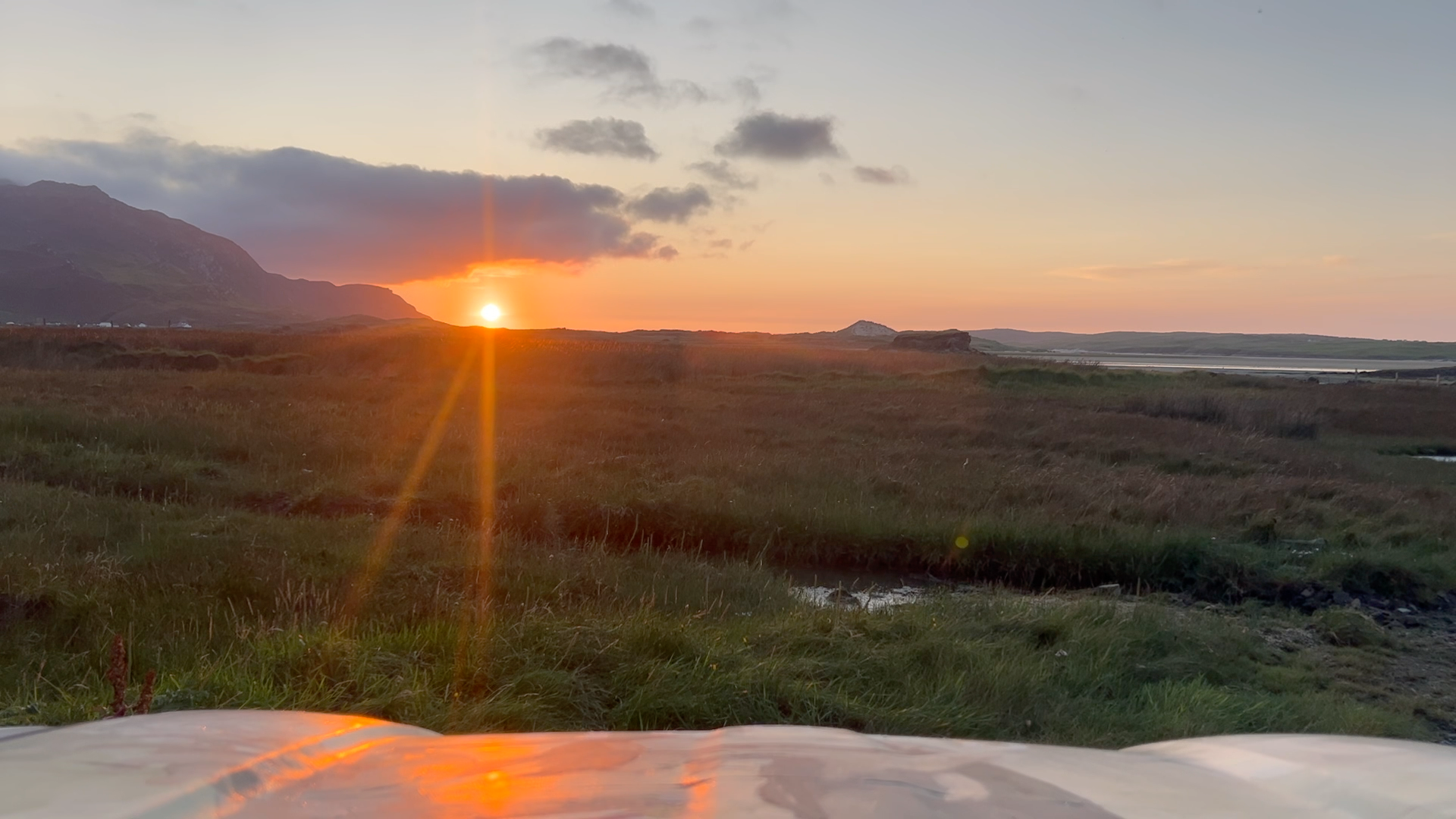
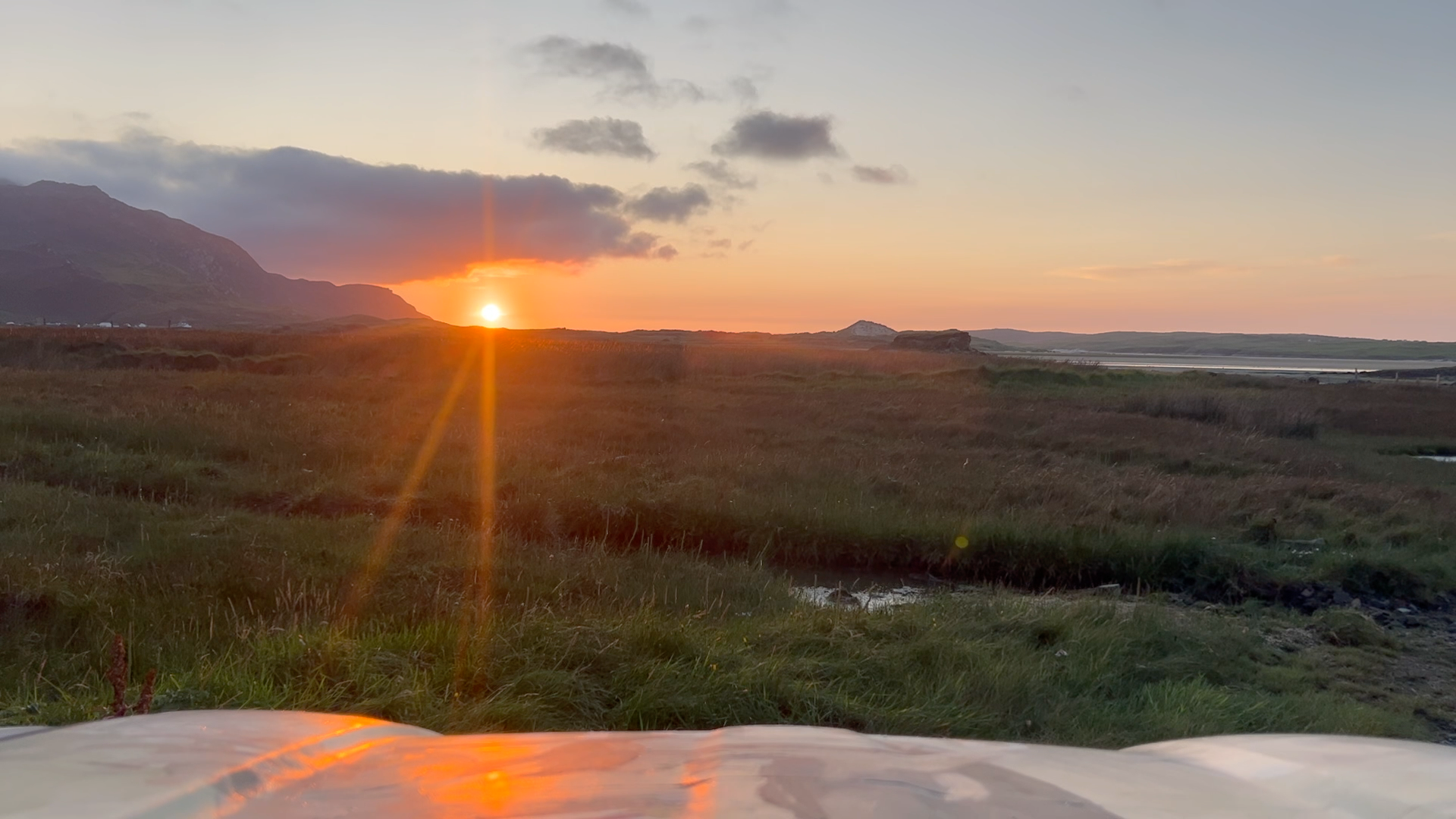
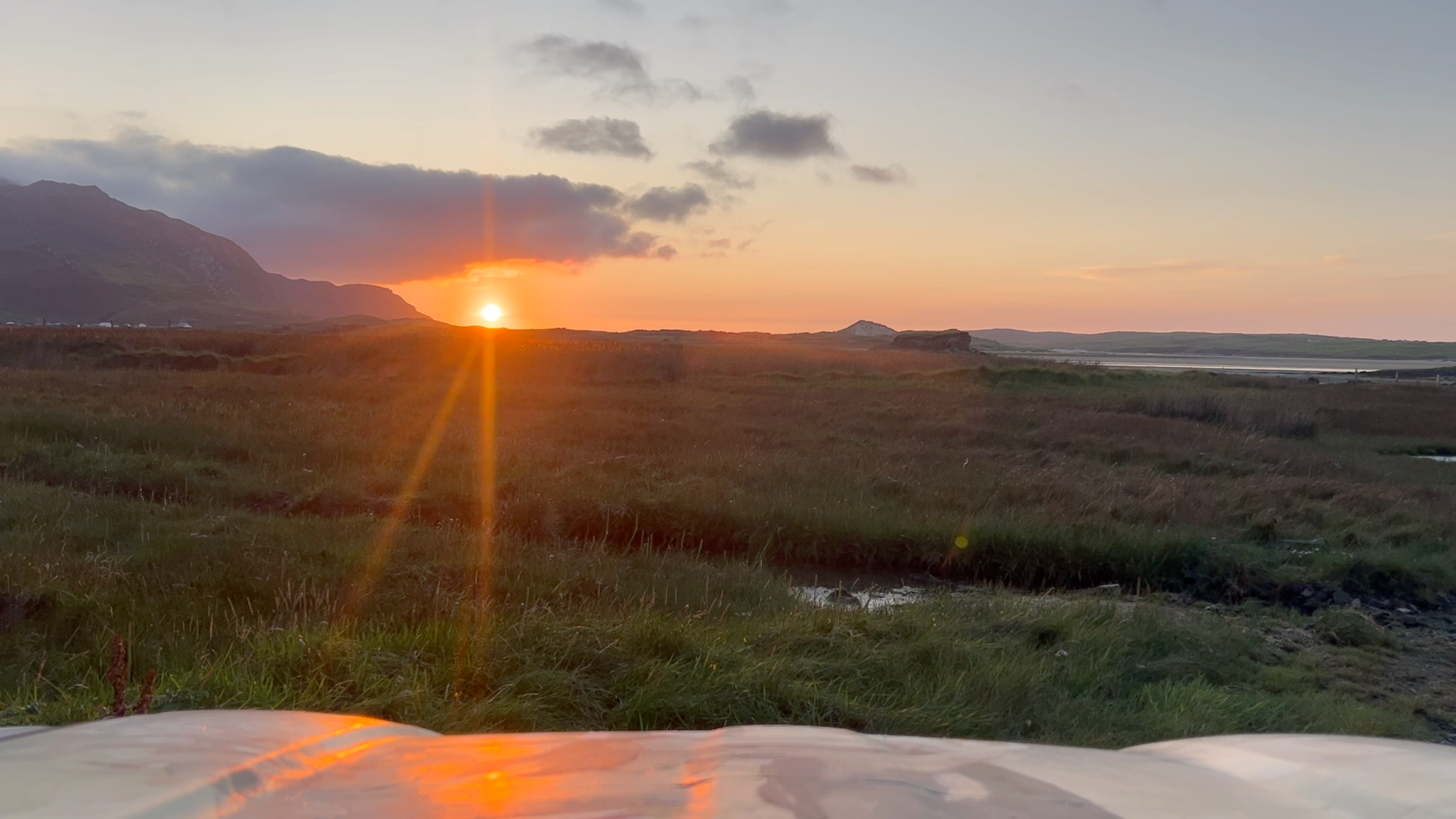
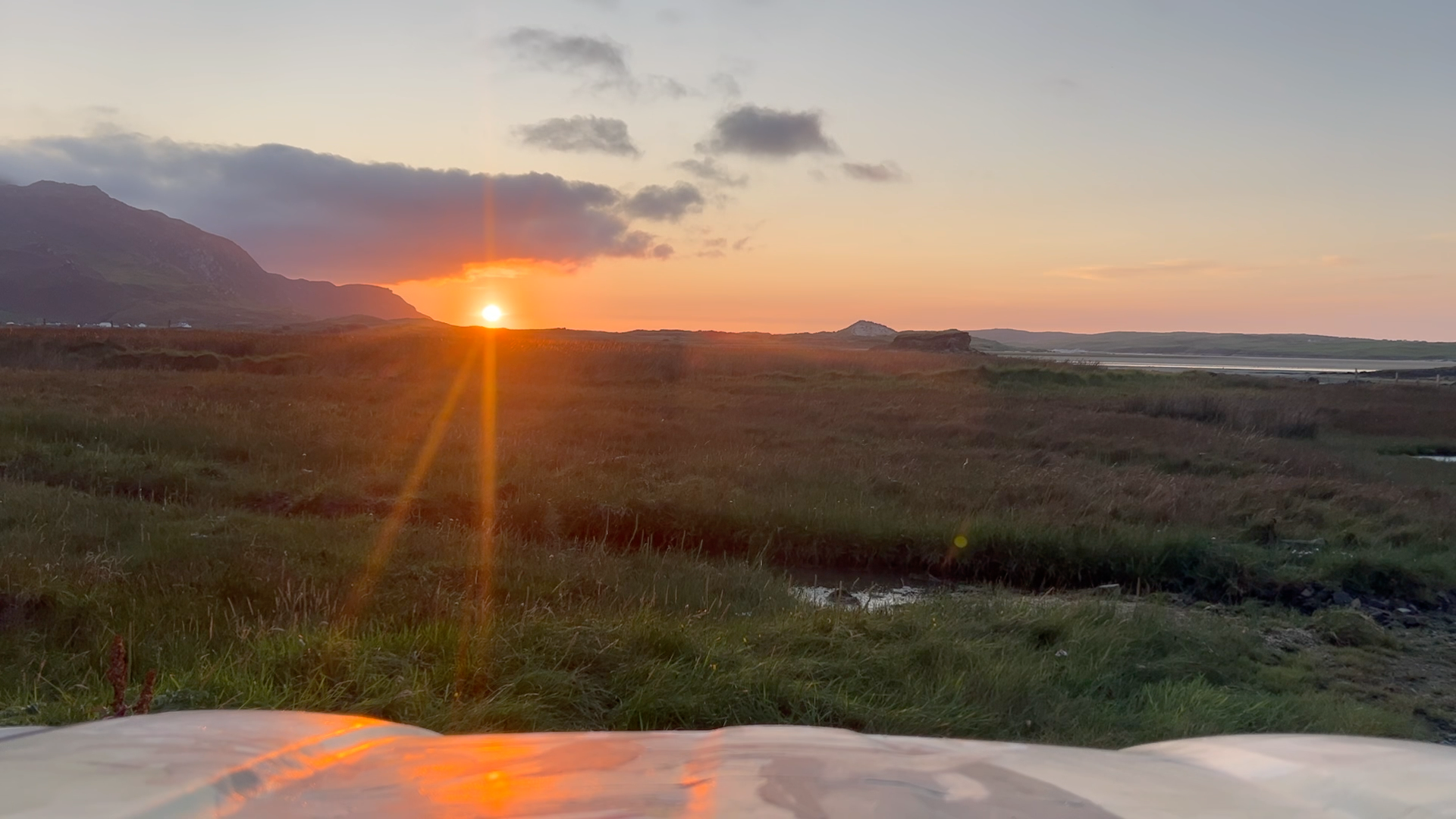
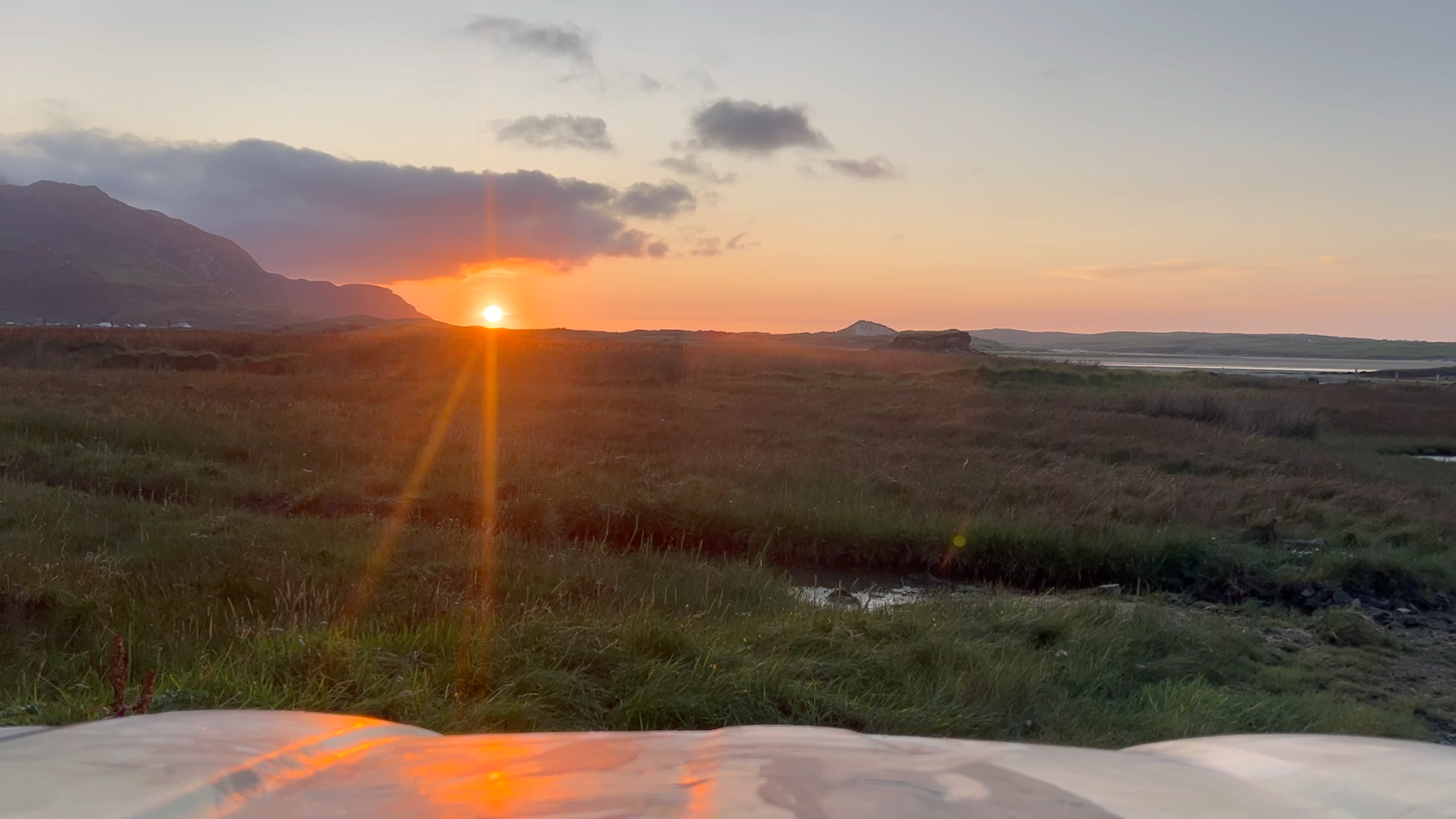
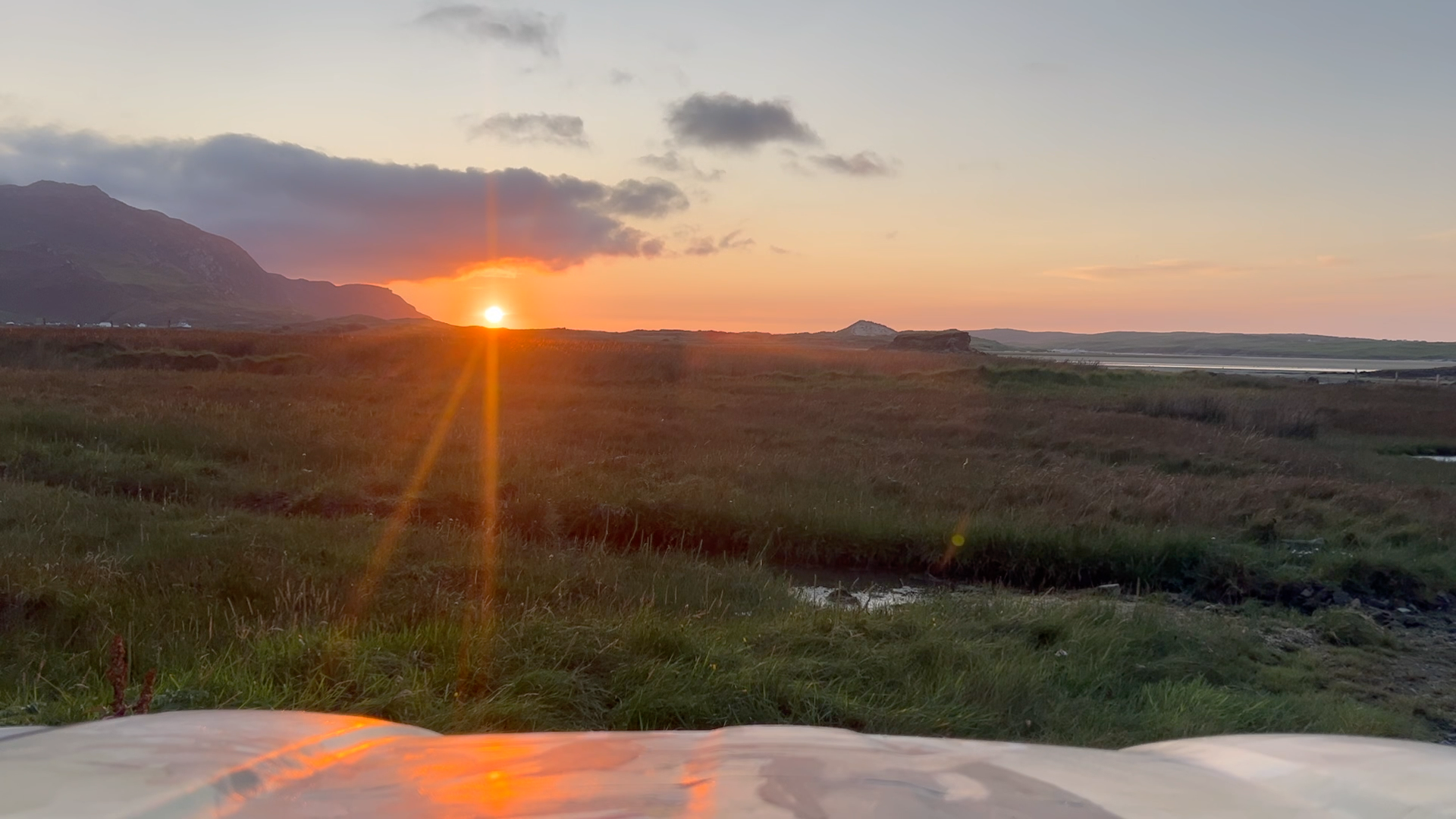
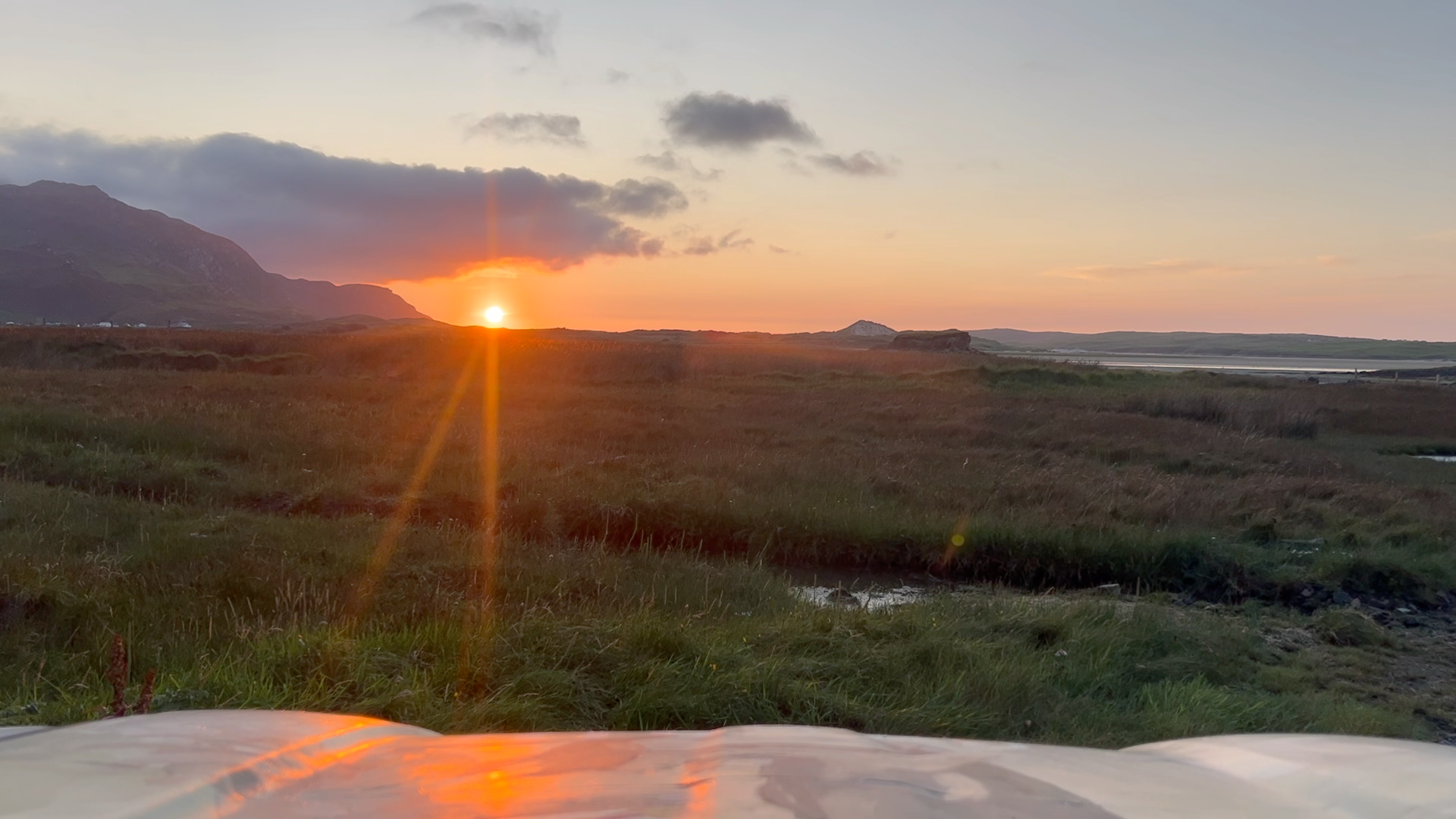
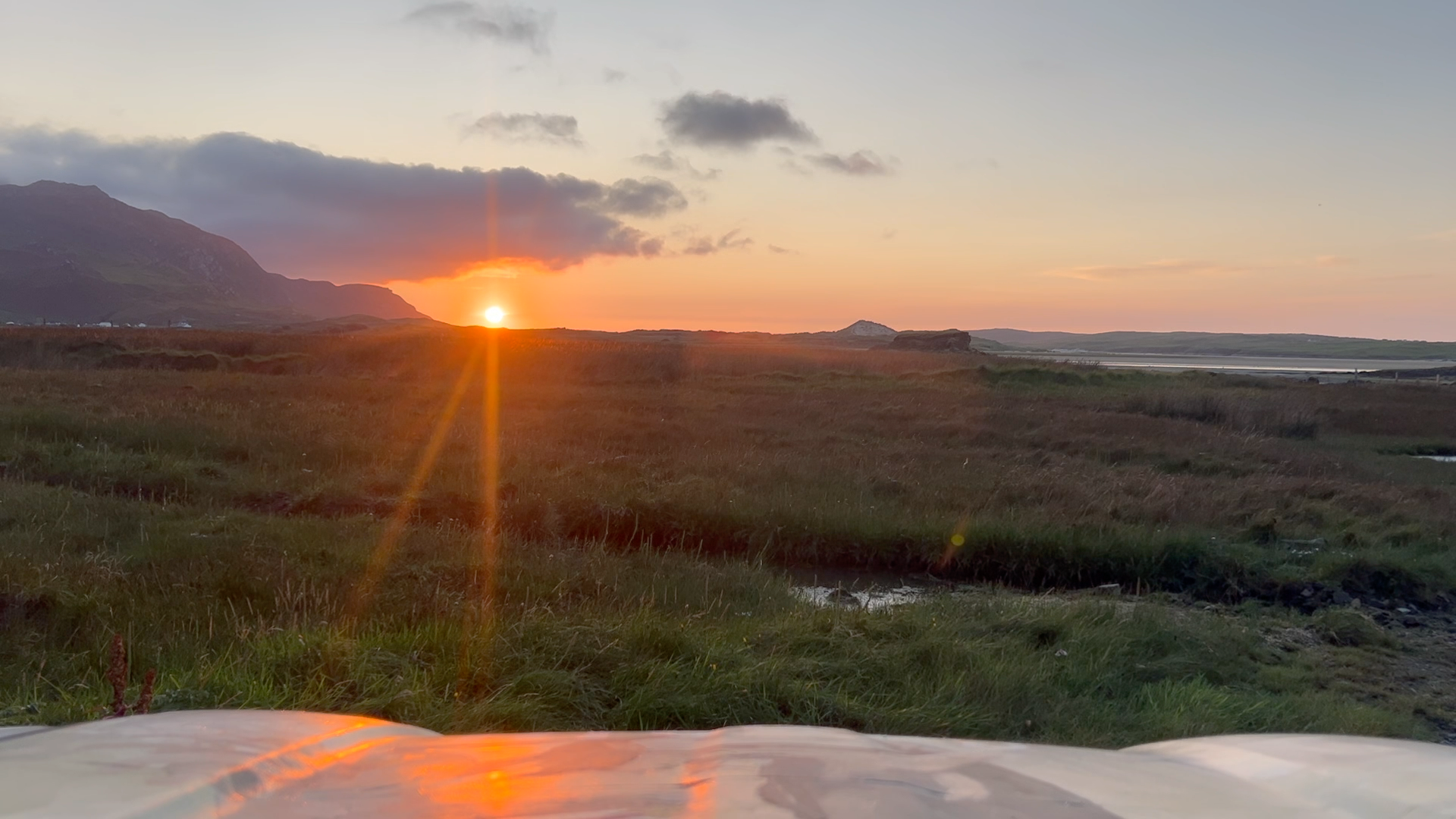
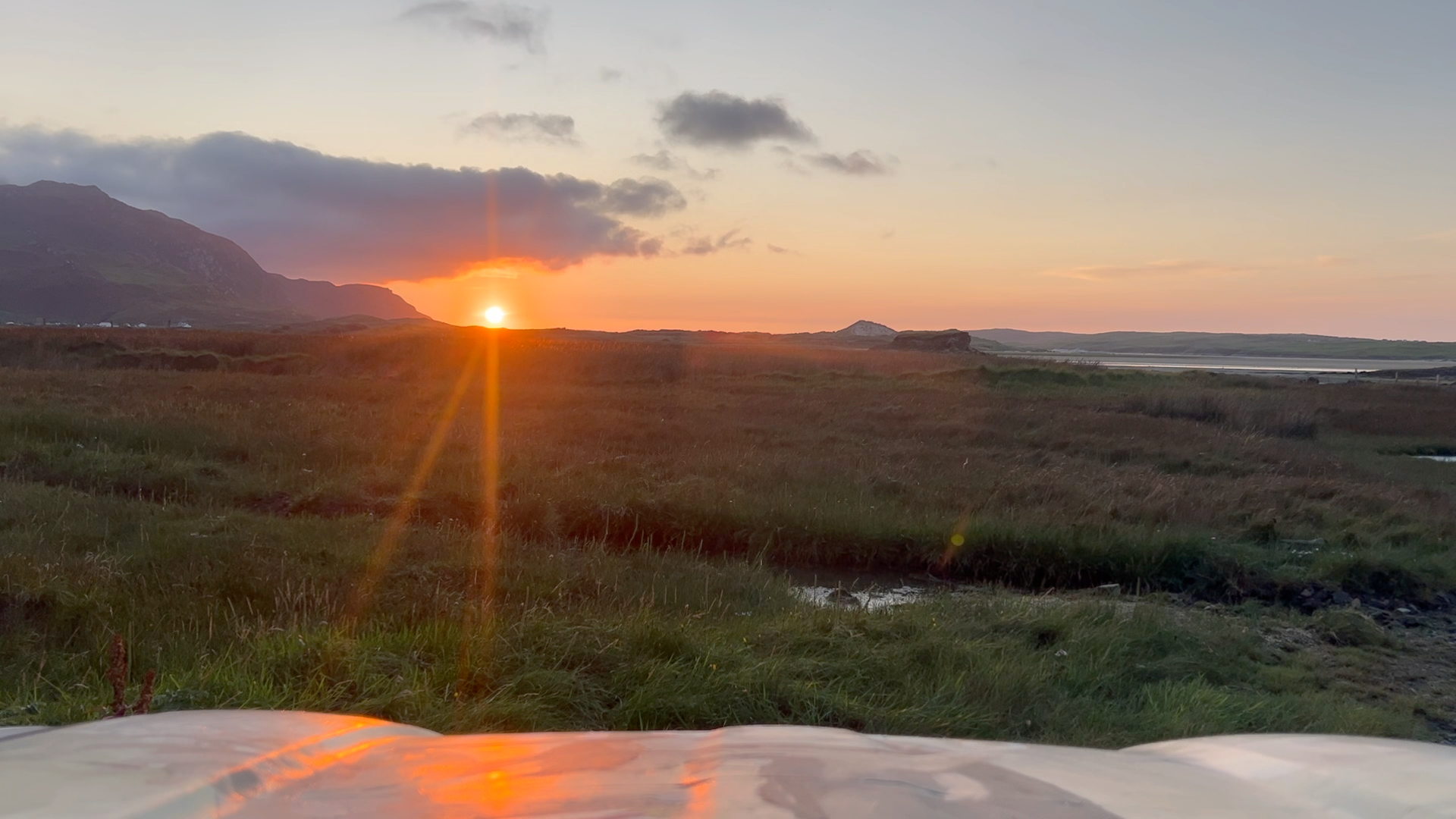
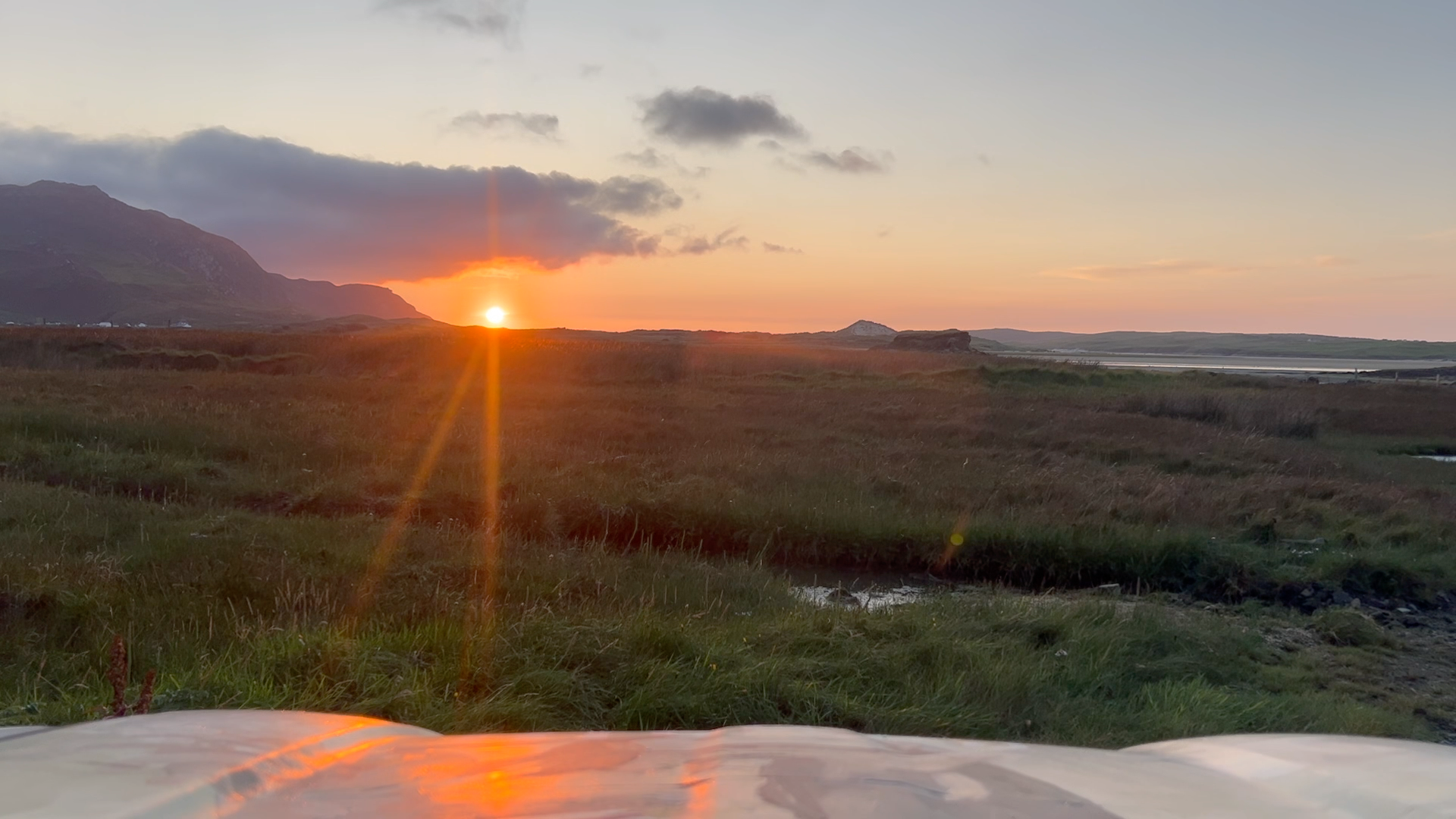
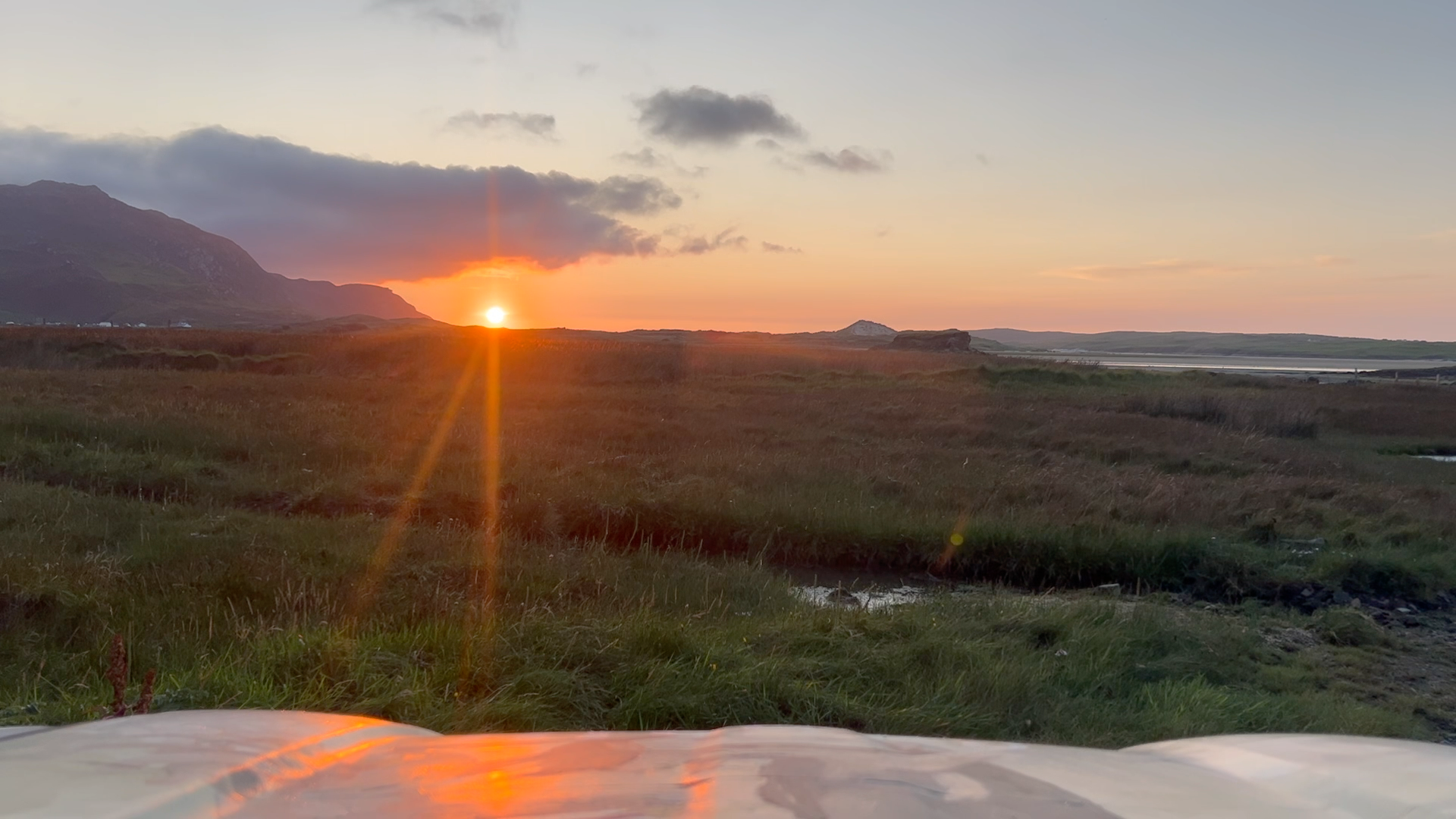
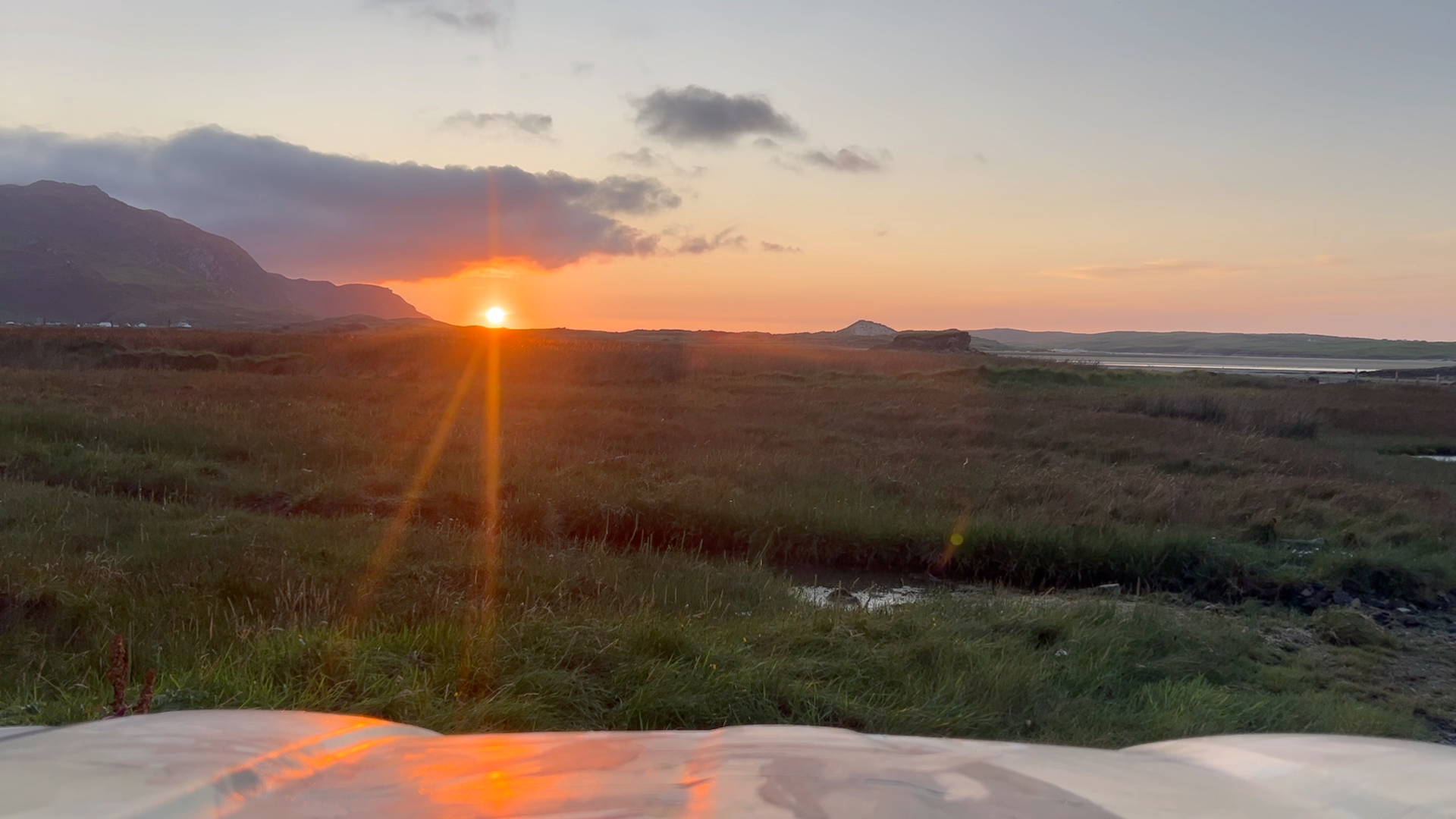
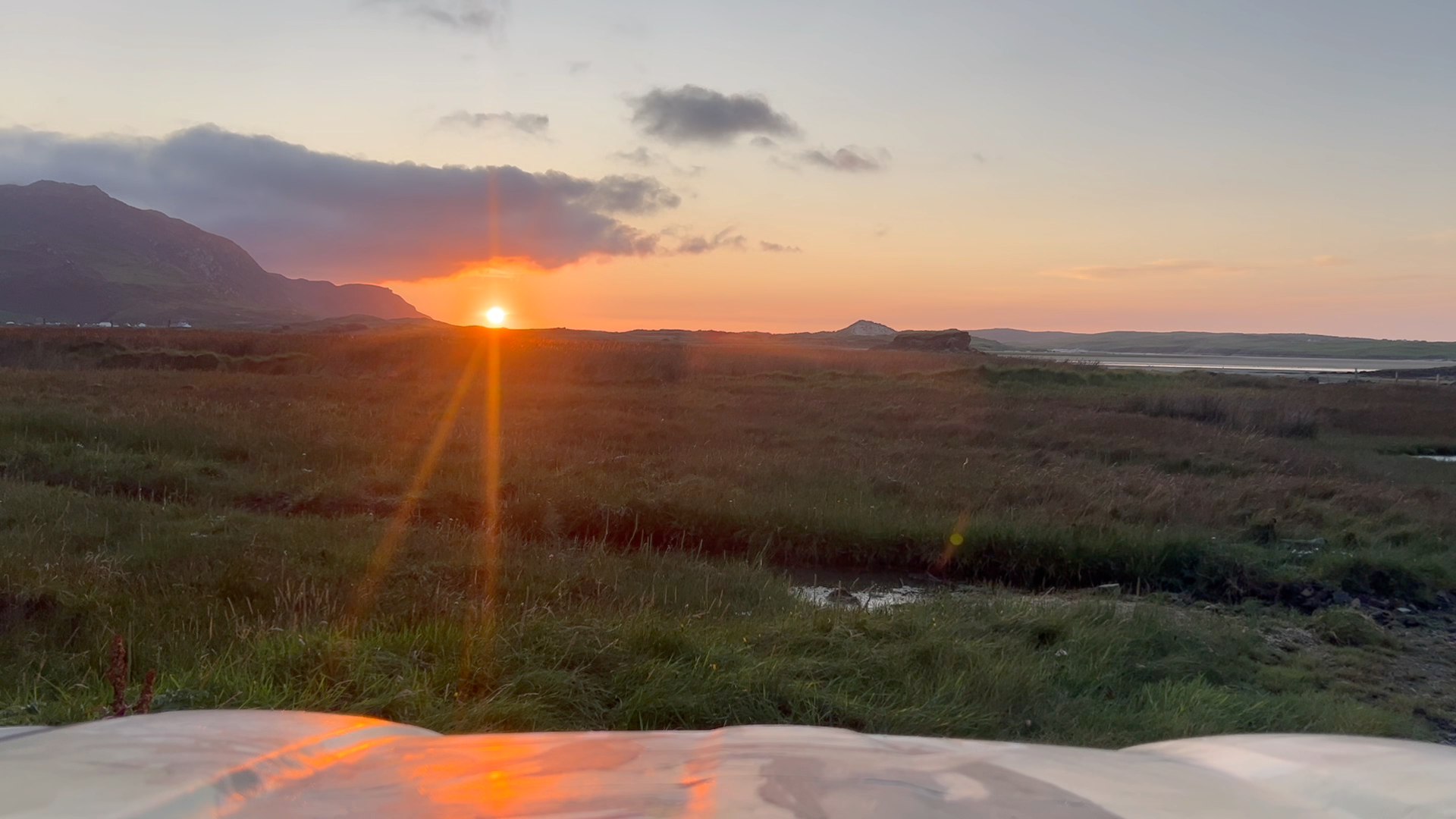
12.08.2025
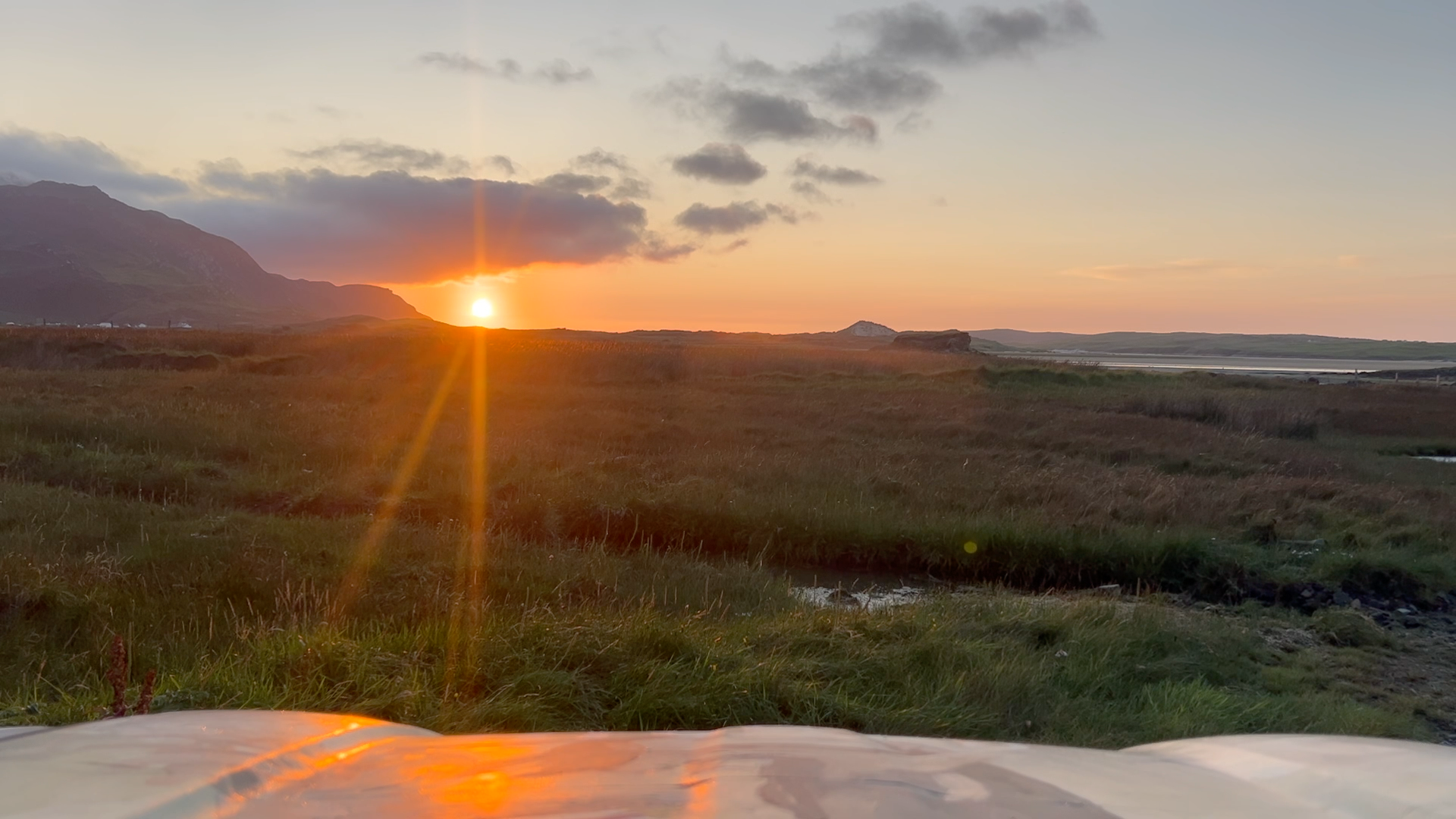
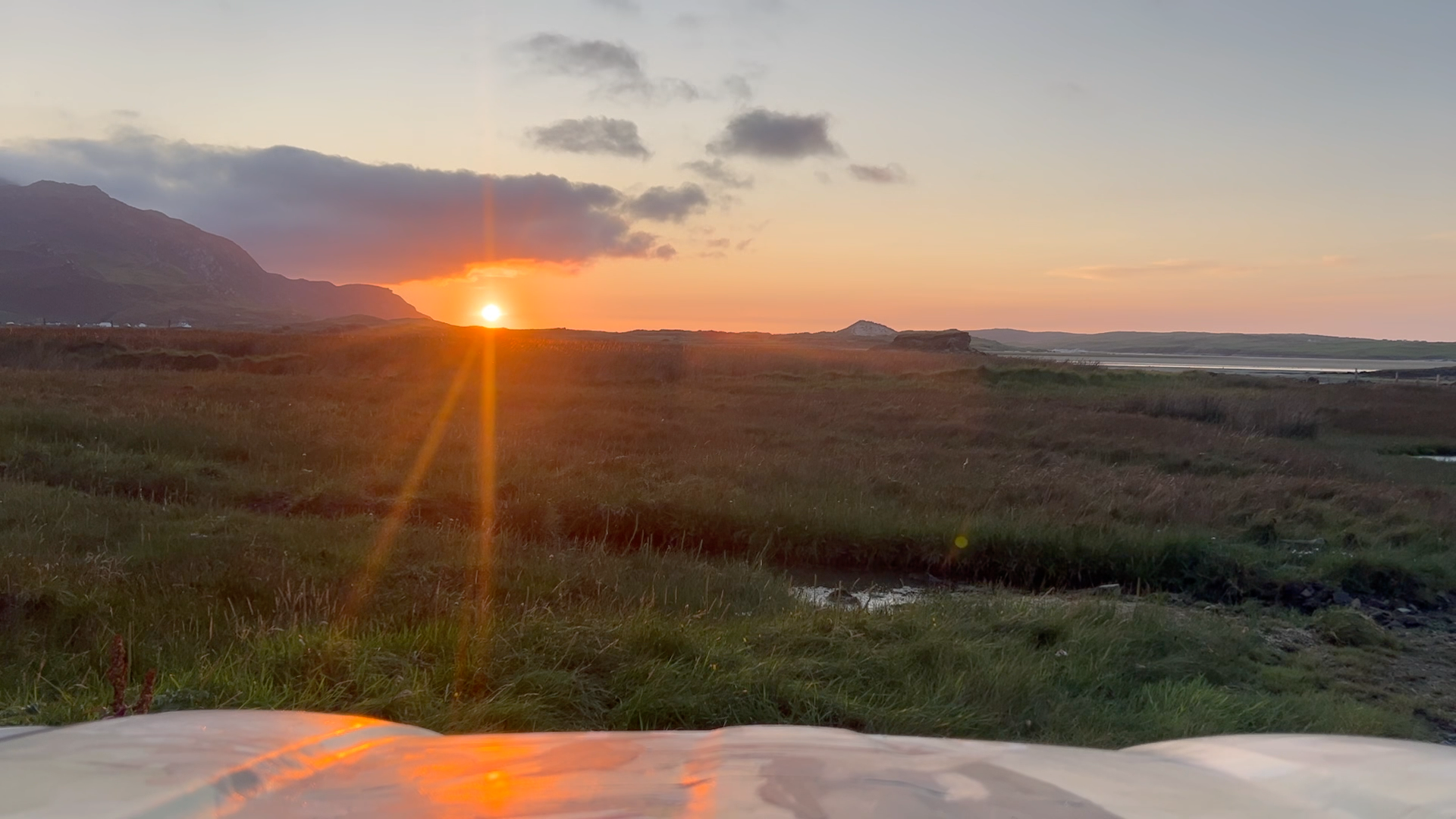
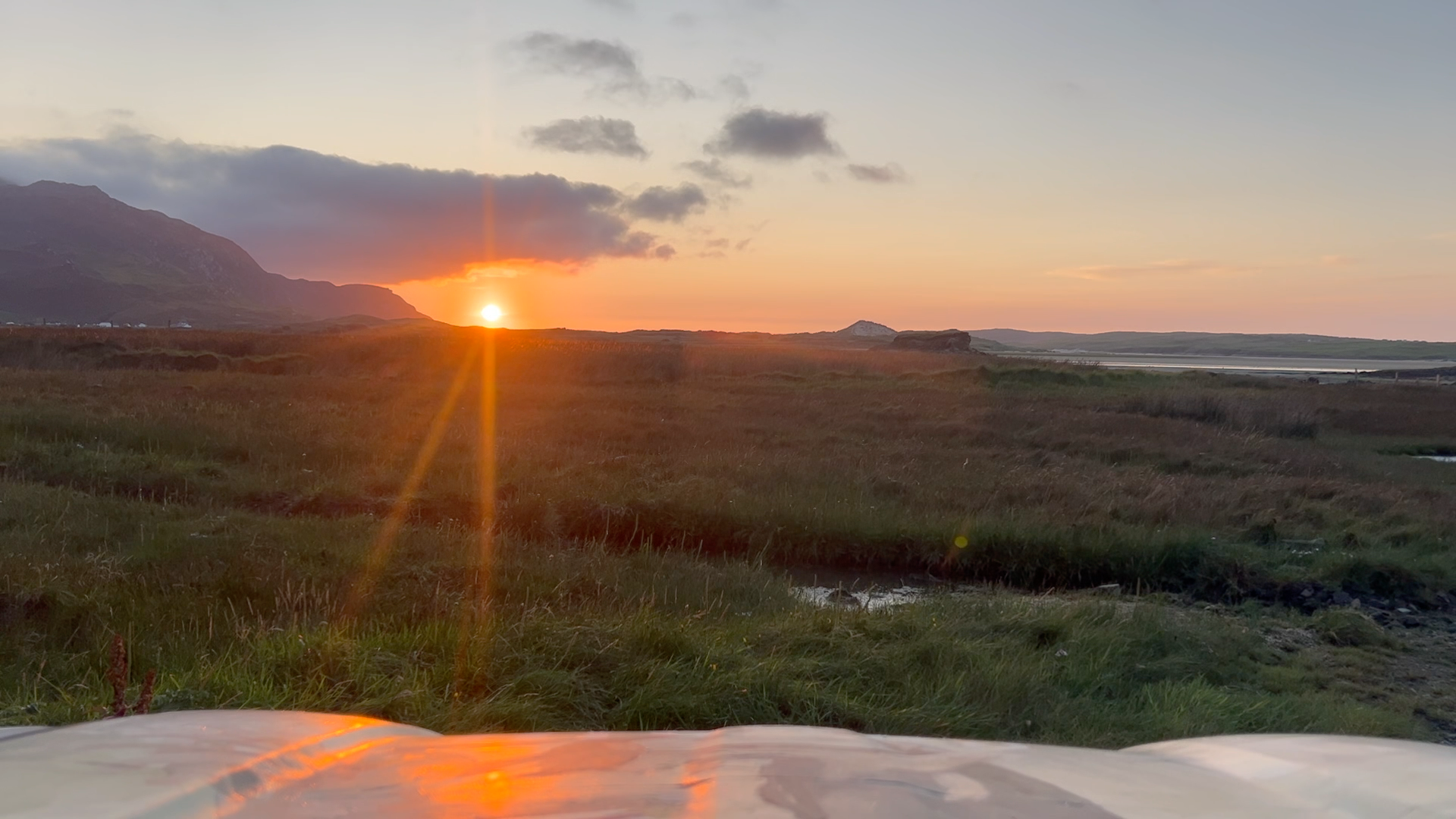
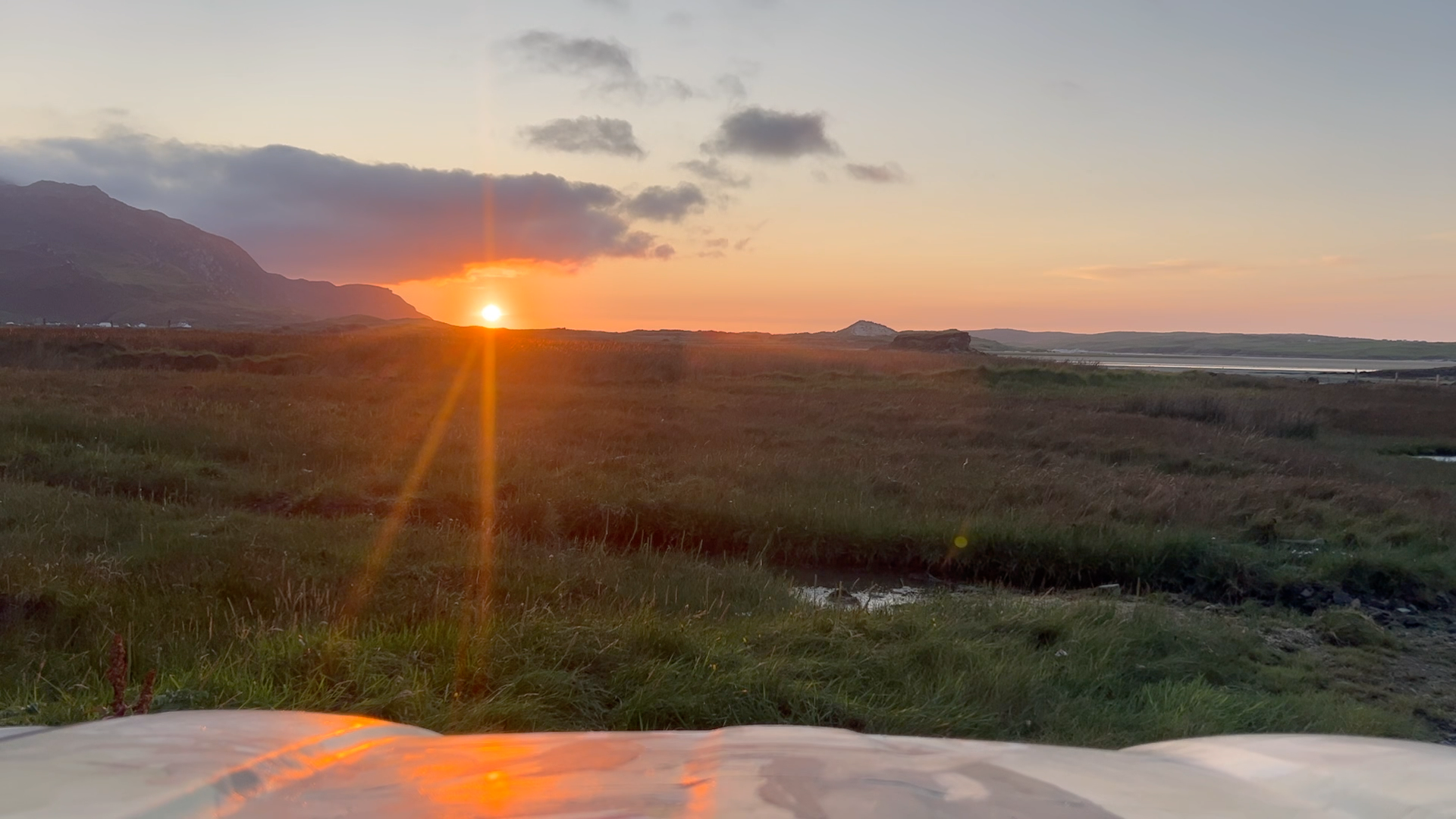
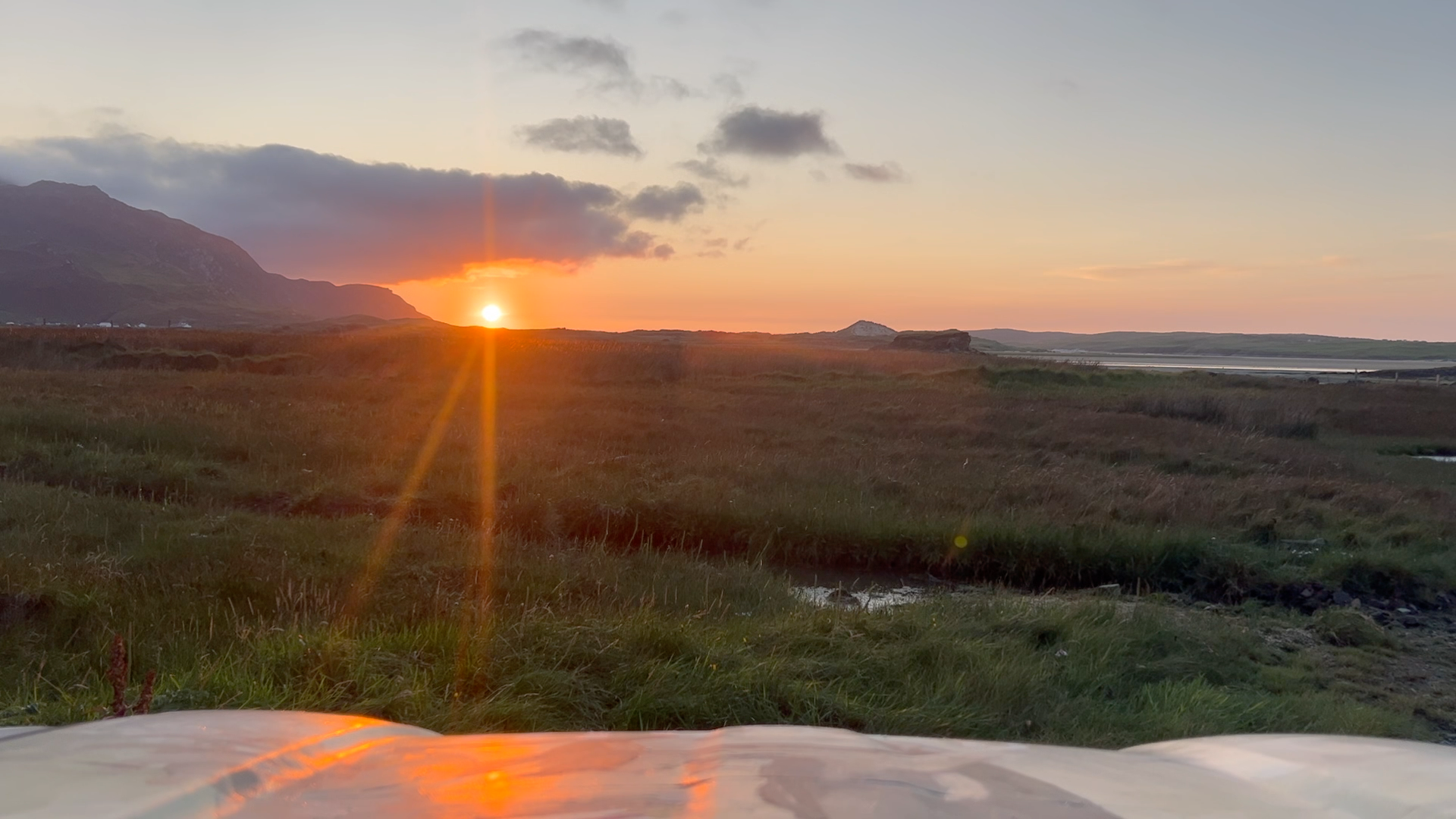
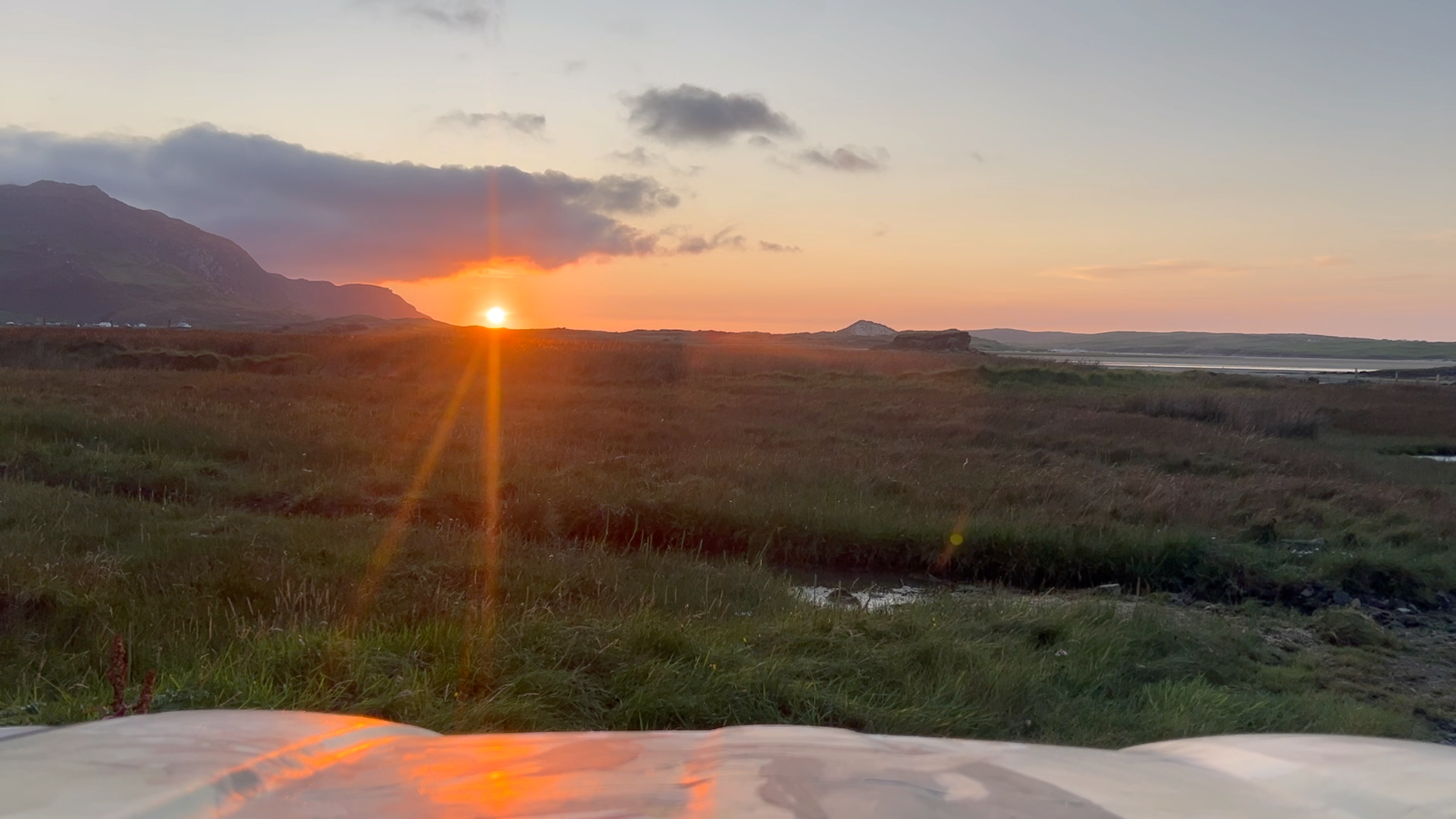
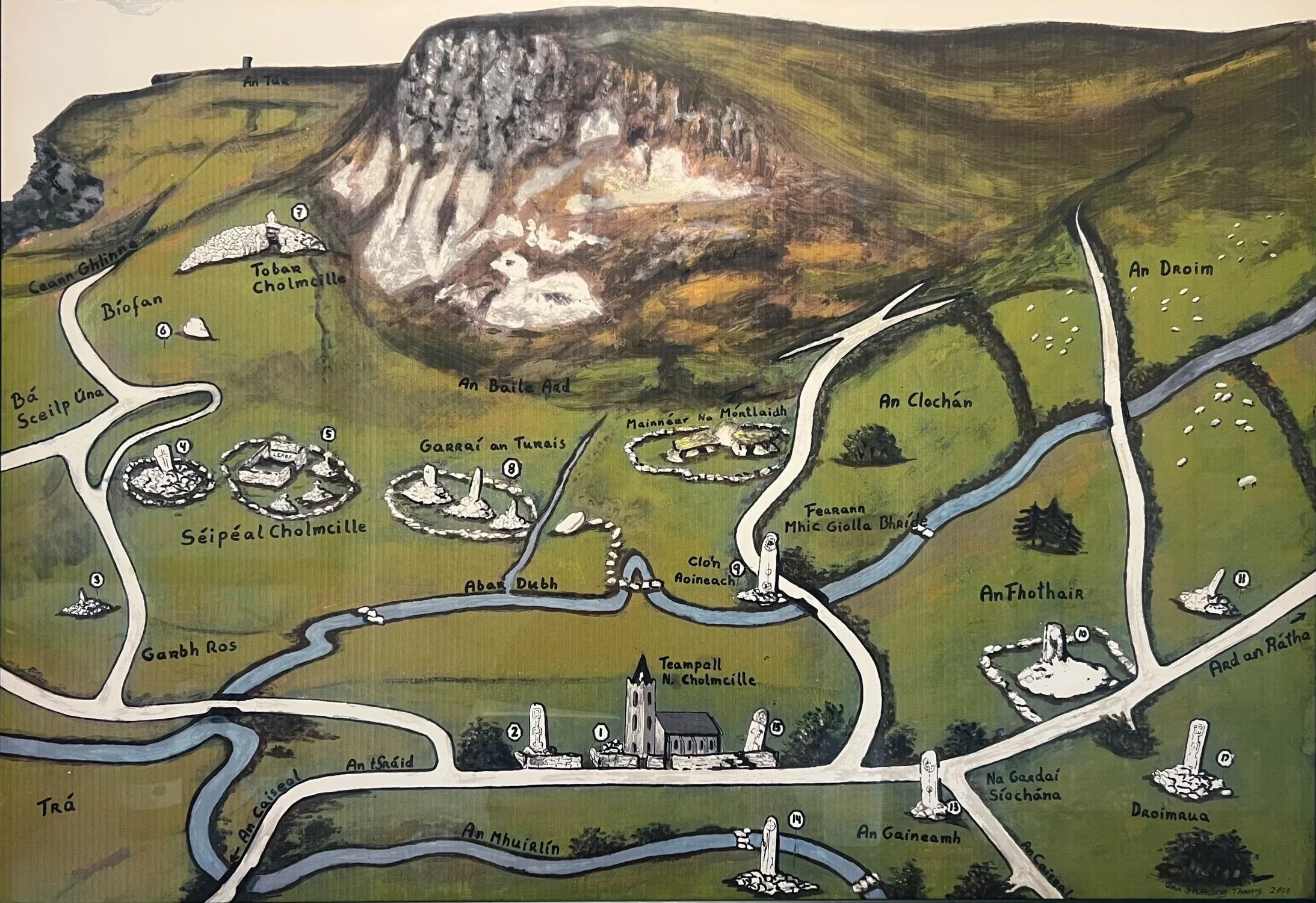
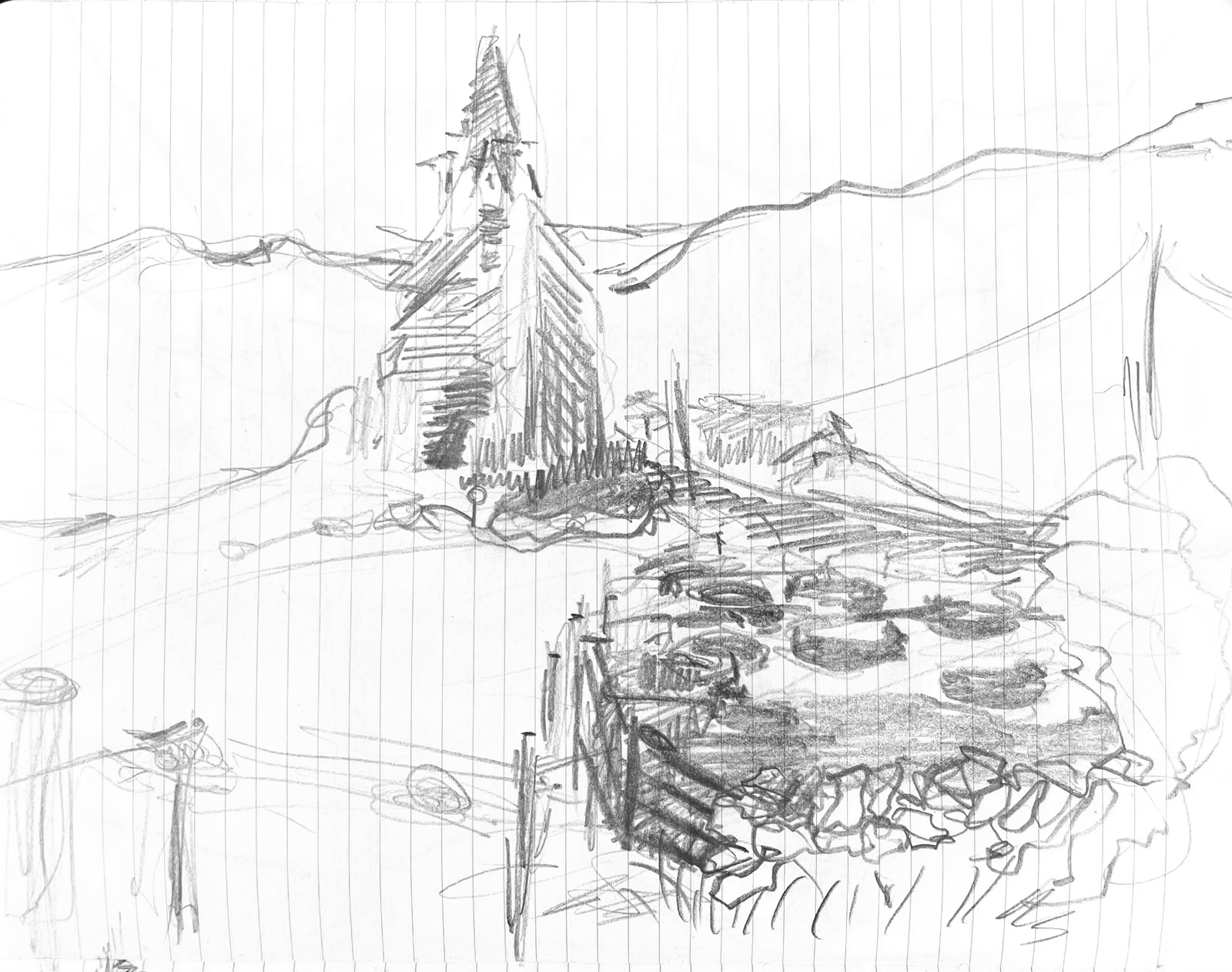
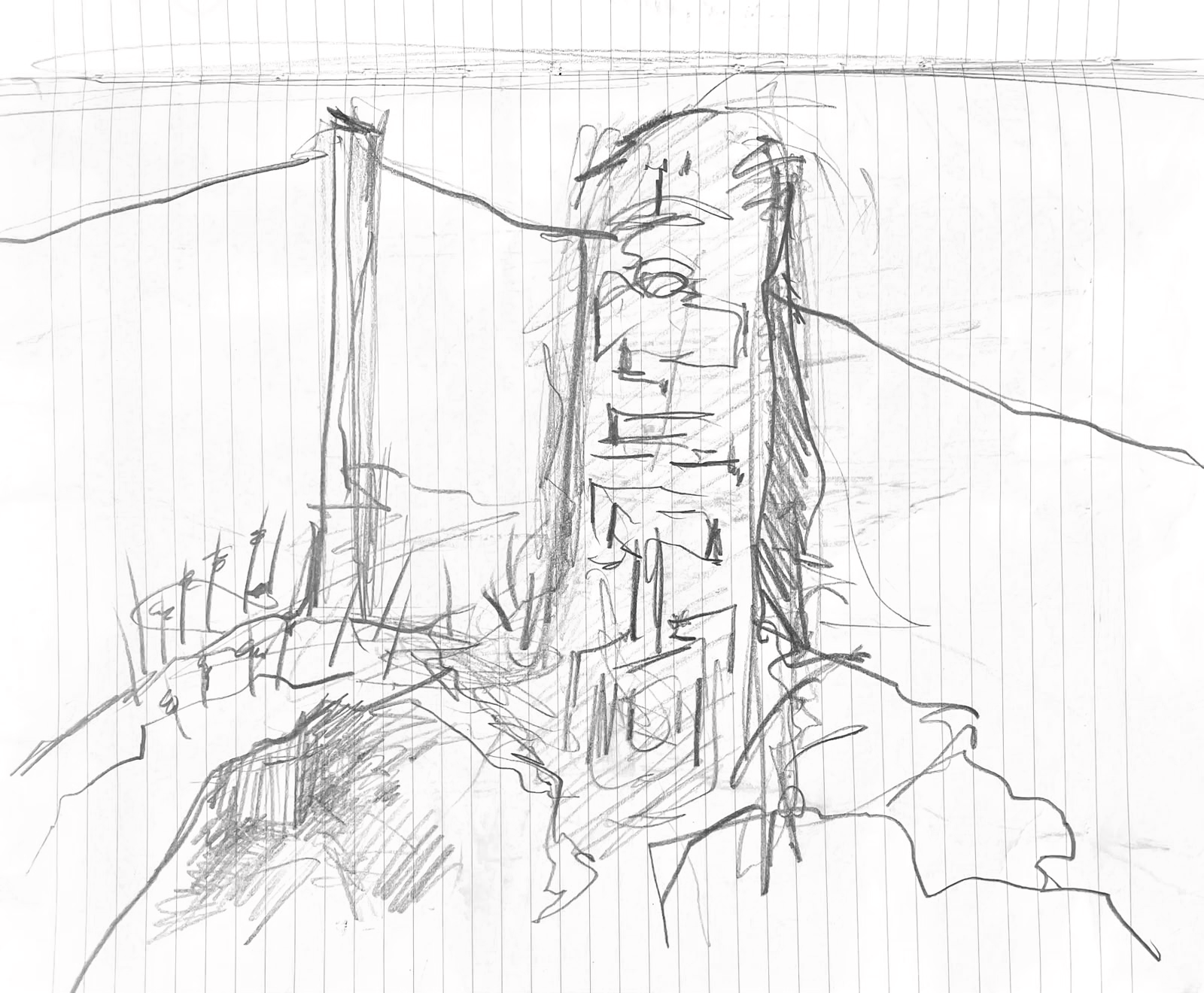
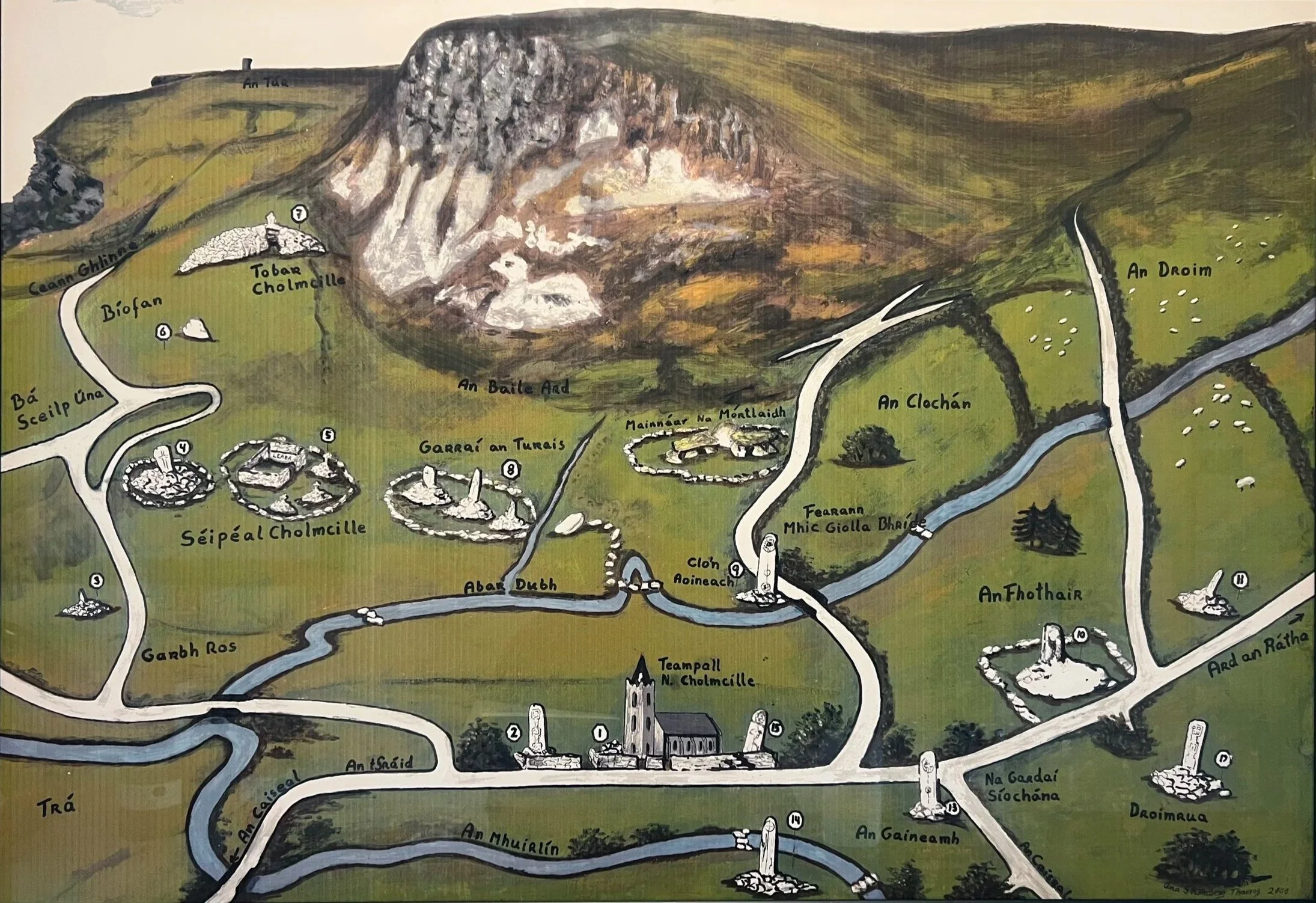
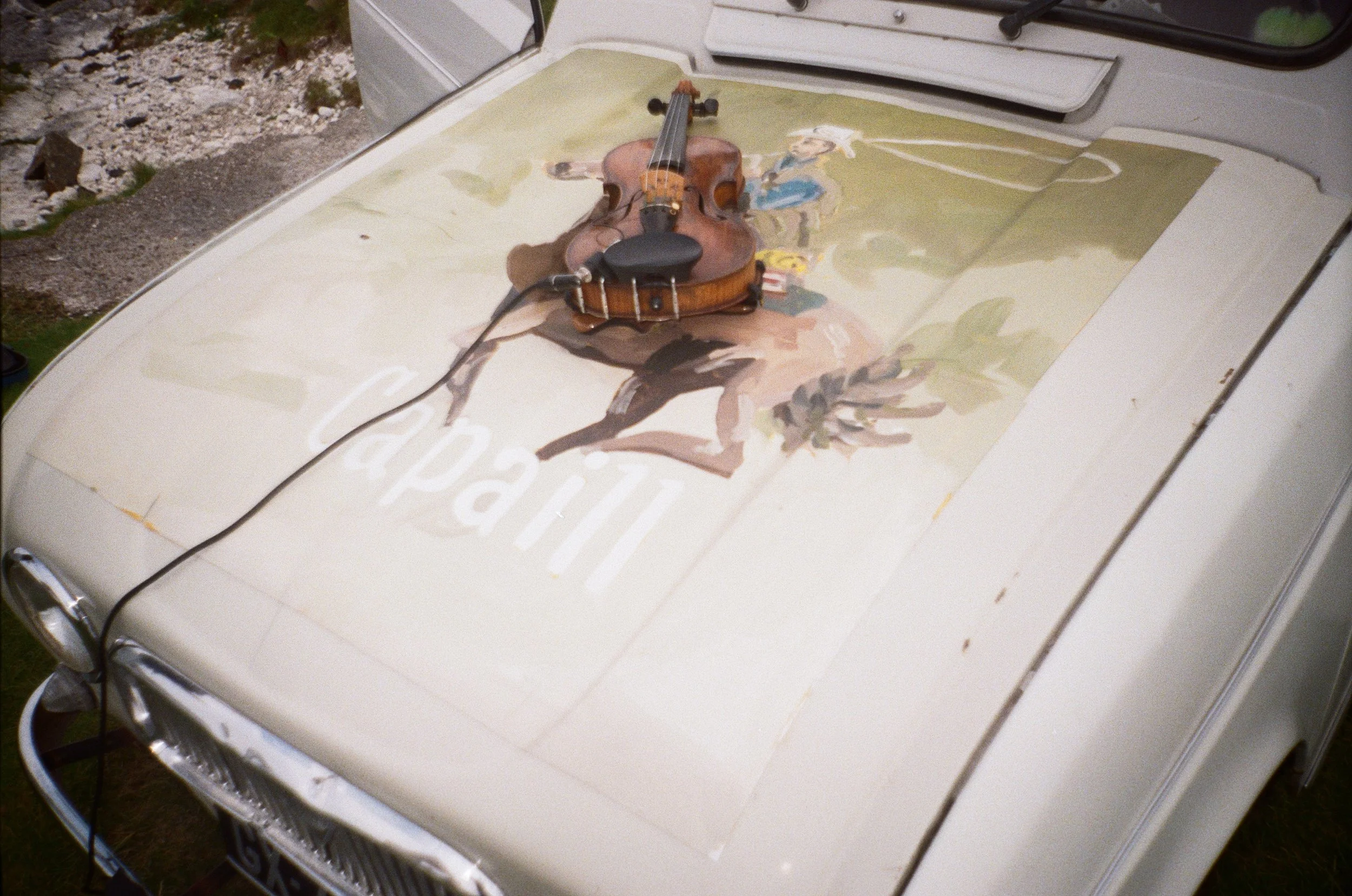
This day last year we walked to Saint Colmcille’s well that springs from underneath Glen Head. Surrounded by mounds of stones, this is well part of an early Christian pilgrimage called the Turas Colmcille. The turas traces an earlier pagan pathway around the Glen. It’s customary to walk the turas on the 9th of June each year in bare feet and some people do it at midnight by the light of the moon. While there are fourteen stops on the tour, there is no real beginning or end, rather people would join the turas at whatever stop was nearest to their house, which for us is the one pictured below, Cloch an Aonaigh, the Stone of the Gathering. It’s a 1.85 m tall schist pillar stone with abstract patterns carved on both sides. Loose and freeform on the western side, rectilinear and concentric on the eastern side. The pillar dates from 500 to 700 AD but was almost certainly erected on a sacred site; the prominence of this outcrop, a vantage point with views across the valley to the sea; or clefts in the mountain where paths were worn, standing here; you can see all paths leading into the valley; which would have provided a great sense of security.
If you stand with your back to the pillar facing east, you will see a 5000 year old tomb, and beside it bales of hay in black plastic tarp, weighed down by tires to secure against the gales that sweep in from the sea. Also on the site, there’s a church that was built in the 1930s. If you sing on this spot, or call; a crisp prompt echo bounces back at you off the church wall. There is a souterrain that served as an escape route. If you circle the stone and face west towards the sea, you can see a path in the mountain that leads to the holy well, you can see the dip where the mounds are. These mounds are the result of hundreds of years of people carrying up stones as penance; circling the well three times, then leaving them by the well. Some stones are pebbles, some are huge, begging the question, who was able to carry that up…what were they absolving themselves of.
Beside the well is Leaba Cholmcille – the Bed of Colmcille, another pagan site on the turas adapted for Christianity during the 6th century. Many of the sites that are part of the Turas are overgrown, this time of year, with native blackberry briars, nettles and ferns and shrubs like fuchsia and montbretia that arrived into the Glen in the 18th and 19th century respectively.
Some of the ancient sites are completely covered over and you’d never know they’re there unless you had a map or knew someone who could show you. A local farmer called Jimmy Carr was an incredible custodian of the knowledge related to the Turas Colmcille in recent times, maintaining the sites and leading the annual turas up until his death about ten years ago. He had a rare and brilliant proficiency in Irish, which was his first language.
Underneath a slab stone at a station of the turas, there was once a stone chalice. With openness and trust, people were welcome to see the stone chalice, in its place for over a thousand years. In earnest, Jimmy would show the chalice to people who came to Glen. Around twenty-five years ago, after one such tour; one of the group returned under cover of darkness to the flagstone and took the chalice, Yes. Maybe they’ll see this and return it.
Condy Campbell a farmer, storyteller who knew how to twist the súgan in the Glen of Glenties had the Irish language to the level that Jimmy did. A súgan is a type of straw rope that was commonly made for use on small holdings in rural Ireland for centuries to tether animals, make furniture, secure tramcocks and so on. Condy was known for making the strongest and most resilient súgans which he’d demonstrate at harvest fairs with tug of war competitions that he always won. He and his ropes were as strong as each other. Up until he died, Condy was there to pass on his knowledge, tell stories, show people how to twist the rope, make tethers for animals, bogadíns and furniture from the straw.
In 1967 Jimmy Carr and Condy Campbell became great friends after Jimmy sold a ram to Condy at a harvest fair in Glencolmcille. Condy walked the road from the Glen of Glenties to Glencolmcille, up the Glengesh Pass, then he walked back again the same route with the ram. 50km each way. After they became friends, Jimmy and Condy would often make the trip on foot to catch up, tell stories as gaeilge, and share observations on changes in crops, seasons or animal behaviours. That same ram has a story Condy and his two brothers risked their lives for it sometime in the early 1970s after it slipped down a cliff face near Na Grianáin and landed on a ledge. When they found it, Condy wove a súgan and used it to lower his brothers onto the ledge where they tied it around the ram and pulled him back up the cliff face to safety. The first brother was pulled up then the second. As he was scaling the rock face, the second brother lost his footing and fell backwards out over the ledge. Condy was known for his strength; but we can only imagine what was going through his head as he gripped the súgan he’d woven himself out of straw, with his brother dangling at the end of it off a cliff. He managed to pull his brother back up, and had the story for Jimmy next time he visited.
Those that overheard the two men talking noted the abundance of words for phases of growth for plants, light at times of the day, descriptions of the sky, weather coming in from the sea.
11.08.2025
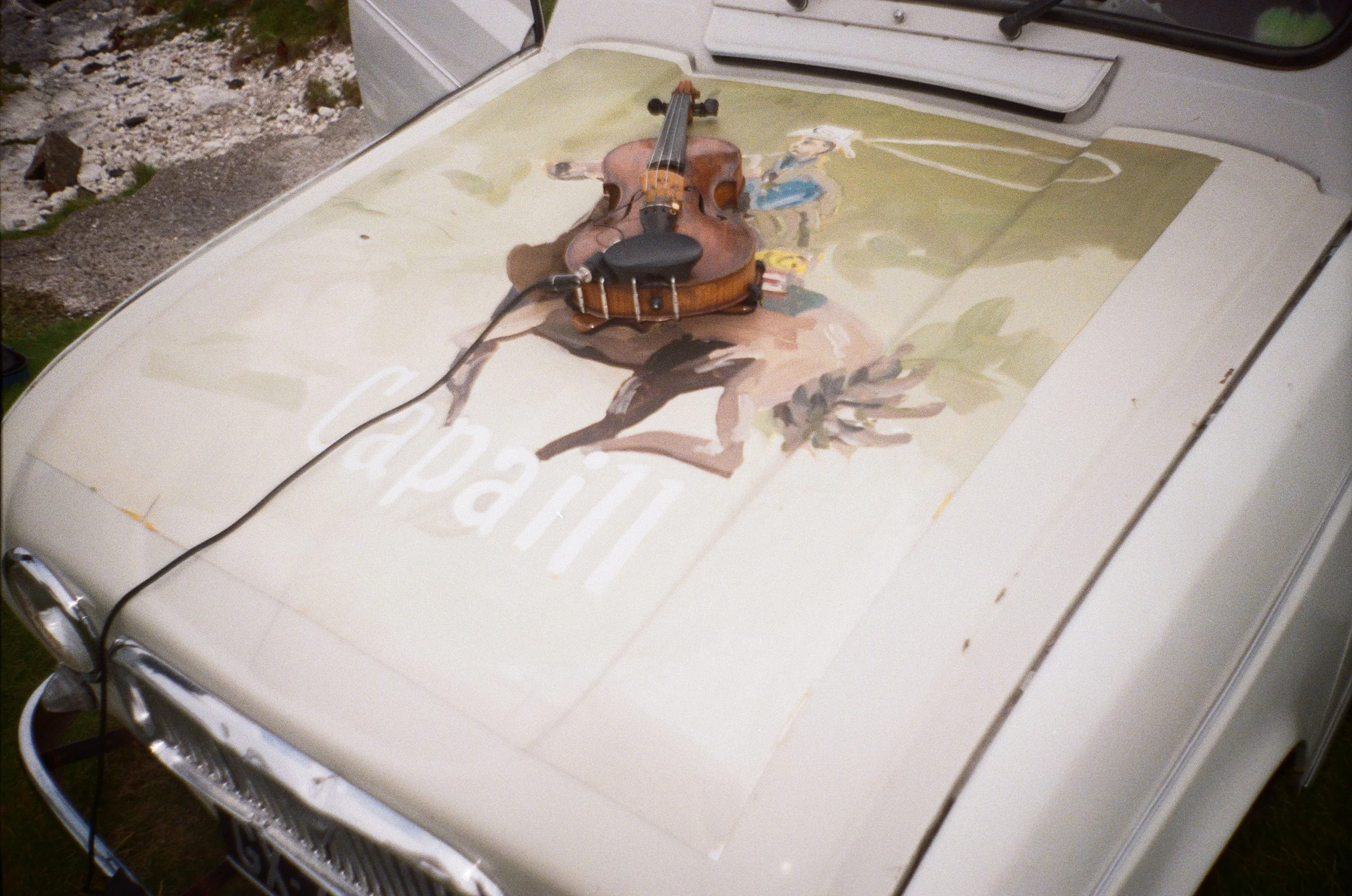
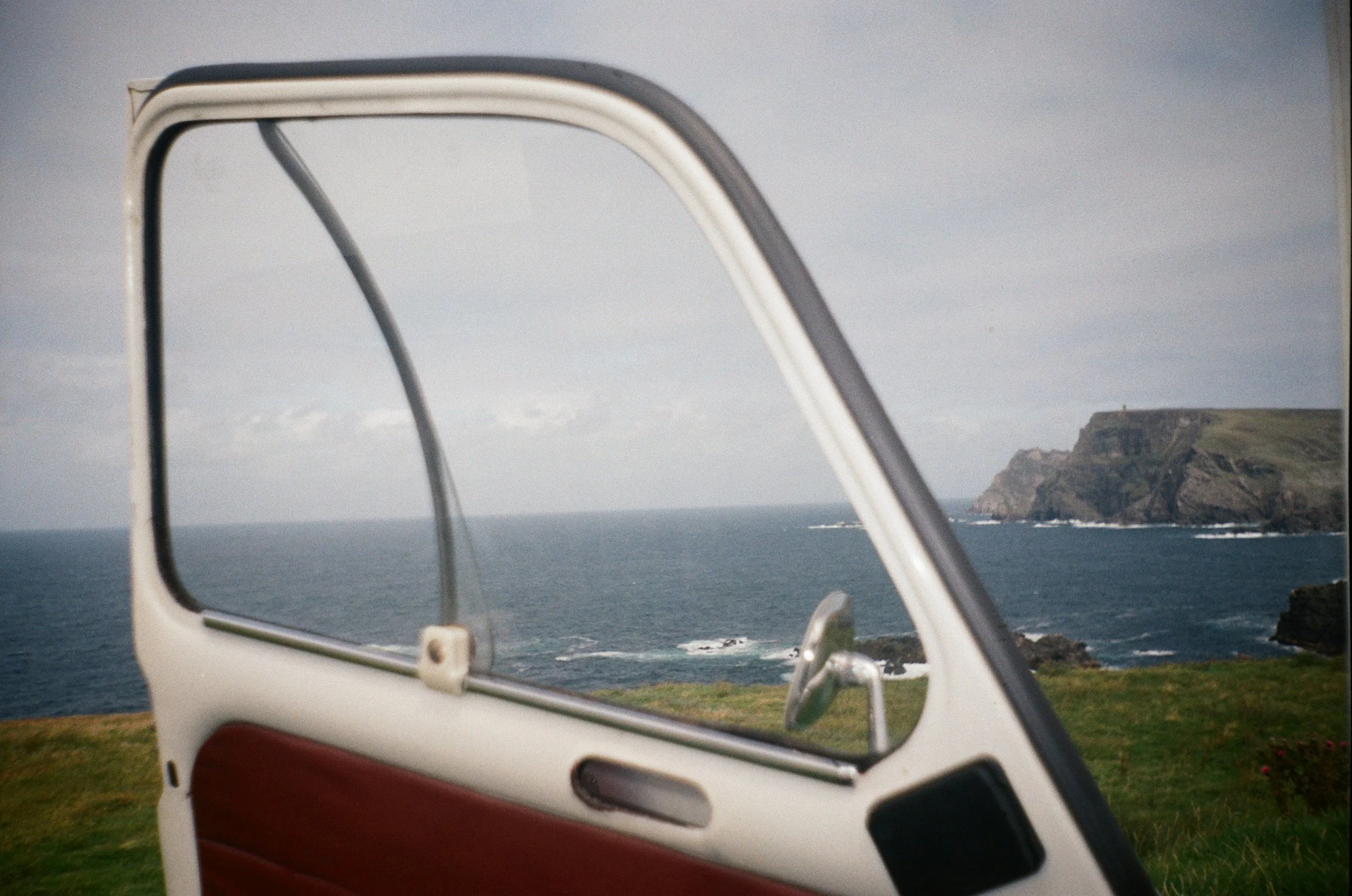
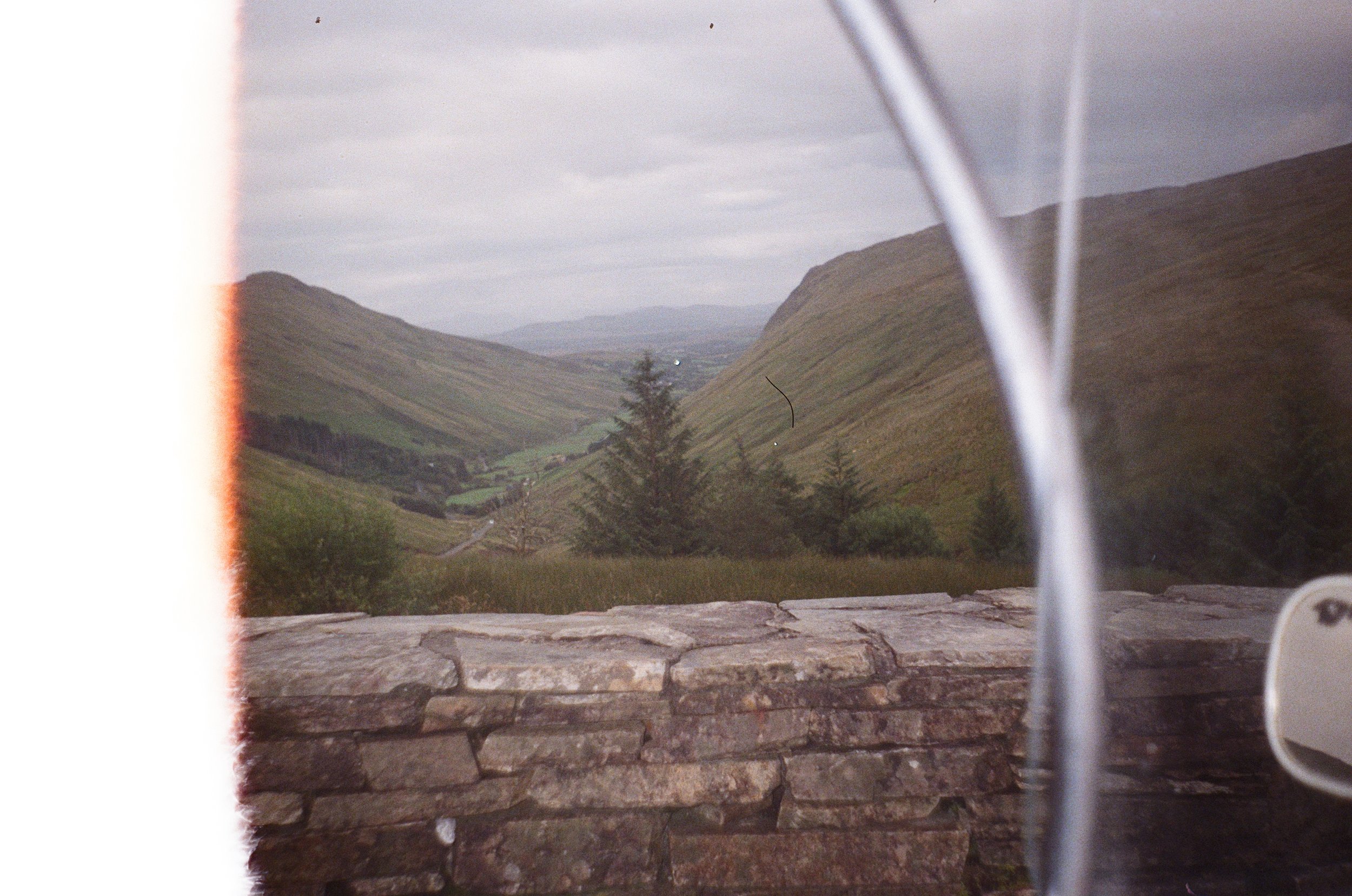
With the backdrop of the mountains, traditional and classical music was played on violin/fiddle to consider merging points between classical and traditional expression with the instrument.
On small roads to remote villages, we retraced the paths that musicians once took, playing at house dances, introducing new melodies, selling tin fiddles, repairing household objects and bringing news with them. John (Johnny) Doherty (1900–1980) was a travelling musician; a fiddle player and tinsmith from Ardara who moved regularly around south west Donegal, representing an old way of life. A way of life that was eroding due to new markets of mass production, the development of new channels of communication and new roads. Let's shorten the road with a tune, he’d say and he’d walk the roads or catch a bus with his fiddle.
There is a story about a tune in Donegal. While the travelling fiddle maestro John Doherty waited for the bus, he was approached by a man who wanted to acquire a beautiful slow air called ‘An Cúilfhionn’ that Doherty had played the previous night. Doherty obliged, but the bus arrived just as he began to bow the notes. He accelerated the tempo in order to impart the full piece before leaving and what was a slow air became a jaunty march as he played out the bus door while it pulled away. So, the tune, believed to date from 1296 or 1297 was transformed in its transmission to create a new tune that lives on in the repertoire.
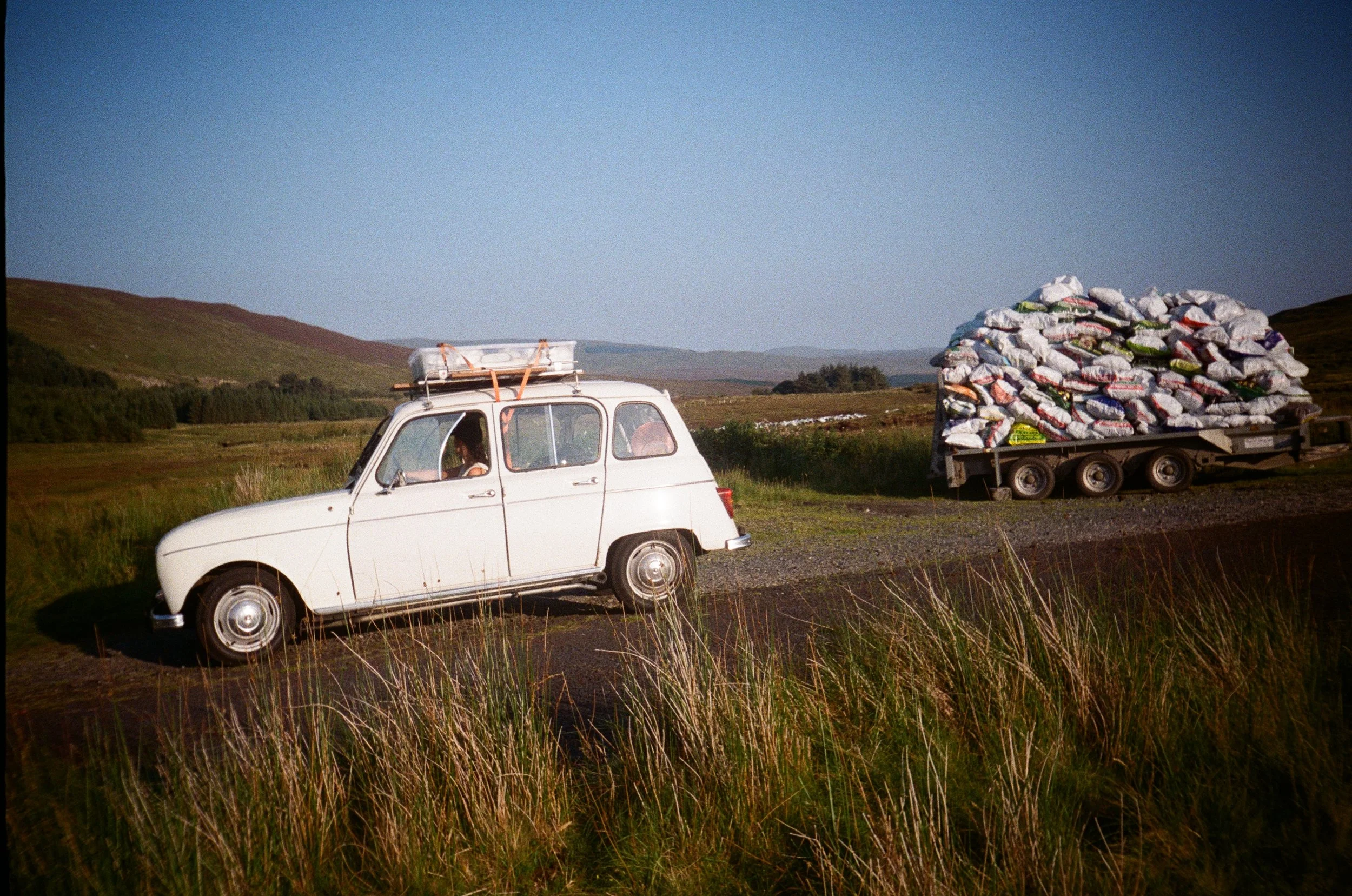
This time of year can be changeable, almost time to light a fire - some people have started already and the smell of turf is in the air. The phasing out of turf as a fuel - how does all this affect the preservation of context for traditional cultural expression - which typically took place around a home fire. The smell, sight and sound of a fire is deeply embedded in the Irish creative consciousness.
10.08.2025
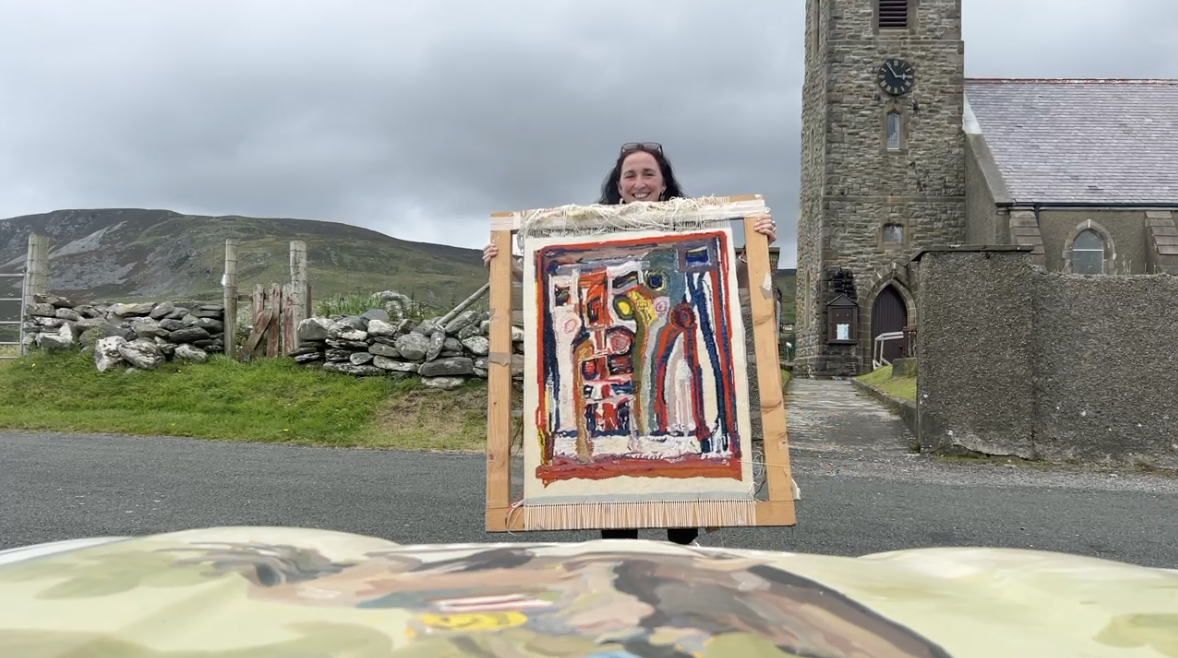
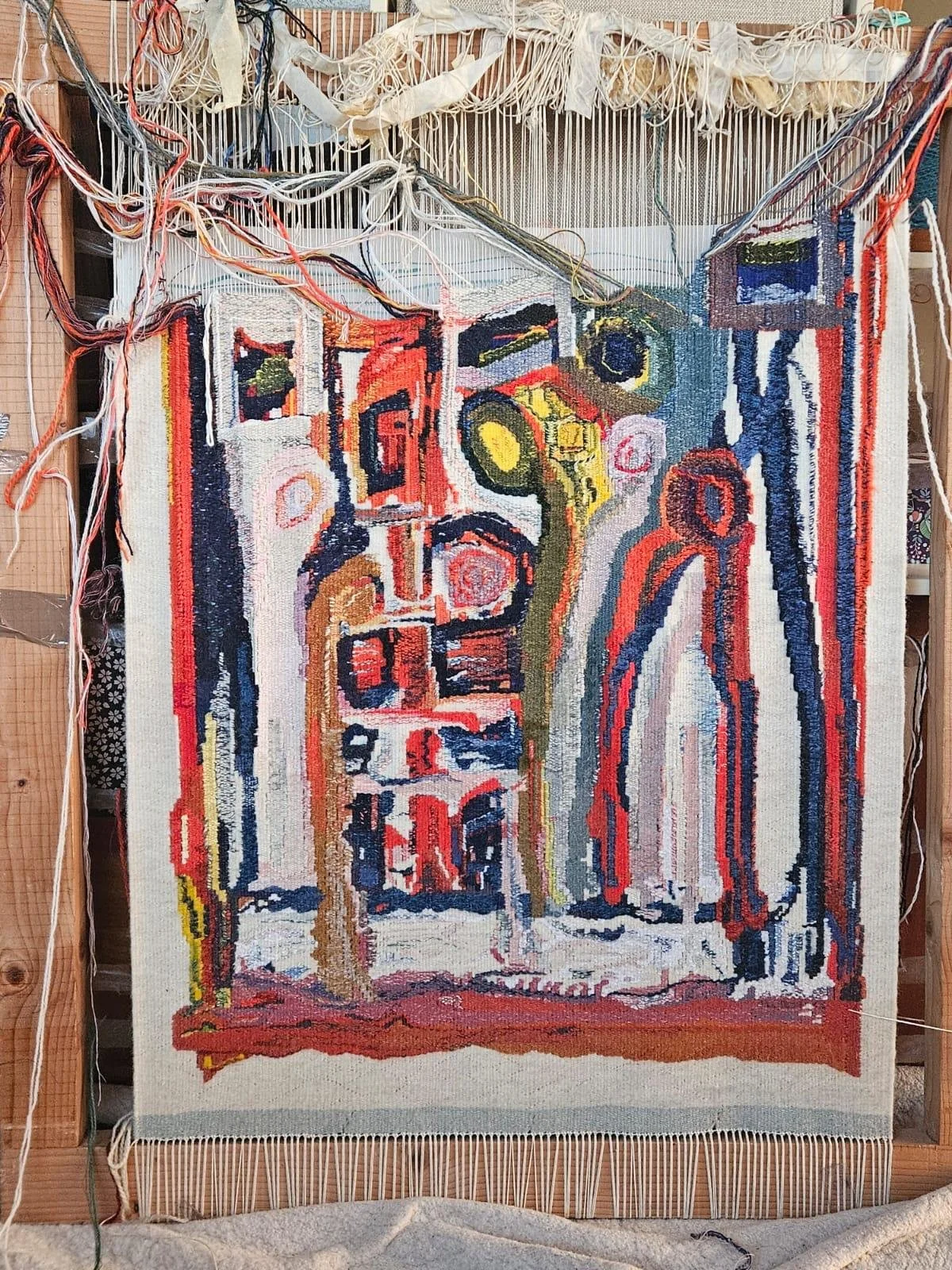
On this episode of K7 dans la 4L, weaver Margaret Rose Cunnigham shares insights into her creative practice, specifically in relation to an artwork twenty six years in the making; a map woven from remnants of hand dyed wool and scrap yarn gathered over decades to trace a route around Glencolmcille. Margaret’s woven drawing of the Turas Colmcille describes the traditional 5.5km pilgrimage, representing each of its ancient stations, pre-Christian monuments, a holy well and decorated cross slabs and pillar stones with intricately intertwined threads.
Margaret is known as a consummate singer of traditional song, director of the Folk Village Museum and people gatherer in Glencolmcille. In her tapestries, Margaret draws on the landscape around her and the stories it holds, with compelling imagery, both pictorial and abstract, her work evokes a deeply atmospheric sense of this place.
Representing the age-old skills of wool production (shearing, spinning and naturally dyeing yarn) as a vital form of artistic expression today, threads of Margarets many talents in draughtsmanship and song weave together to form impressionistic and vibrant tapestries. In contextualising her process, Margaret describes the importance of preserving skills and techniques that have been handed down through families in local community, ‘many aspects of our cultural heritage have been lost with the passing of just one generation’.
Margaret’s tapestries carry forward embodied forms of knowledge to create a vernacular expression that is both historical and contemporary, and so she preserves the tradition in this area with its early medieval and Neolithic heritage.
K7 dans la 4L is tour de force mobile broadcasting arts club, live streamed on Twitch with a curated series of artist’s talks, readings and interviews that were broadcast directly from the Renault 4. A forum for discourse and debate around contemporary culture, a chat room that was utilised to discuss art, landscape and tradition associatively and in a shared stream of consciousness.
09.08.2025
There’s a tune that came from Italy with the bite of a spider, they believed, and spread all over Europe in the Middle Ages. A tarantella, it’s called, after tarantula. Anyone bitten by the spider would go into state of uncontrolled movement, frenzied convulsions and the only remedy, was to call for musicians to come as quickly as possible with their instruments and provide a beat and melody to pace the afflicted, calm them; bring succour. The main instruments of this custom, were a frame-drum with rattles, a type of tambourine, accompanied by various melodic instruments such as flute, panpipes and violin. Anyone could be bitten and once bitten, the symptoms could return at any time. With no medical explanation for this phenomenon, we now understand it as a mass hysteria, a manifestation of the collective impulse to dance together and to be lost in music, released from the bounds and hierarchies of society. The main area affected by the phenomenon covered a large part of Europe that faces onto the Mediterranean, but it travelled in all directions, arriving in Glencolmcille, Co. Donegal in 1832 – with a ship called the Grassen, on it’s return journey from Bergen to Naples. The Grassen, with a crew of Italian sailors was shipwrecked at Doonalt. All the crew survived and they stayed locally to recuperate, taken in by people in the area.
The ceramicists house that looks out on the premonitory, it was there that one of the sailors was taken in by a woman whose name we don’t know but her daughter was called Biddy McNelis, or Biddy Mór McNelis. Both mother and daughter were lilters, brilliant musicians in the area with an expansive repertoire of tunes, an internal archive of countless melodies. It was at this time that the tarantella entered the collective consciousness through osmosis.
Con Chondaí, born 1915 was the grandson of Biddy Mór and he was one hundred years old when he died. He shared many stories over the years, including memories; his own experience; an overlap between two worlds, an early vivid memory of setting eyes on Biddy Mór at her wake in 1919 (Biddy Mór McNelis, the daughter of the women who lilted the Tarantella). Chondaí also knew of a man called John J. McGinley as they were in the same class at school. Con Chondaí would tell you that this man was a brilliant scholar of the Irish language. At that time, the time of Biddy Mór’s wake in the early 20th century, there were very few women playing the fiddle. Accounts vary as to why this was the case. Some believed that you’d be taken by the fairies, others say it was rare enough to come across a fiddle and many families couldn’t afford one. So people lilted for dances, often in two different octaves.
Between 2005-2009 folklorist, academic and fiddle player Rónán Galvin set about creating a map of old roads connecting musical households across the valley of Glencolmcille and out into greater south west Donegal, Traditional music, song and dance was, at one time a part of everyday life throughout County Donegal. Lilters, fiddlers and melodeon players were all part of a dance tradition which was the primary source of entertainment for the majority of people. With the use of the map, we can trace the path of melodies as they circulated over the mountain into Meenacross. It was here that a brilliant lilter by the name of Moya lived, in what must be one of the most isolated parts of Ireland. In this remote, windswept place, she was often visited by musicians who would walk over the mountain to visit her. Musicians like Jimmy Bhidi Mhicí, Frank Cassidy and Johnny Boyle learned the tunes by heart, played them at dances or big nights and passed them on to others. Moya, and we’re not quite sure of her maiden name, is the mother of a fiddle player called John Byrne, known for his great rhythm – a really good dance fiddler. His son was James Byrne.
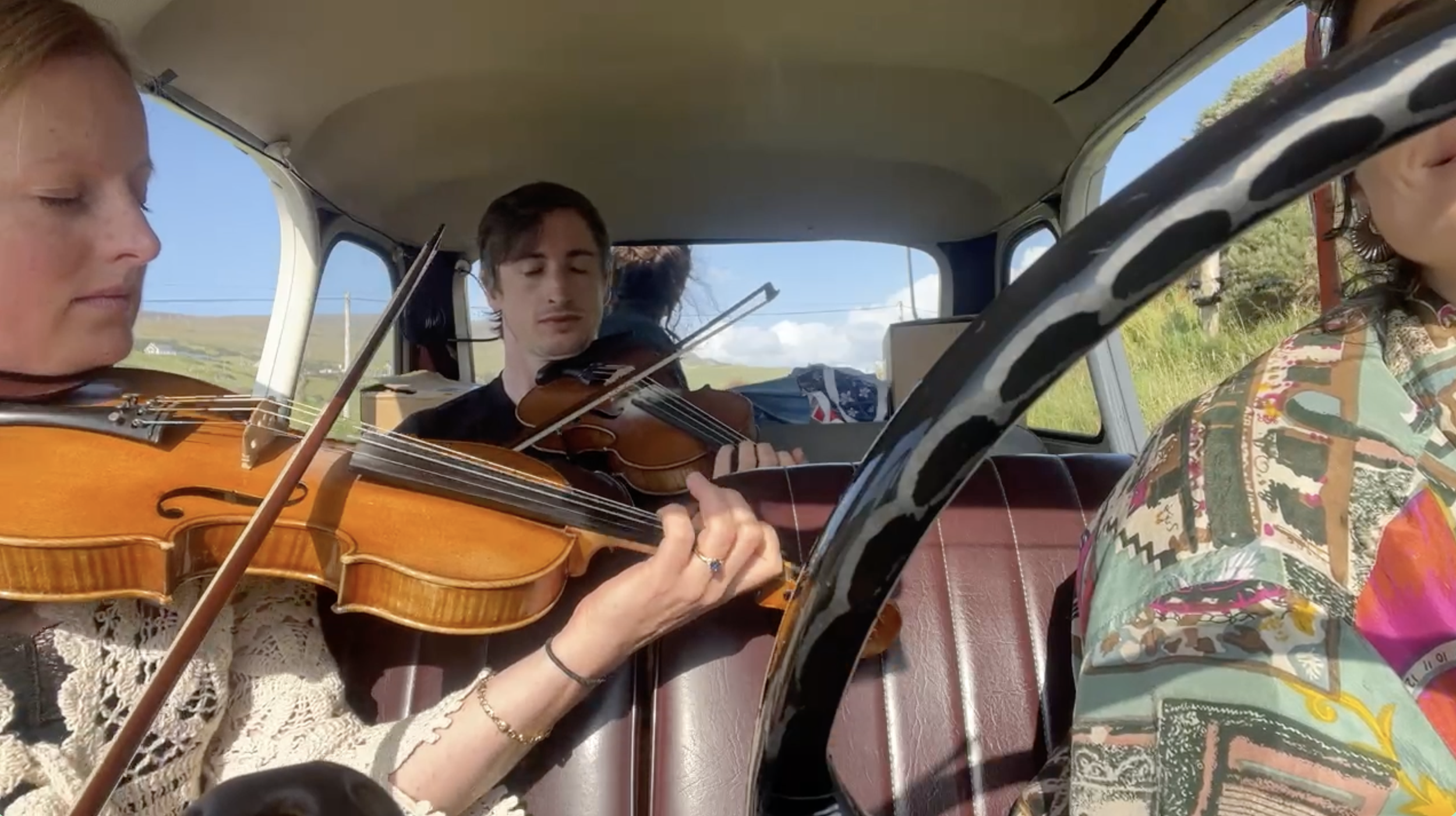
From the townlands of Glencolmcille and neighbouring Meenaneary, the particular, individual artistic styles of Sinéad Kennedy, Ellie McGinley and Catríona Kennedy came together for a special live recording experiment called turas trasna this day last year. Sinéad, Ellie and Catríona, with close familial ties to each of the musicians, storytellers and artists mentioned here, are masterful custodians who have absorbed hundreds of years of melodies and stories. Learning directly from one of the finest traditional fiddle players in Ireland, James Byrne (1946 – 2008), and dancer and lilter, Kitty ‘Seán’ Cunningham (1919 – 2018), the life and soul of many a party; Sinéad, Catríona and Ellie carry forward the melodies and stories of these wonderful cultural figures in the canon of Irish creativity.
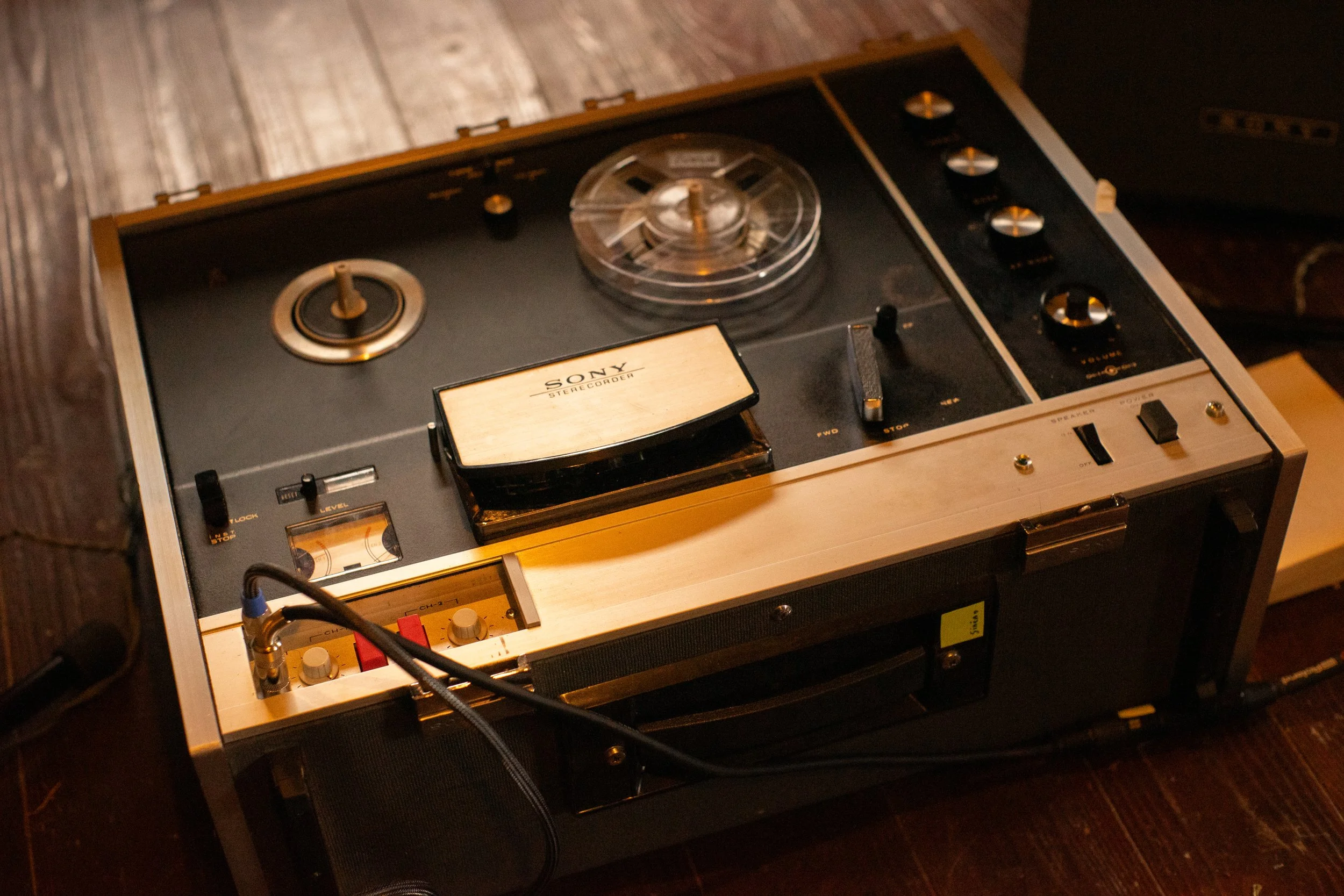
This journey, turas trasna considers retrograde recording equipment as instruments in themselves, and the context and architecture of the surroundings, as part of the texture and atmosphere of the sound. The recording references the historical significance of the school house at the Folk Village Museum, for example; with wonderful acoustics that led to its use for recording and documenting the emanate traveling musician and tinsmith, John Doherty - a highly regarded proponent of Donegal fiddle throughout the 20th century. The school house is part of a reimagined clachan, vernacular architecture with objects of social and historical significance donated by locals. turas trasna focuses specifically on the regional style and repertoire of south west Donegal, and on the history of recording and archiving the tradition from this area.
The title, turas trasna refers to themes of transcendence and journeying and is influenced and informed by ‘The Otherworld: Music and Song from Irish Tradition’, a collection of music, folklore, and photographs extracted from the National Folklore Collection by the editors Ríonach Uí Ógáin and Tom Sherlock. A poem called, The Barter by Moya Cannon for Rónán Galvin also deeply inspires and informs turas trasna (extract below).
By recording the music on retrograde equipment, a speculative fictions forms, reimagining and reconsidering decisive historical moments in the music tradition of the valley. By collaboratively re-creating moments of socio-historical relevance, such as the arrival of the gramophone into Glencolmcille in the 1930s, and visiting folklore collectors throughout the 60s and 70s, turas trasna considers what it means to etch a living art form onto a permanent archive. This performance was recorded by Sinéad Kennedy using reel to reel equipment. The recording of the three fiddle players includes tunes and songs as well as the atmospheric laughter and applause of audience appreciation and the rhythmic sound of dancers.
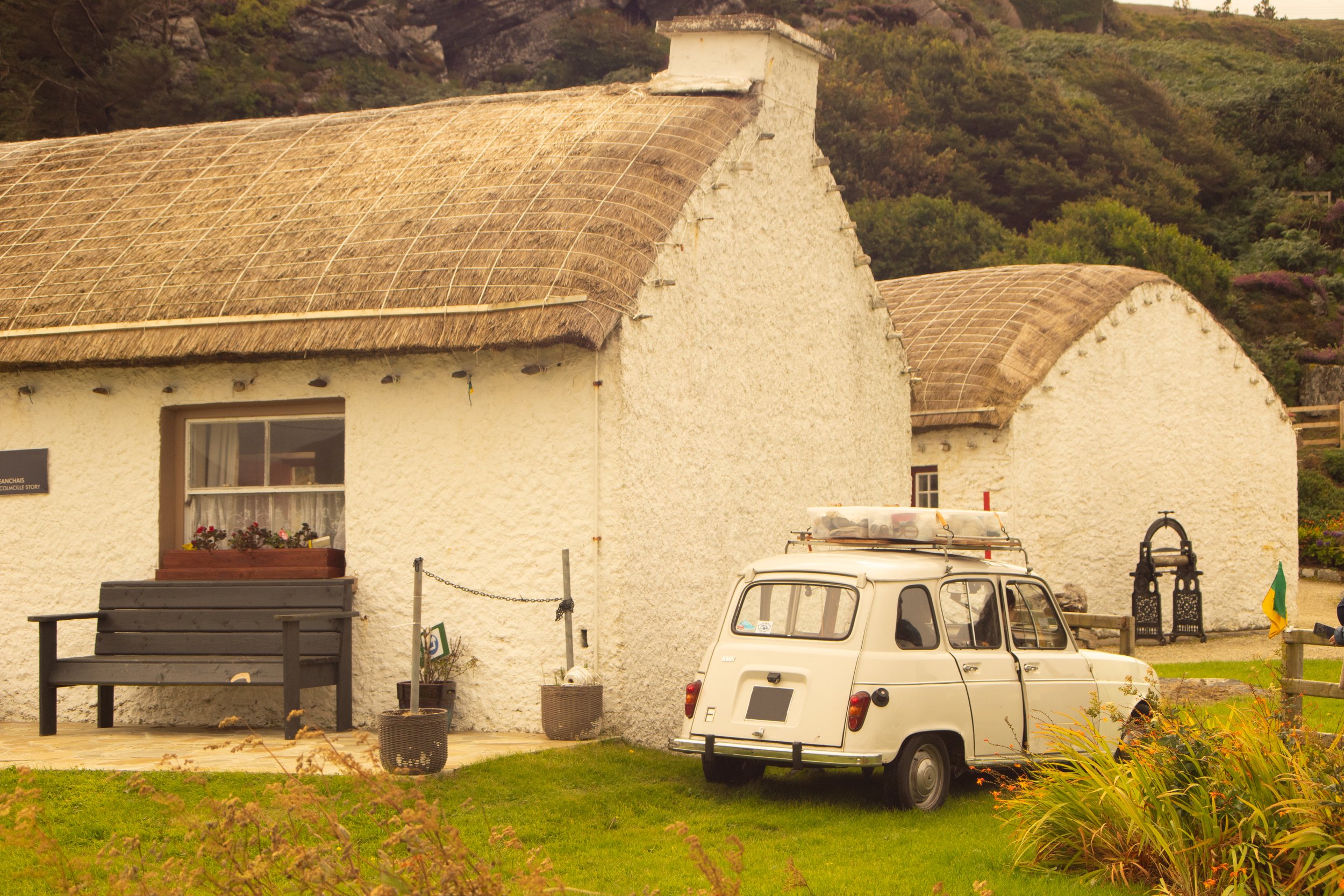
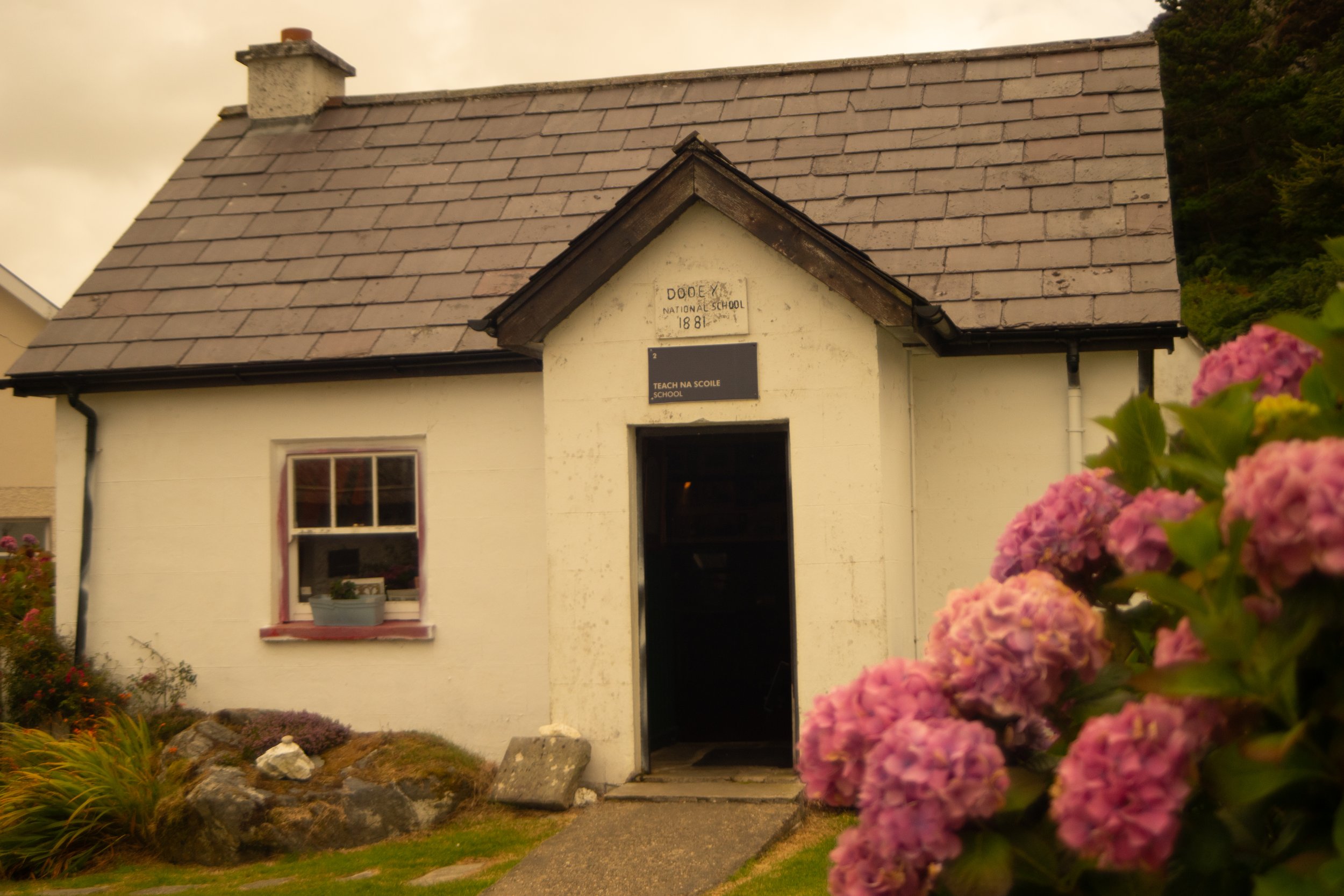
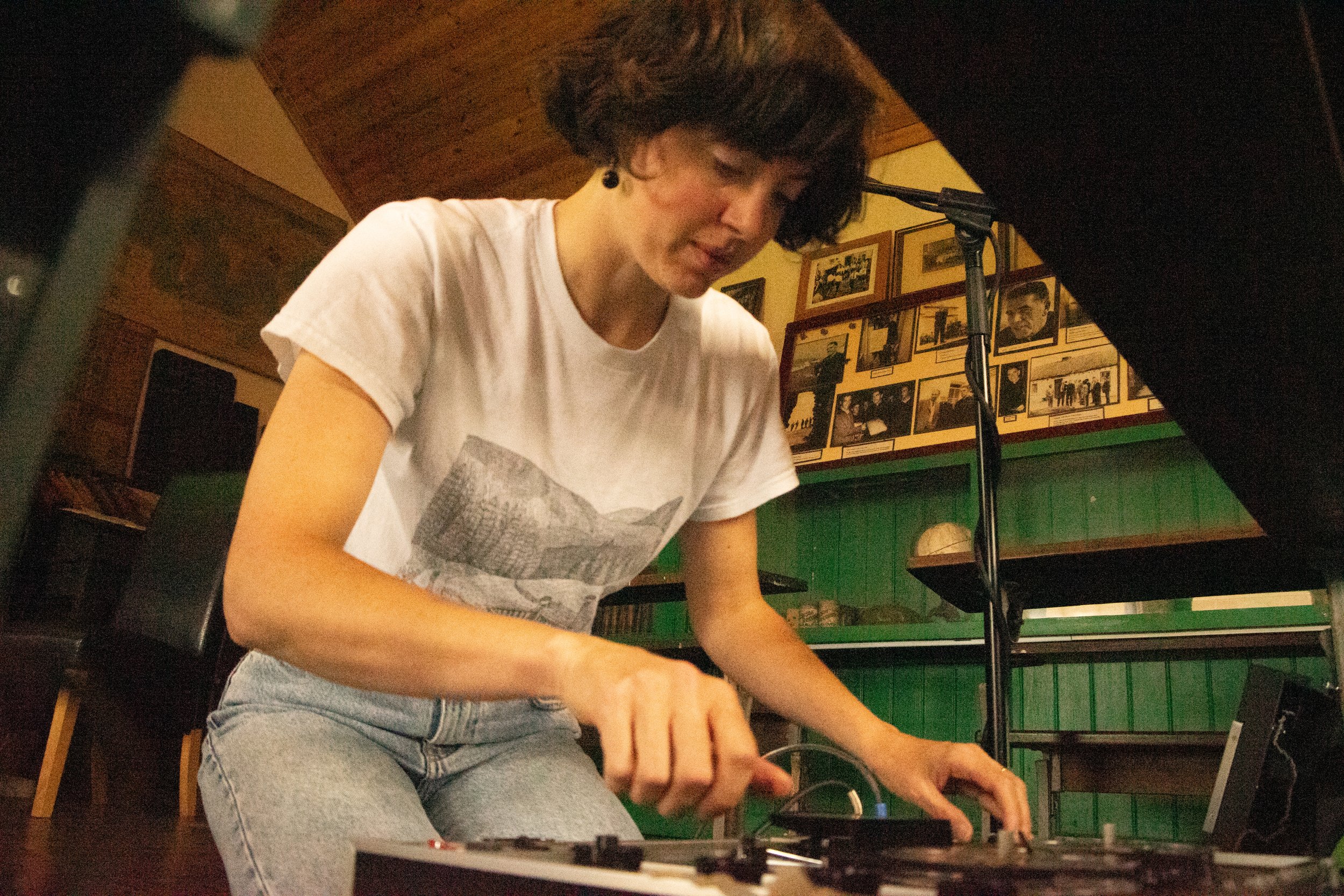
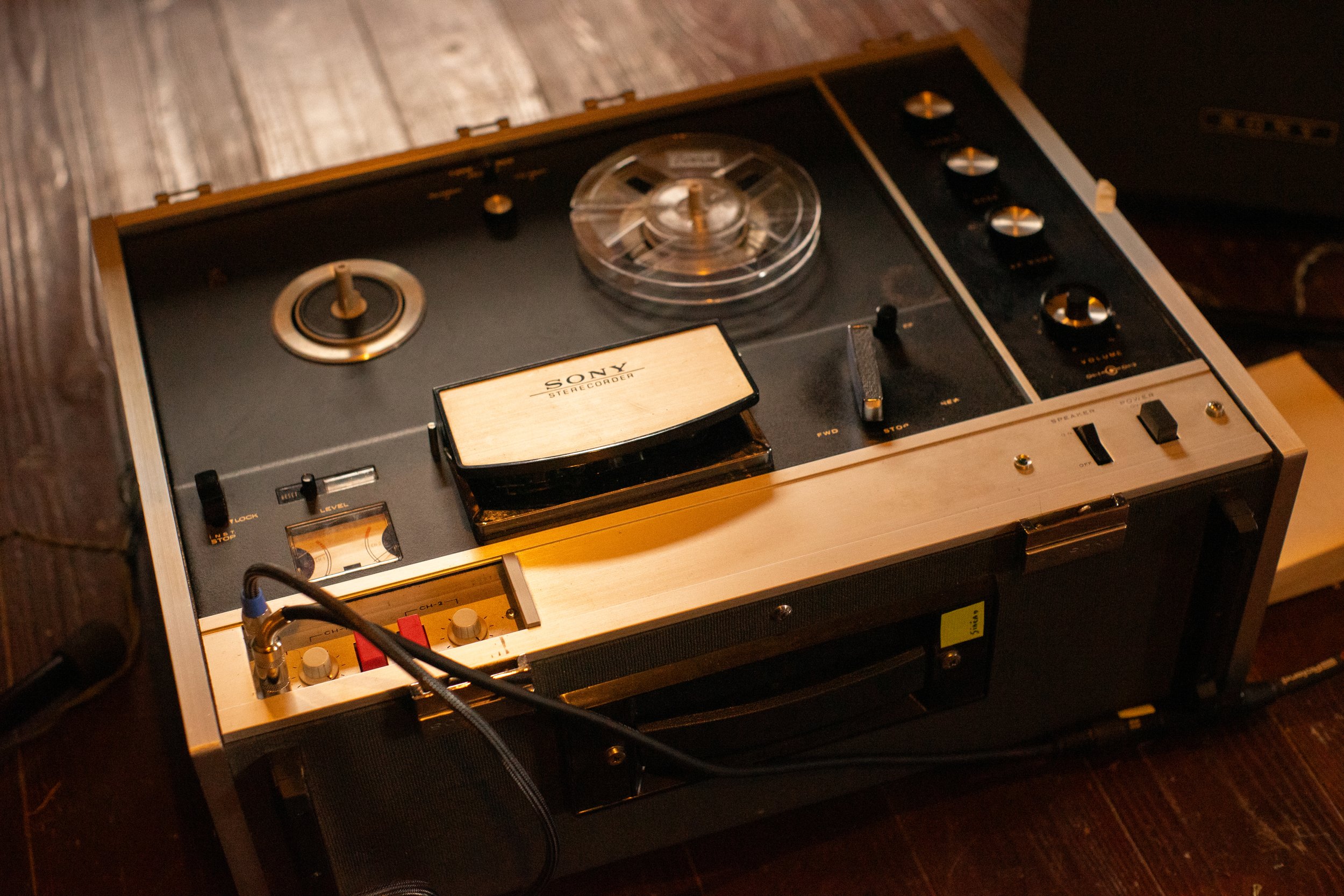
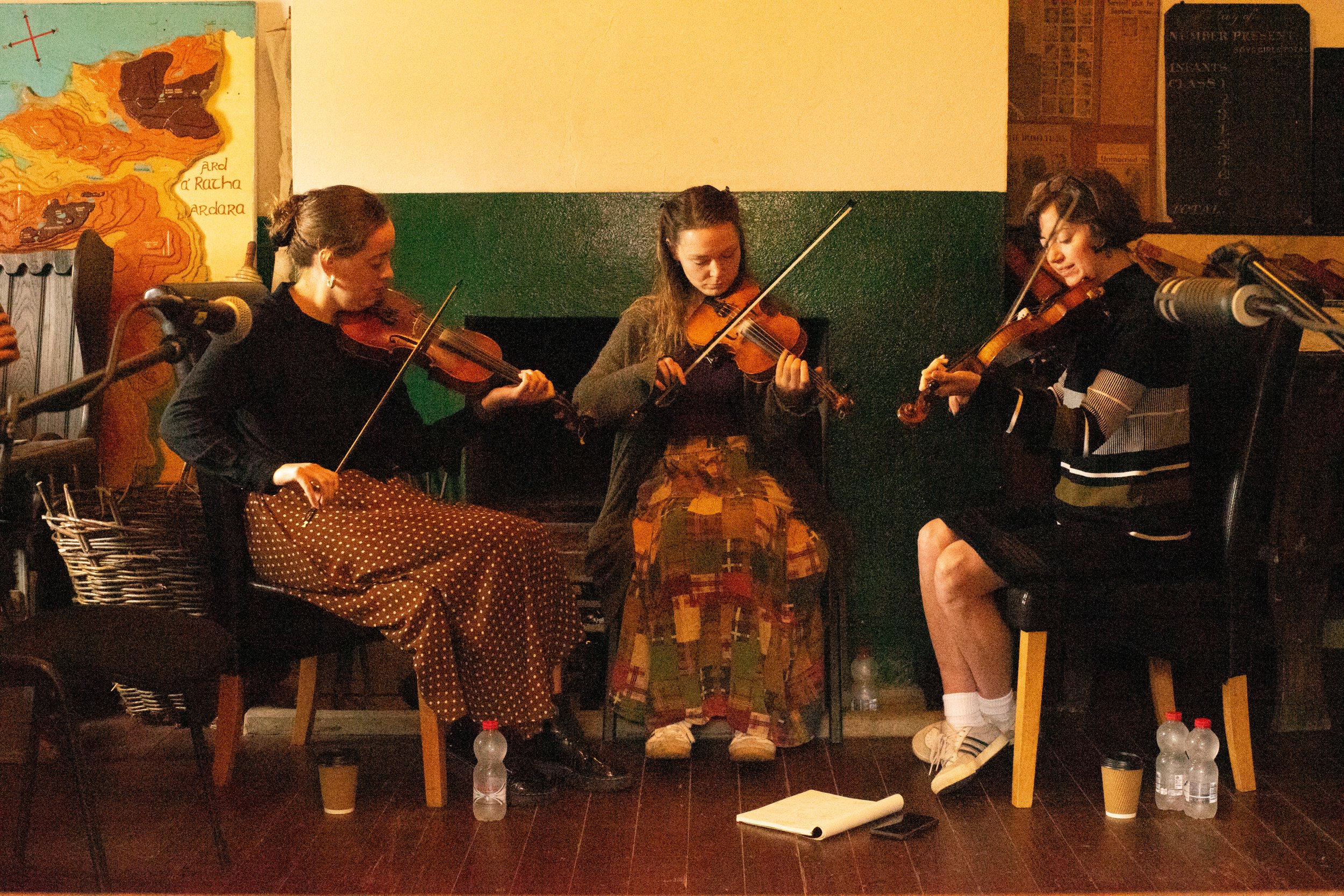
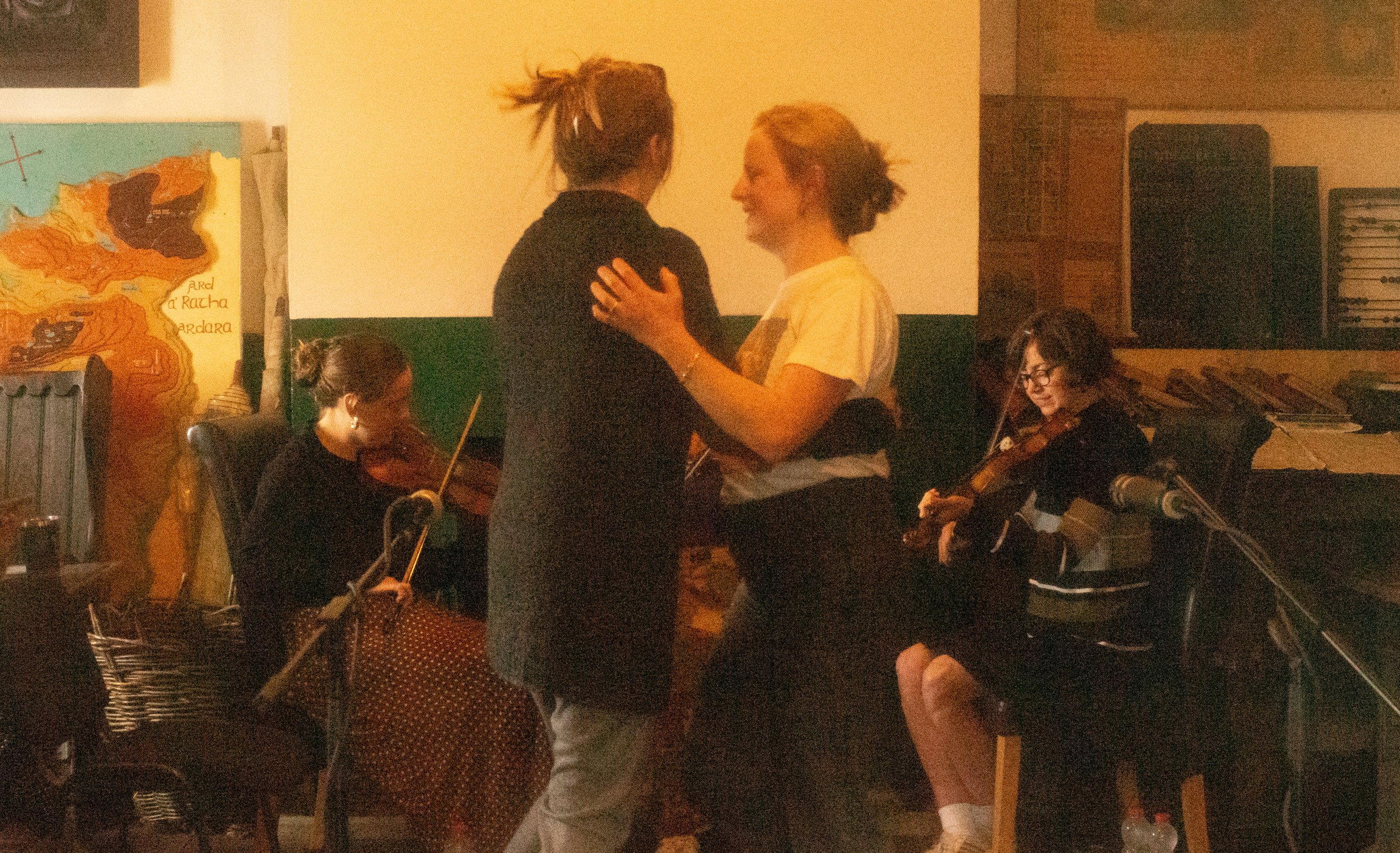
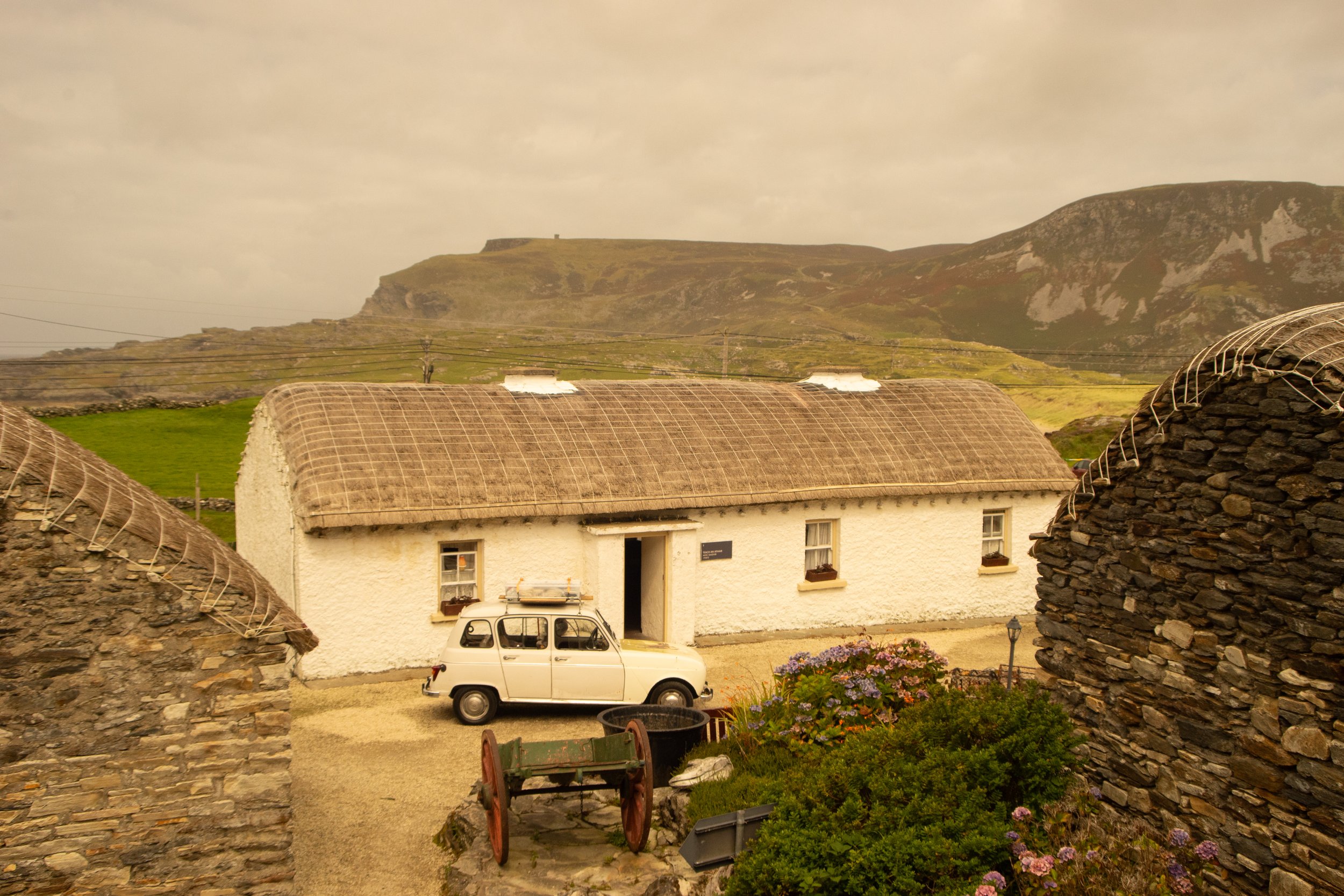
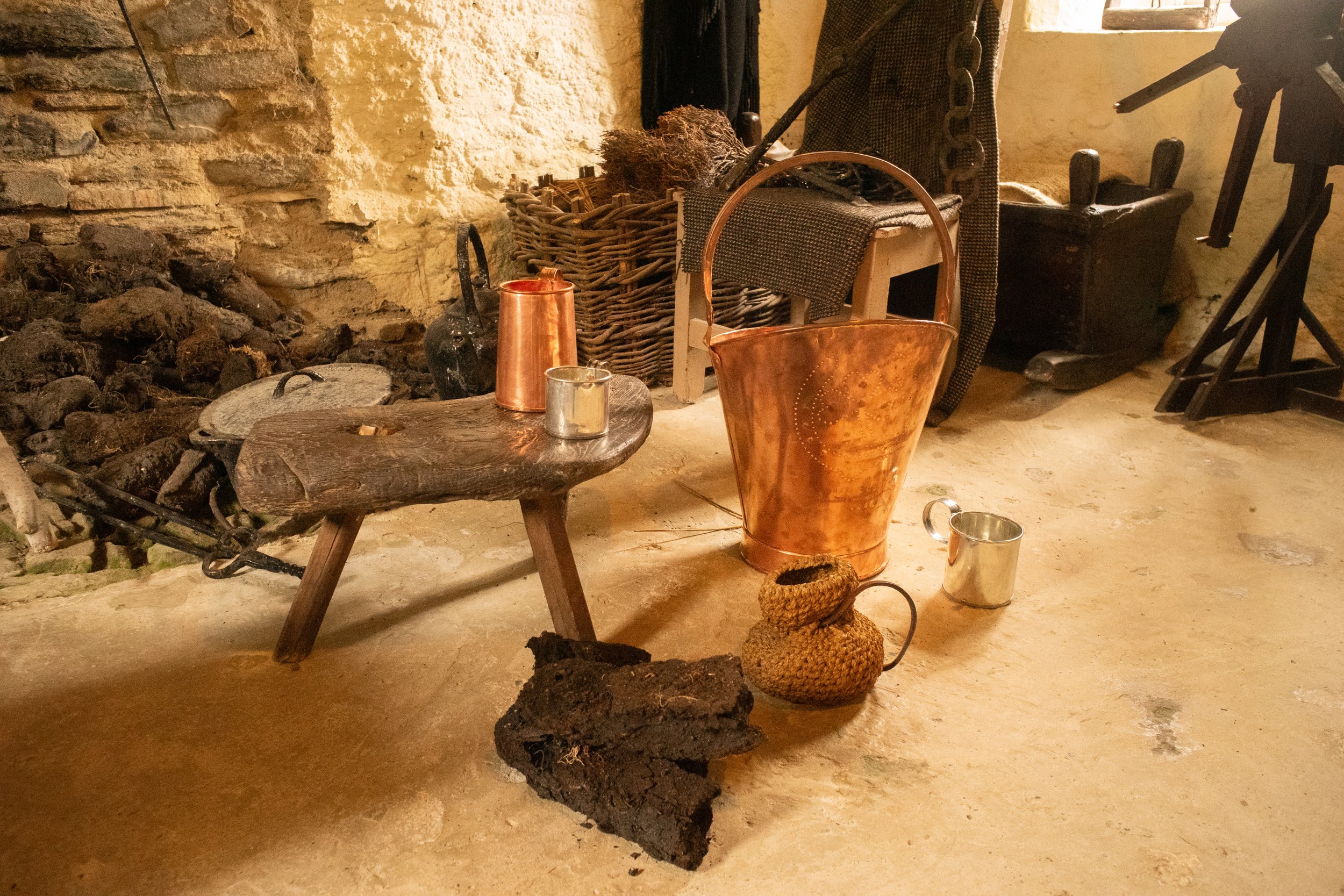
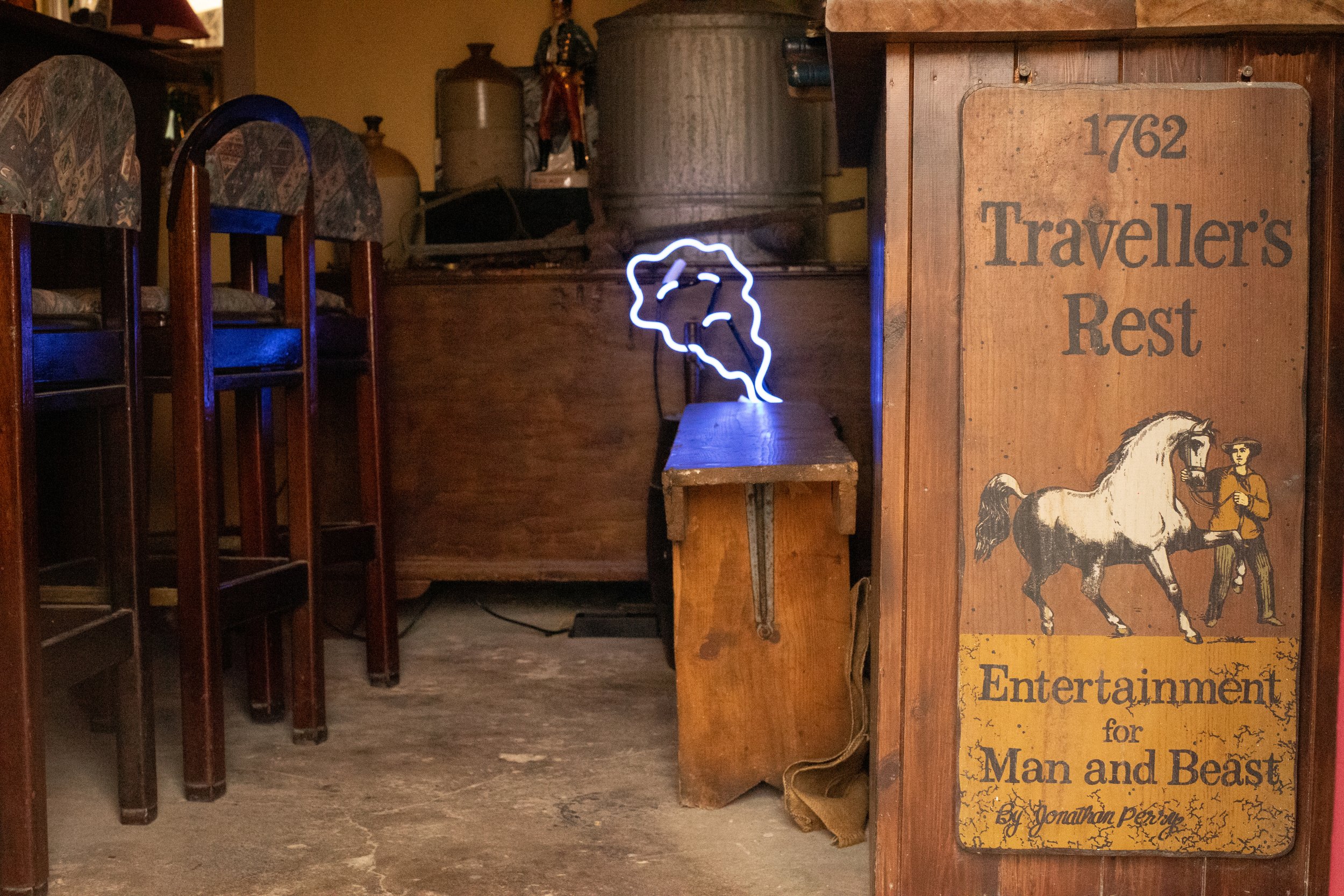
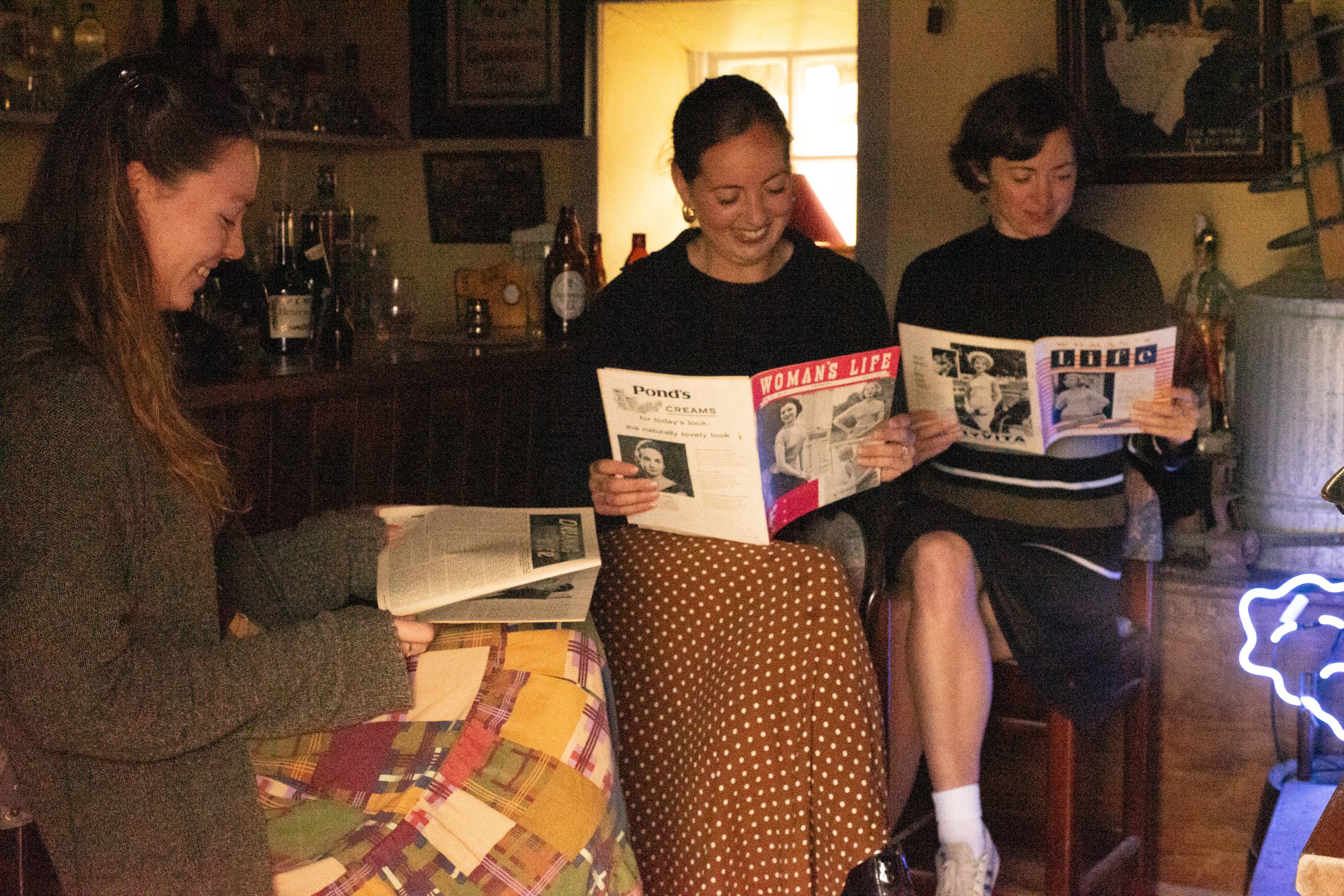
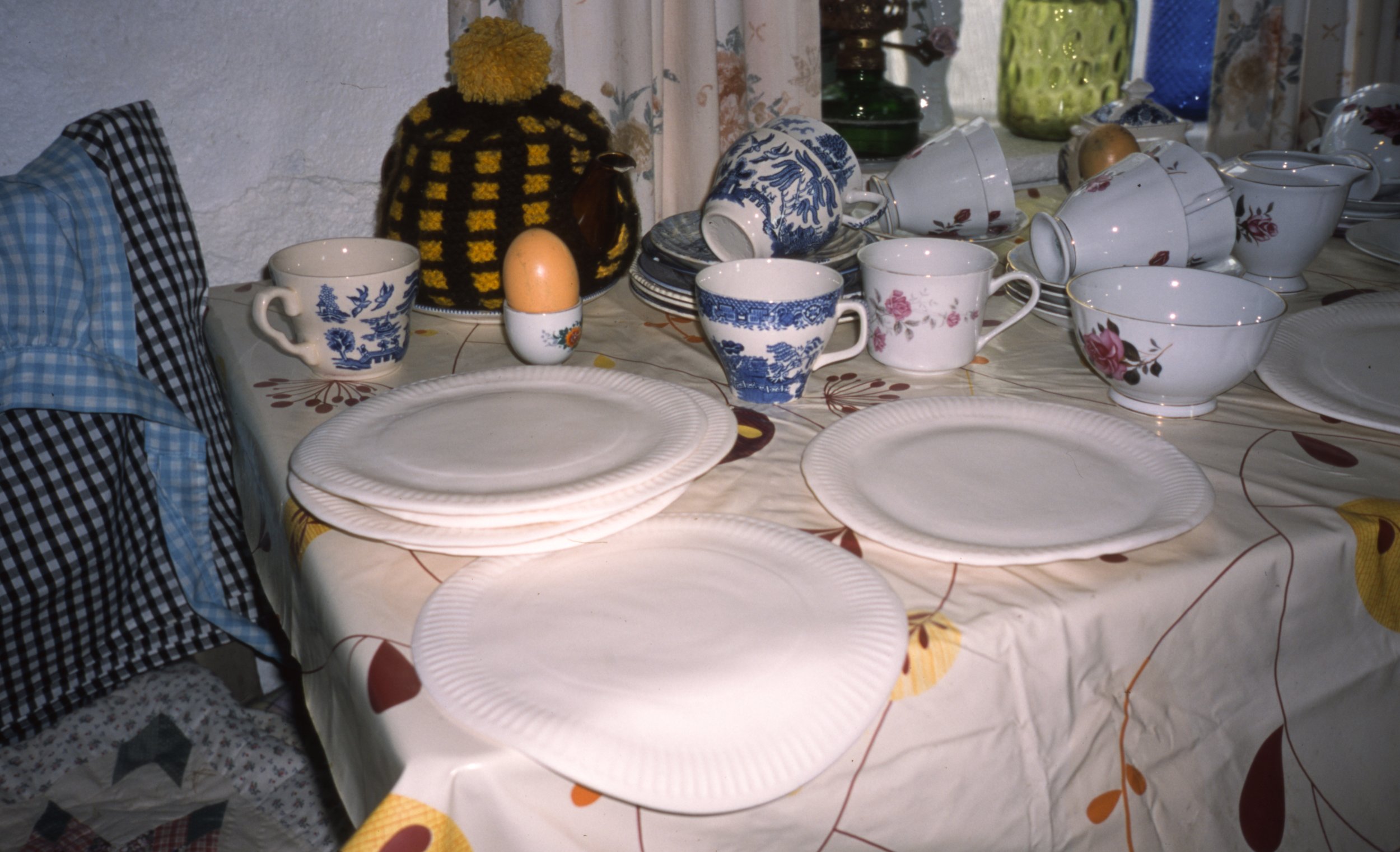
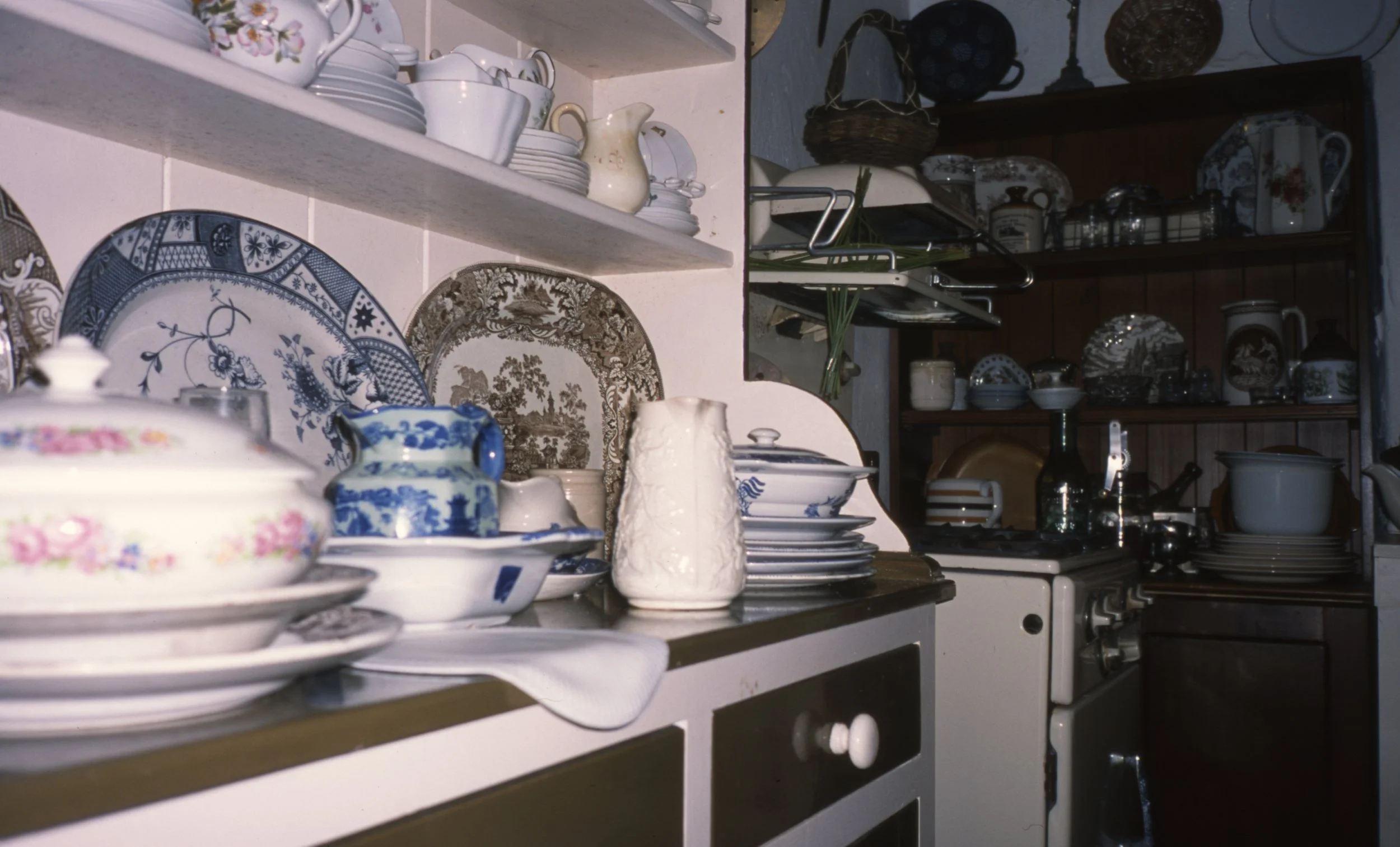
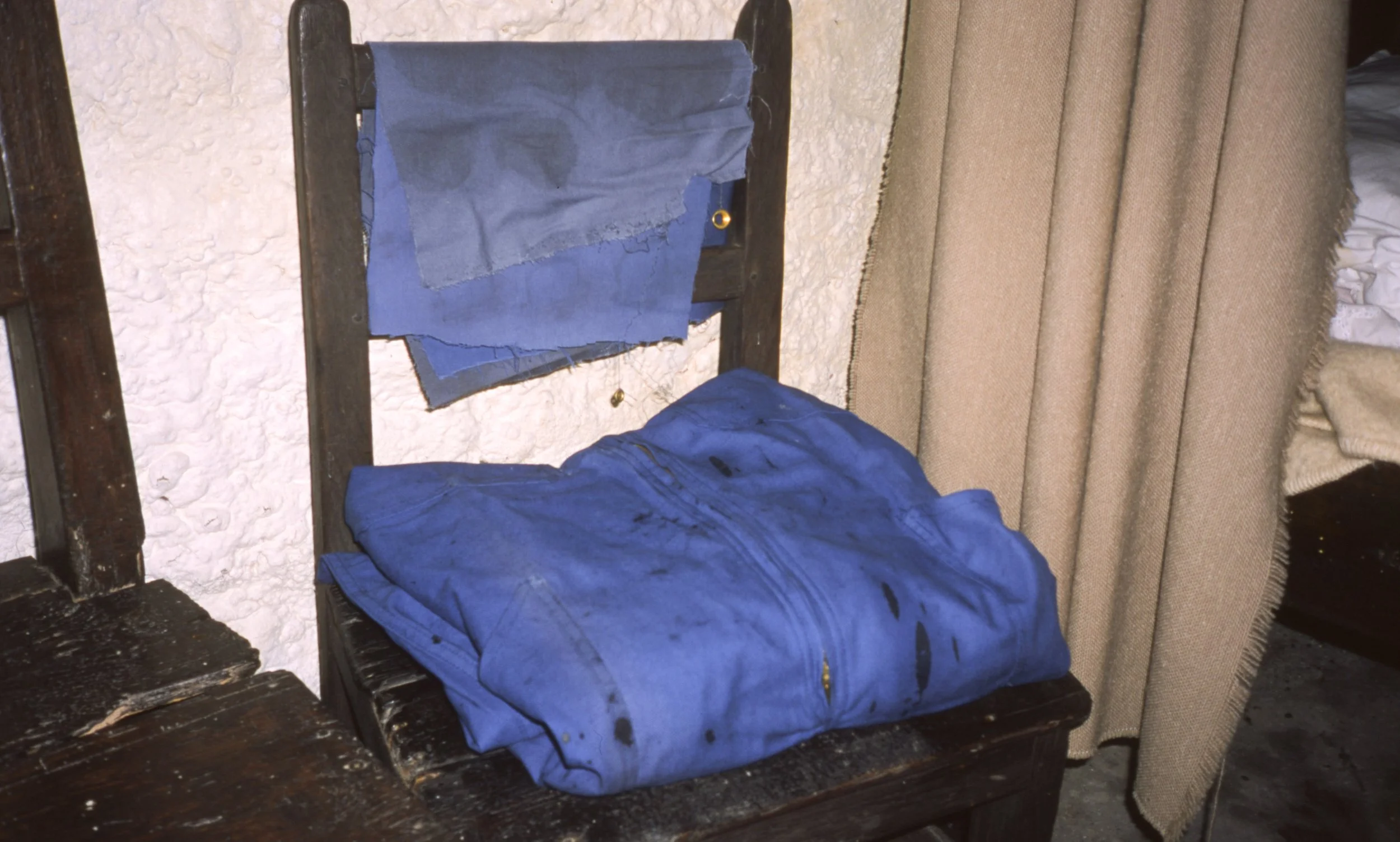
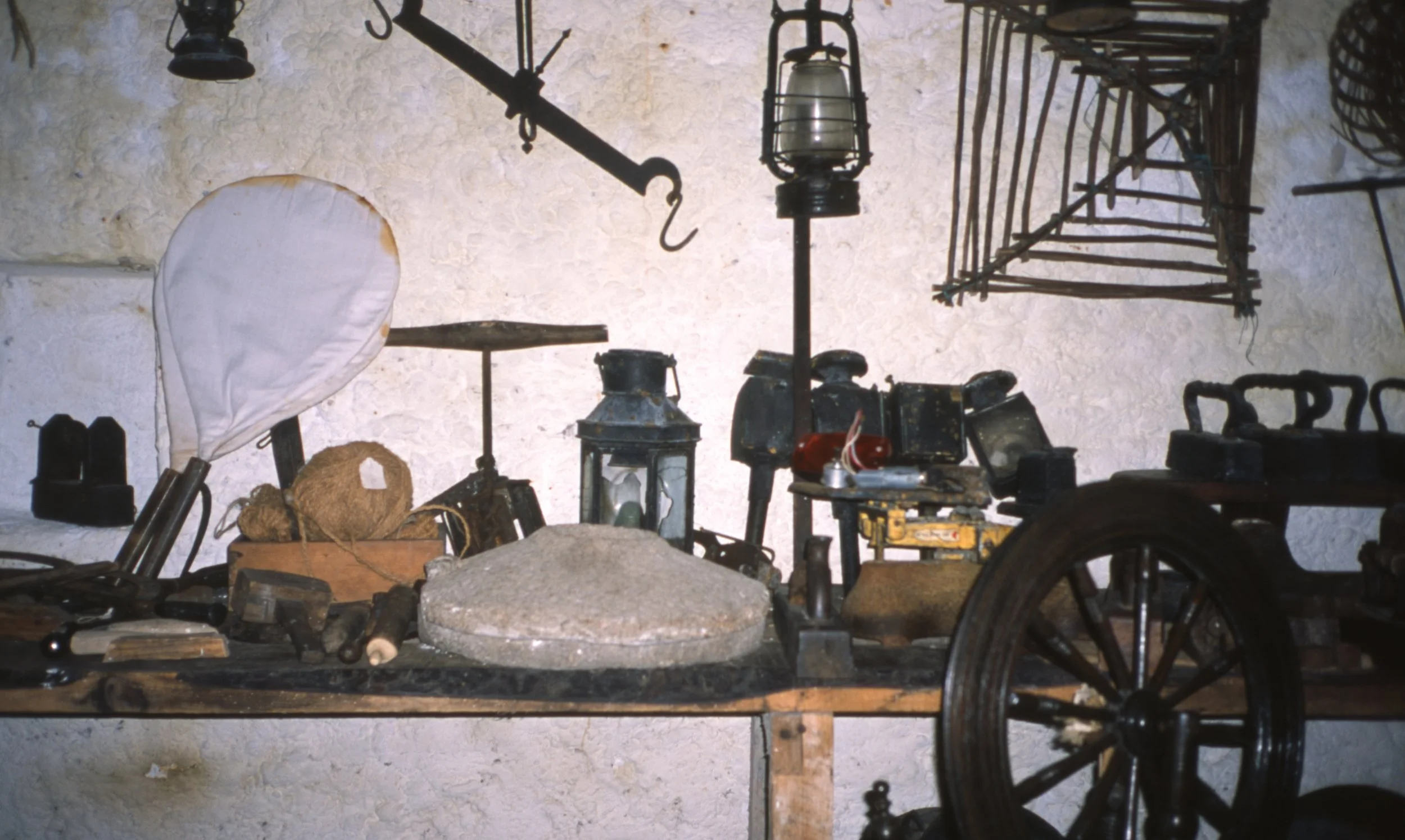
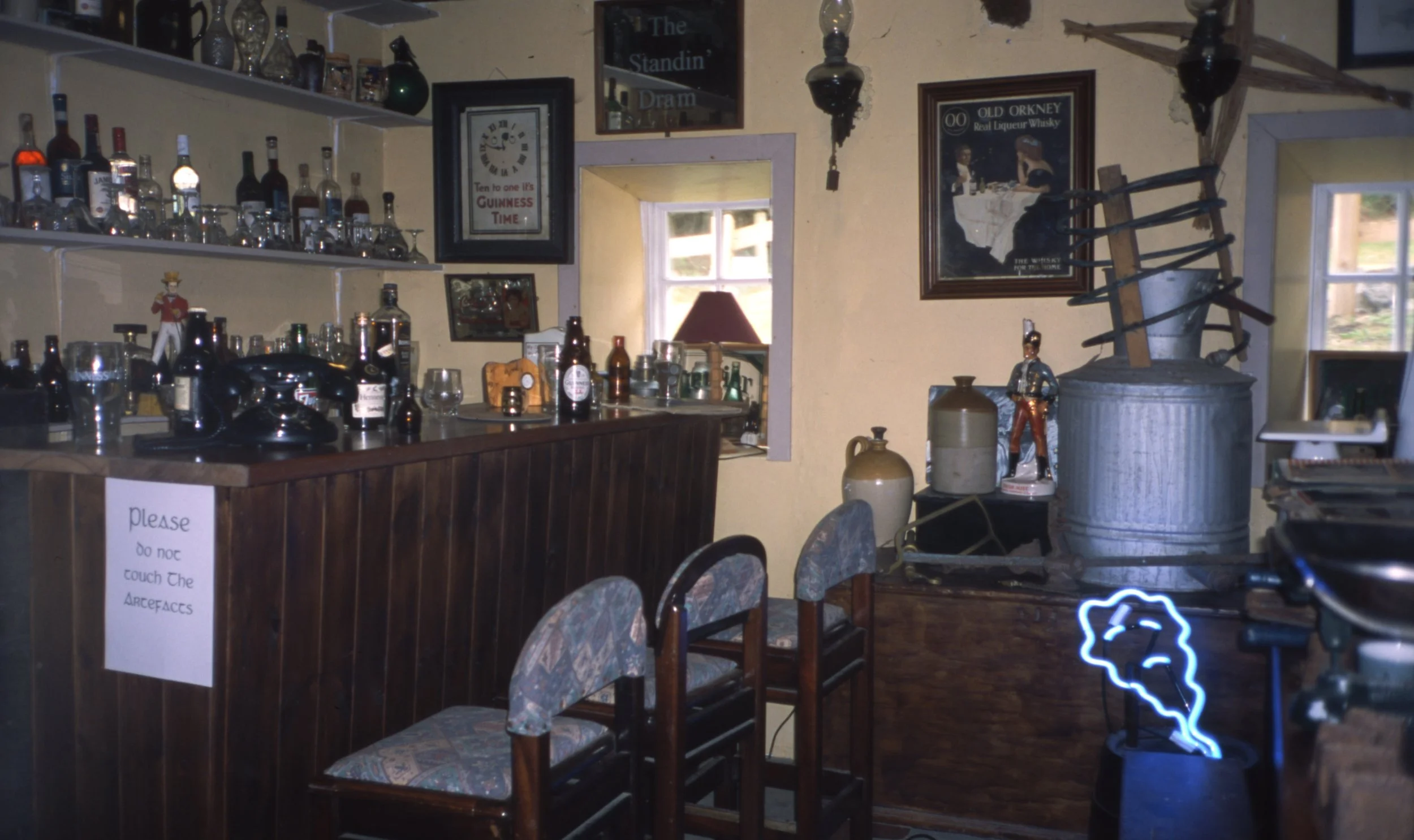
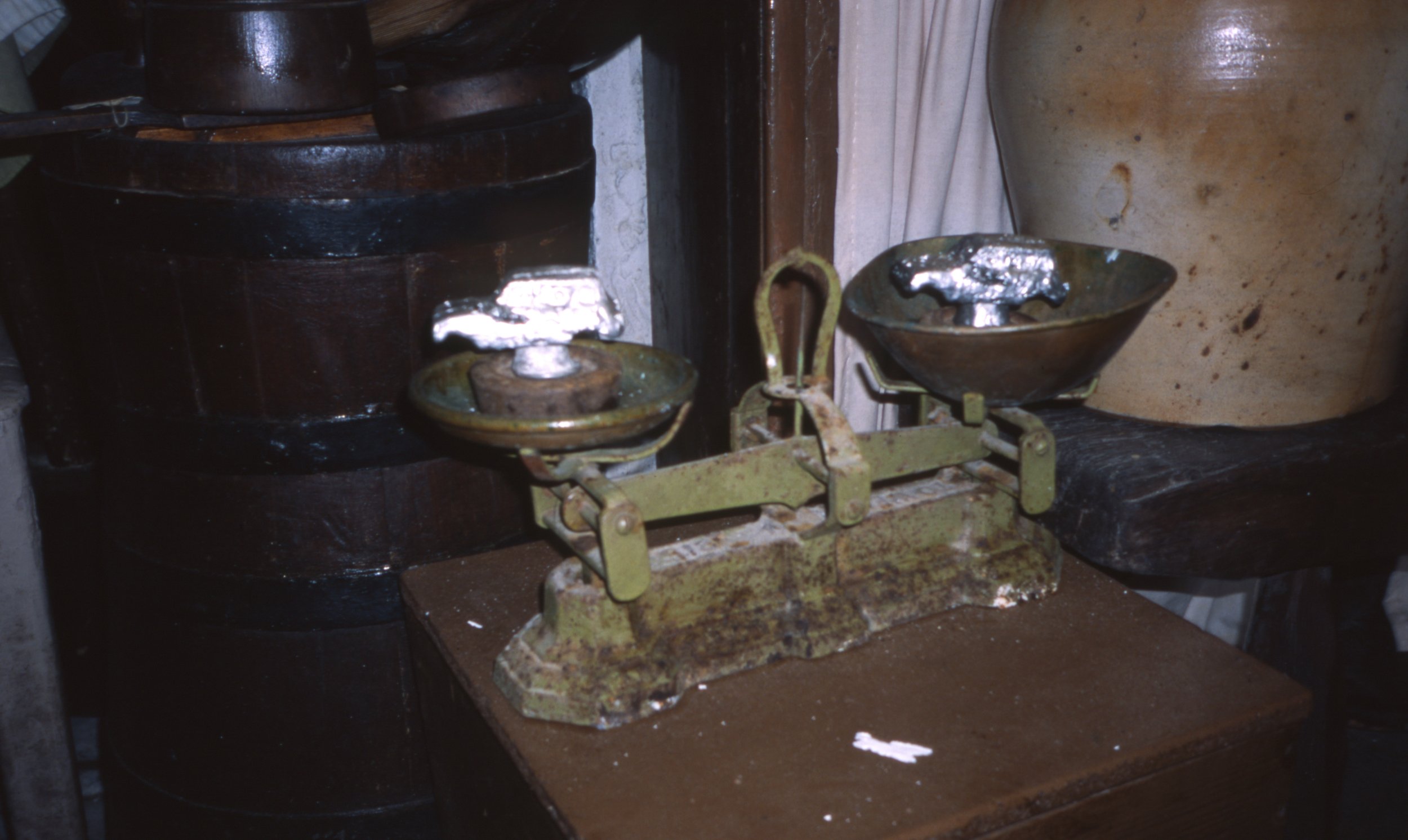
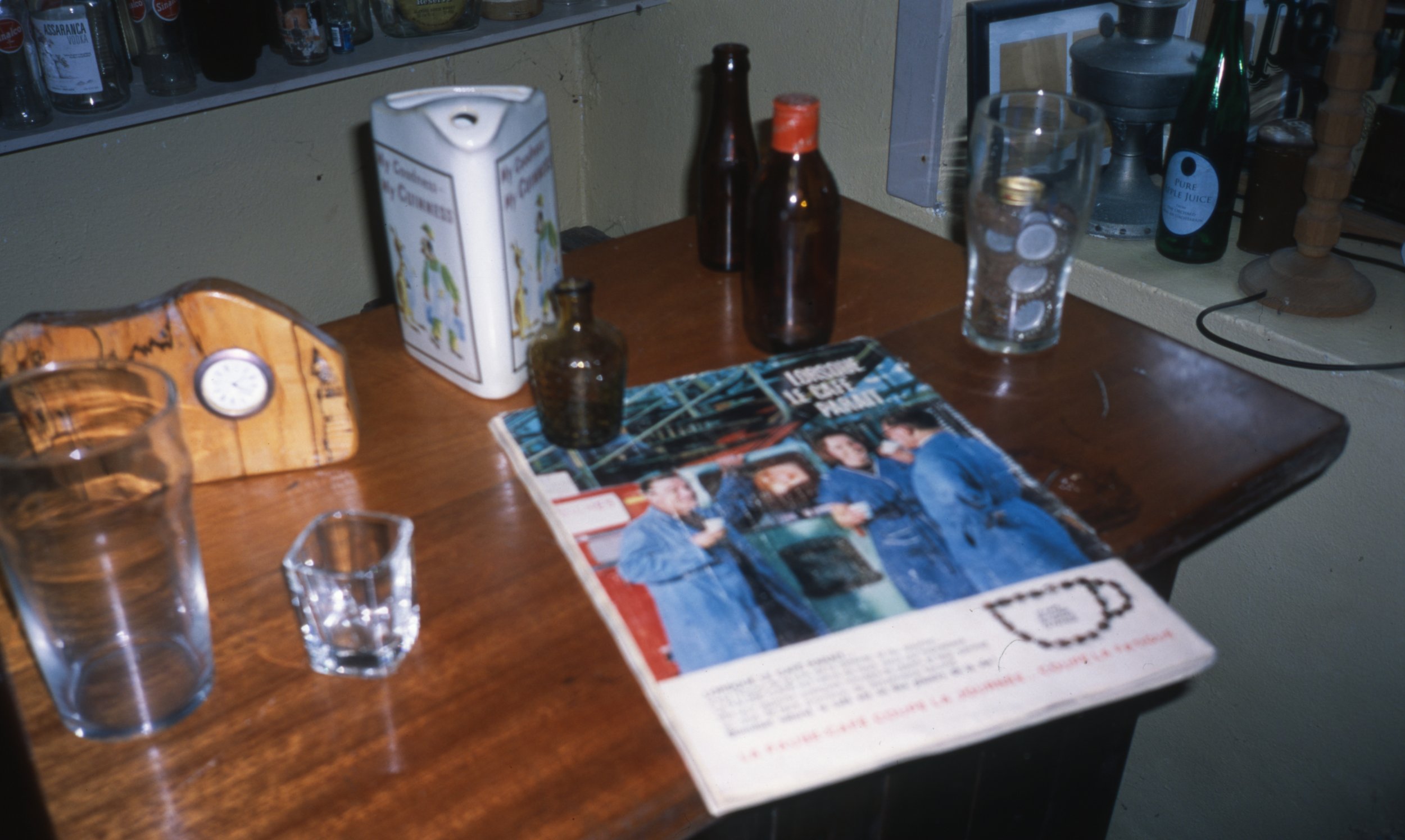
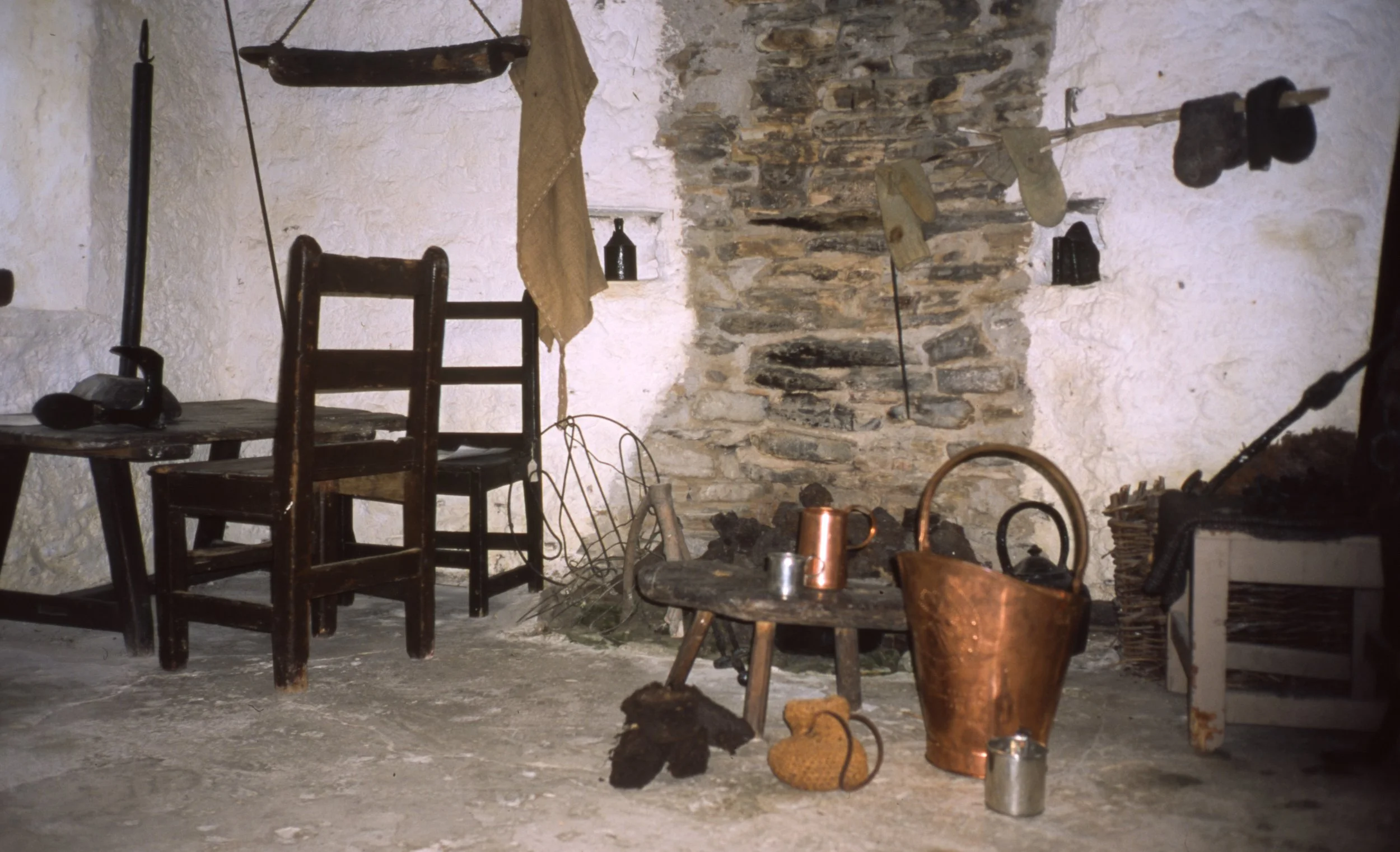
Photo credits: John Lyons
…they came from - Mín na bhFachrán,
named for bogbine,
known for music -
proposed a barter,
the gramophone for turbary rights.
The boys walked home,
taking turns to carry the gramophone
and three records.
We don’t know how many cartloads of turf
the shopkeeper took out of the bog
or for how many summers
or what the boy’s father,
a fiddler in a valley of fiddlers, said
or who got the better part of the bargain,
only that they had dry turf in Carrick that winter
and that new music was played in the valley.
Extract from The Barter by Moya Cannon for Rónán Galvin
08.08.2025
The concept of tour de force represents a journey down roads less travelled where the journey becomes a medium for both dissemination and gathering - the Renault 4 is a mechanical prop, a narrative device; a portal, where we traverse invisible edges between reality and fiction, memory and desire, the past and the present. It becomes, in a sense, a time machine as the car itself has its own histories which can act as signs and signifiers of its narrative direction. Because of restrictively high import taxes in the 1960s, 70s and 80s, a loop hole was discovered and the Renault 4 was made in France and shipped to Ireland in parts where it was reassembled. Cheap labour coupled with a highly skilled work force in Ireland bolstered this economic strategy, creating an intertwined social history between Ireland and France. The Quatrelle or 4L was one of the first affordable, everymans car in both countries and as such it is associated with rural and working class mobility.
The Renault 4 is also synonymous with the circulation of culture. One might picture collector Tom Munnelly in his own Renault 4, engaging with local communities, celebrating and documenting music and song in rural areas throughout the 1960s, 70s and 80s. In her essay ‘Cailín Deas Crúite na mBó' - and the Impact of the Folklore Collector, Ríonach uí Ógáin highlights changes over the last few decades, including technological advances, informant/collector relationships and gender dynamics. she notes, From 1935 to 1971 the Irish Folklore Commission oversaw the recruitment, appointment and fieldwork collecting of upwards of twenty-four full-time and special collectors, all of whom were male and most of whom were born in the late nineteenth or early twentieth centuries.
This raises an interesting question about how gender dynamics, or friendship, for example have affected the way material, intangible heritage; music has been gathered and preserved as documents within an archive. Retrospective examination of ethnographic fieldwork may also illustrate the fact that at times the resulting material from a single informant at different recording sessions may be quite varied in terms. In the context of collecting or recording music, friendship between musicians fosters a convivial dynamic, and friendship with the collector, one would hope; fosters an atmosphere of trust. Different contexts and atmospheres result in different renderings of tunes.
Through the prism of a song, Uí Ógáin describes how musician, singer, collector, Séamus Ennis and Colm Ó Caodháin, a singer, storyteller, musician, farmer and fisherman made discoveries about the song’s history and context through shared research, friendship and having a great laugh with each other,
Ó Caodháin was arguably Ennis' best informant and the informant to whom he was closest. They fished, sang, played music, worked and travelled together. We can imagine the fun and the exchange they had when they spent an entire day together in pursuit of songs around the Carna district. This doubtless led to further shared terms of reference and shared memories.
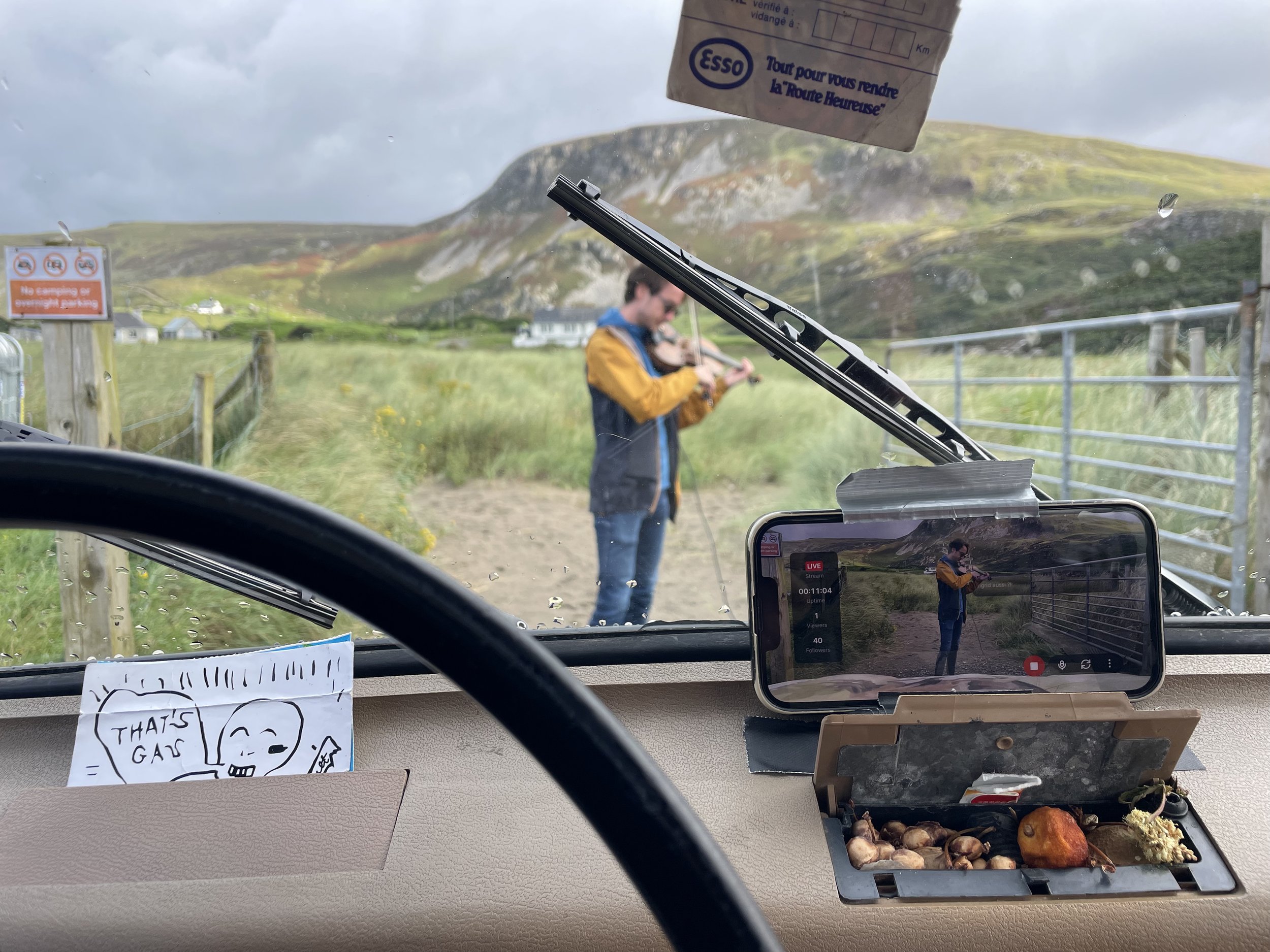
This day last year we invited dear friends, Clíodhna Ní Ruairc and Cathal Caulfield to play a few informal and relaxed tunes in the car at the tail end of Glencolmcille Fiddle Week for K7 dans la 4L a live broadcast series from the Renault 4. Clíodhna is a fiddle player from Garristown co. Dublin now living in Artane and she has spent time in Leitrim, Clare and Donegal learning tunes and styles, adapting her own style and repertoire over time. She cites Antóin McGabhann’s strong steady rhythm as a particular inspiration, and this comes through in her playing. Clíodhna is a relaxed musician which lends fluidity, allowing tunes to shape in a way that feels effortless and often hypnotic. However, her serene disposition belies meticulous dedication and integrity in how she navigates the fiddle traditions that inspire her.
Cathal is a fiddle player and singer from Clontarf, Dublin who has described searching for inspiration ‘in the wells of birdsong, 18th-20th century manuscripts and the places in time where history and folklore collide’. Such influences are clearly manifest in his playing which sounds ancient and transient, caught on a breeze. At times, phrases seem wild, wilfully loose and inquisitive, as though remembering or reimagining lost techniques of forgotten musicians or styles that might have evolved and disappeared before ever being recorded.
First tune, Lucky Lover…the rest of the tunes - a few missing, but most are there,
1. a. ? b. The Gneeveguilla reel
2. a. The maid at the well, jig ; b. The mug of brown ale, jig ; c. The Limerick tinker, jig
3. a. The bunch of keys, reel ; b. The Abbey, reel ; c. Upstairs in a tent, reel
4. a. ?, air ; b. Nora críona, jig
5. a. Con Cassidy's waltz ; b. ?, waltz z
07.08.2025
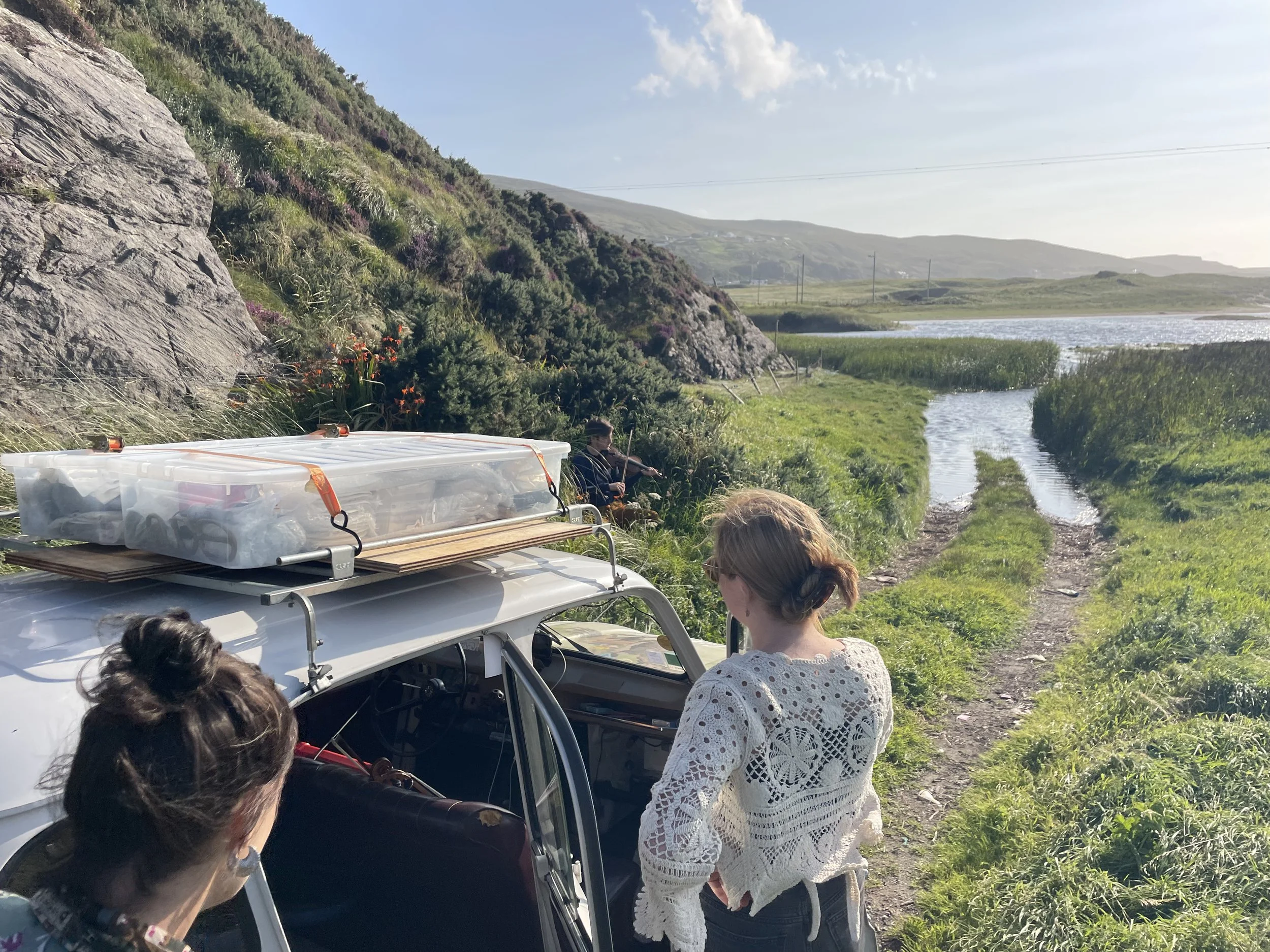
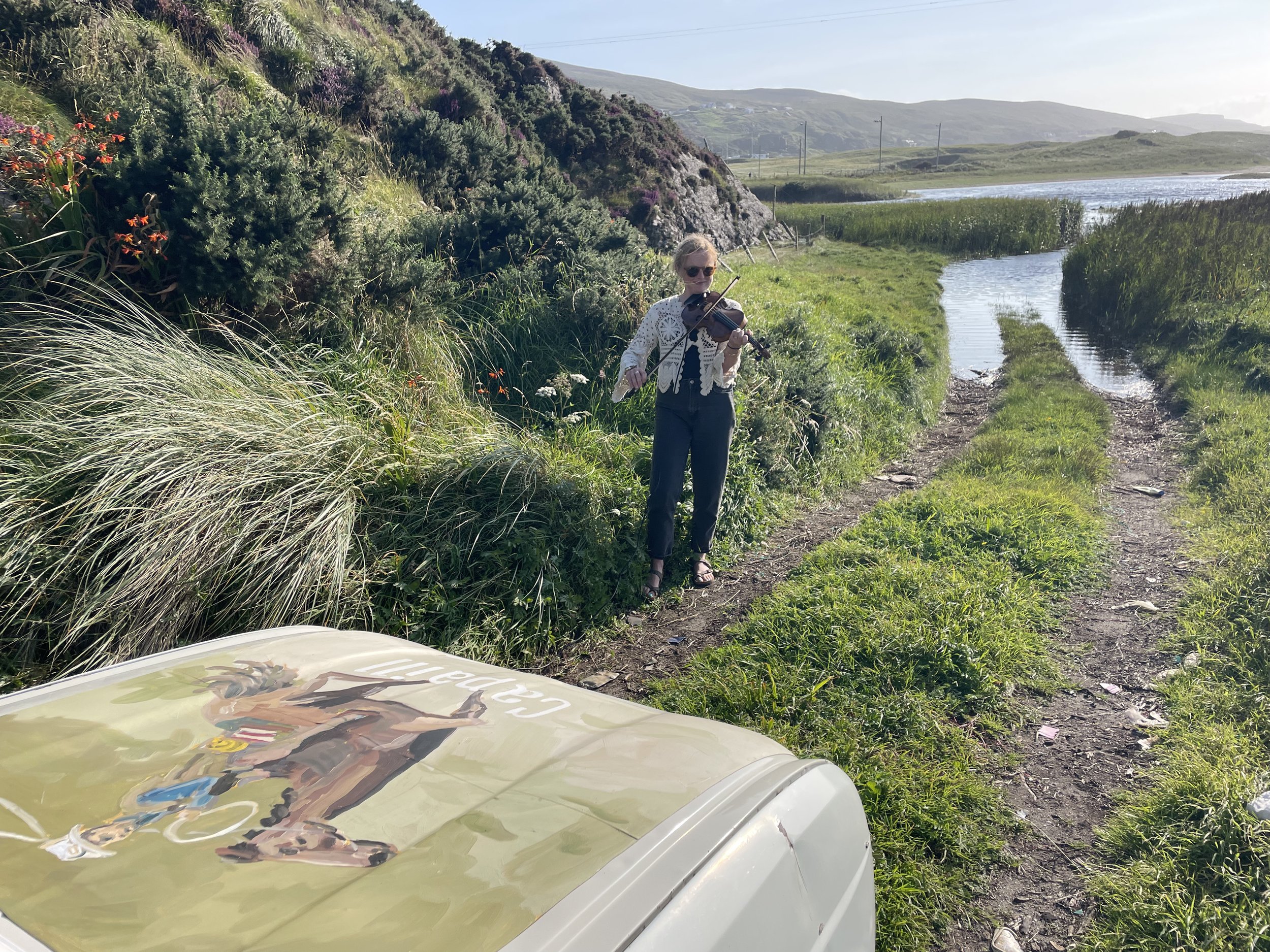
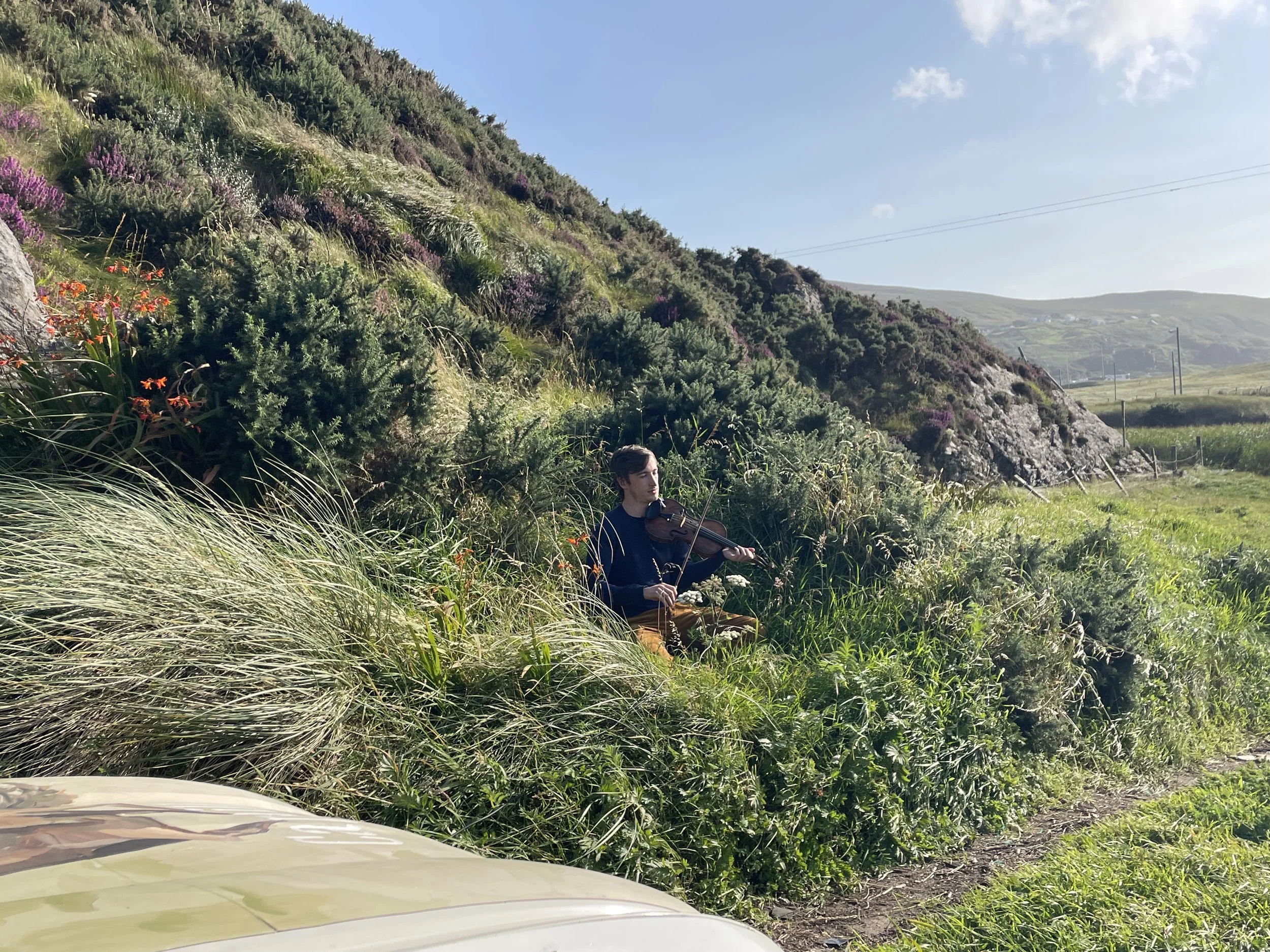
This day last year we were joined by Sebastian Hensel for a magical recital at Sruthán Chorrbhaile; the round area stream - a liminal hinterland where Murlin River meets the Glen Bay in Kilaned. Though his instrument of specialisation is viola, Sebastian is also a stunning violinist. After a series of musings at the court cairn the previous day, we’d decided to drive down to the estuary where Sebastian would improvise; responding to prompts in the surroundings for a live broadcast episode of K7 dans la 4L.
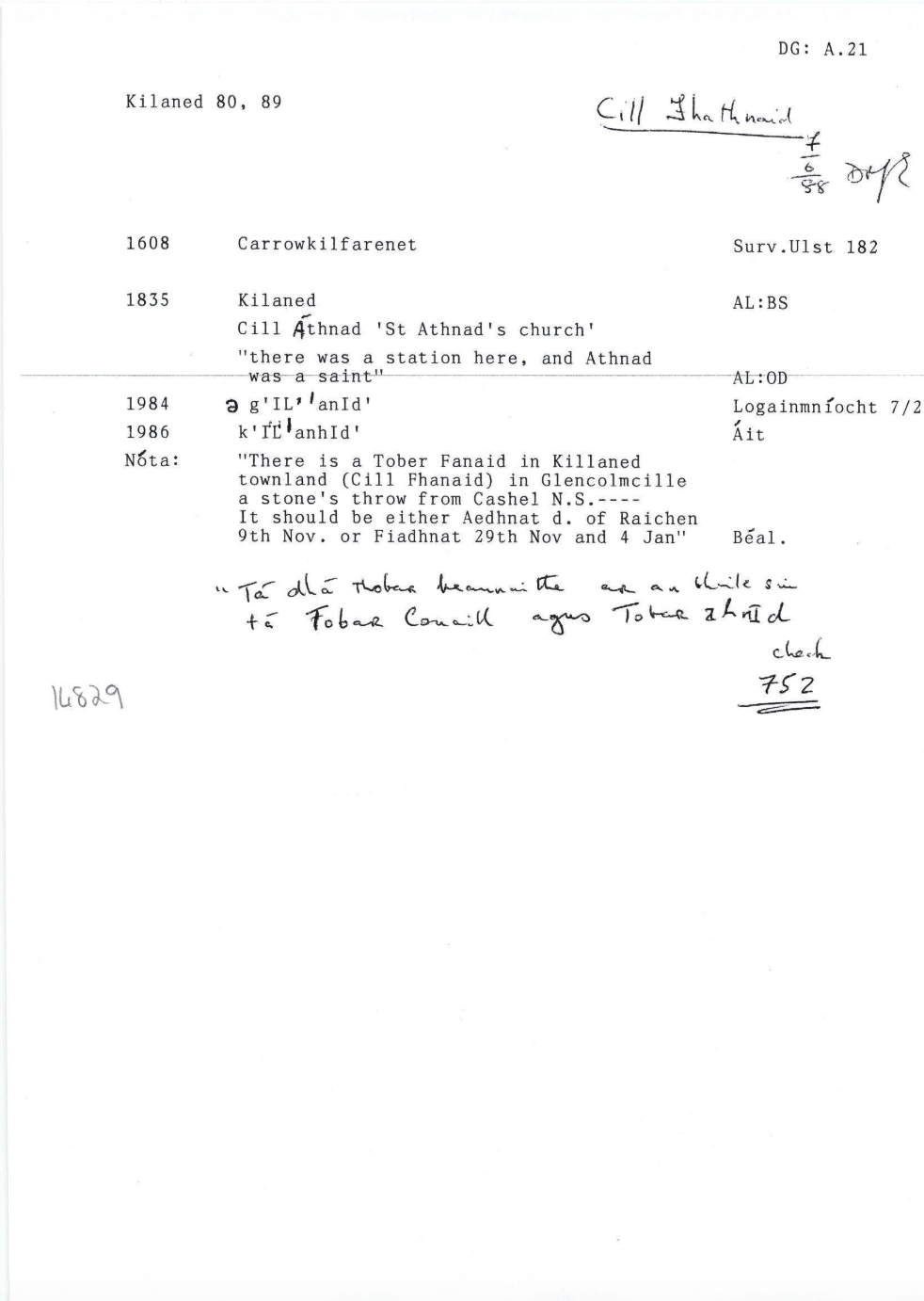
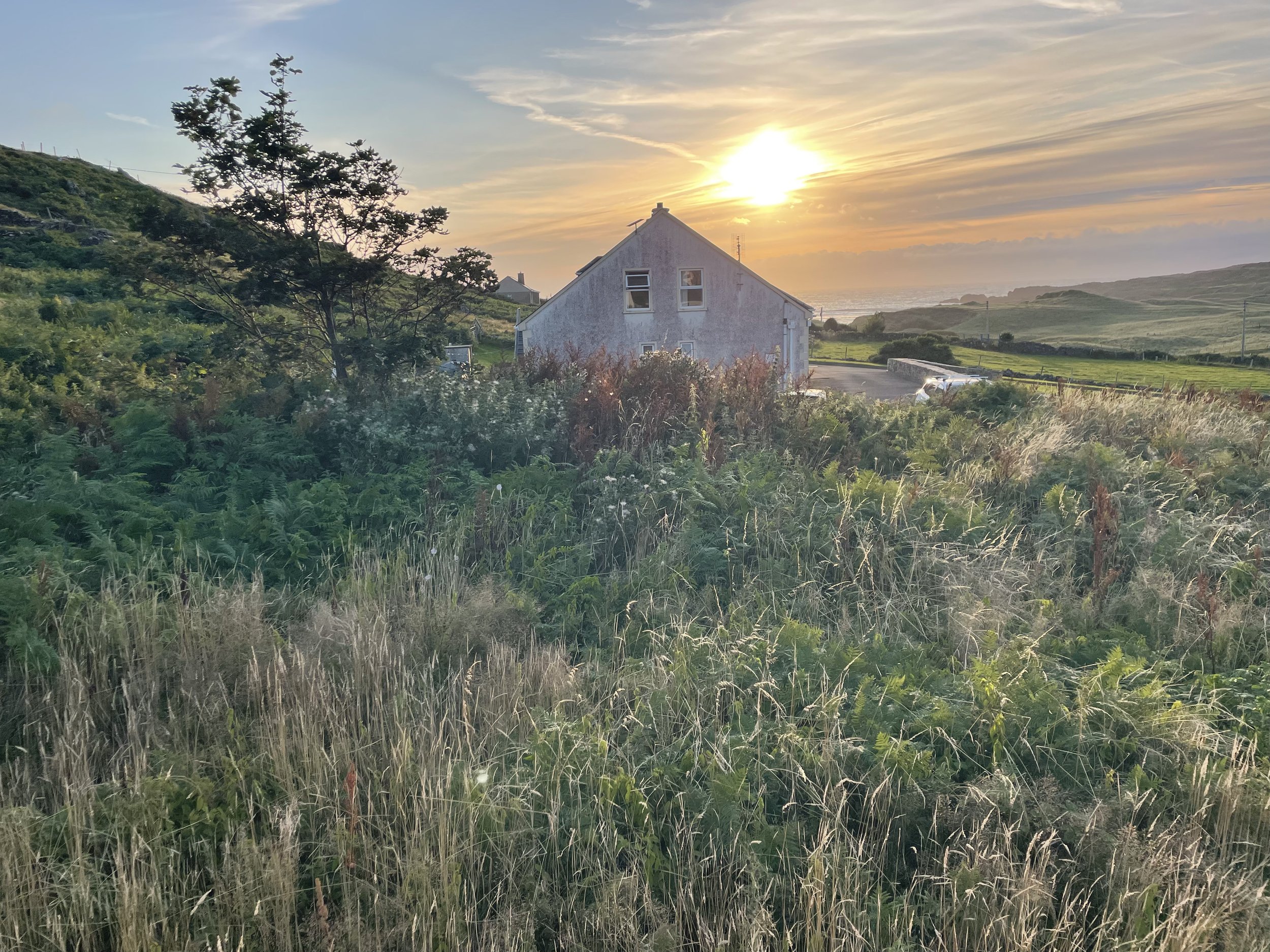
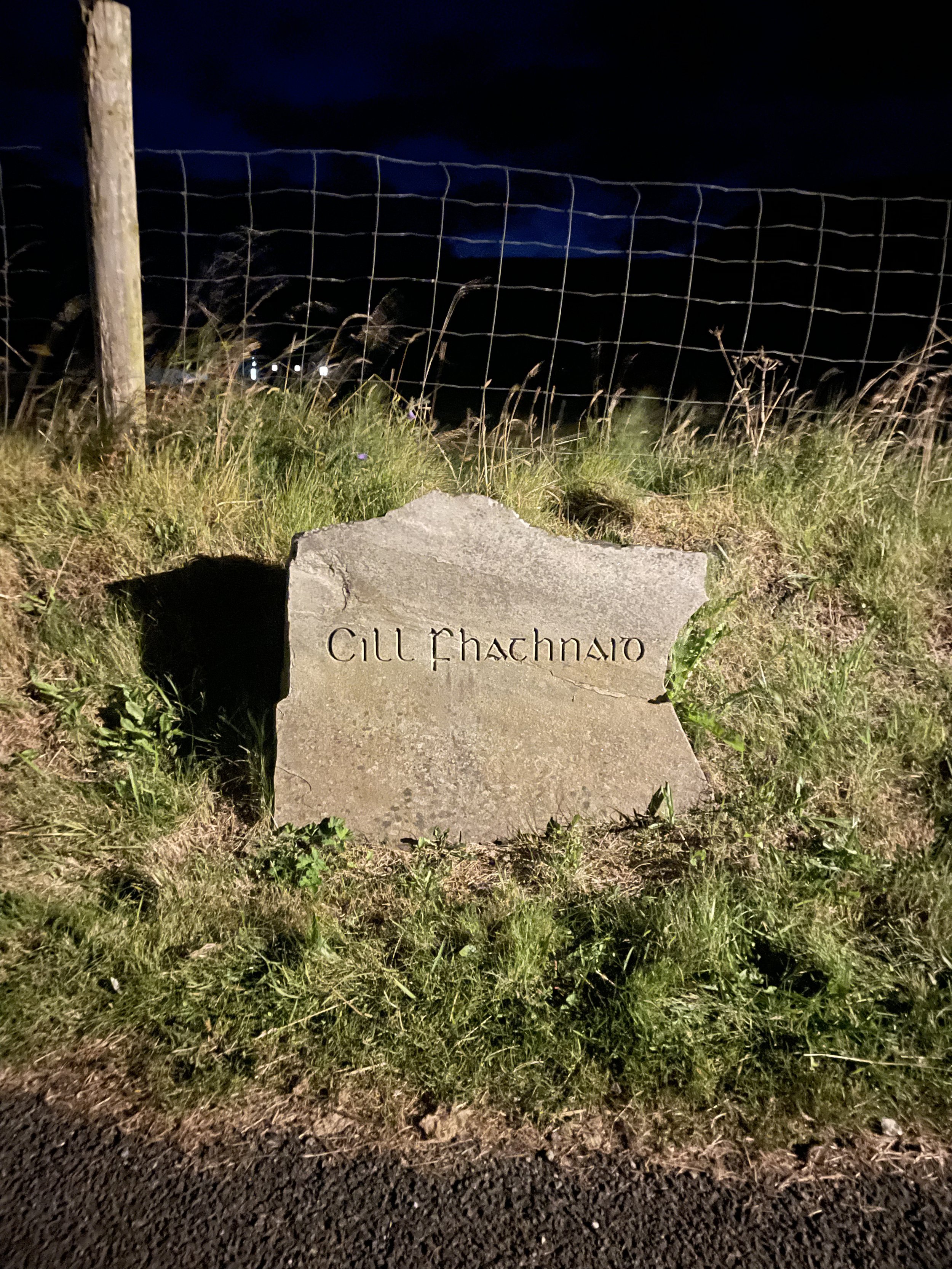
Kilaned, Cill Áthnaid in Glencolmcille is named after Saint Athnad's Church, of which there’s still remnants; a roughly-built stone cell that you can find just above a grouping of cottages built into the side of the hill as part of a holiday development scheme in the late 1960s.
Some would tell you that the stones gathered from the area to build the holiday homes are from structures that would have been in place during the time of St Athnad and apparently another structure related to the saint stood somewhere on the townland, but it is now, by all accounts; level with the ground.
If you climb Glen Head on a bright enough day, and stand at the Napoleonic tower looking across the Glen, you’ll see how lush and verdant the horse shoe shaped shelf of Kilaned is – easy to see why, by comparison with the gale-swept, craggy, scrubby, heather adorned mountains around the valley – this tiny townland promises respite.
A melody associated with the townland, the Kilaned Waltz, is a placid tune composed by fiddle player John Mhósaí McGinley during the 19th Century. Though he was never recorded, the tune has been passed on and people still play it in the area. He composed a number of tunes in response to the natural surroundings, descriptive pieces about the sea, waterfalls, the wind. It’s often said that the field above the holiday development scheme belonged to John Mhósaí McGinley at one point and when the holiday homes were built, stones were taken from the old ruin of what was once his home. There’s a story to go with that, I’ll return to it another time.
Down the hill, towards the monk’s cell, there’s a section of flat ground where there was once a barley plot; Garraí na hEorna and beside it, a flagstone for winnowing, Leac an Cháite. Under the wind influence, the chaff was blown across the stone while the seeds were left in the grooves. Before the horse power threshing engine came into use in the area, people relied on wind for threshing.
Poitín was made here too.
A gentle place, with a holy well (from a time before holiness as we know it existed), that’s overgrown and hidden now between an alder sapling and the pebbledashed gable end of a celtic tiger build. From here, a conjuring breeze sorts wheat from chaff and composes melodies.
Relaxed and poised, with fiddle in hand, we might fleetingly glimpse the moment where melodies and instruments intertwine on this very fine threshold between worlds….
Sebastian Hensel as described in his profile on IRCAM (Institut de recherche et coordination acoustique/musique), Centre Pompidou,
Born in 1990, Sebastian Hensel grew up in a musical family that would lead him right away into playing and composing music himself. Master degrees in music theory, music and French language and viola would set him on his way to becoming a professional viola player with the radio symphony orchestra of Leipzig (Sinfonieorchester des Mitteldeutschen Rundfunks Leipzig).
After publications in musicology focussing on the art of instrumentation of Lili Boulanger (‘Concerning the orchestration style of Lili Boulanger at the example of D’un soir triste and D’un matin de printemps’) and the Prix de Rome en musique (‘The cantata compositions in the Prix de Rome competition. A model between reproduction and transformation’) he is now preparing his PhD thesis on the teaching of instrumentation and orchestration at the Paris Conservatoire between 1900 and 1977.
06.08.2025
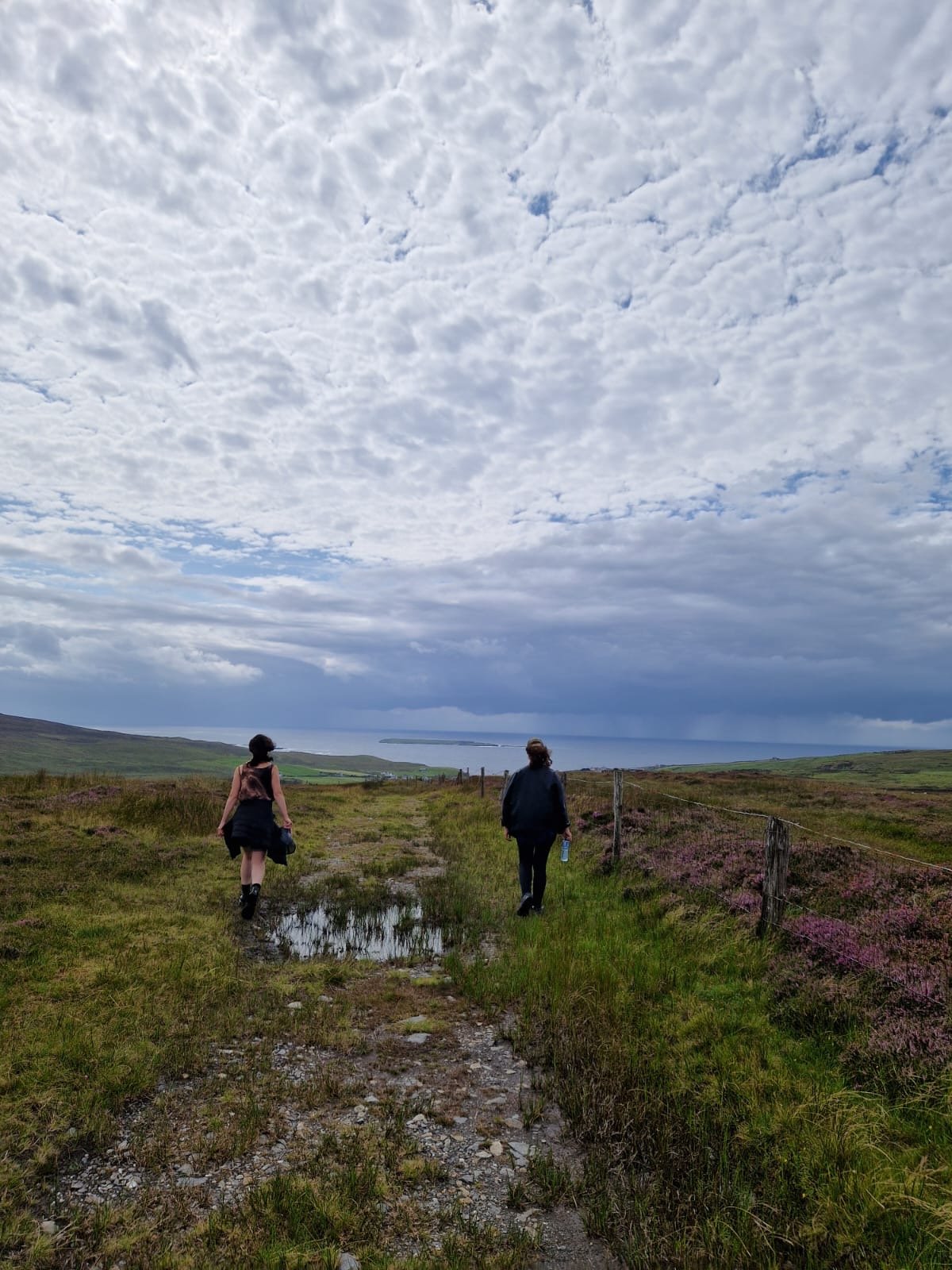
This day last year three of us took a walk from Cill Fhathnaid, up past An Dumhaigh over towards Gleann Mhálanna to see the Cloghanmore court cairn, Cloghanmore; the big heap of stones dates back to around 3000 BC. Subjected to restoration efforts in 1887, parts of this chamber tomb were ‘cleaned’ and reconstructed. Some decisions around its restoration were inexact or erroneous, and while grave goods had been found, these artifacts didn’t merit preservation at the time. Fragments of pottery were discovered, perhaps used to carry food or other supplies, sustaining the deceased on their journey into an afterlife.
It's said that there are drawings on some of the stones, votive art, but I’ve never been able to make them out. Maybe it takes a special type of light or time of year; when the sun - just about to dip under the horizon at Malainn Mór, sends one last long ray to contrast the faint relief.
The walk from Cill Fhathnaid to Cloghanmore is 5.7km by road but only about 2km if you take the mountain path by foot. Thanks to a wonderful book called Gleann Cholm Cille, an áit agus a naomh; Glencolmcille, its places and its saint we have an in depth inventory of place names and their associated stories.
Edited by Seosamh Watson in 1984 and published by Oideas Gael, the book documents the names of every rock, river, path, cliff, cairn, hill, peak and valley and we can see how descriptive, poetic and rich in heritage these few square Kilometers are. If I was to give you directions to the court cairn from the mountain footpath, it would go something like this,
Towards the great brow where the pigs ravine cuts through the hill of the sand martin, bringing the little river past summer hill and the yellow peak near Eoin’s promontory, you can stand at what is believed to be nearest point in the parish to America. From here, you can see the rock of the fox. The rock takes its name from the following story, a fox reportedly heard a sheep bleating on Rathlin O'Birne island and attempted to swim over. Becoming tired during the swim it rested on this rock, and in order to satisfy its hunger the fox lifted a limpet with its tongue. The limpet, however, closed over down on the fox’s tongue trapping it so that the animal died when the tide flowed in and covered the rock.
When you turn your back to the sea and face inland, you’ll see a path at the bottom of a curved glen before you get to the red swamp. You may or may not see the golden castle, a man once found an opening and, on entering, discovered steps which led him to a large hoard of gold. He departed to summon help but on returning found that a boulder fall had covered the entrance which he was unable any more to discern.
You turn left and you will pass through, the striped/grey moor, where little Eoin's rock is. You can take either the lower or upper path to the stone of the purse (a purse containing gold was once buried here). From there, you climb up the lumpy hill, abounding in lumps, knolls and tummocks where you’ catch site of the outline of brown hill just past Jennet's hill.
If you descend to the left, you might find yourself at the slate quarry, or to the right; the crag of the badgers or potentially, the little oxen enclosure. Before you get to Jennet's hump at the foot of Jennet's hill where the big oxen enclosure is, there’s a hollow in a cliff there, from within which there is no view at all.
On the opposite side, theres the cliff shelves; sheep's cliff shelf and just before that, the garden of the pits where a hollow/recess descends into the valley of the brae. Magnetic North of the valley, is Loch Adhbha, Lough Auva. This name, like Loch Inseach is said locally to derive from a holy woman who lived in Slieve League.
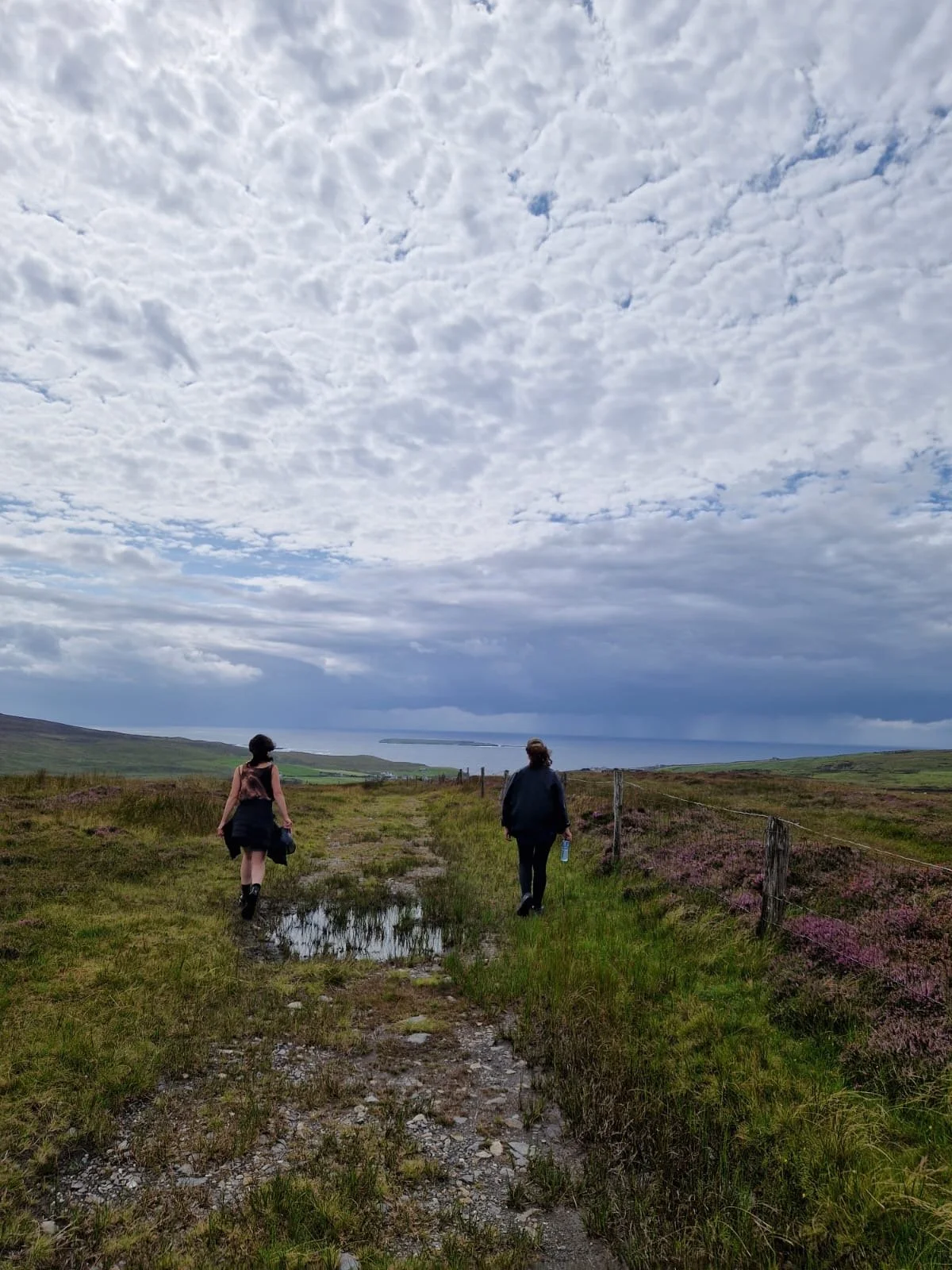
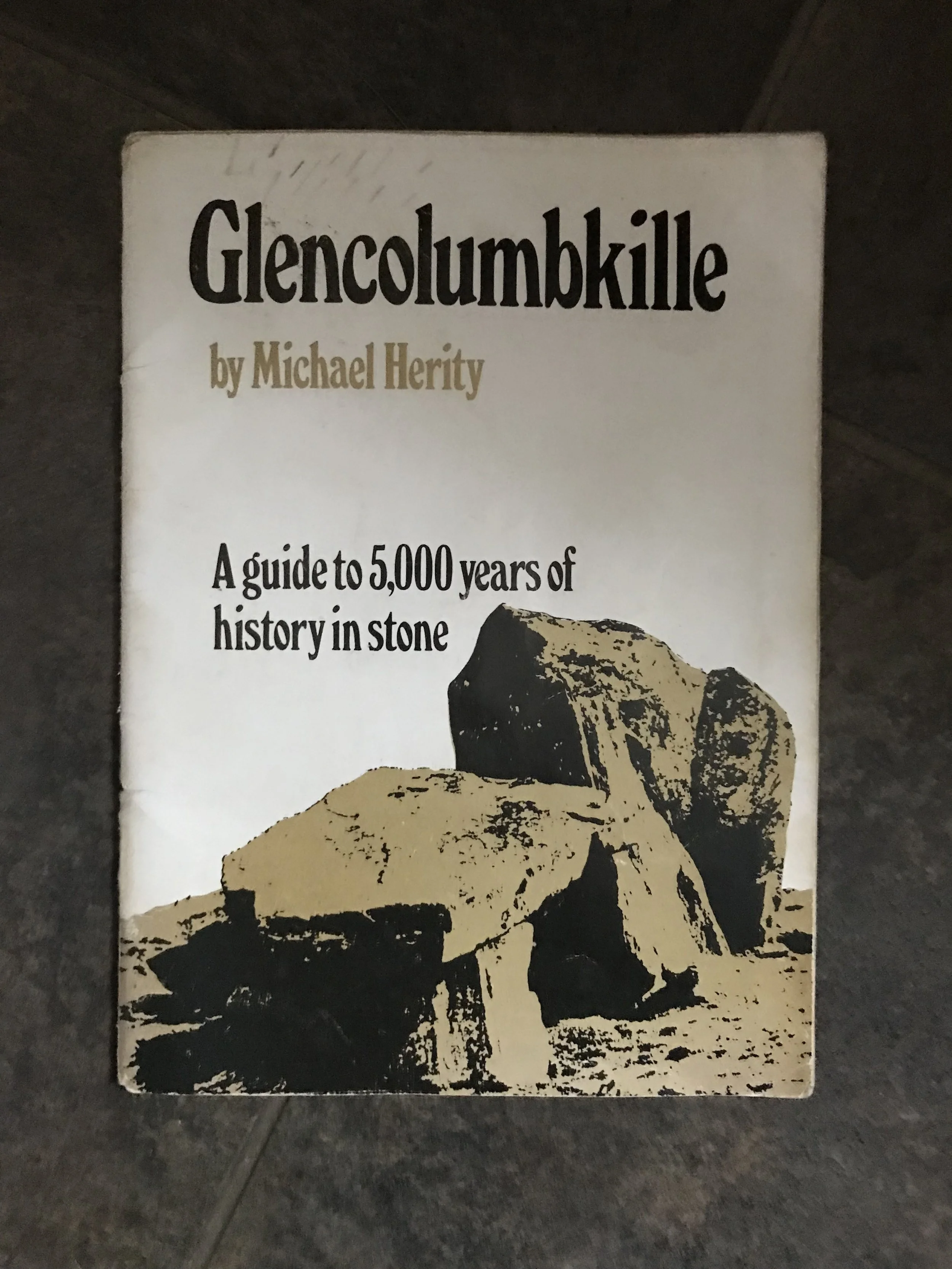
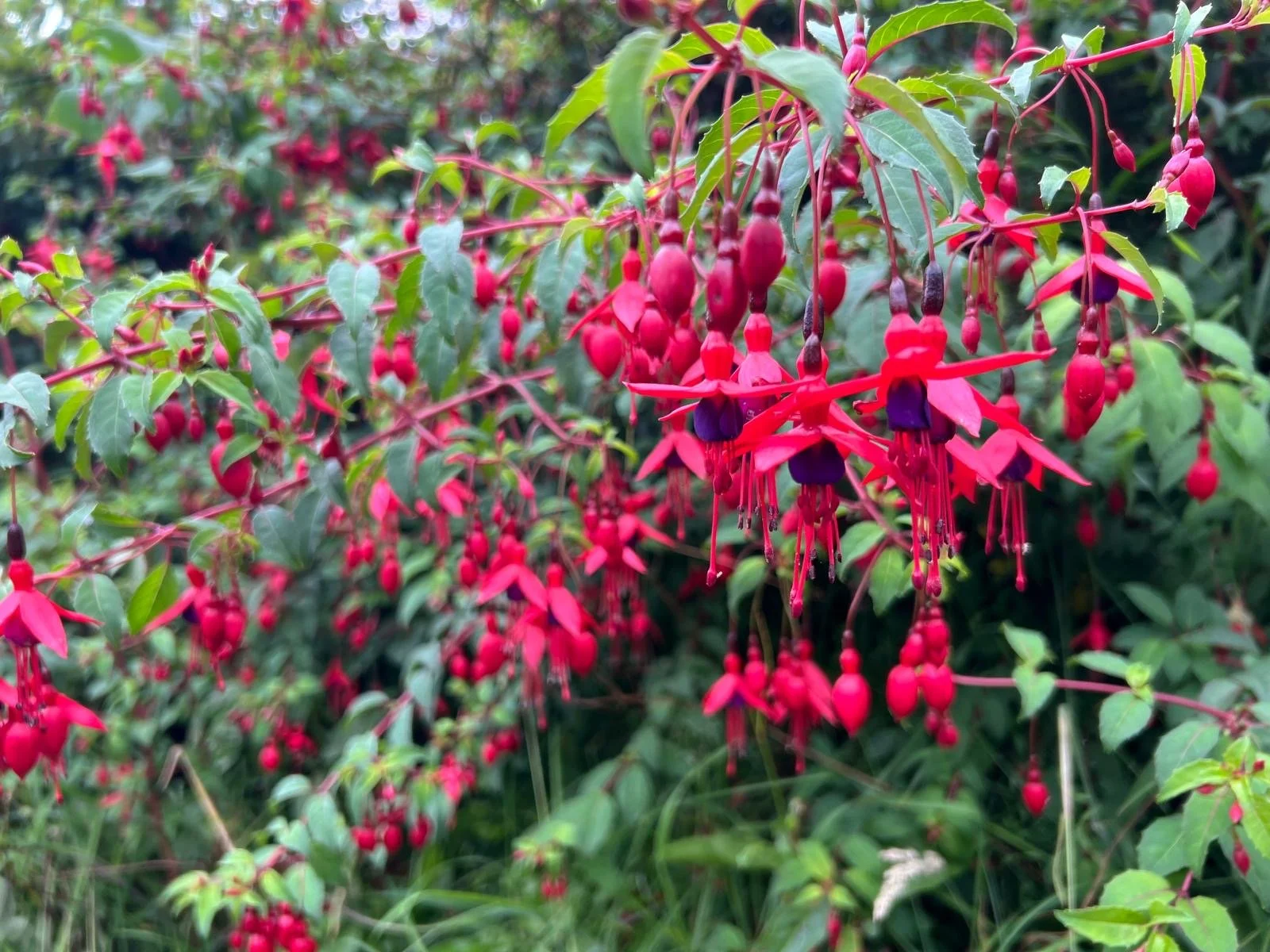
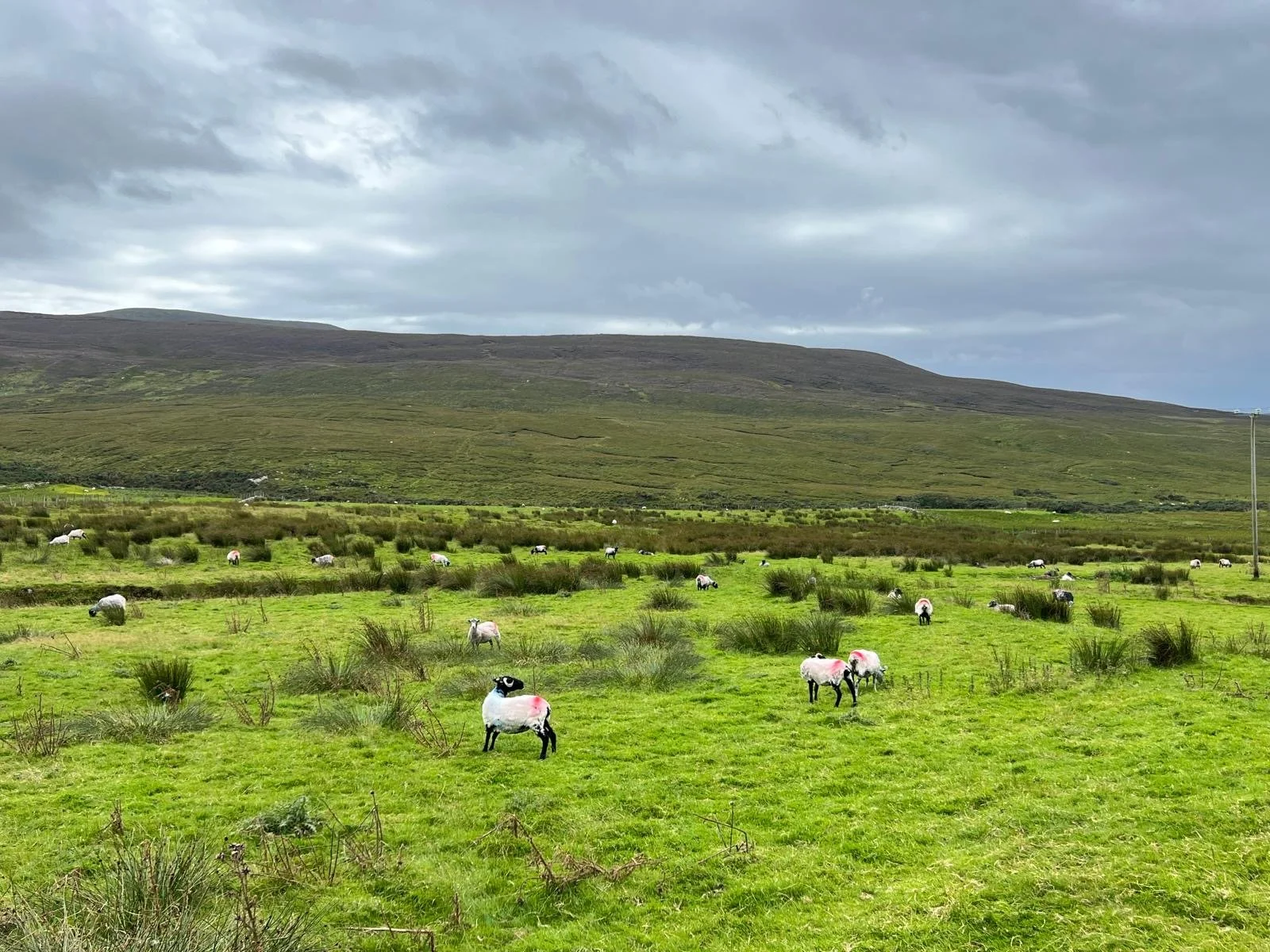
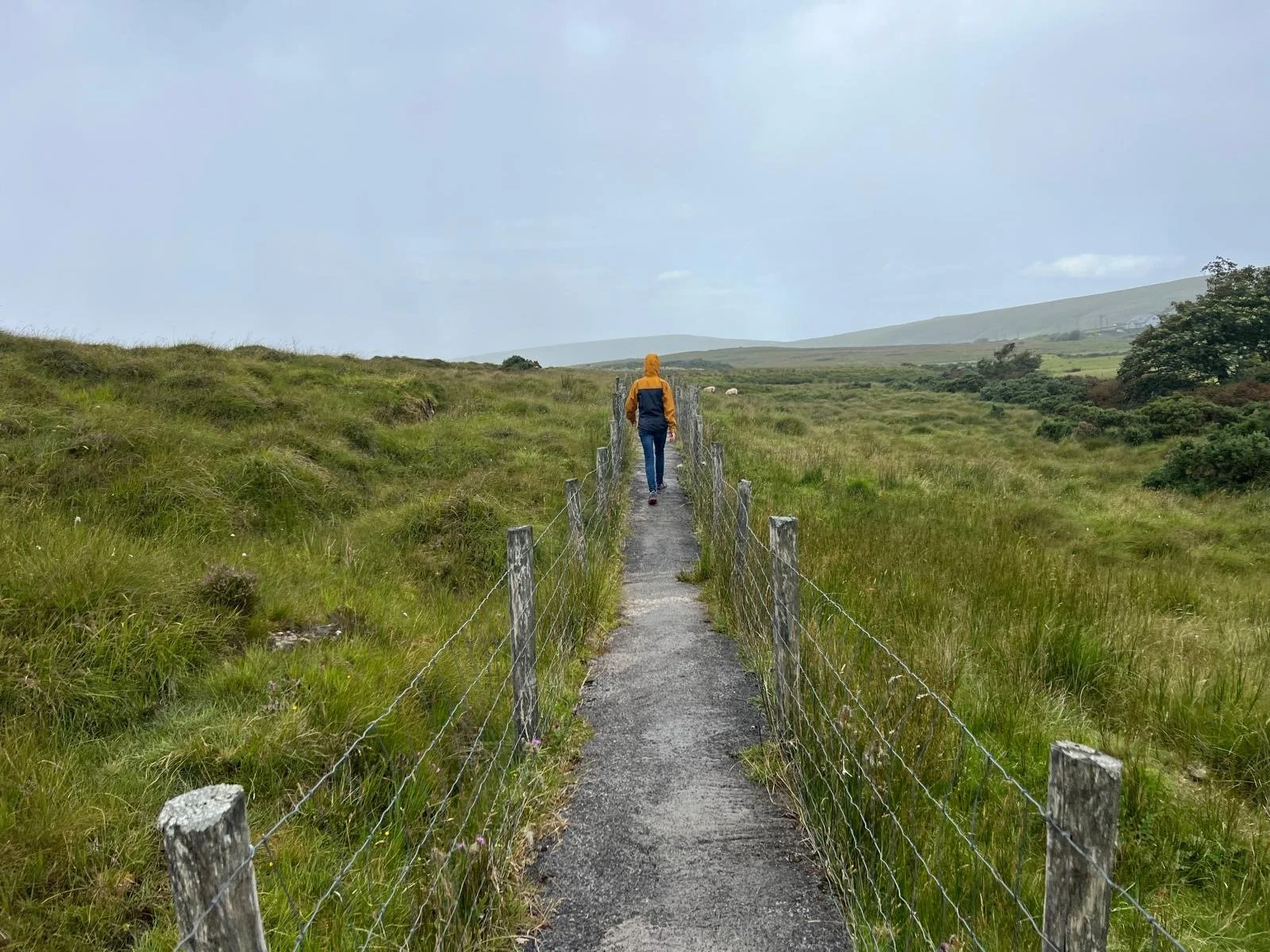
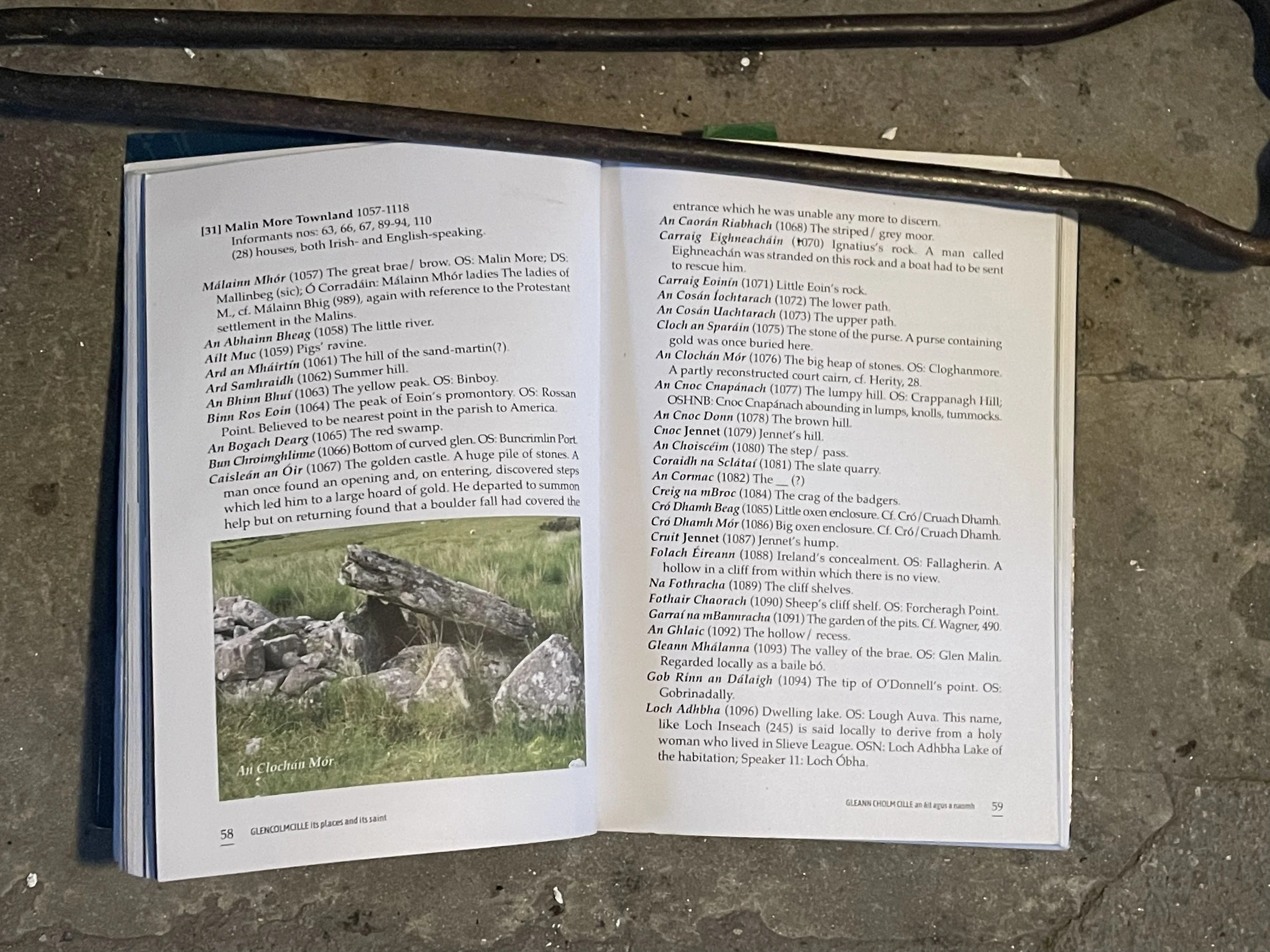
Photo credits: Sebastian Hensel and tour de force
05.08.2025
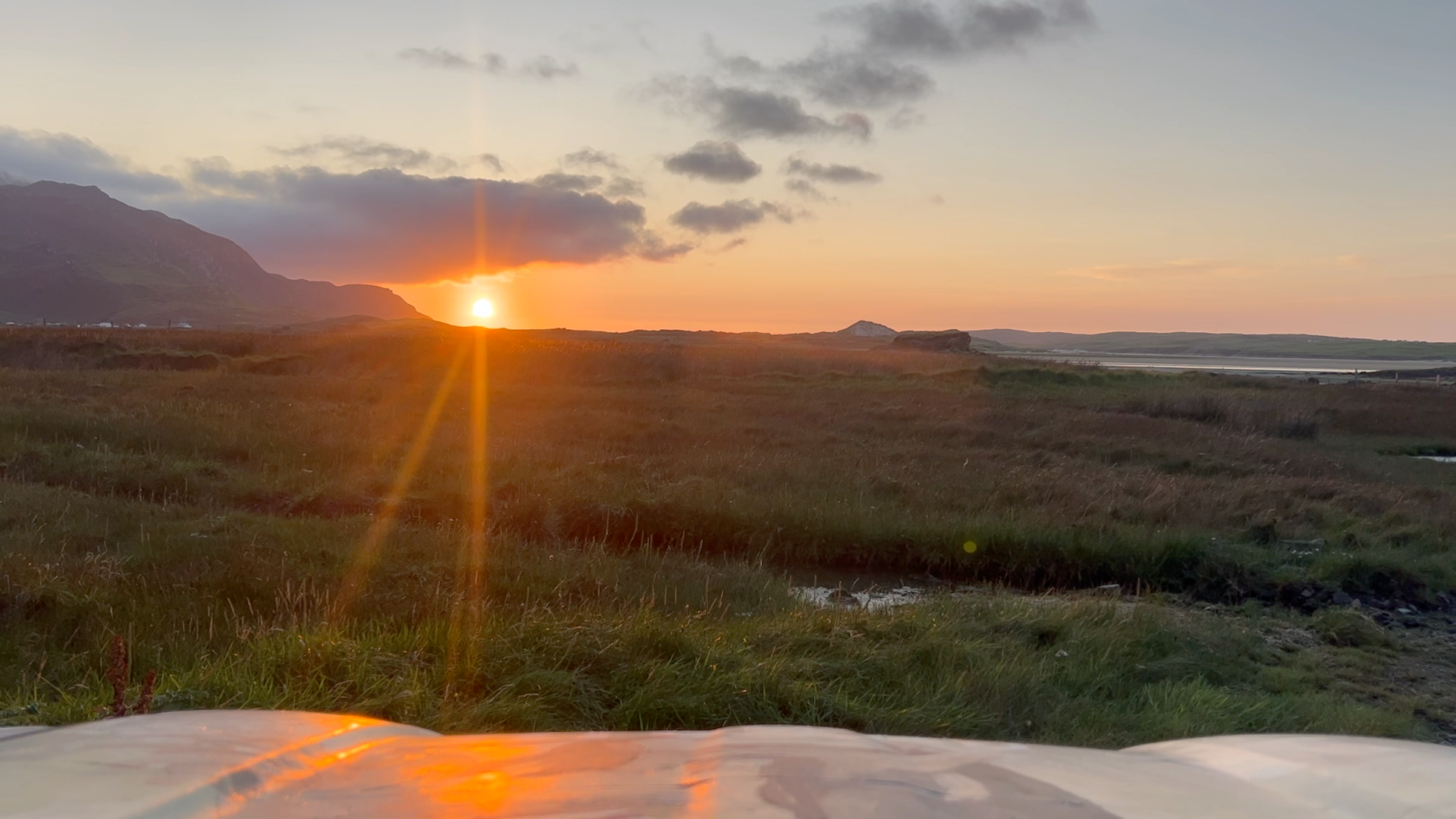
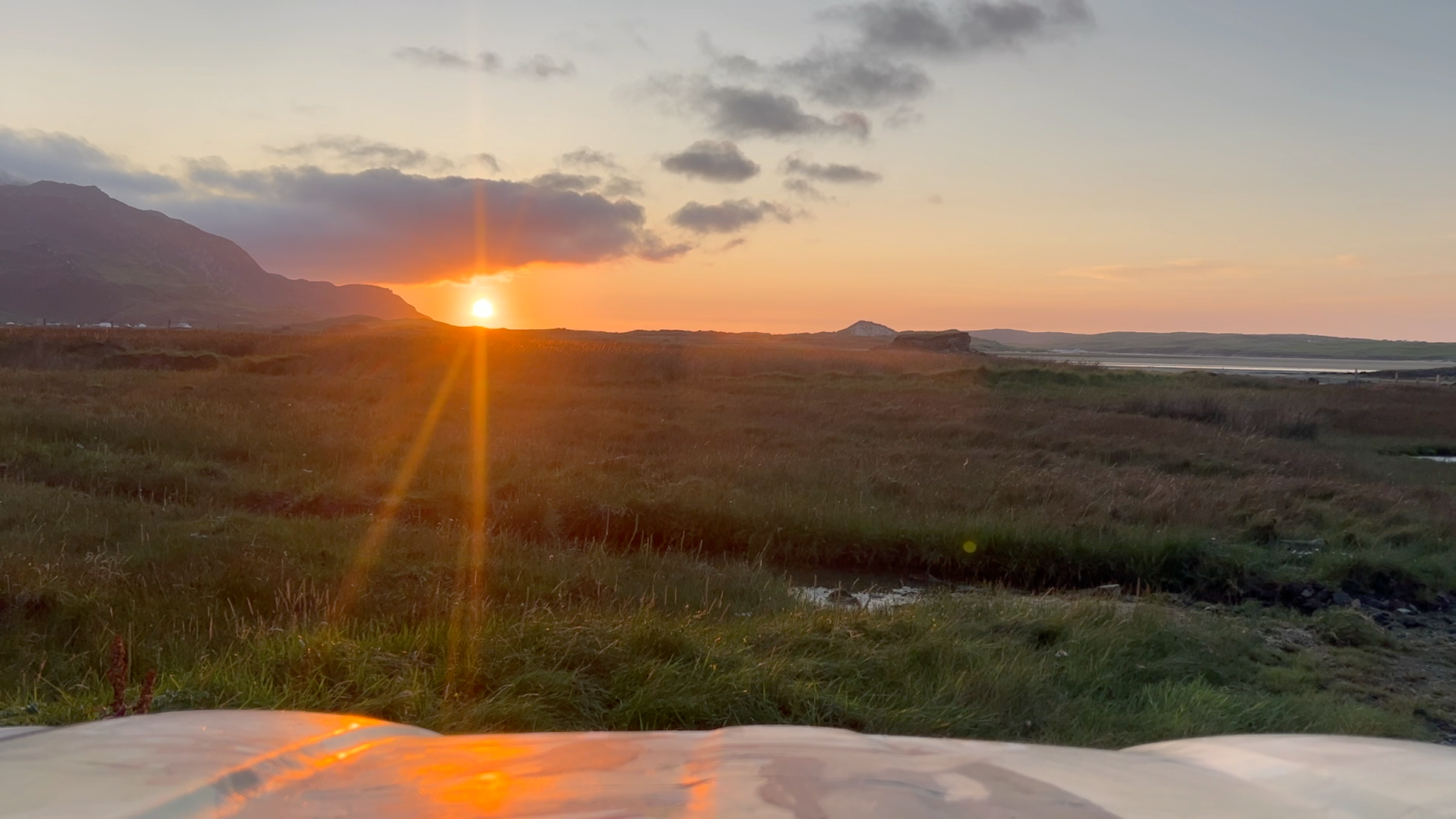
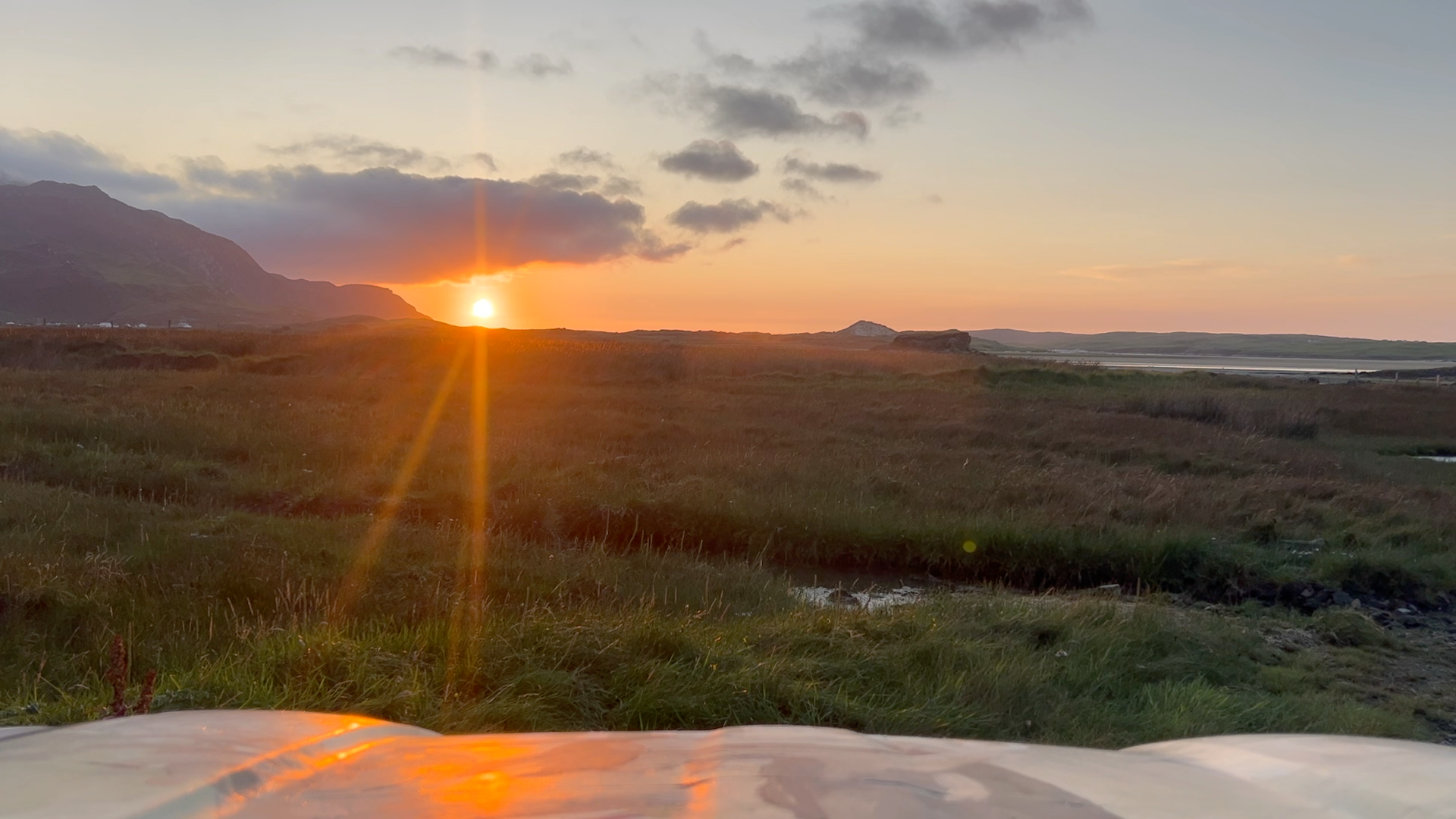
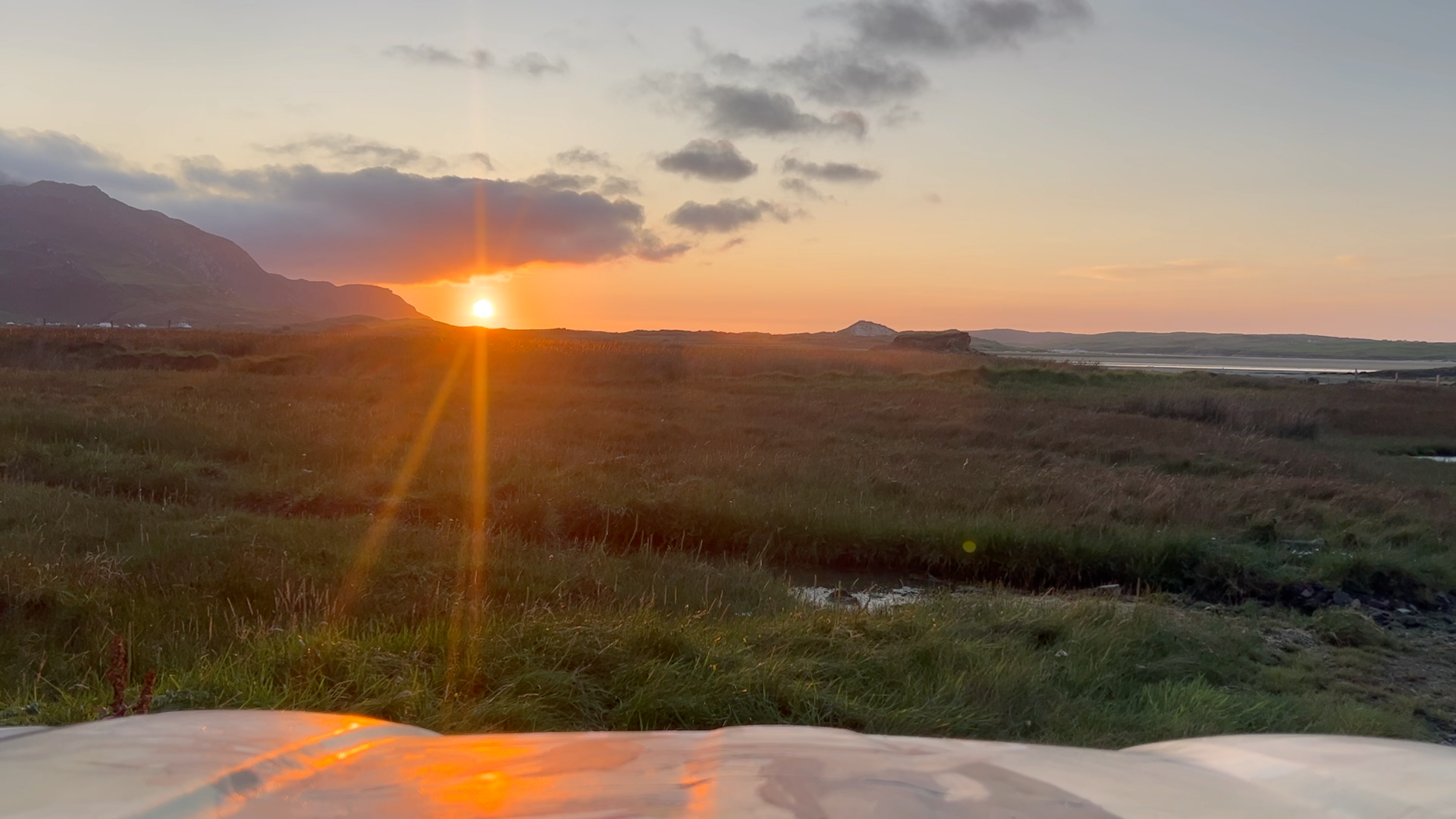
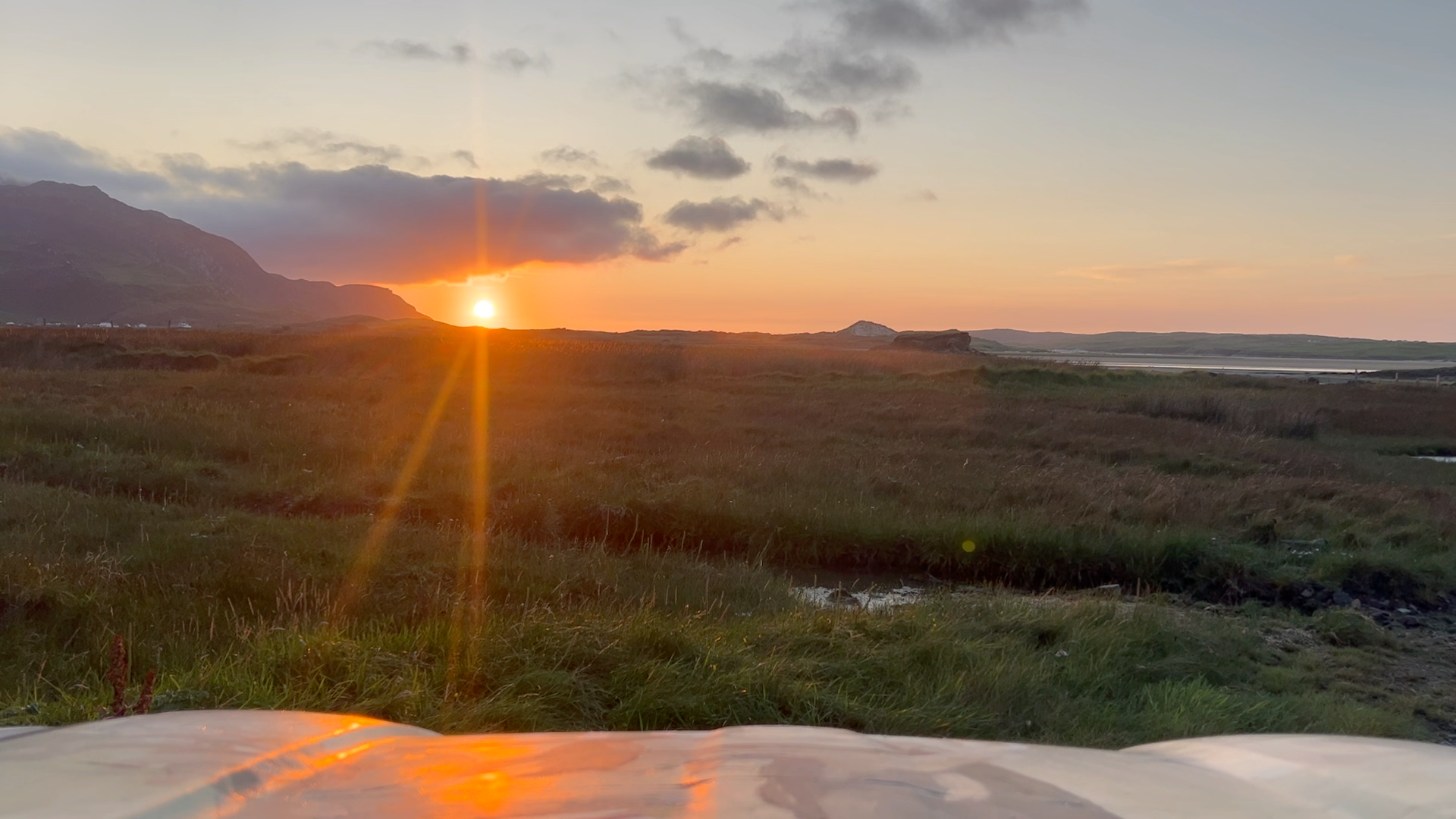
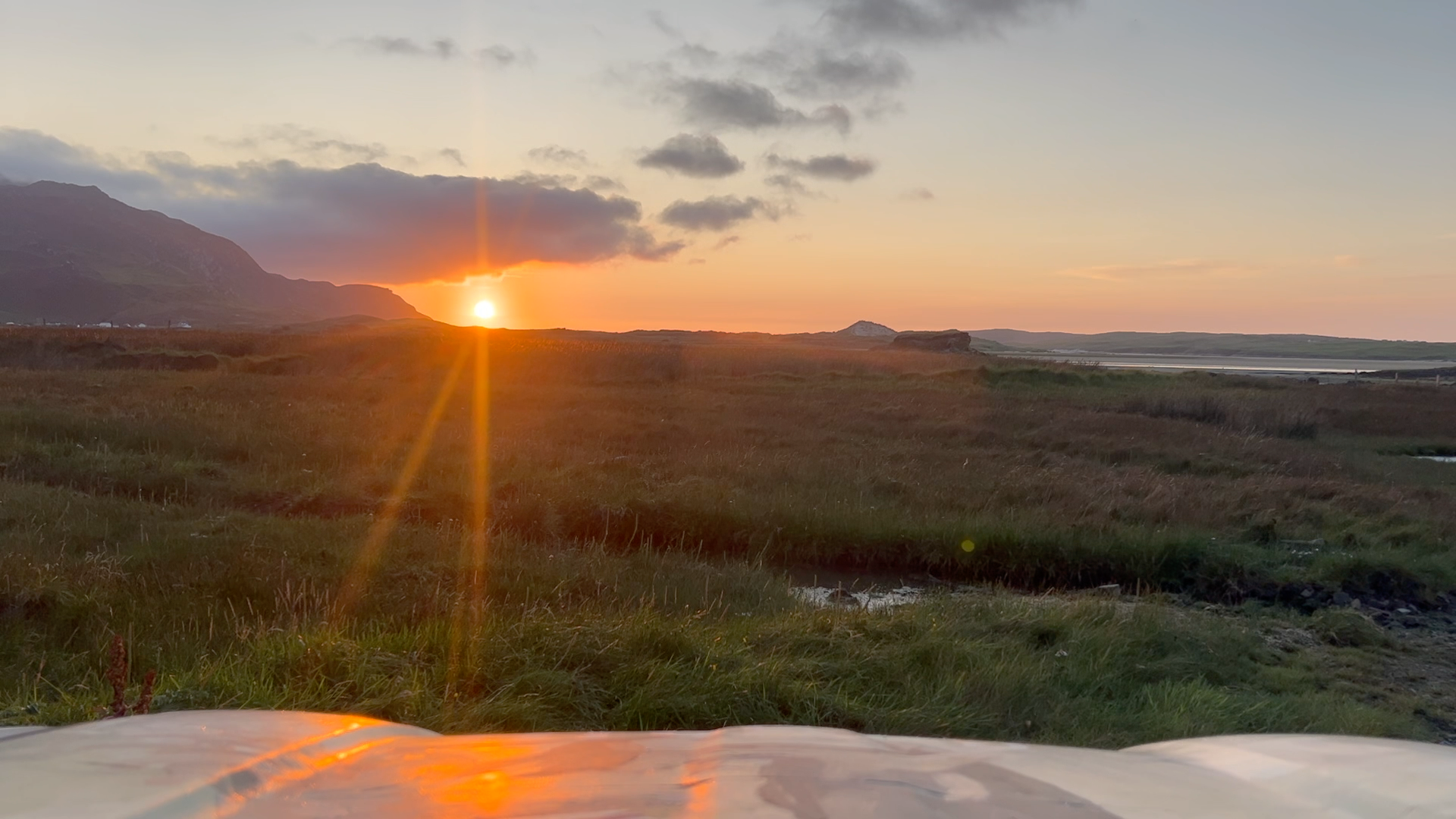
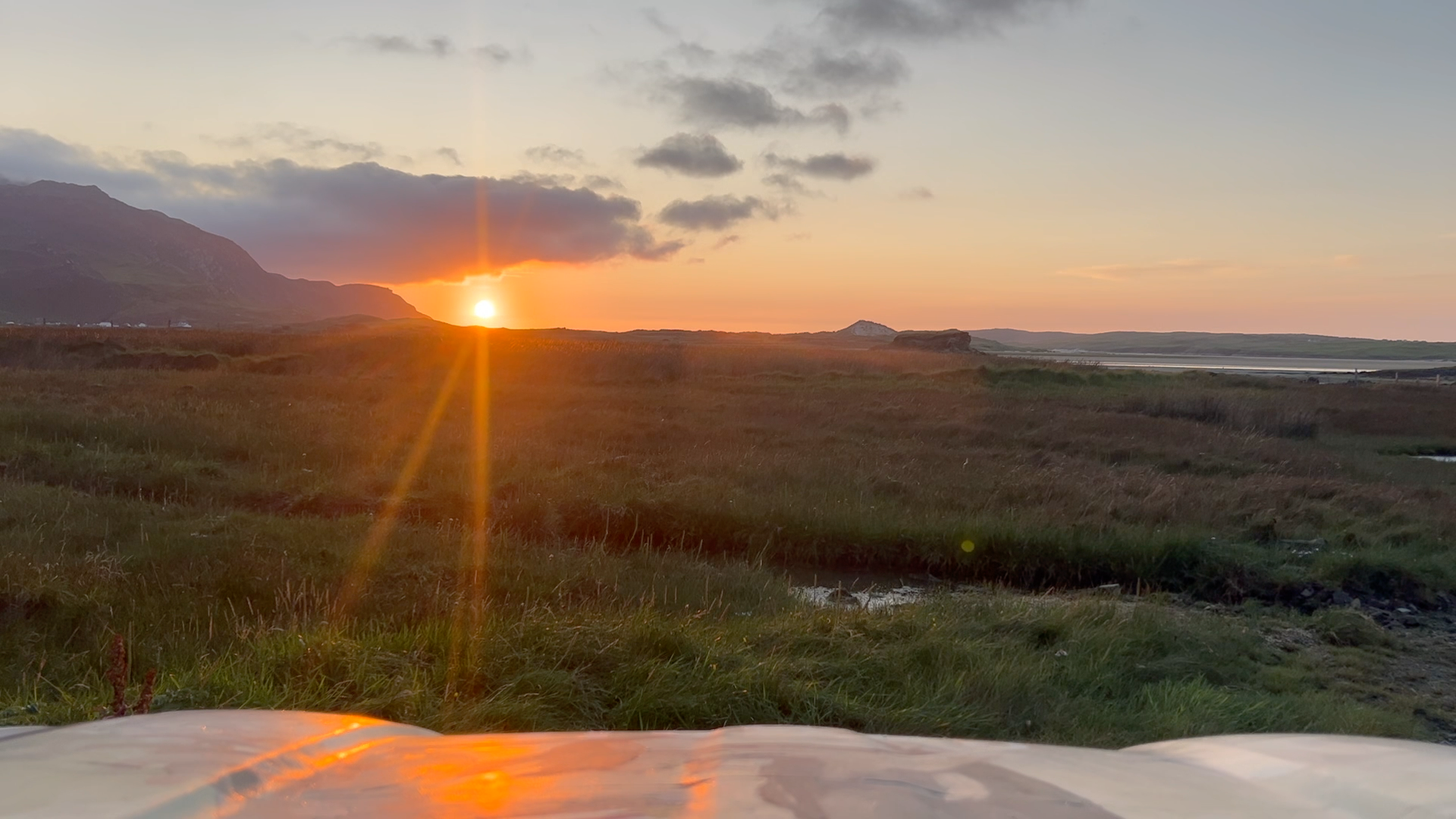
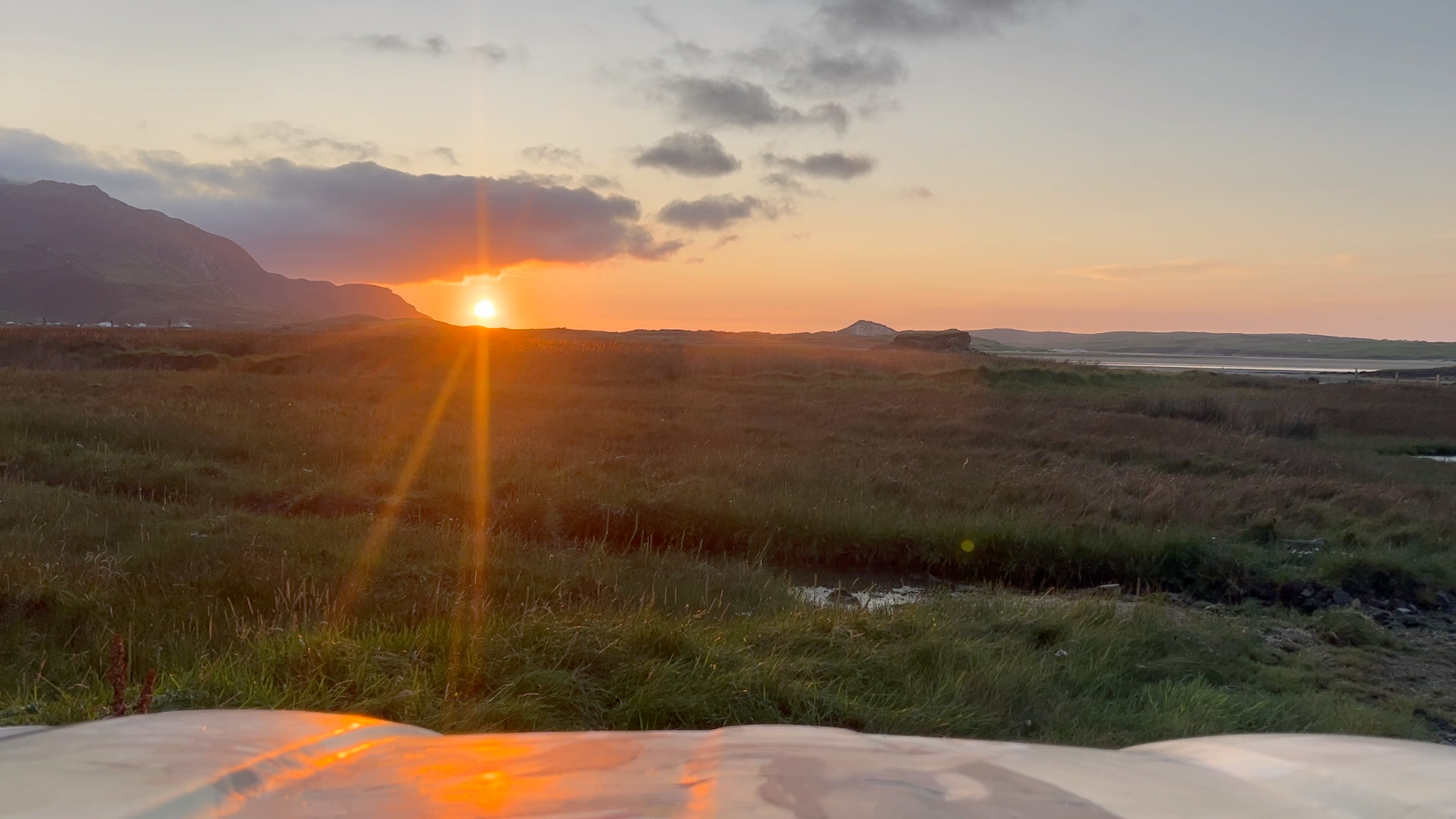
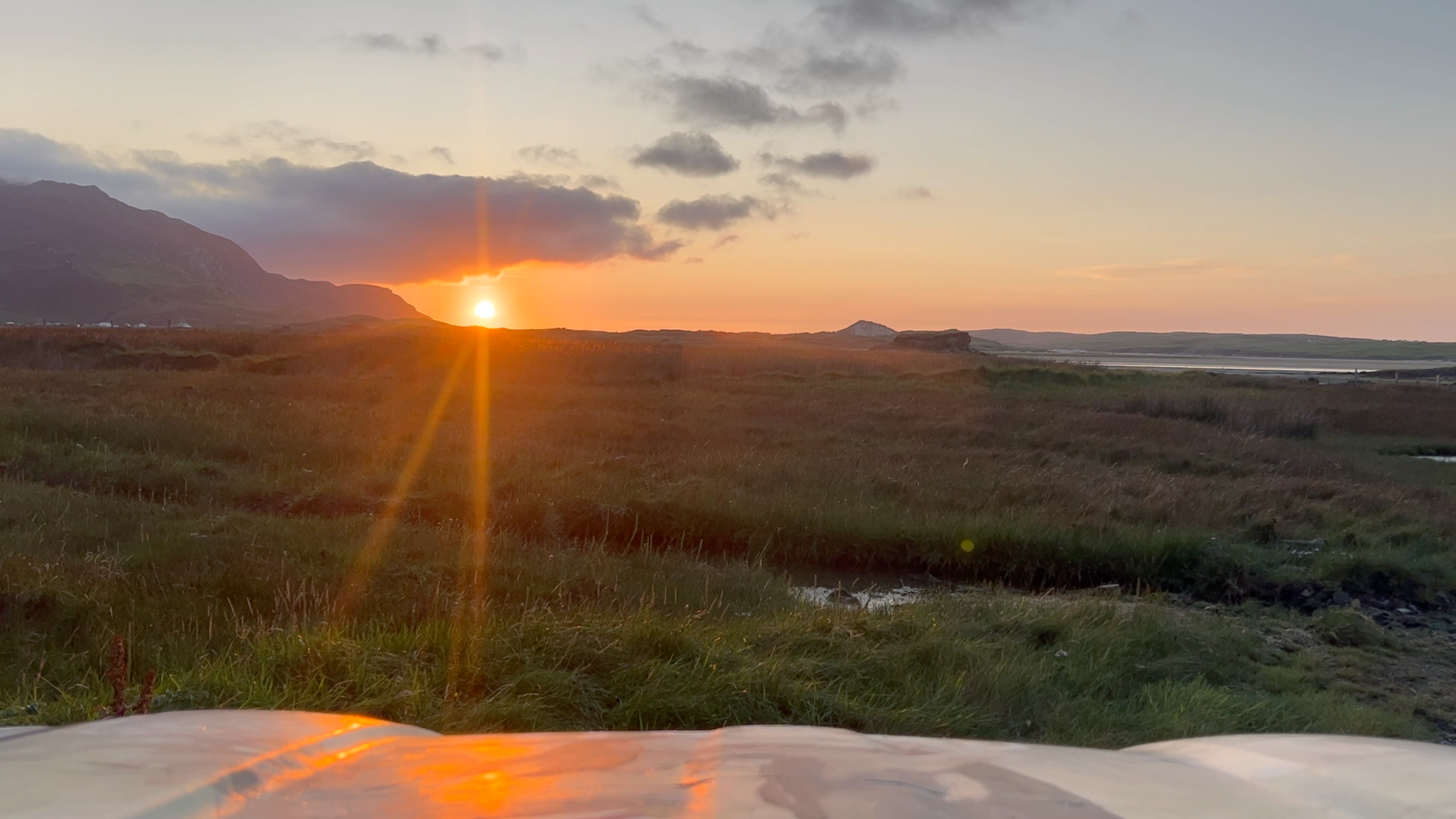
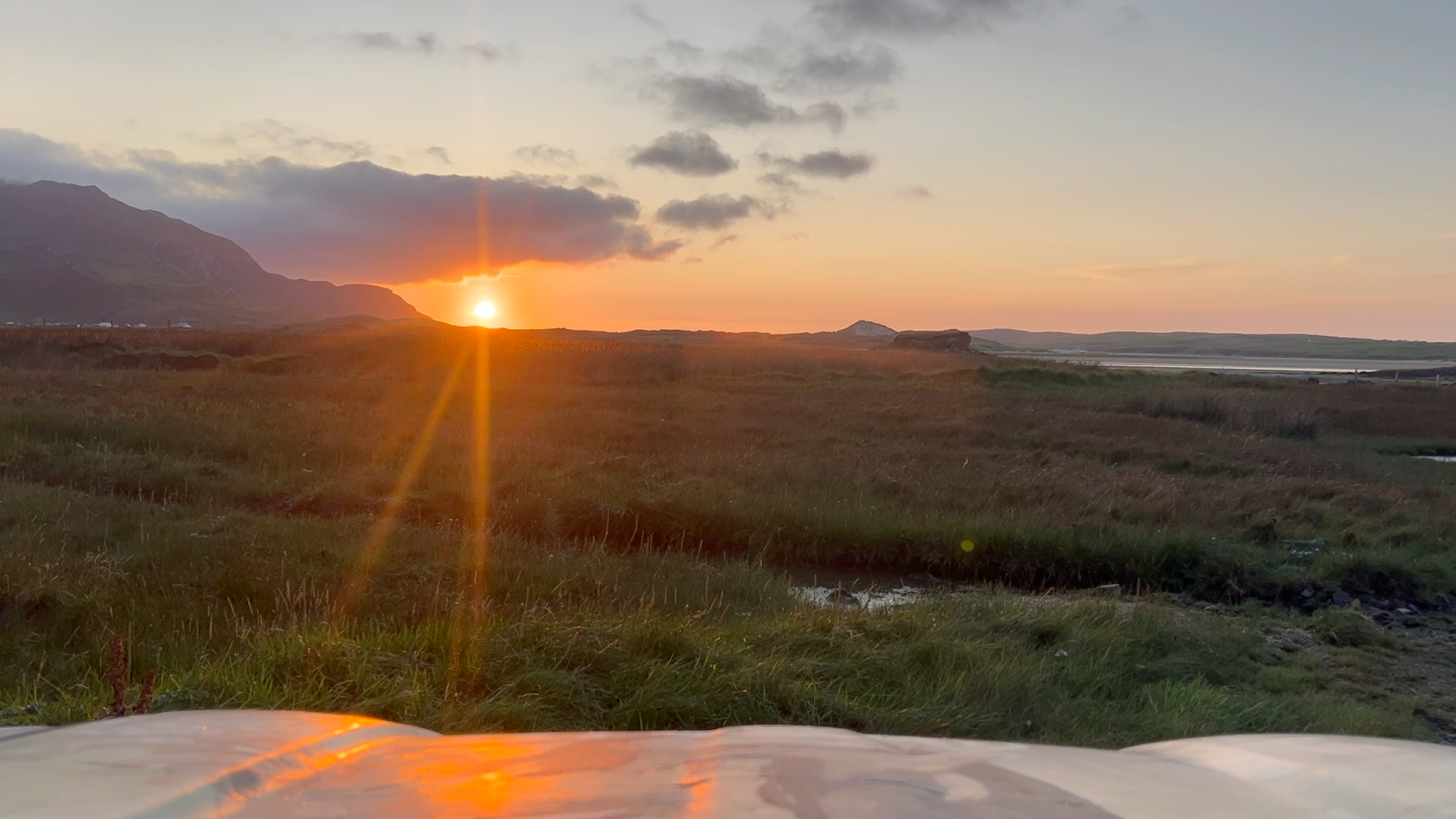
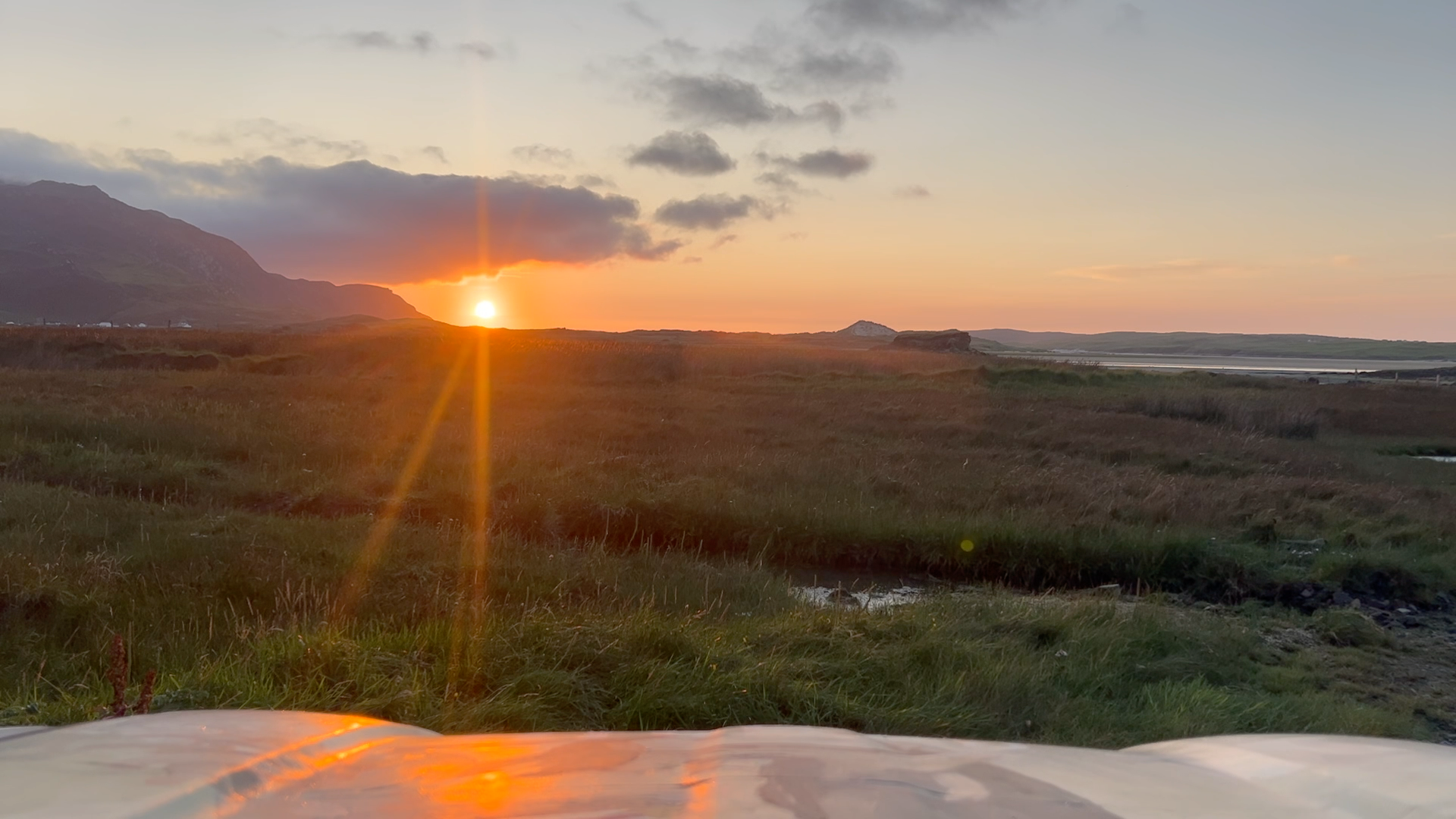
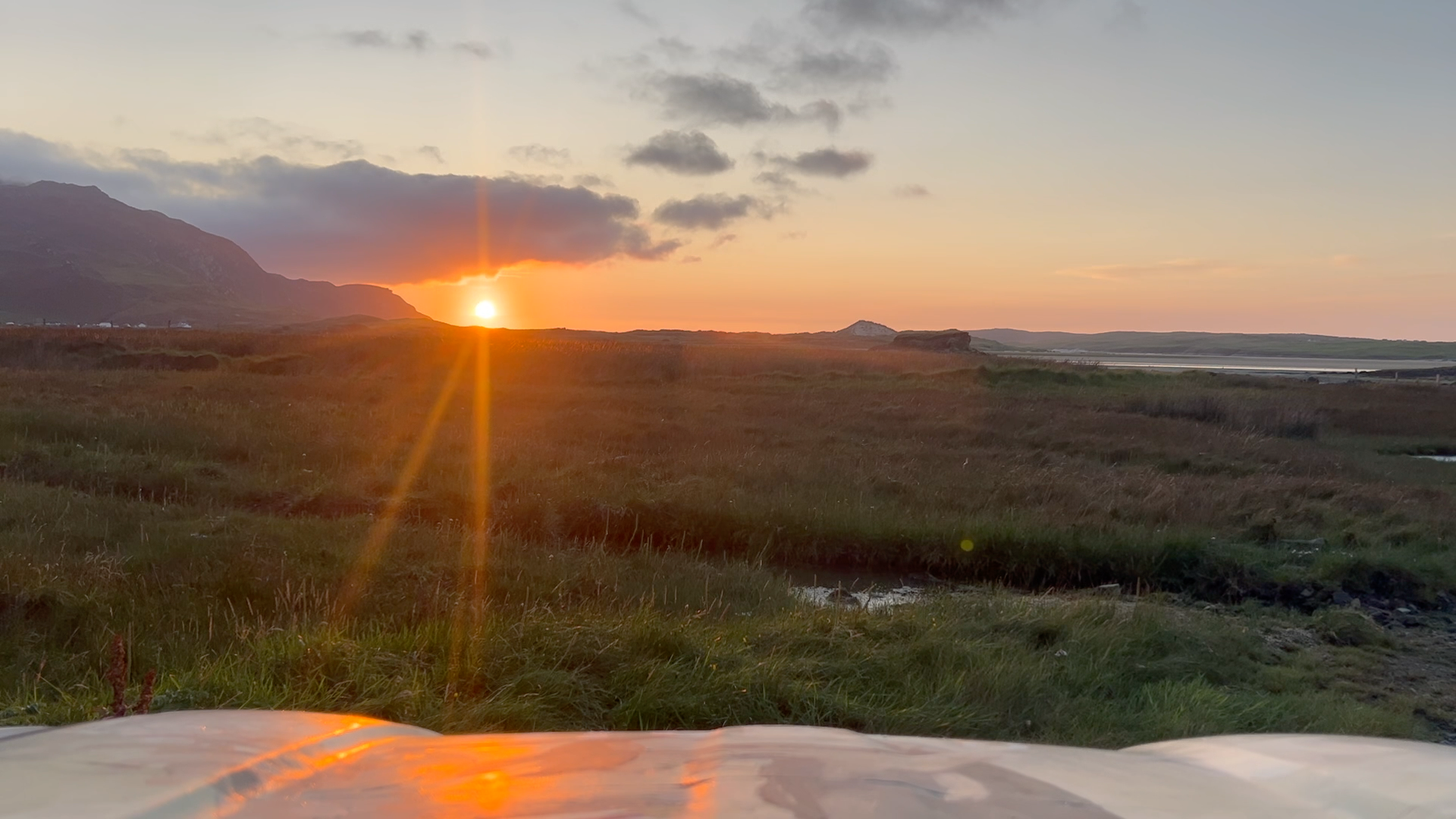
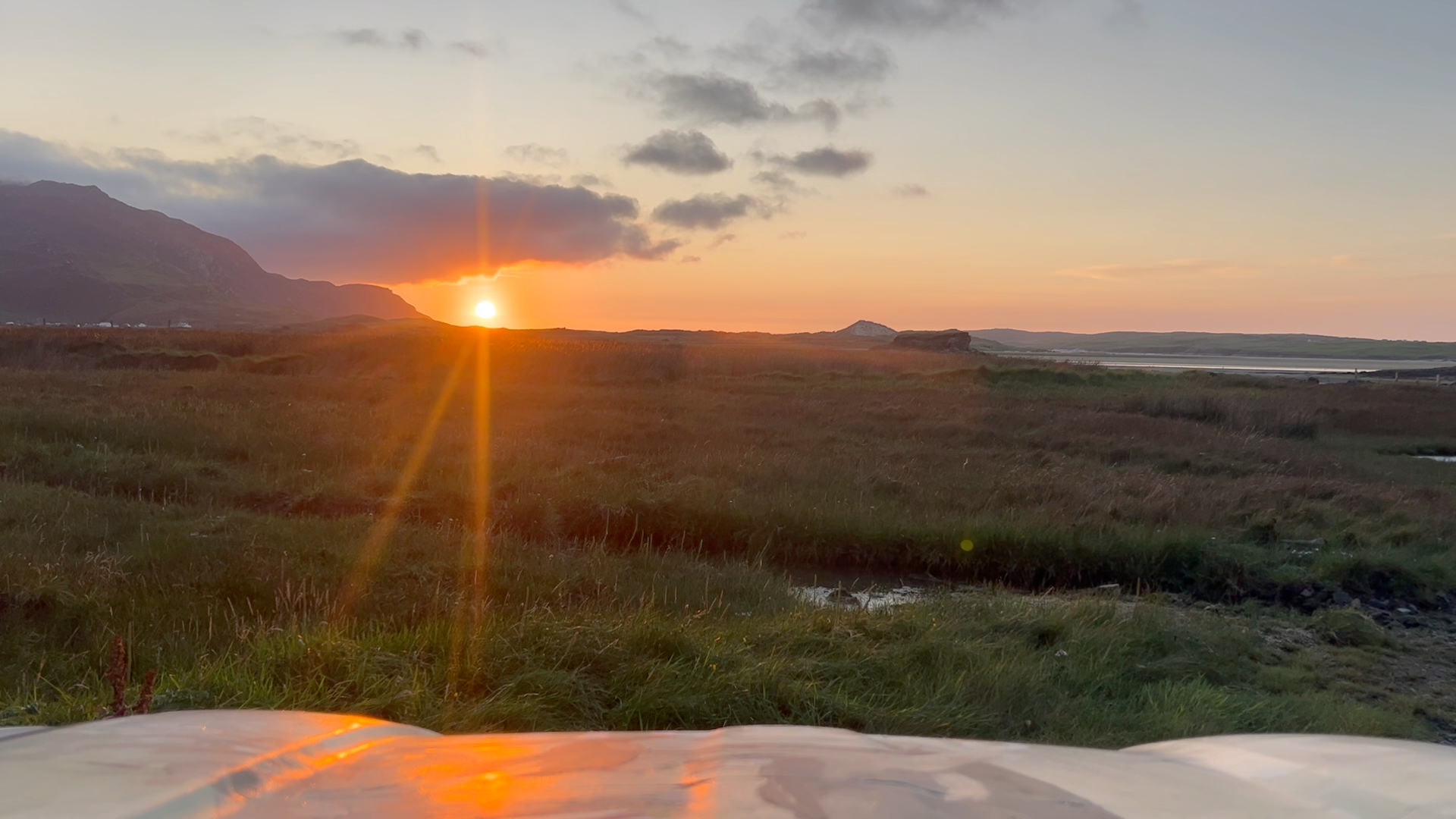
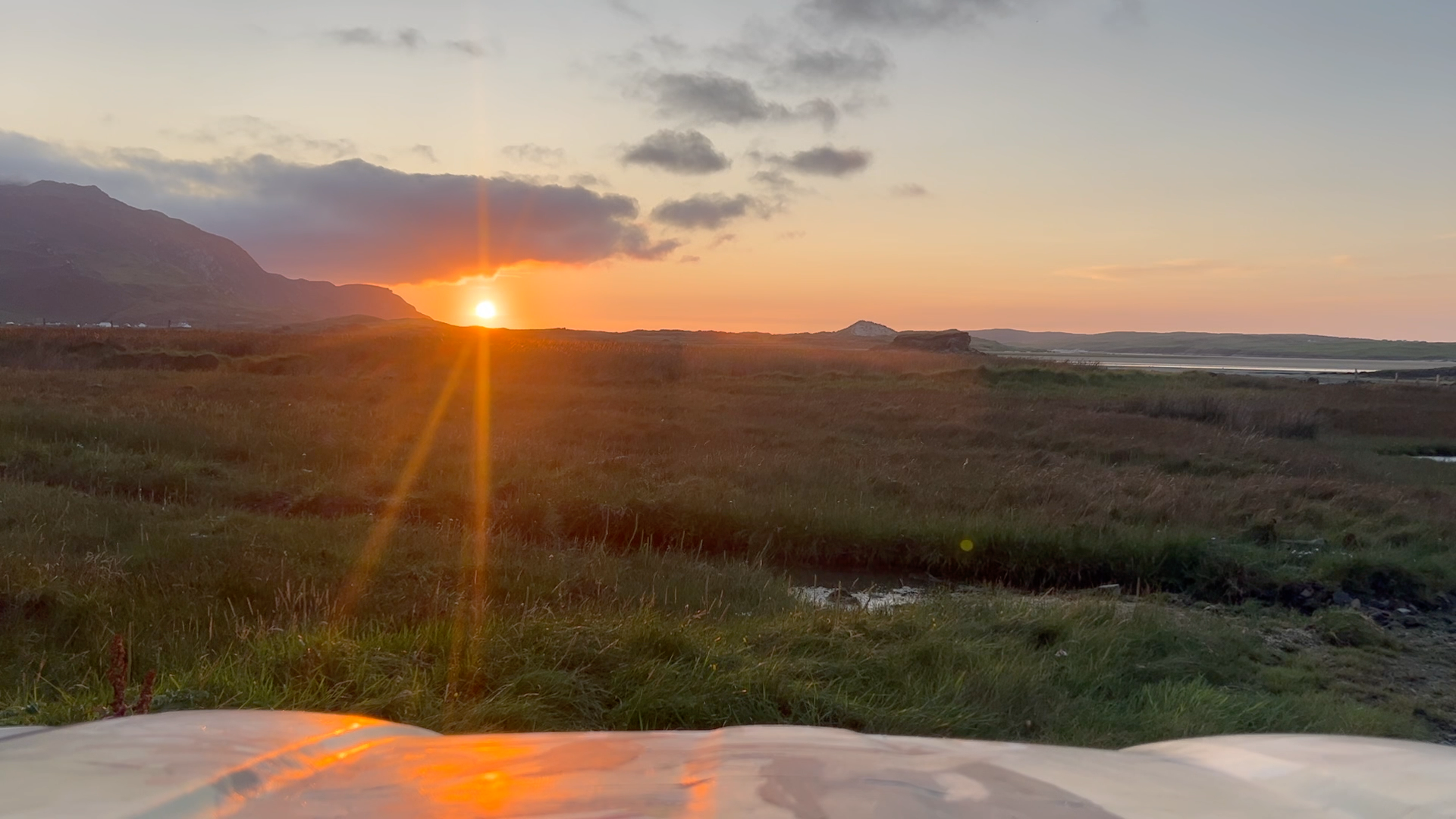
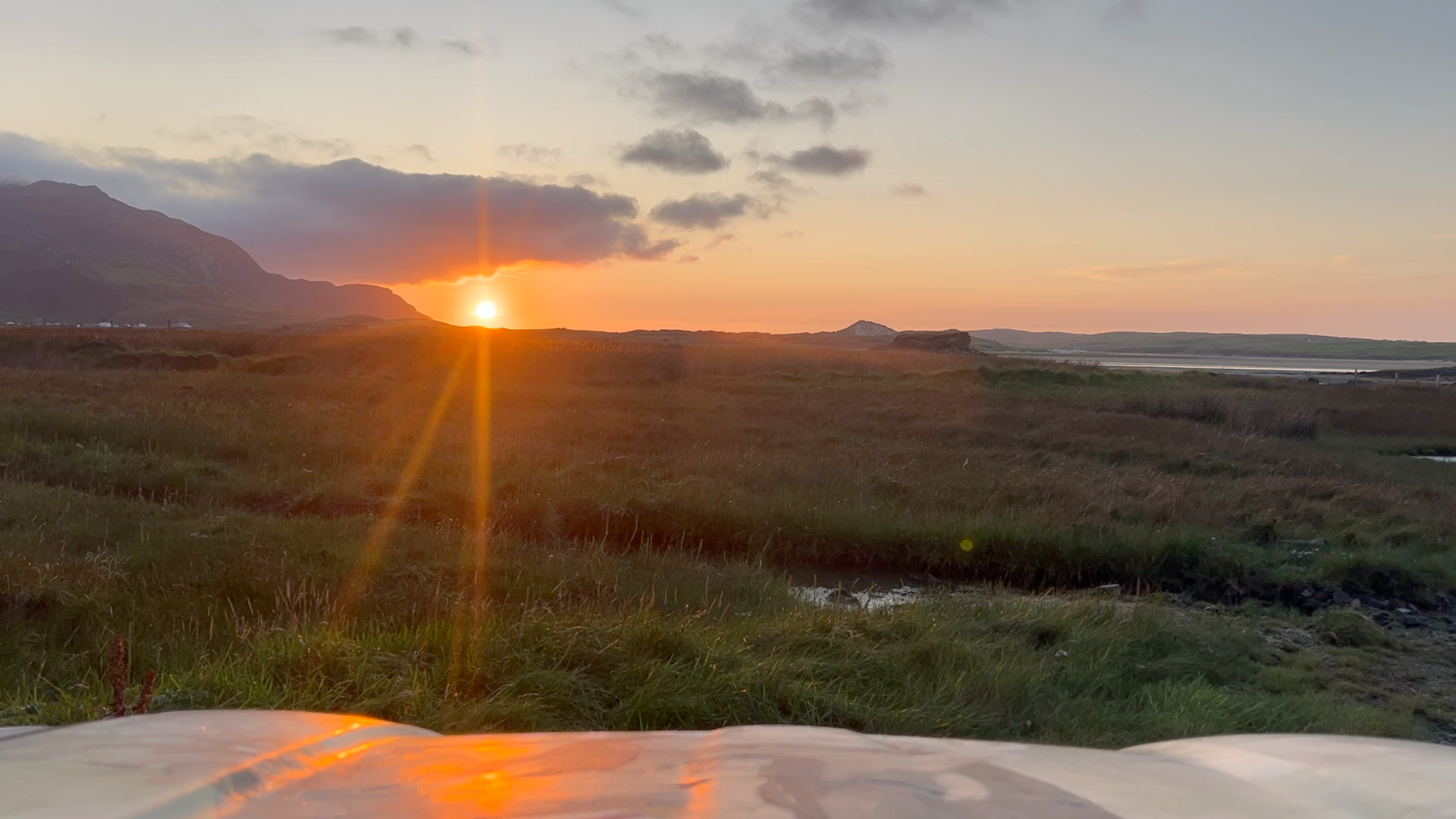
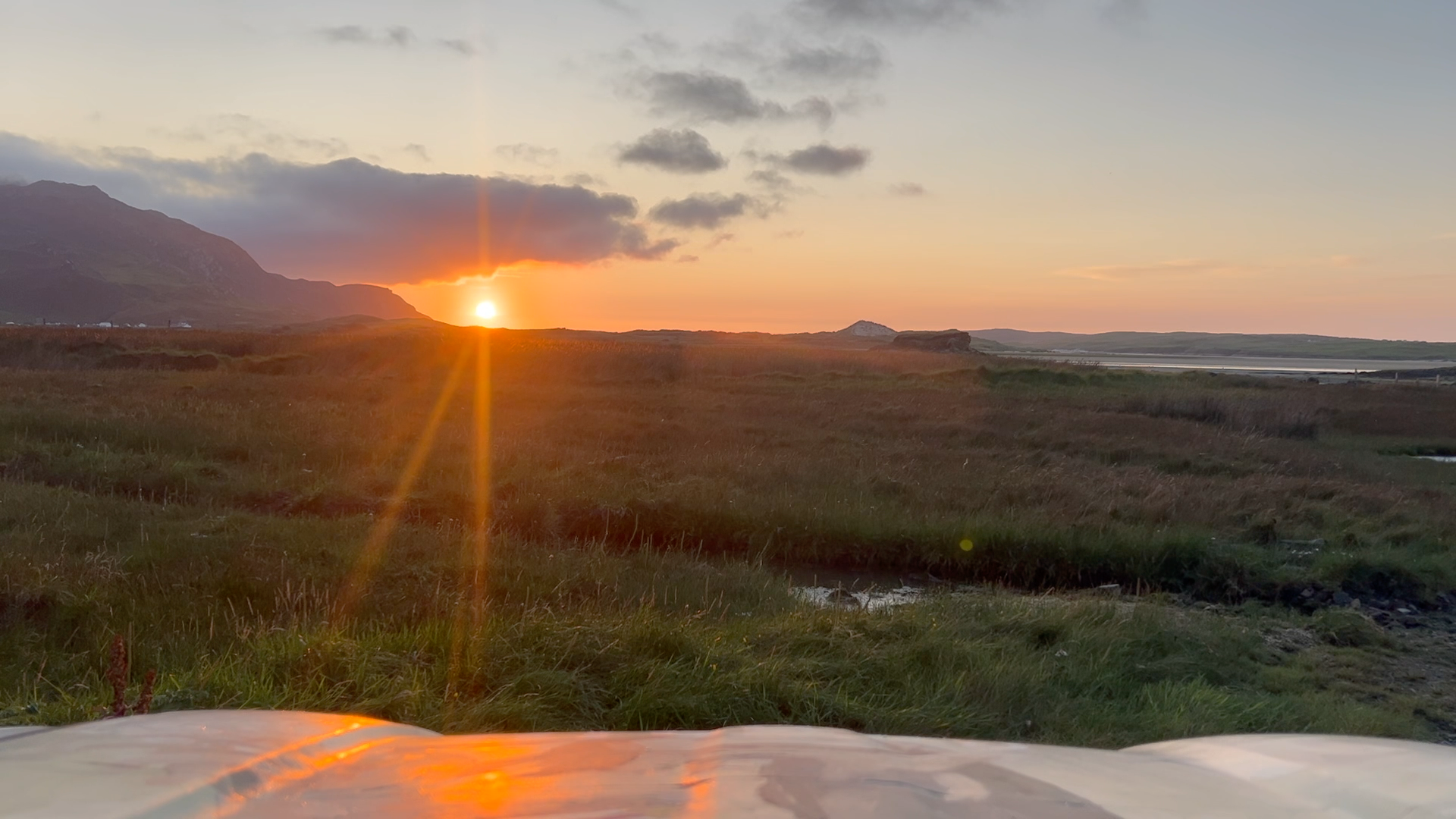
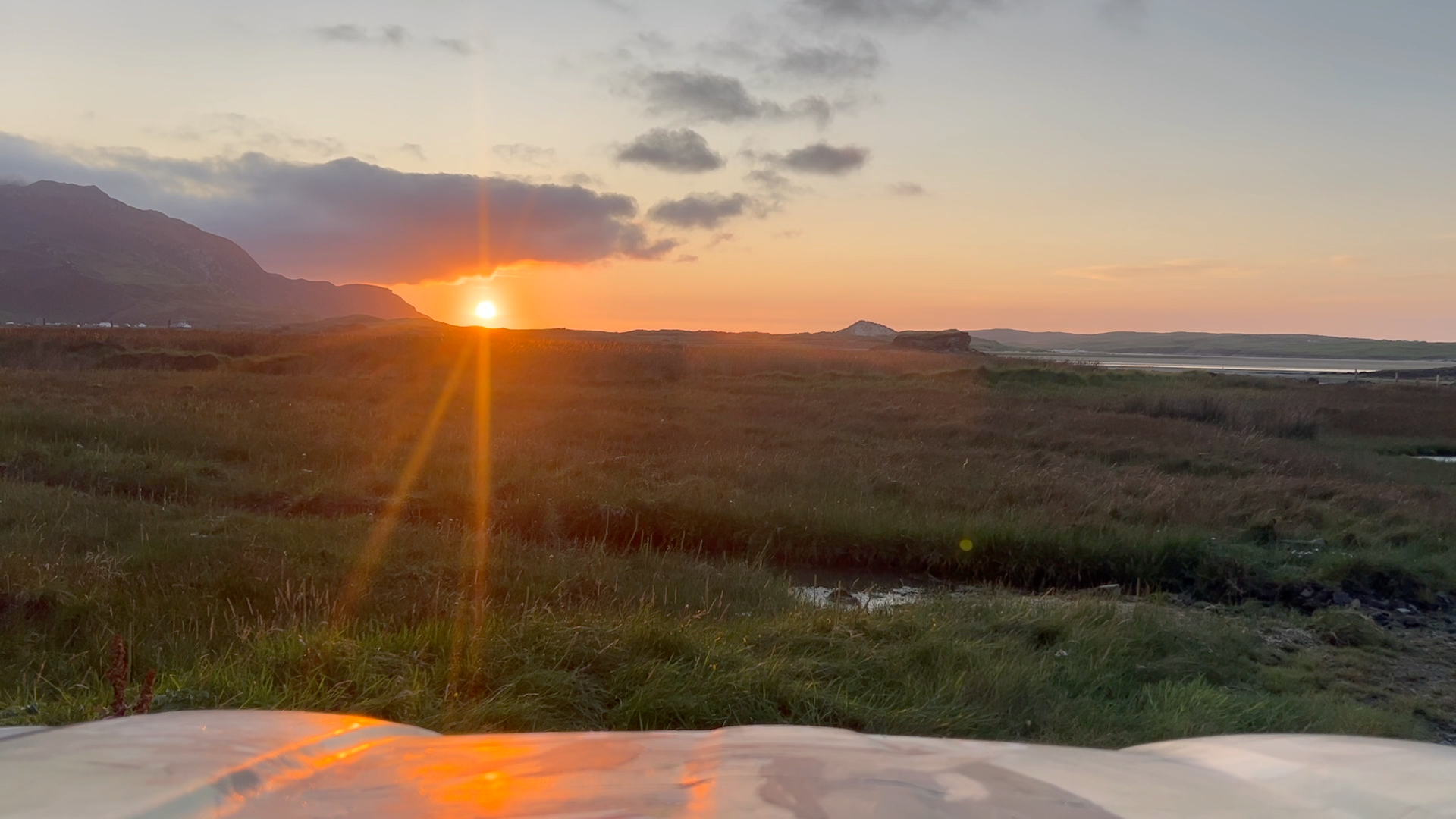
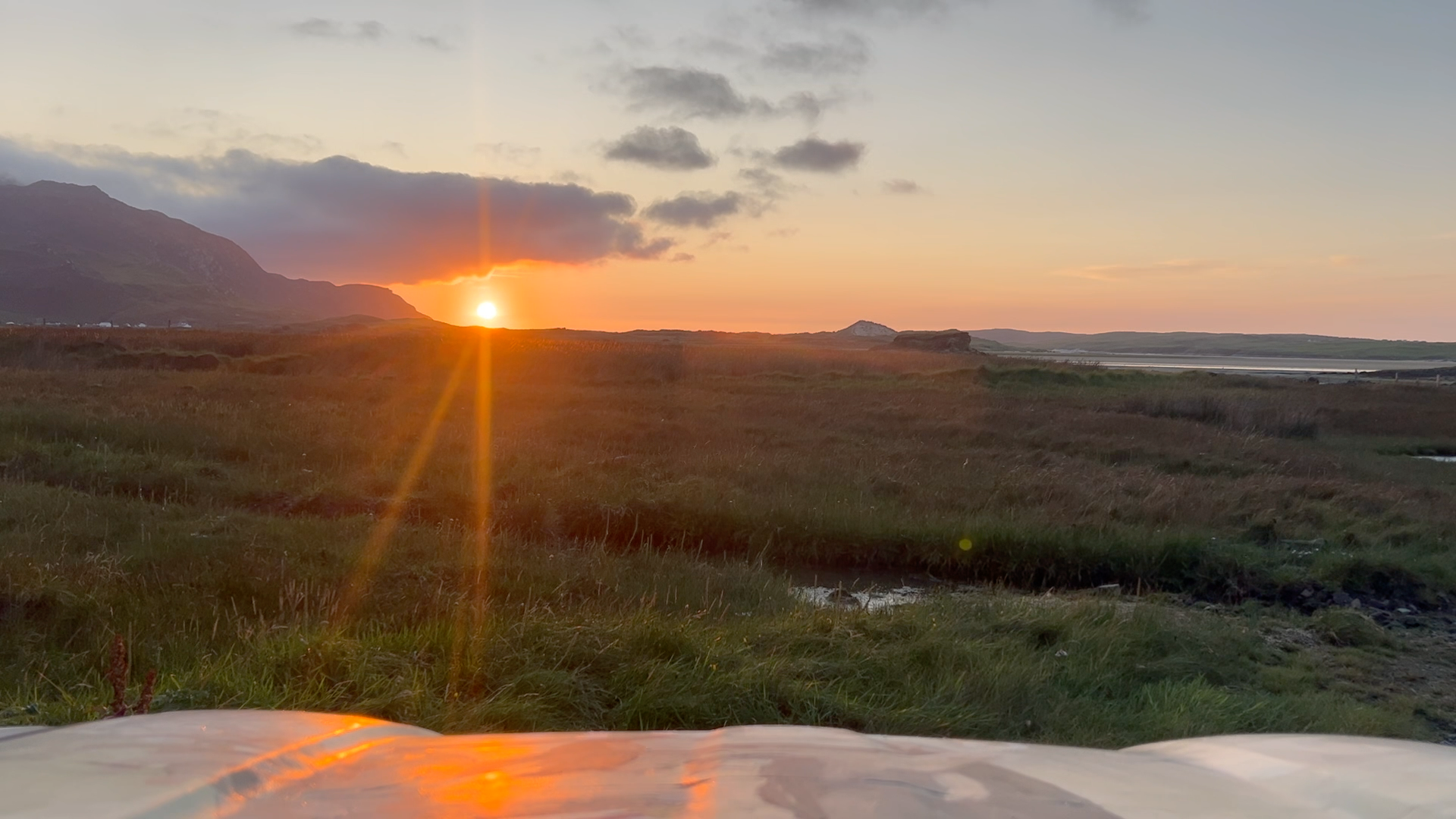
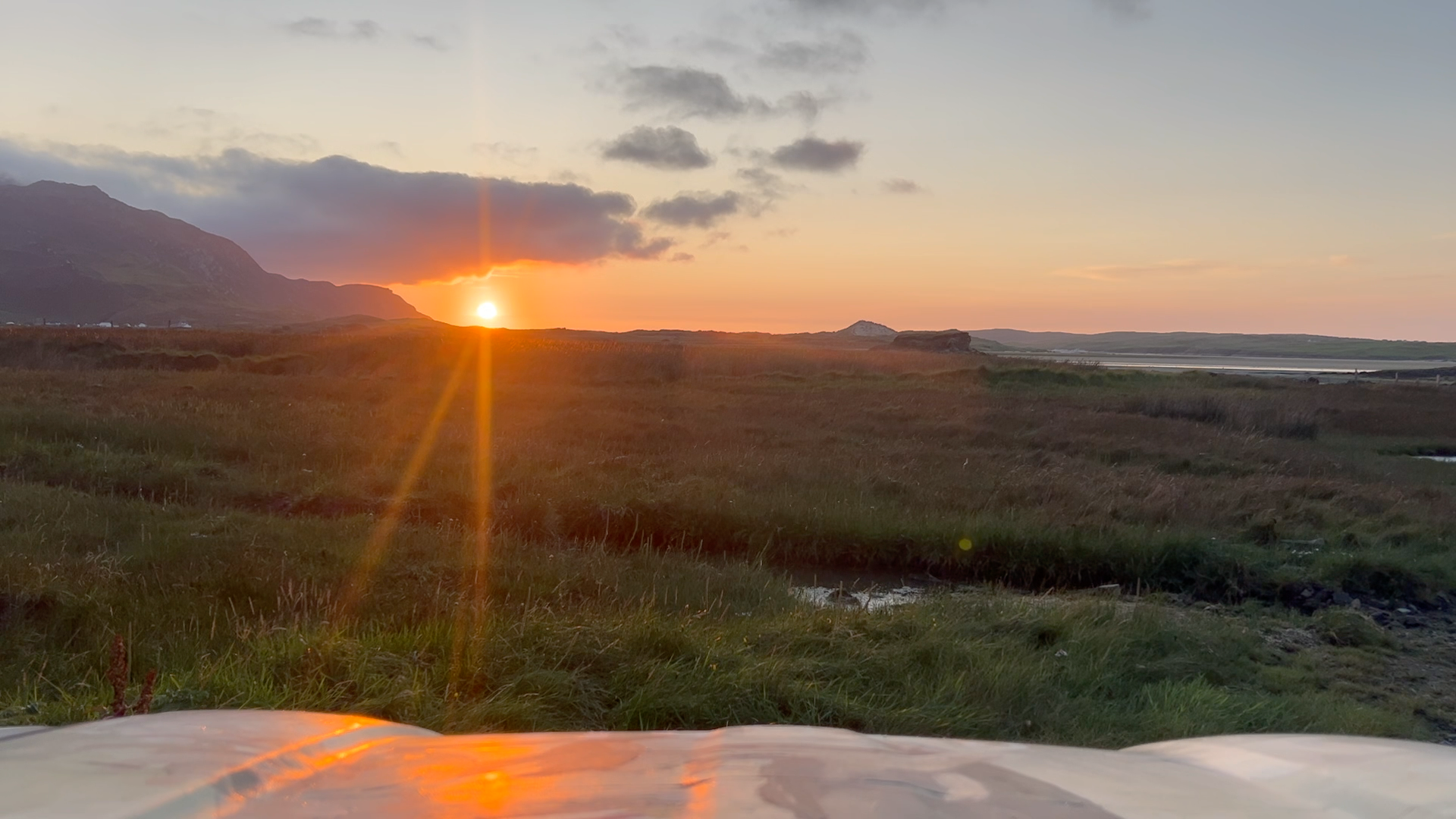
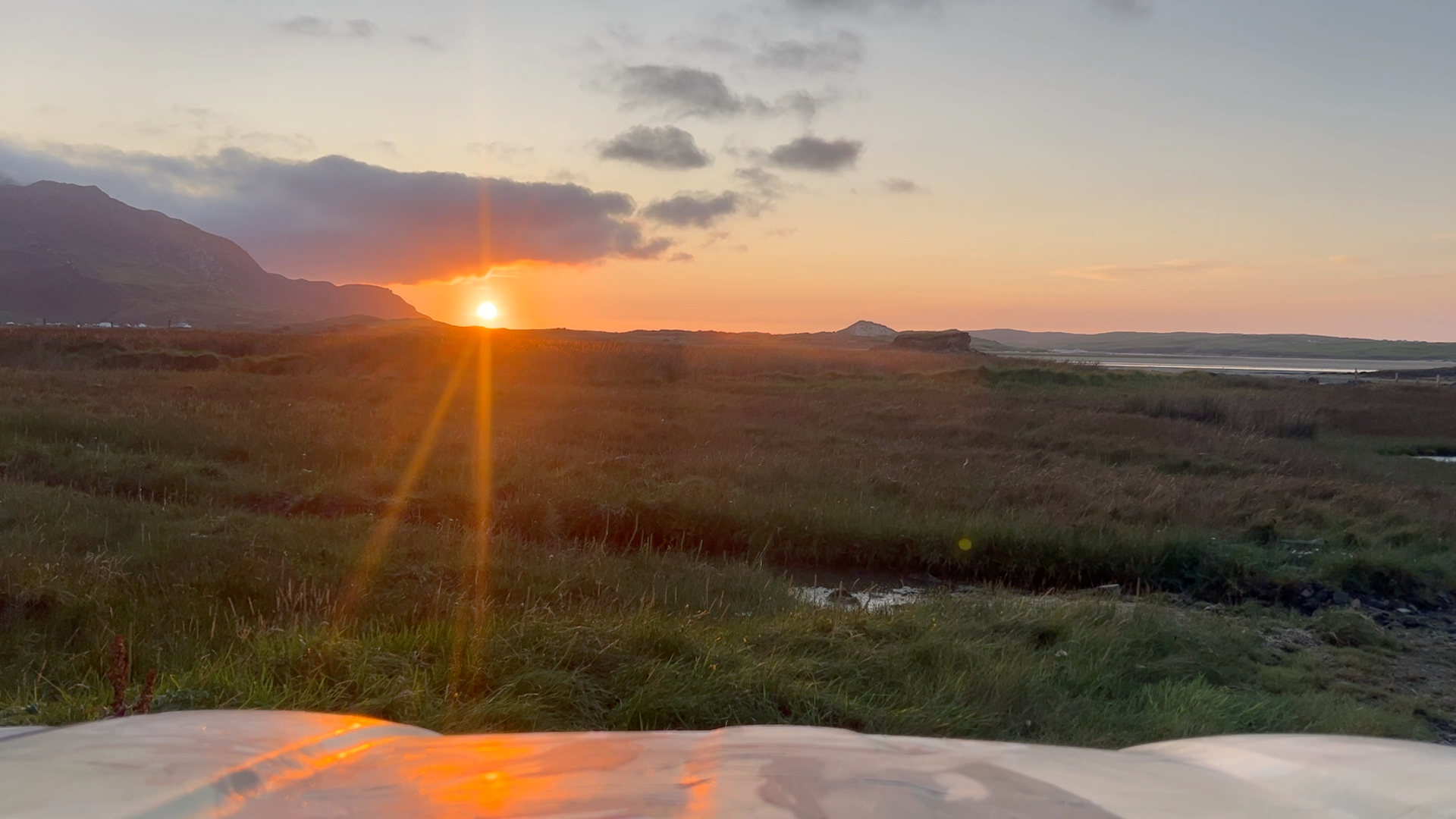
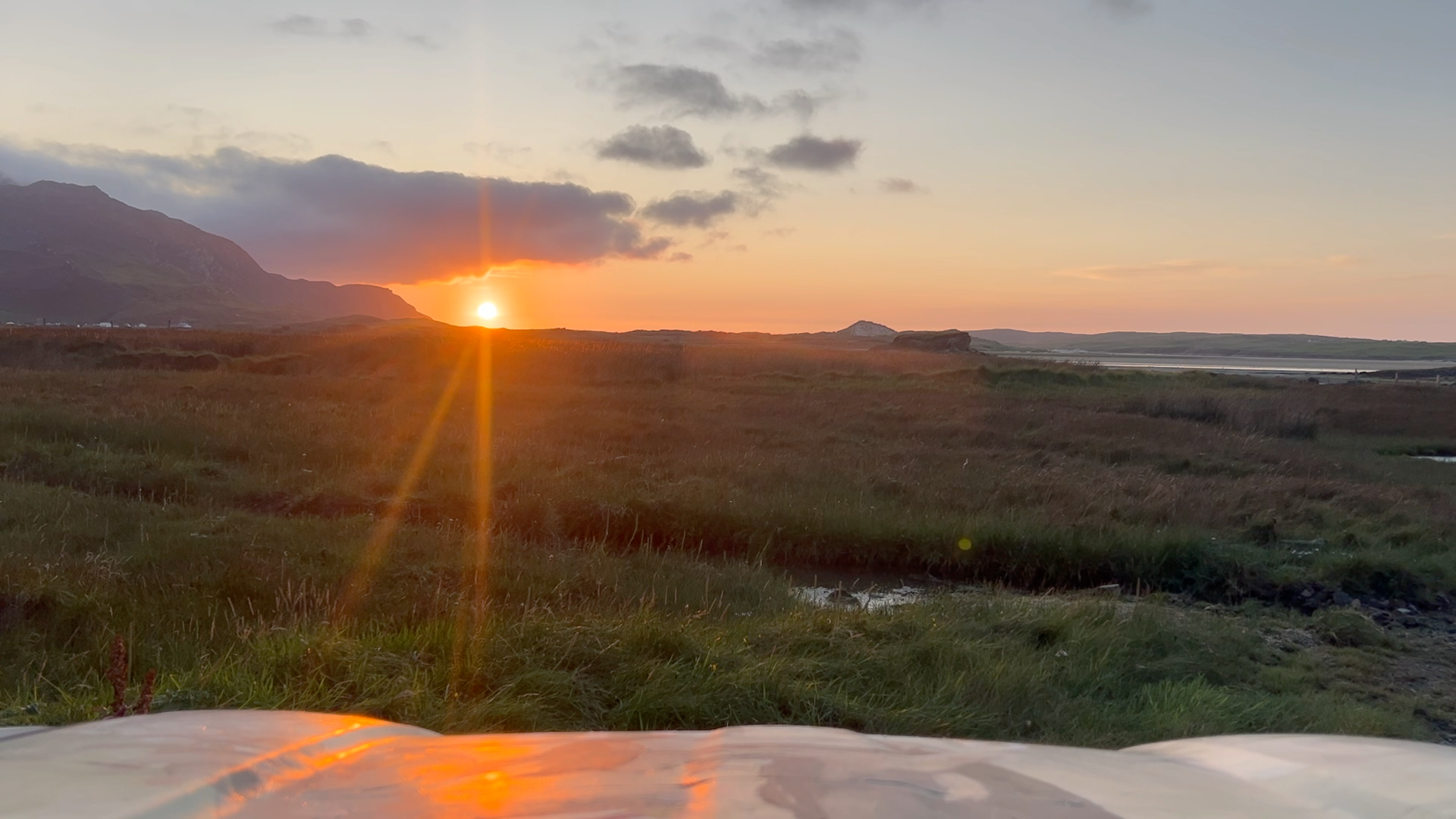
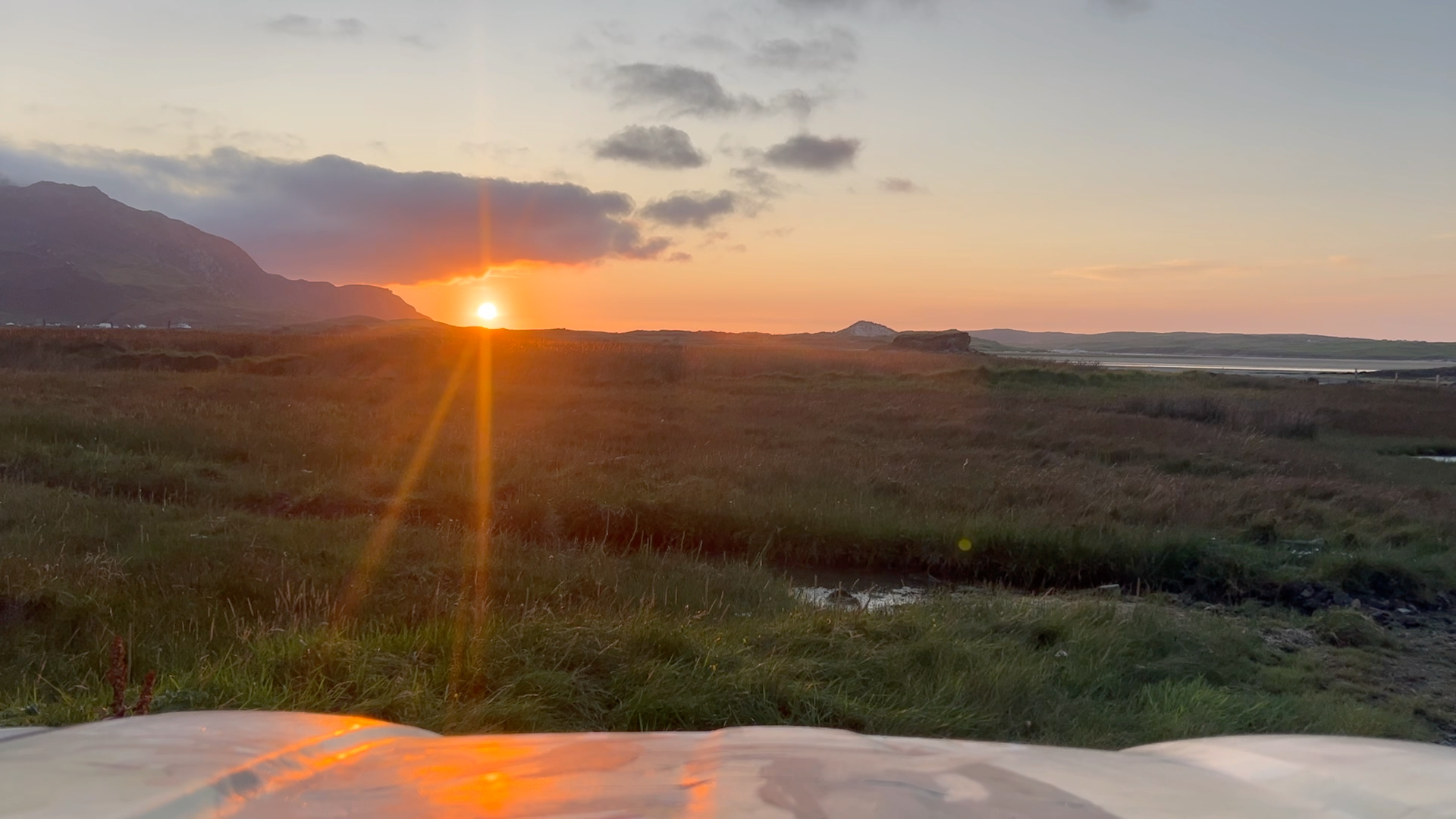
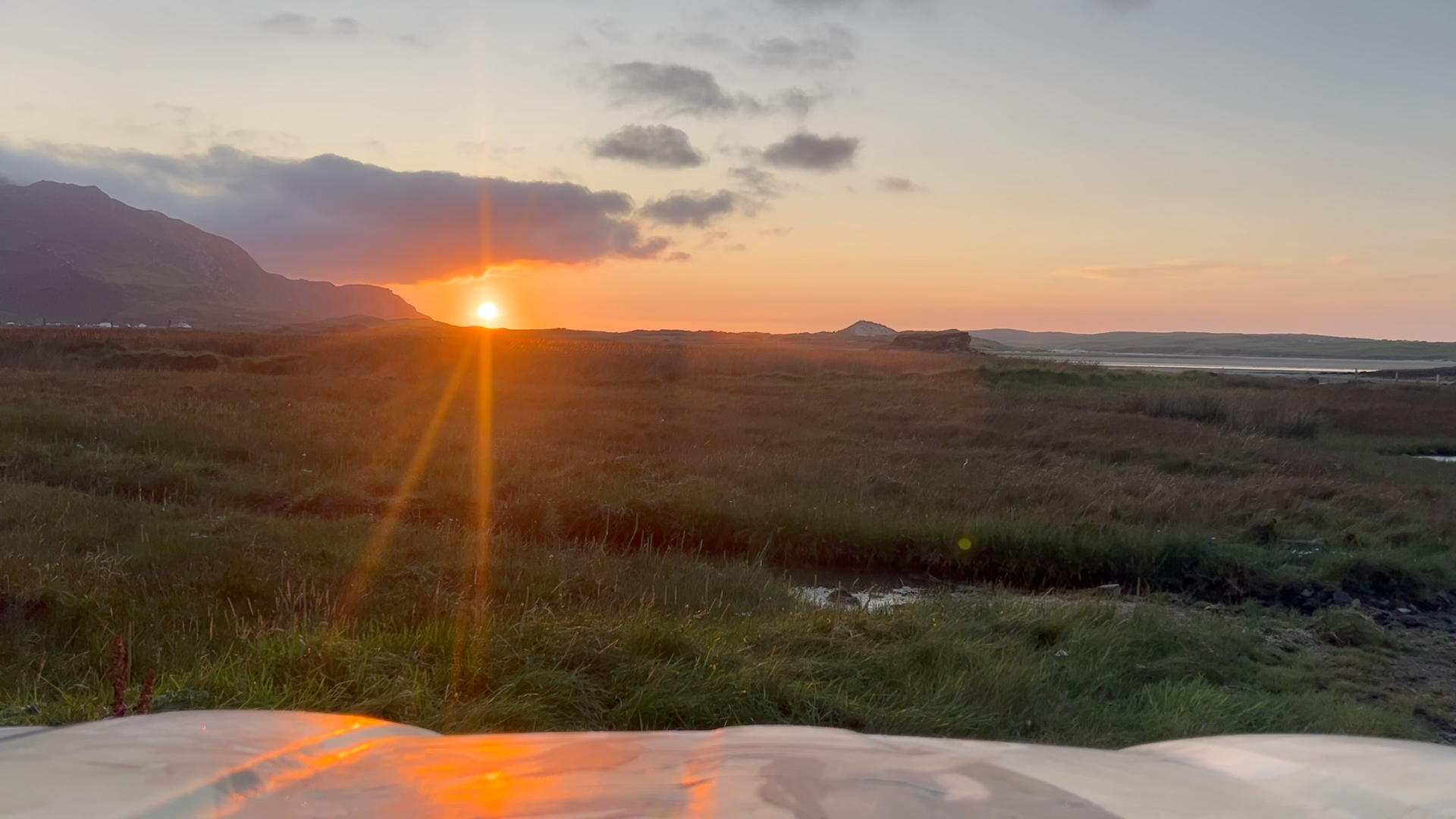
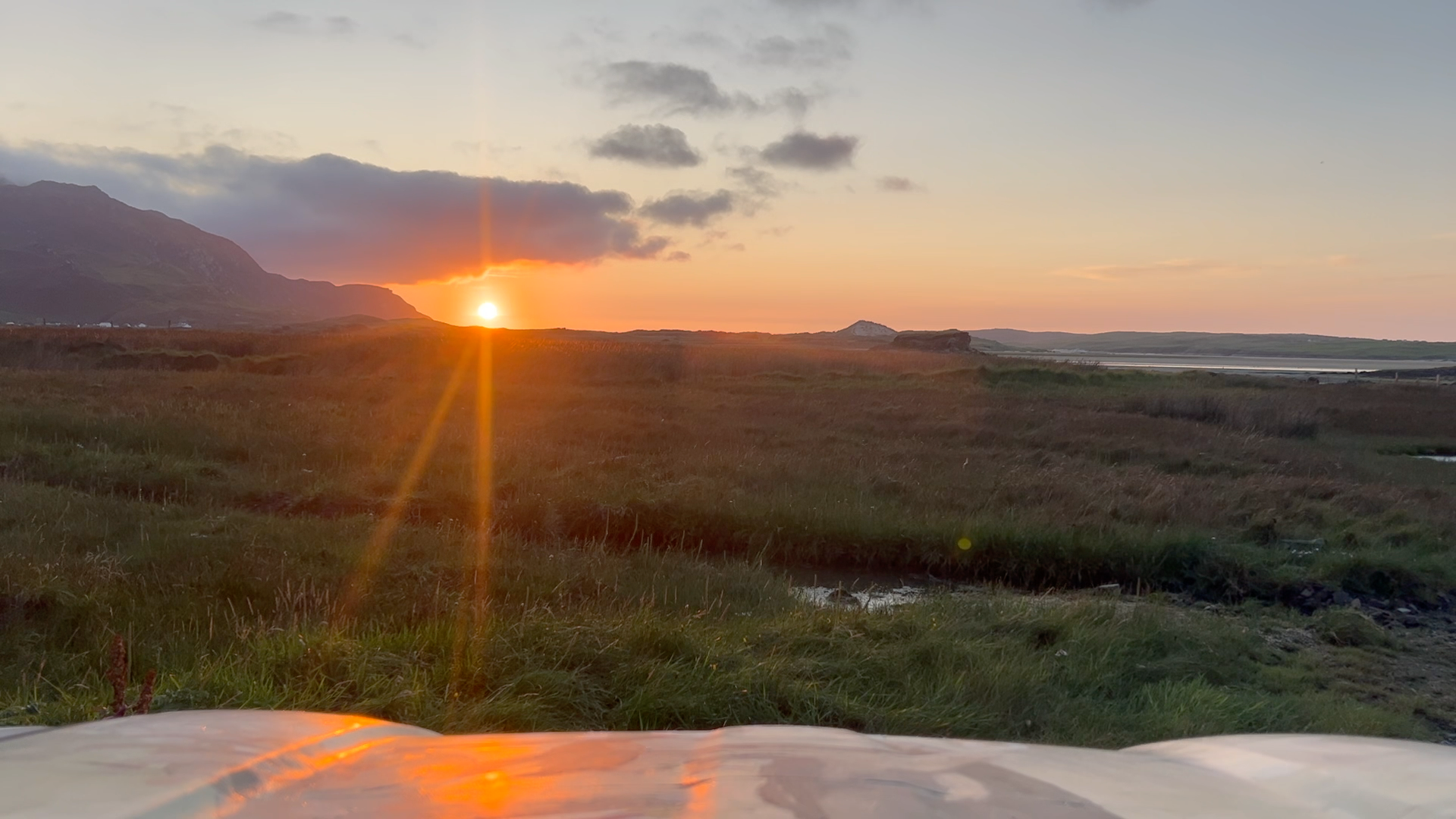
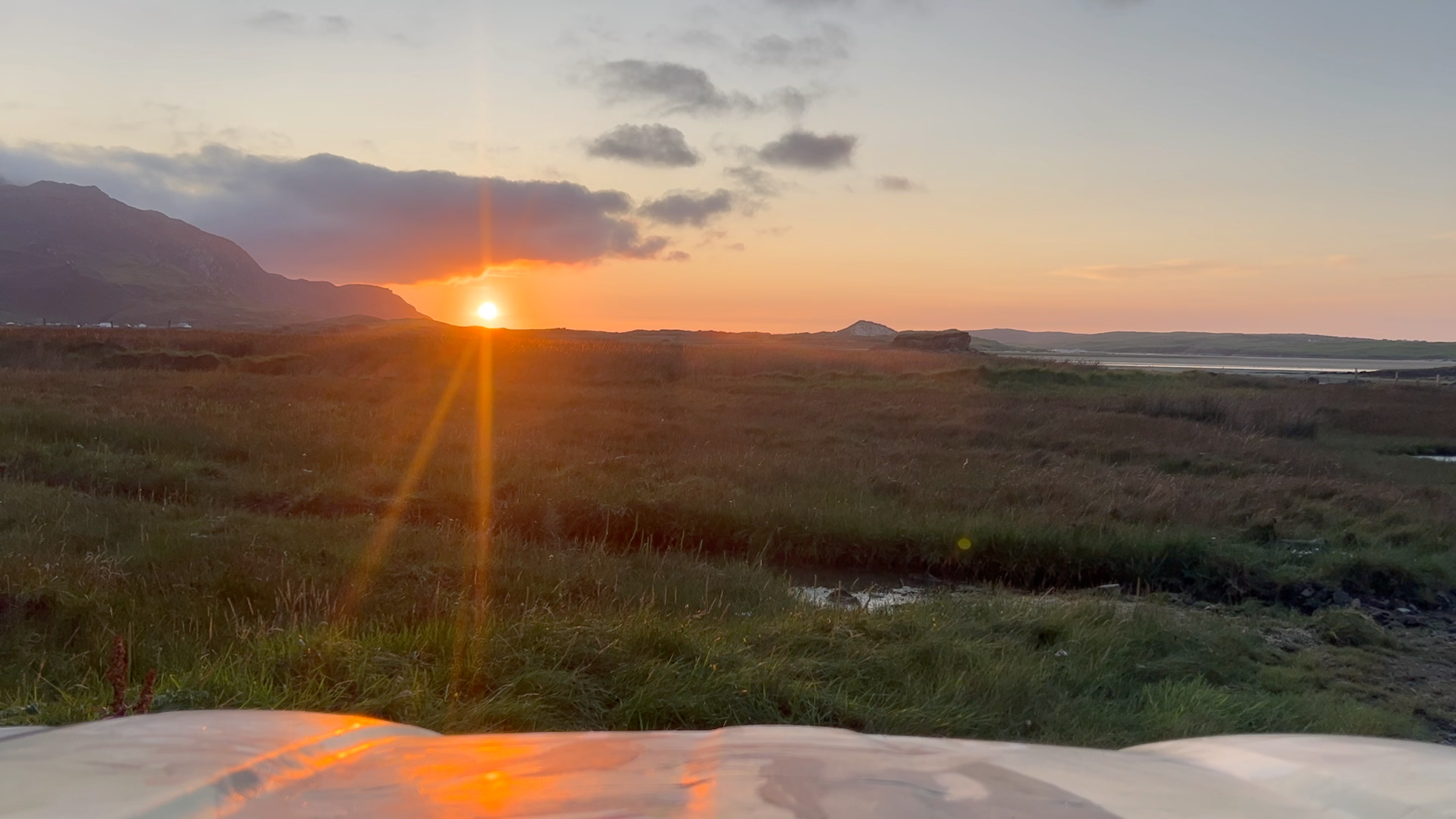
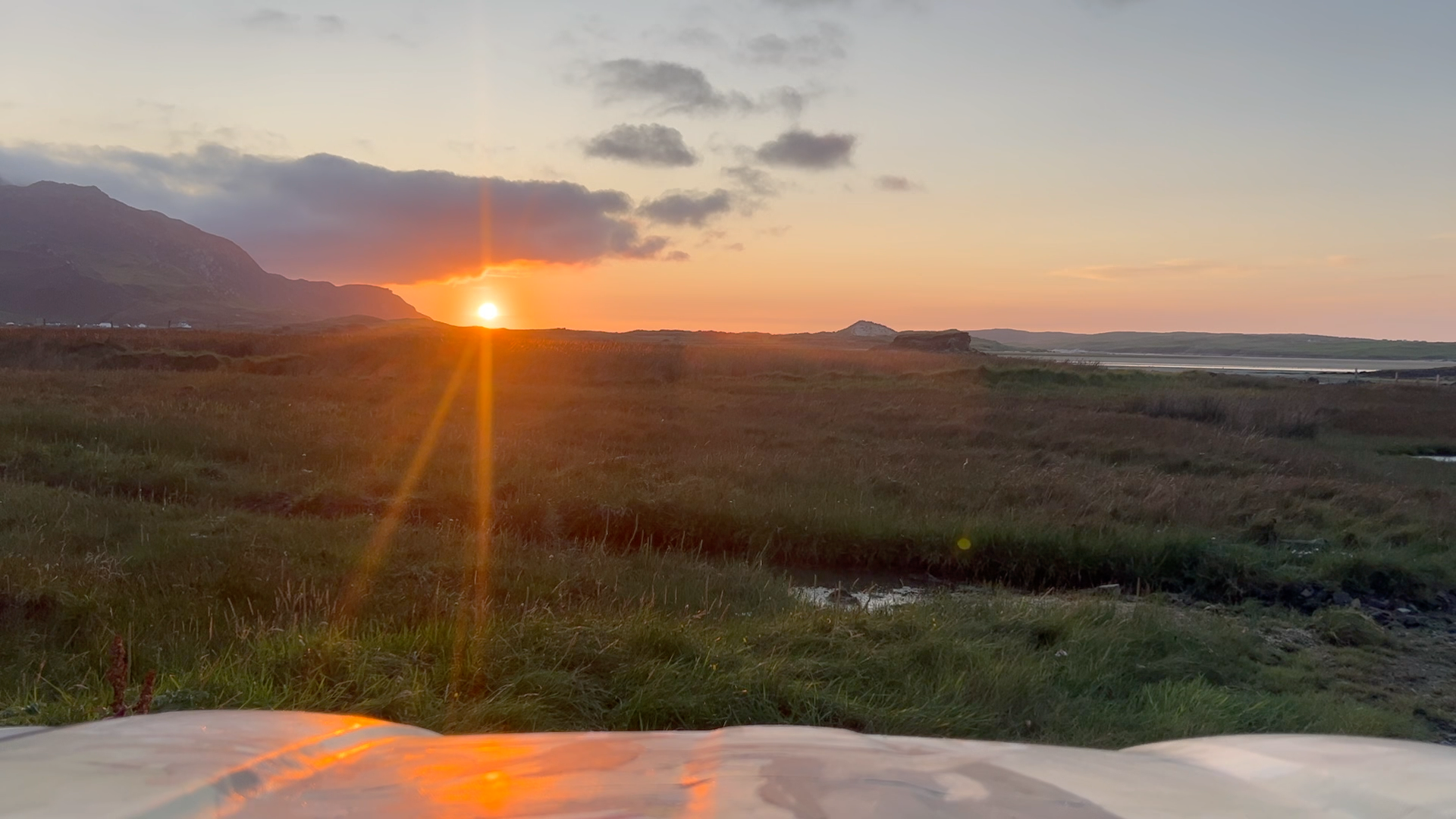
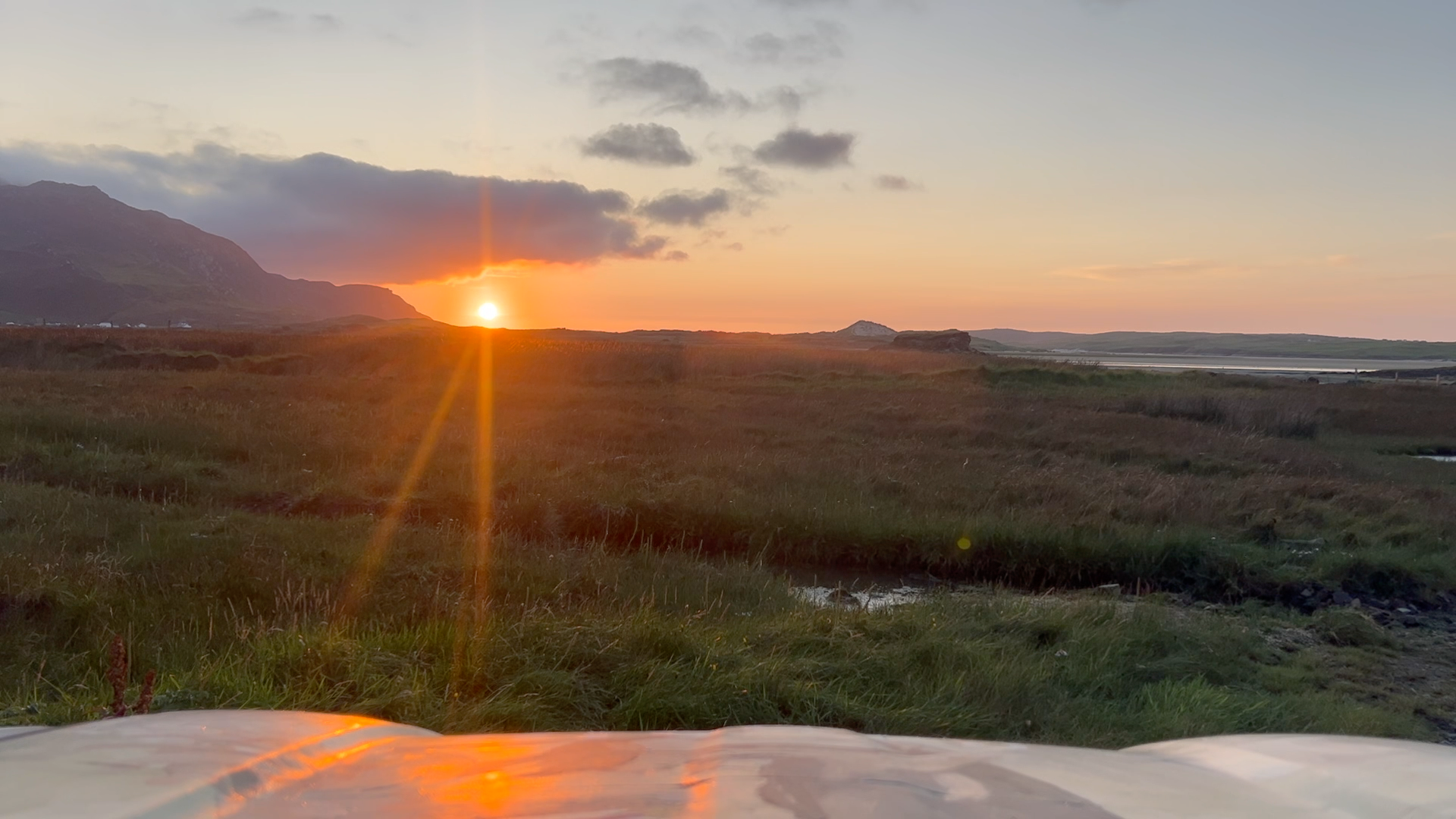
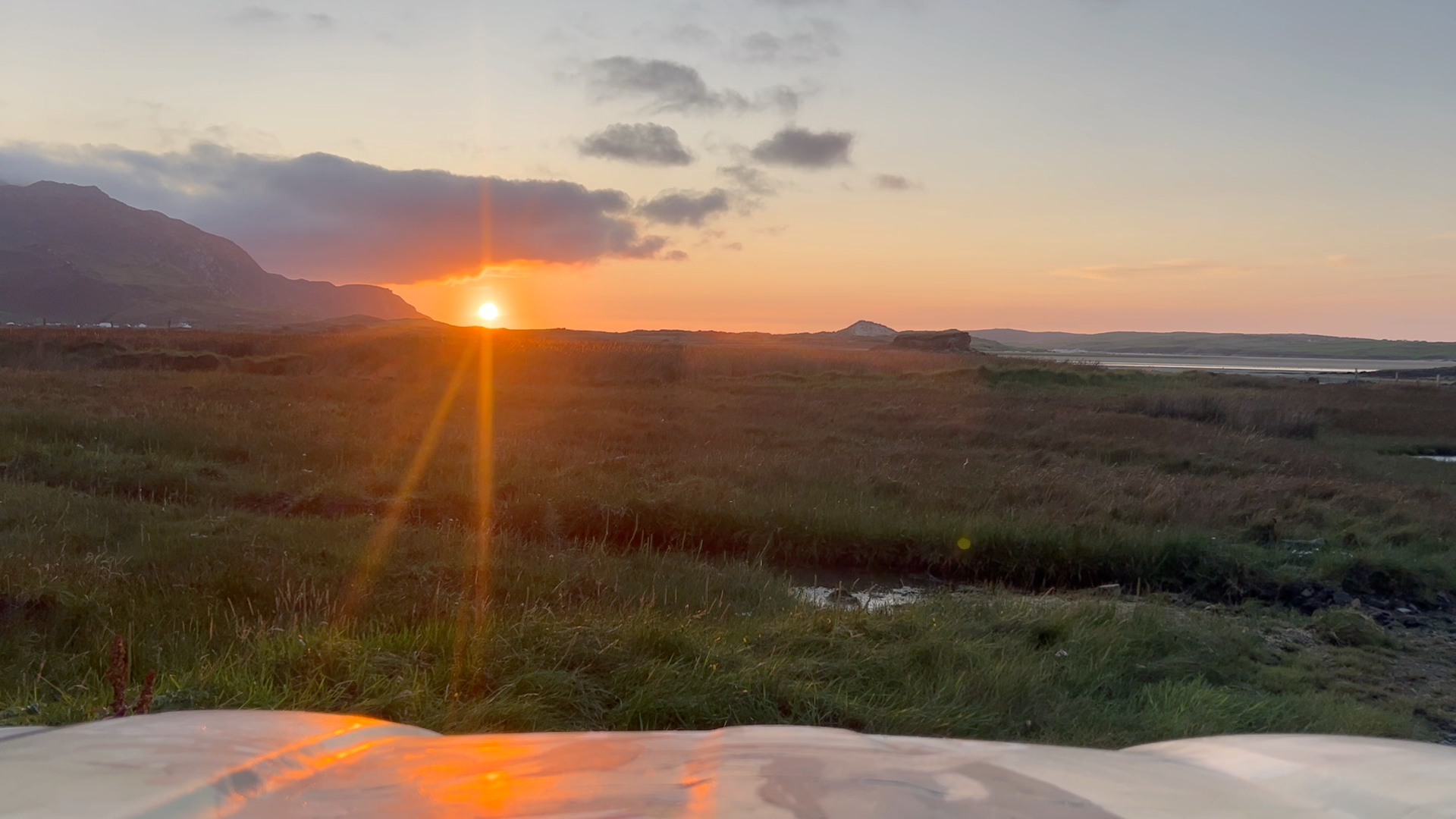
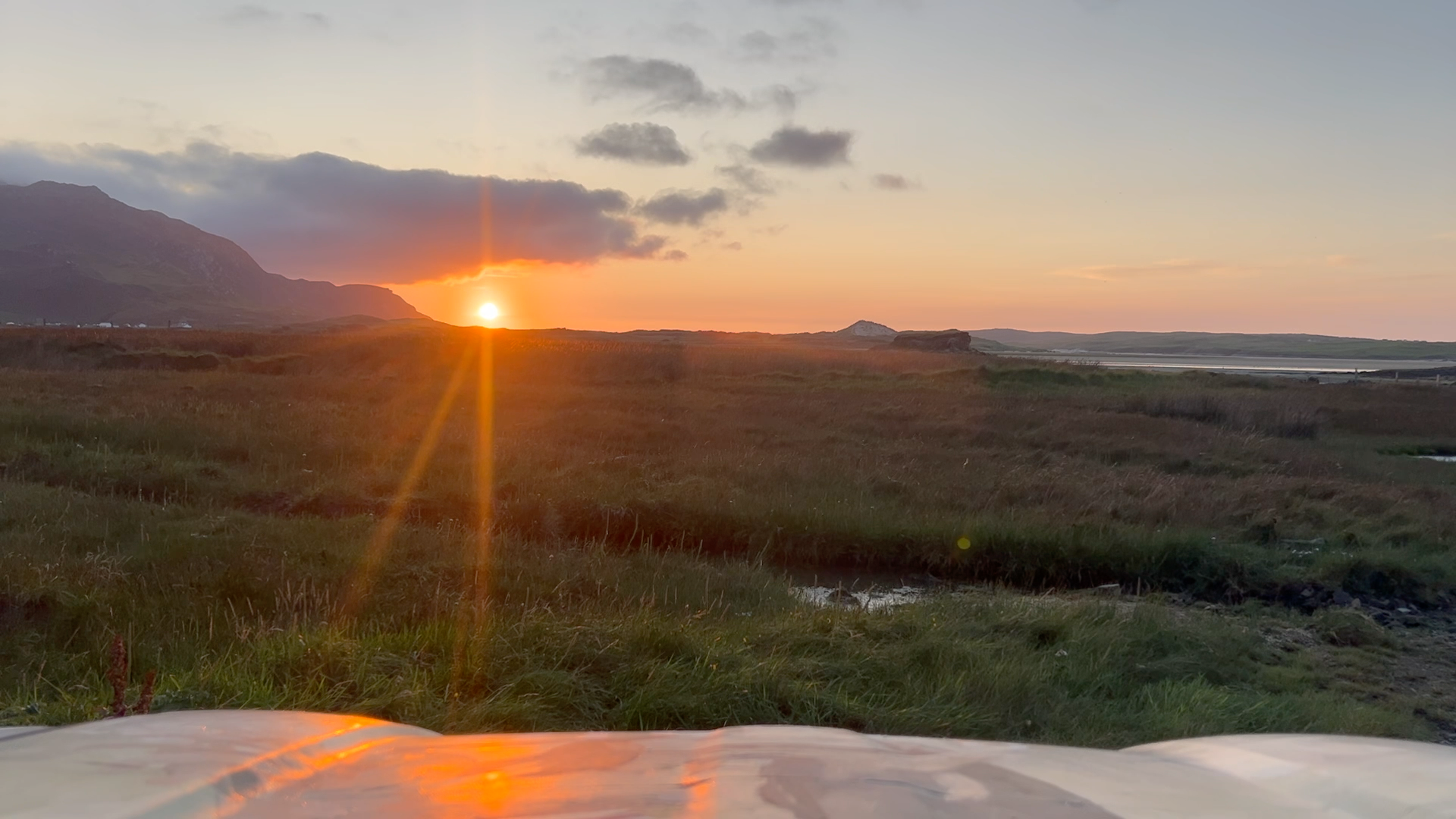
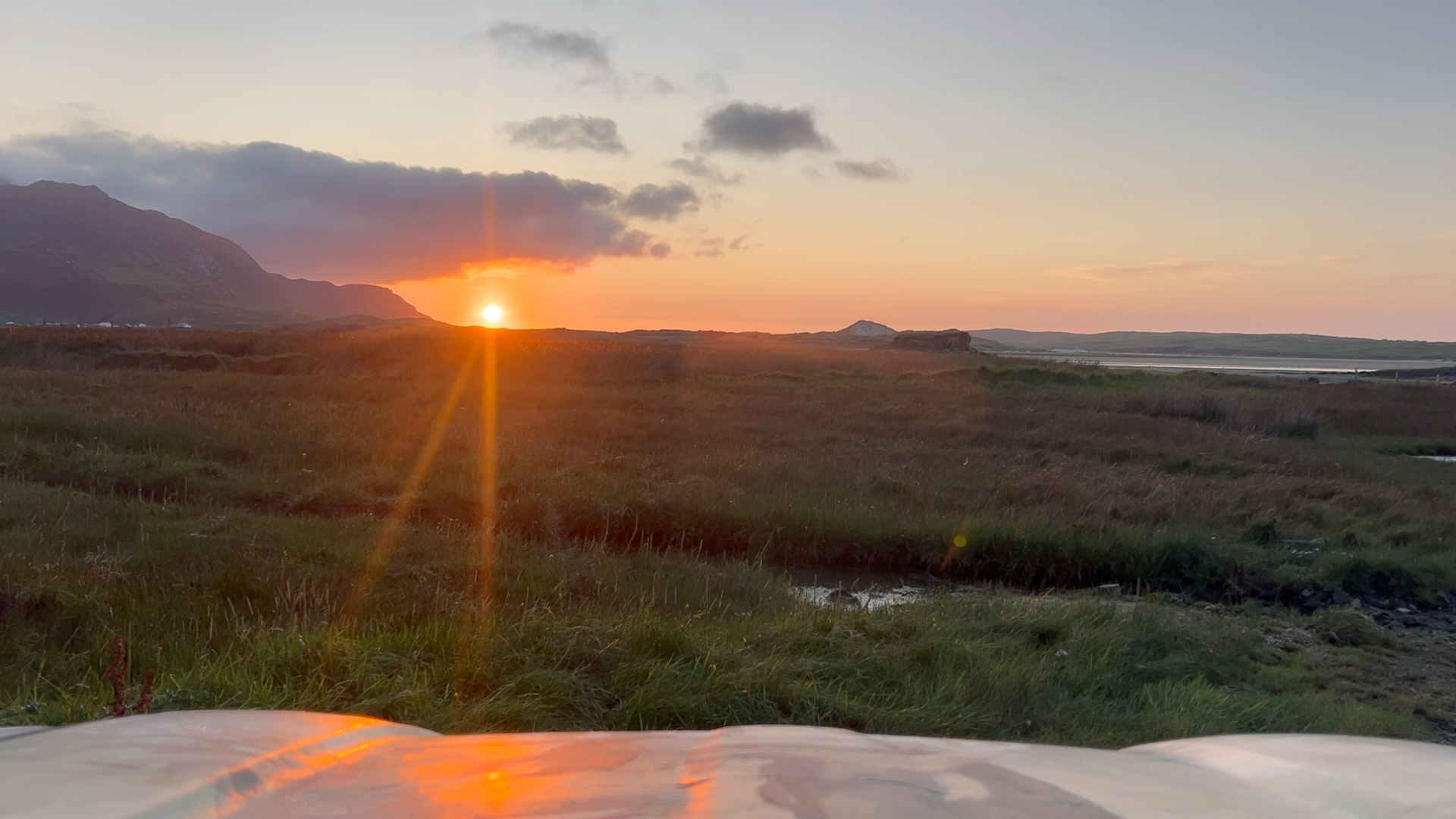
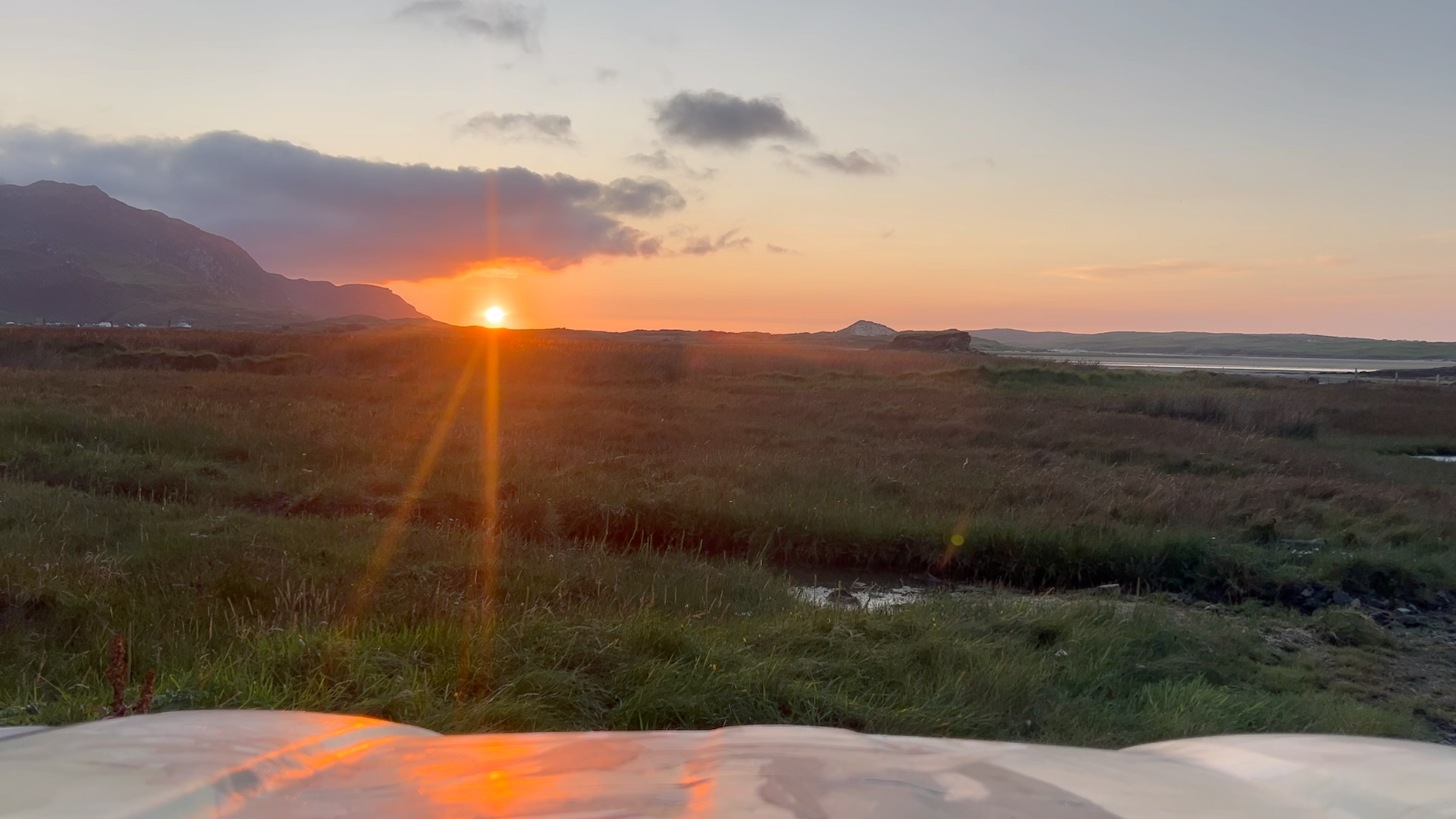
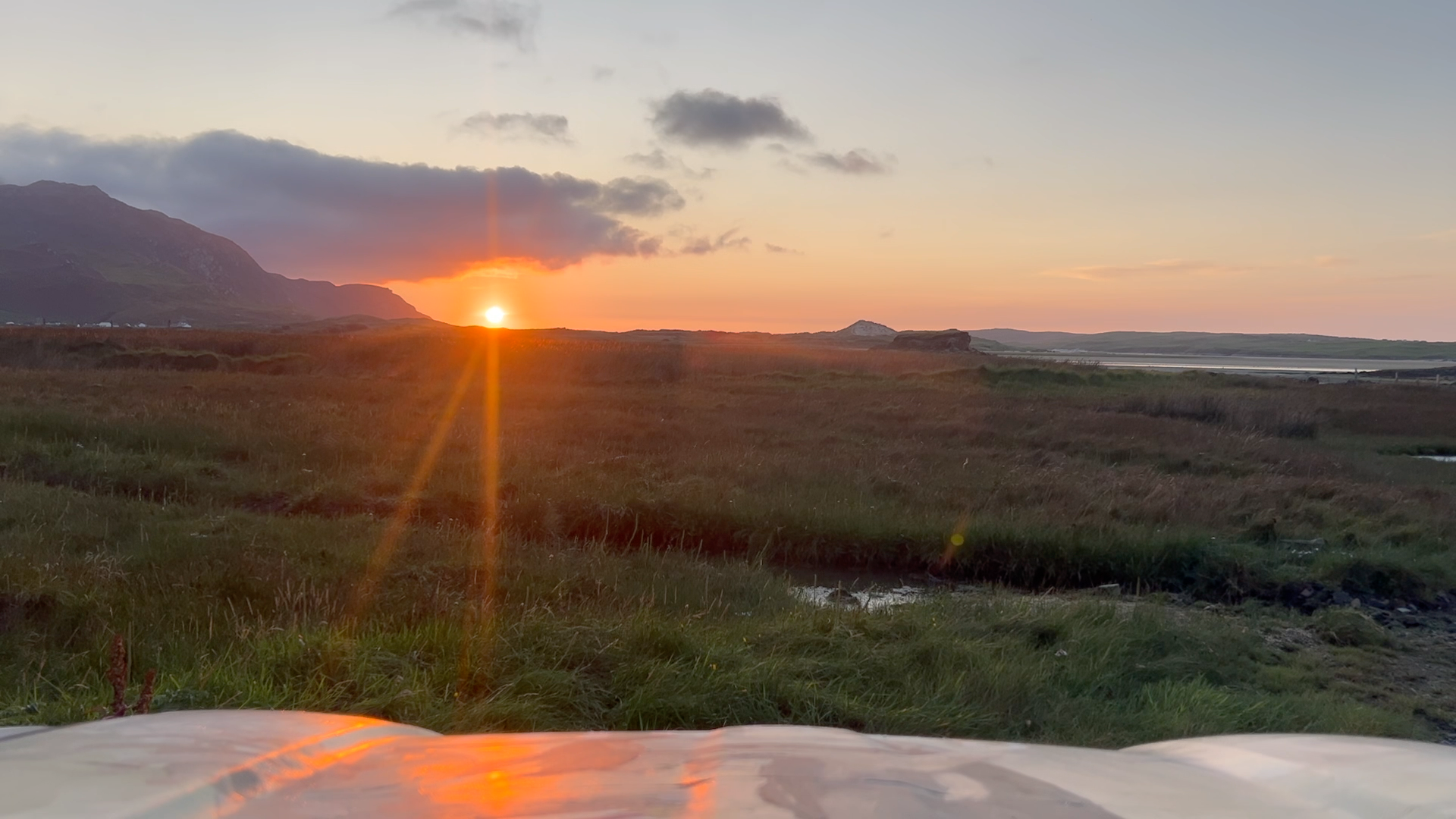
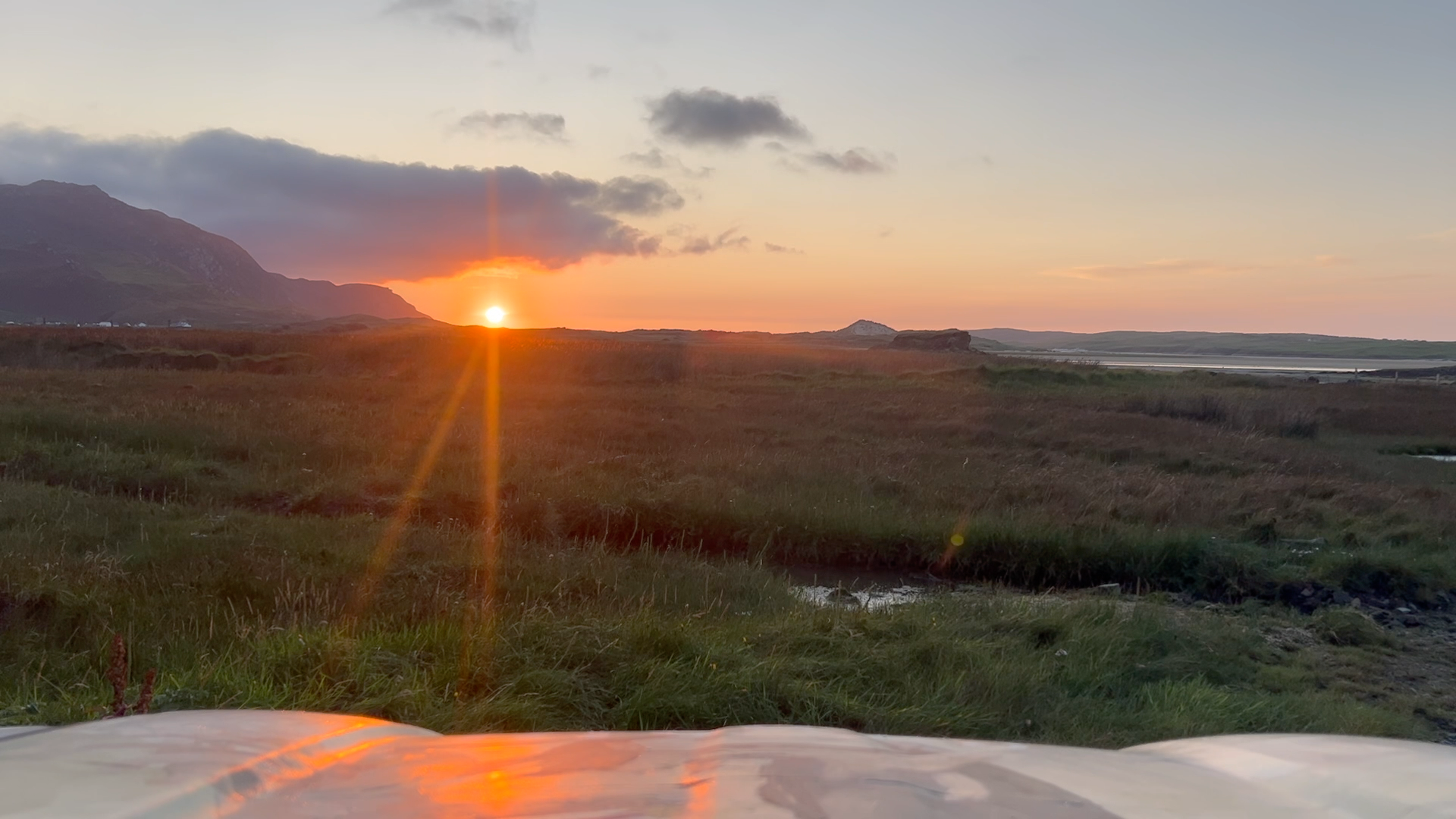
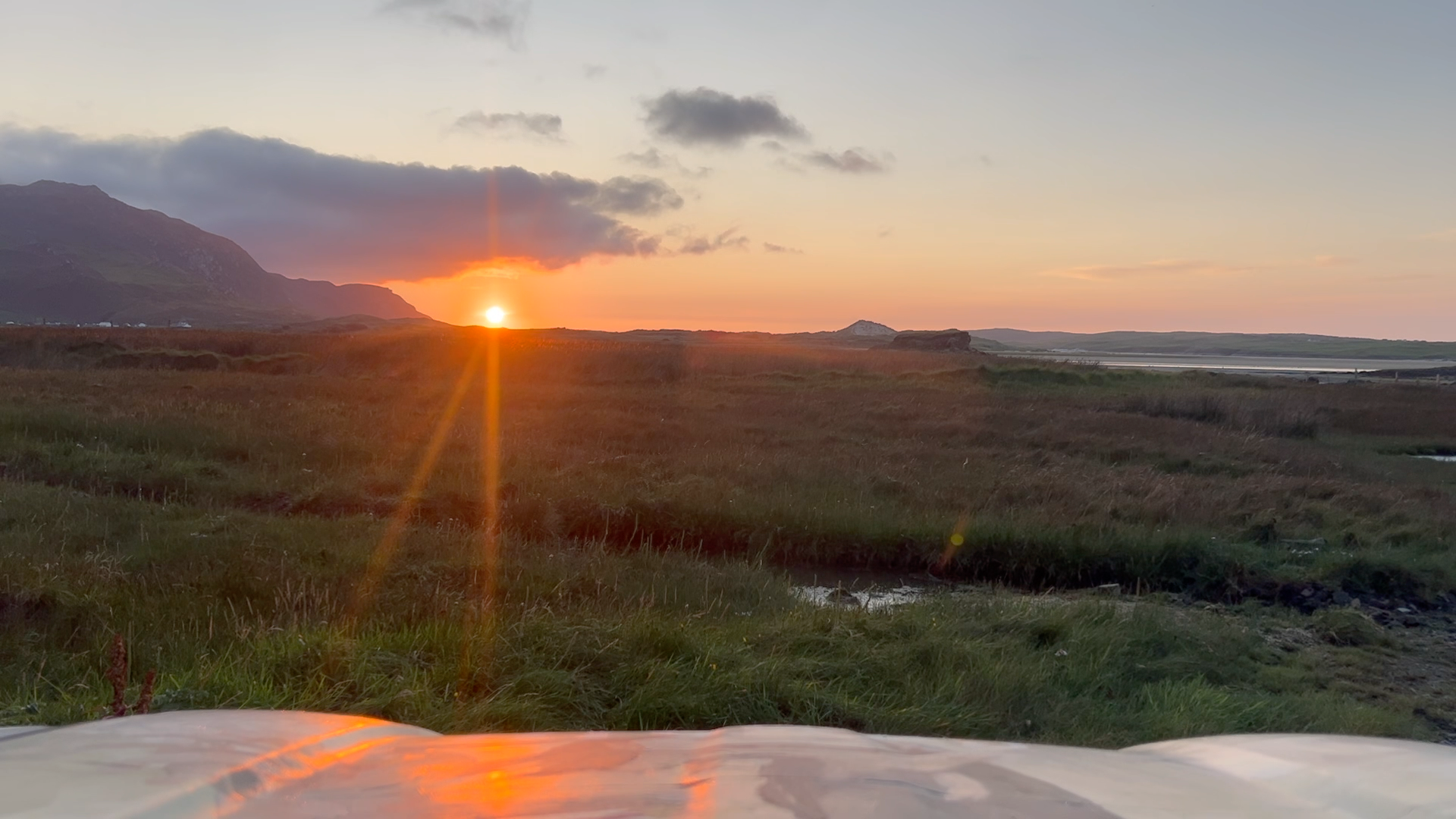
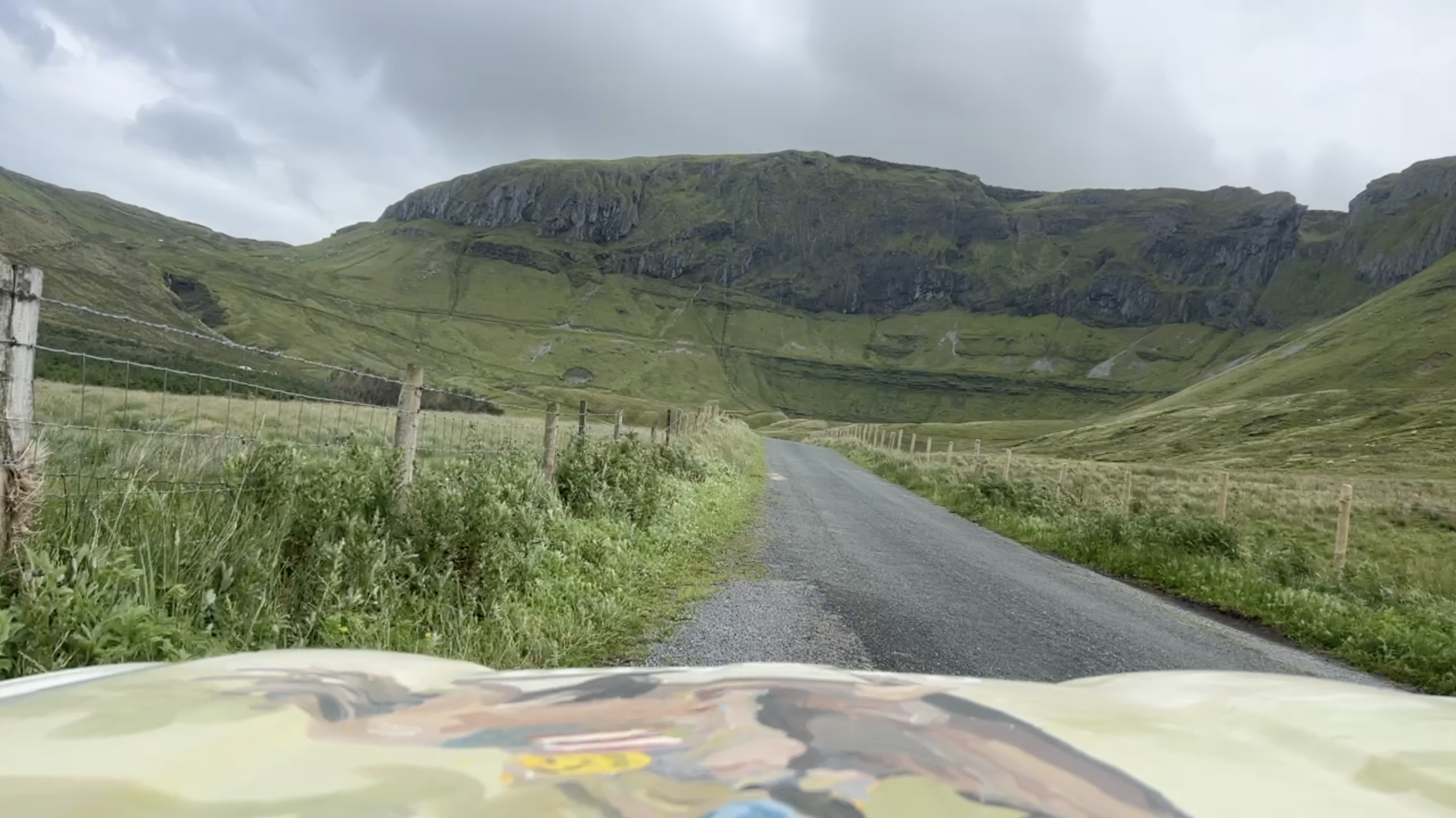
As we drove towards Donegal where we’d be taking a more relaxed approach to tour de force, we starting thinking about unwinding, having a break, going for walks and so forth. We listened to tapes and followed the winding R263 towards Glencolmcille.
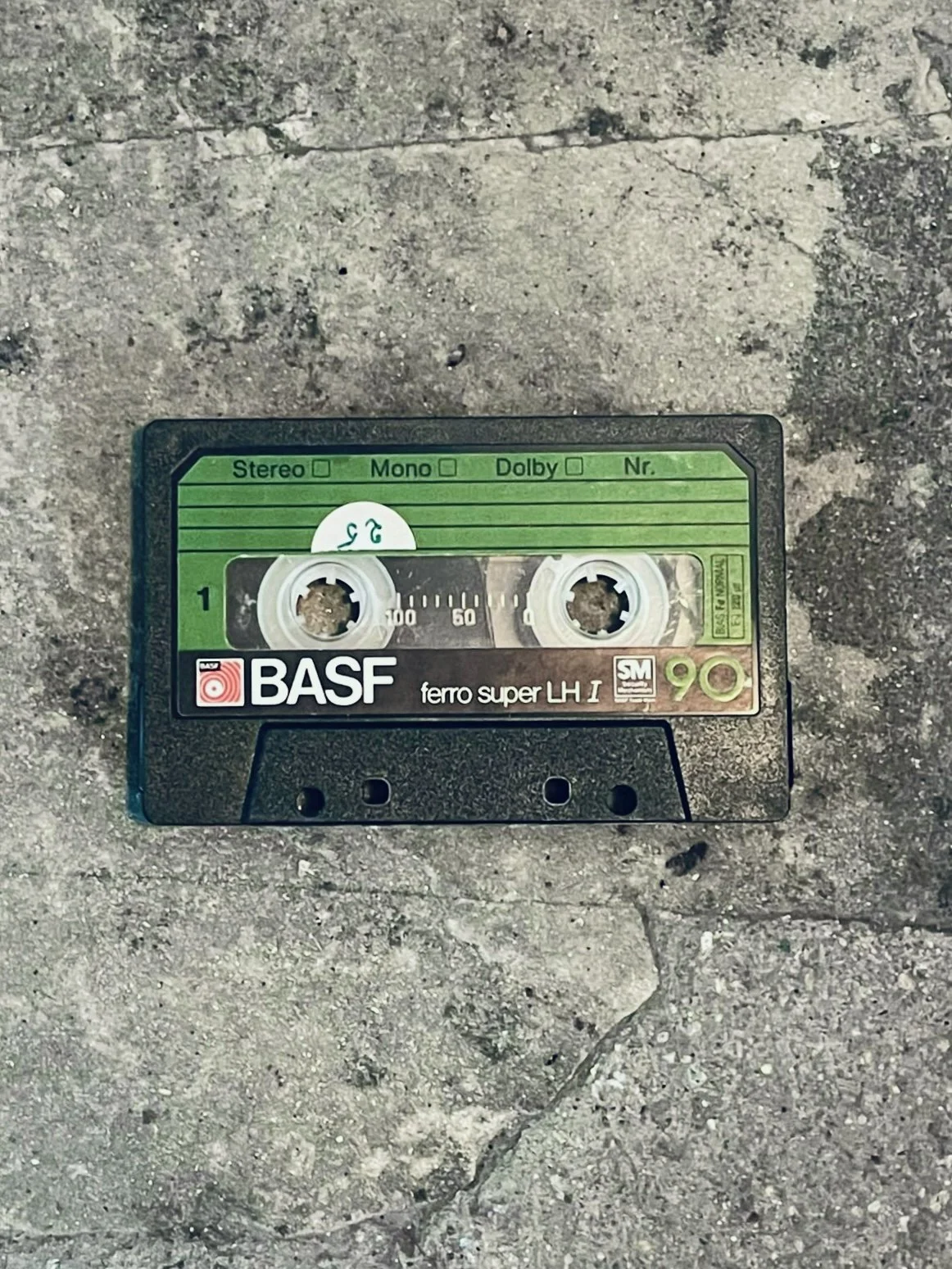
Of the various genres and collections of cassettes we’d taken with us in the Quatrelle for musical accompaniment, we had a few that we’d put aside for the right moment. We called these ones mystery tapes since they had no sleeve notes, labels or information with them, they were mixtapes found or lost here and there over the years. During the trip around Ireland, and on a previous pilot of the trip in France, we took to playing these mystery tapes from time to time, enjoying the surprise element and maybe a moment of serendipity or synchronicity. One such mystery tape was System of a Down’s 2001 album Toxicity, while we were on a night drive between Bourges and Nevers.
Conversion, software version 7.0
Looking at life through the eyes of a tire hub
It turns out we’d both had the album as a teenager; I had the CD and Liliane had this tape which had been played frequently, then intermittently and then rarely before ending up in a box of things, in her Father’s remise.
Flashlight reveries caught in the headlights of a truck
Eating seeds as a pastime activity
The toxicity of our city, of our city
My CD had a similar fate, migrating from heavily postered box room, to the communal music shelf and eventually under the stairs with tools, spare wellies, ornaments (fall-fluties as my grandmother called them), old drawings, Christmas decorations and the Hoover. The mystery tape had opened up a common ground of music taste and formative years.
Another mystery tape transpired to be a copy I’d made of an album I had on CD. Leyla McCalla’s solo album, Vari-Colored Songs: A Tribute to Langston Hughes. The CD had been given to me by Leyla herself after we met and clicked on a road trip around the Sates in 2014. Leyla is a classical and folk musician and this first album of hers, is a series of musical adaptations of Langston Hughes’ poems, interspersed with Haitian folk songs sung in Haitian Creole. It’s one of the most beautiful albums I’ve ever heard.
Throughout, she reflects on folk memory, American identity, Civil rights, colonialism, cultural preservation, linguistic revival, activism, solidarity, solitude and loneliness. The first track on the album, Heart of Gold is a stanza from Langston Hughes' poem Vari-Colored Song,
If I had a heart of gold,
As have some folks I know,
I'd up and sell my heart of gold
And head North with the dough.
But I don't have a heart of gold,
My heart's not even lead.
It's made of plain old Georgia clay,
That's why my heart is red.
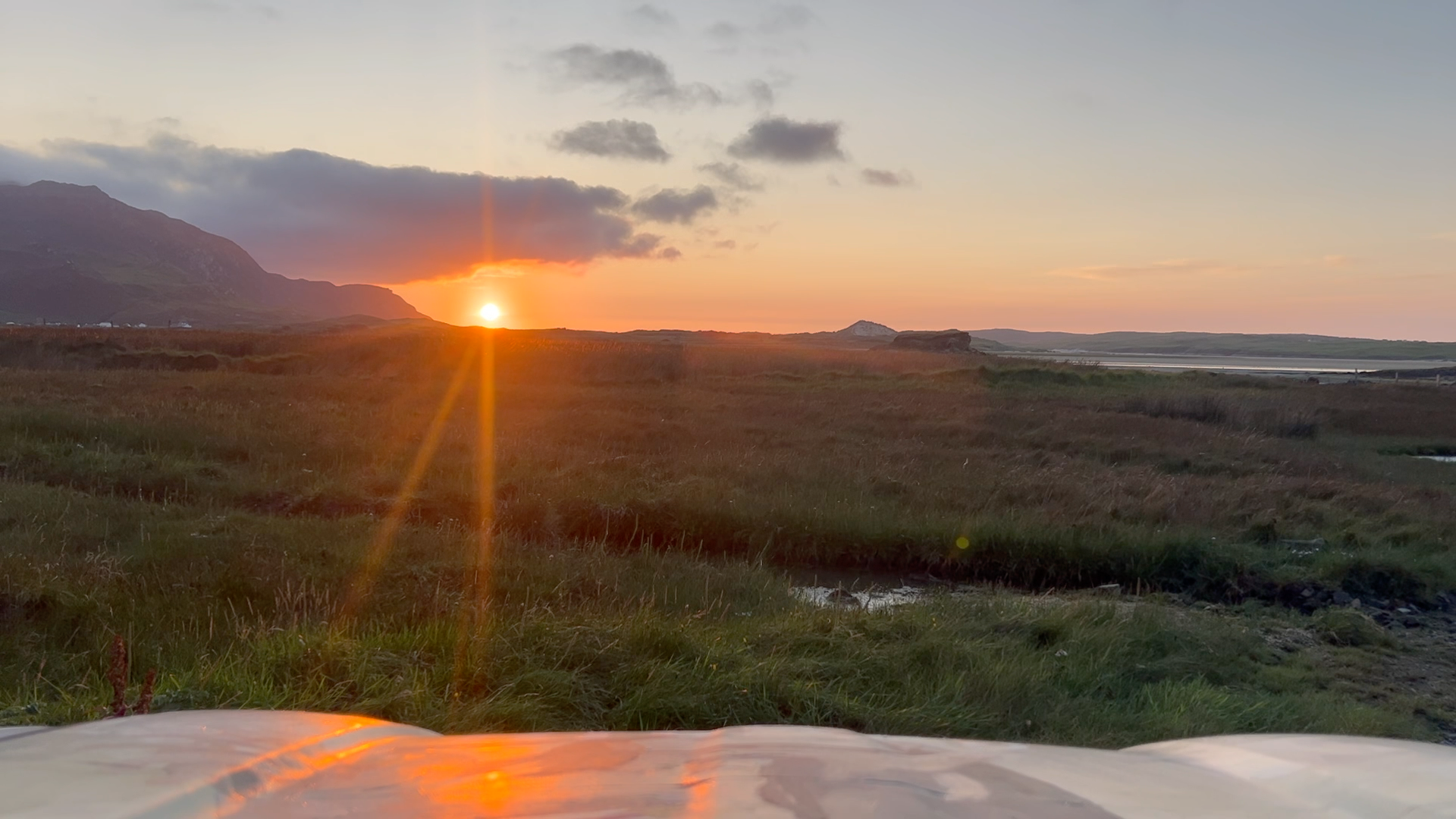
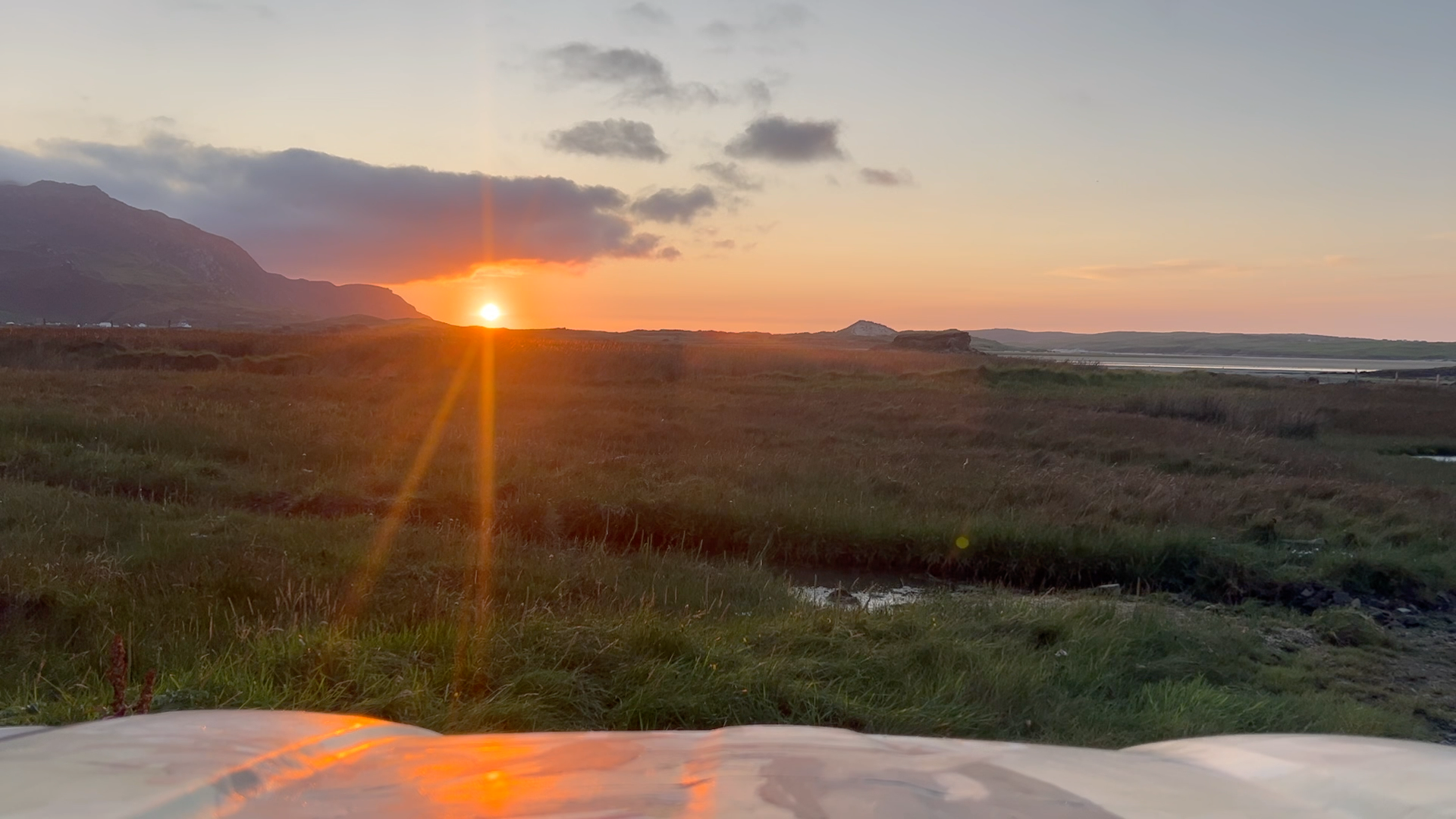
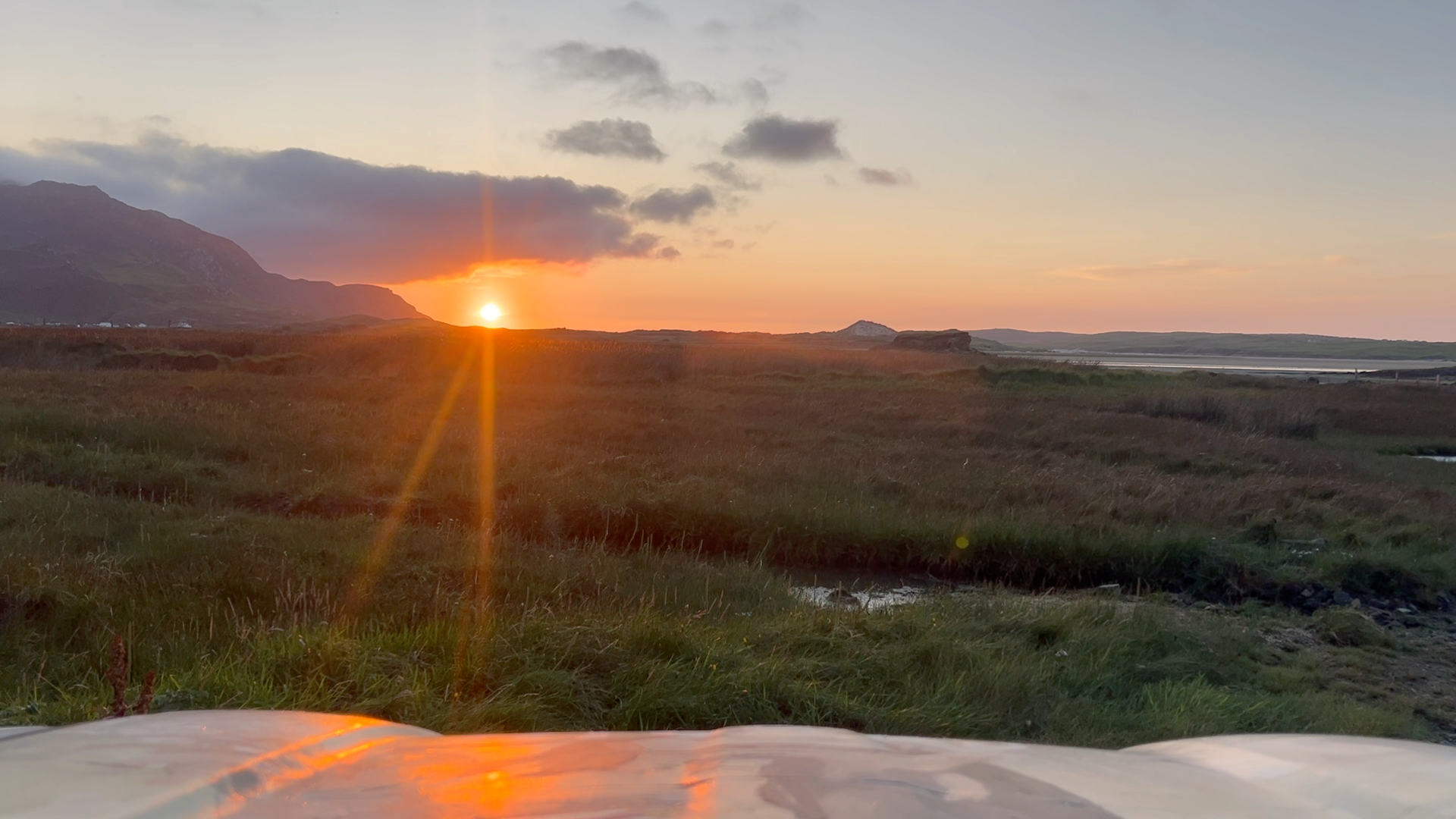
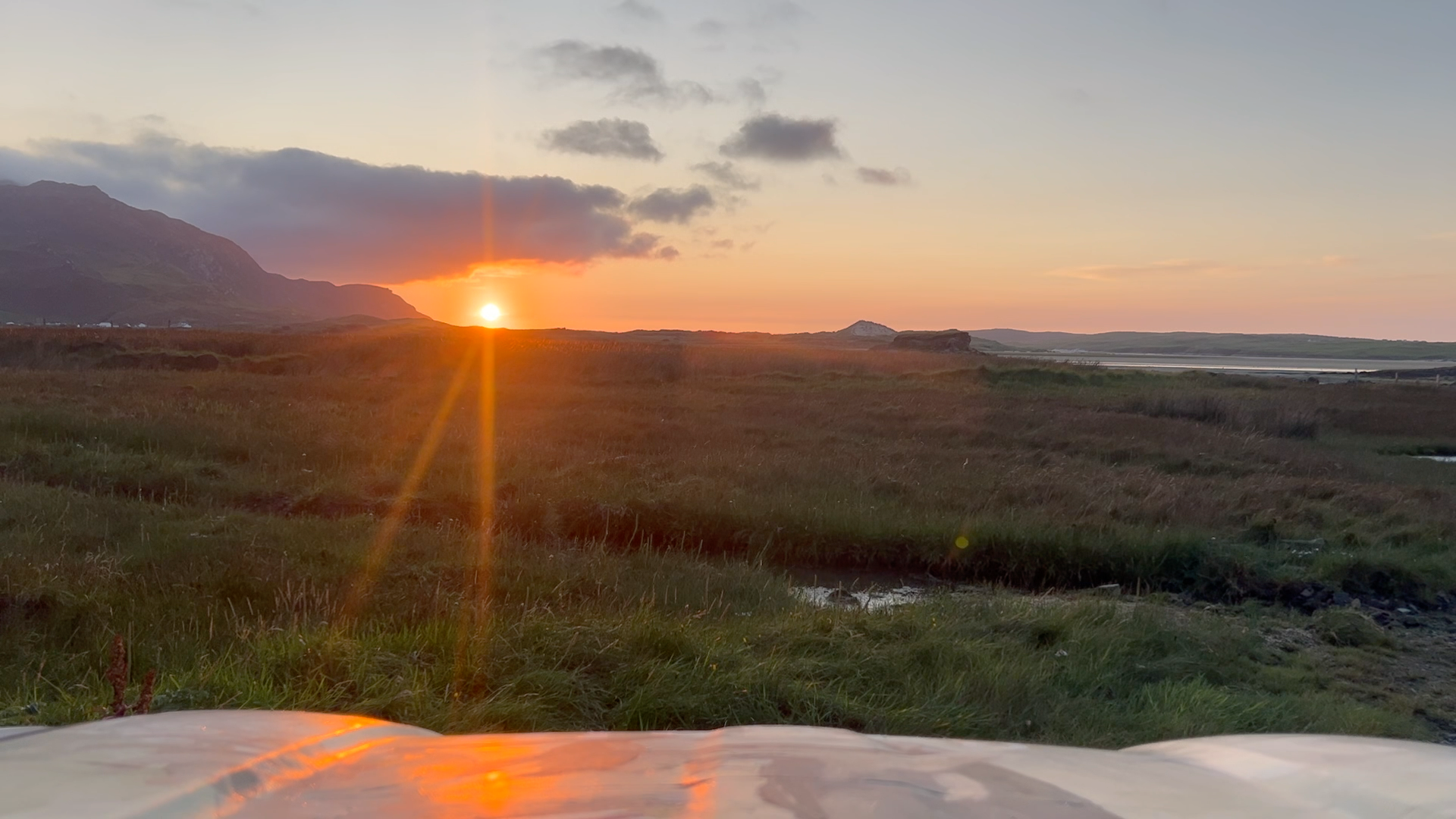
This time last year Liliane and myself were headed north for Donegal, out past Killybegs, in-thru as they say, listening to Langston Hughes via Leyla McCalla.
04.08.2025
On this episode of K7 dans la 4L, collaborative visual artist duo Ruth Clinton and Niamh Moriarty share insights into their creative practice across performance, video, sound installation and storytelling.
Parked up at Drumcliff Cemetery and later on with a spectacular view of Ben Bulben, Niamh and Ruth talk to us about their ongoing research. Topics covered that day include, Edward Said’s idea of a ‘third nature’ in relation to the adjacent fallacies and contradictions inherent in Irish Literary Revival tropes via William Butler Yeats, and a grand French pop-ballad; Michel Sardou’s 1981 hit, Les Lacs du Connemara… inspired by a place he’d never visited.
Drawing narrative threads between a constellation of historical, academic and folkloric sources; referencing poetry, music, dance; Niamh and Ruth give insight into a long-term research project that, in their own words, ‘examines how decisions relating to preservation and presentation can shape national and individual identities, in the context of imperialism, late capitalism, rising ethno-nationalism and polarised public debate on both sides of the Atlantic’.
K7 dans la 4L is tour de force mobile broadcasting arts club, live streamed on Twitch with a curated series of artist’s talks, readings and interviews that were broadcast directly from the Renault 4. A forum for discourse and debate around contemporary culture, a chat room that was utilised to discuss art, landscape and tradition associatively and in a shared stream of consciousness.
The interview is available to watch here…