12.08.2025
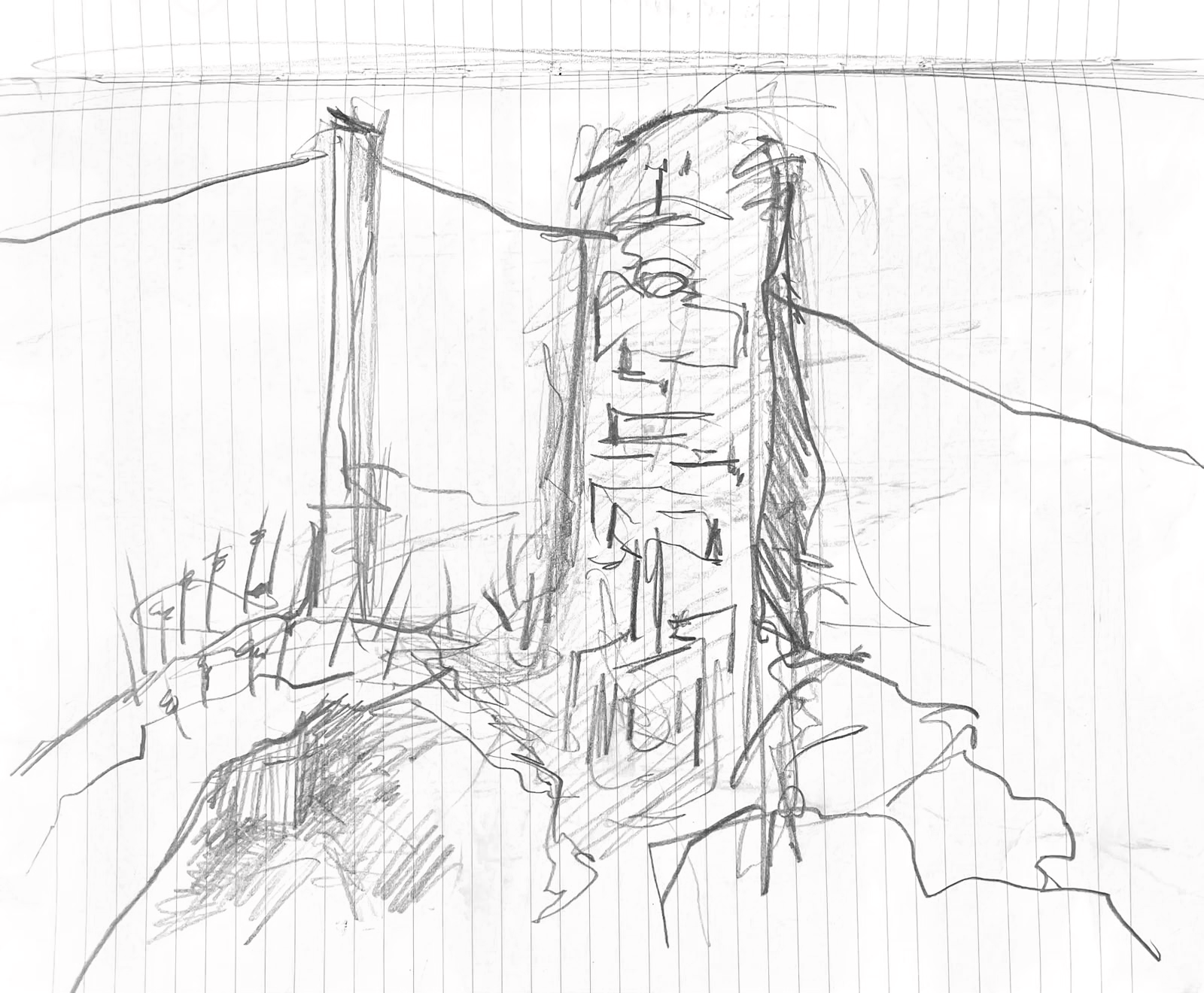
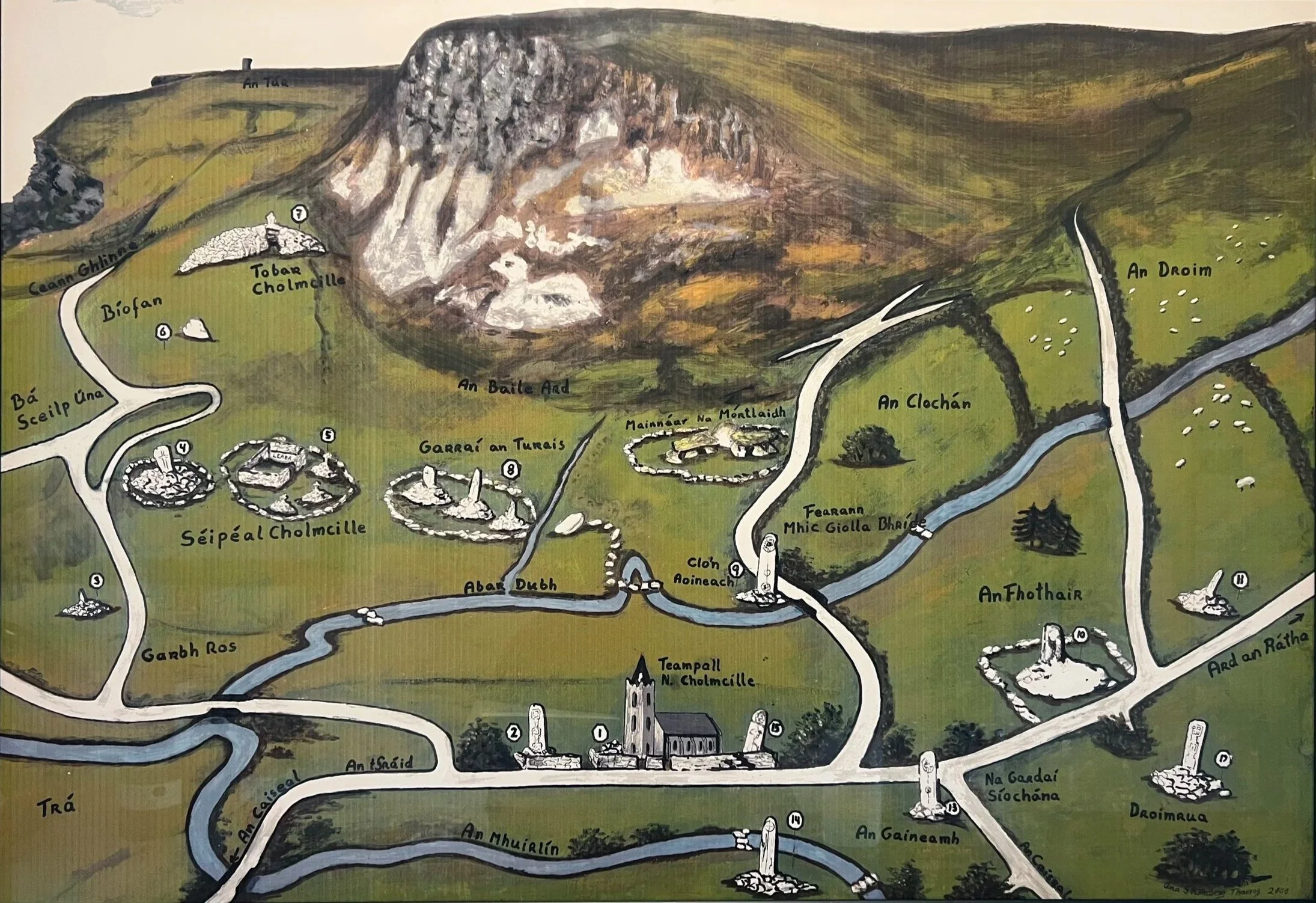
This day last year we walked to Saint Colmcille’s well that springs from underneath Glen Head. Surrounded by mounds of stones, this is well part of an early Christian pilgrimage called the Turas Colmcille. The turas traces an earlier pagan pathway around the Glen. It’s customary to walk the turas on the 9th of June each year in bare feet and some people do it at midnight by the light of the moon. While there are fourteen stops on the tour, there is no real beginning or end, rather people would join the turas at whatever stop was nearest to their house, which for us is the one pictured below, Cloch an Aonaigh, the Stone of the Gathering. It’s a 1.85 m tall schist pillar stone with abstract patterns carved on both sides. Loose and freeform on the western side, rectilinear and concentric on the eastern side. The pillar dates from 500 to 700 AD but was almost certainly erected on a sacred site; the prominence of this outcrop, a vantage point with views across the valley to the sea; or clefts in the mountain where paths were worn, standing here; you can see all paths leading into the valley; which would have provided a great sense of security.
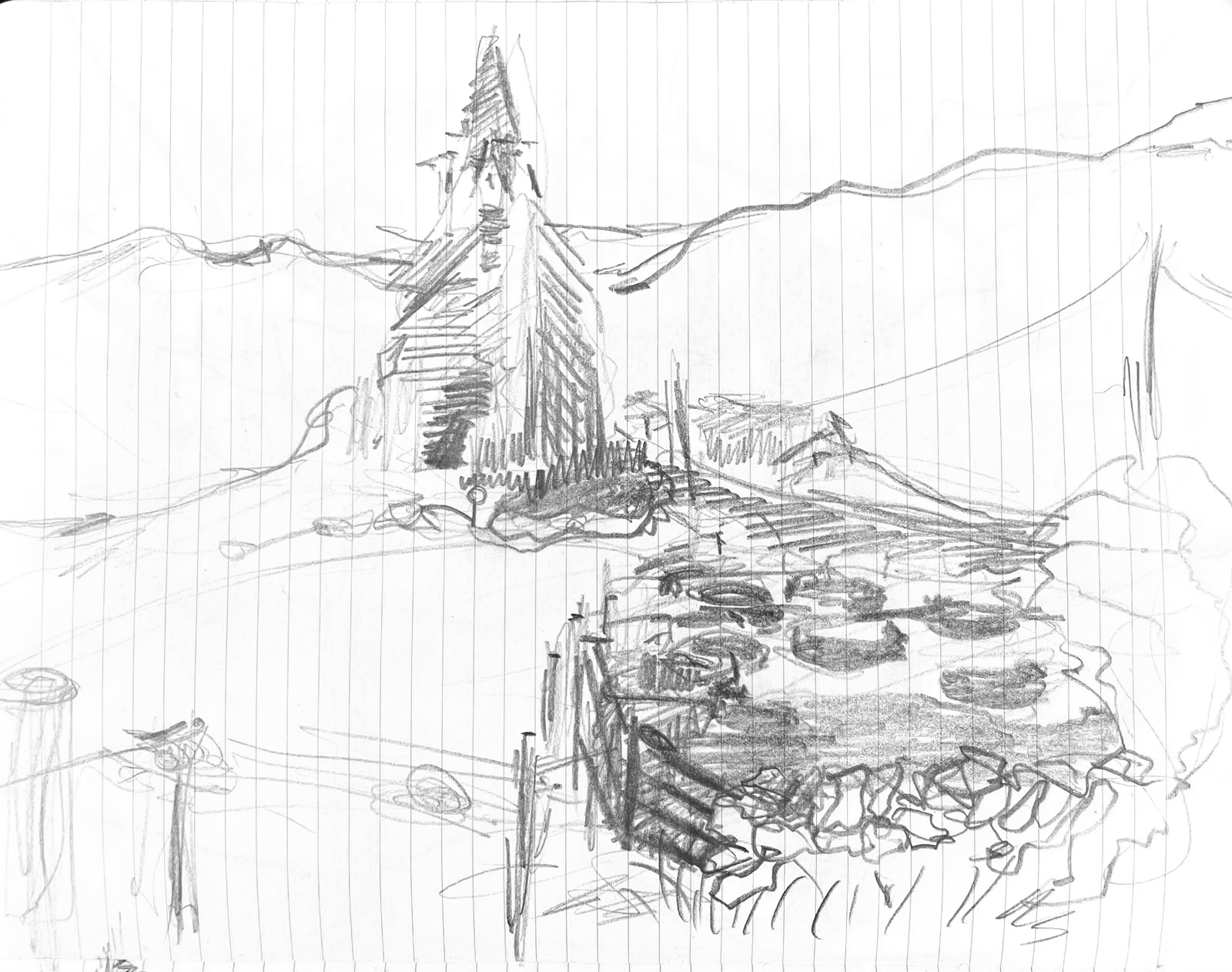
If you stand with your back to the pillar facing east, you will see a 5000 year old tomb, and beside it bales of hay in black plastic tarp, weighed down by tires to secure against the gales that sweep in from the sea. Also on the site, there’s a church that was built in the 1930s. If you sing on this spot, or call; a crisp prompt echo bounces back at you off the church wall. There is a souterrain that served as an escape route. If you circle the stone and face west towards the sea, you can see a path in the mountain that leads to the holy well, you can see the dip where the mounds are. These mounds are the result of hundreds of years of people carrying up stones as penance; circling the well three times, then leaving them by the well. Some stones are pebbles, some are huge, begging the question, who was able to carry that up…what were they absolving themselves of.
Beside the well is Leaba Cholmcille – the Bed of Colmcille, another pagan site on the turas adapted for Christianity during the 6th century. Many of the sites that are part of the Turas are overgrown, this time of year, with native blackberry briars, nettles and ferns and shrubs like fuchsia and montbretia that arrived into the Glen in the 18th and 19th century respectively.
Some of the ancient sites are completely covered over and you’d never know they’re there unless you had a map or knew someone who could show you. A local farmer called Jimmy Carr was an incredible custodian of the knowledge related to the Turas Colmcille in recent times, maintaining the sites and leading the annual turas up until his death about ten years ago. He had a rare and brilliant proficiency in Irish, which was his first language.
Underneath a slab stone at a station of the turas, there was once a stone chalice. With openness and trust, people were welcome to see the stone chalice, in its place for over a thousand years. In earnest, Jimmy would show the chalice to people who came to Glen. Around twenty-five years ago, after one such tour; one of the group returned under cover of darkness to the flagstone and took the chalice, Yes. Maybe they’ll see this and return it.
Condy Campbell a farmer, storyteller who knew how to twist the súgan in the Glen of Glenties had the Irish language to the level that Jimmy did. A súgan is a type of straw rope that was commonly made for use on small holdings in rural Ireland for centuries to tether animals, make furniture, secure tramcocks and so on. Condy was known for making the strongest and most resilient súgans which he’d demonstrate at harvest fairs with tug of war competitions that he always won. He and his ropes were as strong as each other. Up until he died, Condy was there to pass on his knowledge, tell stories, show people how to twist the rope, make tethers for animals, bogadíns and furniture from the straw.
In 1967 Jimmy Carr and Condy Campbell became great friends after Jimmy sold a ram to Condy at a harvest fair in Glencolmcille. Condy walked the road from the Glen of Glenties to Glencolmcille, up the Glengesh Pass, then he walked back again the same route with the ram. 50km each way. After they became friends, Jimmy and Condy would often make the trip on foot to catch up, tell stories as gaeilge, and share observations on changes in crops, seasons or animal behaviours. That same ram has a story Condy and his two brothers risked their lives for it sometime in the early 1970s after it slipped down a cliff face near Na Grianáin and landed on a ledge. When they found it, Condy wove a súgan and used it to lower his brothers onto the ledge where they tied it around the ram and pulled him back up the cliff face to safety. The first brother was pulled up then the second. As he was scaling the rock face, the second brother lost his footing and fell backwards out over the ledge. Condy was known for his strength; but we can only imagine what was going through his head as he gripped the súgan he’d woven himself out of straw, with his brother dangling at the end of it off a cliff. He managed to pull his brother back up, and had the story for Jimmy next time he visited.
Those that overheard the two men talking noted the abundance of words for phases of growth for plants, light at times of the day, descriptions of the sky, weather coming in from the sea.