08.08.2025
The concept of tour de force represents a journey down roads less travelled where the journey becomes a medium for both dissemination and gathering - the Renault 4 is a mechanical prop, a narrative device; a portal, where we traverse invisible edges between reality and fiction, memory and desire, the past and the present. It becomes, in a sense, a time machine as the car itself has its own histories which can act as signs and signifiers of its narrative direction. Because of restrictively high import taxes in the 1960s, 70s and 80s, a loop hole was discovered and the Renault 4 was made in France and shipped to Ireland in parts where it was reassembled. Cheap labour coupled with a highly skilled work force in Ireland bolstered this economic strategy, creating an intertwined social history between Ireland and France. The Quatrelle or 4L was one of the first affordable, everymans car in both countries and as such it is associated with rural and working class mobility.
The Renault 4 is also synonymous with the circulation of culture. One might picture collector Tom Munnelly in his own Renault 4, engaging with local communities, celebrating and documenting music and song in rural areas throughout the 1960s, 70s and 80s. In her essay ‘Cailín Deas Crúite na mBó' - and the Impact of the Folklore Collector, Ríonach uí Ógáin highlights changes over the last few decades, including technological advances, informant/collector relationships and gender dynamics. she notes, From 1935 to 1971 the Irish Folklore Commission oversaw the recruitment, appointment and fieldwork collecting of upwards of twenty-four full-time and special collectors, all of whom were male and most of whom were born in the late nineteenth or early twentieth centuries.
This raises an interesting question about how gender dynamics, or friendship, for example have affected the way material, intangible heritage; music has been gathered and preserved as documents within an archive. Retrospective examination of ethnographic fieldwork may also illustrate the fact that at times the resulting material from a single informant at different recording sessions may be quite varied in terms. In the context of collecting or recording music, friendship between musicians fosters a convivial dynamic, and friendship with the collector, one would hope; fosters an atmosphere of trust. Different contexts and atmospheres result in different renderings of tunes.
Through the prism of a song, Uí Ógáin describes how musician, singer, collector, Séamus Ennis and Colm Ó Caodháin, a singer, storyteller, musician, farmer and fisherman made discoveries about the song’s history and context through shared research, friendship and having a great laugh with each other,
Ó Caodháin was arguably Ennis' best informant and the informant to whom he was closest. They fished, sang, played music, worked and travelled together. We can imagine the fun and the exchange they had when they spent an entire day together in pursuit of songs around the Carna district. This doubtless led to further shared terms of reference and shared memories.
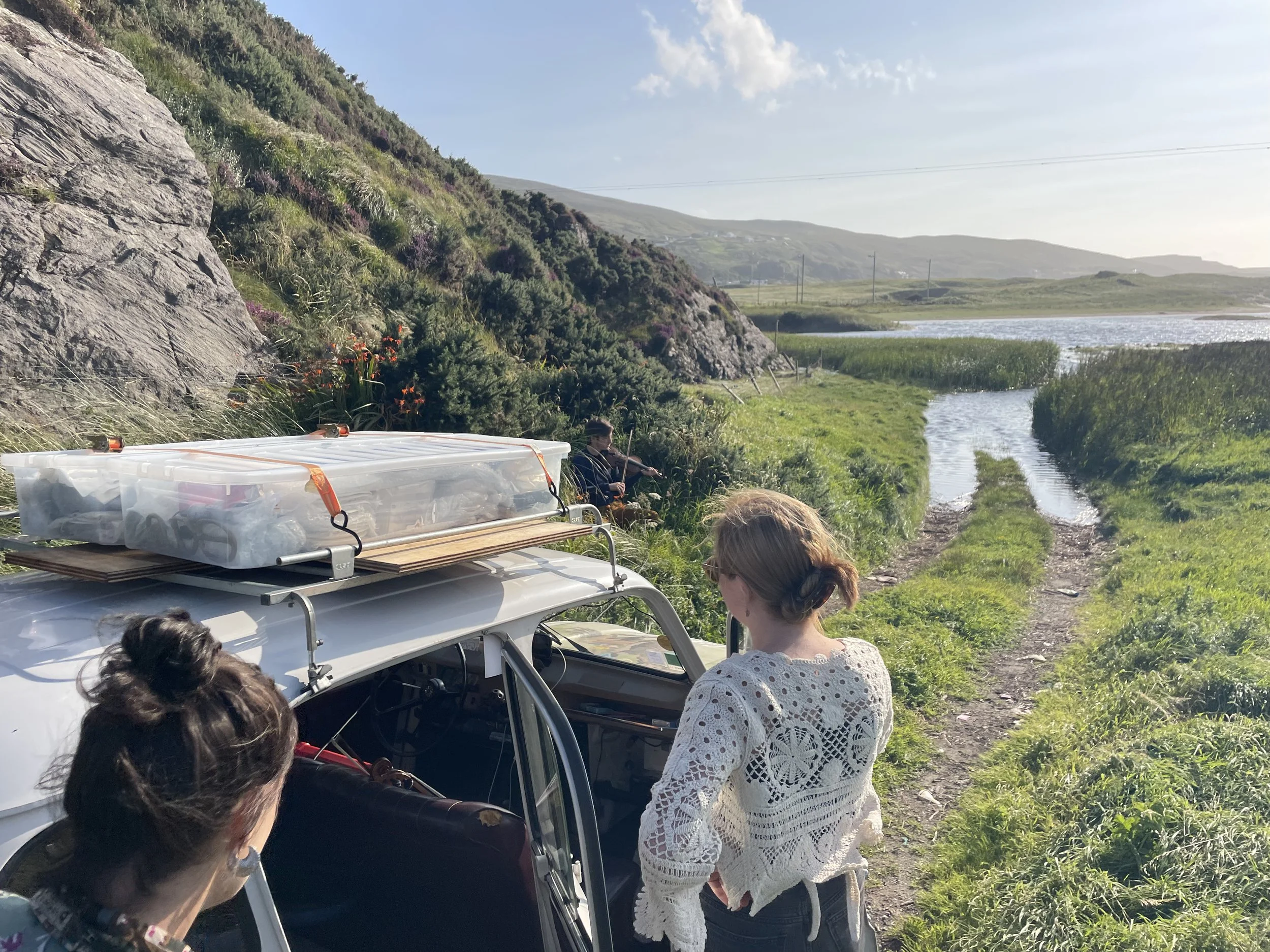
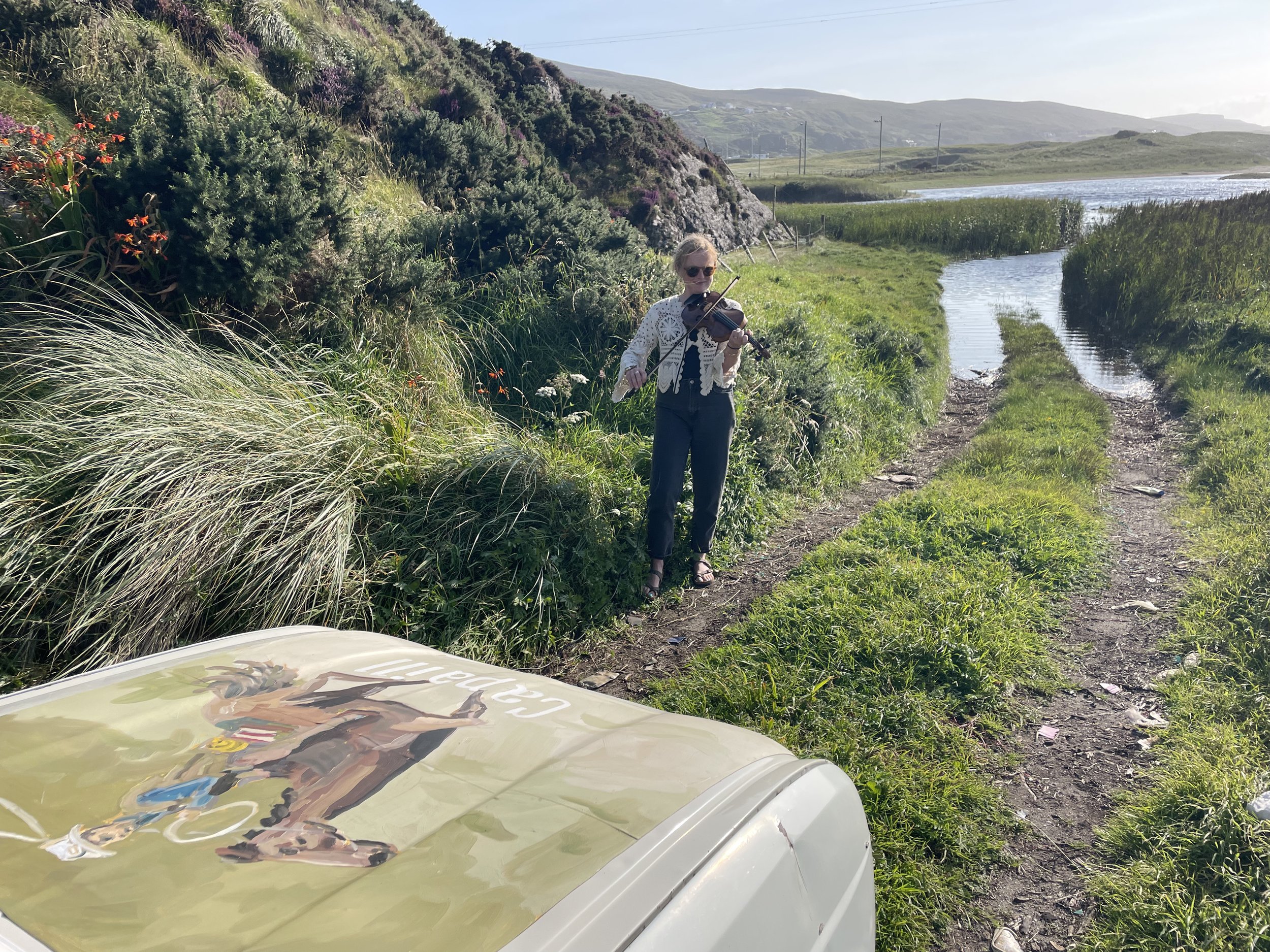
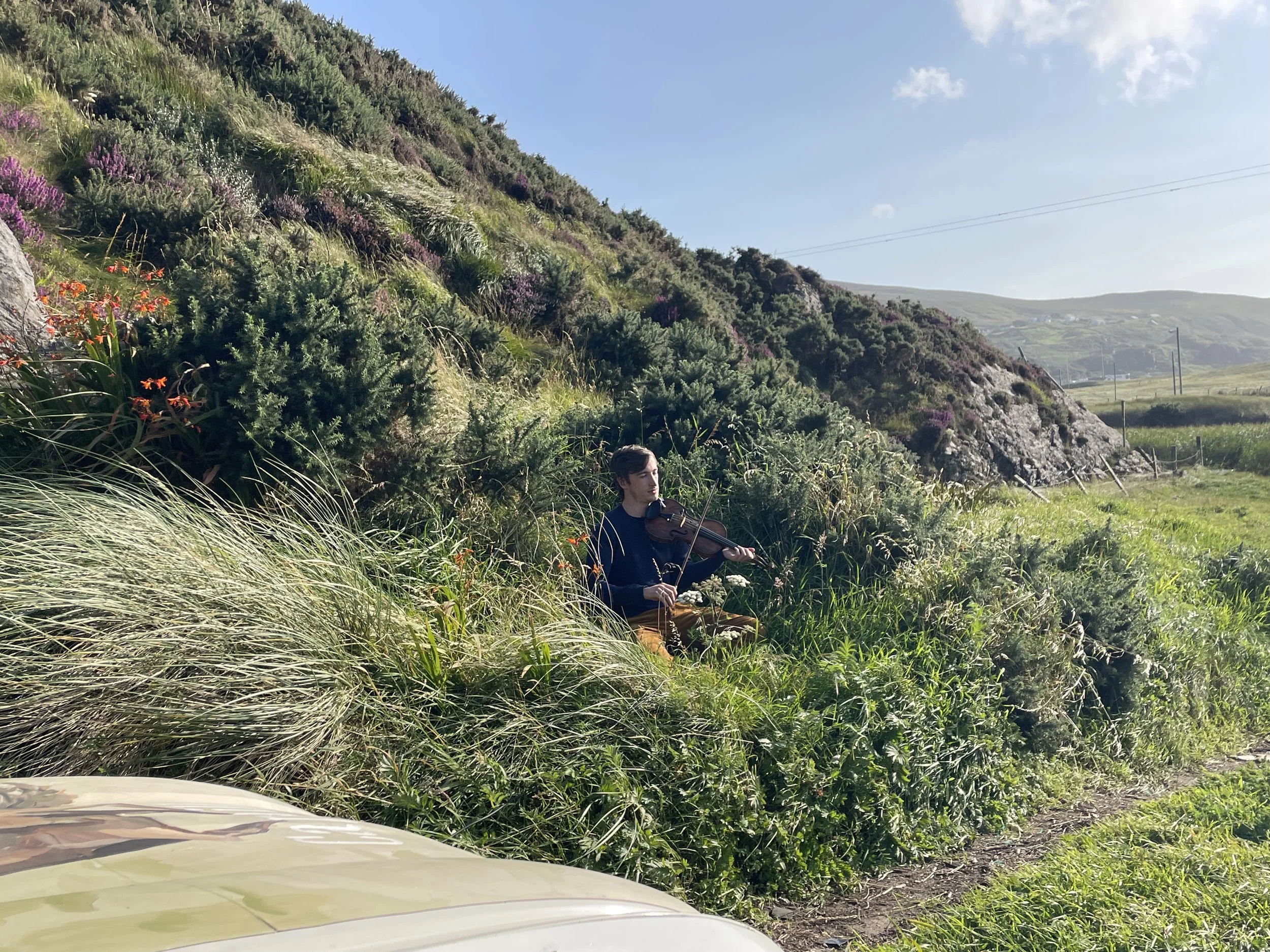
This day last year we invited dear friends, Clíodhna Ní Ruairc and Cathal Caulfield to play a few informal and relaxed tunes in the car at the tail end of Glencolmcille Fiddle Week for K7 dans la 4L a live broadcast series from the Renault 4. Clíodhna is a fiddle player from Garristown co. Dublin now living in Artane and she has spent time in Leitrim, Clare and Donegal learning tunes and styles, adapting her own style and repertoire over time. She cites Antóin McGabhann’s strong steady rhythm as a particular inspiration, and this comes through in her playing. Clíodhna is a relaxed musician which lends fluidity, allowing tunes to shape in a way that feels effortless and often hypnotic. However, her serene disposition belies meticulous dedication and integrity in how she navigates the fiddle traditions that inspire her.
Cathal is a fiddle player and singer from Clontarf, Dublin who has described searching for inspiration ‘in the wells of birdsong, 18th-20th century manuscripts and the places in time where history and folklore collide’. Such influences are clearly manifest in his playing which sounds ancient and transient, caught on a breeze. At times, phrases seem wild, wilfully loose and inquisitive, as though remembering or reimagining lost techniques of forgotten musicians or styles that might have evolved and disappeared before ever being recorded.
First tune, Lucky Lover…the rest of the tunes - a few missing, but most are there,
1. a. ? b. The Gneeveguilla reel
2. a. The maid at the well, jig ; b. The mug of brown ale, jig ; c. The Limerick tinker, jig
3. a. The bunch of keys, reel ; b. The Abbey, reel ; c. Upstairs in a tent, reel
4. a. ?, air ; b. Nora críona, jig
5. a. Con Cassidy's waltz ; b. ?, waltz z