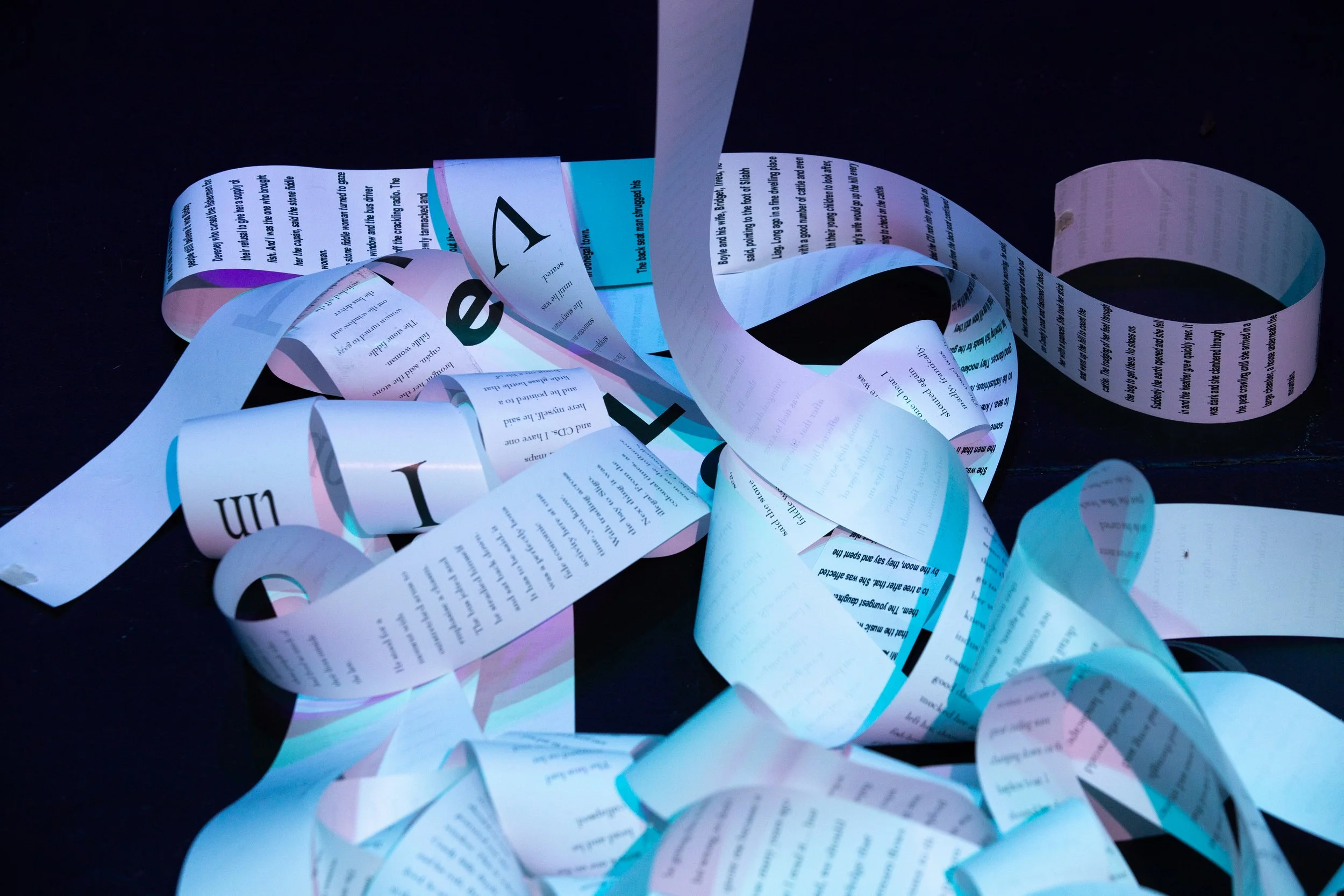
02.08.2025
Cave, A Fiction
They tap into the collective consciousness, these narratives that allowed us to assimilate mysterious occurrences or strange phenomena. Will-o'-the-wisp, northern lights or bioluminescent plankton. Grief and tragedy too. Something that helped to organise all that was happening beyond the usual realm of experience. A common ground. People tarried there for different reasons: boredom, escapism, creativity, something to hold to during times of great emotional turbulence.
There was a distinctive way of retelling those stories after they became artefacts of oral history for the archives. They were often standardised according to motif, trope, archetype; and as a result, a lot of the texture was lost. Before that, the stories were probably much more vivacious. Buoyant. And people were adding all kinds of flourishes, turns of phrases, jokes and other idiosyncrasies.
Even quite recently, in the twentieth century, there was a woman, a cartographer who was intrigued by irregularities in the landscape of south west Donegal. On the maps she had seen clefts in a mountainous area, three large rocks forming the entrance to a cave with a well deep inside. And this story is as true as all that you see before you now; your hands, this screen; a light source that etches black and white noise on your closed eyelids if you stare too long.
Through a series of dreams and waking visions, she understood that she must locate this cave, that it would mean finding or restoring something in herself. She understood this intuitively and set about clearing briars from the path, her physical wrangling with the shrubbery becoming a kind of choreography, and she eked out a circle around the cave.
Moving closer and then further away she approached it. From above, this might appear as an eye with the well as its glinting pupil. She brought with her, to uncover the well, a secateurs and divining rods made from the branches of a hazel tree, which do grow in the valley. And while she searched for the entrance to the cave, she created a map. A map that grew simultaneously outwards and inwards, becoming both more complete and incomprehensible. She could sometimes see the opening of the cave from afar, but because it was elevated and jutting outward, like a mouth gaping in shock at the sky, she had no choice but to circle towards it. Even when she got closer and was mere metres away, she was looking over her shoulder at it.
Heather grew in tangled clumps like matted hair. Inside, the cave was temperate, even in winter, though she still shuddered when a clump of soil dropped on her neck or rolled down inside her shirt. She would wake to find herself lilting. Then she might continue spinning through the tune all day. Sometimes she heard the opening notes of a highland whistling with the gales through holes in broken copper buckets strewn beside the well. Or the blackbirds arrived with a mazurka she hadn’t heard in a while. Sometimes from inside the cave she heard a piper in the distance. Rusting melodies of her world, a single lonely voice searching out harmony or even discord, mesmerised, entranced with the repetition.
We know from her research that there were stories and tunes associated with the cave. A recording was discovered too and on it, her voice, wavering and teetering. You could hear it, then you couldn’t – the sound disappearing and returning cyclically as if she was on a fairground ride. She recounted a dream about a time of everything coming out of nothing. Everything is mud, she said. Light dances around us, even at night, even in a cave.
We don’t know for certain what prompted these words but it was charted in the archives that this particular cave was known to sparkle with phosphorescence.
I saw it on the beach too one night, she continued. I waded through the sloppy sand, dragging my feet through the slip and watching the sparks. I went down on the sand and crawled for a minute, and there was light all around me and on my hands. I lifted them to my face, I slapped the water and that lit too. Everything I touched was glowing. And when I jumped in, the water shimmered brightly for twice the length of me all around. Bioluminescent plankton on the beach, do you dream the same dreams as us? In a star shape I floated on the surface and shouted whatever I liked. There was no one around. Later, I lay awake in my room and when I looked out the window, I observed the moon escaping its stranglehold in the boughs of a tree, moving swiftly between clouds, making its way hastily across the night sky.
Later, the recording was transferred from a wax cylinder to a floppy disc after a brief spurt of funding during the Celtic Tiger era and today it’s part of a digital archive. The rest of the recordings were never digitised and some are still on wax cylinder, in frayed cardboard boxes with tapes and 48s. The floppy disks are stacked in plastic trays amidst piles of obsolete computers from the 2000s, in an office space with chord navy carpet and a sponge-tiled ceiling, rotted through. Crooked on the walls are the hand-painted posters for bygone festivals; warped by the damp, sits a gramophone that may have been the first ever to arrive into the area.
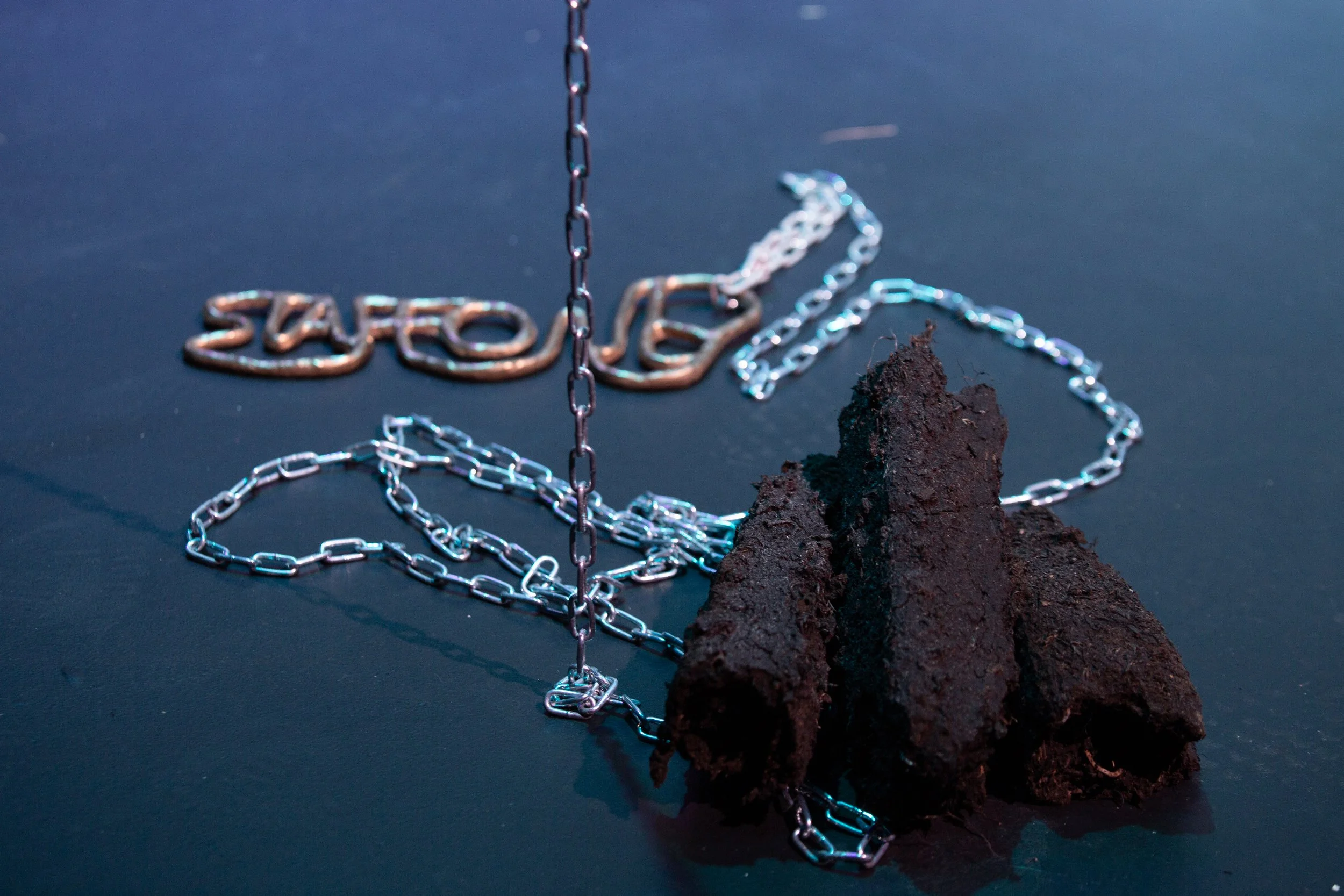
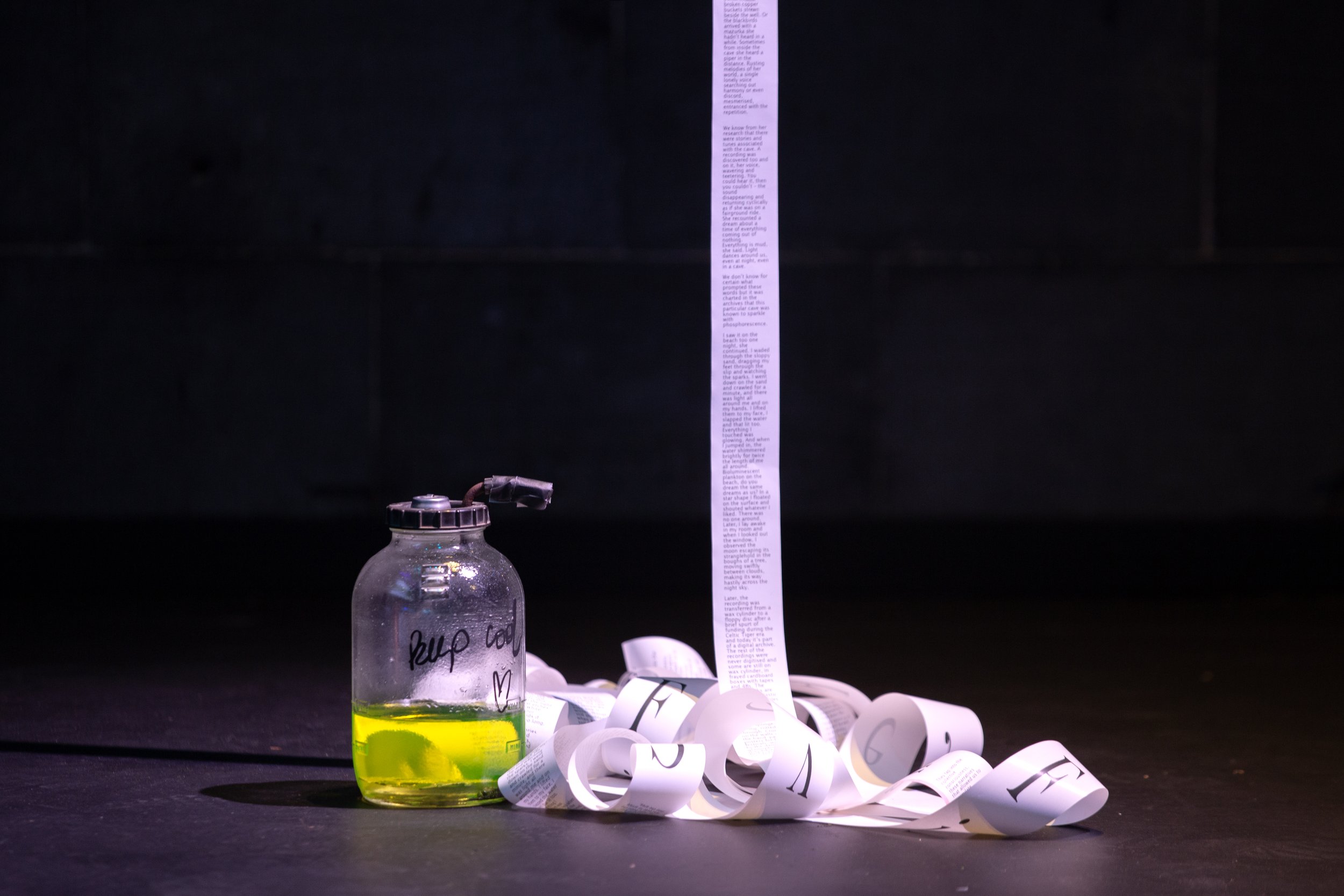
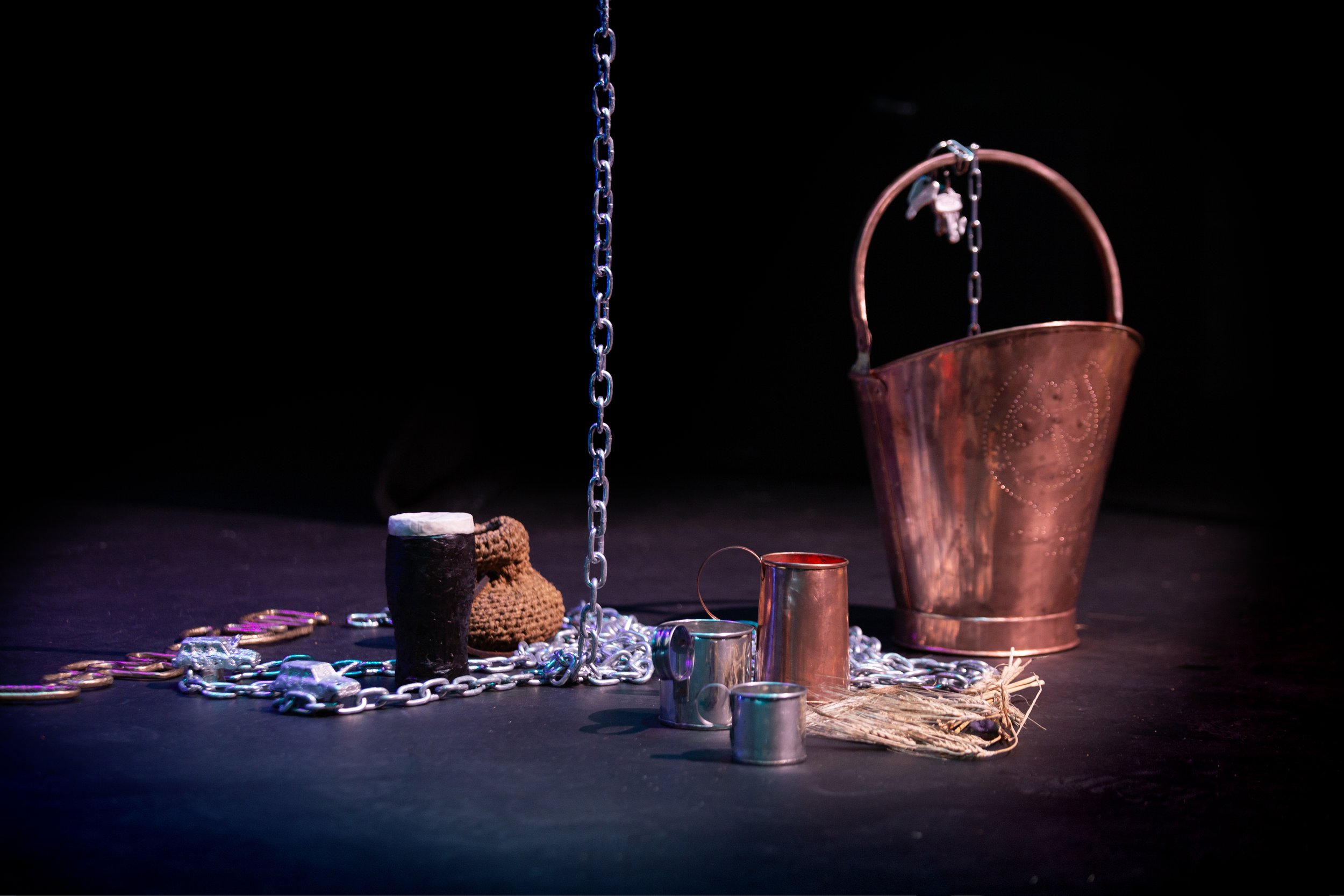
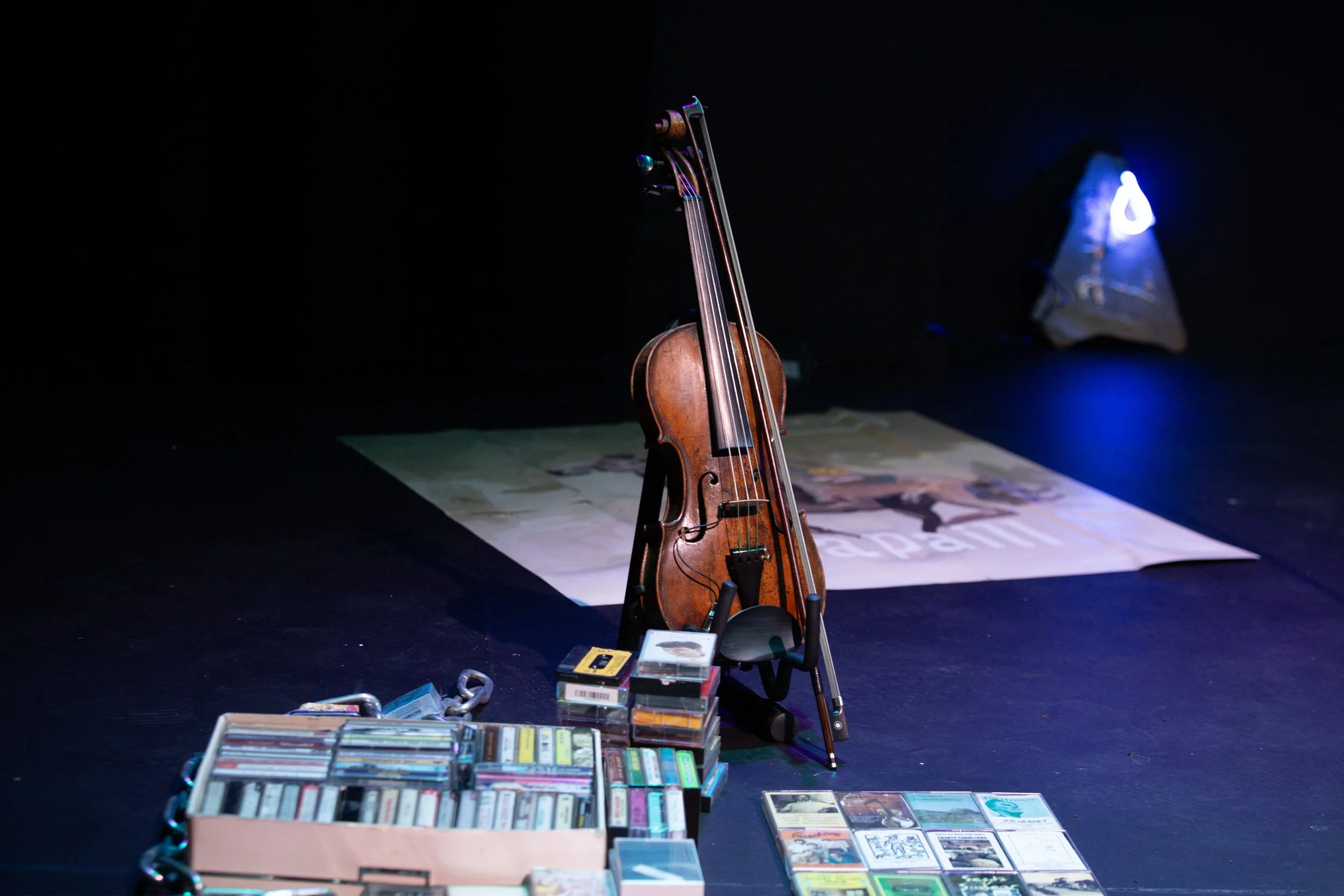
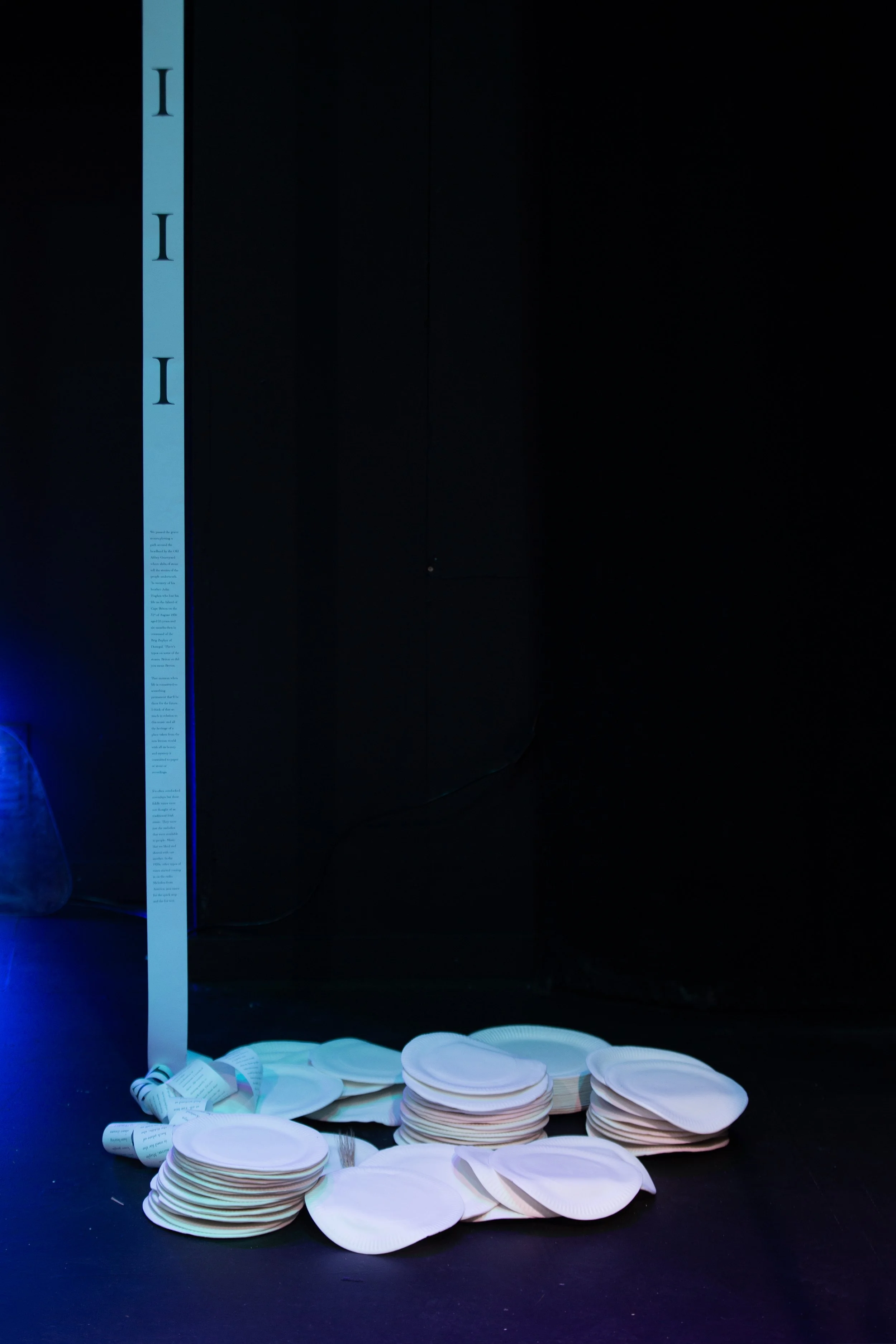
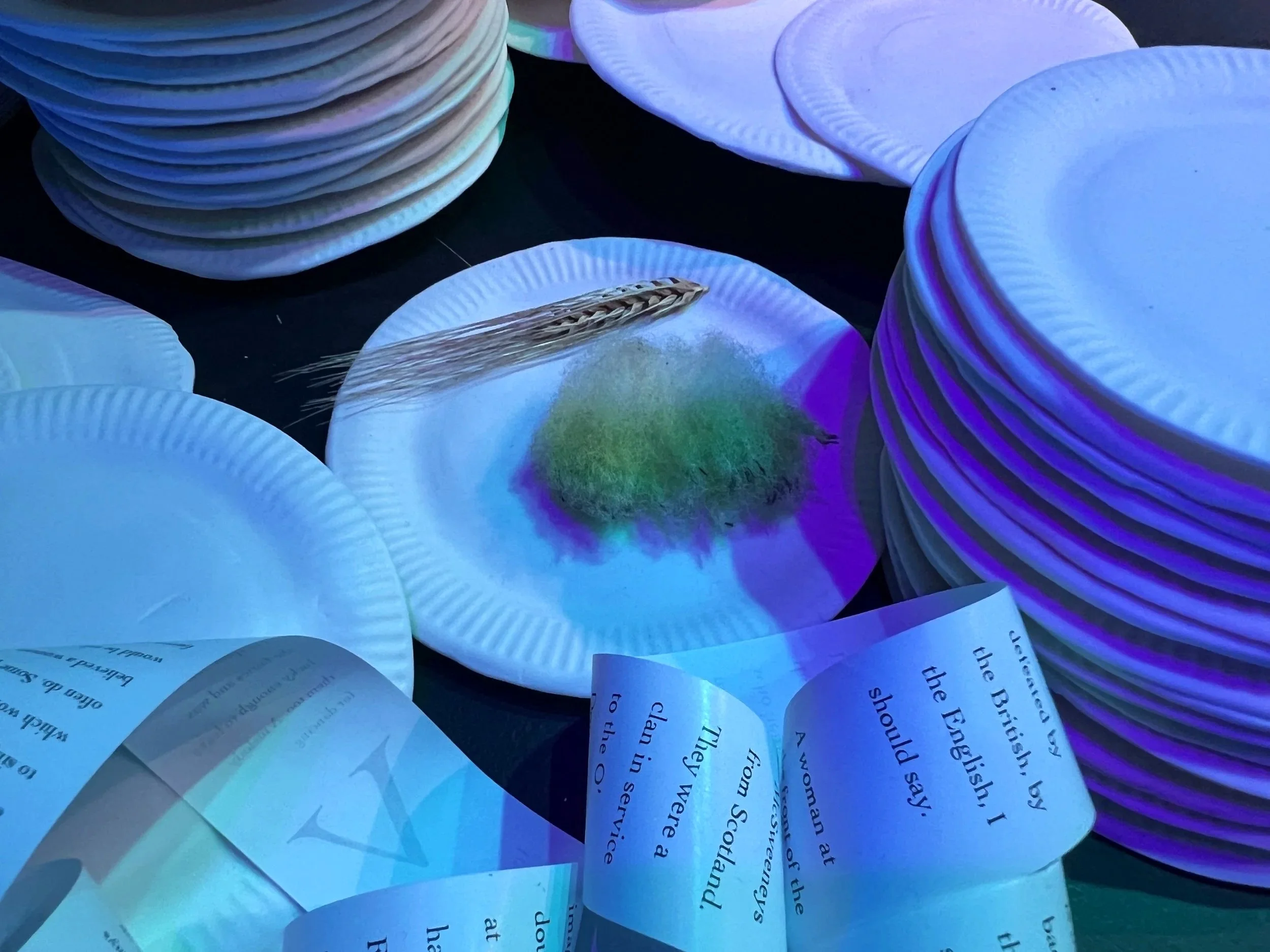
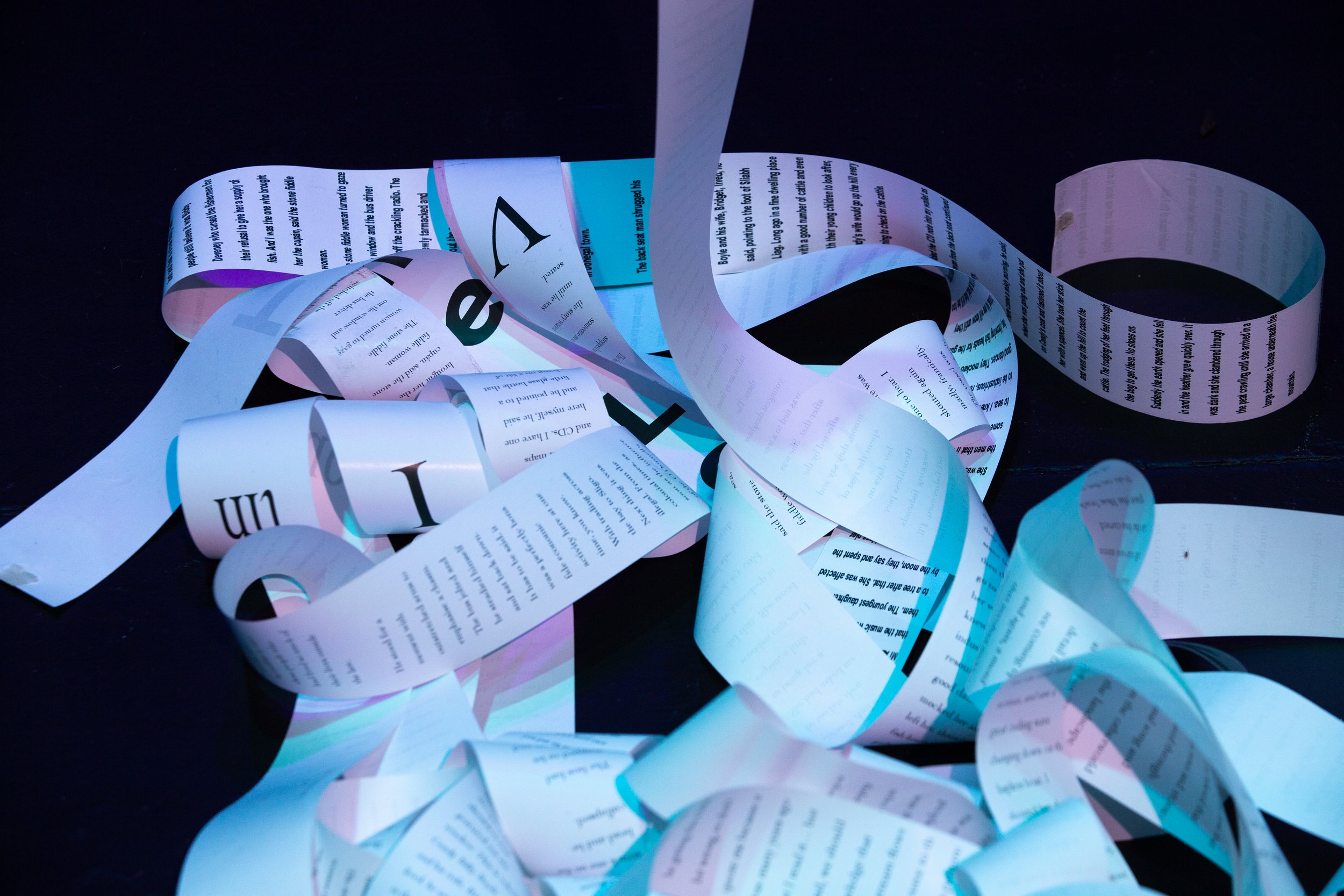
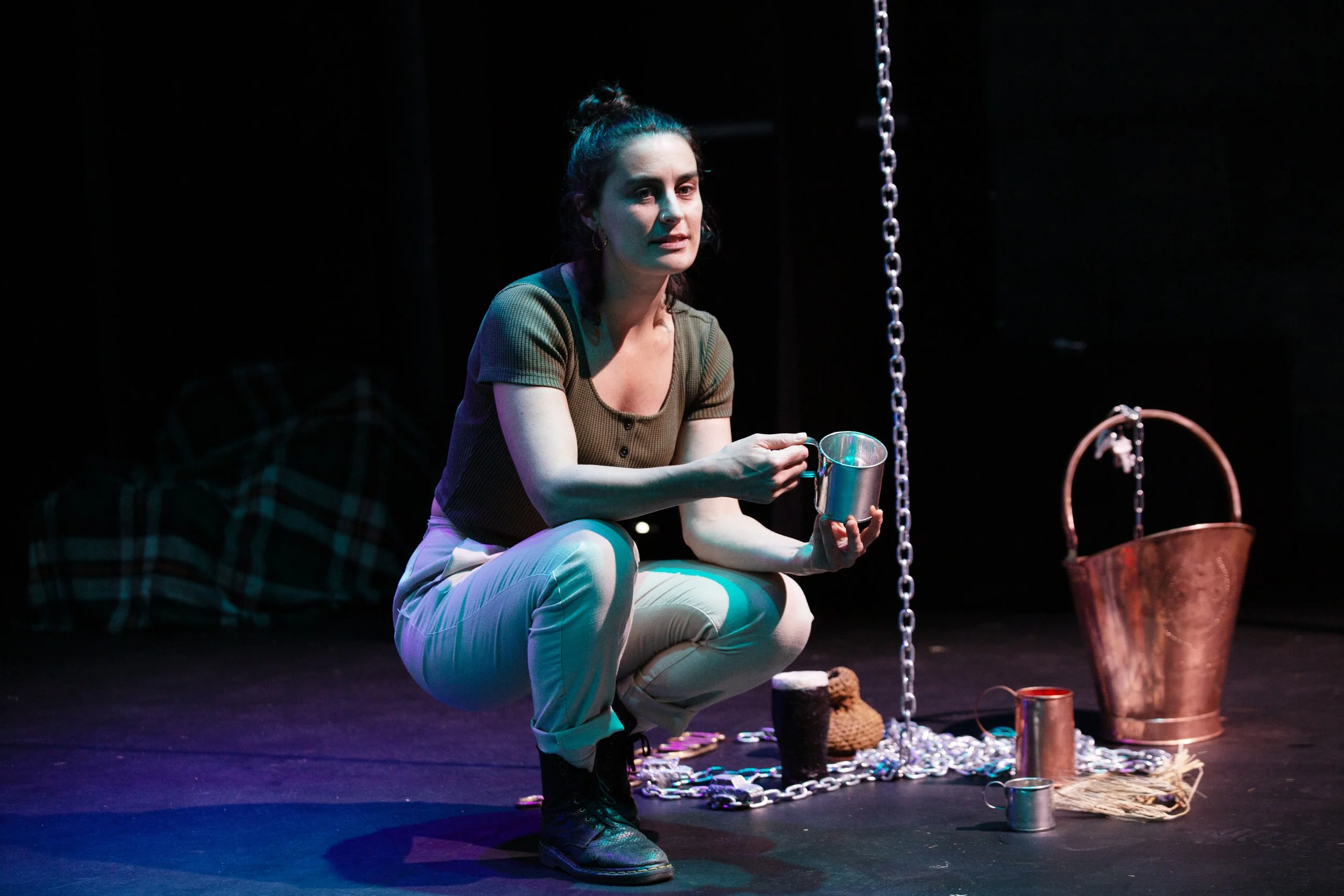
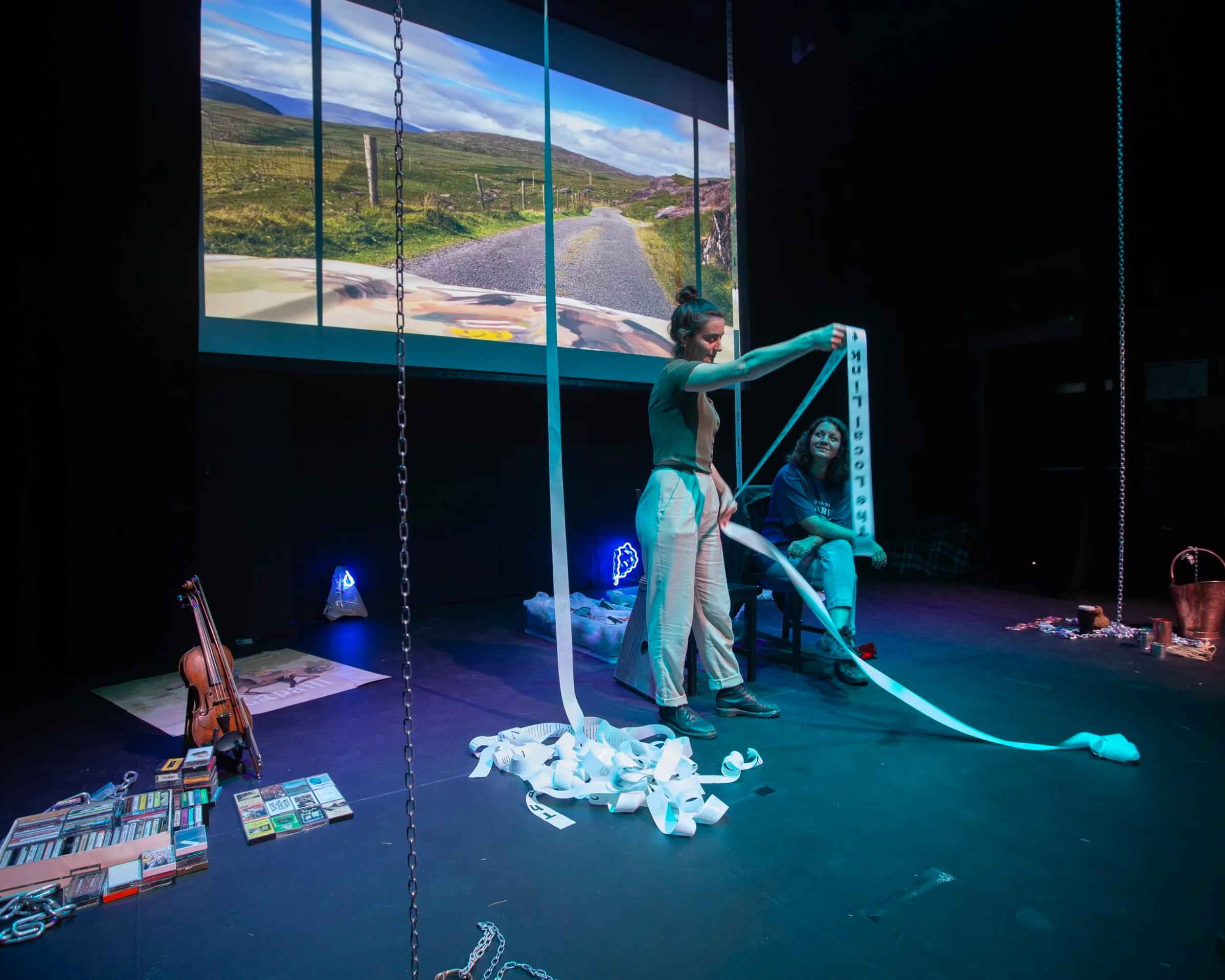
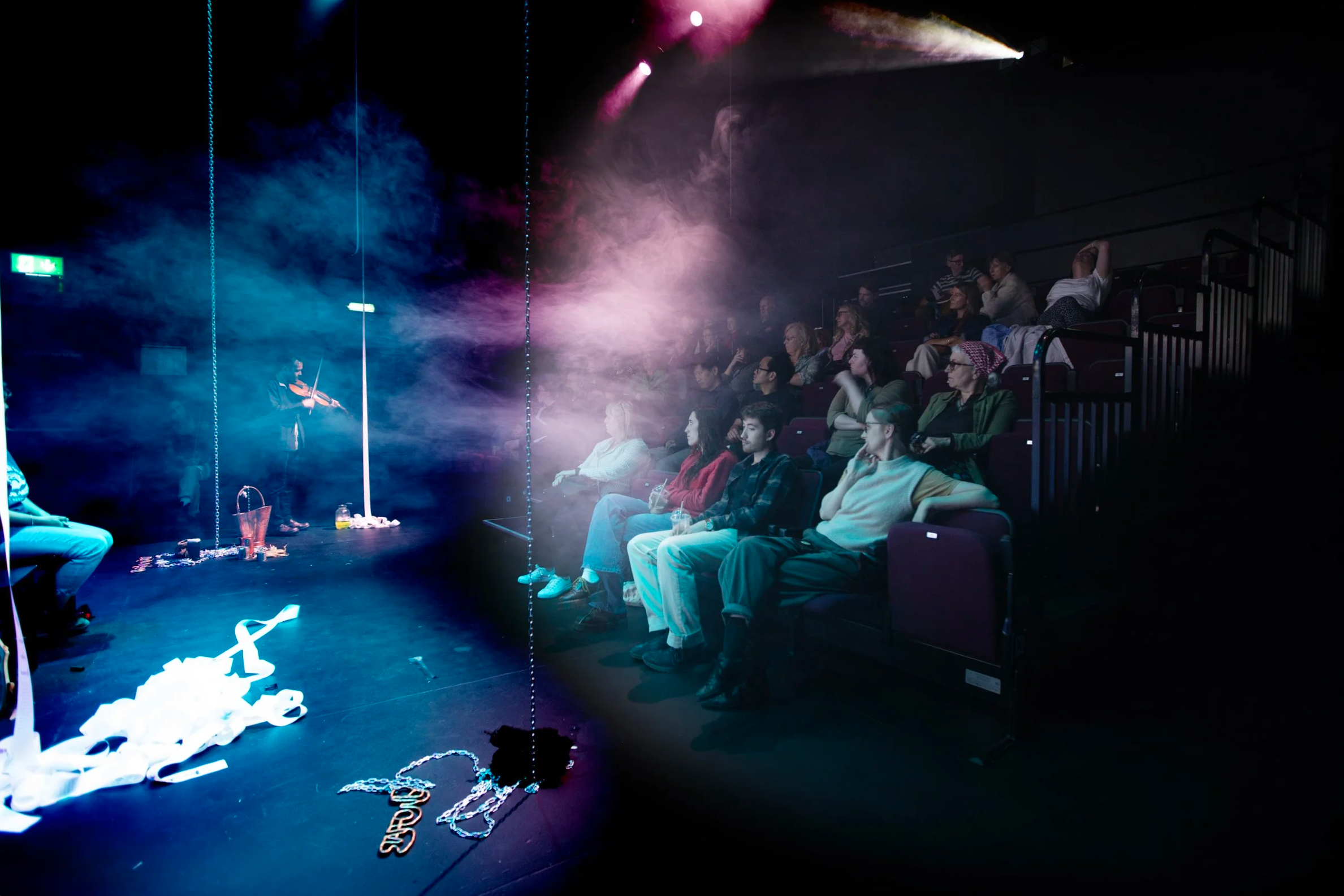
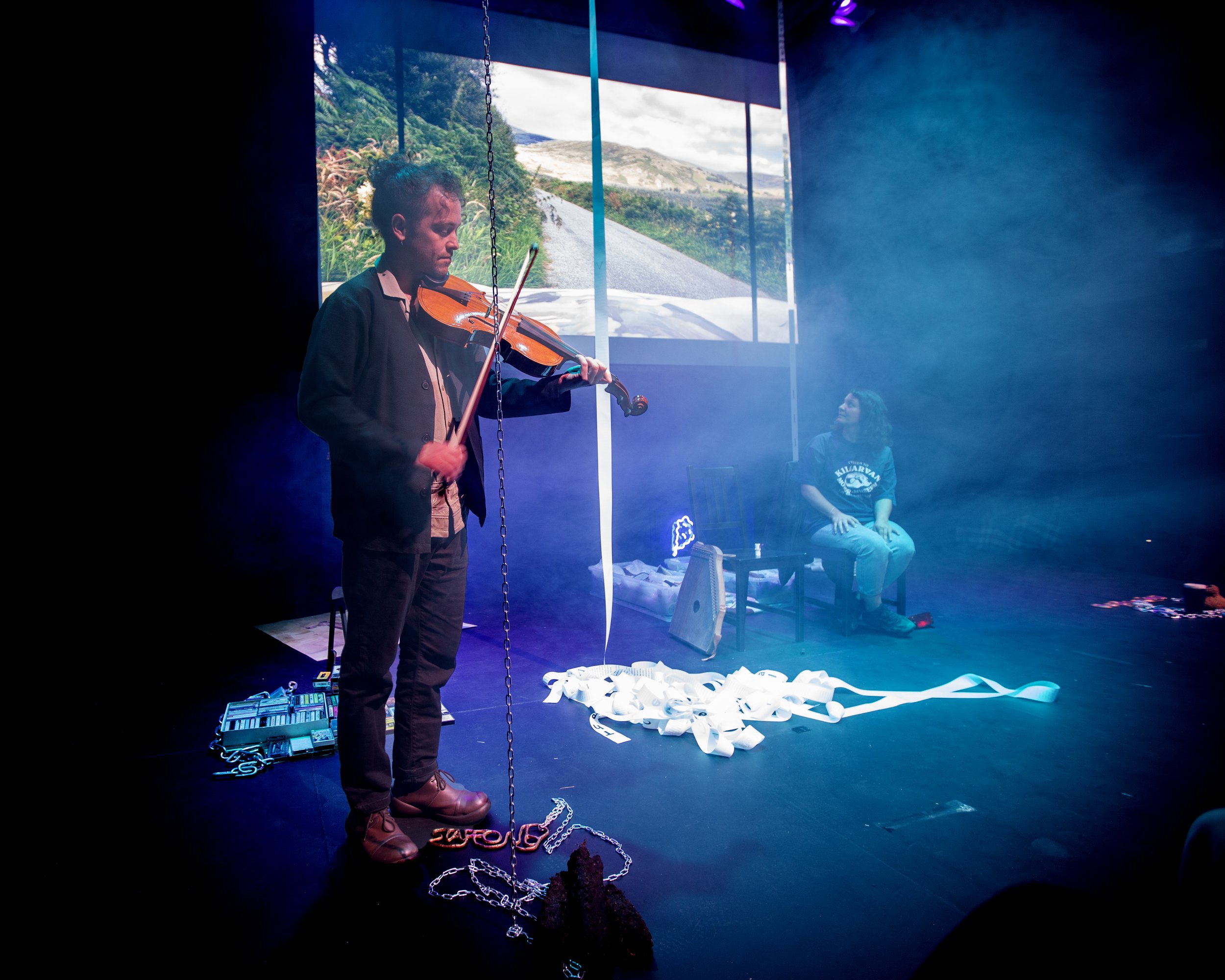
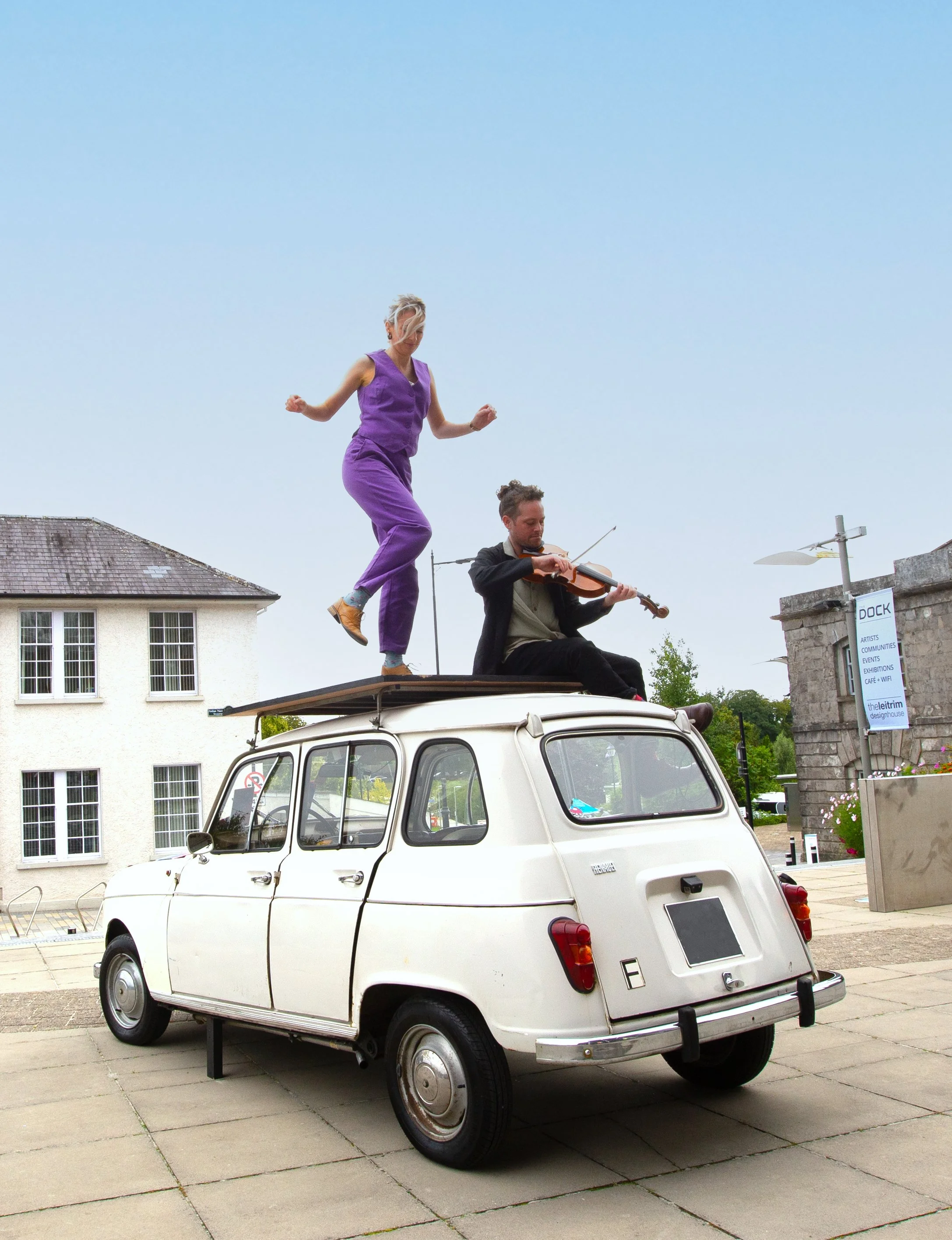
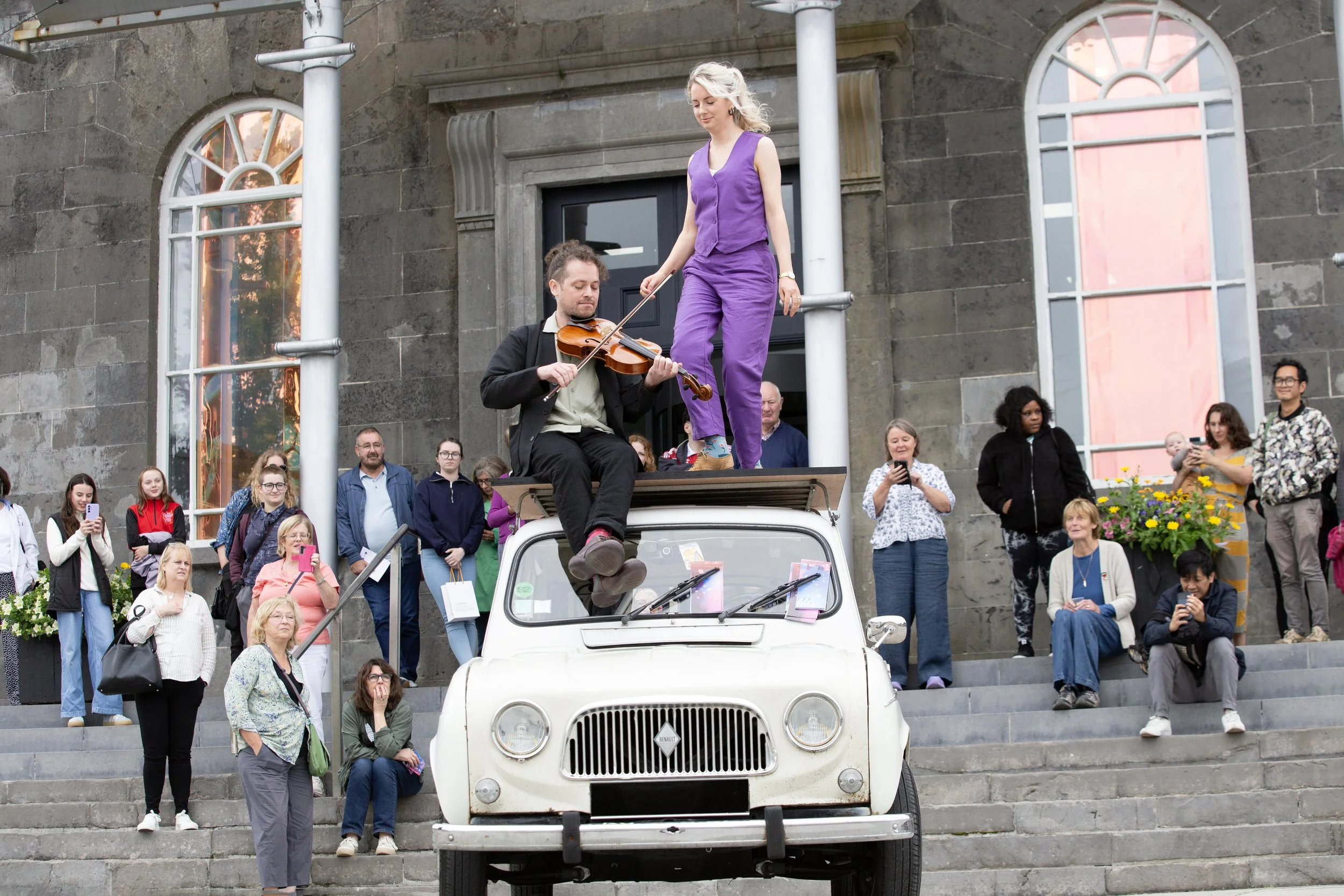
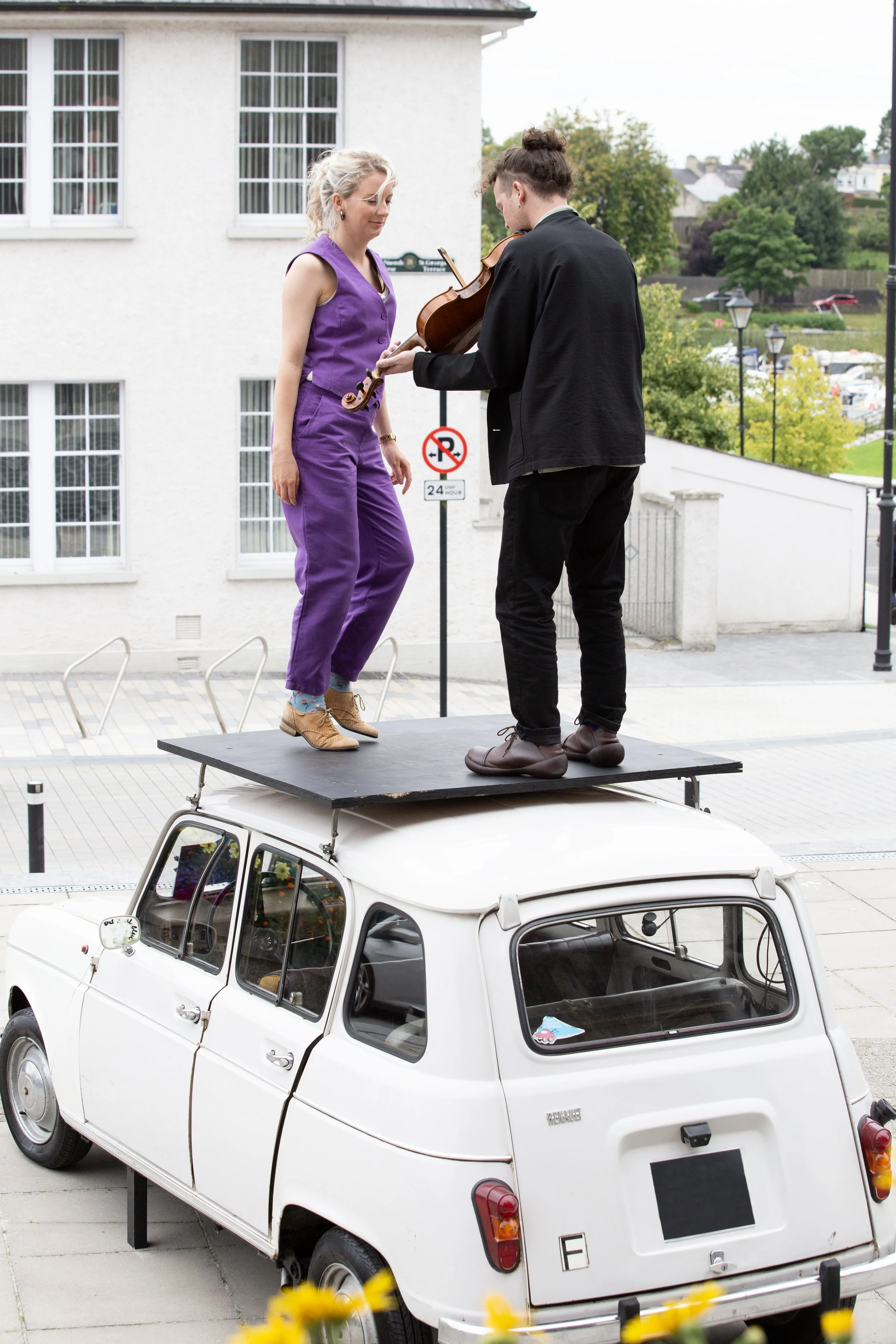
Photo credits: Brian Farrell
01.08.2025
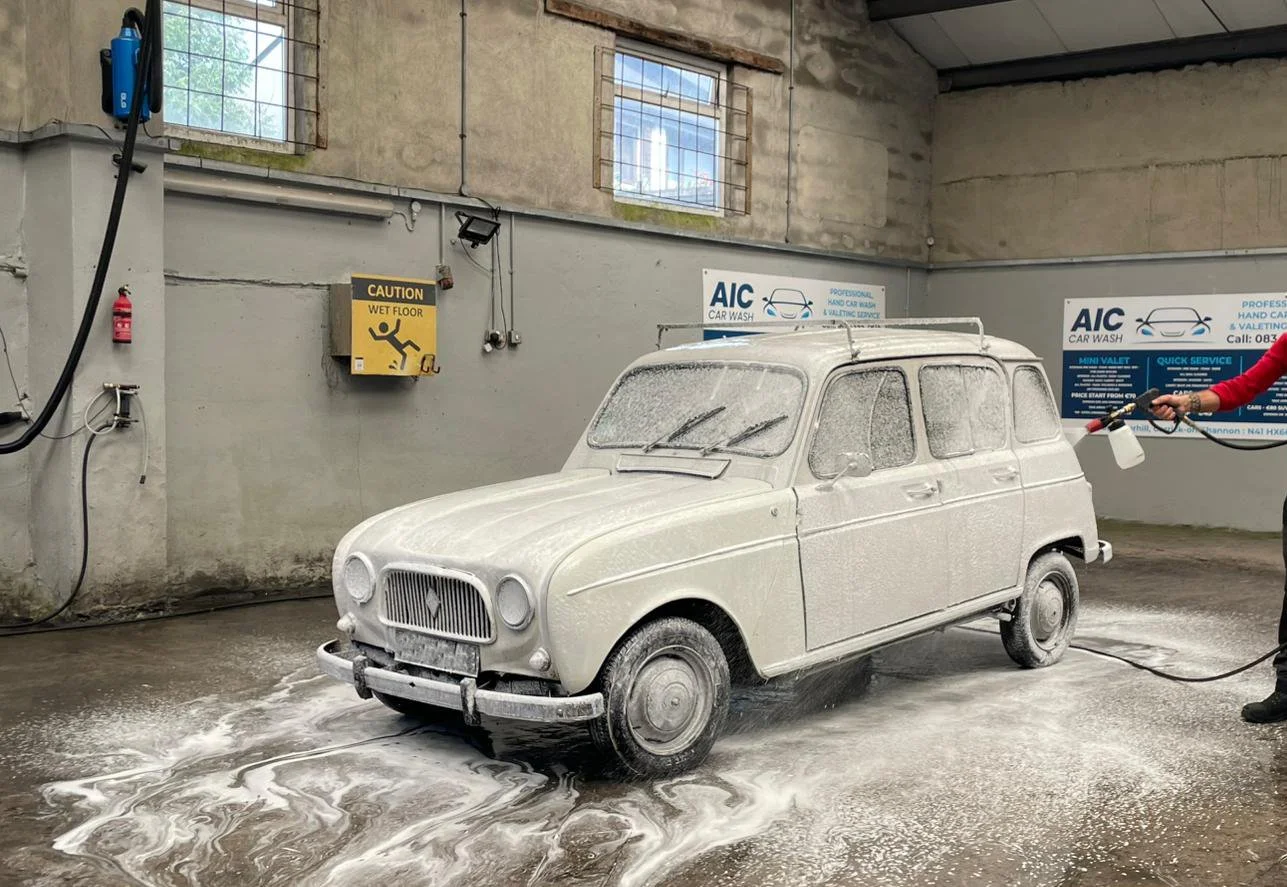
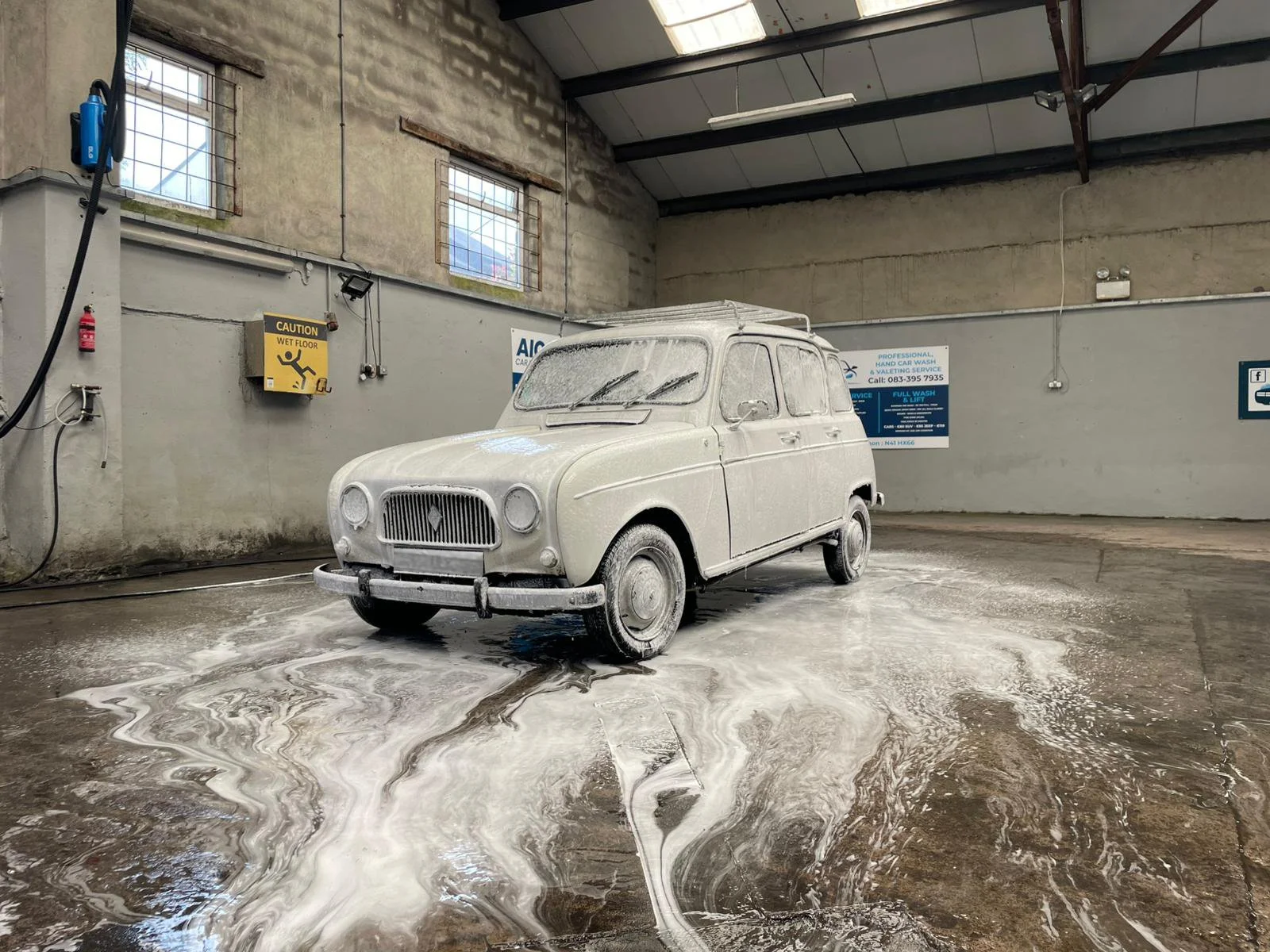
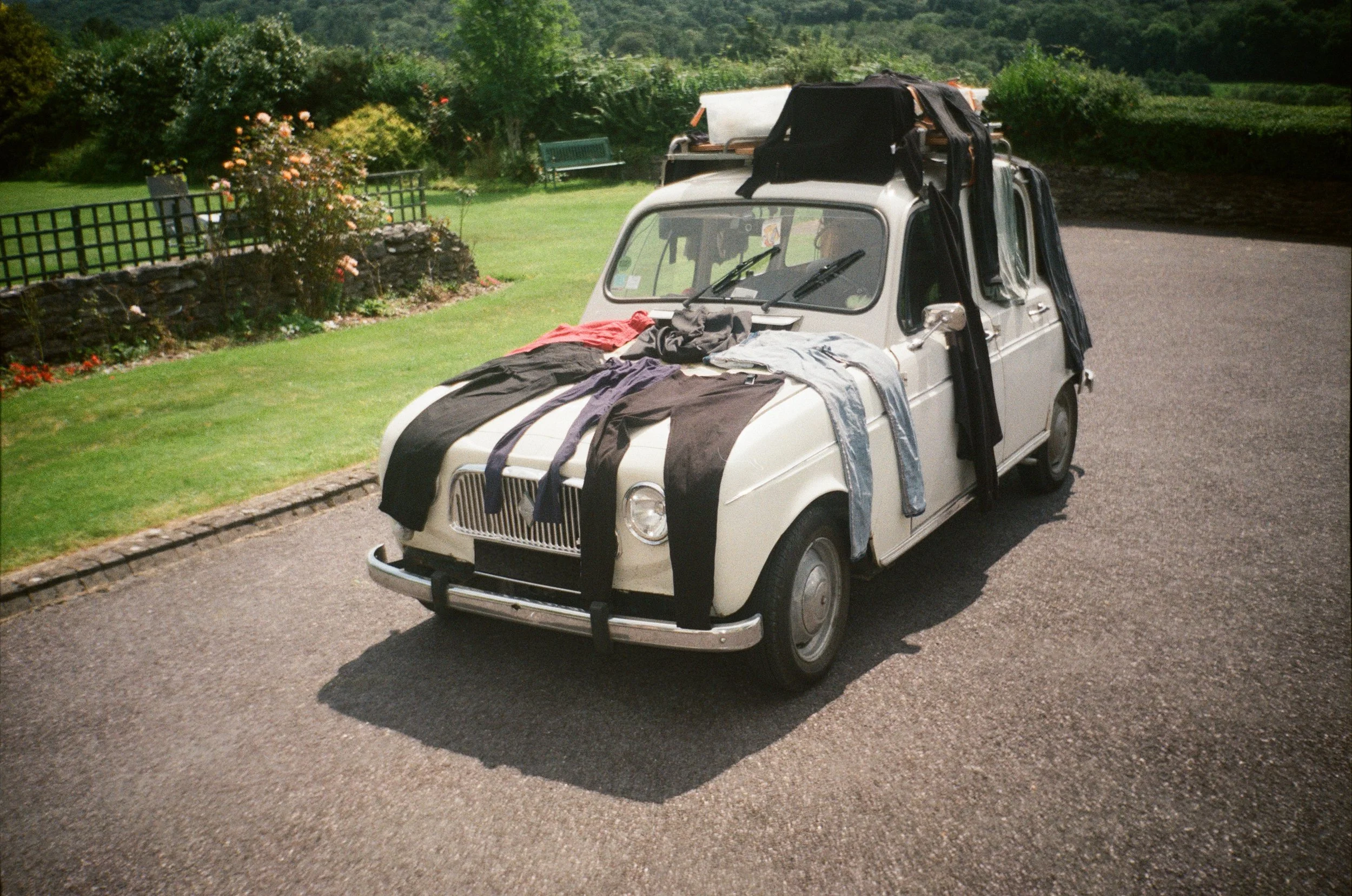
In Carrick-On-Shannon the Renault 4 went through a car wash and the seemingly mundane or quotidian act of emptying the car, unpacking and cleaning it, led to an interval of restoration, renewal and catharsis at the midpoint of the six week tour de force. Recontextualising the car as an artwork, we reflected on how the tour thus far had taken shape through evolving processes and the accumulation of objects.
To celebrate the midpoint, we wanted to spruce up the car as much as possible, washing it and fixing a platform to the roof rack, because we would be joined by two very special surprise guests. The car would become a moving stage for a collaborative performance taking place through installation, storytelling and music. This day last year we prepared the car in advance of the event titled, CKD* Completely Knocked Down. With Liliane’s art works, a short story of my own and objects from the tour, Edwina Guckian and Ultan O'Brien would be performing on top of the car as part of a theatrical event where tour de force partnered with The Dock, Leitrim’s flagship centre for the arts.
Edwina Guckian hails from outside the village of Drumsna in Co. Leitrim. Coming from a family steeped in the tradition of music and dance, her style is greatly influenced by the style of local music she grew up with across Leitrim and Roscommon. To see Edwina dance is to understand that great lightness and wit can be carried forward from a rich and dense repertoire of steps, rhythms and refrains.
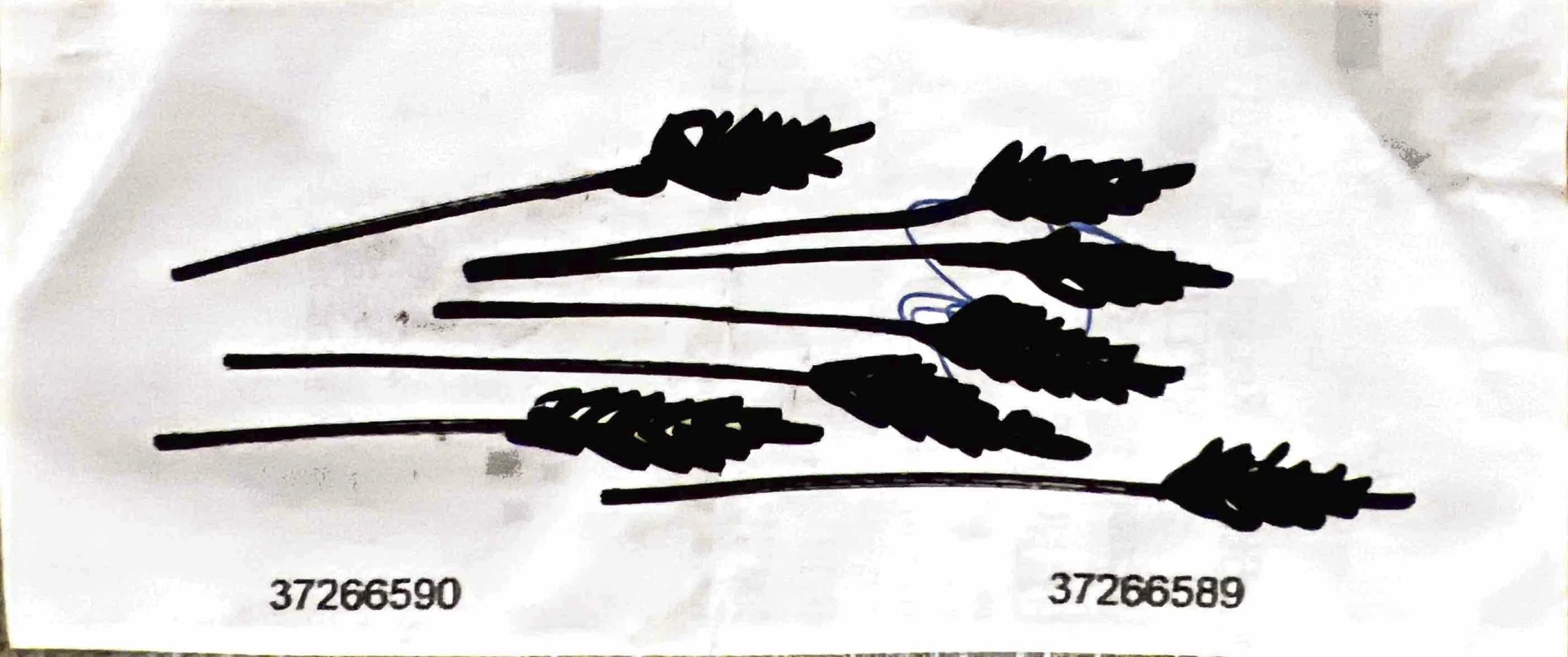
This day last year, we chatted with Edwina, who is also a cultural preservationist working with strawing traditions, harvest knots, strawboy hat and costume making. Materially, the preservation of straw techniques prompts questions of value, what we deem worthy or important and why. Straw, it’s historical use as a material used ubiquitously on small holdings and homes, might be considered fragile or ephemeral when in fact it is versatile and robust.
Edwina’s care and celebration for objects of intangible and material heritage prompted us to ask would she be interested in dancing on the car. We’d seen pictures of her dancing on a wooden barrel in the rapids of a river, so we were hopeful. She got back to us; yes, she’d happily dance on the old Renault 4. When we met in person, Edwina told us a story about dances and tunes performed on horse-drawn jaunting cars during market or fair days and speculated that dancing on a car would be a natural progression of this town square tradition. Such events have faded with the disappearance of traditional horse-drawn transport and local market fairs, from daily community life. Edwina asked Ultan on board for musical accompaniment….
Ultan O'Brien is a fiddle/viola player and composer from Miltown Malbay. Listening to Ultan’s playing, of both traditional tunes and melodies he’s composed himself, transports you; takes you somewhere, across a vast expanse of time and space. His otherworldy album, Dancing the Line opens with an evocatively titled track, Iron Mountain Foothills. One of his own stunning compositions, it is perhaps a descriptive piece of the landscape of Sliabh an Iarainn, Iron Mountain, east of Lough Allen and northeast of Drumshanbo, Co. Leitrim. Deriving its name from iron ore deposits found within its rock strata, the mountain was mined for ore that was used for the creation of the Ha'penny Bridge, built in May 1816 over the River Liffey in Dublin.
CKD* Completely Knocked Down, was a meditation on obsolescence and endurance; an embodied response and expression of the dovetailing between old and new worlds, between industry and tradition. This day last year, we had the car spruced up by the specialists at AIC CAR WASH for our collaborative event that would take place the following day at The Dock. Photos of the event will appear here tomorrow. In the meantime you can watch footage of the cathartic car moment below…
31.07.2025
Before photogrammetry, laser scanning, and other forms of digital preservation became widespread, archaeological sites would employ artists, often students from local art colleges to join digs and draw artefacts as they were excavated. Artists, who worked on these sites described the human attention to detail in terms of priority and focus. The human eye noticing details on pottery fragments, bones, and stone tools for example, and the immediacy of hand rendering surface textures, break lines, and cross-sections to give a more rounded emphasis. These are perspectives that a photograph can miss. It’s interesting to think about; the endeavour of artists, excavating artefacts that were crafted, created, forged, assembled, and then buried. In a moment, creative expressions spanning hundreds or thousands of years are drawn together on archeological sites; materially, contextually, philosophically to align people over a vast expanse of time.
This time last year in Leitrim, one by one, we removed objects from the Renault 4. After being on the road for 22 days, we had amassed a collection - we unpacked items from the car examining them to decipher their use. Are they functional, representational; a tool, a prop, a portal, a touchstone. Are they a work of art.
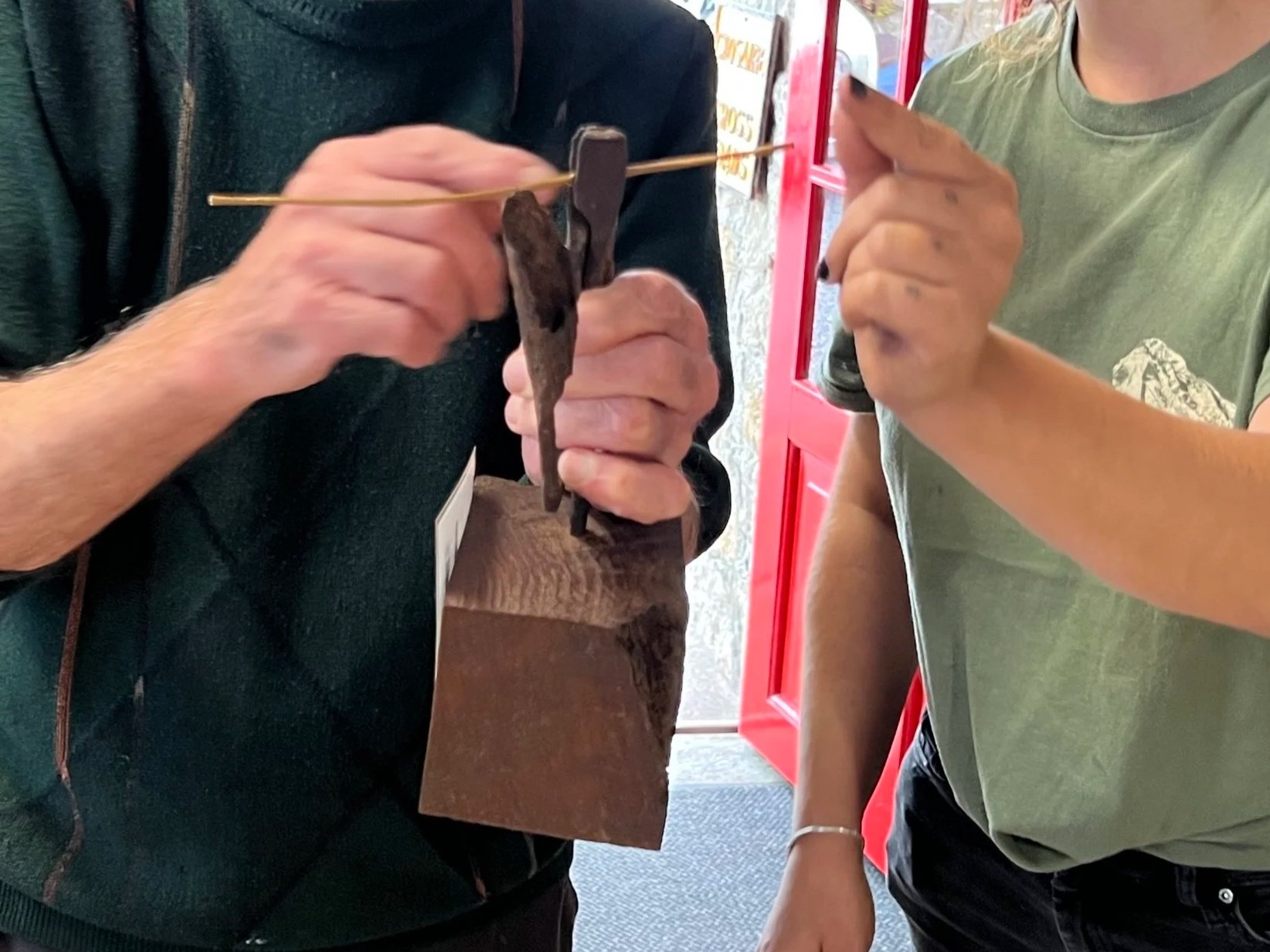
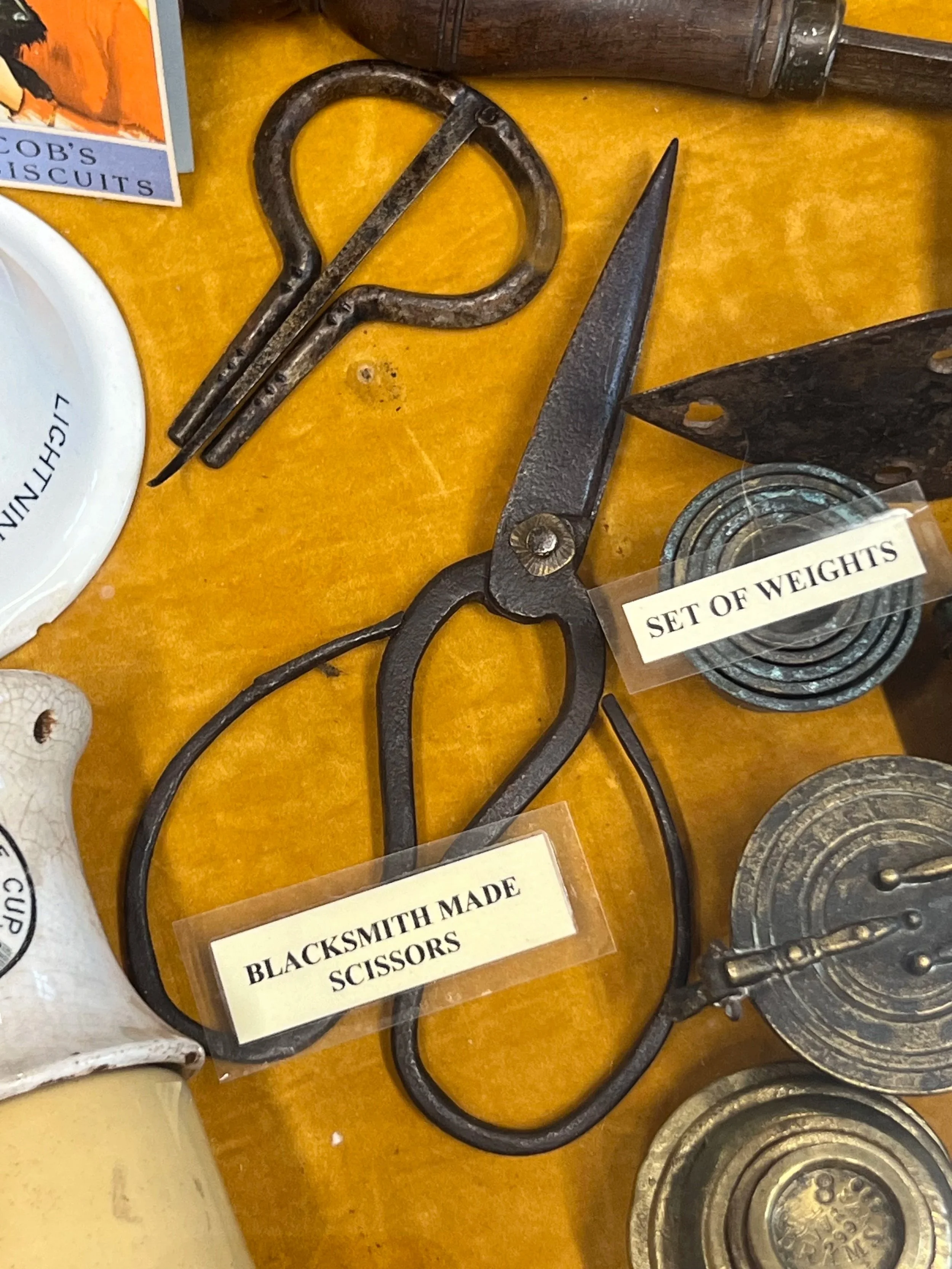
Perhaps the object has a history of both function, and ritualisation. Like the stories we read about tools that are talismans. Accounts from the Schools Copy Book Collection, an archive of folklore compiled by schoolchildren in Ireland in the 1930s, often connect objects with narratives, fictions and uses to represent a broader history, local or global. One such story is The Blacksmiths Anvil. In Ireland, forges historically served as local hubs, providing essential infrastructure for rural communities: they were the social heartbeat circulating news and stories, whilst providing a necessary service; ensuring practical repairs and maintenance. According to an 1841 census, there were about 25,000 blacksmiths active across Ireland before the famine. Dotted all along the old roadways of Ireland.
Blacksmiths, were believed to hold powers of clairvoyance as well as the ability to bring good or bad fortune upon a person. Stories abound in the Schools Copybook Collection, a national archive of folklore, a Smith's Cure for example, where half a crown from a blacksmith can cure an ailing horse. Turning the Anvil is another such story. Placing the anvil at the centre of communal storytelling, where it is turned and struck. In a circle at a forge, people move through discussions, perhaps toward the discovery of a wrongdoing or the decree of a curse. A group of people centre an object in order to express a shared grievance. They strike the anvil creating a narrative beat. Rhythmically, steadily each person has their say and from this communal percussion, a solution emerges.
When we are documenting artefacts digitally, with vector programs etc, for digital archiving towards the representation of their historic function, we might miss the depth of associations that the object has; what it could represent for rural workers, impoverished tenants, transient trades people of the past, and so on.
Maybe nowadays, our holding objects of material or intangible heritage in order to expand on their greater meaning gives space for speculative histories to come to the fore, and this is the point where fiction and history blurs and merges.
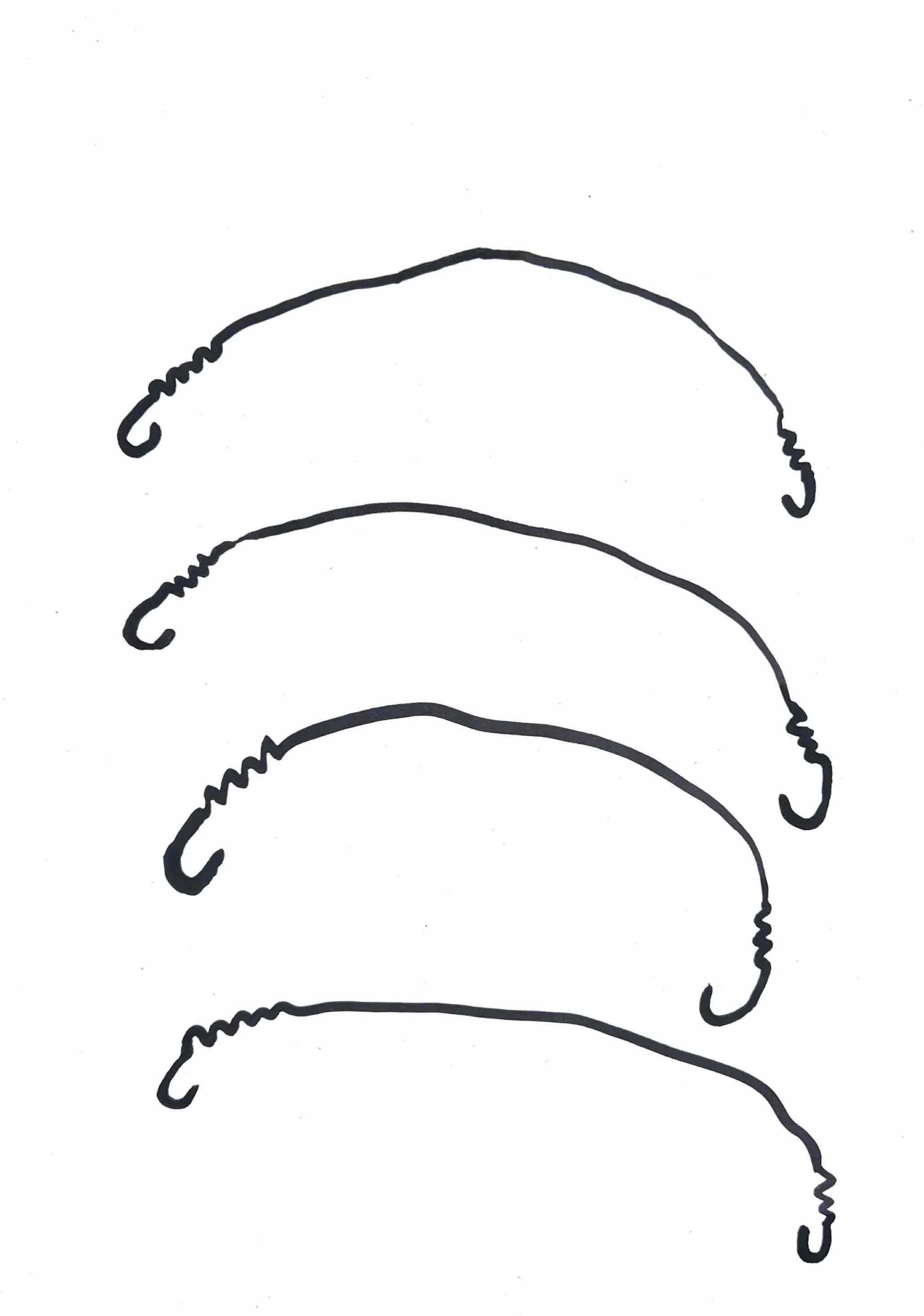
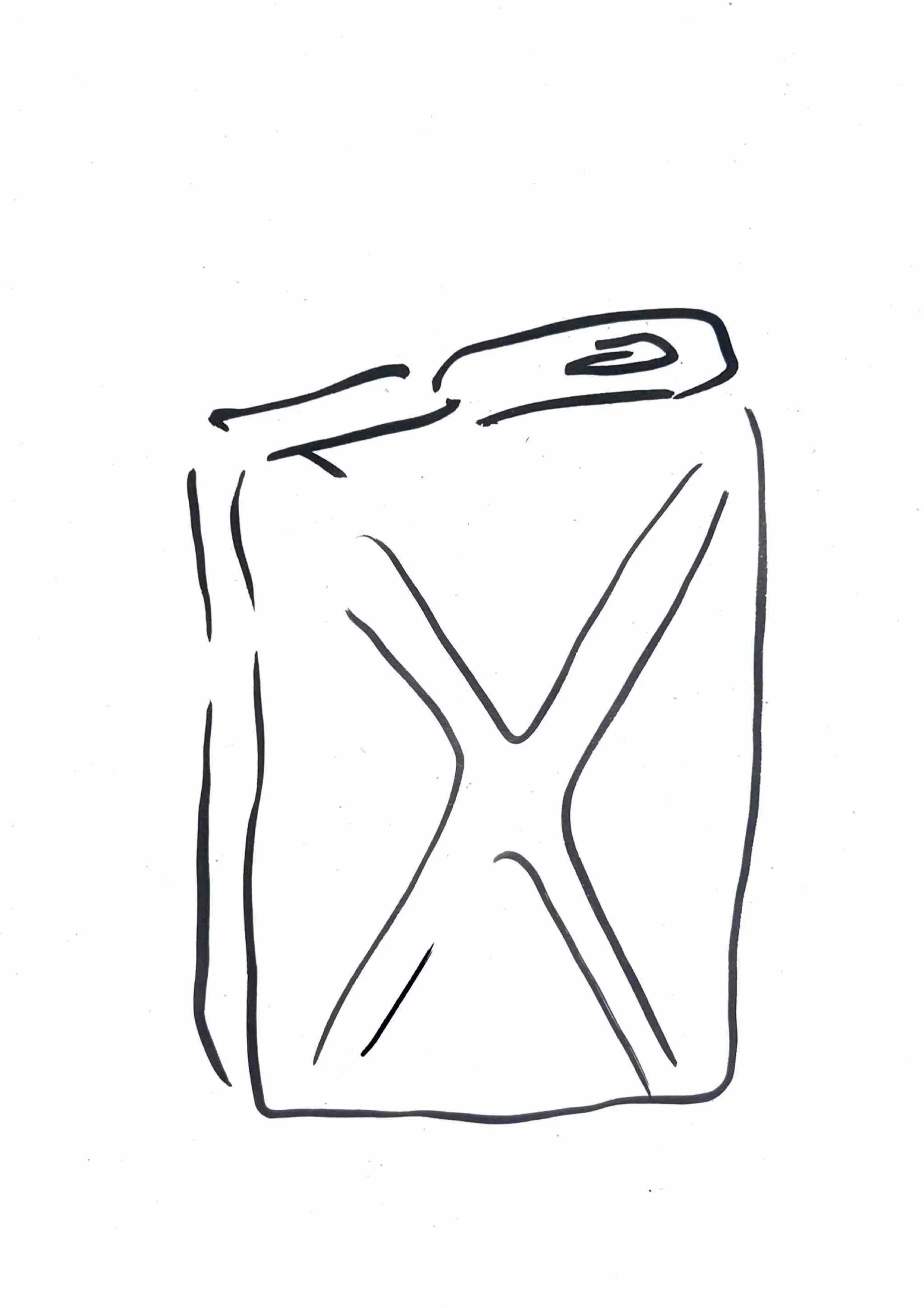
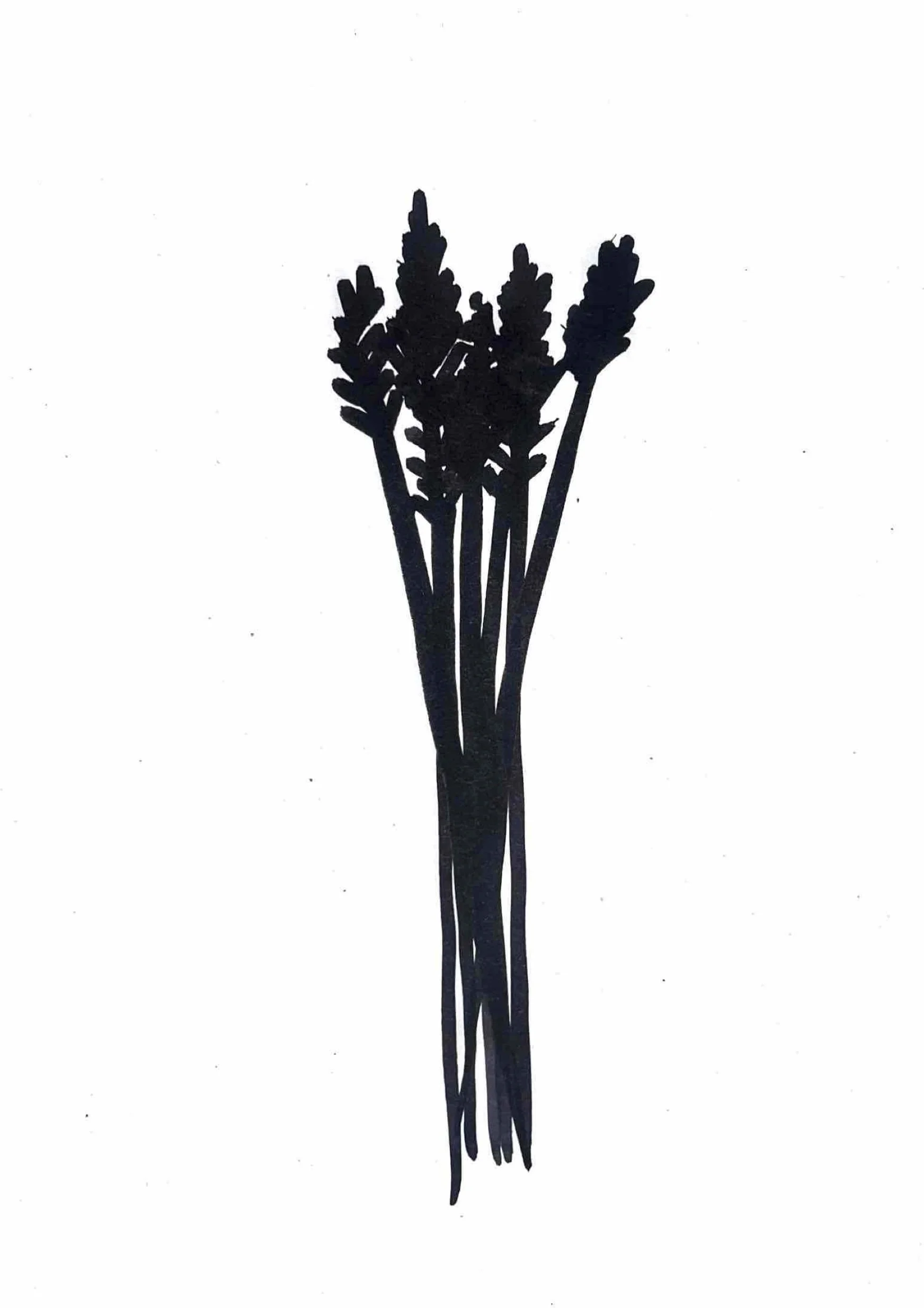
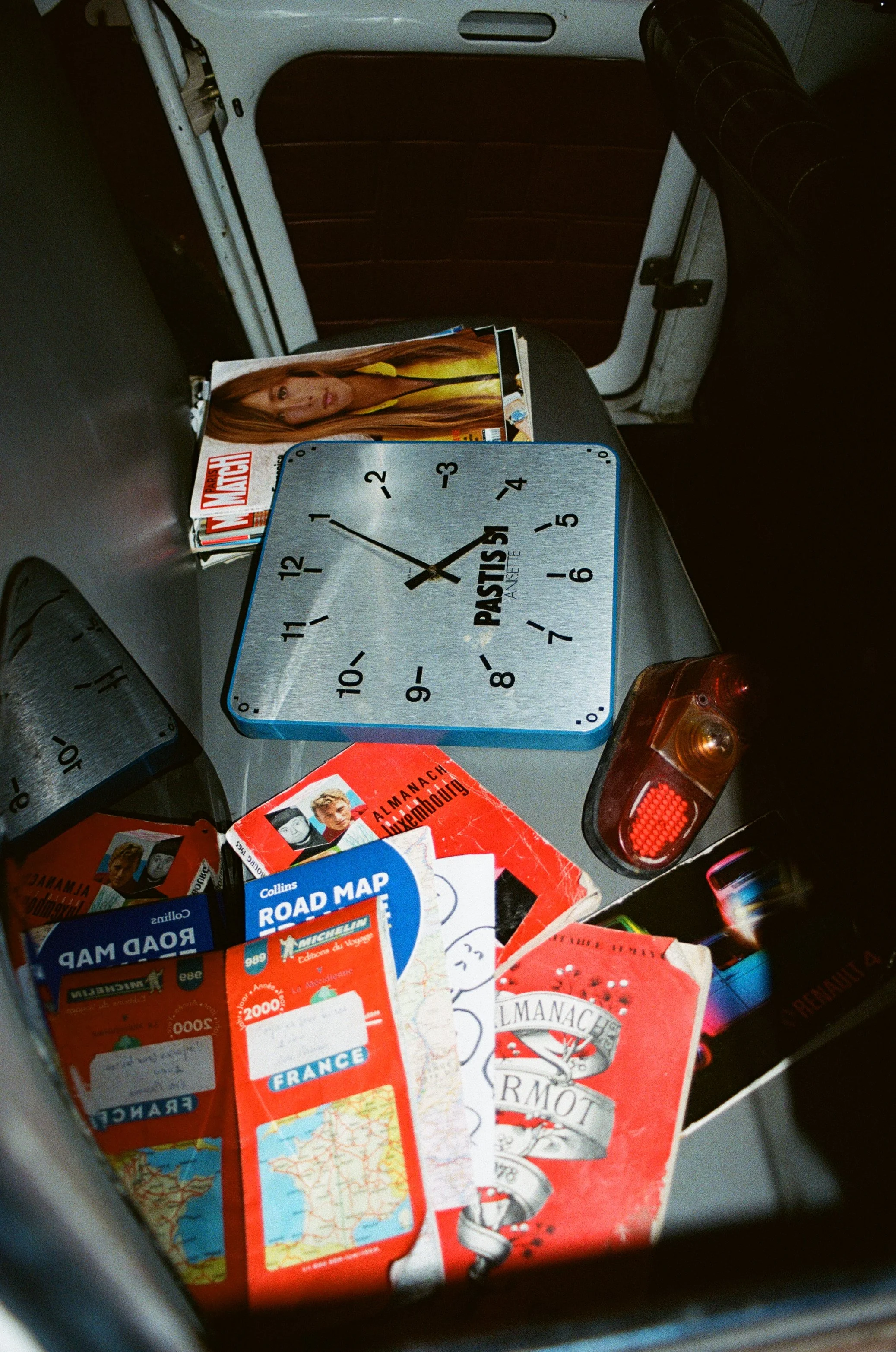
30.07.2025
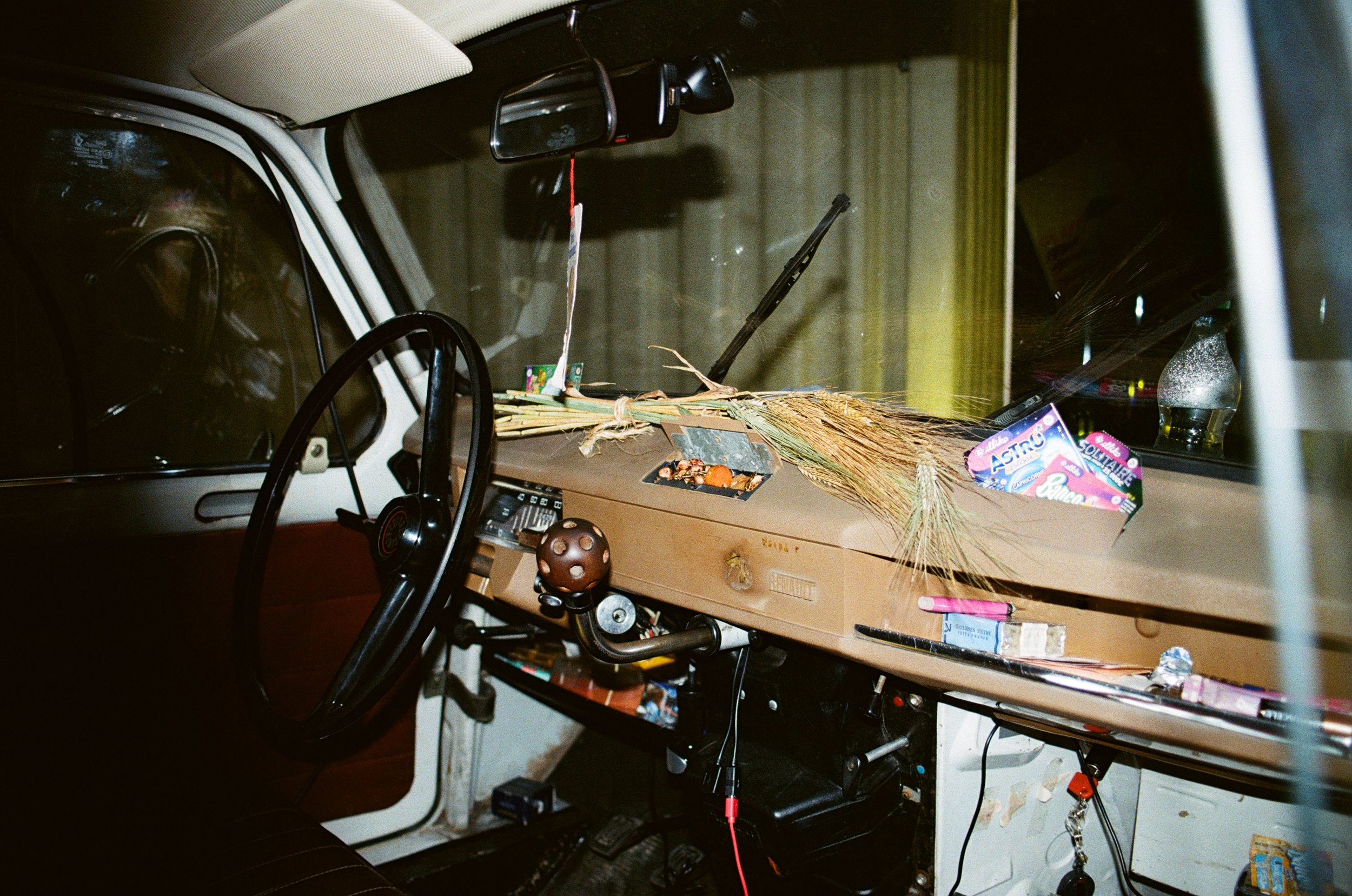
List of things we took out of the car ahead of CKD* performance at The Dock, Co. Leitrim pitstop:
Spare billboard from JC Decaux
Gaffa tape x 2
Spare light bulbs
Cables
Cassette tapes x 40
Receipts rolls printed with Ingrid’s stories
Wooden box with books and miscellaneous
High vis x 4
Wooden sticks x 4
Wrench
Sugar sachet ‘DADDY’ x 2
Little metallic measuring cup
Gauloises cigarettes
Pencils
Markers
Woollen blanket x 2
Petrol jerrycan
Chains x 3
Pallet wrap black
James Collins’ tin poncher x 2
James Collins’ copper poncher
James Collins’ copper coal scuttle
Dried wheat bouquet
Paper plates
Porcelain plates
Car jack
Metallic hollow tube
Plastic boxes
Turf found on the road, Co. Roscommon x 2
Ingrid’s fiddle
Bronze mars bars
Bronze signs (mind your head, staff only, exit, no entry)
Paris Match magazines
Spare Renault 4 back window
Receipts printer
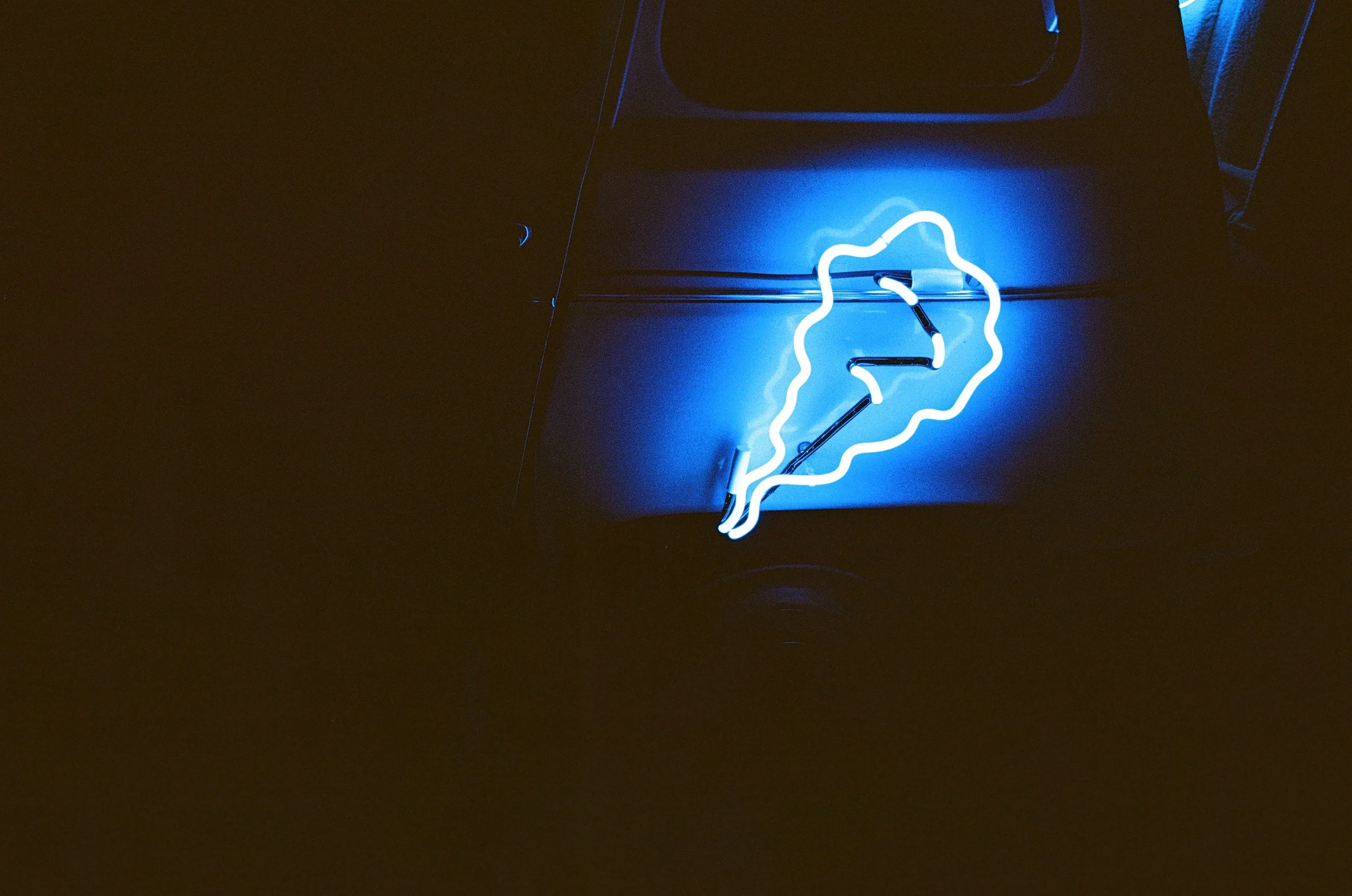
Fatigue, neon
Precious Oil, neon
Paddy Critchley’s Capaill, magnetic roll
Orla Barry’s memento, green sheep fur
Publication by Laura Fitzgerald, Greetings from the Country Side (Strong Emotions)
Book by Orla Barry, Shaved Rapunzel, Scheherazade and the Shearling Ram from Arcady
Line marking spray can x 2
Bungee cords x 4
Sandstone cast with alloy metal
Toolbox (🧰)+ tools (⚒️🔧🔩🔧🪛🗜️⚙️t🔨✂️🪢)
Ingrid’s Zither
Plastic shopping bags
Cross rim wrench
Spare red light
Battery charger
Emergency triangle
Caps
Mechanics workwear x 3
Heart keyring
Shoes
Microfibres cloth
Rags
Sponge
Chewing gums
Full pint of Guinness wax sculpture
Woven bag with leather handle
Spare rear mirror
Ovomaltine container
Cast keyring
Half filled coolant jar (keep cool)
Bubble wrap
Axe head
Bronze kit kat
Agricultural wooden tools
Books
Beer mats
Lavender perfume bottle
Modelling wax
Car air freshener
Magnets
Car parts, ignition
tour de force programme leaflets
Lighters
Foam bits
Fabric
Copper wires
Cast corn
Earthenware cans painted with nail polish
Ratchet straps x 2
Used scratch cards
2L82BL8 reg plates
Gear box oil
Motor oil
Almanach
Map of France
Pastis clock (broken)

29.07.2025
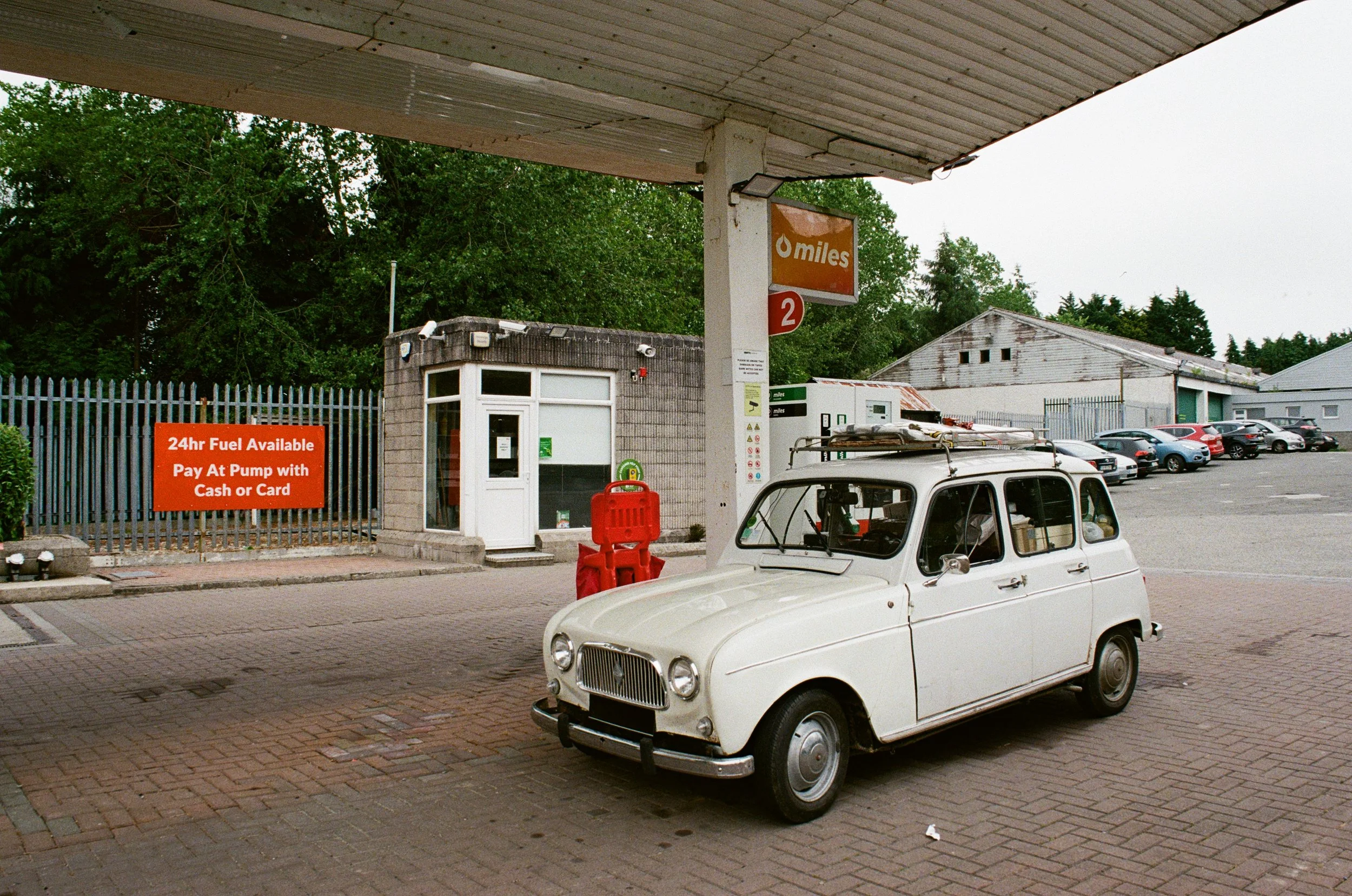
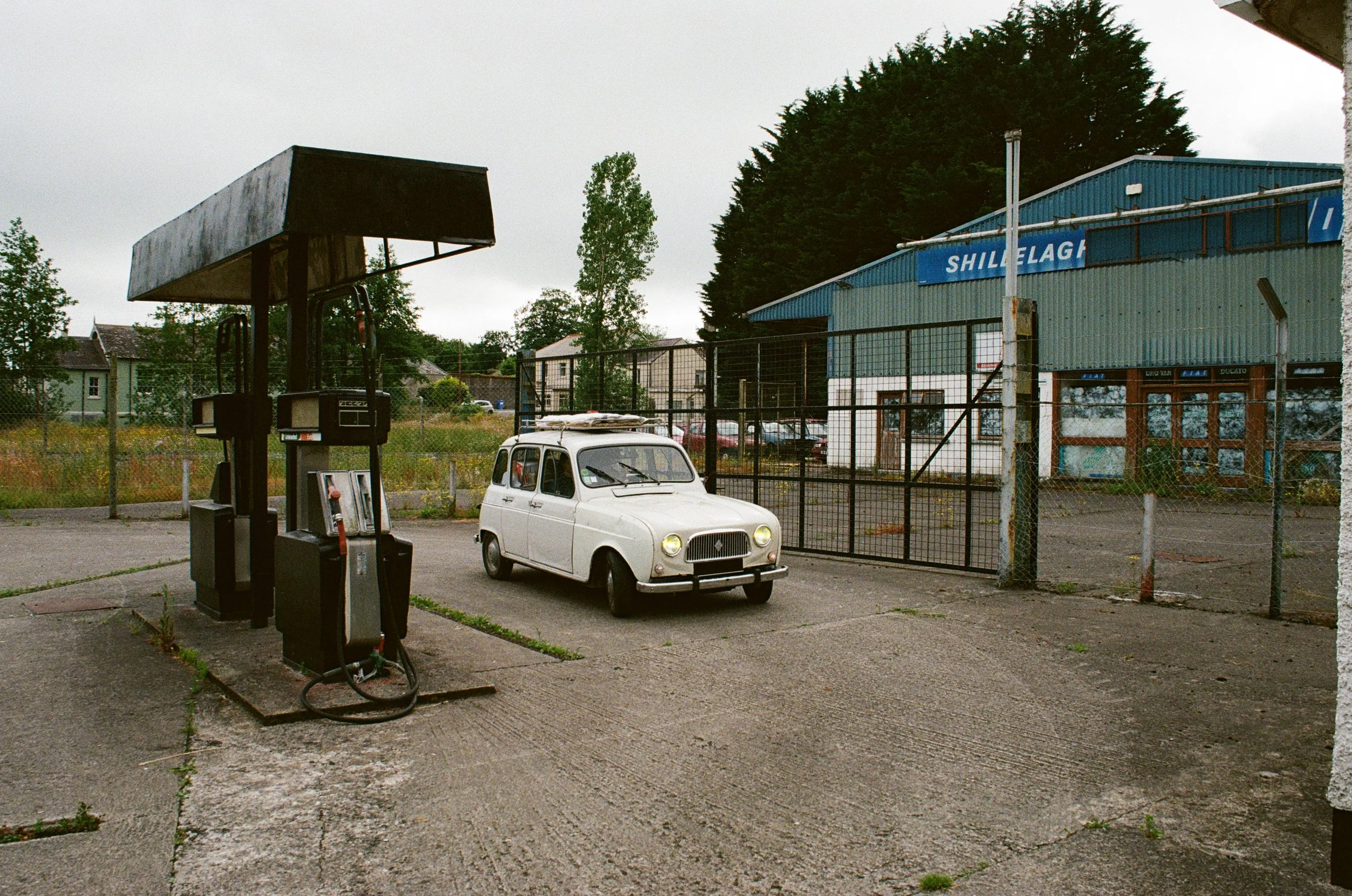
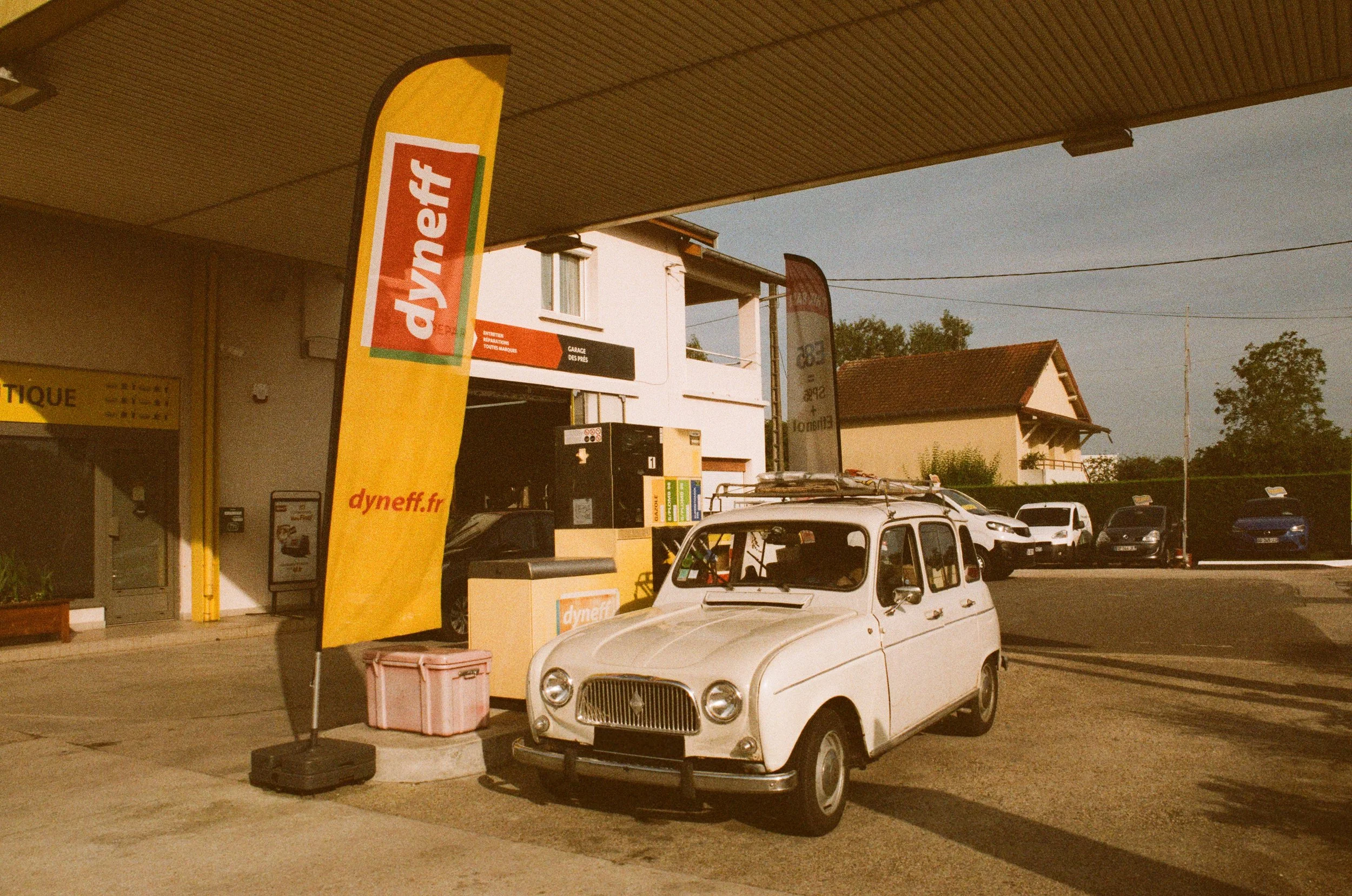
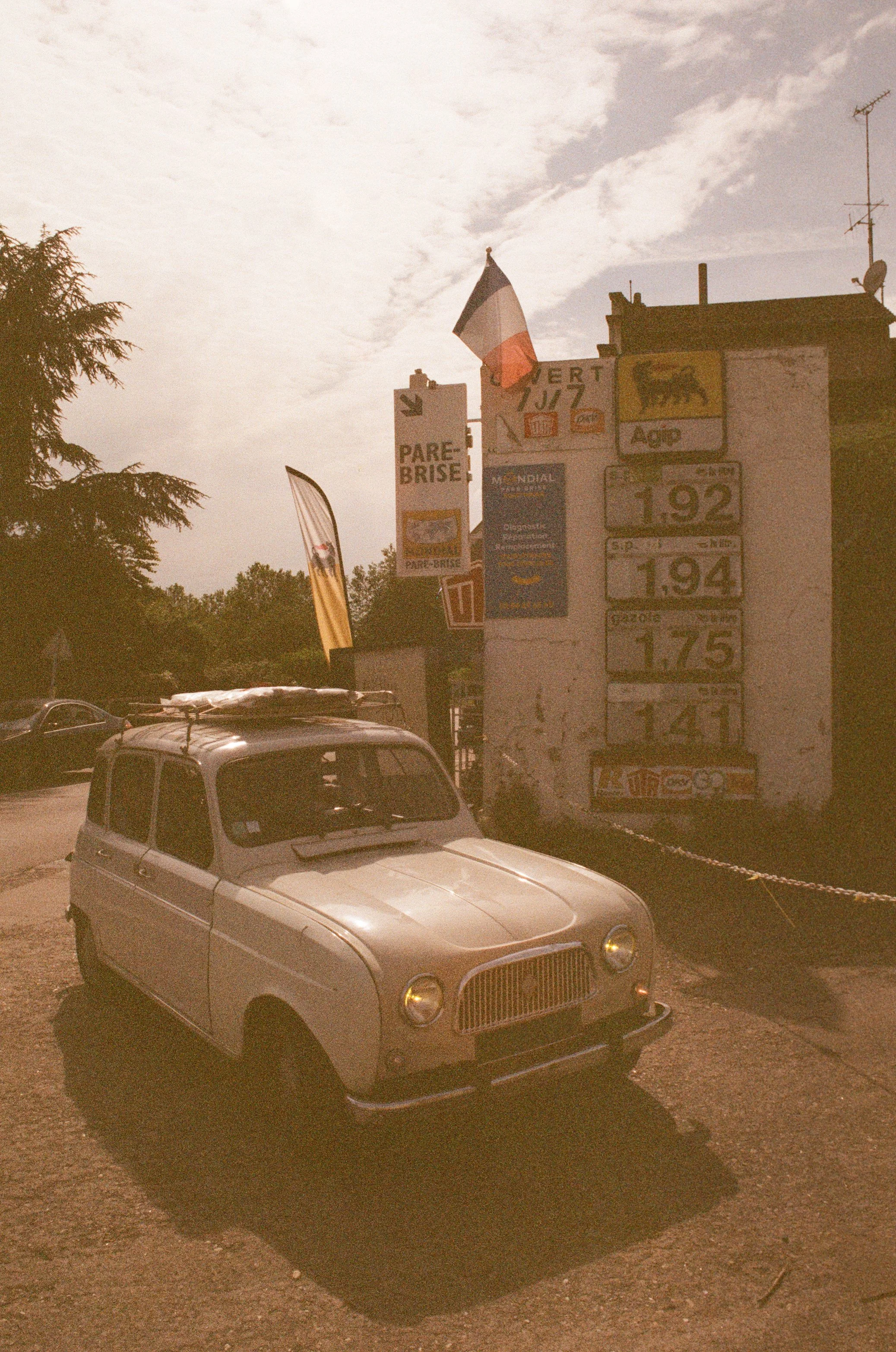
On our mapped adventure around Ireland – a year ago today, we were approaching the midpoint of the journey so we started to slow down a bit; refuel, take stock, break up our journey, send some emails, do some organising, go for a walk, have a picnic, peruse some bookshops.
At Trinity Rare Books in Carrick – On- Shannon, Liliane found a copy of The Otherworld; Music and Song from Irish Tradition’, the book is a collection of music, folklore, and photographs from the National Folklore Collection. I found Roadside Picnic by Arkady and Boris Strugatsky. The title Roadside Picnic refers to detritus that might be left behind after setting up camp for a few hours, the scattered debris one may leave behind at an insignificant stop off point before moving on to a more consequential destination.
The rubbish left by these travelling extra terrestrials is quarantined in areas known as ‘Zones’; Stalkers venture into zones, gathering the items - alien rubbish left there. This otherworldly detritus has strange powers on earth but it’s challenging to stay in the zone; temporal and spatial limits are in constant flux.
Both books we found that day, The Otherworld and Roadside Picnic incorporate narratives where a significant amount of time has elapsed after the protagonist has tarried in a fairy or zone realm. Where the protagonist returns, only to find that their friends and relatives have died or grown old and that their home place has changed considerably under the ravages of time. This is an enduring belief and fascination in the Irish imaginary, exemplified in the story of Oisín returning after one year from Tír na n-Óg only to find that 300 years have passed in Ireland in the interim. In Roadside Picnic, protagonist Redrick ‘Red’ Schuart notes the slippage and contortions of time according to journeying within the bounds of the zone, ‘I take my watch and look at it-my lord, we were in the zone for more than five hours! Five hours. I shudder, Yes my friends, there is no such thing as time in the zone’.
It was often said of gifted musicians in Ireland that they were given their gift by the fairies, some were given enchanted objects, musical instruments. These stories circulated widely up until the 1960s. Similarly, stalkers like Red Schuart who navigate the zones of Roadside Picnic are rewarded with highly valuable. objects. It's unclear whether or not they are dangerous. One character in Roadside Picnic, Richard Noonan, spends his time superstitiously returning objects to the zone. He doesn’t want to see them displaced. Noonan is of the opinion that everything from the zone should remain in the zone. In fairy lore too there is a common motif of objects from within the fairy realm having dubious or unpredictable manifestations for those who procure them or take them out of the fairy realm.
For example, one Irish migratory legend, Midwife to the Fairies tells the tale of a young girl who is carried away on horseback in order to act as midwife to a fairy in the throes of childbirth. She’s rewarded with a fine silk belt but on her return to the human world, she is warned not to wear it and instead tie the belt around a nearby tree and to ‘be quick about it!’ When she ties the belt around the trunk, it immediately contracts causing the tree to break in two. The midwife was about to bear the brunt of a fairy grudge. She had unwittingly insulted it by joking about its protruding belly while it hopped past a well in the form of a frog.
Objects taken from the fairy realm can be imbued with certain powers and characteristics that at first seem positive; in this instance being silk and associated with grandeur, though they are actually dangerous, like this belt that would have killed her. The objects gathered in the zone, or brought from the otherworldly realms have yet to be understood in their entirety, they are ambiguous and often their value dissolves or erodes when they are removed from the zone or their otherworldly context.
We often referred to these two books in researching and planning tour de force but it seemed fortuitous to find them here and to be able to peruse them while we unpacked mementos, treasures of our journey so far; objects gathered along the way; deciding what to bring with us into the second part of the tour and what to leave behind.

28.07.2025
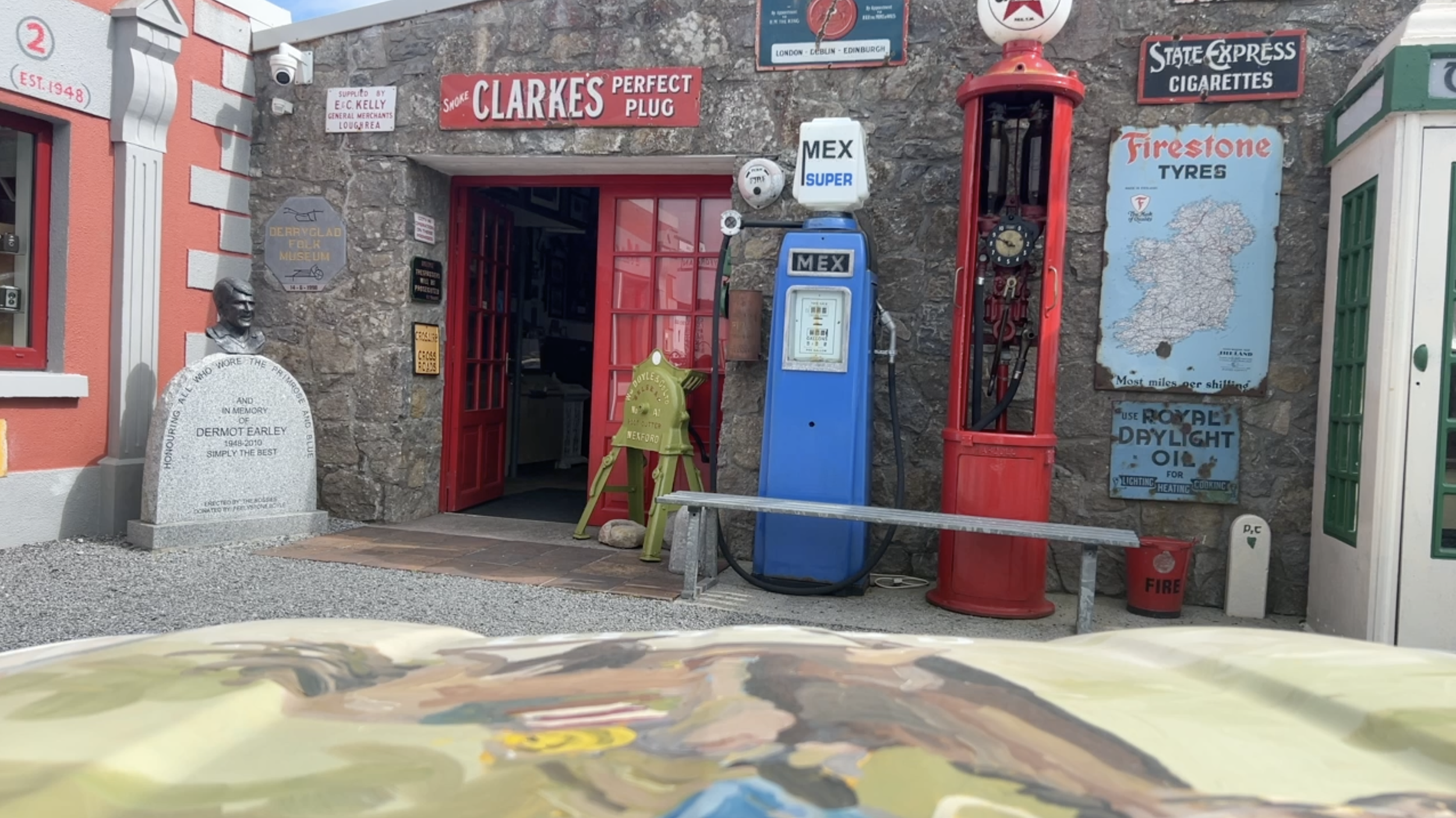
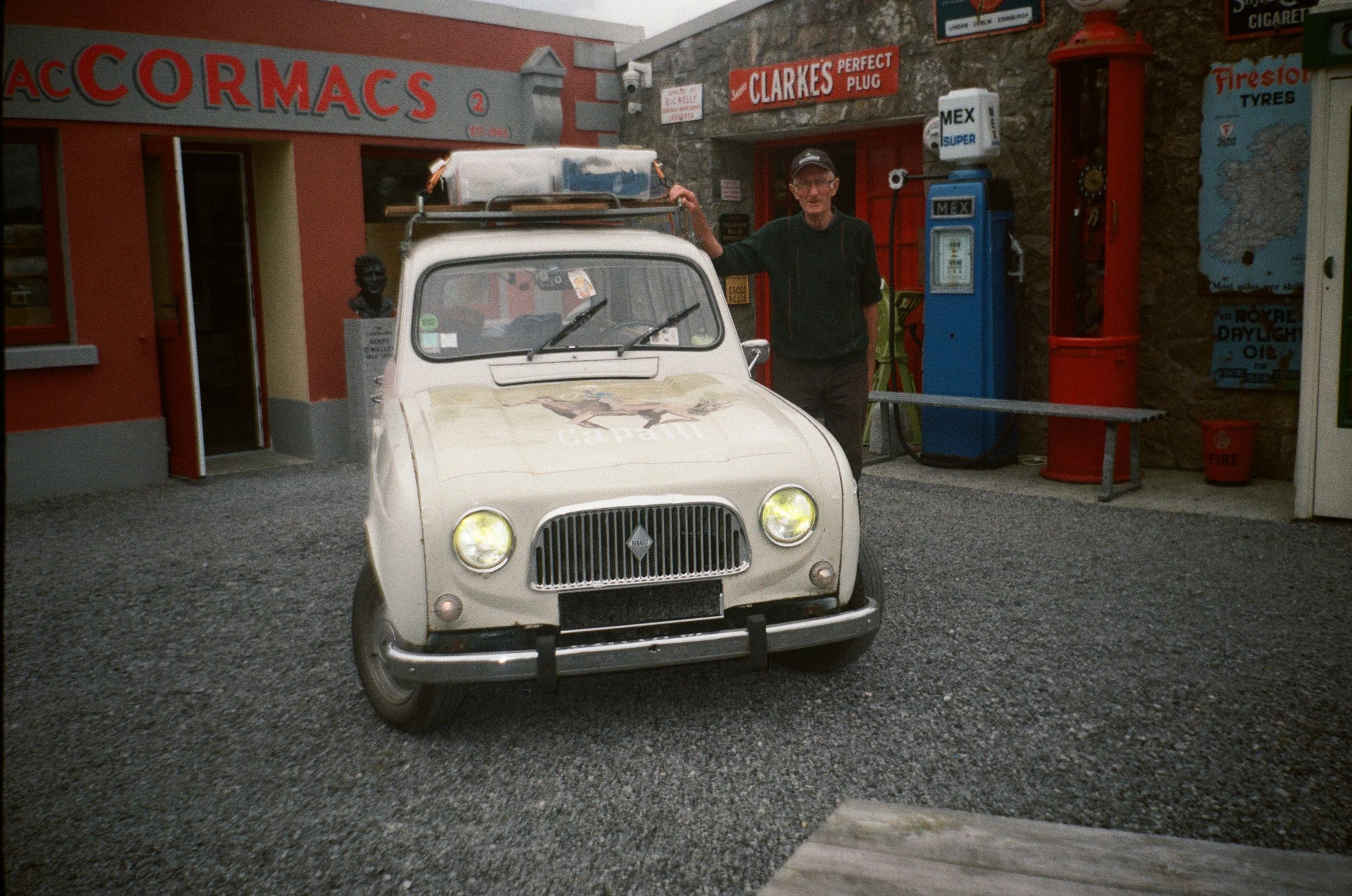
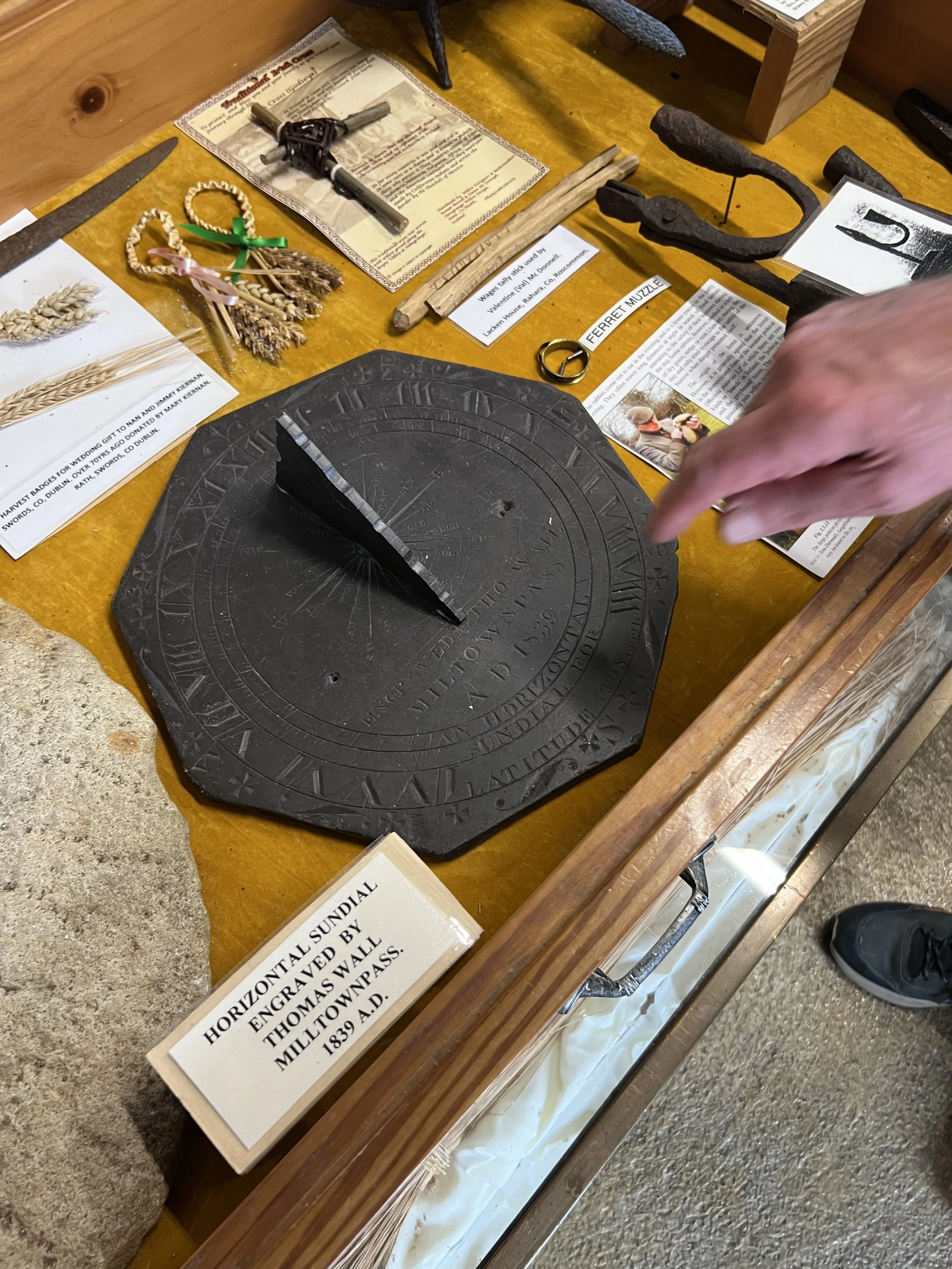
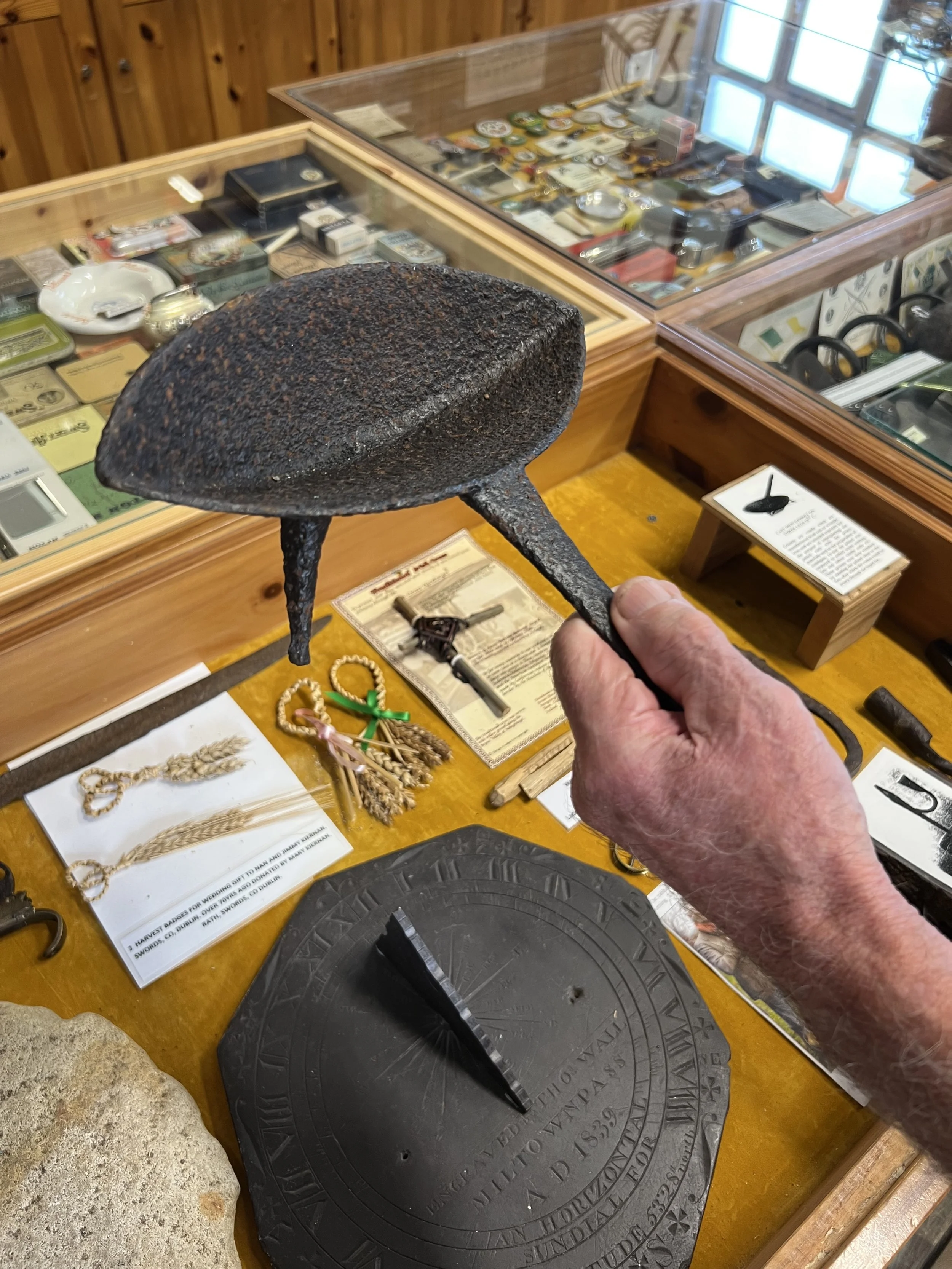
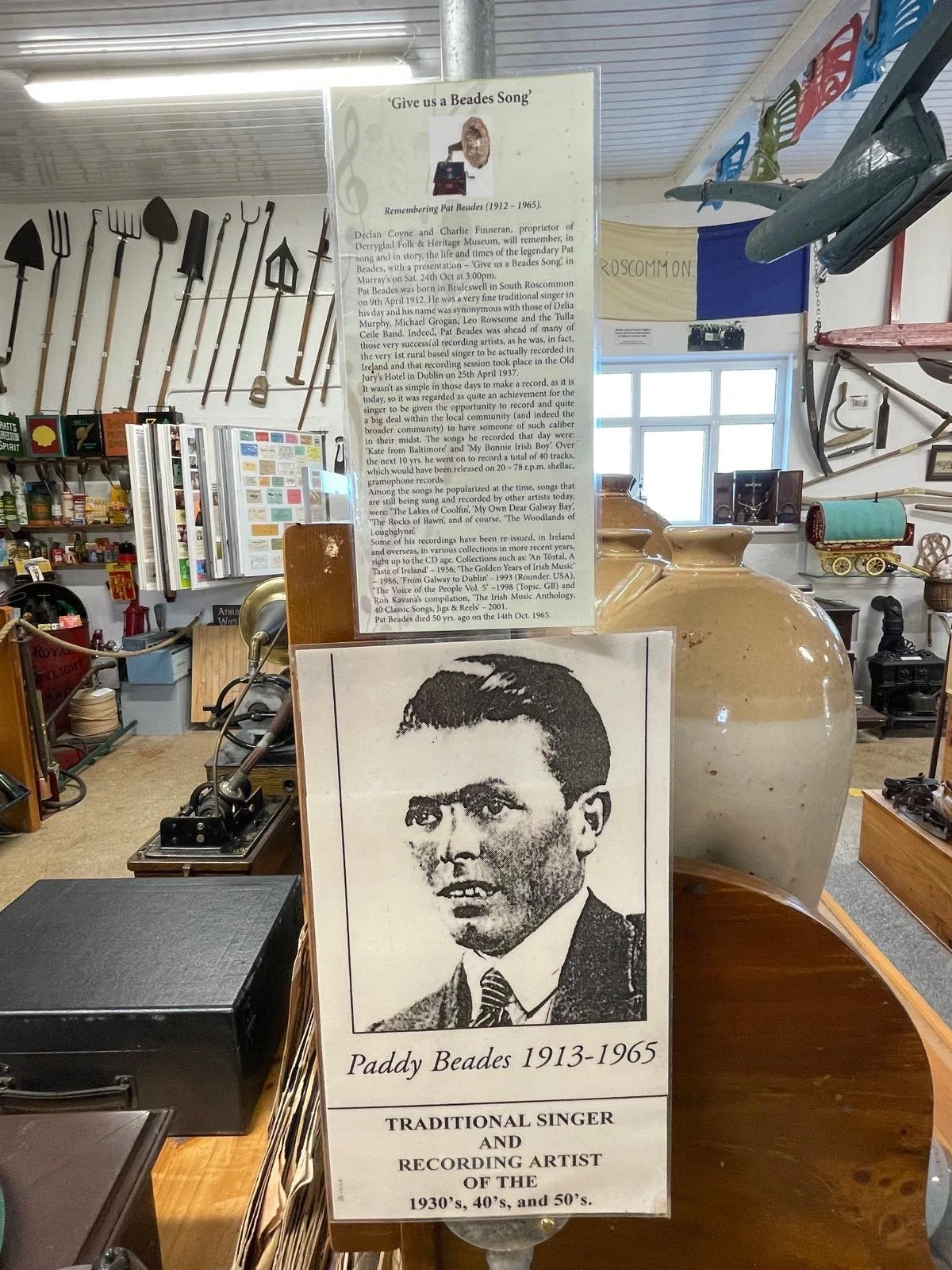
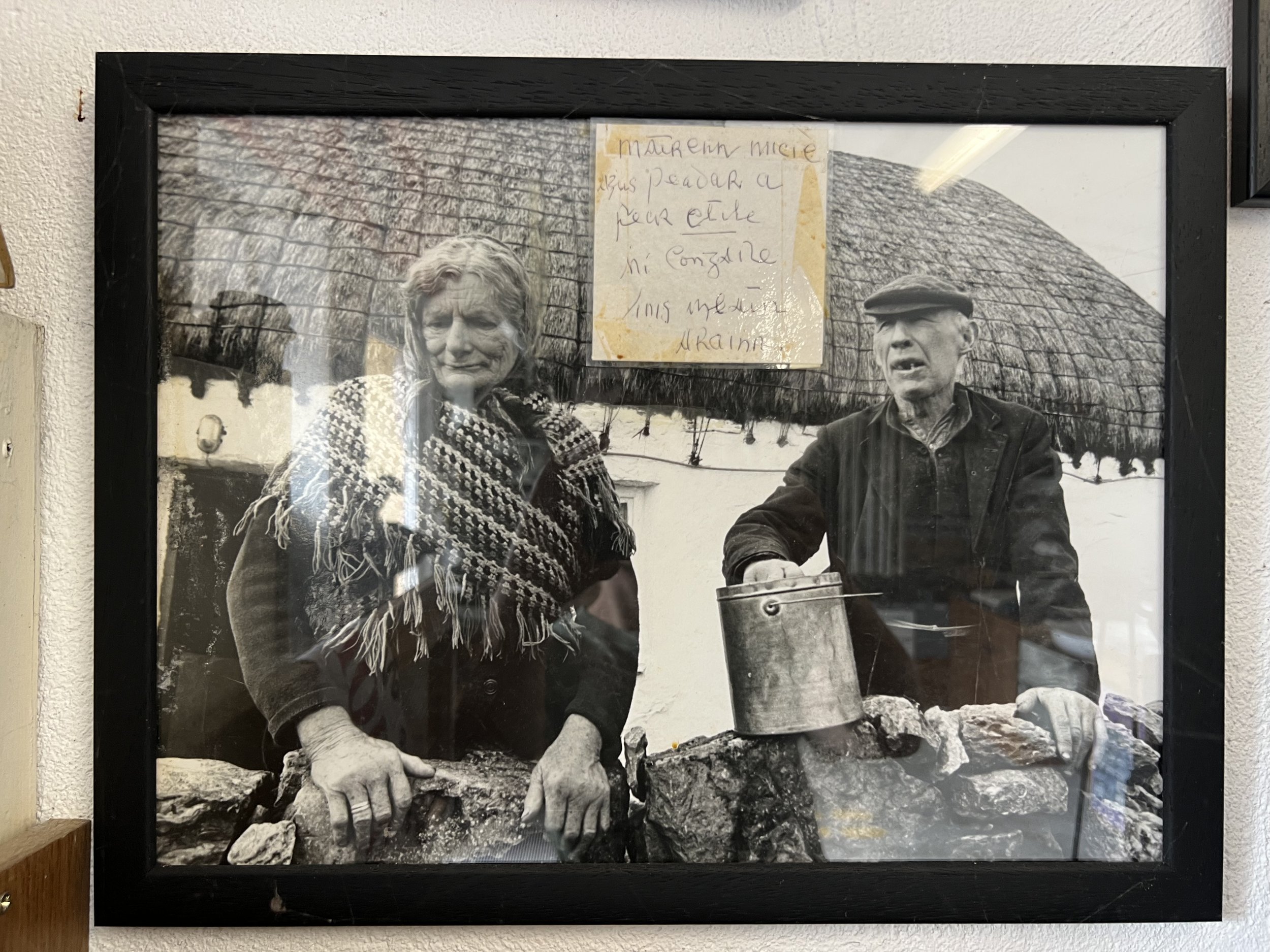
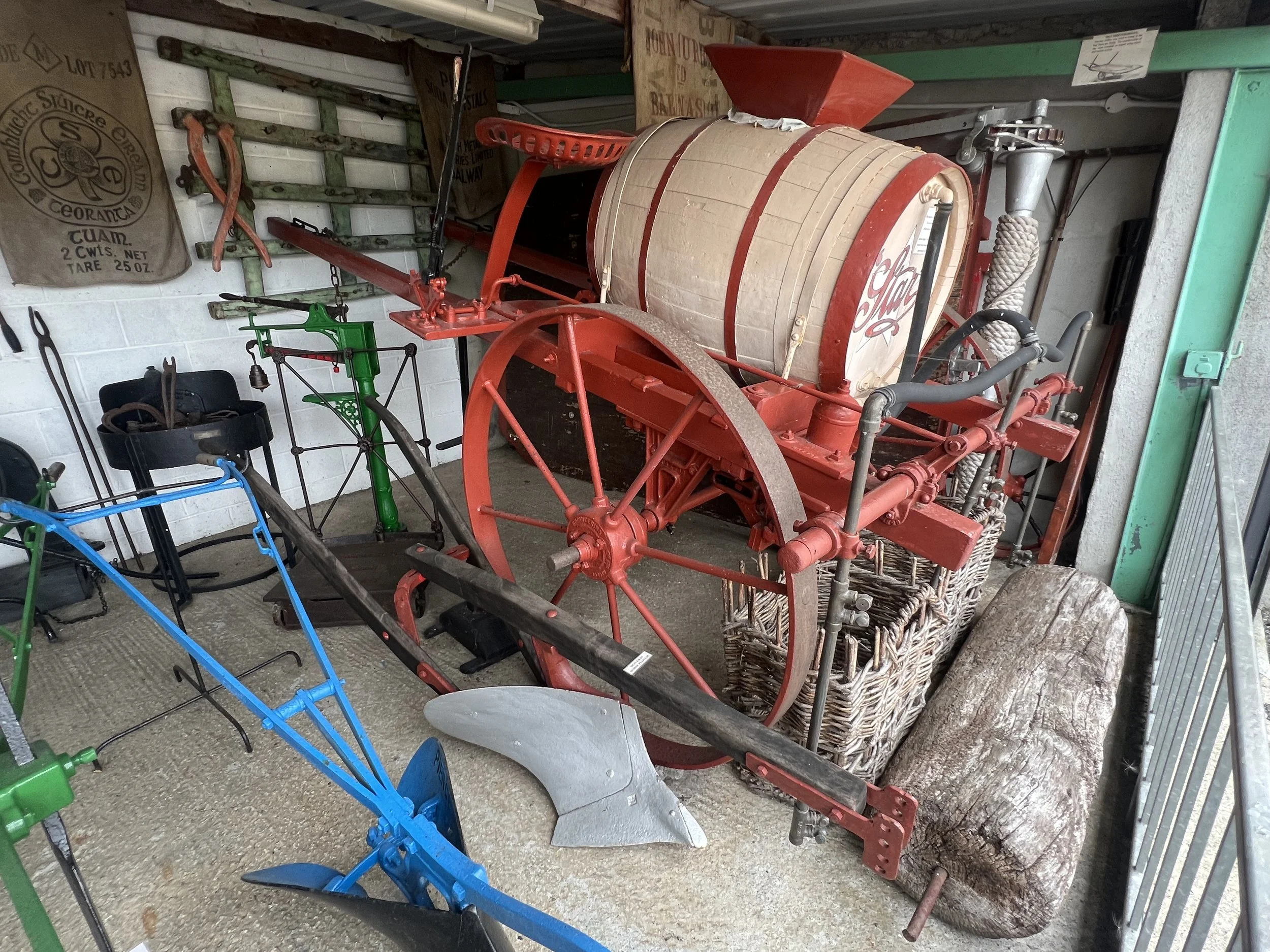
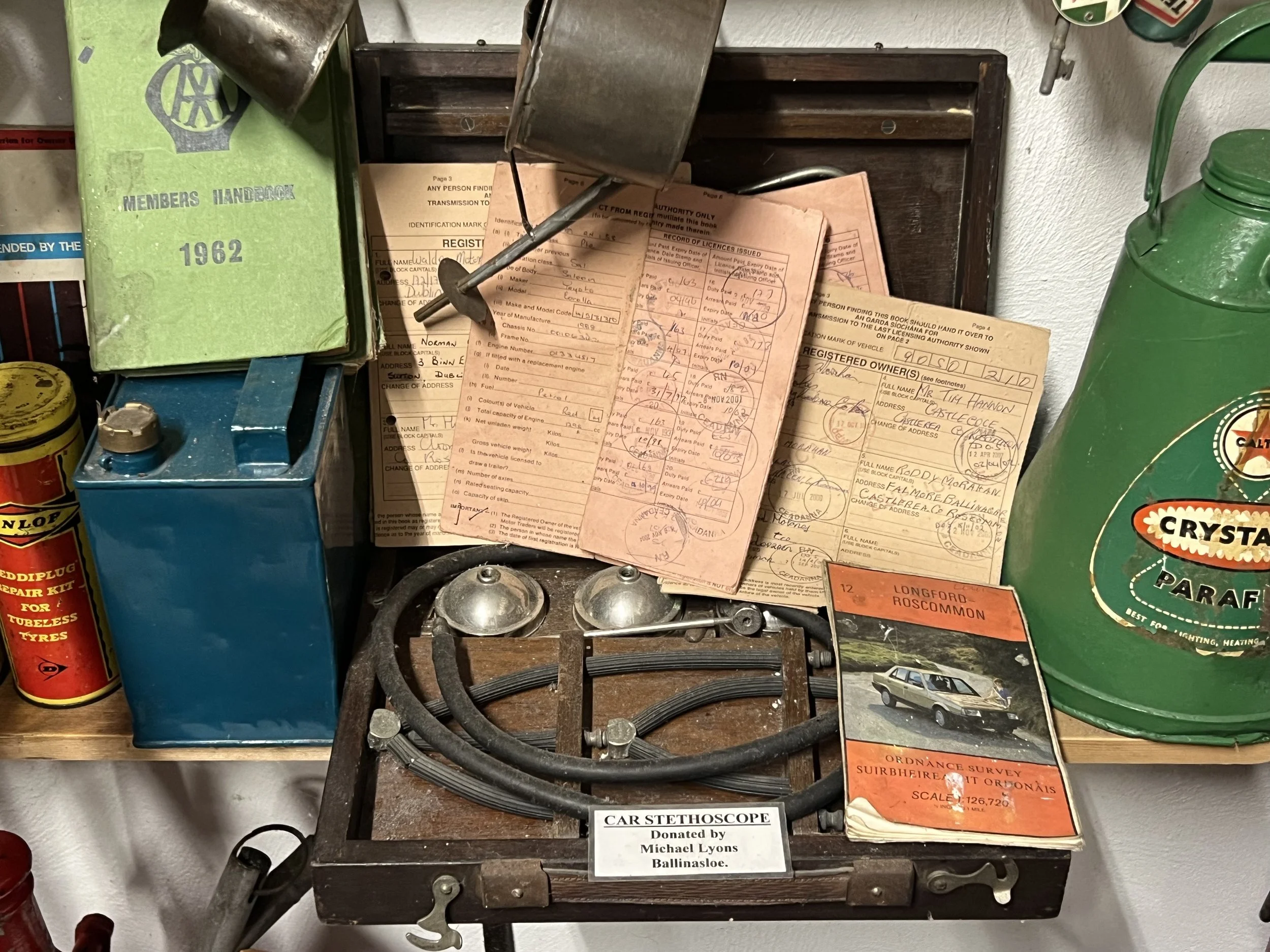
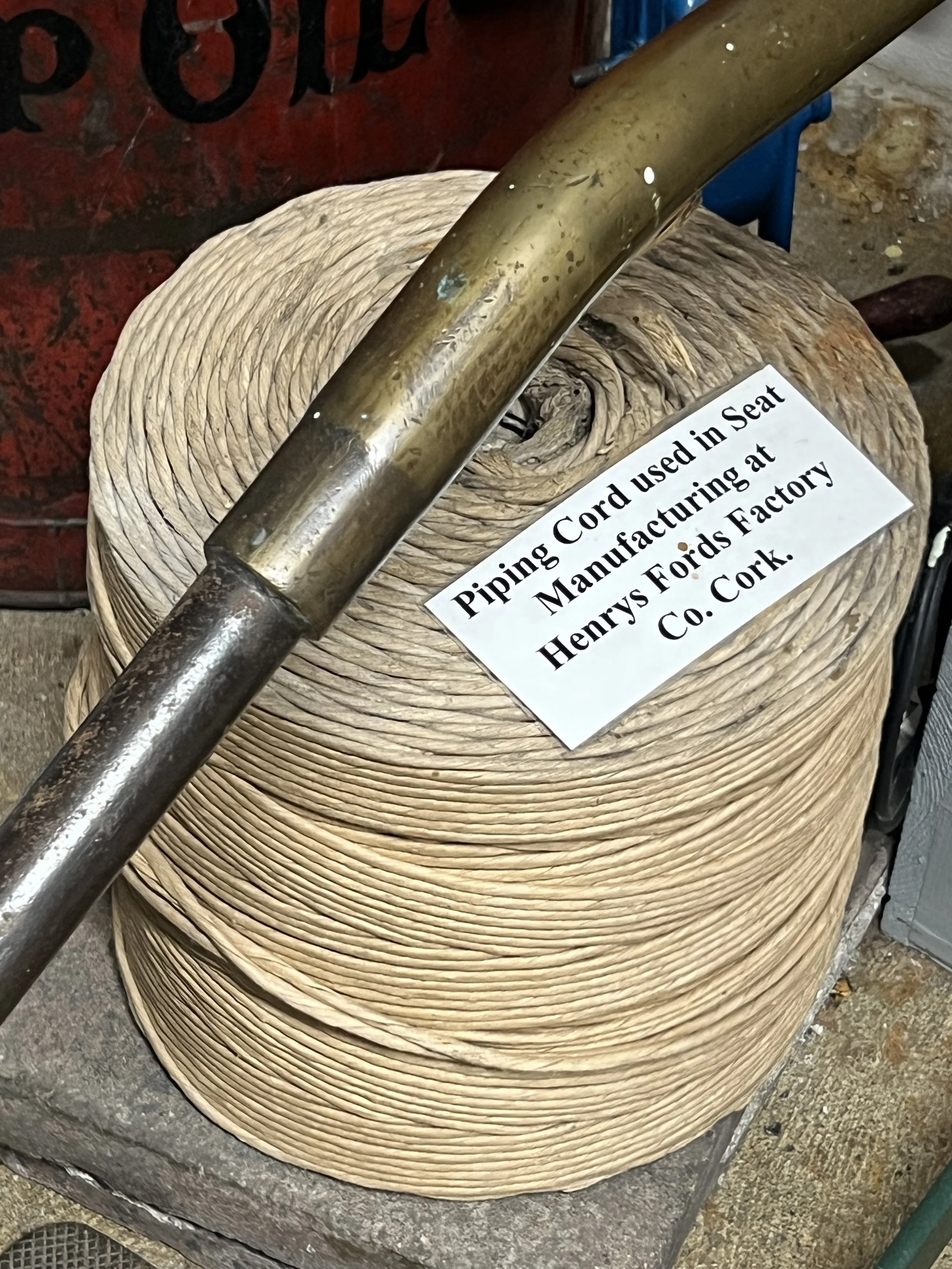
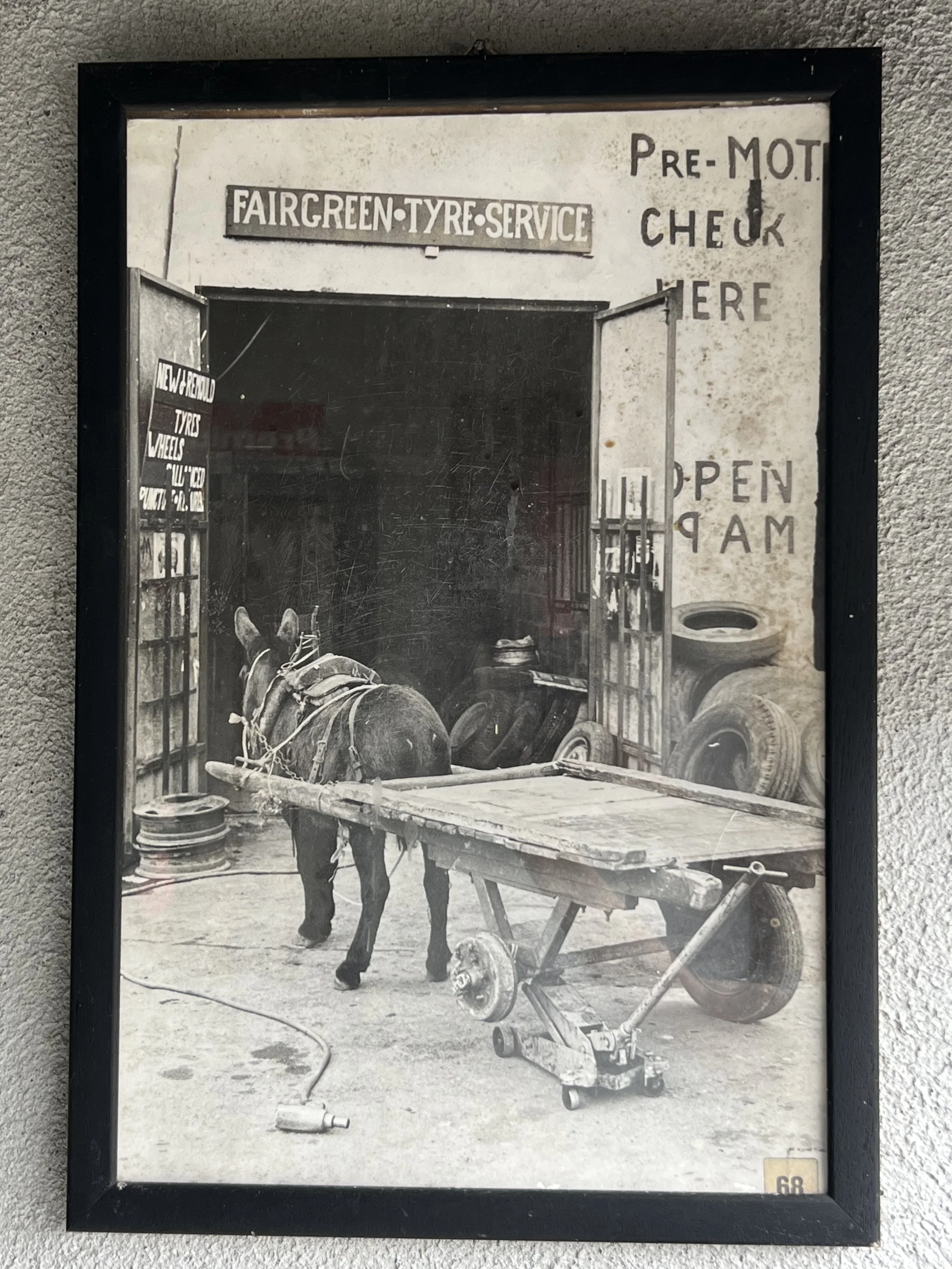
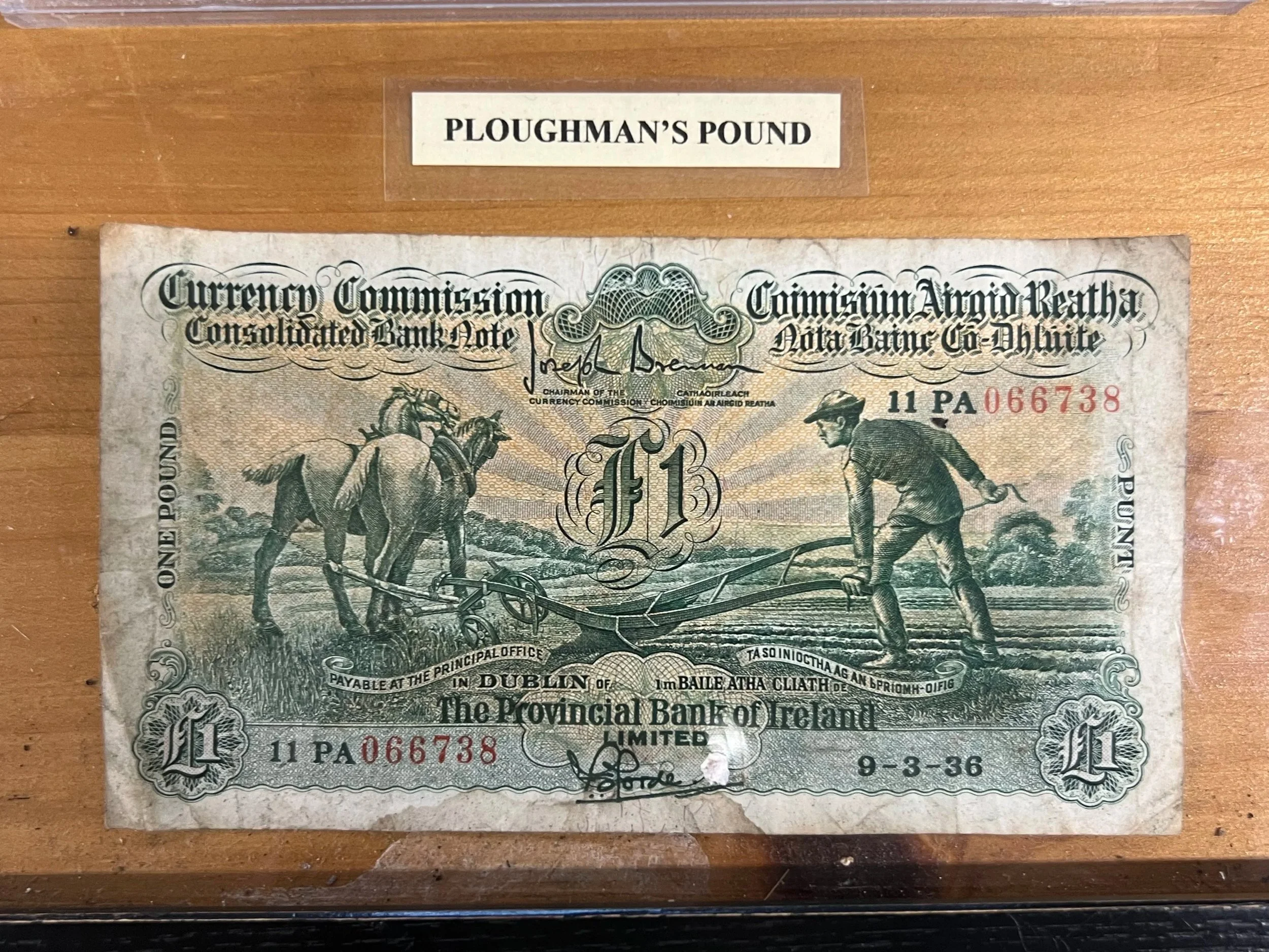
Charlie Finneran, a man who runs his own folk and heritage museum in Derryglad, Co. Roscommon has collected about 8000 objects over the years. His collection started with a slate sundial, dating back to 1839, which was engraved by Charlie’s great-great grandfather and built into their family home. After discovering the sun dial in the thatched roof of the house as a young man, Charlie began seeking out everyday objects representing stories that might otherwise be overlooked or forgotten, mostly stories about local rural life.
Gradually he built sheds to house the objects, adding more sheds as the collection grew. Word spread and people from the area at first, and then from all over Ireland, started to bring items to donate. What sets Charlie’s collection aside from other folk museums, is that he himself can tell you the story behind each object, as well as the life and times of the people connected with them. He remembers every detail. He’ll pick an item up, turn it over, examine it for a moment and then tell you all about its history.
His encyclopaedic knowledge covers a range of topics and timelines, that describe for example, the advent of rural electrification and the move from horse power to diesel power. His contextualisation of the objects in relation to their histories is surely unparalleled for a self-initiated, self-run museum. Charlie has a great depth of understanding around the folklore and common work of rural communities, having spent much of his time with older generations, listening to them and learning their ways all throughout his life.
The collection includes but is absolutely not limited to; horse-drawn implements, restored ploughs, a Ferguson TVO vintage tractor, tradesmen’s tools and old-style sheep shears, dairy items like butter churns, quern stones, griddles, kettles and rare old washing machines, school desks, inkwells, slates, chalk, fountain pens, and leather school satchels, radios, wax cylinders, advertising ephemera from the 20s, 30s 40s…gramophones, and a large collection of 78rpm records, collections of 1930s original grocery packages, shop dockets, bill-heads, darkroom equipment, camera enlargers, and black-and-white/colour processors as well as historic memorabilia, including items from Croke Park.
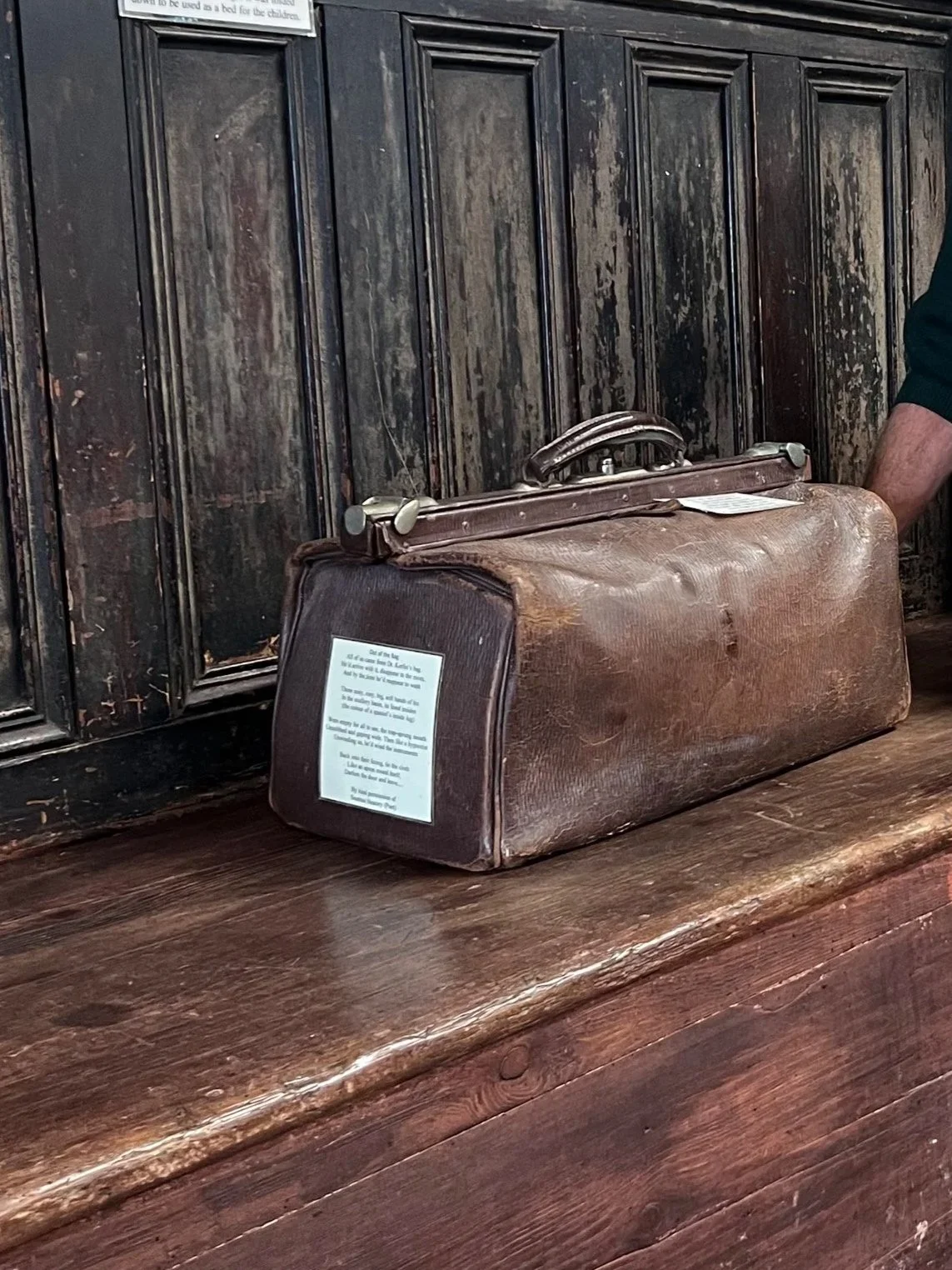
Charlie asked us about our tour, curious about the story behind the Renault 4. He said he always loved to meet others who were interested in the stories of old, seemingly obsolete objects. He very kindly agreed to do an interview at short notice. And as the interview and guided tour drew to a close, he mentioned to us that he had an item that might be of particular interest to us - that we might like to hear a story about it. We nodded and Charlie sat down and held up a bag for us to see…’A man, a stranger came in here once’, said Charlie and asked me…
‘Did you ever hear of a Dr. McManus up in the village?’
No I said. I heard my mother talking about him. But I didn't know him.
Well, said the stranger, ‘I'm his son and now I'm a doctor too, up in Dublin - would you like something from my father's time down here as the doctor of Derryglad?’
Jesus, I said I would.
Well, my mother is still alive, he said. She's in her 90s up in Dublin, and she still has my father, Dr. McManus senior’s maternity bag from this area’.
And soon after that conversation, he made good on the promise and brought it down and gave it to me. Sometimes he'd ring me up or he'd call in here, when he'd be down visiting his cousins and that. So one day he phoned me up and he said, ‘Have you seen my father's maternity bag down there?’ And I said, I have, yeah. It’s here in the museum.
I said, Why?.
Well, he said, uh, ‘I'll tell you a story now. I was at a function the other night in Dublin-and this man, a poet came up to me and he said, 'Are you Dr. McManus?' And I said, I am. And he said, ‘Was your father a doctor before you?’ And I said, ‘Oh, he was. Oh, for sure’.
He said, ‘Would there be any chance of you having his Gladstone bag?’
And he answers the poet, he says, ‘Well, I have and I haven't’.
And the poet says, ‘You have and you haven’t?’
Well, he said, ‘It's in a museum down in Roscommon’.
Charlie turned the bag over and showed it to us, passing it for us to hold, then he continued with his story, ‘This gentleman, who approached Dr. McManus’ son was wanting to see a Gladstone bag. That’s what he wanted to have a look at, not any old maternity bag, but a Gladstone bag. He couldn't get one anywhere. He came to have a look at this very one.
Didn’t he write a poem about it.
He came back again to read the poem to us and then he left it here with the bag.
The poet was Seamus Heaney….
You see, back when we were young, when the doctor came to deliver the baby in the house, the children would be ushered outside and the doctor would go up into the room to the woman, and the children would be coming in and listening to hear a squeal or a roar. And they'd say, ‘Where'd the baby come from?’ ‘Oh, the doctor's bag’…You wouldn't tell them really, do you know…
All of us came in Doctor Kerlin's bag.
He'd arrive with it, disappear to the room
And by the time he'd reappear to wash
Those nosy, rosy, big, soft hands of his
In the scullery basin, its lined insides
(The colour of a spaniel's inside lug)
Were empty for all to see, the trap-sprung mouth
Unsnibbed and gaping wide. Then like a hypnotist
Unwinding us, he'd wind the instruments
Back into their lining, tie the cloth
Like an apron round itself,
Darken the door and leave
With the bag in his hand, a plump ark by the keel ...
Extract from Out of the Bag by Seamus Heaney
27.07.2025
We were now running behind schedule, having stayed in Kilgarvan to visit the Motor Museum, arriving at Inch in the evening. The initial plan was to leave Inch that night because we had a hard deadline in Galway for the Mountbellew Vintage Car and Agricultural Show. We absolutely had to be there no later than 12 noon as we’d been booked in as exhibitors. After a really moving interview and guided storytelling itinerary in the car with Micheál Fitzgerald with a brand new fiction read by writer and visual artist Laura Fitzgerald we made our way to Foley’s pub where electronic musician and sound artist, Chris Steenson , Laura’s partner was sitting at a picnic table with a view of the sea. It was almost dark but we could hear the waves. Laura’s friend, who is the proprietor of Foley’s bar came out to join us. When the moment came to order a round of drinks our plan to leave inch was suddenly jeopardised.
A Rave?
Yes rave
A Beach rave?
Yea.
They’ve got the whole place set up down there…they’ve been arriving all day.
It’s happening right now?
We couldn’t hear anything, it was the most peaceful and serene place. All of us quietened and cocked our heads to listen. Nothing. Nothing except the lilling of the waves. There’s hardly a rave happening just there. Surly not. Chris described a natural feature in the landscape - a colosseum in the dunes that traps the soud. Every year they host a huge rave down there. It’s kind of unbelievable. We don’t hear anything. Should we go down to it Laura asks and of course there is only one answer to that question.
Liliane and myself confer to discuss logistics. As long as we leave by 4/5am we should be ok to get up to Mountbellew on time. We’re cutting it fine though. There’ll be no more detours - we’ll have to go there directly. Okay I get you, we’ll drive straight there, no tangents, quiet roads It’ll be smooth.
But the odds are stacked against us. Heads touch pillows for about an hour or less after the beach rave and we do indeed get up at the crack of dawn. However…so does everyone else. It’s the day of the all Ireland finals and Kerry are playing Donegal so everyone and their mother is booting it towards Croke Park.
We’re in the tiny car and simply have to keep pulling over to let everyone pass. Tensions are rising on the road. People have no time to be stuck behind a 1962 Renault 4 driving 50km/hr. Finally we find a turn off the national road onto a local access road where we can relax into the drive. Beautiful scenery all around and we are listening to Brian’s composition cassette when suddenly the dulcimer stops and the old recording from underneath comes through. That’s mad, I say. Why what’s wrong, Liliane asks…This song is about a relative of mine. Jerry (Jeremiah) Lyons,
You may sing and speak about Easter Week and the heroes of Ninety Eight.
Of Fenian Men who roamed the glen in victory or defeat.
Their names on history's pages told, their memories will endure,
Not a song was sung of our darling sons, in the Valley of Knockanure.
There was Lyons and Walsh and the Dalton boy, They were young and in their prime.They rambled to a lonely spot where the Black and Tans did hide.
The Republic bold they did uphold, Tho' outlawed on the moor. And side by side they fought and died In the Valley of Knockanure.
It was on a neighboring hillside, We listened in hushed dismay.
In every house, in every town, a young girl knelt to pray. They're closing in around them now, with rifle fire so sure. And Lyons is dead and young Dalton's down in the Valley of Knockanure.
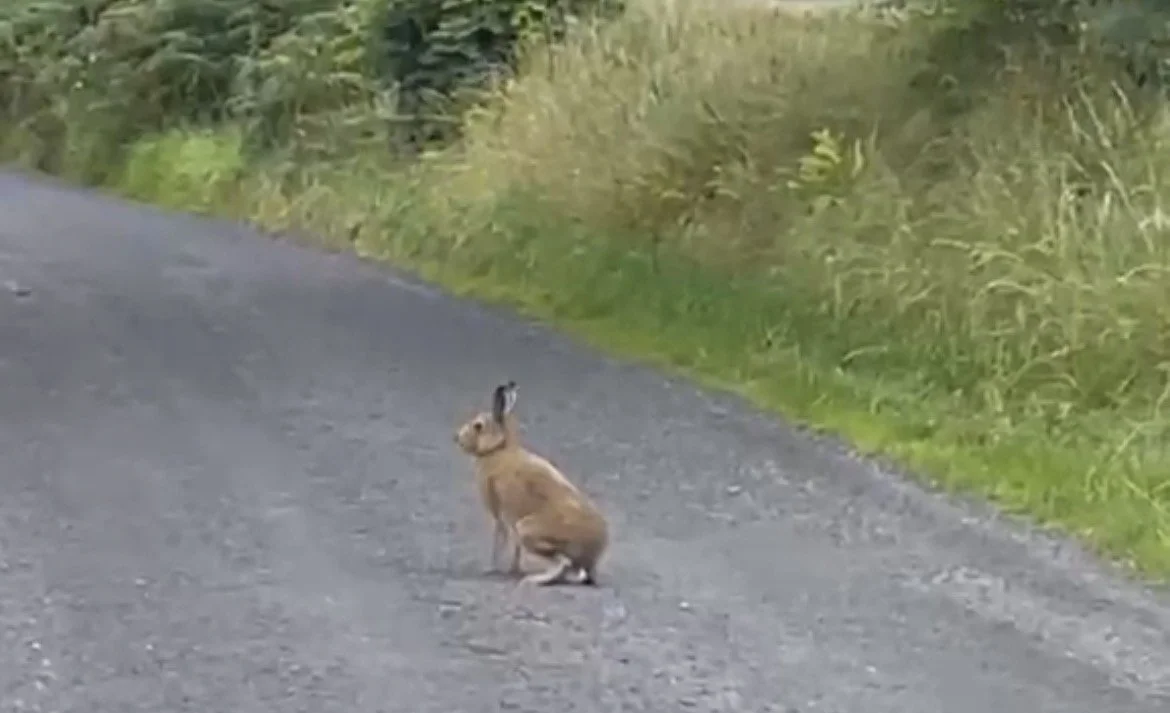
On 12 May 1921 four young men died defending the village, the valley of Knockanure from a large troop of Black and Tans who were travelling from Listowl, Kerry towards Athea in Limerick, drunk and marauding. By chance we were driving through the valley of Knockanure. The song petered out and Brian’s otherworldly dulcimer returned. Then a hare appeared in front of the car and Liliane stuck on the brakes, the mythical hare.…a powerful liminal symbol closely tied to shapeshifting and the supernatural Otherworld. So light and swift that they can cross fluently between realms.
This encounter between several realms threw at least an hour on the journey and while Liliane had been incredibly patient, indulging the detours that we swore we wouldn’t take…we were now very behind schedule and would surely not make it to Galway on time. For the final stretch of the journey, we drove in silence. The apprehension of falling short of our commitments to the Mountbellew Vintage Club was now a reality. Stern but fair in email correspondence, we felt they’d kindly refuse us now that we’d be at least 45mins late for our slot as exhibitors, literally holding up the show. When we did eventually arrive, we were greeted with smiles, badges and tokens for complimentary cups of tea and a meal ticket for the chip van.
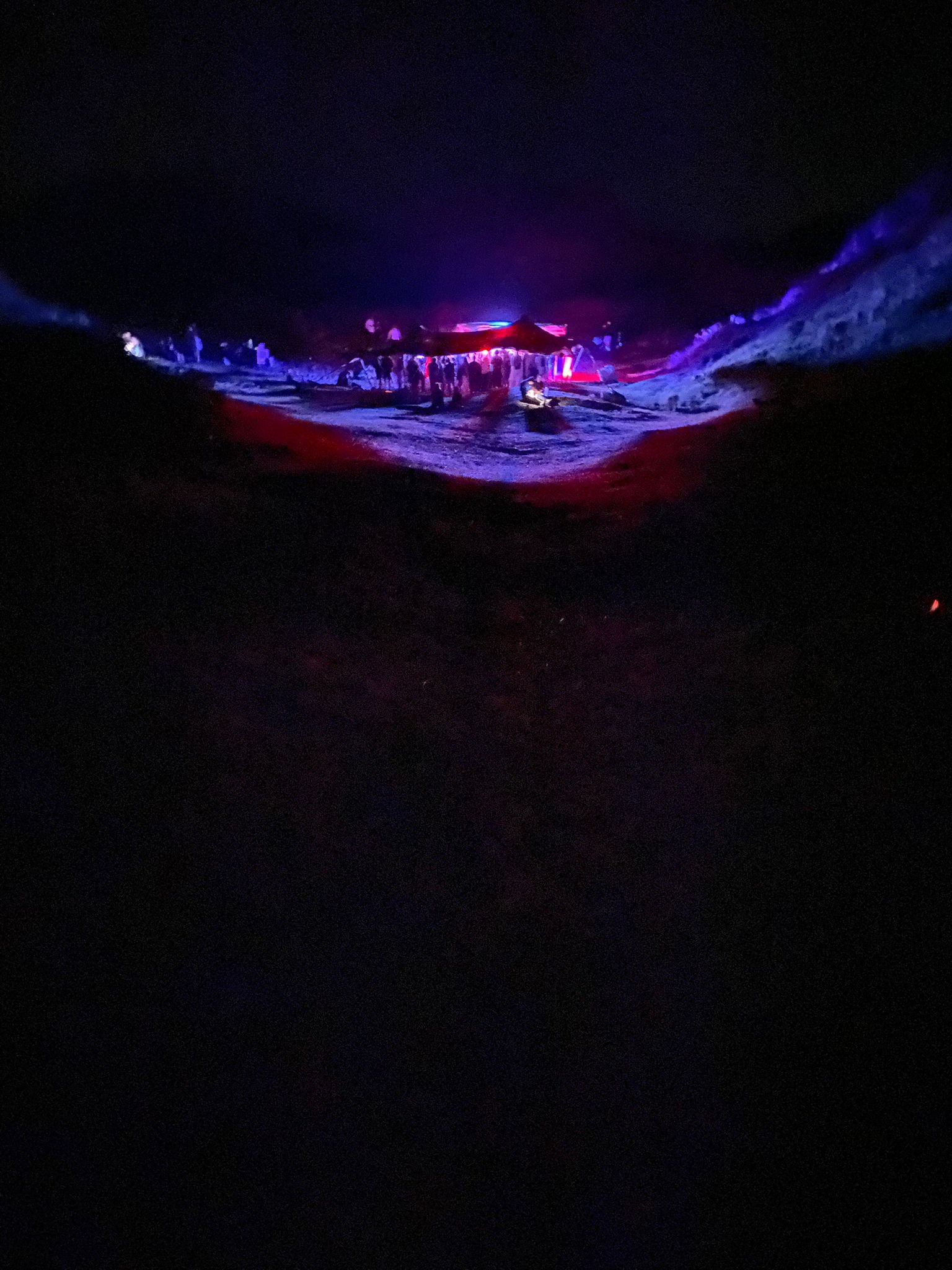
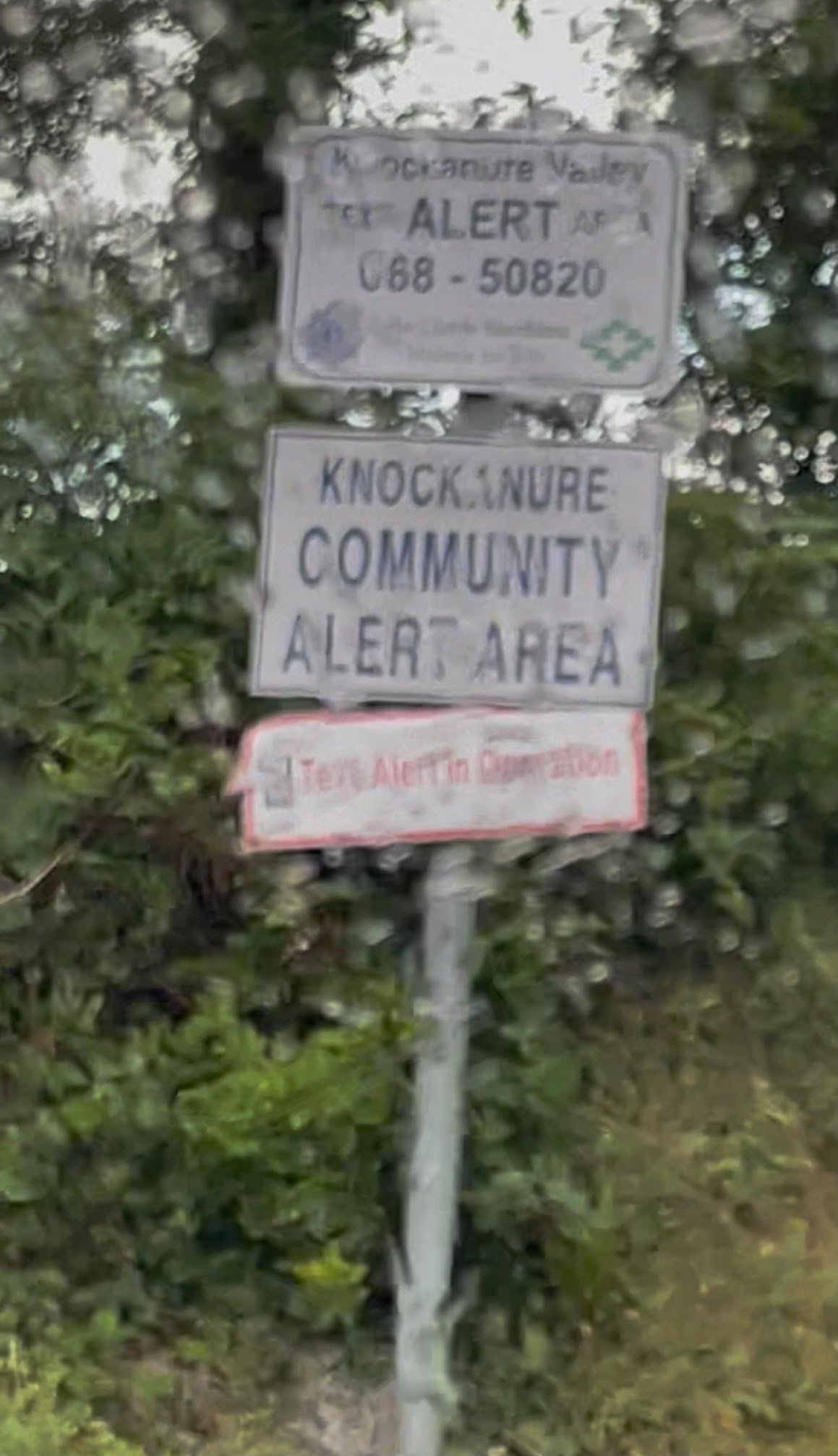
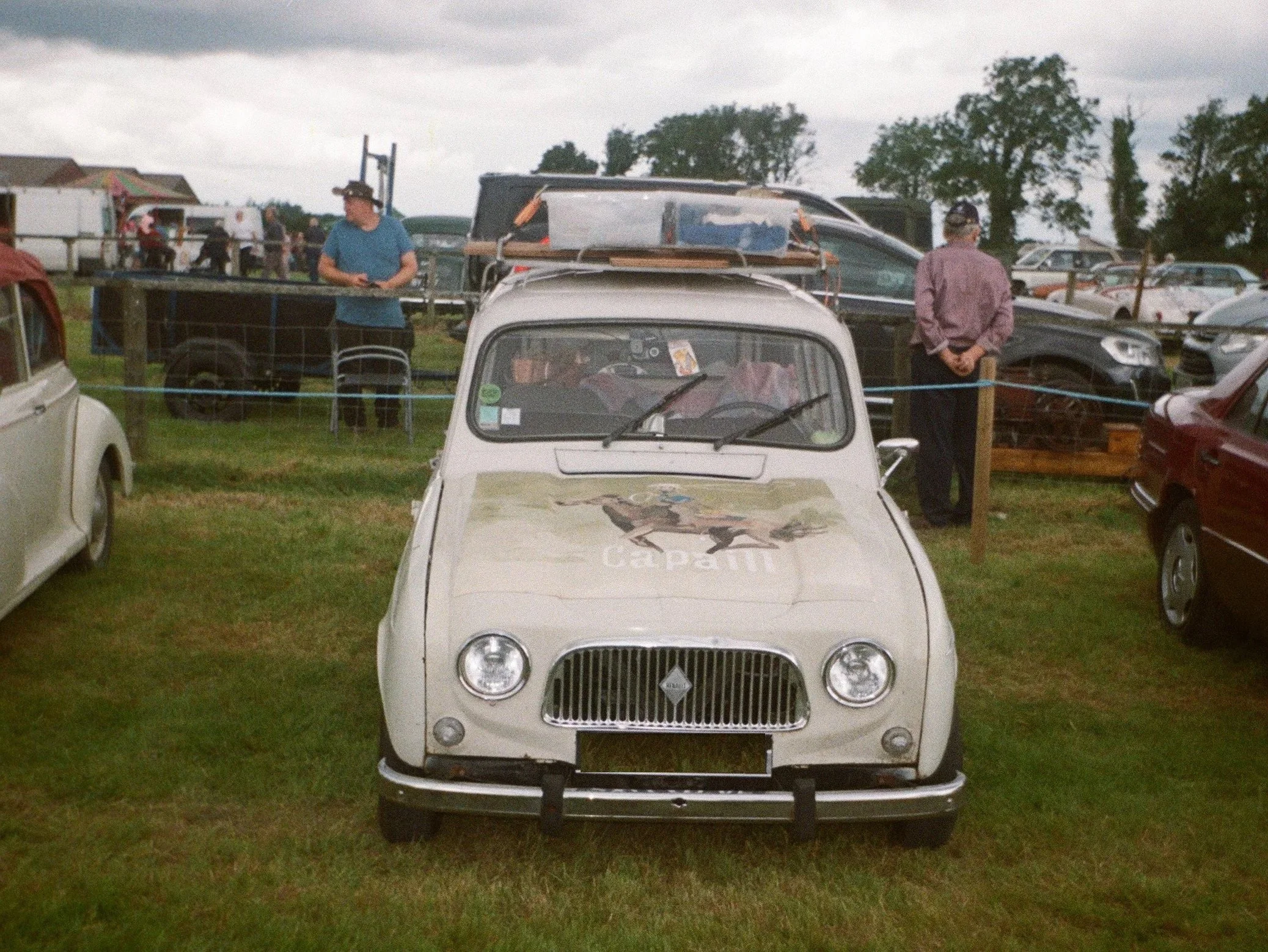
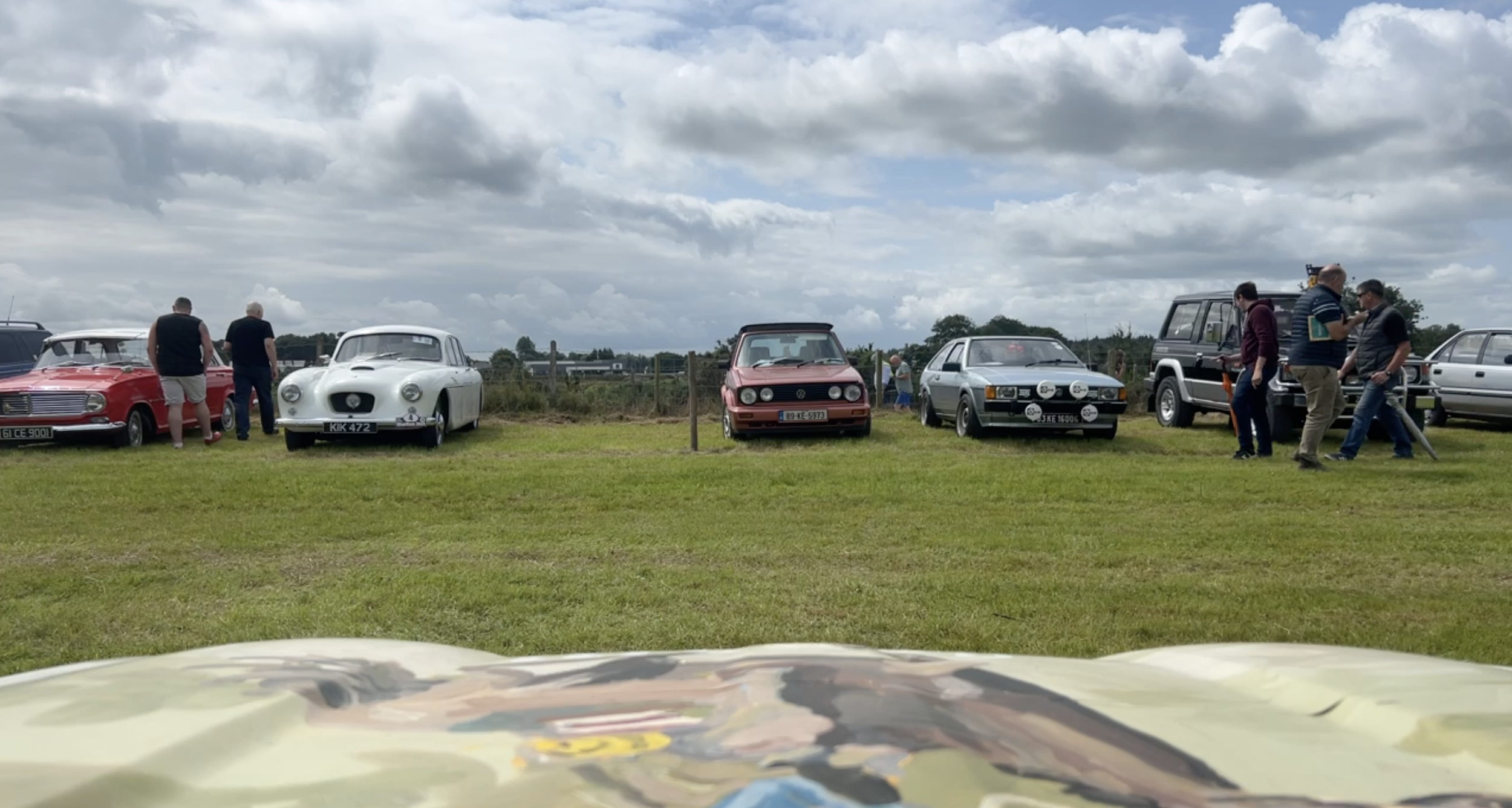
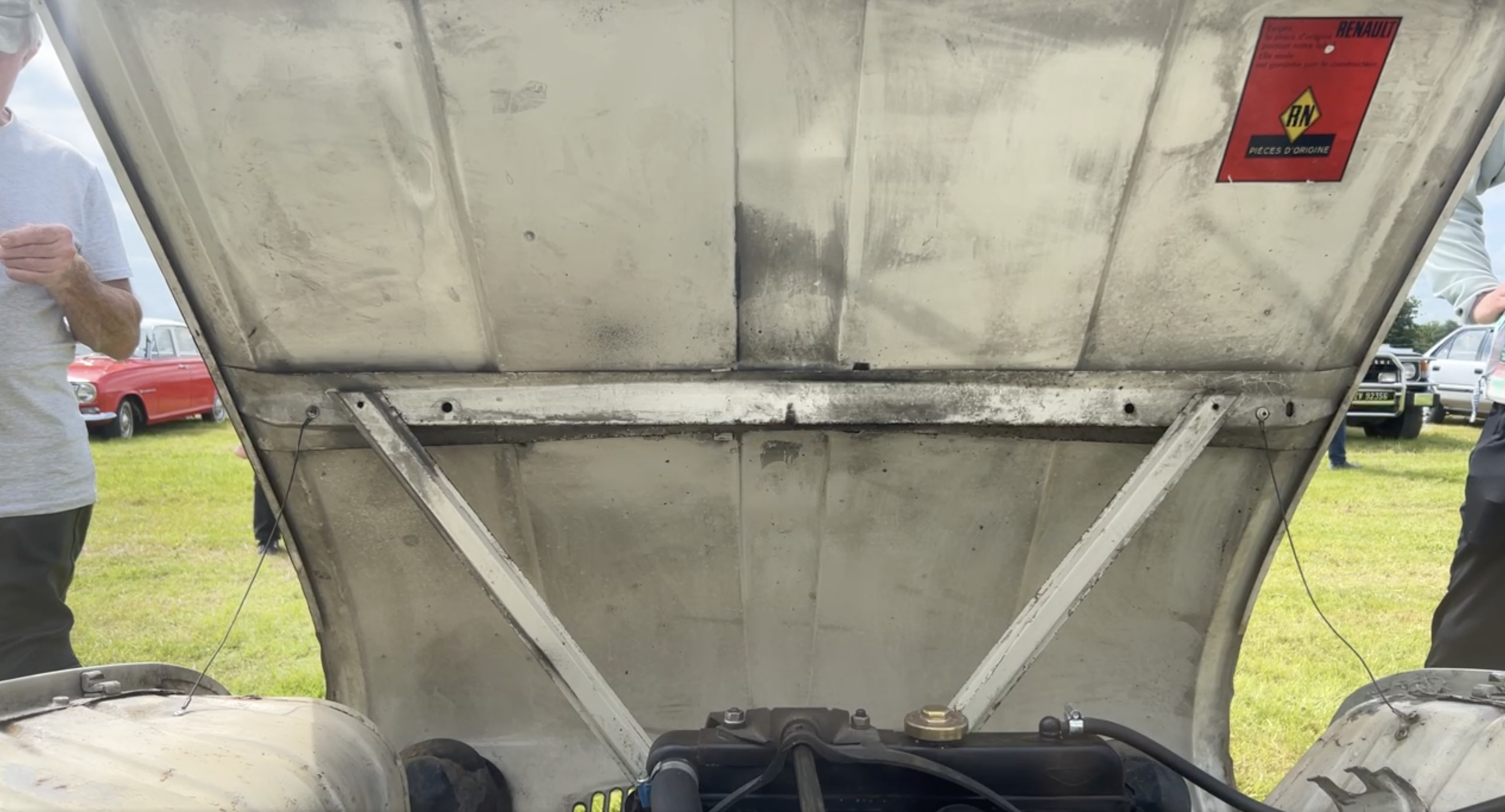
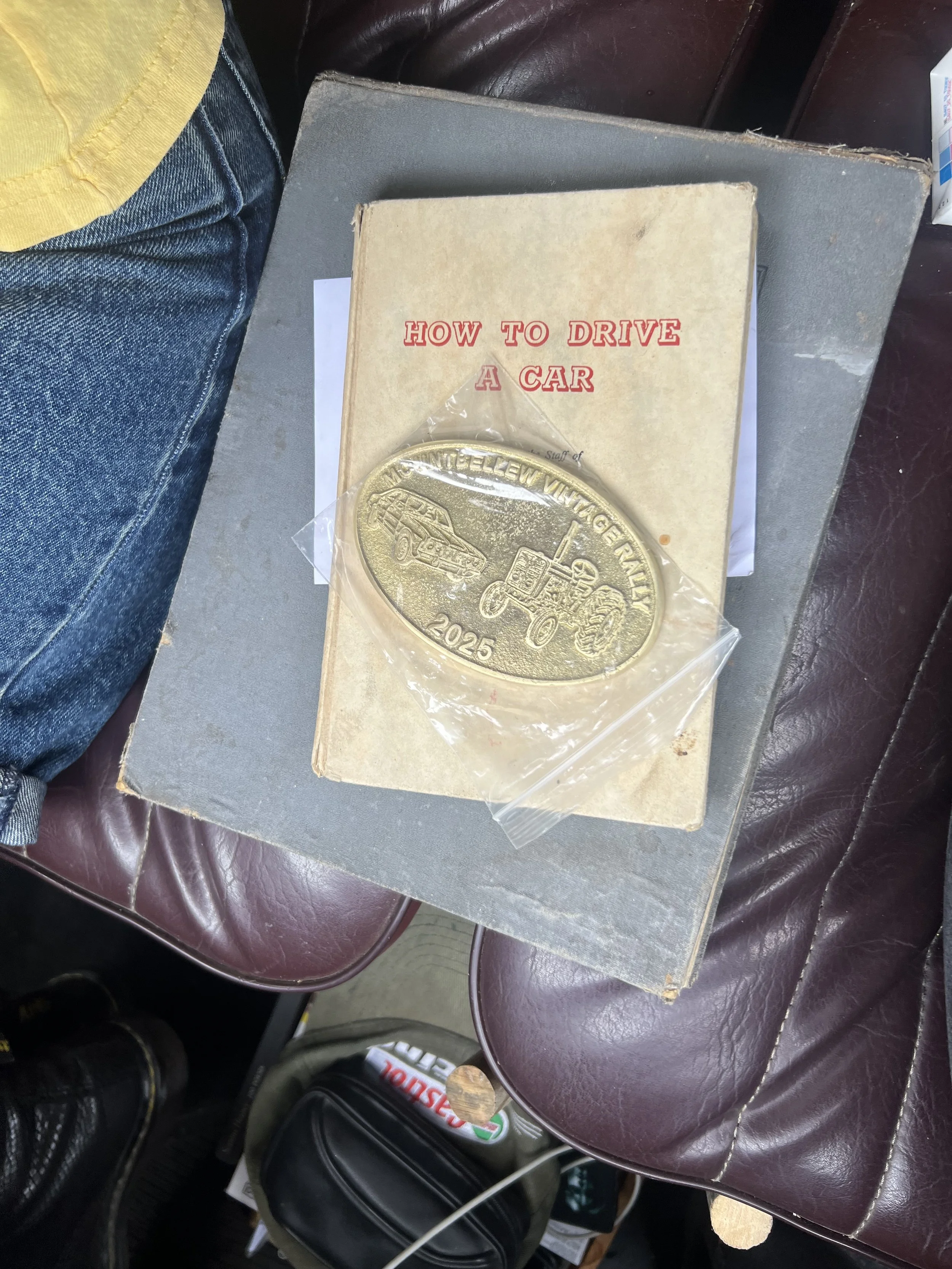
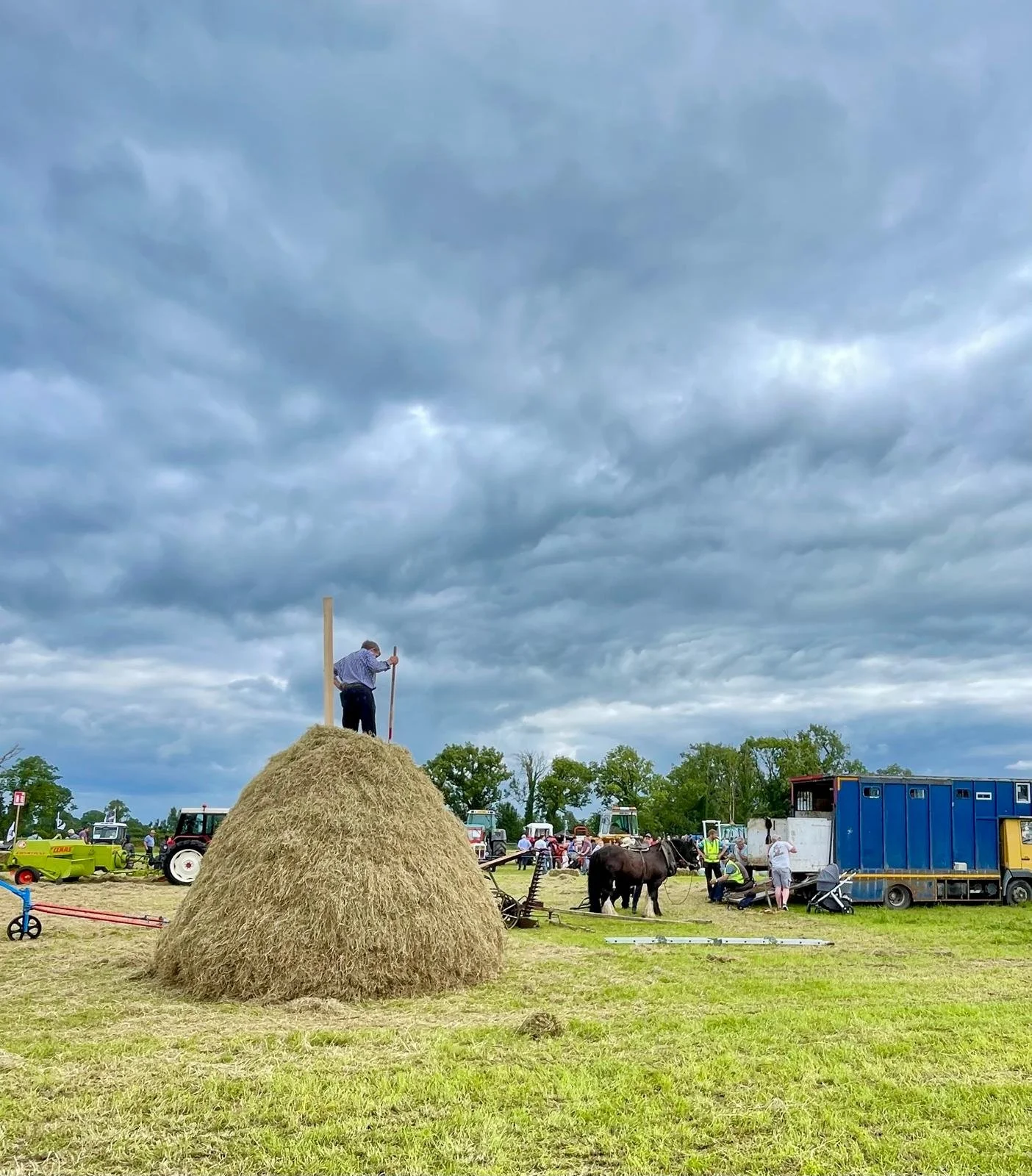
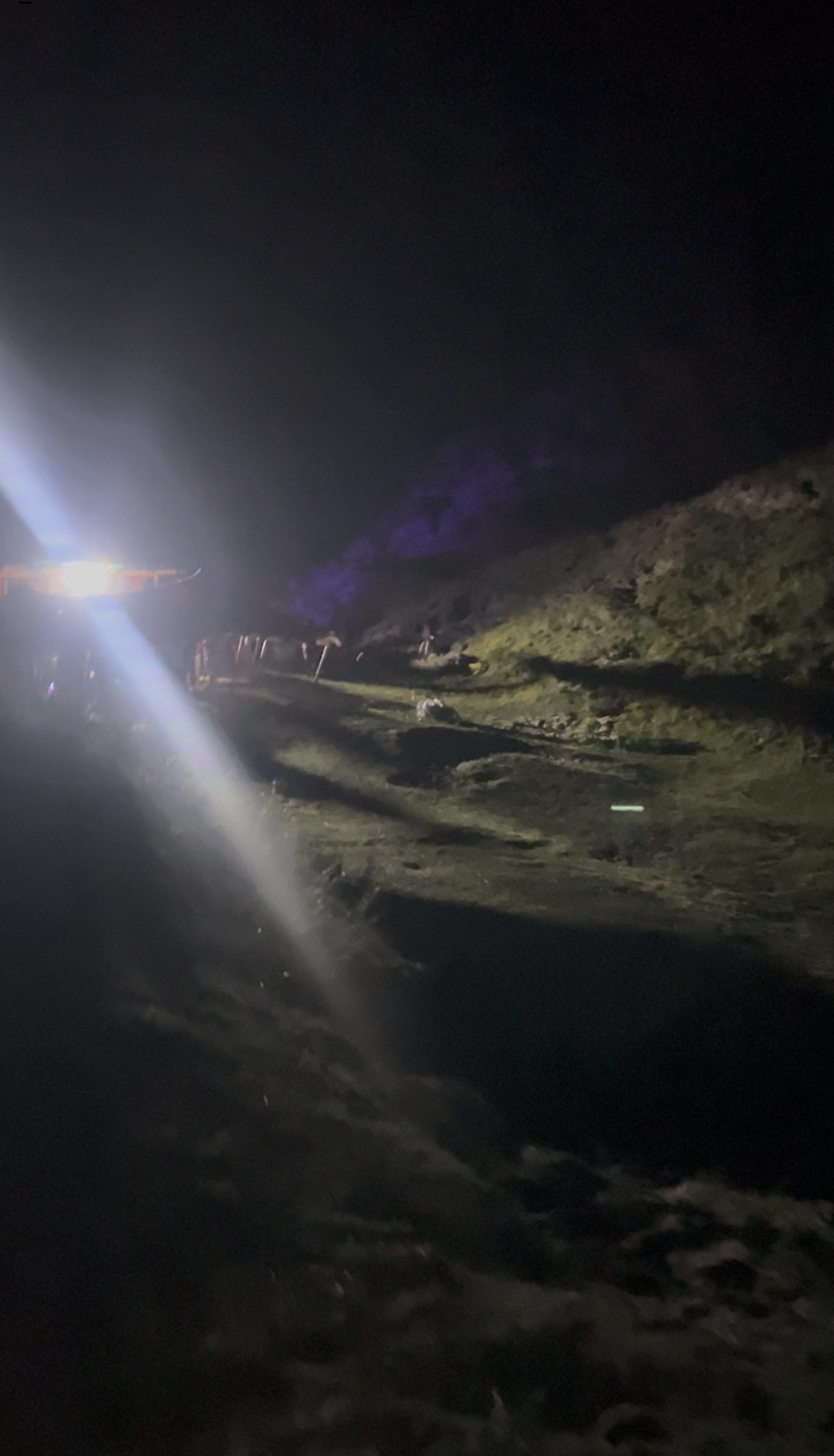
Photo credits: Laura Fitzgerald and tour de force
26.07.2025
After crossing the Priests Pass we arrived in the village of Kilgarvan on the banks of the Roughty River where we were able to rest a short while, wash and dry clothes, listen to polkas in the local pub, witness the elation of someone winning Gaelic football all Ireland final tickets, and eat one of the best burgers of our lives at The Village Grill. We had a nice chat with the proprietor who has been cooking for the village for over fifty years, and a fella came in wearing a Donegal Rally t-shirt and joined in. Everyone in Kilgarvan is either massively into Gaelic football; Kerry are a leading team that frequently make it to the finals; or motor heritage; being home to the Kingarvan Motor Museum and the well-known rally stage, the Healy pass. The pass is an ancient track known in Irish as Bealach Scairt, meaning the way of the sheltered caves. It was cut and dug in 1847 by starving people in the area to earn a wage, as part of an infrastructural public relief project during the famine.
Travelling in Ireland in 1835, French magistrate, Gustave de Beaumont and his companion, philosopher Alexis de Tocqueville documented extreme rural poverty - the damaging role of absentee English landlords, the deep social divisions tied to the Protestant Ascendancy. They researched rural Ireland’s socioeconomic conditions and the impact of British rule. In his journal, de Beaumont noted, The Irish Catholic finds only one profession within his reach – and when he has not the capital necessary to become a farmer he digs the ground as a labourer.
Initially the Famine road was called the Kerry Pass and at some point it was changed to Healy pass, named after the troublesome and ‘scurrilous’ politician, Tim Healy; who openly clashed with Charles Stewart Parnell in a hilarious feud that prompted nine-year-old Dublin schoolboy James Joyce to write a poem called Et Tu, Healy? These are the only lines that remain from that poem, which was printed on broadsheet in 1891, circulated with family friends and sent to the Vatican…
His quaint-perched aerie on the crags of Time
Where the rude din of this century
Can trouble him no more.
On this day last year we sat in the sun drinking coffee and drying our clothes with the heat emanating from the 4L. The tour had stalled here in Kilgarvan after we happened across the Motor Museum just as it was about to close. For this reason, we decided to see if it was possible to fit in a visit in the morning before heading towards Inch to meet visual artist Laura Fitzgerald.
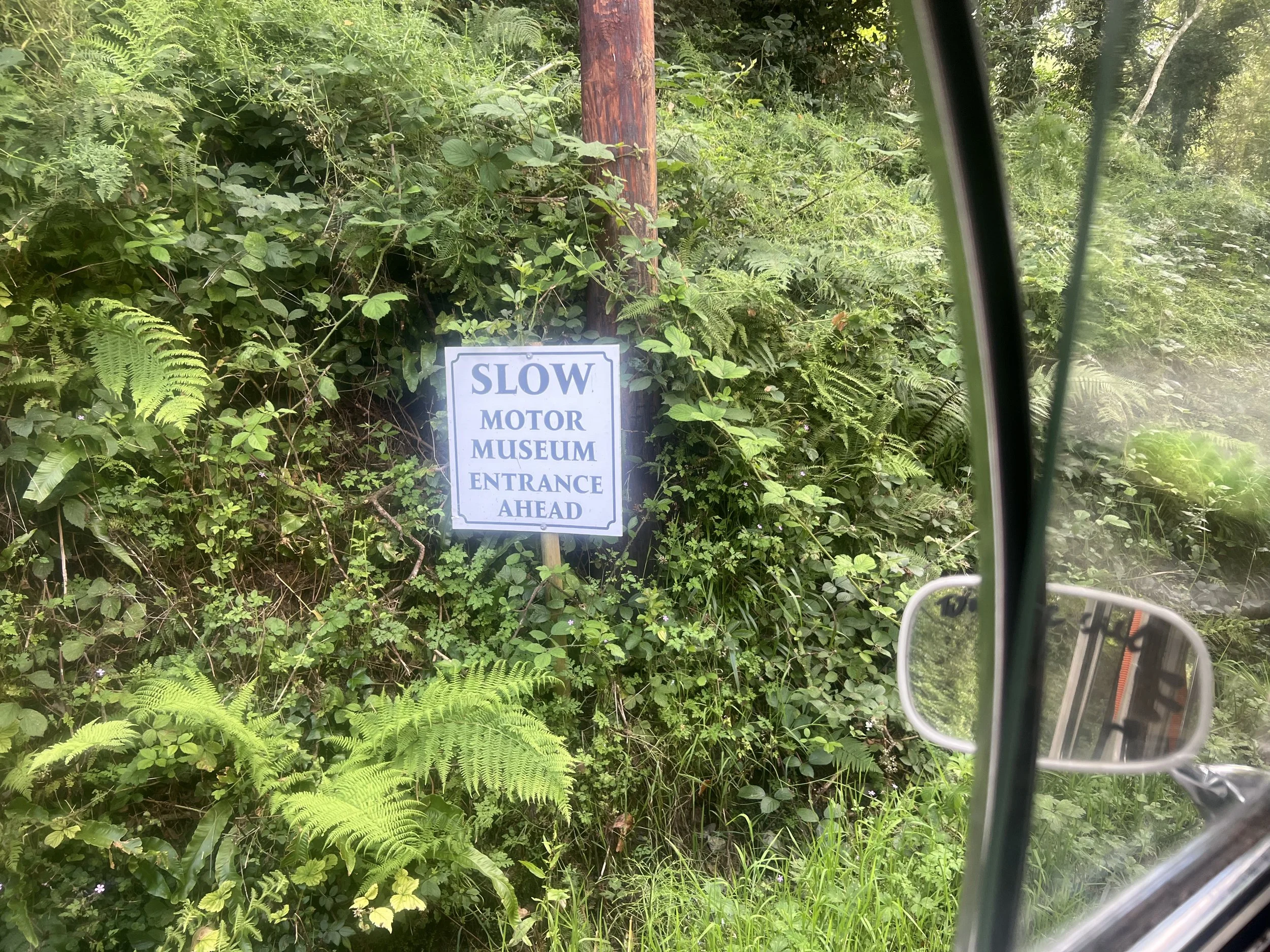
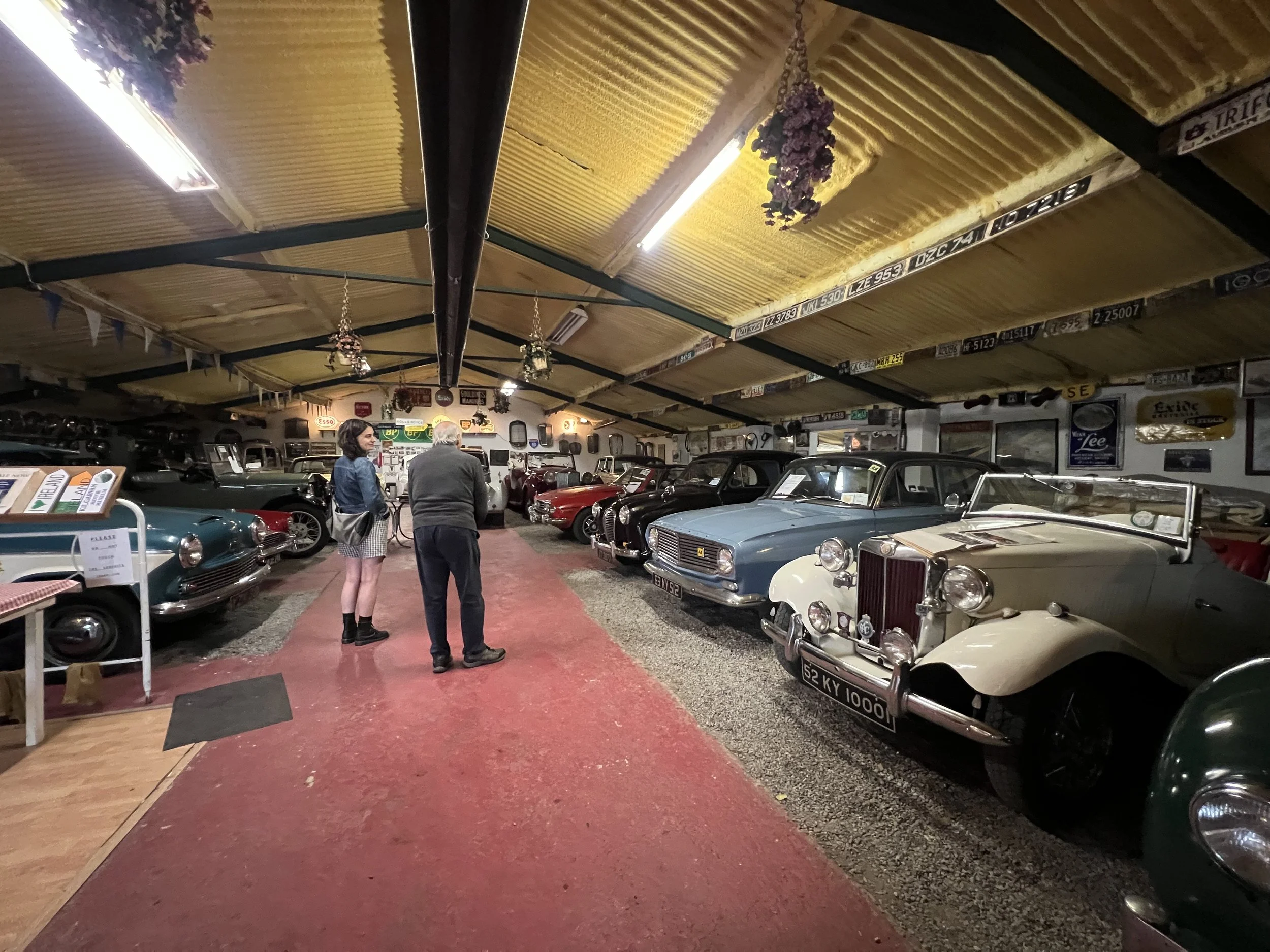
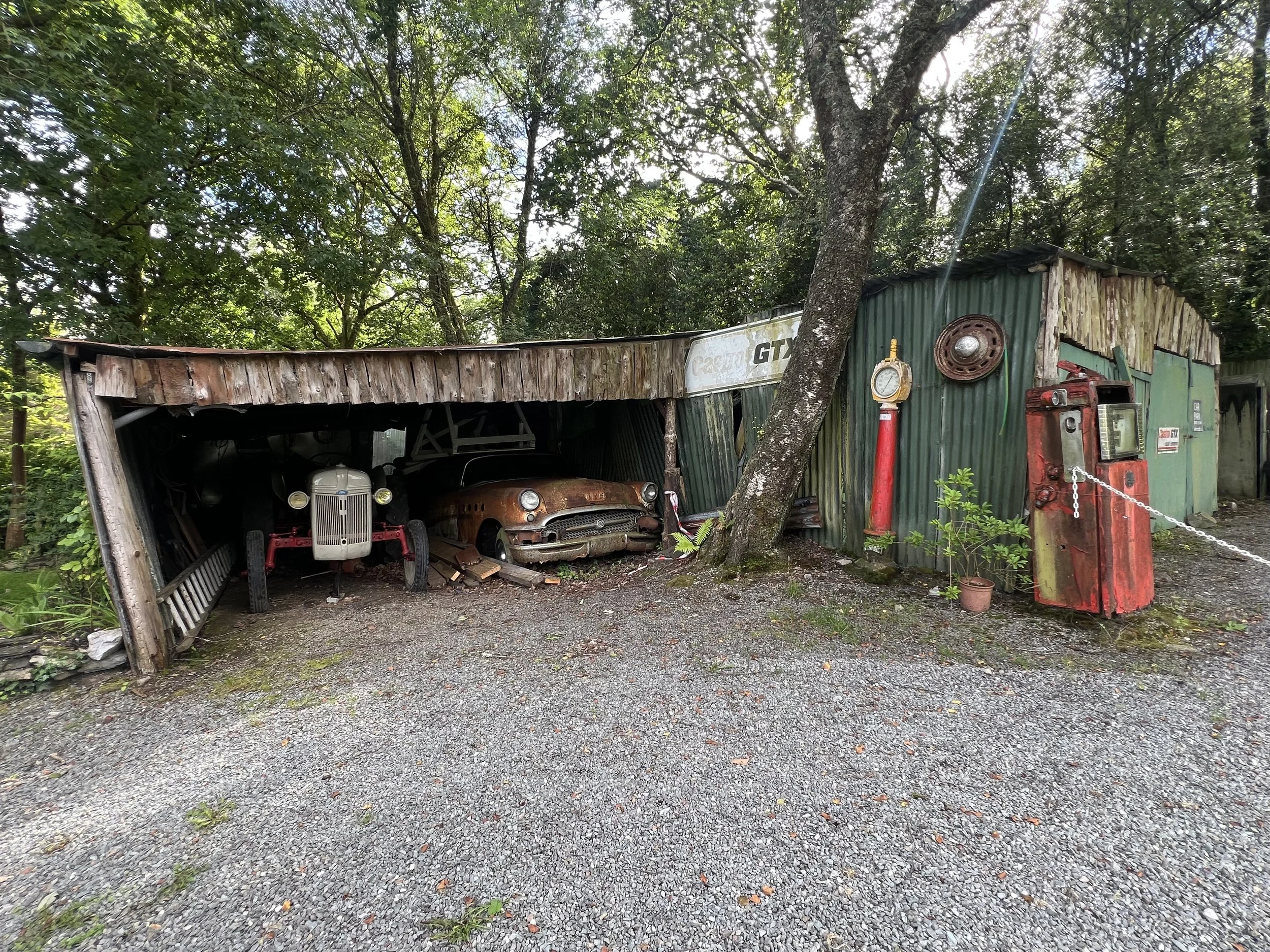
Driving along the Shandrum road, a small sign in the thicket points in the direction of a barn. On following the sign, approaching the clearing, you can see there are several barns with vehicles at varying stages of rust and ruin, awaiting their resurrection. Inside the barns, there’s a collection of cars, that represent a comprehensive cross section of Irish motor heritage. John and Joan Mitchell have built this collection over decades. The two of them repairing, building, sourcing parts, studying, researching, problem solving to preserve old models or bring them back from the brink. John started the museum in 1986 with his first exhibit, a 1946 Armstrong Siddeley Lancaster. For years John had the car in the back of his garage in the village where he worked as a mechanic, opening his business in 1968. And as he gradually repaired the Armstrong Siddeley Lancaster, people frequenting the garage shared stories of other forgotten cars in far flung barns. It became John and Joan’s life’s work to collect these cars, restoring them to their former glory. Exhibiting the objects, curating the collection, welcoming visitors through guided in-person tours and self-published memoirs, John, Joan and their two sons are an example of one family preserving an entire story, a material history through carefully collected and meticulously repaired objects sourced in barns and exhibited in a museum built from the ground up.
That evening, we finally made it to Inch, where Laura Fitzgerald and her father Micheál warmly welcomed us and so kindly agreed to guide us around the area on a tour in the Renault 4, with a storytelling itinerary according to the local landscape. We parked up at the local pub in Inch and met beside some humorous, tongue in cheek murals by Laura – the classic smiling stout and a country road stop sign, subtle interventions in the visual lexicon of village life.
Laura is a visual artist based in Inch, Co. Kerry. Her work is colourful, playful, and distinctly humorous. Often handwritten comments and narratives accompany her drawings and paintings, sometimes referencing personal experiences and sometimes pointing to much broader issues. Laura’s work can be simultaneously dark but interspersed with lightness and wit. Moving between the local and the global, she references climate change and agricultural shifts in the context of residual colonialism in rural Ireland, the complicated relationships between land ownership and land occupation that have arisen circumstantially.
We joined Laura and her father for an interview where the two shared a co-authored story. The sensitivities of boundaries between places, how co-existence in rural areas is rapidly changing due to tourist interest or EU levies, compounded by inherited dynamics, neighbouring or familial tensions and feuds over land ownership, divisions, boundaries... Laura’s stories look at the embedded complexities of rural life that spill into the local environment catalyzing further intergenerational strife.
Land Eats You, a fiction by Laura Fitzgerald will feature here tomorrow evening…
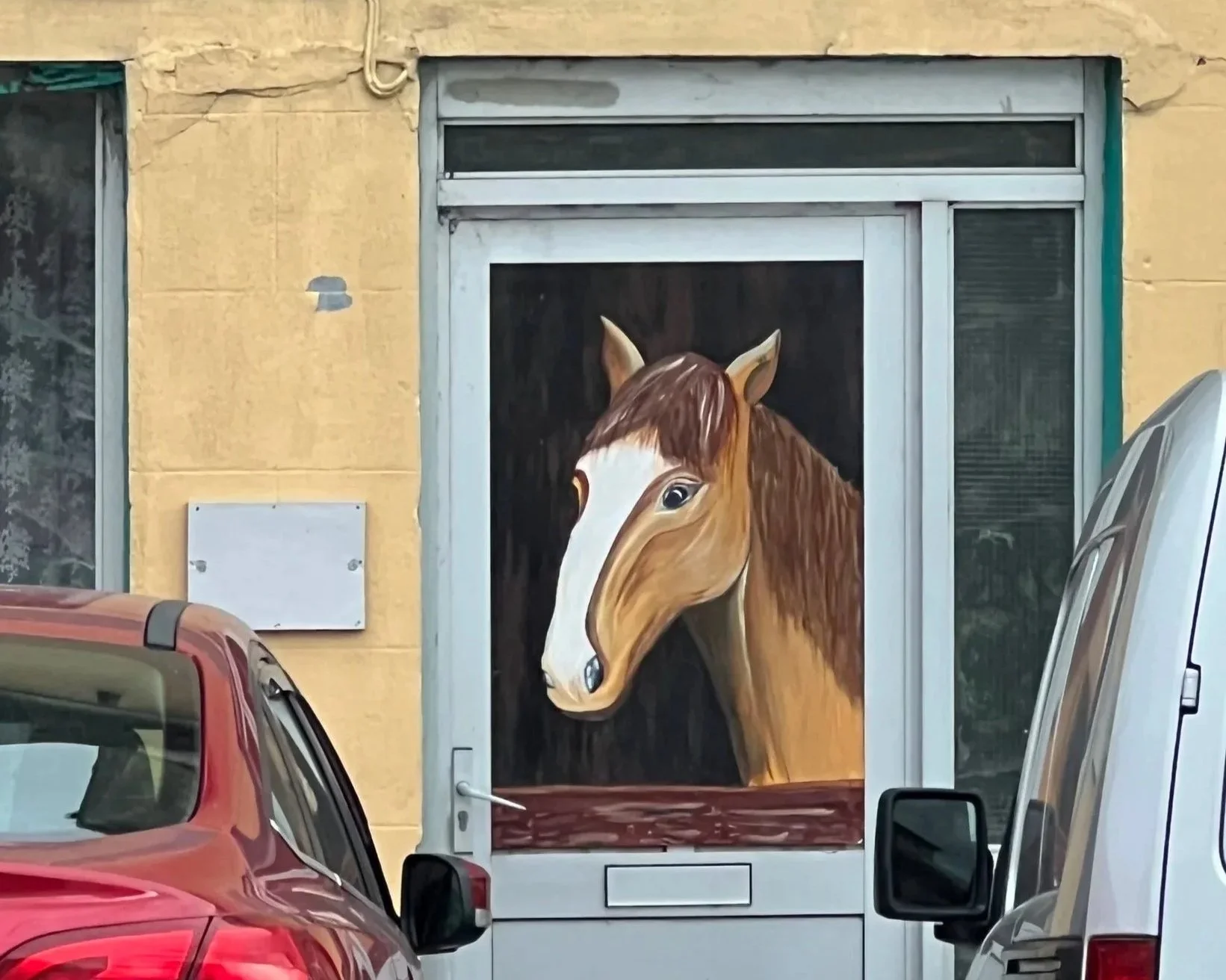
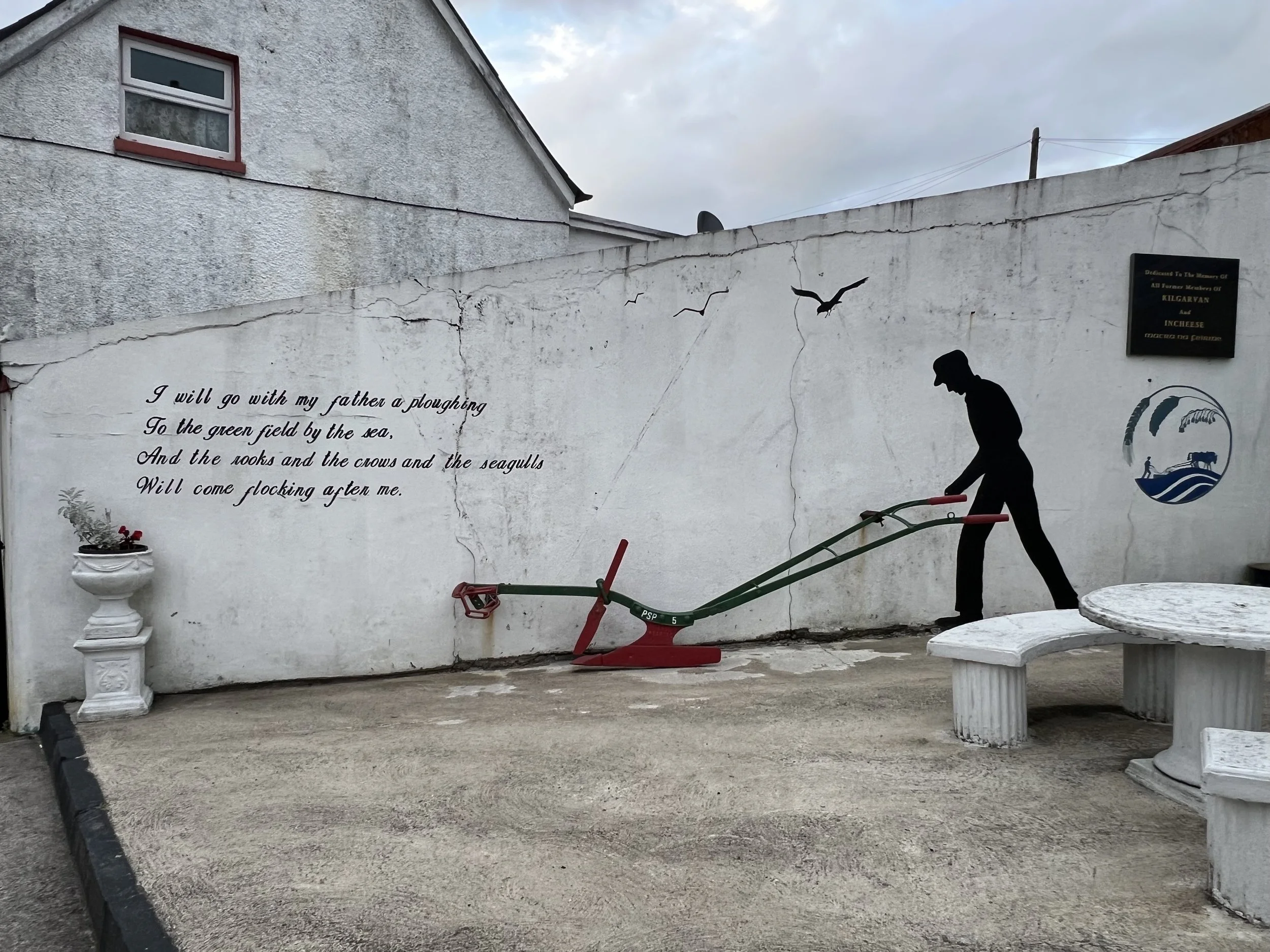
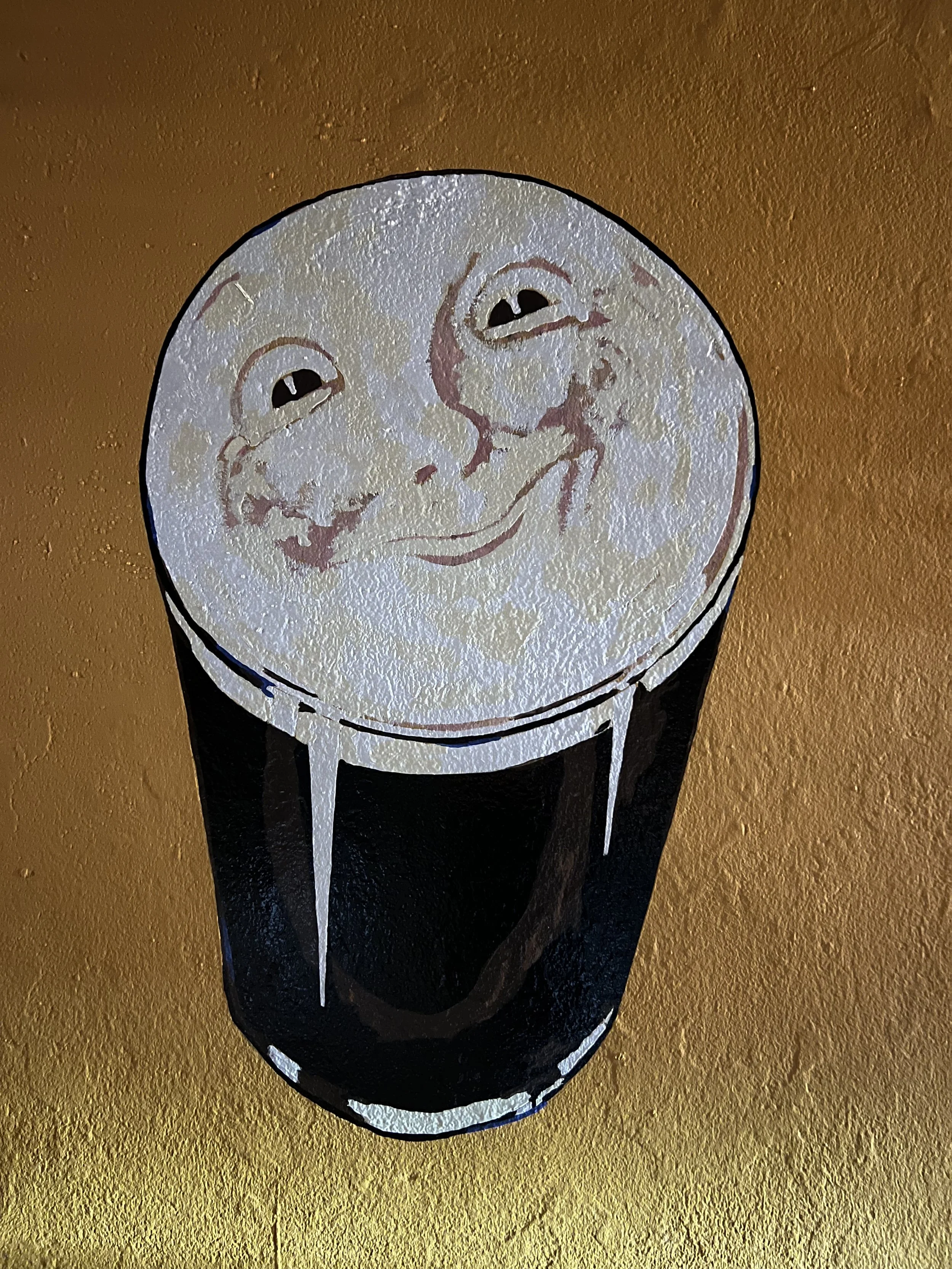
Hand painted artwork by visual artist Laura Fitzgerald at Inch Foley’s Bar
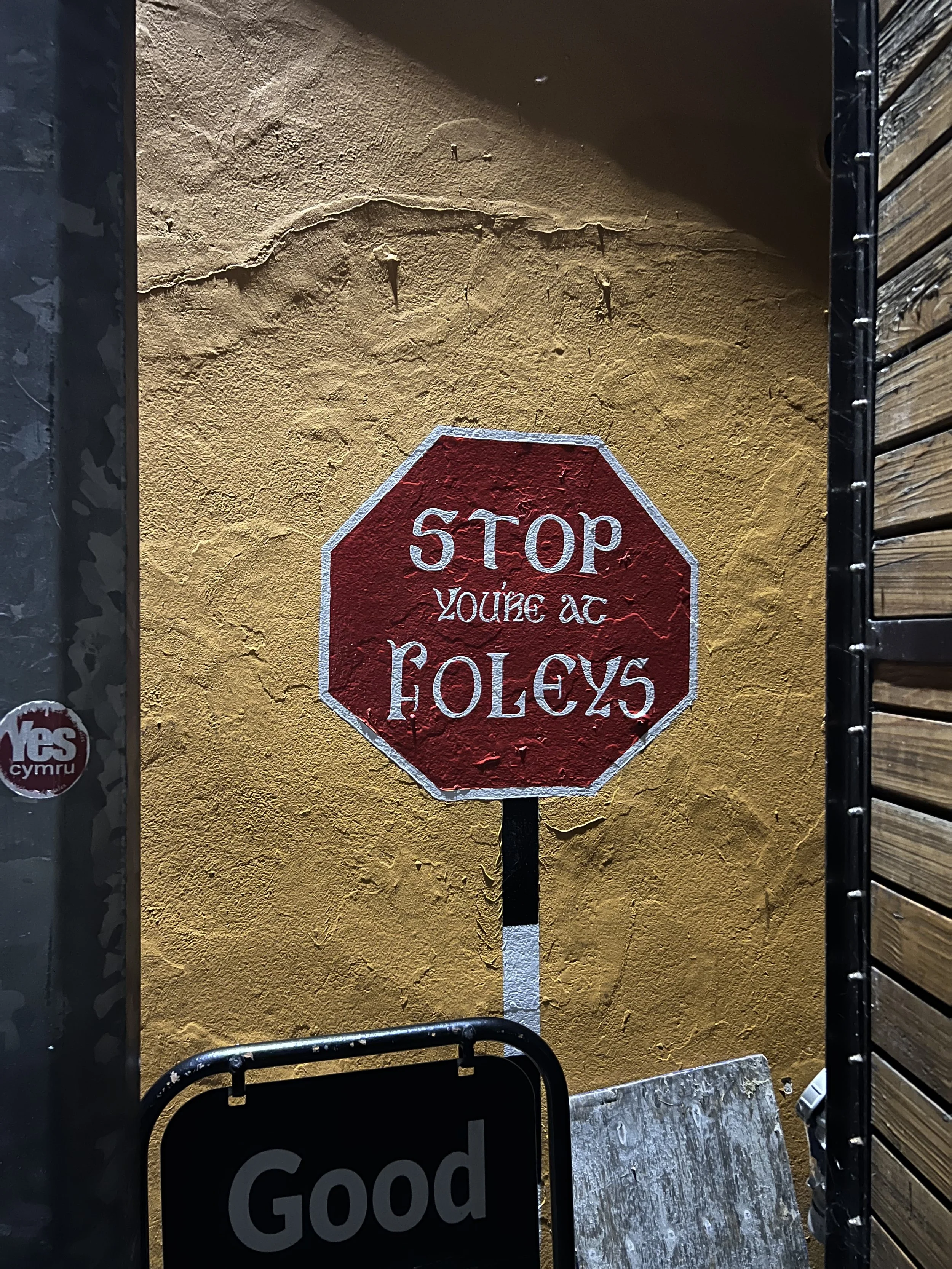
Hand painted artwork by visual artist Laura Fitzgerald at Inch Foley’s Bar
25.07.2025
This time last year, we were travelling from Cork to Kerry on the highest road in munster on the advice of two ecologists we’d met in Ballydehob.
A conversation had sparked up outside Levis Corner House the previous night - about dwindling rural populations, obsolete farming practices, land use, outmoded equipment and extinct crops in upland, rural Ireland. We were due to leave Cork the following morning, so we asked…if by any chance at all, Will and Howard would be up for an interview in the Renault 4 that very night.
Something that seemed important on the tour, was to allow for diversions and tangents to take us off course from time to time – we wanted to accommodate detours from the main path so we could understand how the scale of development from premodernity to industrialisation had played out according to the landscape, and what effect this might have had on the circulation of culture.
Sometimes there are these moments in research, writing, art making where things click. For myself and Liliane who value process, fluidity and flux, it was wonderful to meet two academics with shared philosophies but in a completely different field. It was an opportunity to glean insight into how environmental changes are shaping land use, landscape and culture as a whole. And how fast this is all happening. Will and Howard, experts on wildfires and peat bogs respectively….
Will Hayes in his own words,
Currently I am a Postdoctoral Research Associate in Fire Governance in the Department of Geography at Royal Holloway, University of London. My work focuses on how land-use change, agricultural policy and governance shape wildfire risk, biodiversity and rural livelihoods, particularly in Ireland and Guyana. A few years back I completed a PhD in Biodiversity Management at University of Kent, where I examined the impacts of environmental change on biodiversity and rural communities.
I come from a farming background and originally trained in conservation ecology, later working in bird conservation and community engagement across Ireland and South America. Although I love working on the mountains or in the forest, I’ve always been equally interested in people, especially how communities live within, manage and shape landscapes over time. My work now focuses on socio-ecological systems and sustainable land management, with the aim of supporting landscapes that work for both biodiversity and the people who depend on them
Howard Cross biography from The Co-Centre for Climate + Biodiversity + Water is an international research centre website….
Howard Cross is a Co-Centre for Climate + Biodiversity + Water PhD researcher in the Trinity Geospatial and Environmental Modelling (T-GEM) group at Trinity College Dublin, supervised by Dr. John Connolly. His research looks at how restoring blanket bogs affects their ability to store carbon, and how changes in vegetation and land use play a role in that process. Before starting his PhD, Howard built up broad experience working across government agencies and multinational companies, carrying out both laboratory and ecological fieldwork. As an environmental consultant, he has contributed to a range of major infrastructure projects across Ireland, supporting assessments of how developments might affect wildlife, habitats, and protected sites. Howard’s background spans environmental science, project management, and farm payment schemes linked to environmental outcomes. This gives him a practical, joined-up approach to balancing the needs of rural communities with the wider demands of the modern world.
Throughout the tour, the maximum speed we’d reach would be no more than 60km or 70km/hr and we wanted to stay away from motorways, choosing quiet, forgotten roads and taking our time. With this in mind, the two ecologists recommended a route for us as we planned our onward journey towards Inch. They suggested that we take a route known as the Priests Pass from Cork, to Kerry, the highest pass road in Munster.These were the kind of roads we wanted to take during tour de force; roads less travelled, back roads, old rights of way, forgotten paths. Journeying in this way, connected us with storytellers and musicians of a bygone era, and with old place names remembering local landmarks and their associated uses and histories; millstones, wells and mountain passes. Along the route recommended to us by Howard and Will, we played music selected from a stack of specially commissioned mixtapes made for us by Vera and Taf in Ballydehob. We will revisit these beautiful soundscapes (with handmade covers from some very special guest artists) later when tour de force arrives on Rathlin Island.
One of the main ideas behind tour de force was to look at points of convergence between traditional and contemporary forms of creative expression in rural parts of Ireland. Something we came back to again and again; what it means to etch a living artform onto a permanent archive. During the tour we collaborated with, and commissioned artists, writers and musicians working across varying forms of cultural expression from traditional music and dance to contemporary visual art. This was a way for us to consider the history of creative expression on the island of Ireland; to look at why some traditions are documented in archives, and not others; or how they have circulated for generations through networks of old roads that follow the shape of the land. To think about the origin of a melody; how it became separated from the landscape that inspired it and the person who composed it, to belong to everyone forever.
Because Ireland is a country that has been colonised, it has a divergent canon of creativity compared to the rest of Europe. The institutions that stand to represent cultural circulation in Ireland were established by governing bodies, who were colonisers. We might think about how few contemporaneous paintings depict the Famine; An Gorta Mór 1845 to 1852, one of, if not the most significant events in the history of Ireland. We can thank musicians of the past, Travellers mainly, for their artistry in preserving objects of intangible heritage - in retaining the shape and integrity of ideas, thoughts, philosophies that moved freely and were only recently recorded and corralled into archives. Countless songs, melodies, techniques have been safeguarded by people with a kind of memory we won’t encounter again and shaped along roads and towns now bypassed.
In an oral culture that relies on social and generational dissemination, the rupture caused by the Famine obliterated the culture with a monumental effect on shaping the collective consciousness of rural Ireland. In huge numbers, the custodians of skill, creativity and innovation; the people themselves were killed and the knowledge died with them. We can’t know how many techniques, recipes, tunes, songs, ways of life, dwindled and became extinct during this time. But we can understand that oil painting was not the expression of these people and so is a merely illustrative, or removed representation of the canon of rural Irish creativity; a flimsy document of a monumentally devastating event. The idea of the Otherworld in tour de force considers Irish mythology as a place of music, poetry and dance. It’s the realm of the deities and the dead, a heavenly land beyond the sea, through a cave, down a well, on a plateau or under the earth, a parallel world that exists alongside our own through familiar and ancient features in the landscape.
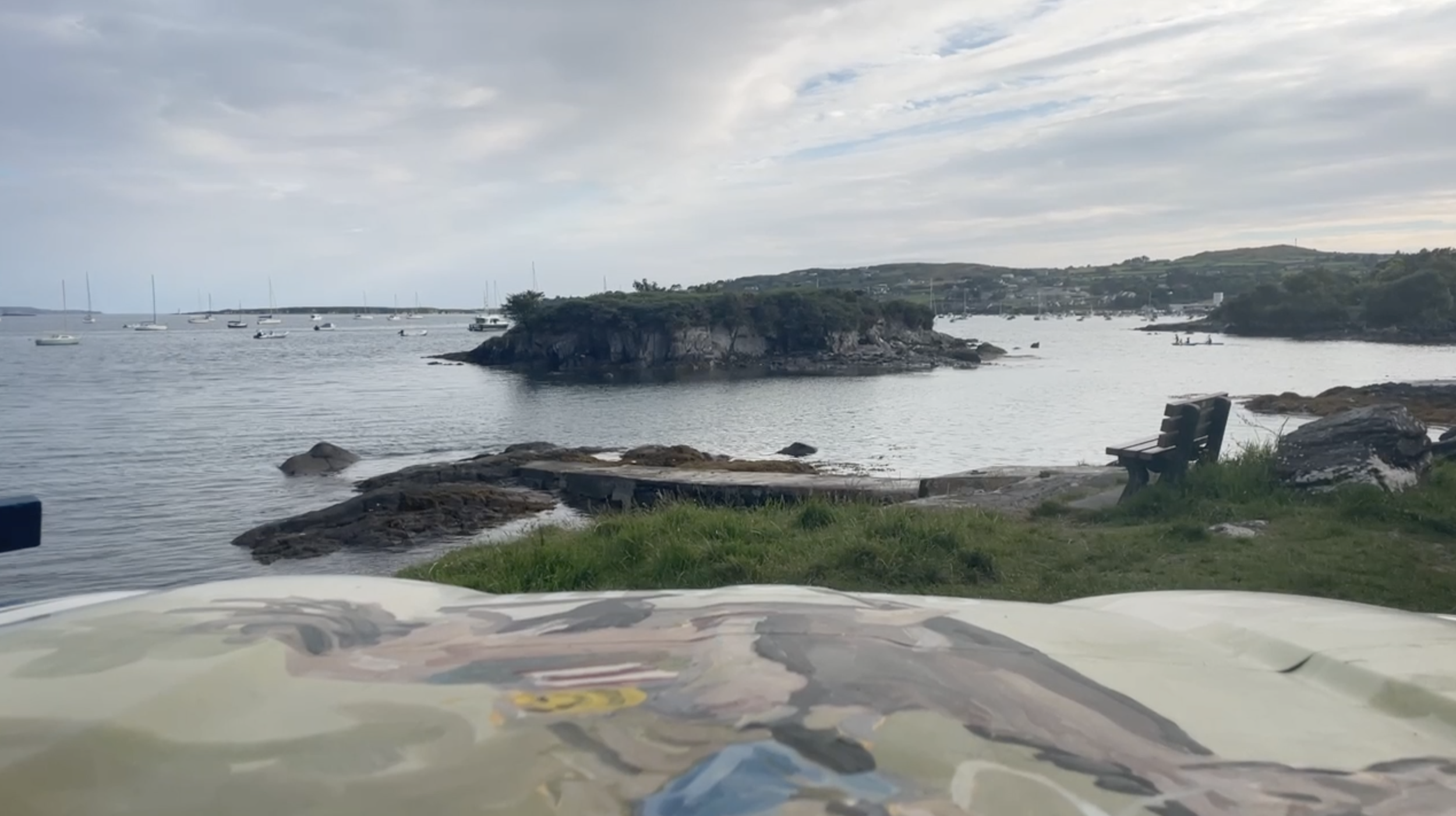
We sat in the car, the four of us, Liliane, Will, Howard and myself, for an interview facing into Schull Harbour at night. Our collaborative tour de force adventure crossed paths with Howard and Will’s ecologist adventure and the encounter resulted in a very unexpected and fascinating conversation. You can watch the interview here…..
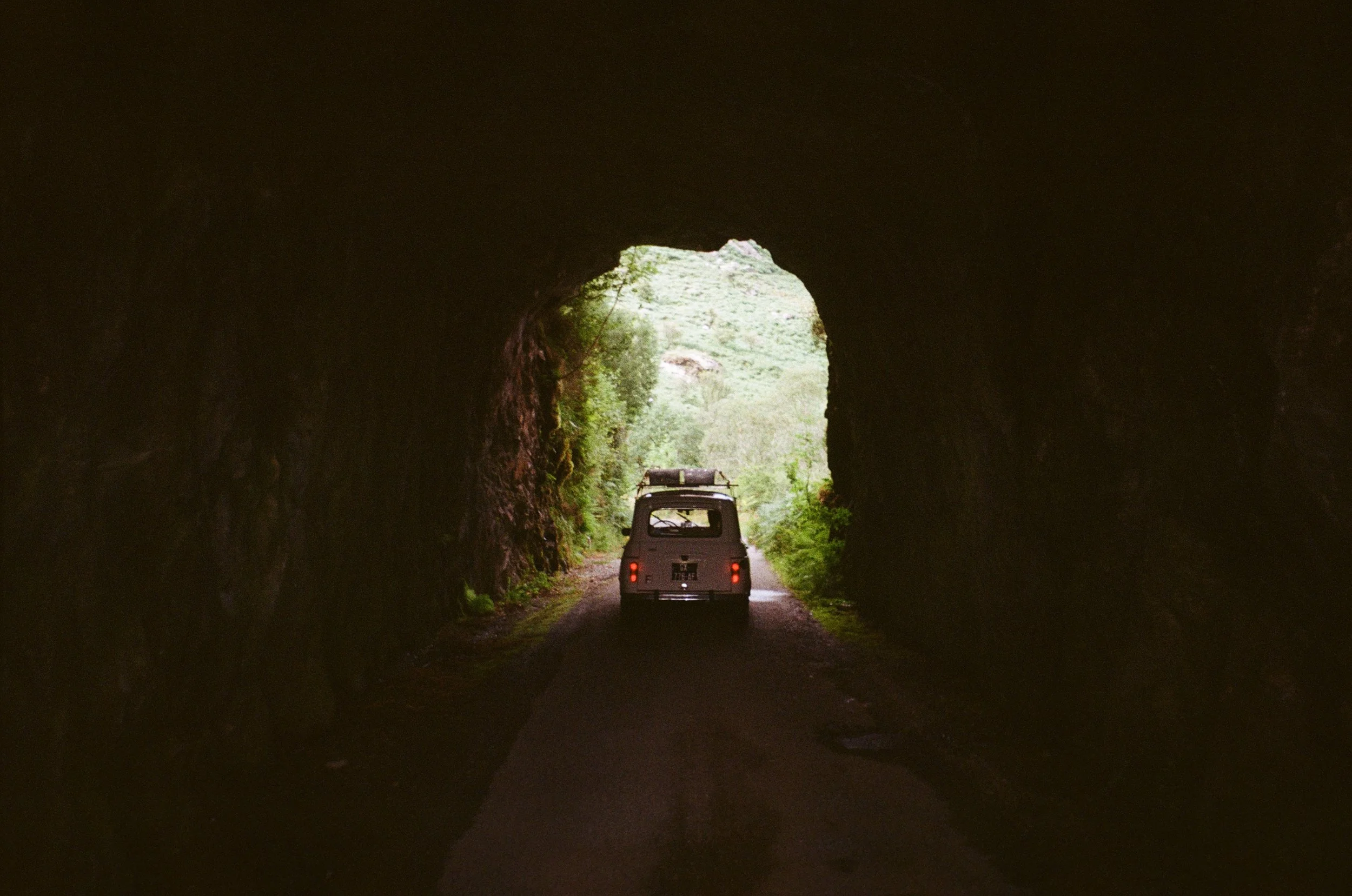
24.07.2025
The transition from Wexford, Waterford into Cork City along the quays, in and out of industrial areas toward the idyllic west brought a change of rhythm.
Cities develop towards circulation; transport, movement of people from place to place, and planning laws are usually closely monitored; architecture being valued as functional or culturally significant. The countryside on the other hand conforms to an ideal of pastoral farmlands or protected wildlife reserves. Both city and countryside are constructs but between the two, is a buffer zone that is largely unacknowledged, poorly planned, unsightly and often associated with waste management and criminal activity; ports, industrial areas, forgotten hinterlands, liminal zones…edgelands on the fringes of society.
An ignored and neglected terrain, they flourish with wildlife, providing an environment of unfettered growth for a wide variety of plants. Such environments exist on their own terms, and are not tended to according to our ideals of function, recreation, beauty etc. In a way the lawlessness associated with edgelands makes them more of a wilderness than the mountain tops, rocky coastlines or lush forests that you see as you travel west along the road. The mysterious quality of these places-their promise and potential for adventure as well as danger, the feeling of non-conformity that is abundant in such places, their ambiguity is all worth acknowledging and even celebrating.
The definition of weeds in the dictionary illustrates our limitations here, where we define flora and fauna according to perceived ideas of worth. Weeds, says the dictionary, are ‘a valueless plant growing wild, especially one that grows on cultivated ground to the exclusion or injury of the desired crop. Any undesirable or troublesome plant especially one that grows profusely where it is not wanted’.
Concrete, dumps, weeds, machinery, scrapyards, factories, wastelands…
Edgelands are the dovetail between tradition and modernity, rural and urban. For a materialist society based upon the widespread belief that ever-increasing production, consumption and profit are yardsticks for measuring the quality of human life, the particularity of subjective or embodied experience, of mythical thinking and the value of local knowledge are consistently undermined. Whole bodies of knowledge belonging to particular place and time; folklore, the mythical and the marginalia of the local are being destroyed.
For our pit stop in Ballydehob we got in touch with Vera and Taf, musicians, artists, educators and founders of BRRR Record and Tape Fair. Vera and Taf travel around with their extensive and brilliant vinyl collection, DJing and teaching people it's core fundamentals, causing club nights to spring up in their wake. Given that Vera and Taf always have their ear to the ground on local projects, we asked them if they knew of anyone in the area who would like to be part of tour de force for an interview, to share some music, art, knowledge, a good story. They got back to us suggesting Samuel Arnold Keane and together we arranged an evening of music and storytelling at Levis Corner House, Ballydehob, where Samuel joined us to share some songs en français. Having spent his childhood in Lyon, he’s interested in urban foraging, how we can reclaim small forgotten parts of the city, and perhaps discover a burgeoning biotope on the peri-urban fringe. Samuel is a self described wanderer who merges various art forms to tell stories of the seaweeds, coasts and streets as he gathers, wades and walks.
This day last year we interviewed Samuel in the Renault 4 with a live broadcast for our series K7 dans la 4L. You can watch the episode below. Much of the conversation centred on foraging. Samuel current research focus is the preservation of, and access to shorelines in west Cork where he shares his knowledge of seaweed in person with small self-published booklets of text and drawings that he often distributes during guided foraging tours.
23.07.2025
Bedtime story for Ballydehob at Levis Corner House….
293 Local Link
I
I read about a bard who once remarked that perhaps streams should have rights – that they should be allowed to travel wherever they please.
He said, and I might be getting this a little bit wrong, so don’t quote me because it was many years ago that I read it… but he said, we should acknowledge that when a stream flows from its source to the sea, it forms patterns in response to the terrain it traverses. And we are passing on our tunes and stories in a similar way. Before aural prompts could be shared electronically, they were passed on in person.
People were inspired by their surroundings and their experience of nature, more so than they are today. We’re so disconnected nowadays aren’t we? Have you heard the story of a tune from Donegal? Tuam na Farraige or the Atlantic Roar as it’s called in English. It’s a south-west Donegal tune that entered into the consciousness of a man as he slept by the sea. After he had spent the night playing music with friends and was on his way home, he grew too tired to walk any further and lay down on the crest of a hill by a beach in Glencolmcille. The tunes from the night mingled with the ebb and flow of the tide and he awoke with a fully-formed composition, which he then played on the fiddle. It has a great rush to it, the surging and swelling of the sea and then it pulls back and when it does so, smaller waves are still rushing forward. Do you know what I mean by this? Do you know the way that those smaller surface waves rush forth daintily when the hefty wave sucks back in to the Atlantic temporarily. Lilling some call it. The sound of this body of water rising and pushing against the land.
And some of the musicians from that time believed that yes; tunes and stories arrived through animal song and from the otherworld into the landscape around us. There is a detail that you will see coming up again and again, a motif that involves sudden disorientation – a disordering experience of the landscape often accompanied by the sight of mist or of a wisp rising. And the person is lost and they might wander for days or months or even years, and when they return home, they are mysteriously enriched.
Tree branches and streams can have the same pattern, reaching out for what they need and moving closer to where they are going, so wouldn’t it be like that for us too?
Another such tune, also by the great John Mhosaí McGinley who lived in Glencolmcille in the early to mid-19th century is this one that I will play for you now soon. It came to him at a waterfall as he made his way back from a big night in Mín bhFáchrán. Mín bhFáchrán - the mountain meadow of the bogbean, a place where people would gather, usually in March to boil and eat the bogbean as it was said to purify the blood. (An T-Eas Hornpipe, The Waterfall)
II
This happened in 2018 and though some aspects seem implausible now, I do remember that it was a bright day in early spring and I walked towards the Diamond through the car park where an encampment of vans bordered the Eske River. Outside the Abbey Hotel I leaned into the jamb of a doorway and perused a noticeboard with a few weather-beaten pamphlets. A boat cruise, a country and Irish band playing tonight, a new online exhibition about the Spanish Armada. The others along the footpath started to gather themselves for the bus and when I glanced over my shoulder, I saw it rounding the Diamond slowly to allow for a group of tourists to cross, holding their ice-creams and bags of tweed.
€4 to Glencolmcille from Donegal town. The price of the ticket is after going down when the price of everything else in the world is going up. I handed over a €20 note.
‘You don’t have the four do you?’ he asked, picking through the float.
‘I don’t,’ I said so he took a tenner from his own pocket to add to the change.
A string of wooden beads swayed from the rear-view mirror as the bus pulled out onto the road and turned the corner past the Blue Stacks Pub. Something occurred to me, very subtly. I wouldn't go looking for trouble, ever. I wouldn't entertain it, allow it to manifest, feed it or encourage it. That was a quiet epiphany and I watched a cormorant dive as the bus crossed the river.
III
We passed the grave stones plotting a path around the headland by the Old Abbey Graveyard where slabs of stone tell the stories of the people underneath. ‘In memory of his brother John Hughes who lost his life on the Island of Cape Briton on the 31st of August 1836 aged 25 years and six months then in command of the Brig Zephyr of Donegal.’ There’s typos on some of the stones. Briton or did you mean Breton.
That moment when life is committed to something permanent that'll be there for the future. I think of that so much in relation to this music and all the heritage of a place taken from the non-literate world with all its beauty and mystery it committed to paper or stone or recordings.
It's often overlooked nowadays but these fiddle tunes were not thought of as traditional Irish music. They were just the melodies that were available to people. Music that we liked and shared with one another. In the 1920s, other types of tunes started coming in on the radio. Melodies from America, jazz tunes for the quick step and the fox trot. (Jim Curran’s March)
IV
It had been a poor night’s sleep in that hostel on the hill with such a slant to it that if you took a marble and placed it on the table, it would roll off and continue rolling until it hit the skirting board. In the sloping rooms, laying down you would feel the blood flow from your head to your feet, you might switch and lay back down again in the opposite direction, seeking out a balance, waiting for the blood to flow back to the feet. I followed this pattern until finally I was tired enough to drift into a brittle, listless slumber. I saw the dancers and witnessed the most incredible co-ordination of movements, I watched them – the women, dancing quietly to each other. Do you ever have those days when you wake up and look outside and feel a hankering for a time before things were ruined with the noise of importance? When we could share music and stories, songs and dancing between ourselves, and just that – in itself – was good enough. The women were tapping their feet as they spoke. Some were lilting a highland, lilting in case you don’t know is to sing the tune, which women would often do. Some people believed a woman would be taken by the fairies if she played the fiddle. I’ll try to play it for you now as I’ve spent time with the fairies and was lucky enough to leave them too. A melody for dancing.
V
In the morning I had only a constellation of vague images and the doubt I slept at all. The bus had arrived at Frosses and stopped to let a sporty looking teenager on.
Frosses was once home to a particularly fearsome clan of fighters. These mercenaries, these particular Gallowglasses were the McSweeneys from Scotland. They were a clan in service to the O’ Donnells between the 13th century 16th Century. Serious mercenaries who helped the O’ Donnells make sure that this was the only part of Ireland, which was never entirely defeated by the British, by the English, I should say. (McSweeney’s Lament)
A woman at the front of the bus was chatting with the driver about the bog oak beads that were dangling from the rear-view mirror, Maple is used for the back plate of the fiddle, she said, as well as the rib, neck and scroll, while spruce is good wood for the front plate.
I have this dream regularly,’ she said, ‘and I know people hate hearing about dreams so I’ll make it quick, but I was given a fiddle and it was so heavy I could barely lift it. How can the sound resonate, I thought, how can it flow through such a heavy wood, it was that heavy, it could have been made of stone. The bus stopped and the sporty teenager got off. (Tommy Burke Hightland)
The woman with the stone fiddle who had done her shopping in Aldi was still there with her continued chatting to the bus driver. She divided the space in front of her with a gentle hand before allowing it to curl again and rest on her knee. Can you imagine the tunes that that girl had? But the girls in the house were not to court the devil with music. And anyone who listened to their music would be struck with the Mí Adh, a sort of hex.And so it was, that the music was taken away from them. The youngest daughter was tied to a tree after that. She was affected by the moon, they say and spent the rest of her days on Bruckless pier begging fisheads off fishermen. I’ll tell it to you the way I heard it. (Báitheadh Bhruclais, The Bruckless Drowning Jig)
She was out in the morning, warning the men that if they couldn’t spare some fish heads then they shouldn’t go to sea. I knew her well and I knew her to be industrious, resourceful and a good dancer. They mocked her and left her, throwing fish heads for the gulls instead. No one will know until they are out at sea, she said. And it’ll be too late then. She had asked me to bring her a cupán, a little wooden cup and I did that. She stood there knee-deep in swishing, icy cold water and she cursed them, with her arms stirring a maelstrom in the water. The cupán circled and sank. I looked out to sea, said the stone fiddle woman, and saw a great curling wave charging down on the hapless boat. I shouted hoarsely although there was no one to hear. I shouted again madly, frantically. The vessel was almost completely submerged. One last time, it jerked up, but the mast went by the board – snapping and creaking with loose ropes, slashing like whips. A flying block of wood came rushing through the air. As the debris went overboard, it struck one on the head and he collapsed.
The bus had stopped to let someone on and the story waited until he was seated.
VI
The tune remembers the day, on February the eighth in the year 1813. Between 300 and 500 fishermen were lost and that is a true story. And people still believe it was Biddy Deveney who cursed the fishermen for their refusal to give her a supply of fish. And I was the one who brought her the cupán, said the stone fiddle woman.
The stone fiddle woman turned to gaze out the window and the bus driver switched off the crackling radio. The road was newly tarmacked and smoothed out the sensation of the journey. A finger tapped my shoulder around the seat to point out a €20 note that had gone roving from my pocket. The twenty I had given the bus driver in Donegal town.
The back seat man shrugged his shoulders and gestured out the window. This is where Condy Billy Boyle and his wife, Bridget, lived, he said, pointing to the foot of Sliabh Liag. Long ago in a fine dwelling place with a good number of cattle and even with their young children to look after, Condy's wife would go up the hill every morning to check on the cattle.
I folded the €20 note into my wallet as this man from the back seat continued his story.
There came a misty morning, he said, when she was going out and she put on Condy's coat and fastened it about her with a spancel. She took her stick and went up the hill to count the cattle. The trudging of her feet through the bog to get there. No shoes on. Suddenly the earth opened and she fell in and the heather grew quickly over. (The Fairy Reel) It was dark and she clambered through the peat crawling until she arrived in a large chamber, a house underneath the mountain.
Inside the house there was a party in full swing with a crowd of people dancing and singing. Tapping and lilting. And plenty of Poitín being passed around. (The Poitín Highland). Drink it and badly you need it, said a women, who with a big welcoming smile and excitement in her eyes embraced Bridget before handing her a wooden cupán of the Poitín.
Bridget took it and was about to drink when a large brawny woman rushed in the door and knocked the cup with the back of her hand, splashing it across the room. She doubled over out of breath and gasped up at Bridget. Now, she said. It's a hard race you put on me today from the Cruachán of Connacht through the drowning waves to save you. The singing and dancing had come to an abrupt end and all were watching the three women who stood at the centre of the room as the Poitín trickled down into the corner and made a soft dropping sound on a peat step. If you drank that, you would never get away from here. Out with you now before me quickly. Don’t ever eat or drink anything given to you by na daoine mhaithe, the bus driver interjected. (The Fairy reel)
I'm not surprised poítin is mentioned in relation to fairies like this, continued the back seat man.
A lot of those stories, especially the ones that have dream-like sequences, I often think to myself, there was fair chance, poítin was involved. I haven't experimented with it myself mind you. But I might one of these days. I had the pleasure of meeting some of those who had been, in their younger days, the great poítin makers of this area. Incredible to meet these people who had lived so much of their lives outside the law.
He stood for a moment with outstretched arms to emphasise a chasm. The bus jolted and he steadied himself and sat back down. It has to be said, it was a perfectly bona fide economic activity here at one time, you know. With trading across the bay to Sligo. Next thing it was illegal. From the colonial times, as soon as the influence of the O'Donnell's receded from this area, every way that the people had to make a living in a place like this - fishing, home crafts, poítin - was taken away from them, plank by plank.
Never eat or drink anything the fairies give you, the bus driver repeated.
And never drink the water from the Cill Fhanaid well if the fish is there. The stone fiddle woman glanced up at the rear-view mirror and announced proudly that she had seen the fish with her own eyes. Yes, I saw it as a child when I went to the well to get the water,’ said the stone fiddle woman. (The Cill Fhanaid waltz)
The bus driver nodded. He had seen it too. I still visit the well before travelling to take a drop with me for good luck. For my brother and sister too,’ he added. ‘I collect water in jars, with their names and the name of the destination on a curl of masking tape. And they have them there in the glove compartment with chewing gum pellets, old maps and CDs. I have one here myself, he said and he pointed to a little glass bottle that hung on a bit of twine near the bog oak beads.
Out the back and encircled by a loosened drystone wall, through the briars, quietly and moving very slowly to lift the cover, gradually, imperceptibly as if it was only the rising sun meeting the water’s surface, and in so doing, you might catch sight of the fish, said the bus driver. A surprised and timid eye, a glossy, curved lip agape then gently mouthing. Orange, and speckled turquoise, dark green and silvery. Rich crimson on its belly and a stroke of white above its lip and on each fin. To see it you would be elated, but sorry as well to disturb it, knowing that you’ve frightened it. Moving towards the surface to bask in the warmer water, it would freeze in shock to see you there. Or it might dart under the overhanging stone but you’d still see its shadow swaying with the bending light. It would be at your mercy with nowhere to go in the well. And yet it was very rare that people would see the fish, because it usually wasn’t there and no one knew where it went for the rest of the time or how it got in and out. You can look through the well on bright days and see parts of the mountain. A holy well from before holiness, as we understand it, existed.
In the distance, cliffs drop into rough seas that gouge more away each year and even in five years you can see how much the shape of the beach has shifted. If you look at it from the hills, you can see the headland and every few months a change in the layout of sand.
That night I swam at Dooey, an Dumhaigh Uachtarach, near the raised sand bank.
Bioluminescent plankton on the beach do you dream the same dreams as us. Do we sing the same songs. Can I play your melodies to see if they are similar? I waded through the sloppy sand, dragging my feet to watch the sparkles. I went onto the sand where the estuary is and crawled for a minute and there was light all around, and on my hands. I slapped the water and I tell you that lit up too. Everything that was touched was glowing. I made a starshaped bellyflop, the plankton flashed and glared about me. I dove deeper and turned to look up, a layer of luminescence before and another layer of stars above, the salt was stinging my eyes but I couldn’t bear to close them on the light. When I surfaced, I heard music from somewhere in the Glen.
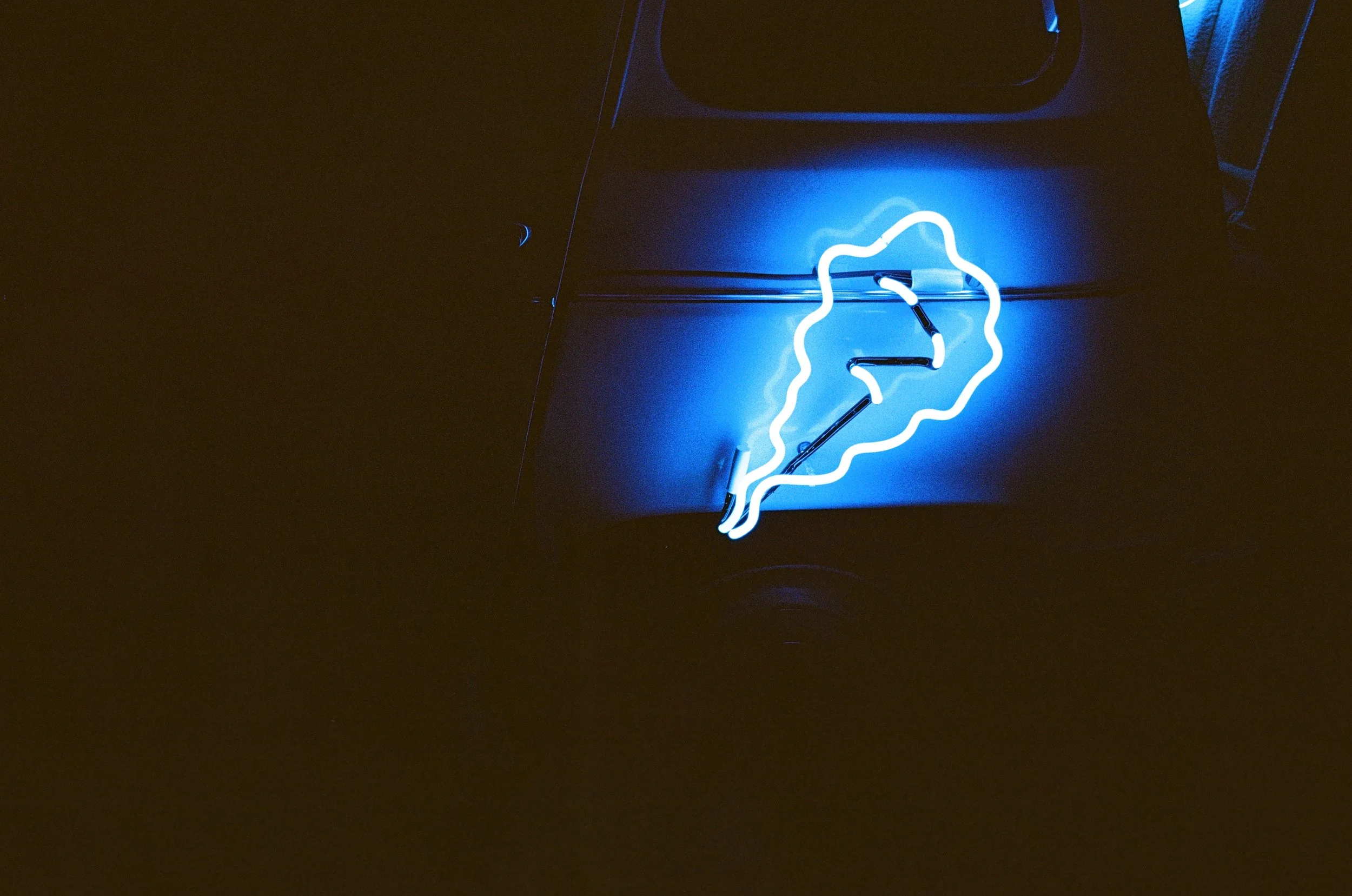
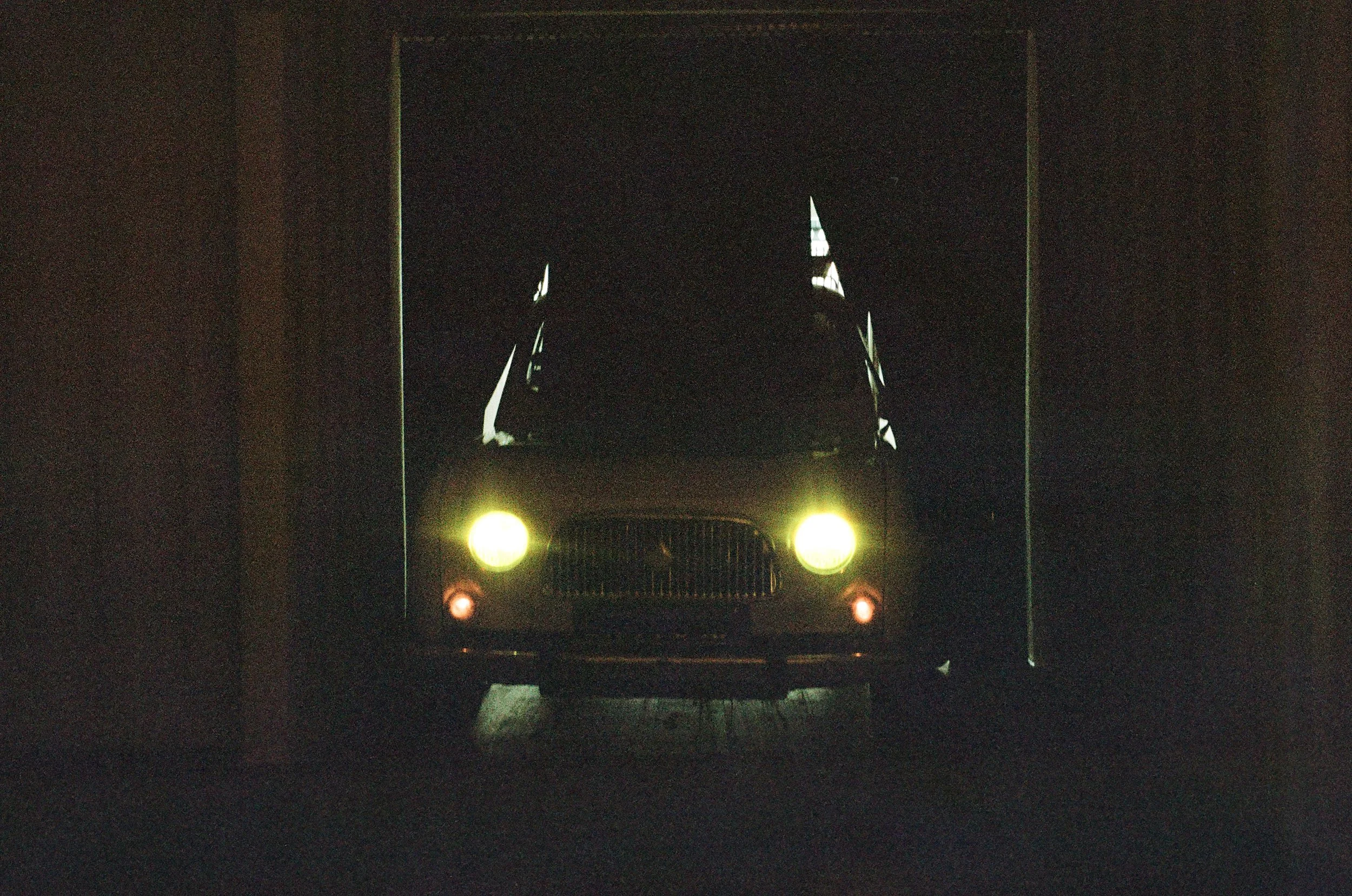
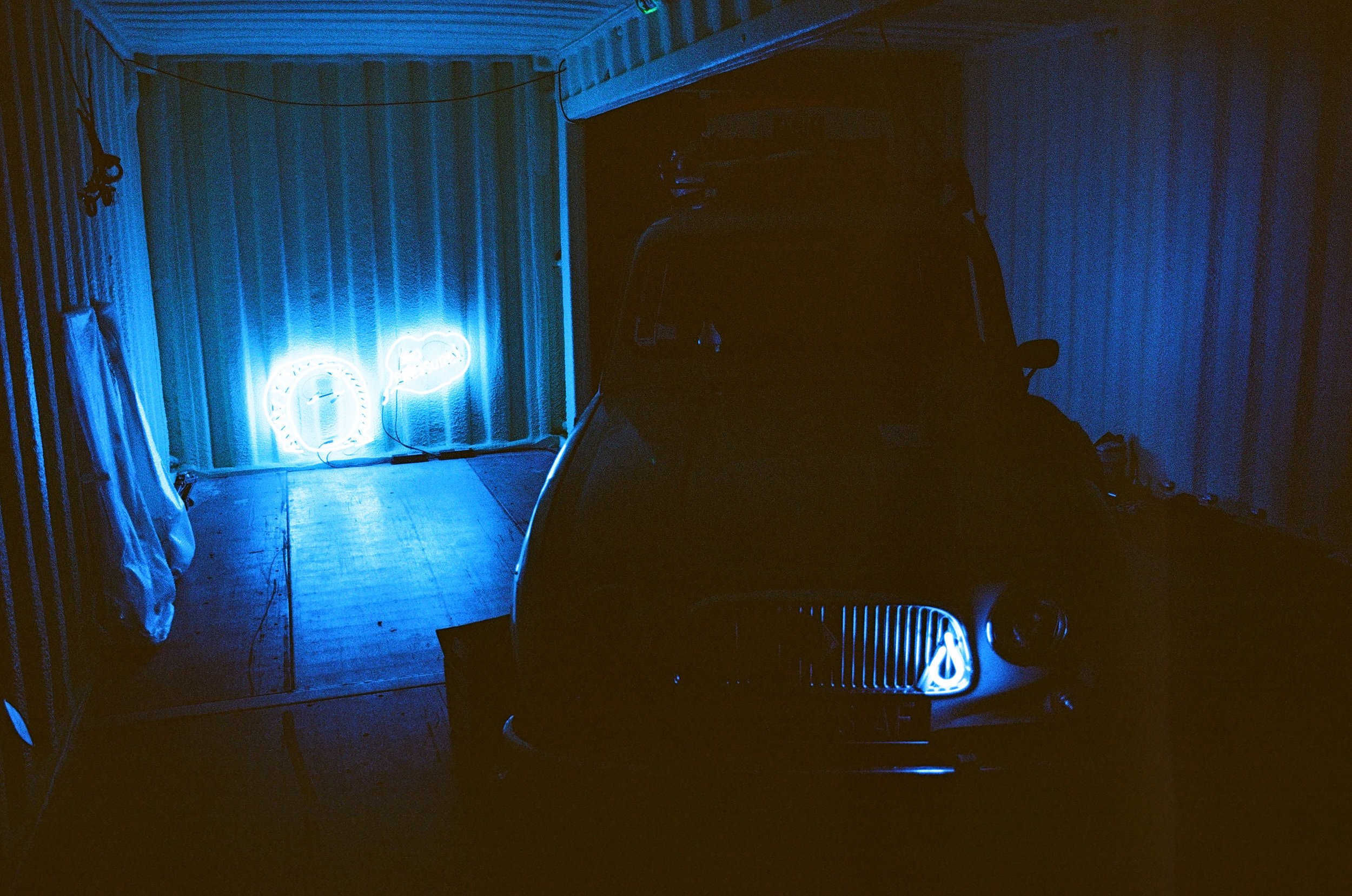
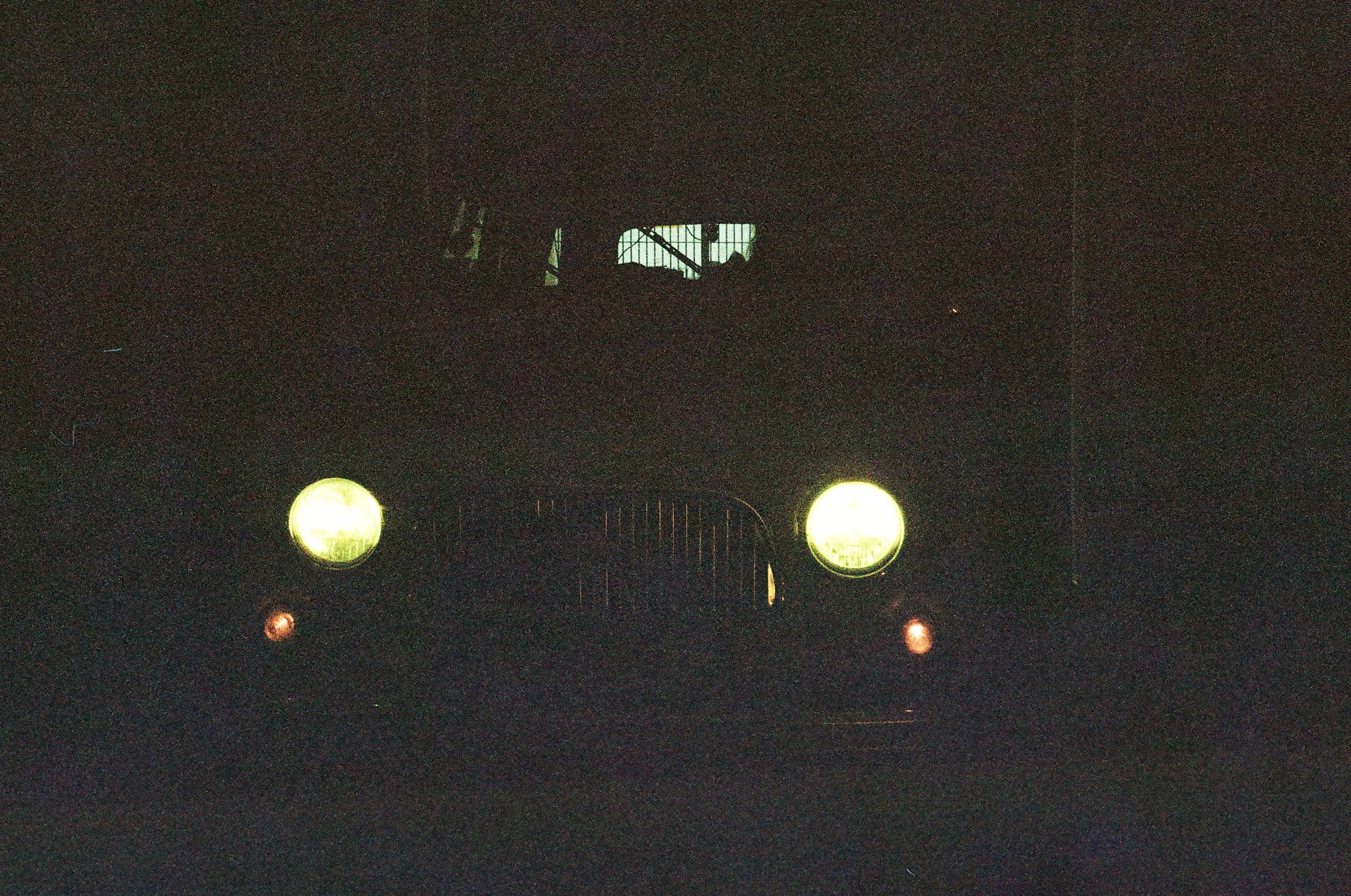
Photo credits: Michael Hill and tour de force
22.07.2025
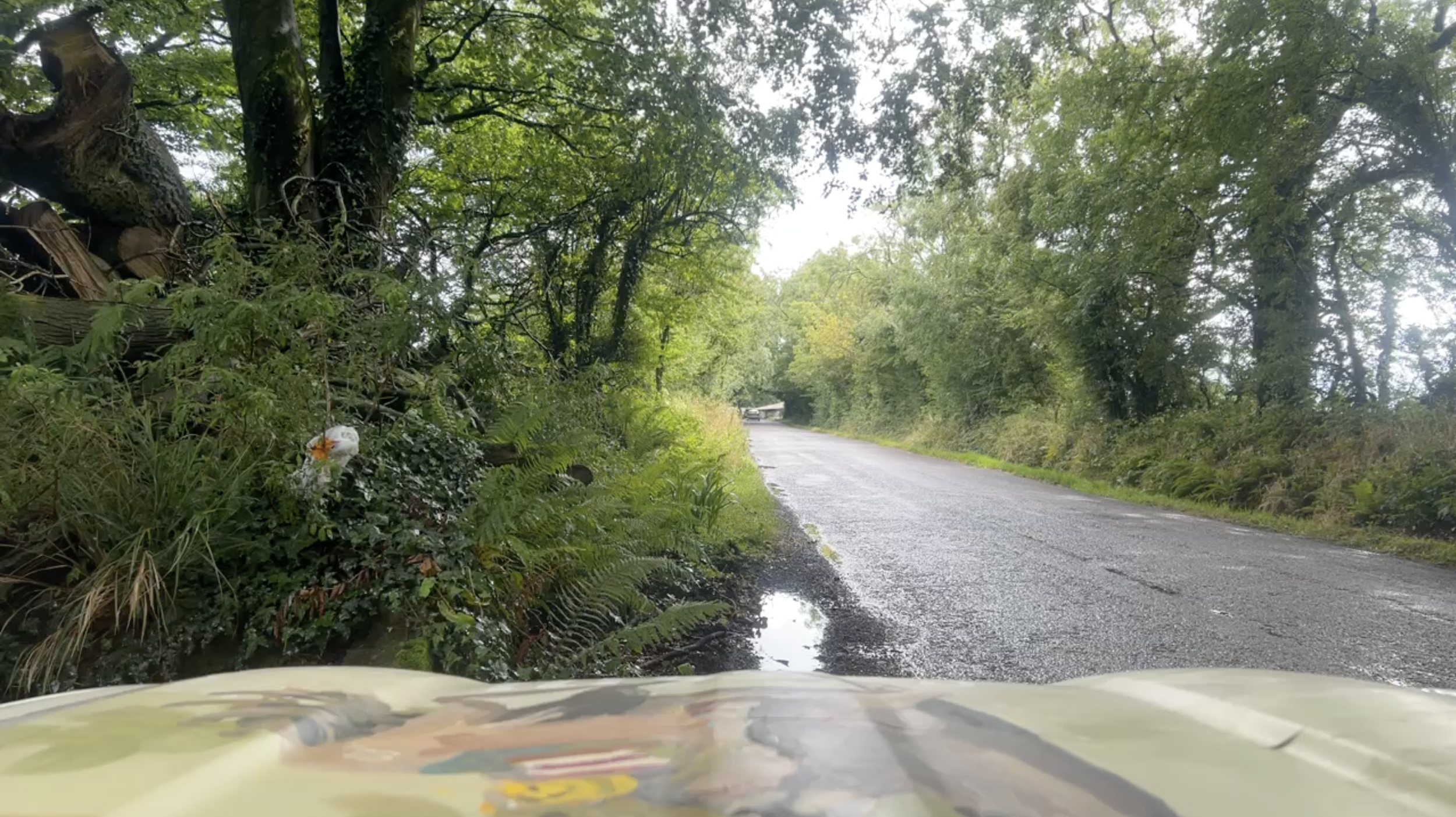
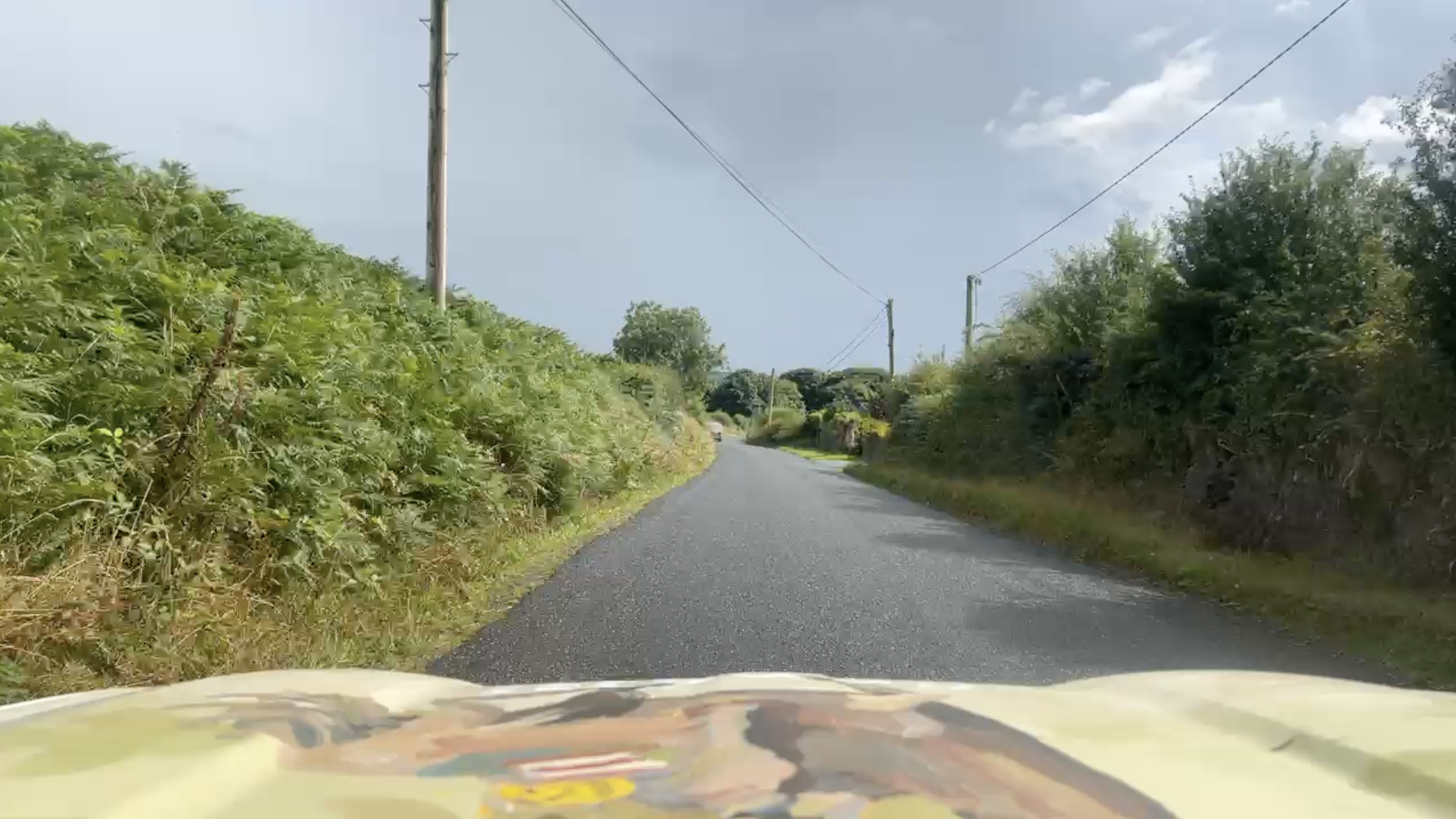
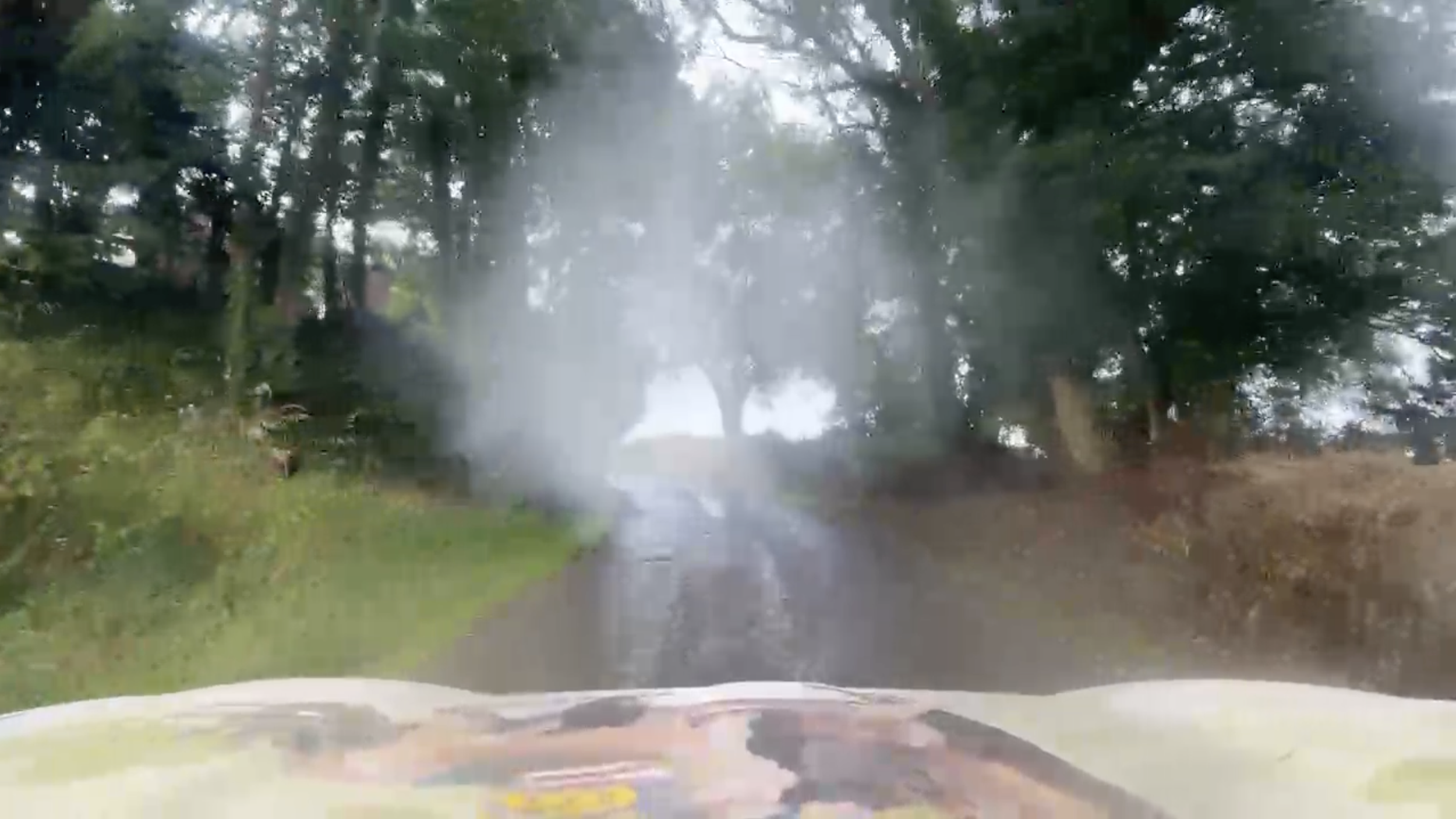
This day last year we received some good news; we got a slot on the radio to talk about tour de force - about six or seven minutes to contextualise the tour, explain it, publicise it. But the simple interview format quickly escalated into a series of complex metanarratives, expanding and spinning outwards simultaneously over several days and myriad townlands. Luke Clancy of Culture File - RTÉ lyric fm would interview us, whilst we concurrently invited him onto our DIY broadcast set-up via the gaming app Twitch, where he would join us for a live show of his own interview, which would take place while we were on the road…on a country lane in west Cork, with patchy coverage. Our tech rehearsals were throwing us into a state of disarray and pixilation and compounding the pre-existing nervousness ahead of the radio interview, but we were spurred on by the challenge and Luke’s enthusiasm for the experiment.
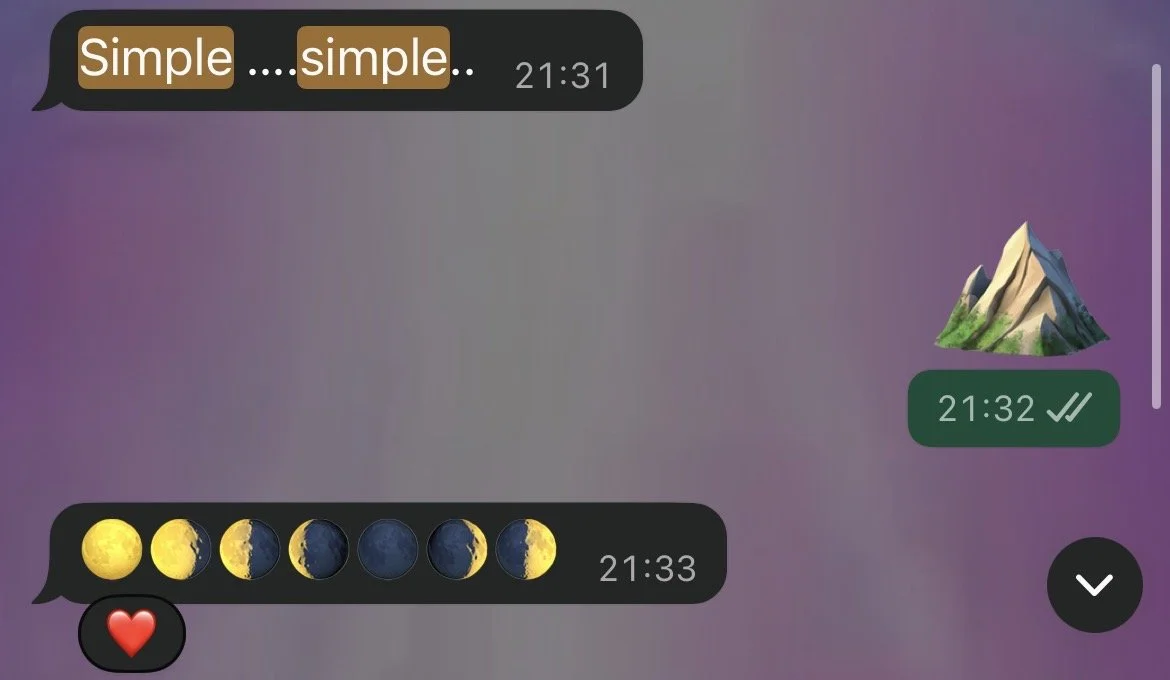
Back in June ‘25 in the lead up to the tour we’d received the following advice,
Keep it simple
This we did not do, not once. It became a running joke during the tour as we could never resist a tangent or detour, constant ornamentation and elaboration of ideas. The distant advice echoed across the mountain tops Keep it simple 🗣️ ⛰️ ⛰️ ⛰️
Simple simple simple…🌕🌖🌗🌘🌑🌒🌓
Perhaps this is what defines or activates tour de force as an artwork – a forty-five day, ever expanding durational performance on the road,
a nomadic museum on a journey into the Otherworld through a series of collaborative pit stops, speculative flash fictions; vignettes that mark out points on the broader narrative. A series of mise-en-abyme, where stories are embedded in one-another. Cycles of apotheosis occur within the plot, proposing a generative, self-reflexive structure that harks to the orally disseminated storytelling traditions, material culture and intangible heritage of Ireland. Allegory, symbolism and metatextuality represent an intricate labyrinth, an evolving, circuitous structure that contains narrative rotations within the overall system, much like the revolutions of the crankshaft of the car itself.
In the making of tour de force, ideas from the pilot tour across France in 2024 merged with a writing and curating phase in January 2025. Fuelled by the excitement of working with people we deeply admire, our plans constantly intensified. Collaborations became increasingly baroque, with additions, tangents, detours happening on the road, in real time. A bit like Jack Kerouac’s, On the Road…but sans the misogyny - take Sal Paradise and Dean Moriarty, and replace them with Thelma and Louise.The expressionist, energetic drive; uphill, downhill, the restlessness, the wanderlust - to keep moving no matter what. Fictions and non-fictions, intertwined with artworks, artefacts and encounter to create a labyrinthine adventure, a living Roman à clef / autofiction.
In 1951, Jack Kerouac typed out the legendary manuscript of On the Road over a twenty day period at an appartement in New York after his travels were over. In order to keep his flow, he taped long strips of architects' and Japanese tracing paper together to form a 120-foot scroll. Our own attempt at creating a stream of consciousness flow was to build a collection of mementos, objects, documents, recordings or soundscapes that could be pieced back together afterwards. A flow of fragments pooling together.
Technological glitches during radio interview trials and rehearsals reached epic proportions and generated a script research segway, culminating in a comedy of errors for our auto-reflexive, mis-en-abyme, worlds within worlds, constellation of microcosms interview for Culture File. We will share this with you in the near future….

21.07.2025
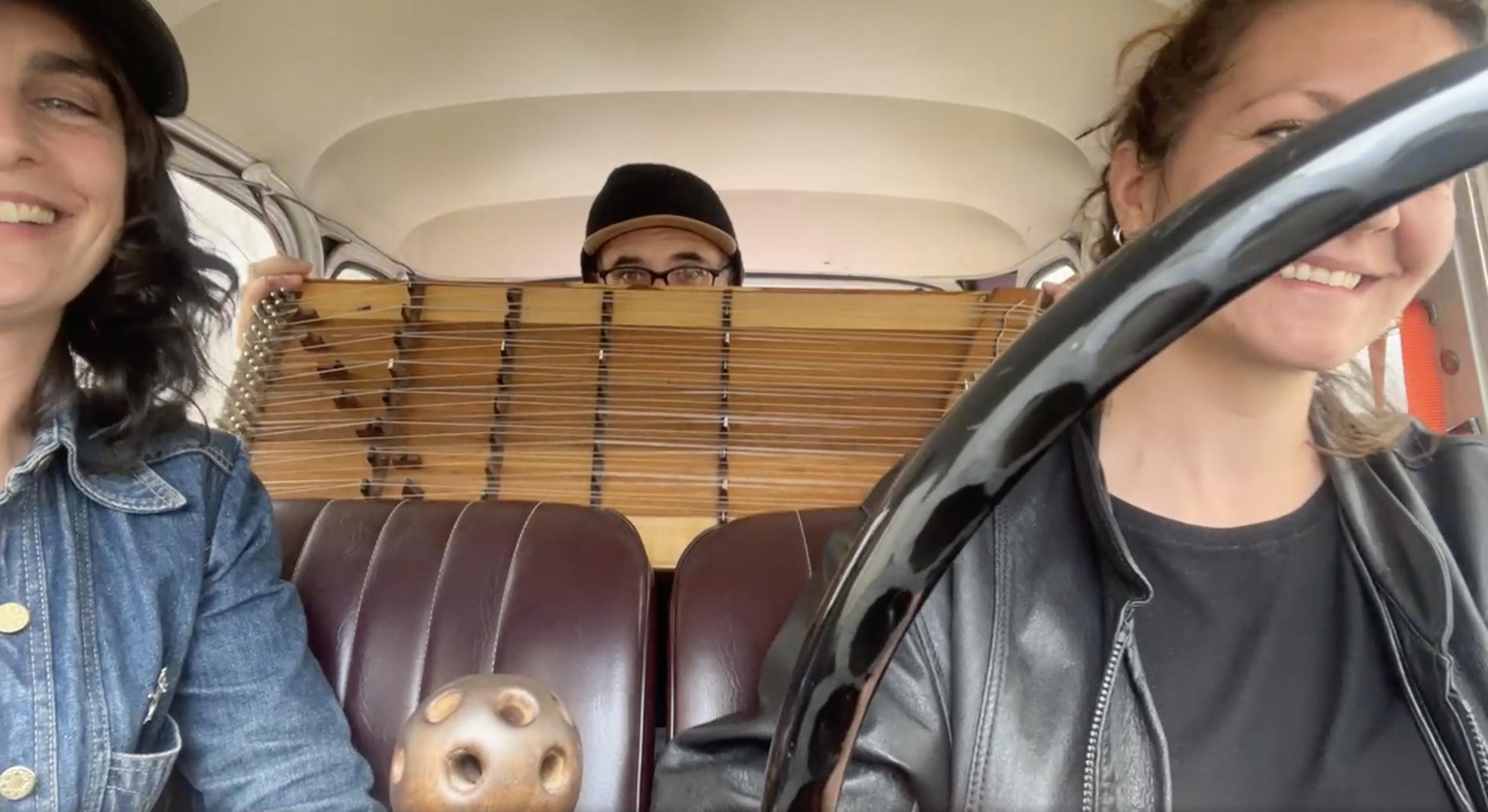
Thus far on the tour, we’d been transporting a large mysterious instrument on the roof rack, a door sized monochord affectionately nicknamed Dooris Day. I had it on loan as I’d been making compositions and playing the instrument for CKD* live performance series at Liliane’s studio in Temple Bar Gallery + Studios in May. Catching the breeze up on the roof rack, Dooris was contributing an eerily beautiful accompanying hum to tour de force, warbling, droning when we gathered speed. But now it was time for Dooris to return home.
Dooris was made by luthier, composer, musician and artist Brian Leach and this day last year we delivered Dooris to Brian at Outlaw Studios, near the site of the old Ford factory in Cork. Brian’s practice flows fluently between self-expression, dream realm, creative immersion and the everyday pragmatics and practicalities of mediating artistry and venue sound systems. I got to know Brian while we were on tour with singer, musician, poet, friend, national treasure Lisa O’Neill. During the tour, Brian created compositions and responses in collaborative musical conversations, adding colour and texture. But he could also advise on sound engineering, instrument maintenance/repair, technical equipment and varying venue acoustics, if needs be.
One day after a busking session in Melbourne, we had a conversation about a long spanning research interest of Brian’s; the life and work of the wandering Louth musician Michael O’ Shea. Brian and I had been chatting on the topic of permits and how their necessitation detracts from the spirit of this global tradition. Brian brought up, Michael O’ Shea who had busked London’s underground and travelled around Ireland in the 70s undertaking a wide range of jobs and activities to keep him going. According to O’Shea’s notes he had worked as,
…barman, waiter, soldier, labourer, packer, wireman, hippie, factory worker, salesman, hobo, manager, leather craftsman, odd job man, clerical worker, reconciliation relief worker, social worker, sculptor, designer, collector, joker, transvestite, inventor, psychonaut, actor, catalyst, community worker, musician, traveller, instrument maker...
Travelling with an instrument of his own creation, a hybrid hammered dulcimer called Mo Chara made from a door he found in a skip in Germany, Michael O’Shea brought his music to rural places, off-the-beaten-path. Like O’Shea, Brian plays dulcimers and zither-type instruments of his own making, and as such; he has become the go-to guy for adopting broken, forgotten, neglected, disused instruments…or objects/materials that could become an instrument. For our tour de force pitstop in Co. Cork, we visited Brian to play a large instrument made of many such instruments. Afterwards, Brian guided us around Cork city for a special set on his Dulcimer in the Renault 4; a mobile broadcast for our series, K7 dans la 4L.
Brian played an absolutely beautiful gig by the River Lee, interspersed with tonal, notational explanations, background on the dulcimer’s construction, the history of the dulcimer in general, his education in astrophysics, how this feeds into his music, the influence of Michael O’Shea, philosophical resonance, the concept of oneness, turning the turf, countryside co-incidences, jigs and reels…acceptance of the unpredictability of things. You can watch the episode below.
When we were leaving, Brian modified the 4L with steel strings, making an instrument out of the roof rack. It could be played; bowed and plucked, if we so wished. He also gave us a mix tape of his own compositions which subsequently became a favourite. Reaching towards the boxes of cassettes to select music for journeys, Brian’s tape was the perfect accompaniment for that feeling of slipping into the otherworld, down rural country lanes heading west. We had one particularly magical encounter with a mythological hare, at the break of day…to the music of the dulcimer near the valley of Knockanure…more on this later…
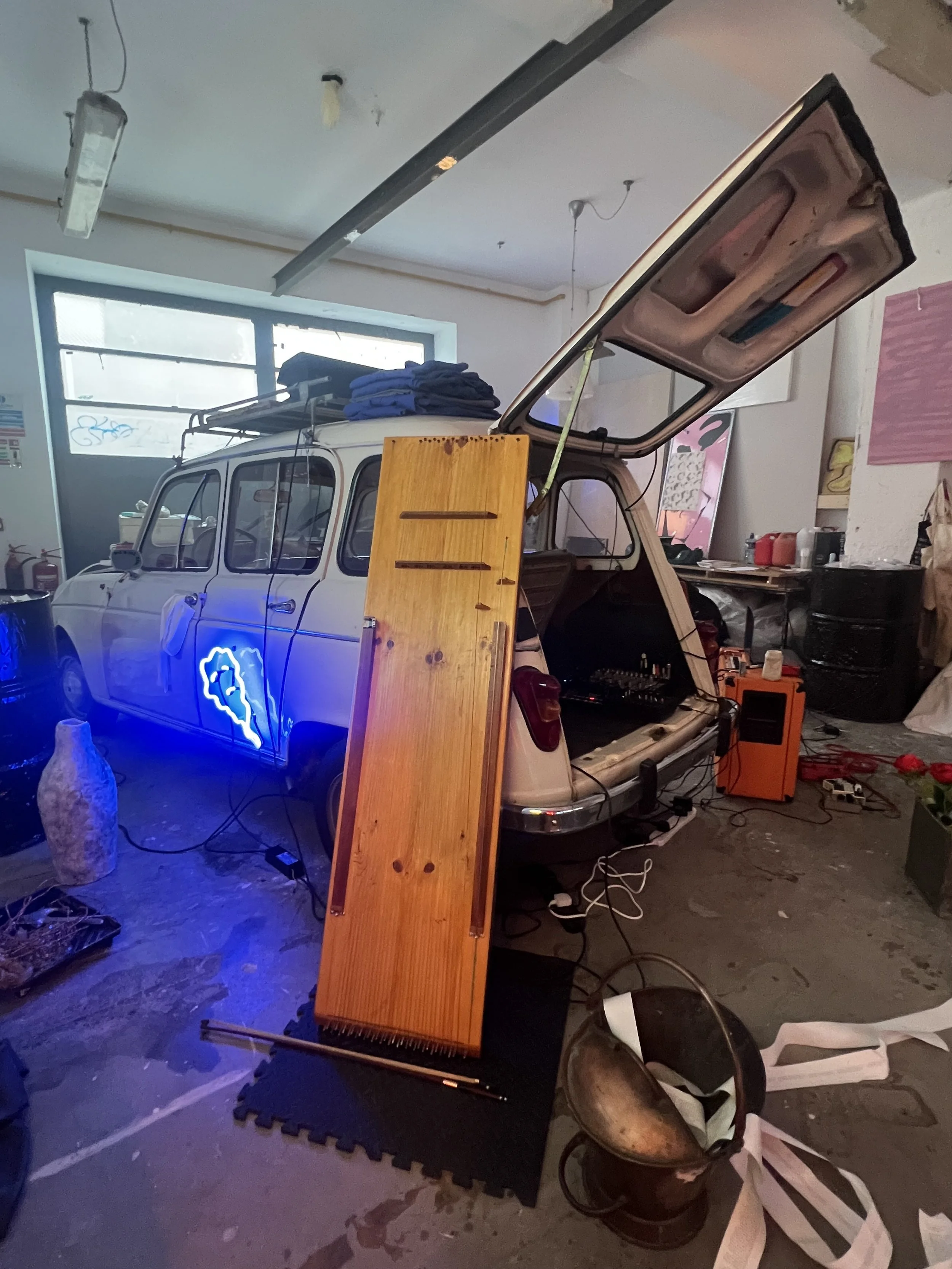
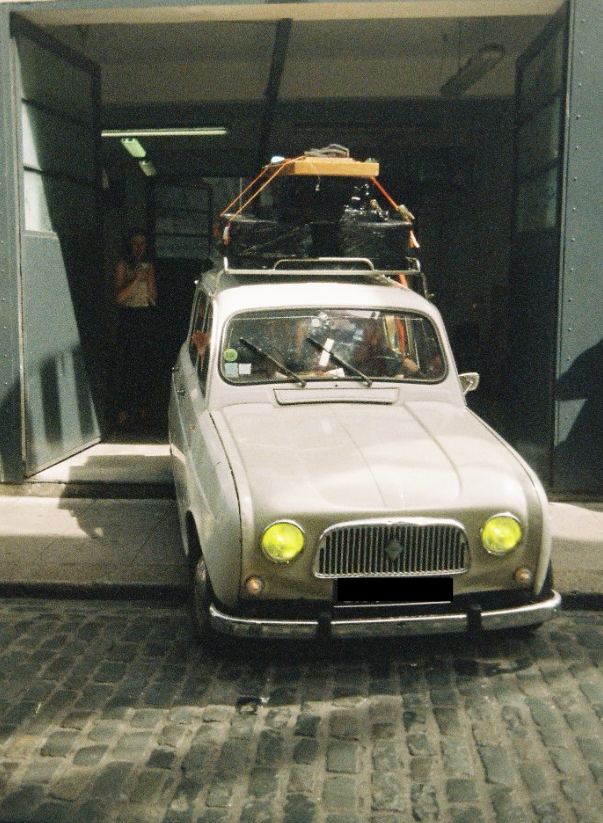
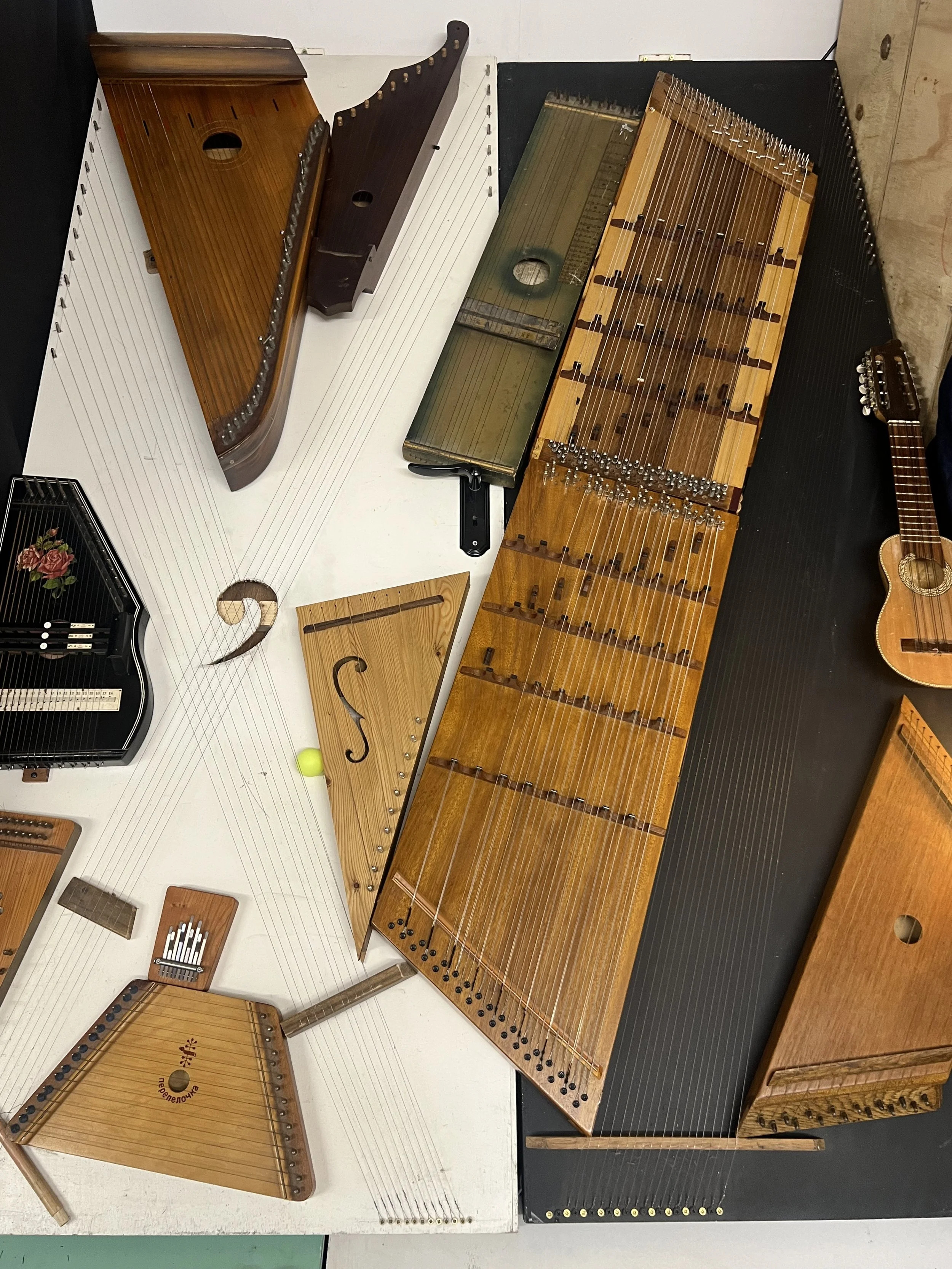
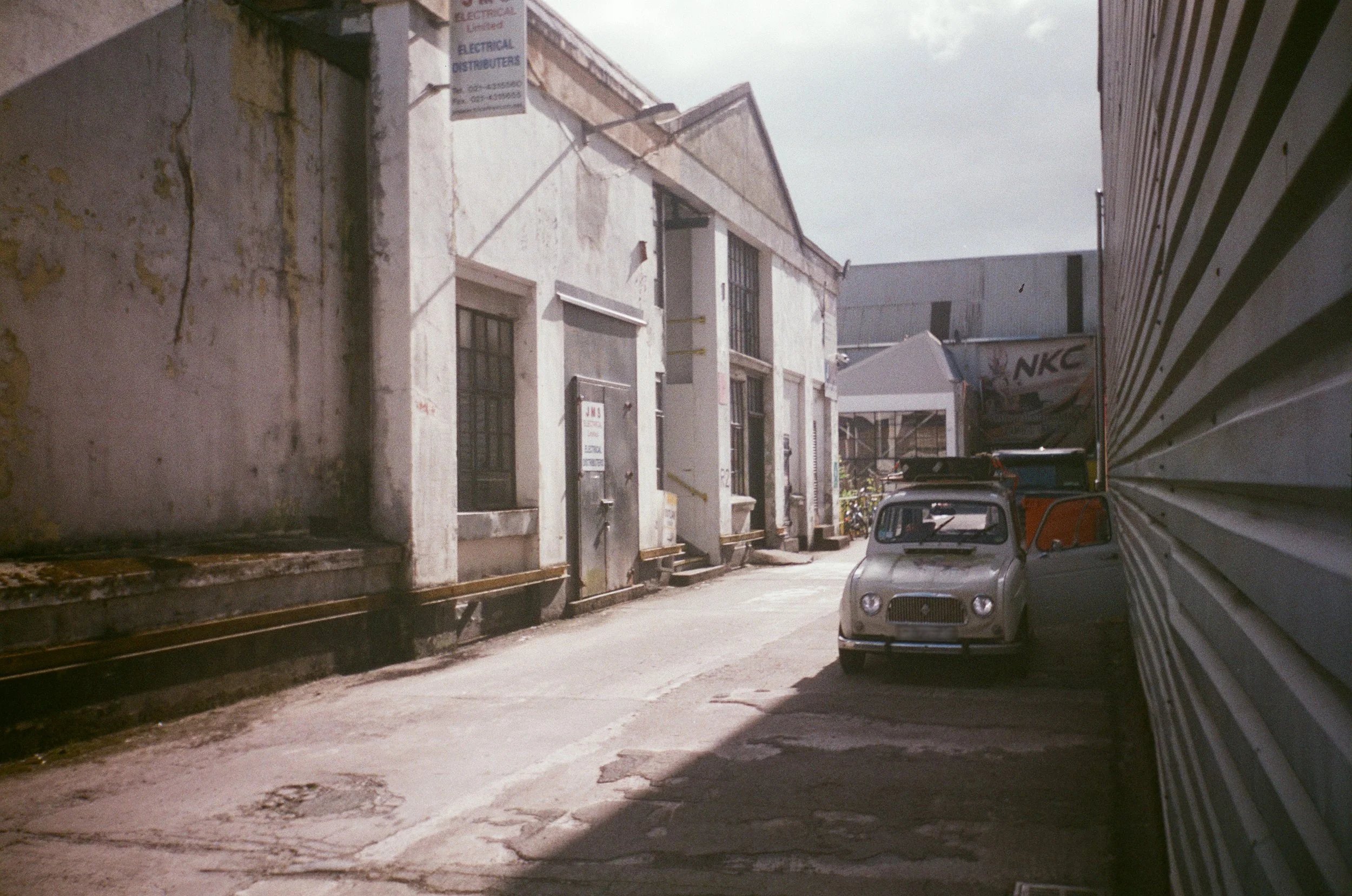
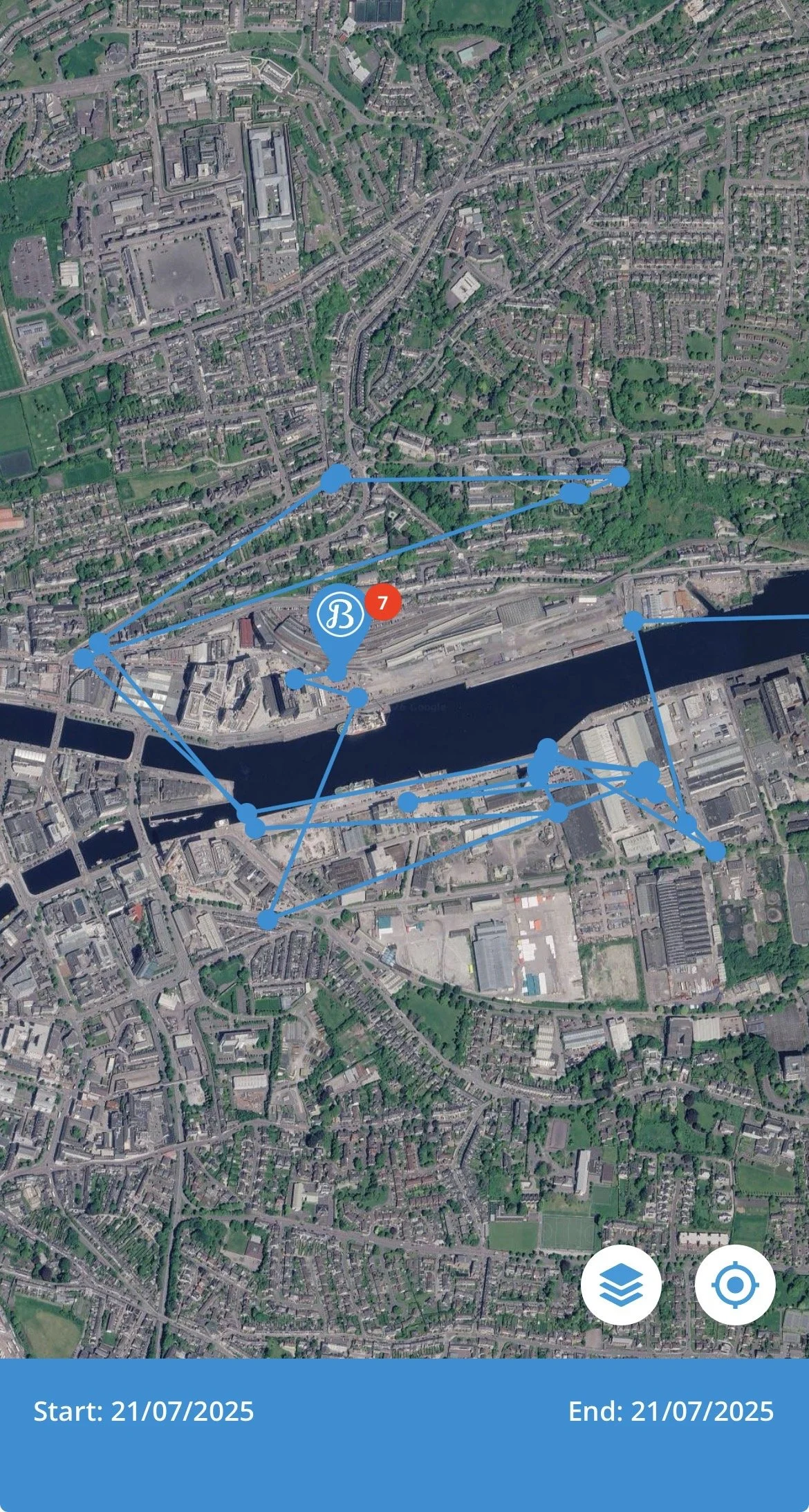
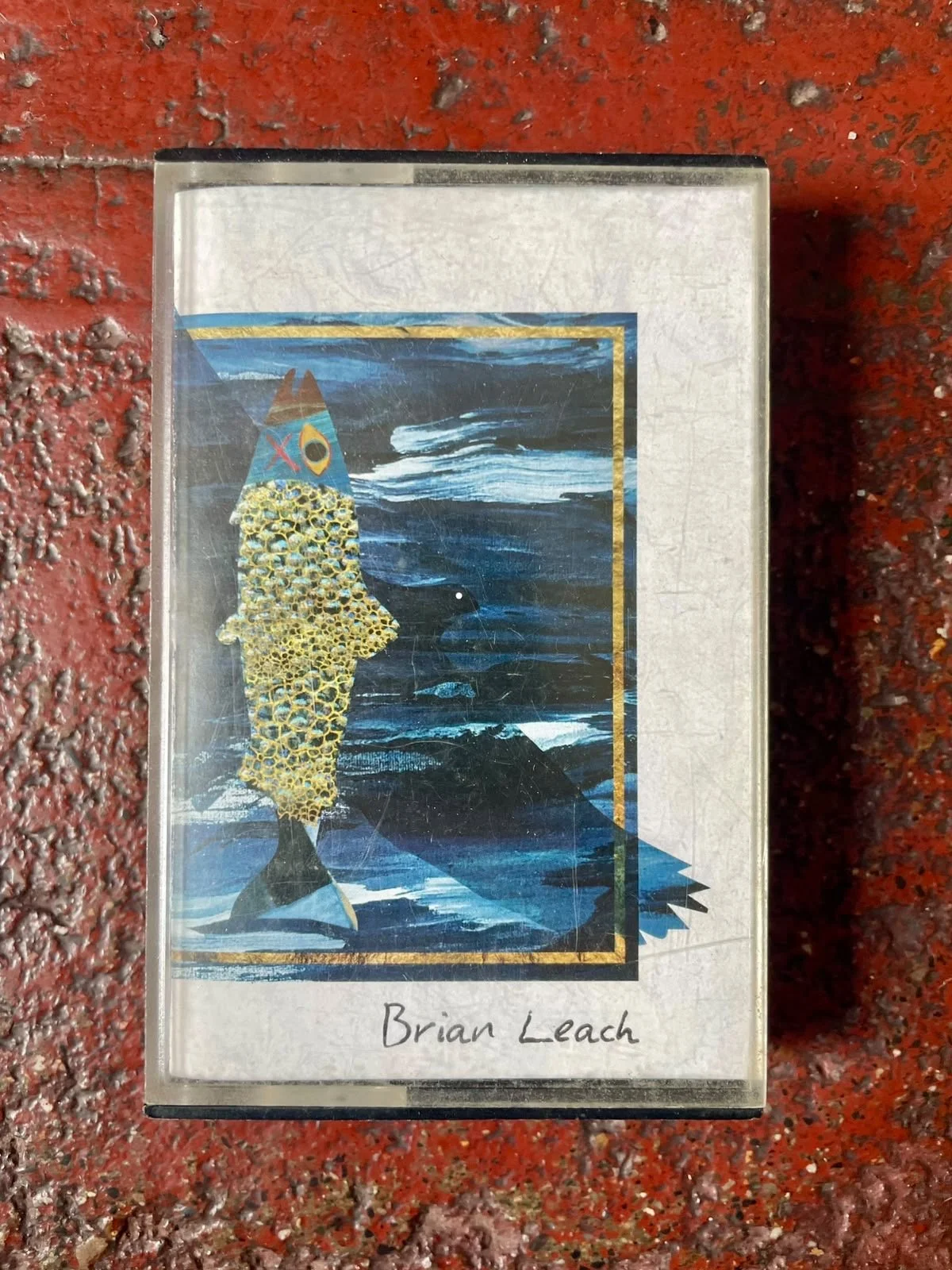
Photo credits: tour de force, Sarah Grimes (cropped)
20.07.2025
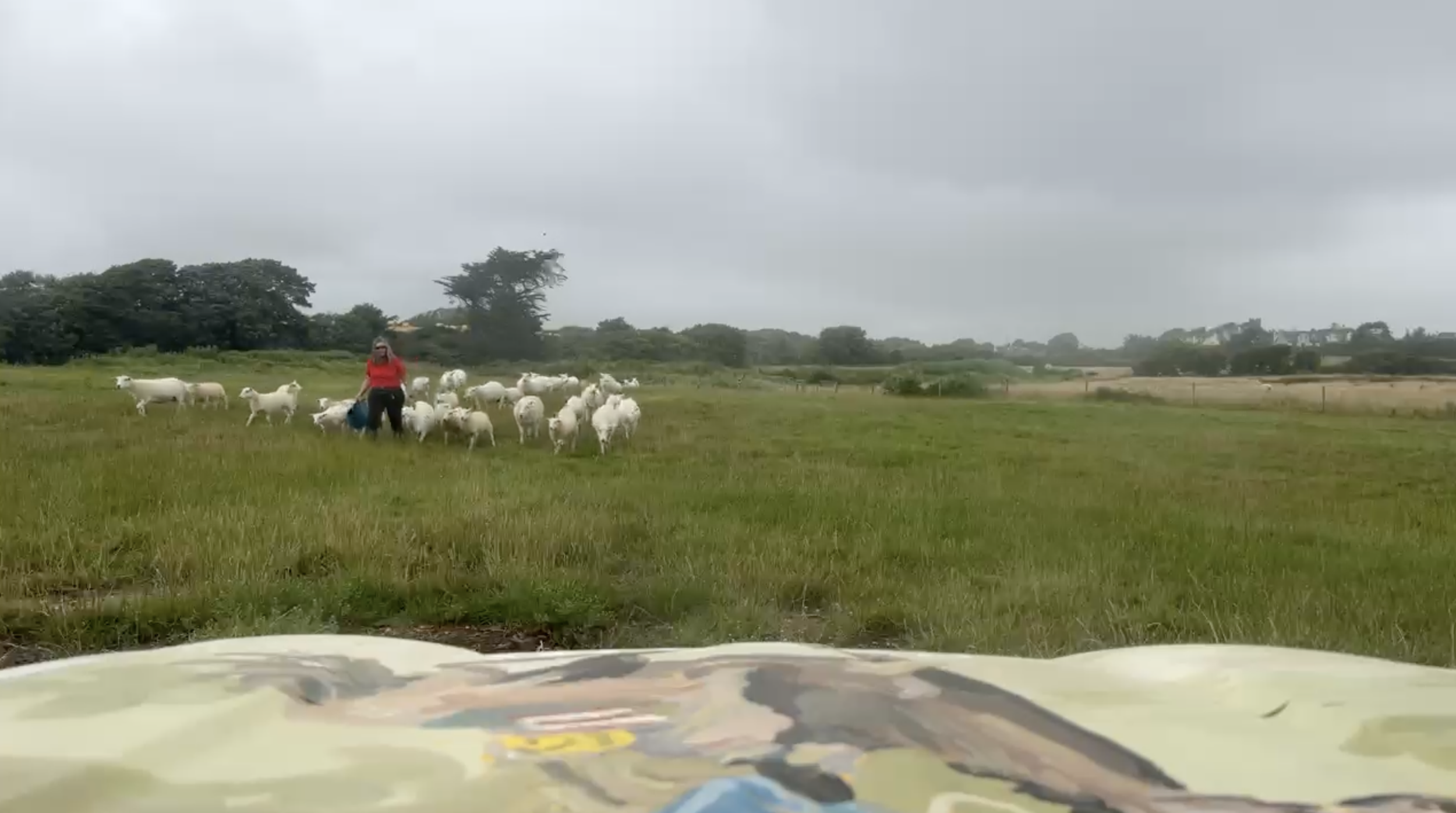
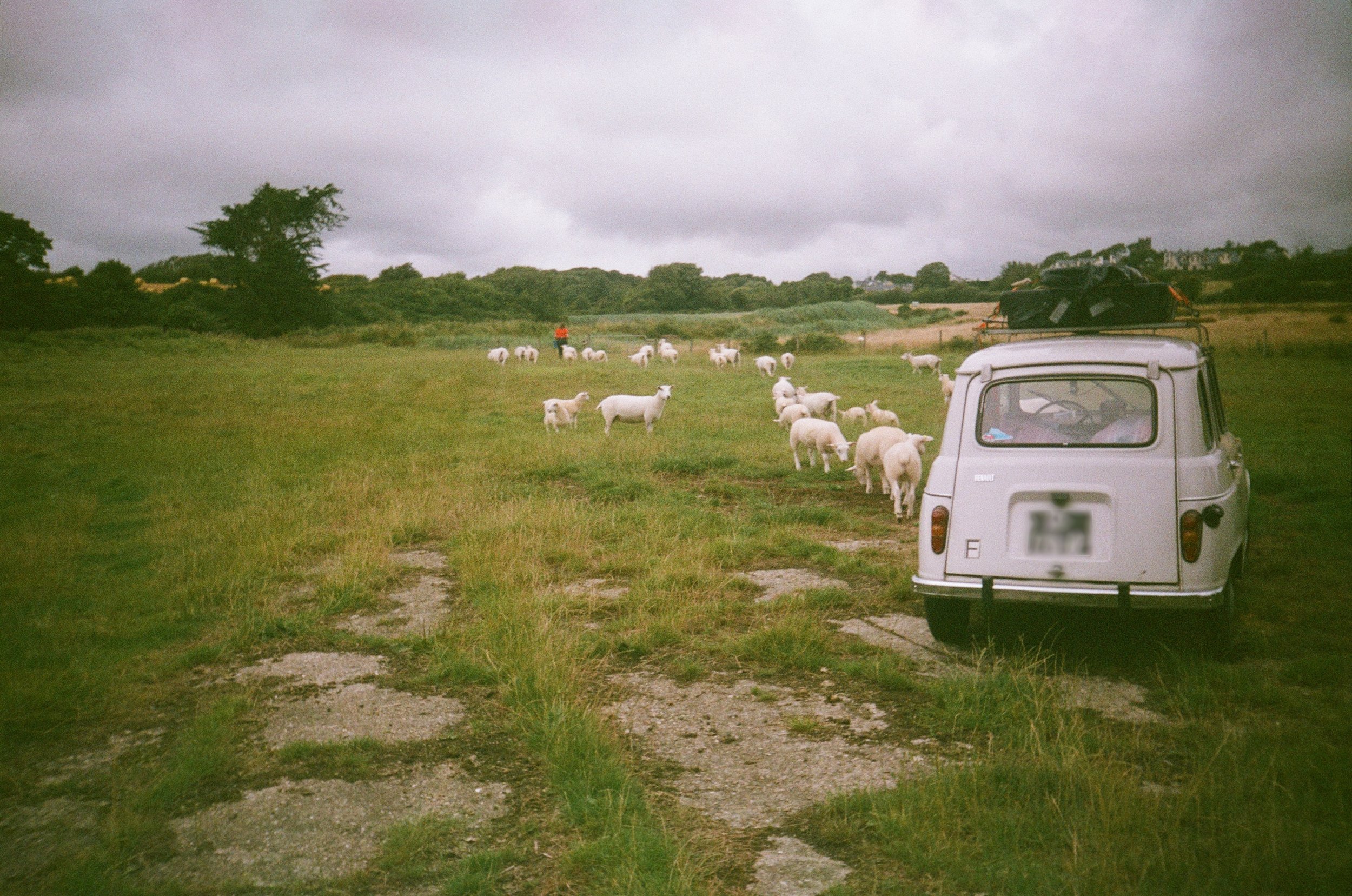
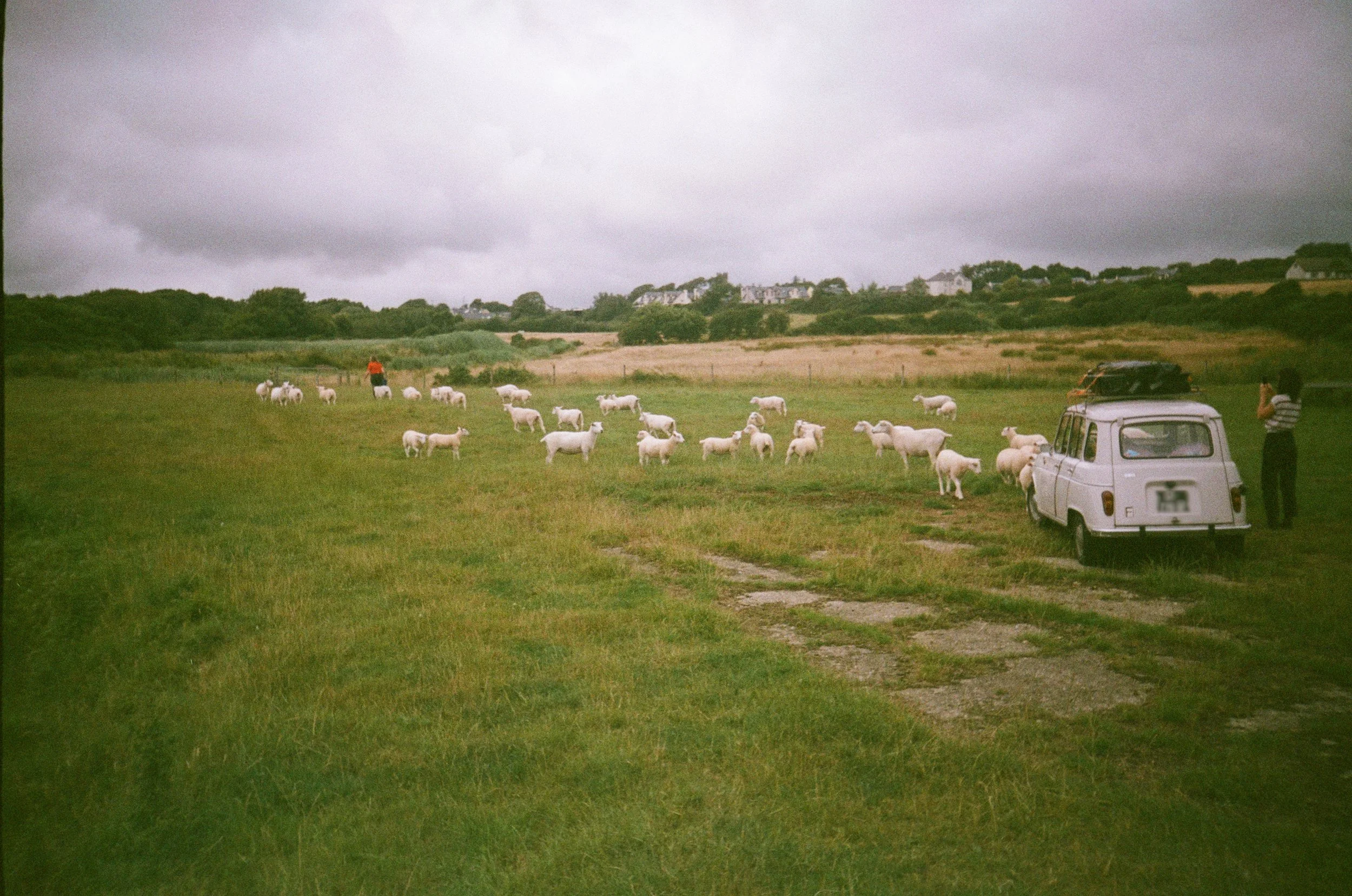
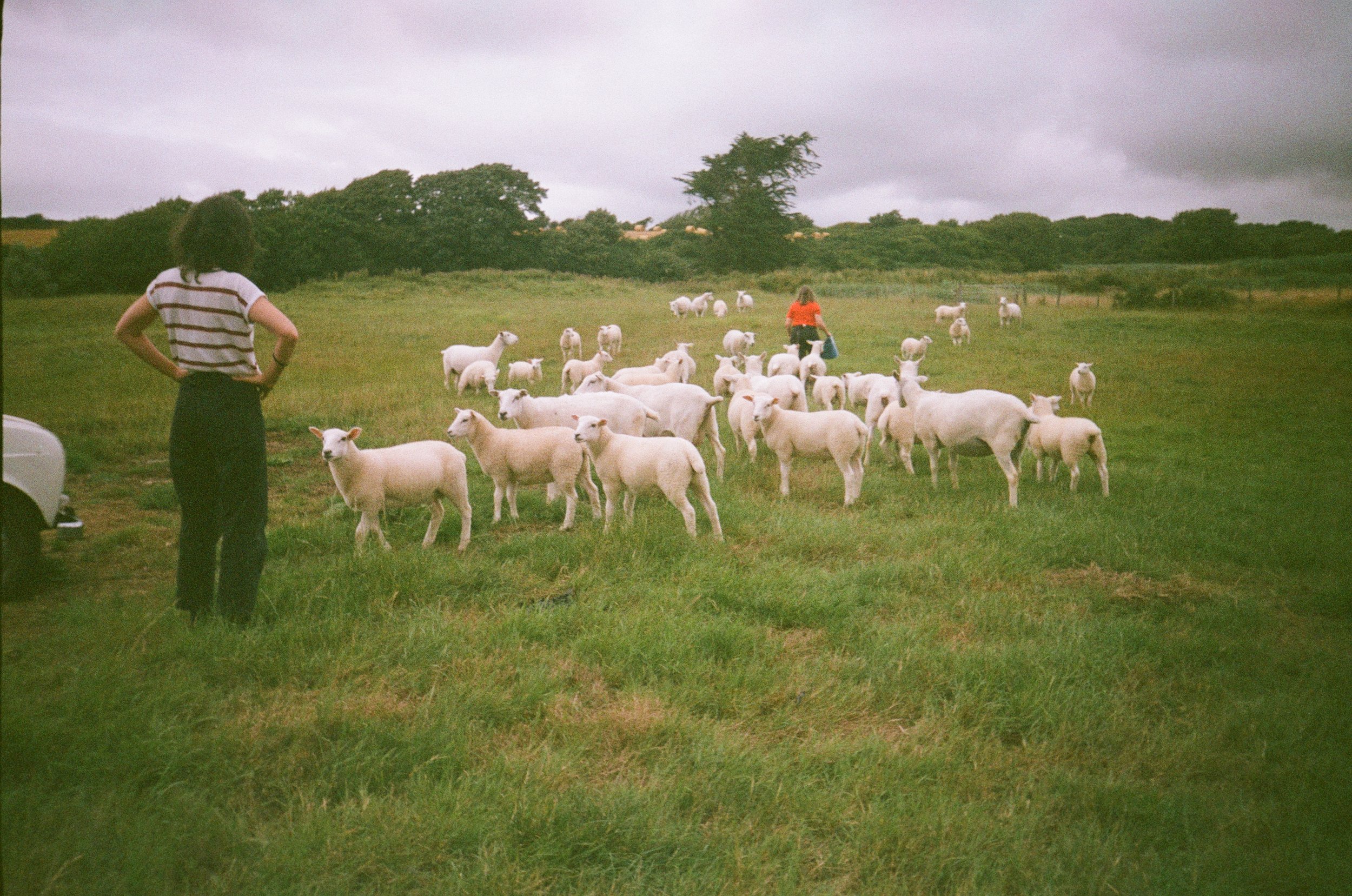
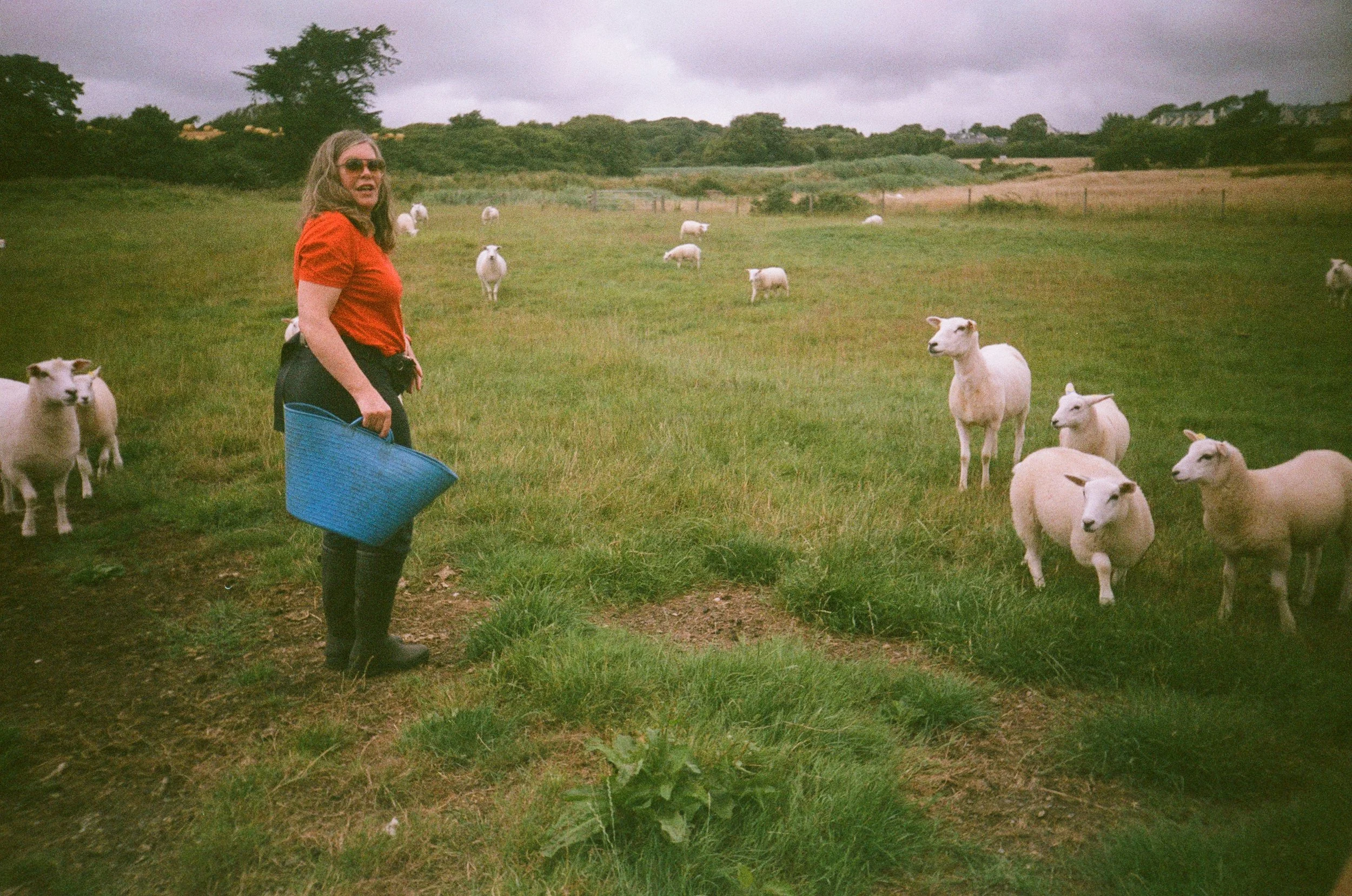
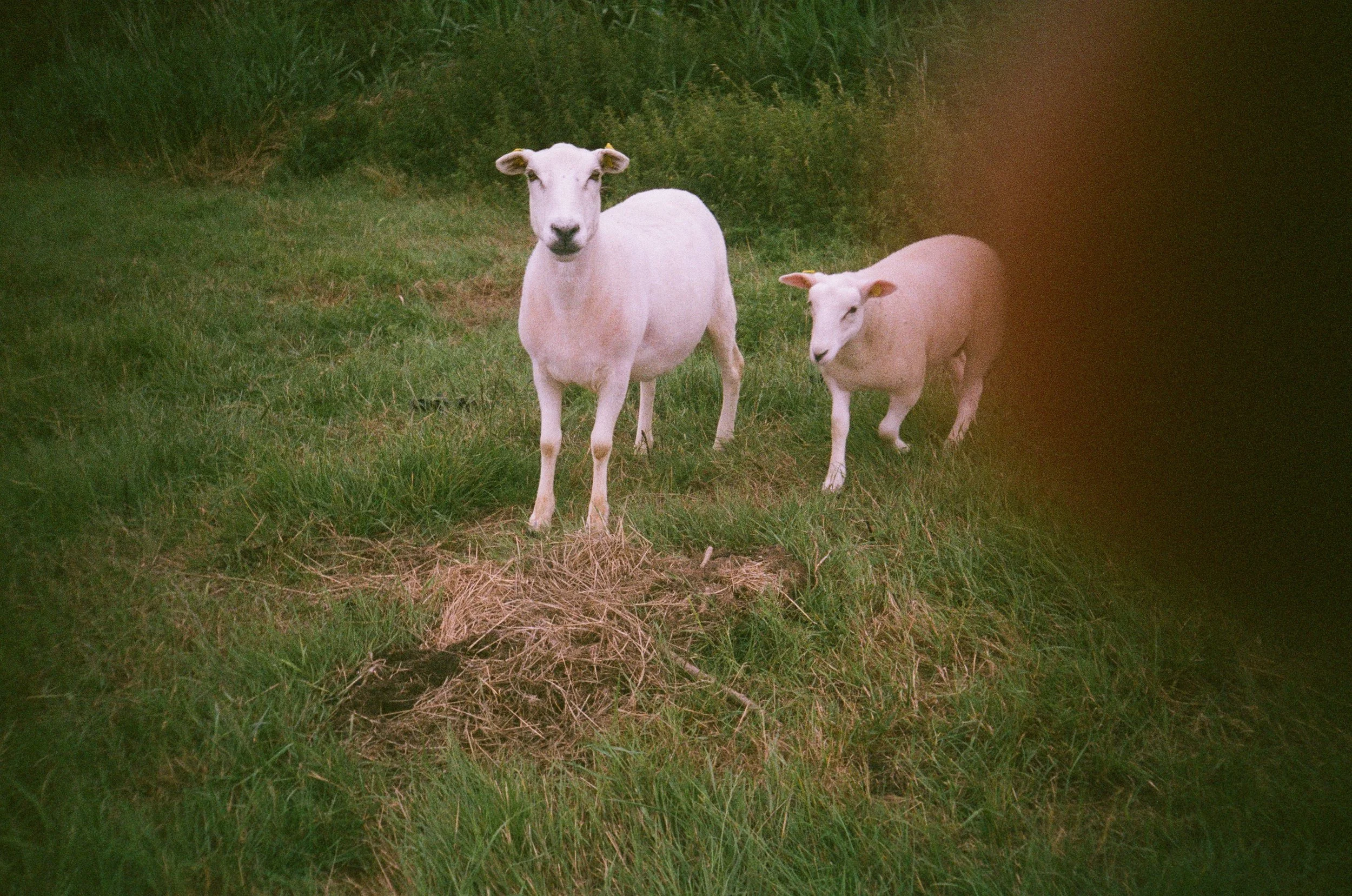
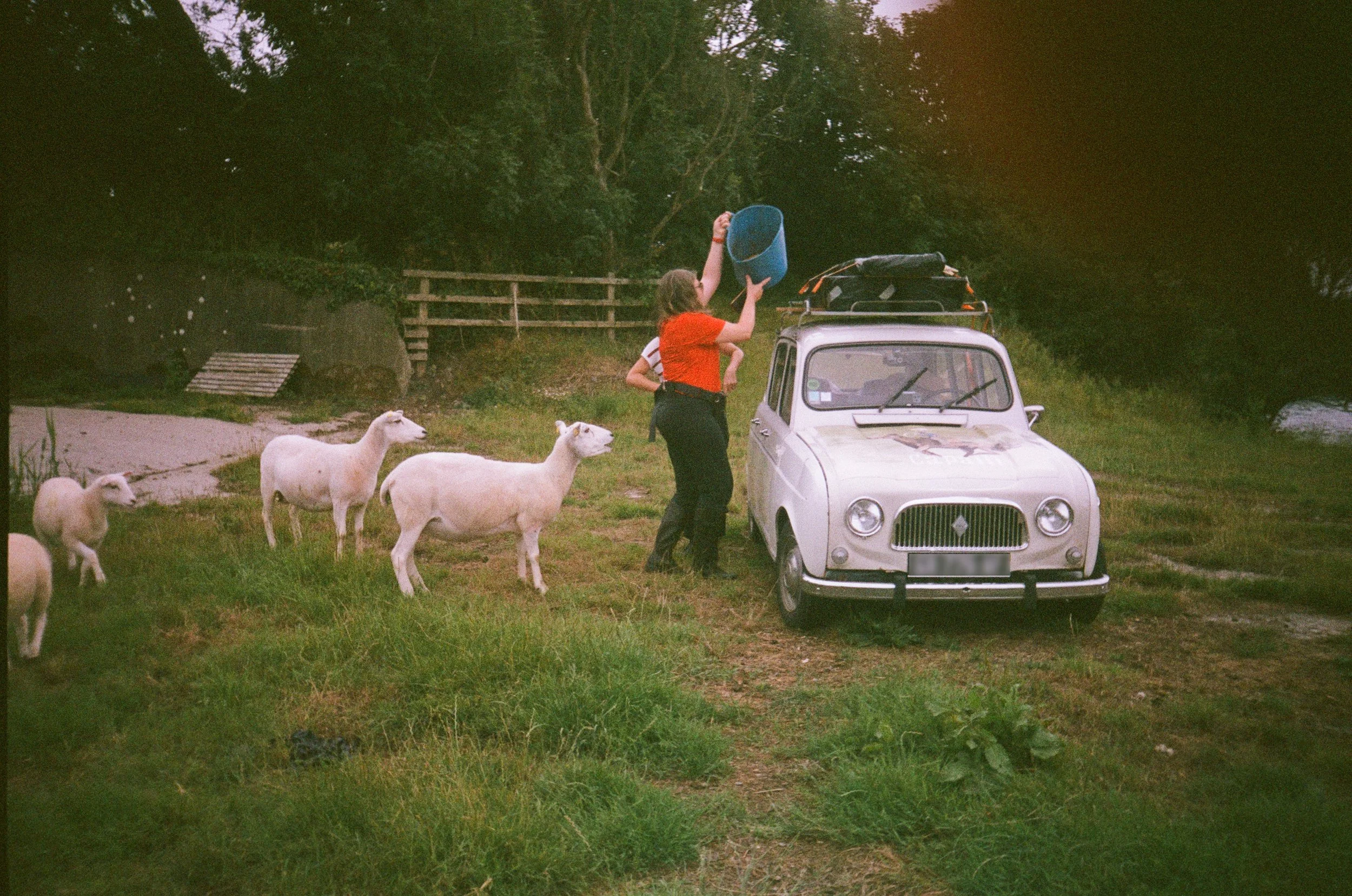
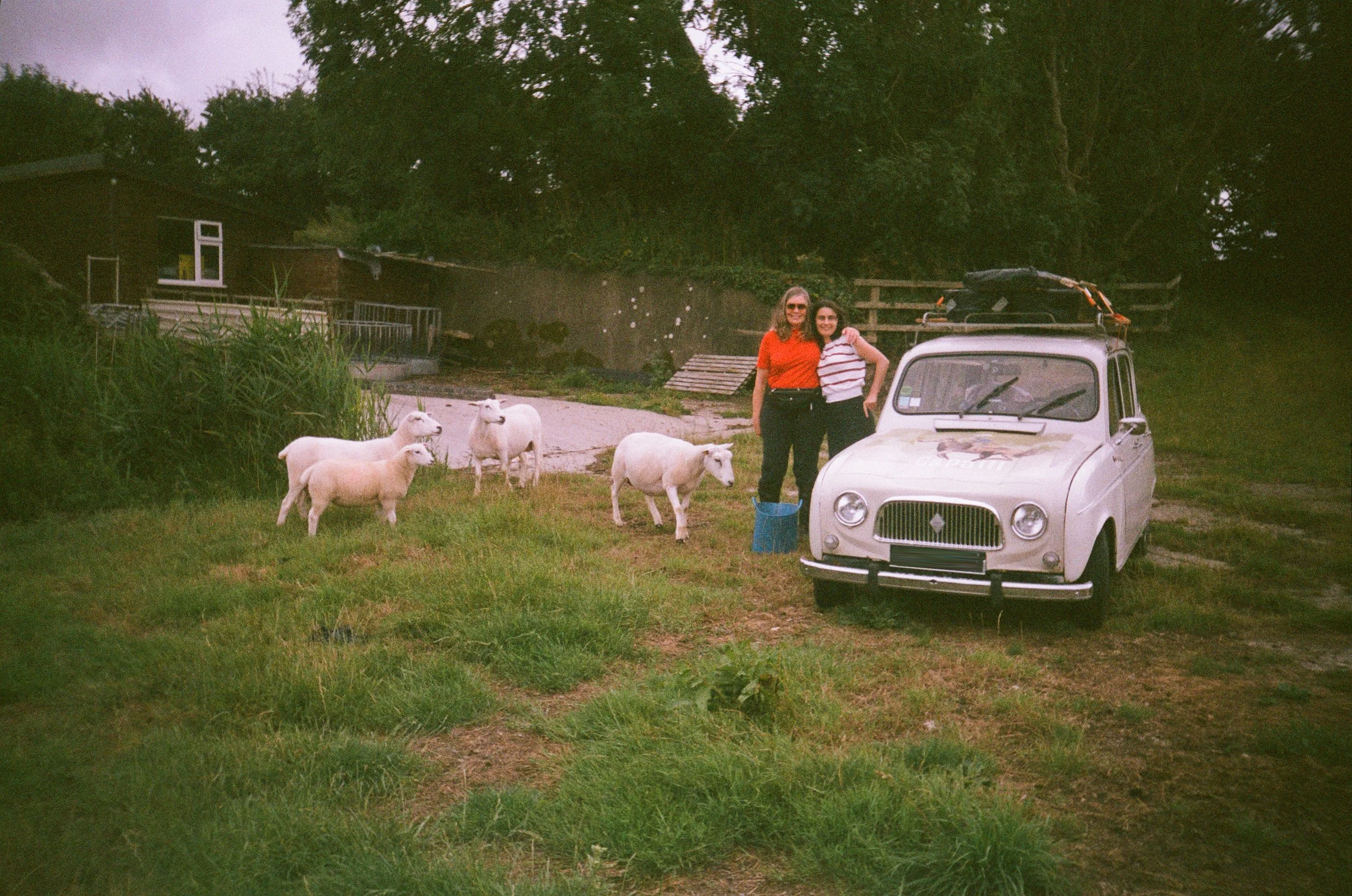
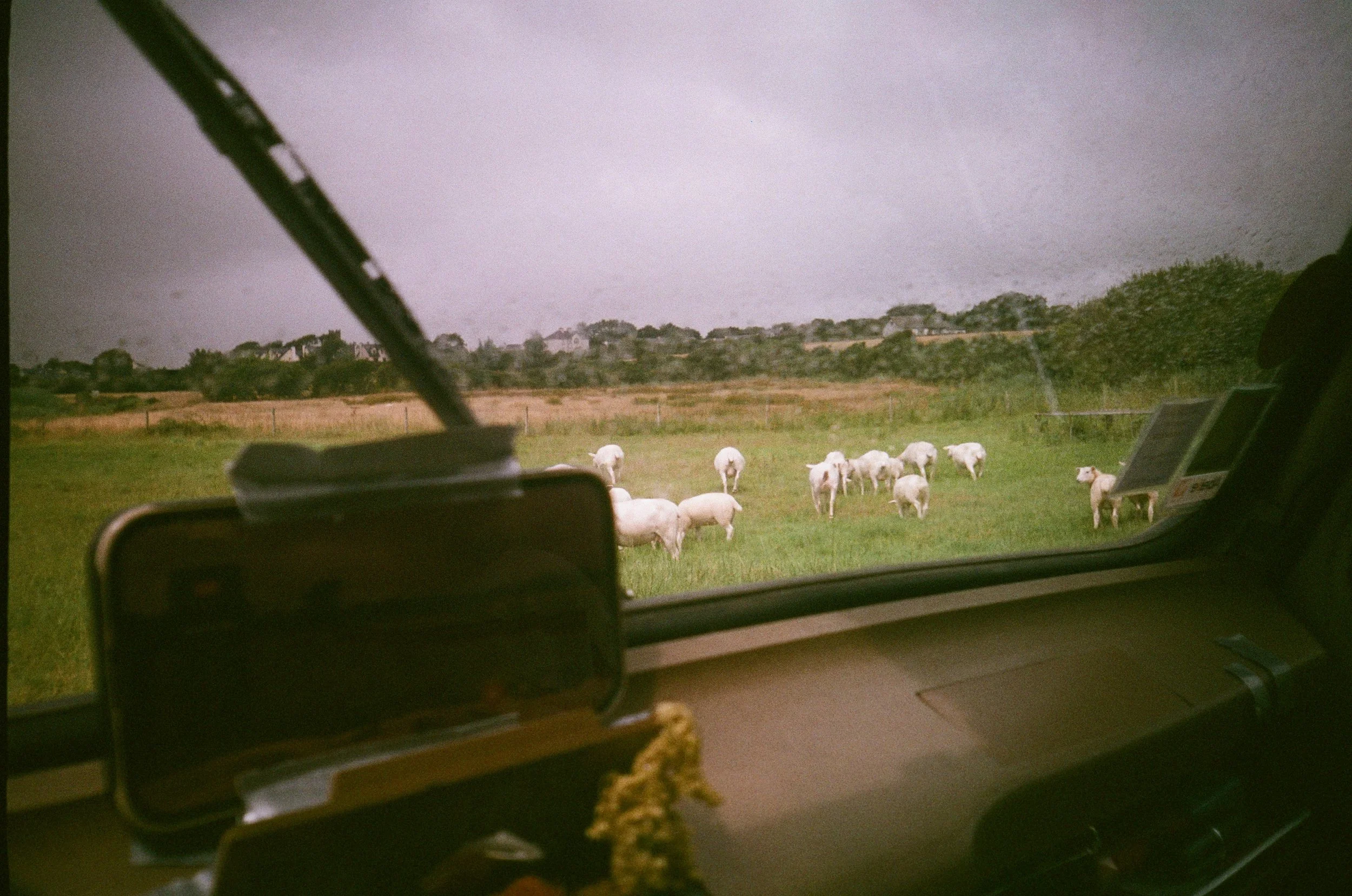
Sitting in the low slung seats of the Quatrelle, off road, beside a lime quarry, surrounded by sheep and broadcasting from inside the car via gaming app, Twitch, visual artist Orla Barry joined us this day last year for an interview. Orla Barry is a regarded shepherd with, ‘honest sheep’, a trusted farmer specialising in the Lleyn breed. Day to day, seasonally, year in year out, her dedication and care produces a naturally finished, hardy flock of content animals.
The flock are also part of Orla Barry’s captivating art practice where tales; autobiography, memoir, and critical theory glean insight and access to otherwise hidden worlds. From the visceral nature of the labour, the physically arduous and psychologically trying conditions of sheep husbandry, Barry’s multi-disciplinary art practice incorporates, fiction writing, performance, objects, sound and video in what might be called an autotheoretical distillation. A heavily engaged, often messy, muddy, bloody process…through livestock auctions, lambing, competitive dynamics, qualitative metrics, local yarns, where Barry weaves her experiences into witty fables and expansive installations.
Afterwards, along the R736, a road that’s part of Ireland's old Trunk and Link road system, we reflected on the interview; Orla’s way of creating these living fables where animals, plants, objects, humans are drawn together towards a revelation, life lesson of some kind, an epiphany. Orla had cited Maggie Nelson’s, The Argonauts as profoundly influential during the interview and this made sense given that both blend the line between the personal and the political to create something highly subjective, yet grounded in lived reality. Thought provoking and gas, you can watch the interview below.
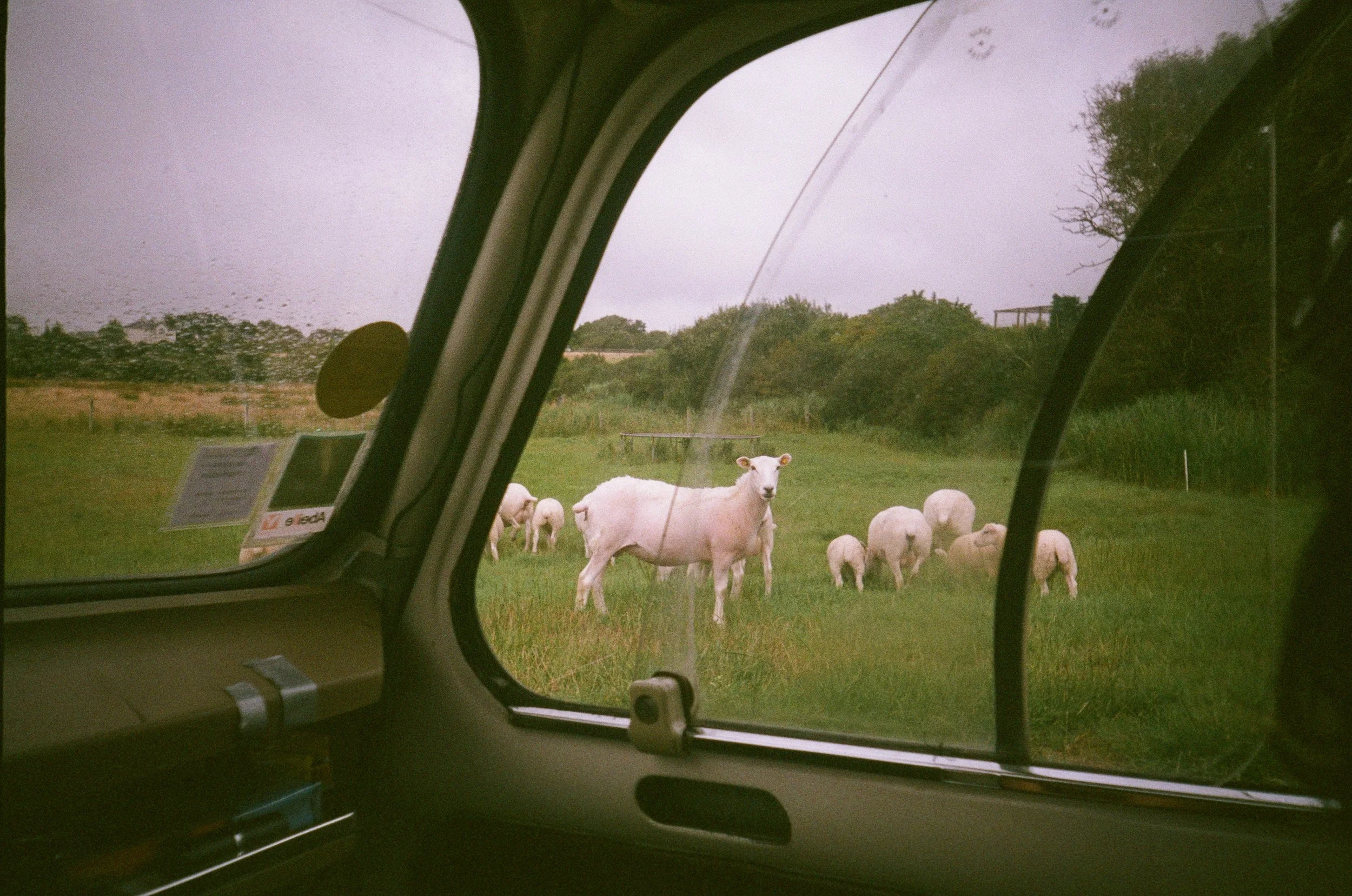
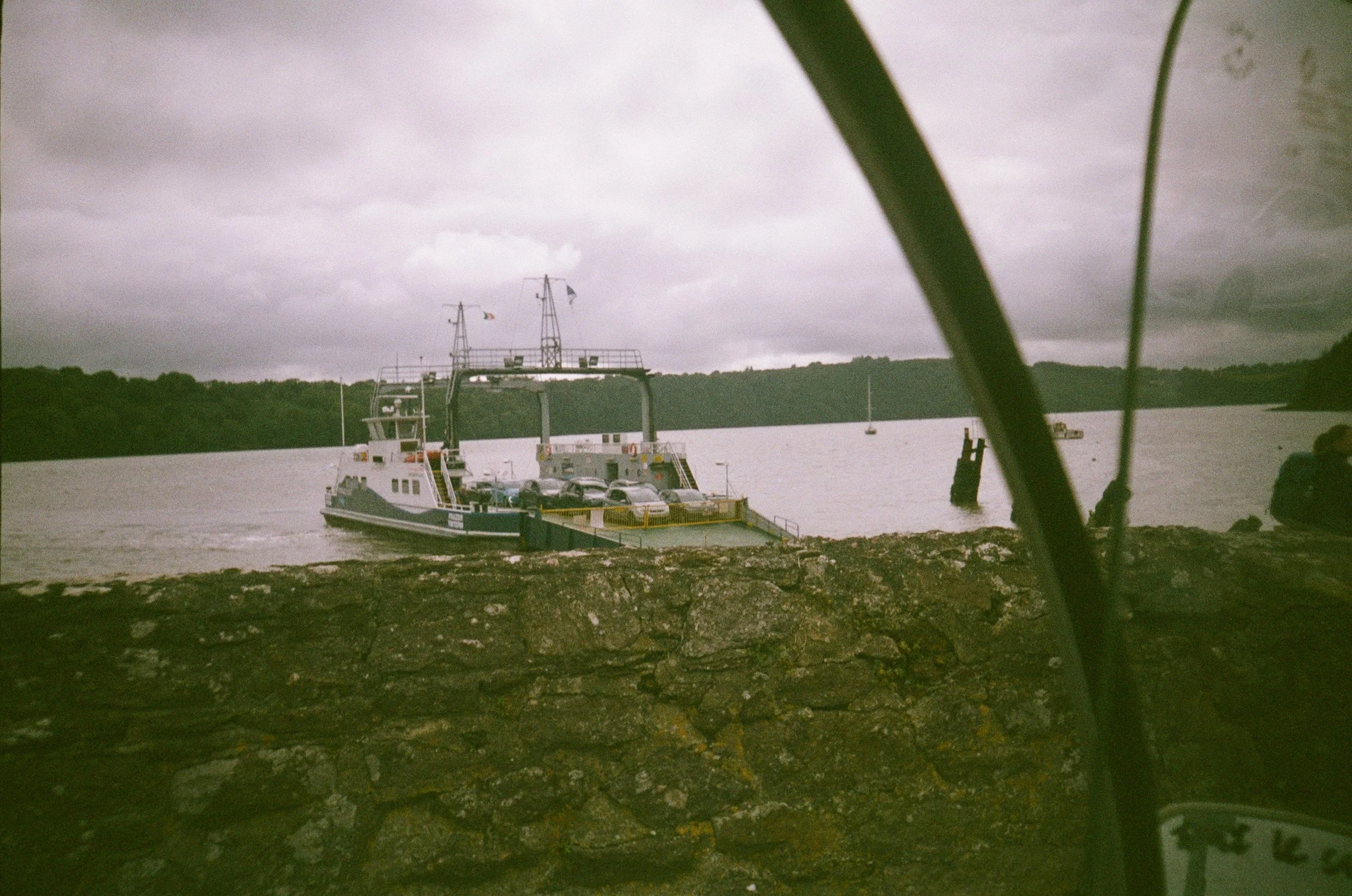
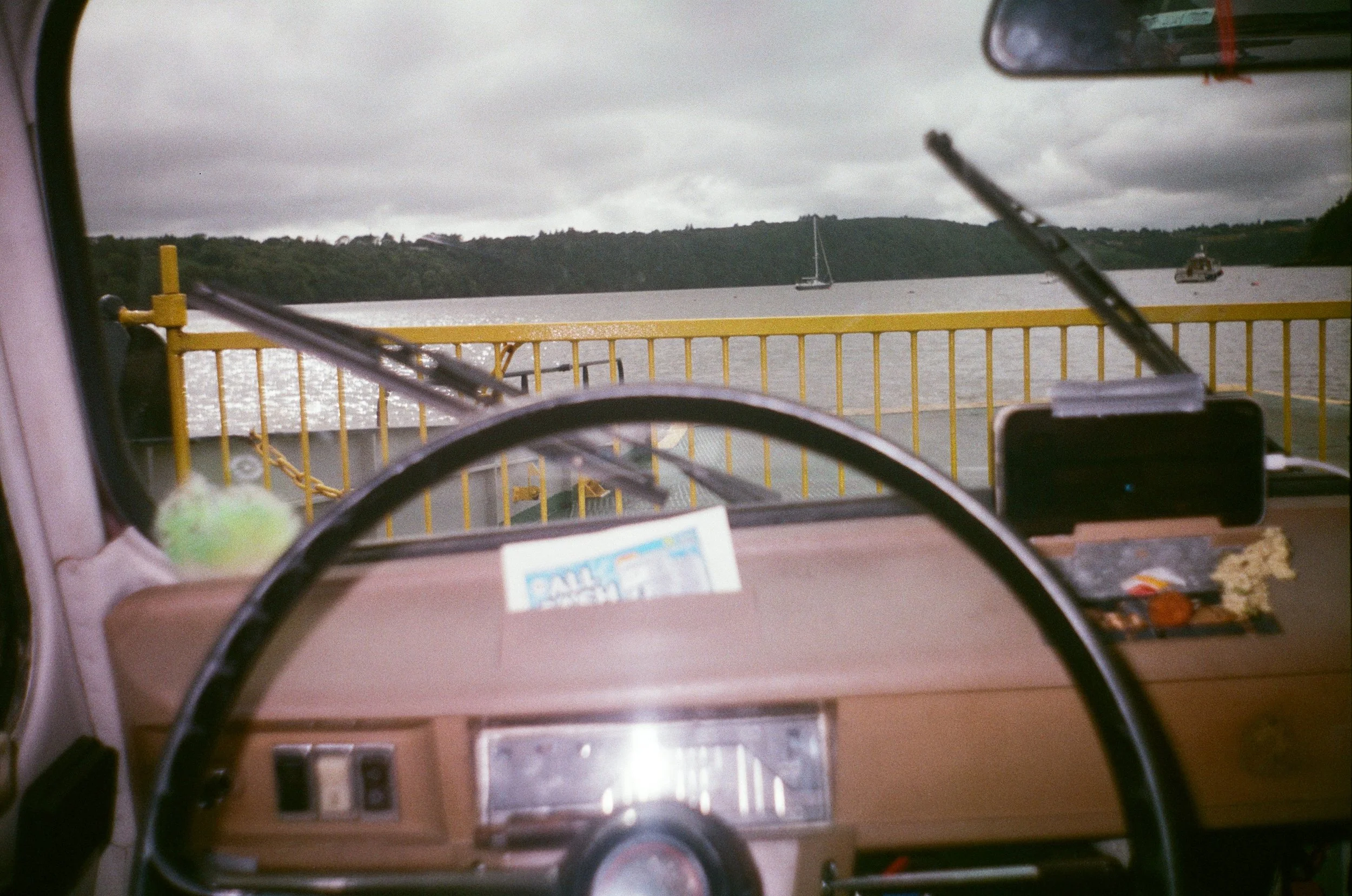
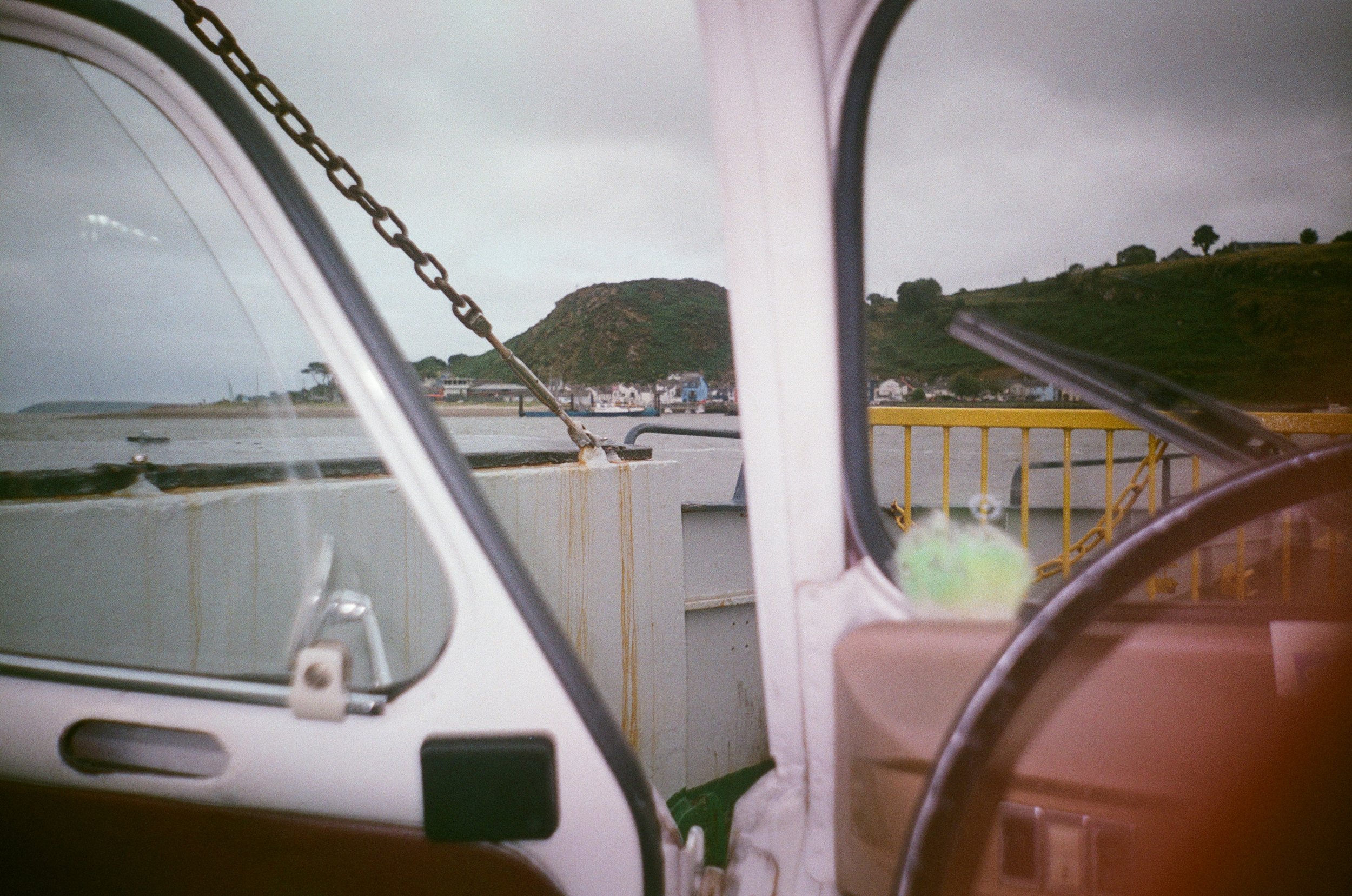
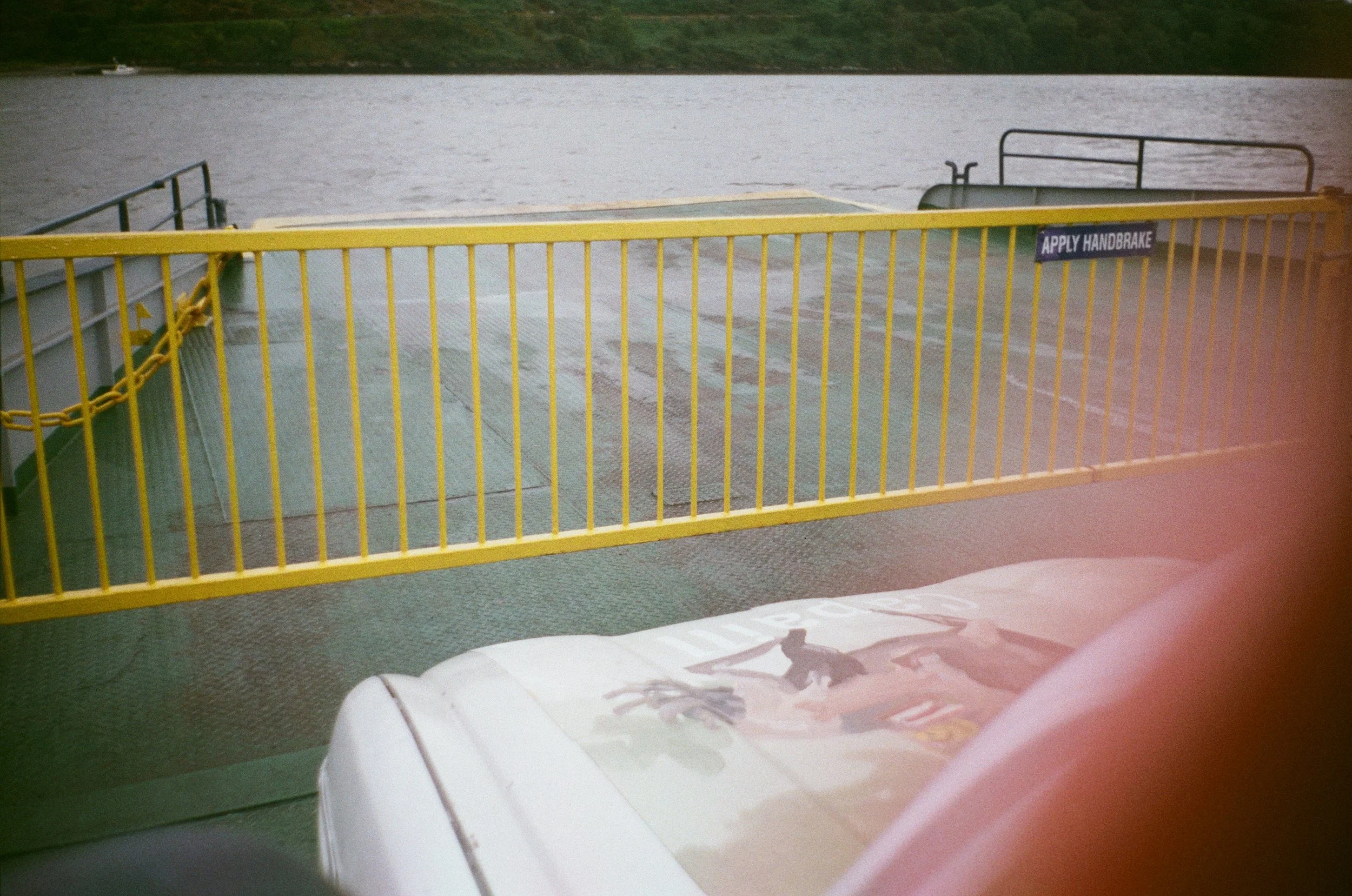
We stayed on the R736 until Wellingtonbridge, originally Ballyowen, Baile Eoin where we crossed the Corock River onto the R733. At Ballyhack a ferry took us across the River Suir estuary where the Barrow, Suir, and Nore meet, to Passage East. There we met a man with Ireland’s one and only Renault 4 Pick-Up. The model was never officially manufactured in Ireland, but Noel Shanaghy from County Waterford had carried out his own conversion to create one. Noel had invited us to drive with him to visit his friends, a family who were also passionate about the restoration of Renault 4s. A large group gathered to see the Quatrelles parked alongside one another with great excitement and levity, tea and homemade cake, funny anecdotes, and when we were leaving they formed a guard of honour, go n-éirí an bóthar libh for our journey ahead.
19.07.2025
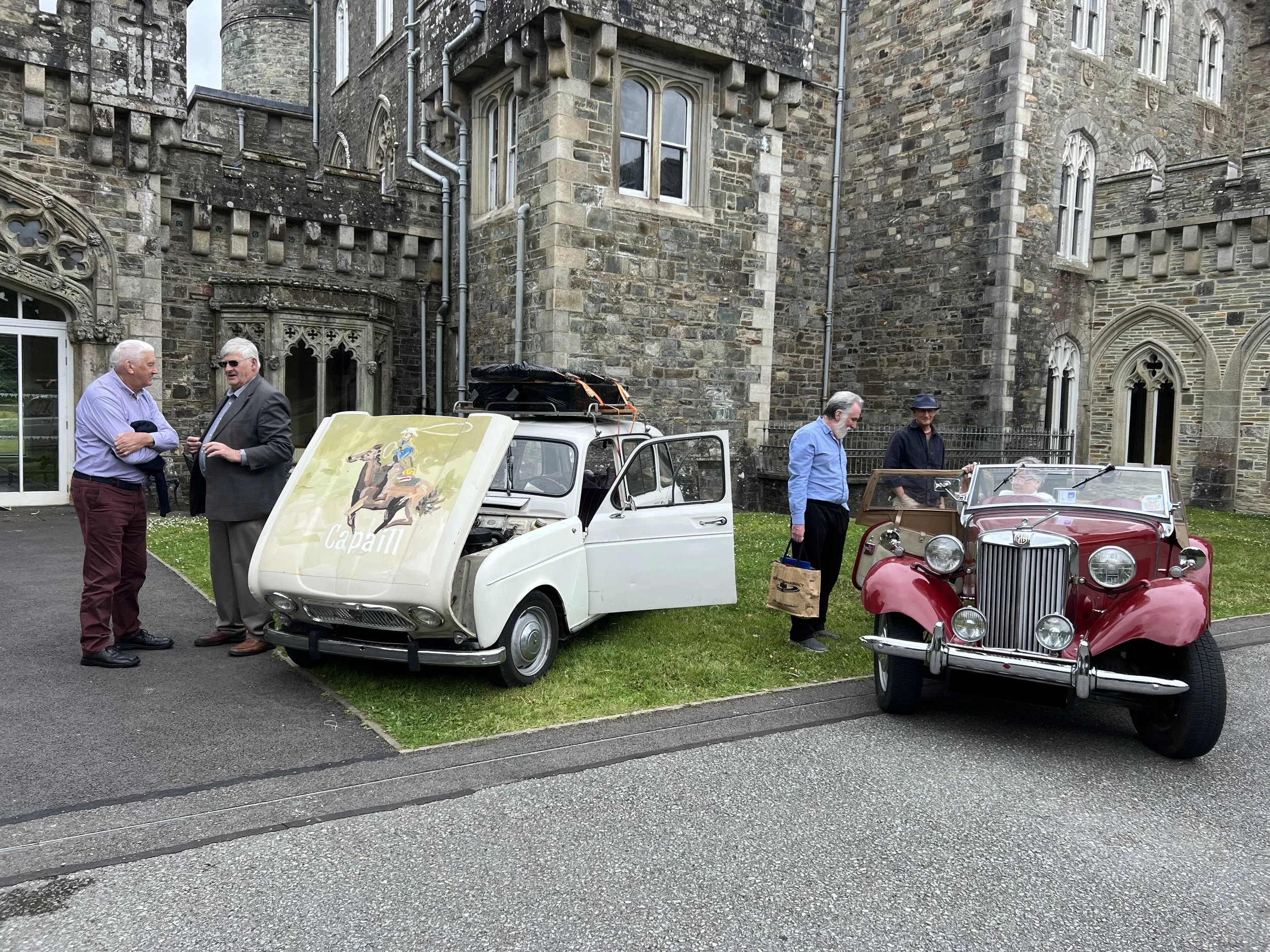
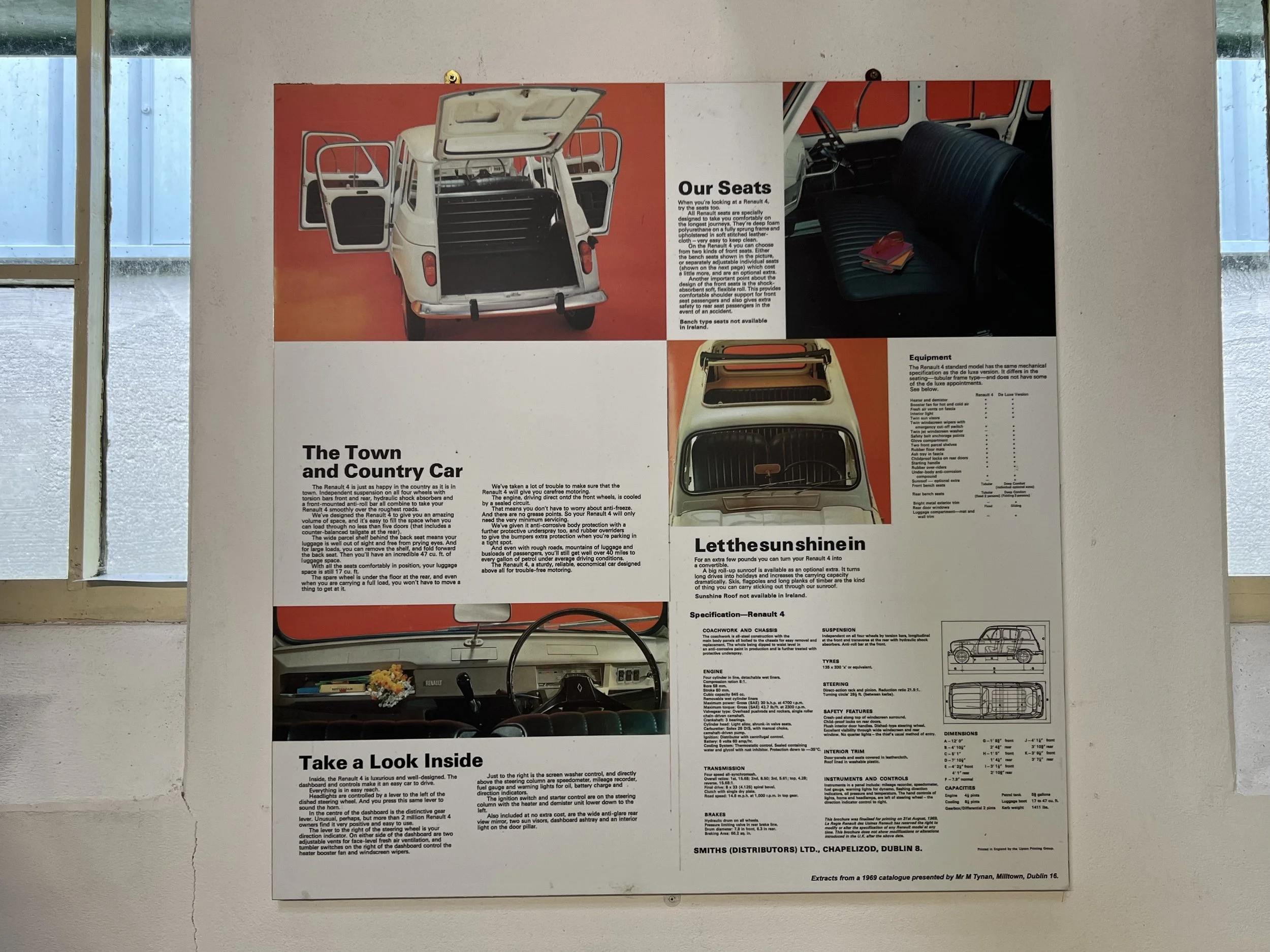
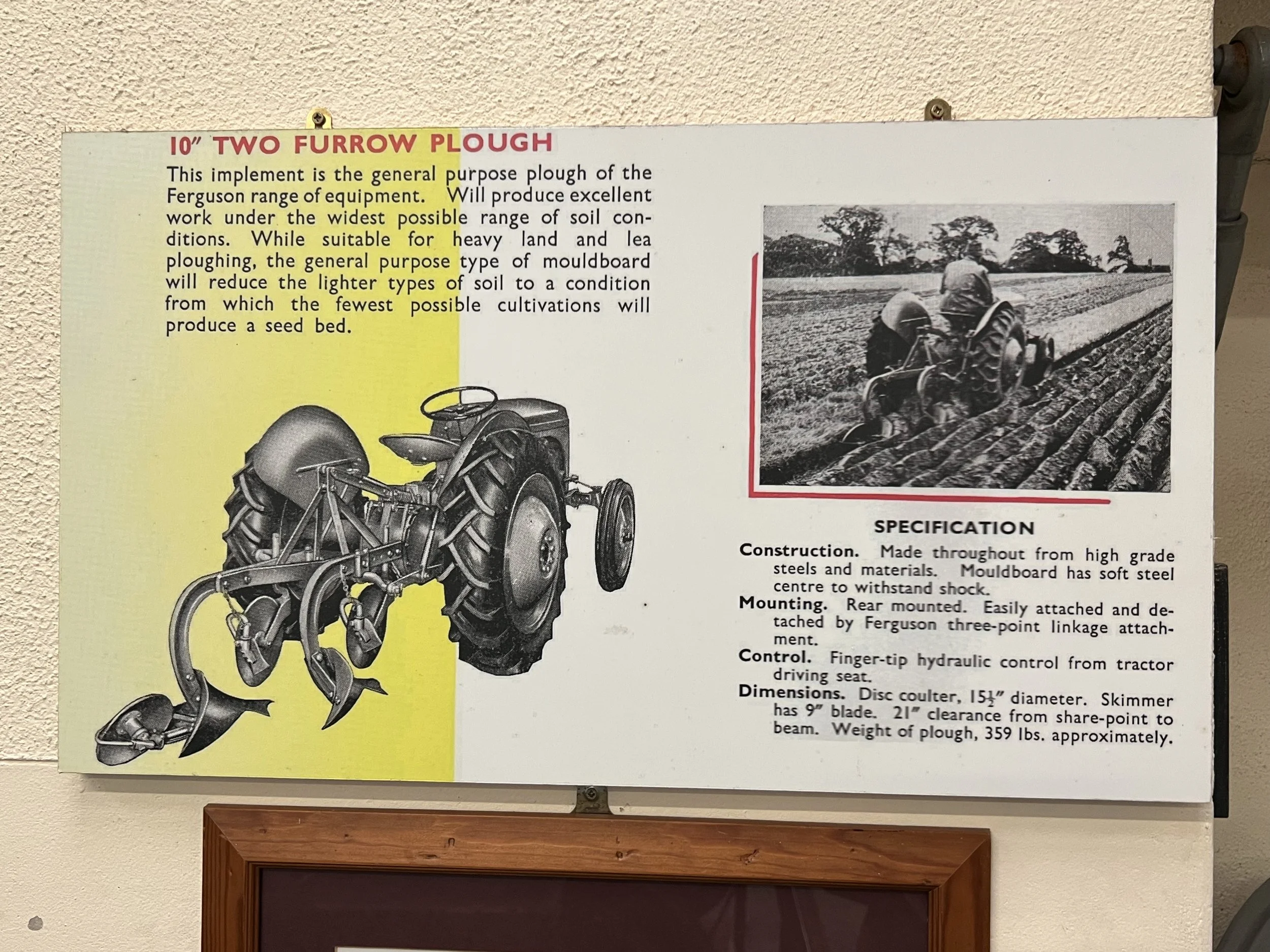
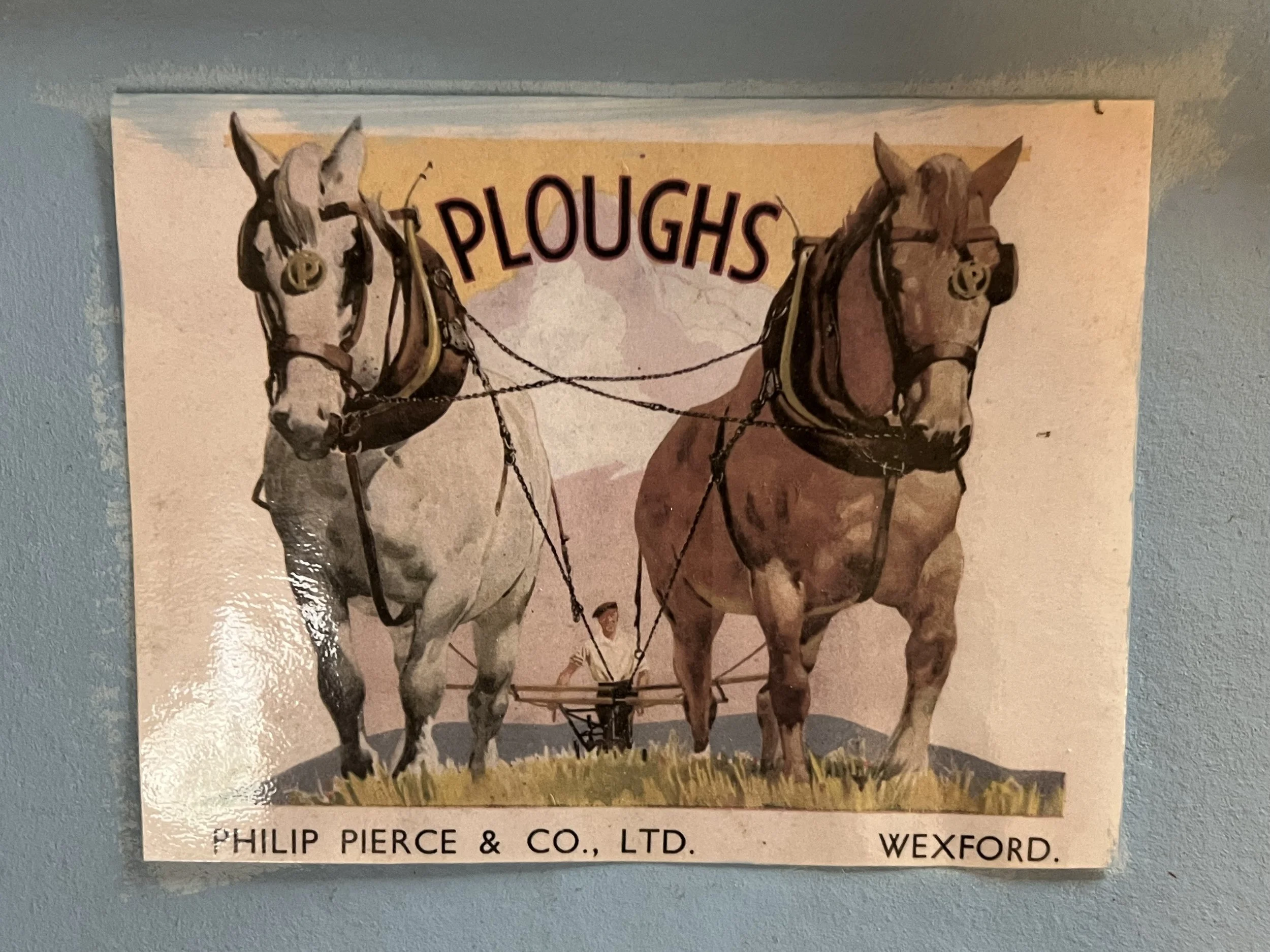
This day last year, we had a classic car meet up, where car aficionados were invited to drive their restoration projects and park in front of the historic Johnstown Castle in Co.Wexford. For this event, we partnered with Irish Agricultural Museum at Johnstown Castle for a public lecture, From Star to Car with curator Matt Wheeler about the history of the Wexford Engineering ‘Star’ site and how it transformed from the manufacture of ‘Star’ ploughs to assembling Renault 4 cars.
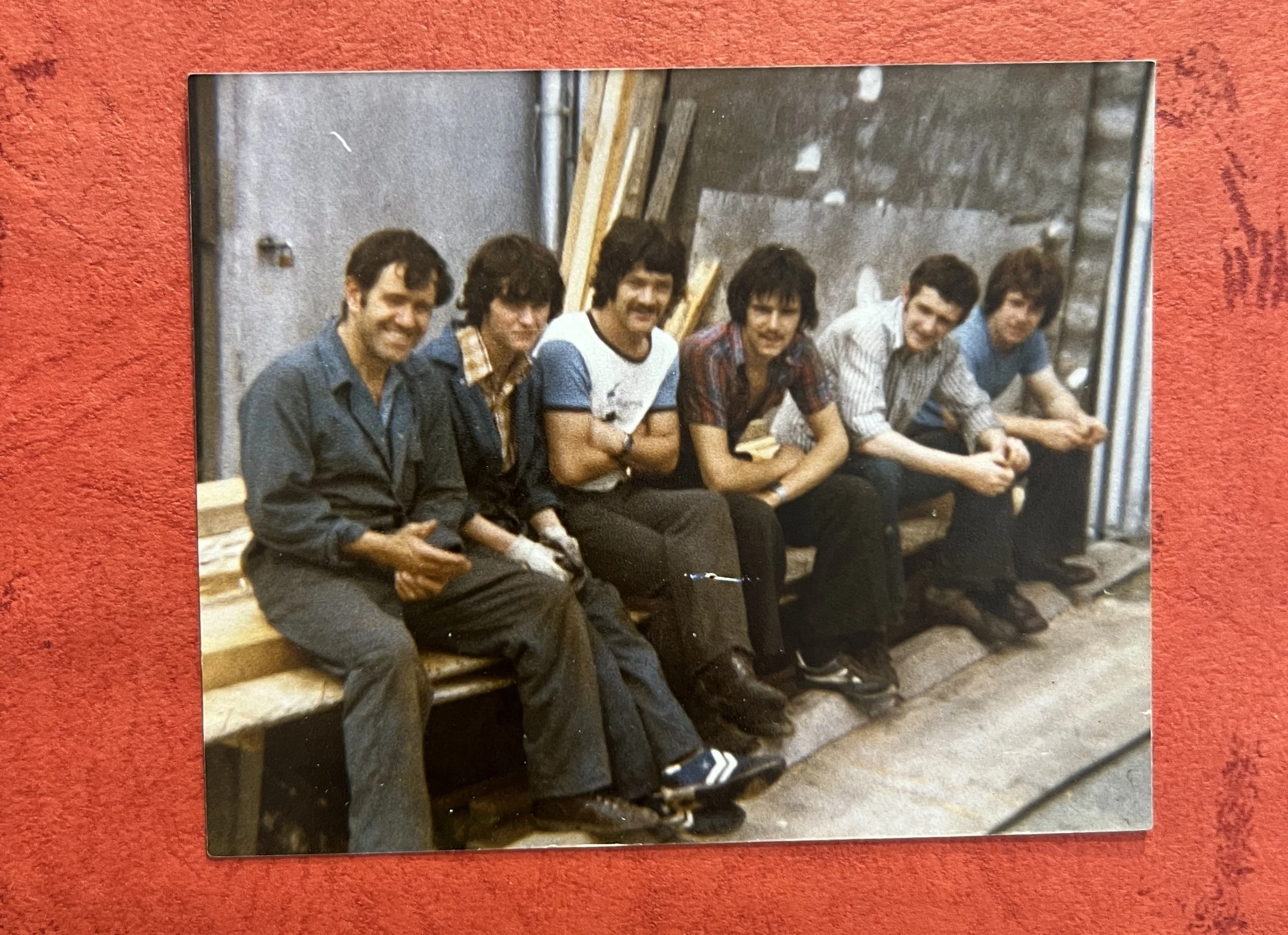
With reference to, a number of exhibits documenting changes in farming life in the wake of the industrial revolution, Wheeler’s lecture traced the evolution of The Star Works, founded in 1893 from manufacturing locally branded horse-drawn and later, tractor-drawn ploughs. This move from manual to mechanised culminated in the assembly Pivot, which began around 1965 when the site started assembling cars, primarily the Renault 4. At one stage, at its peak; the factory employed around 200 workers and produced between 35 to 100 cars per day.
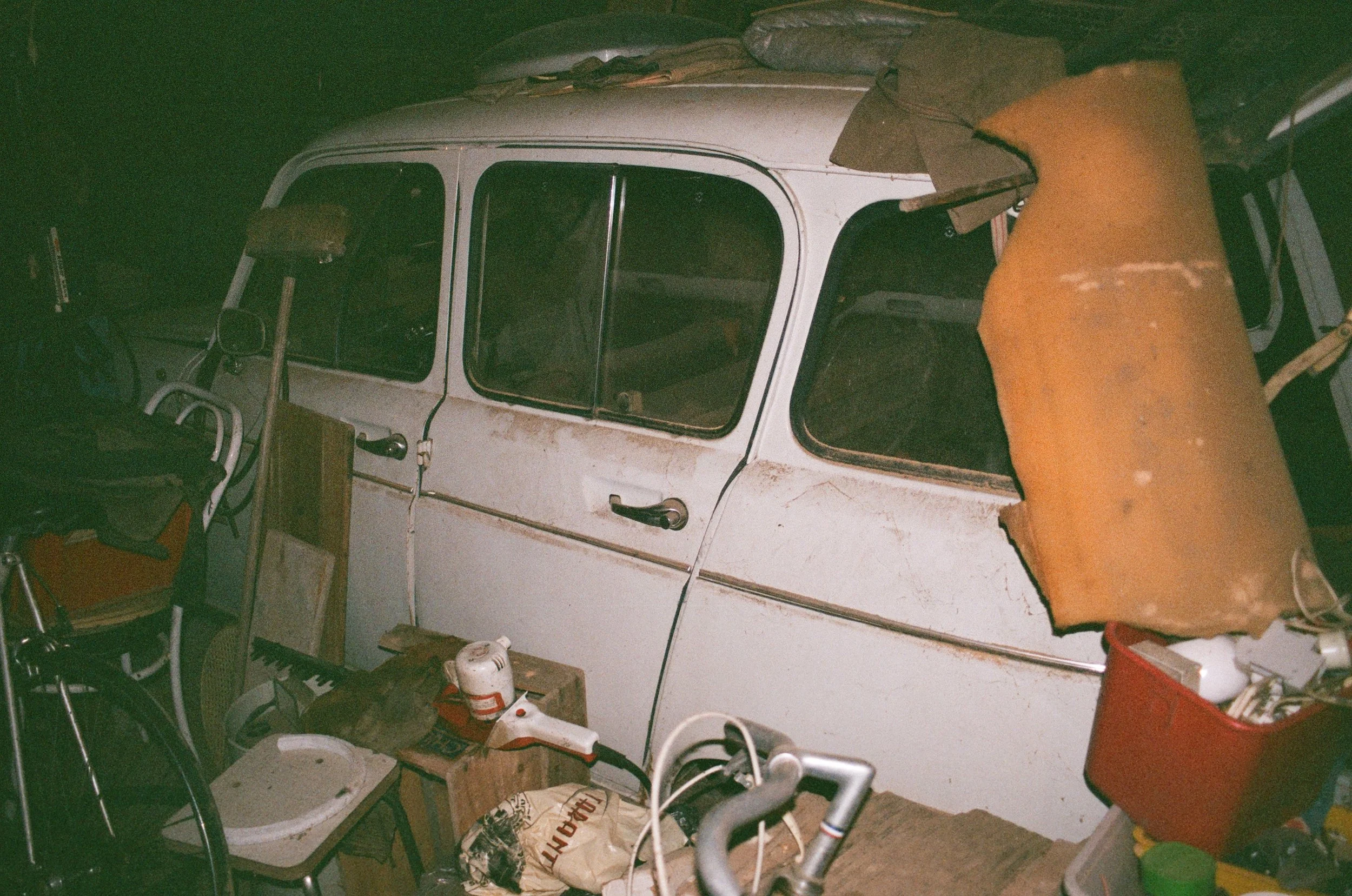
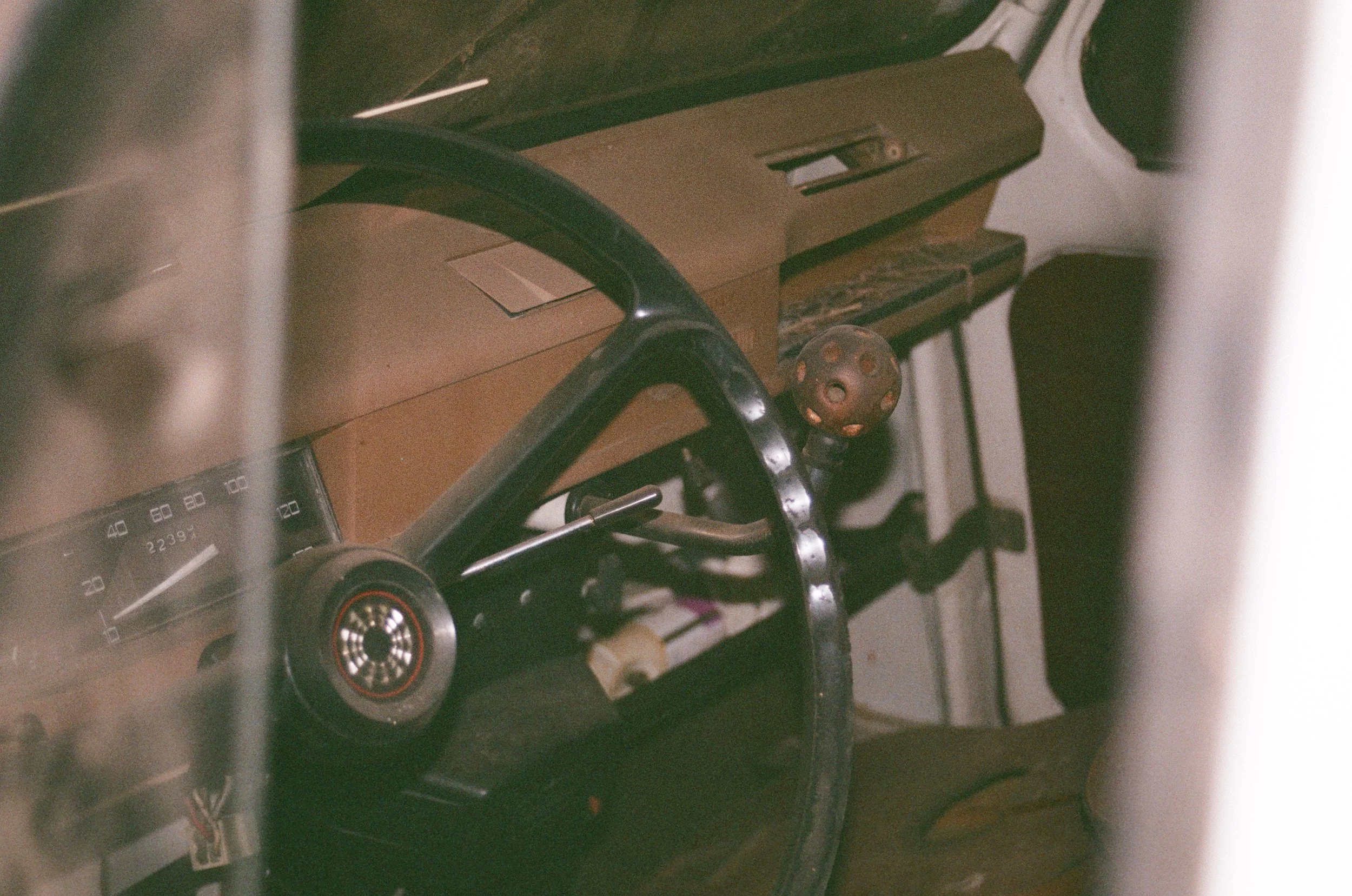
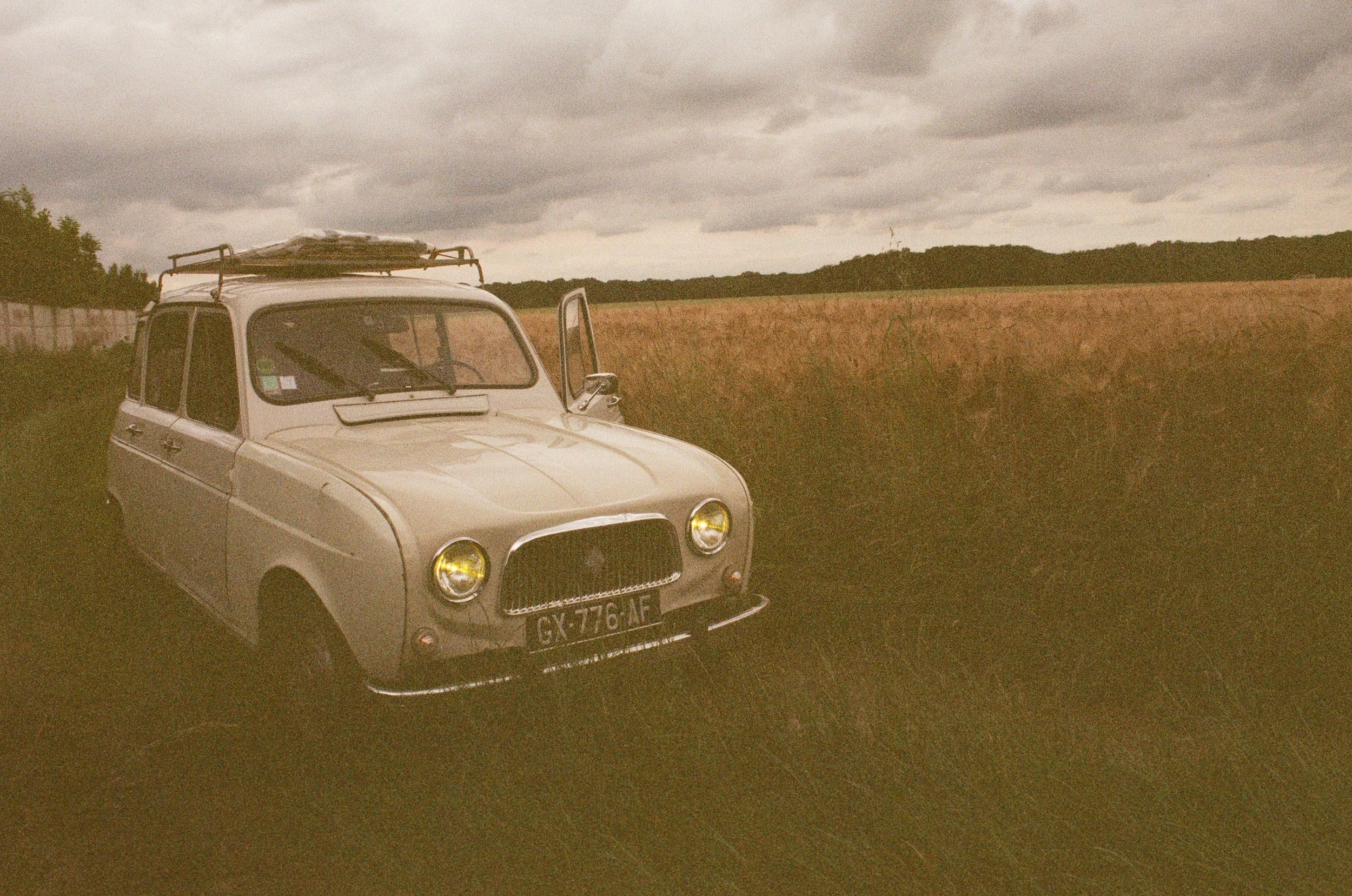
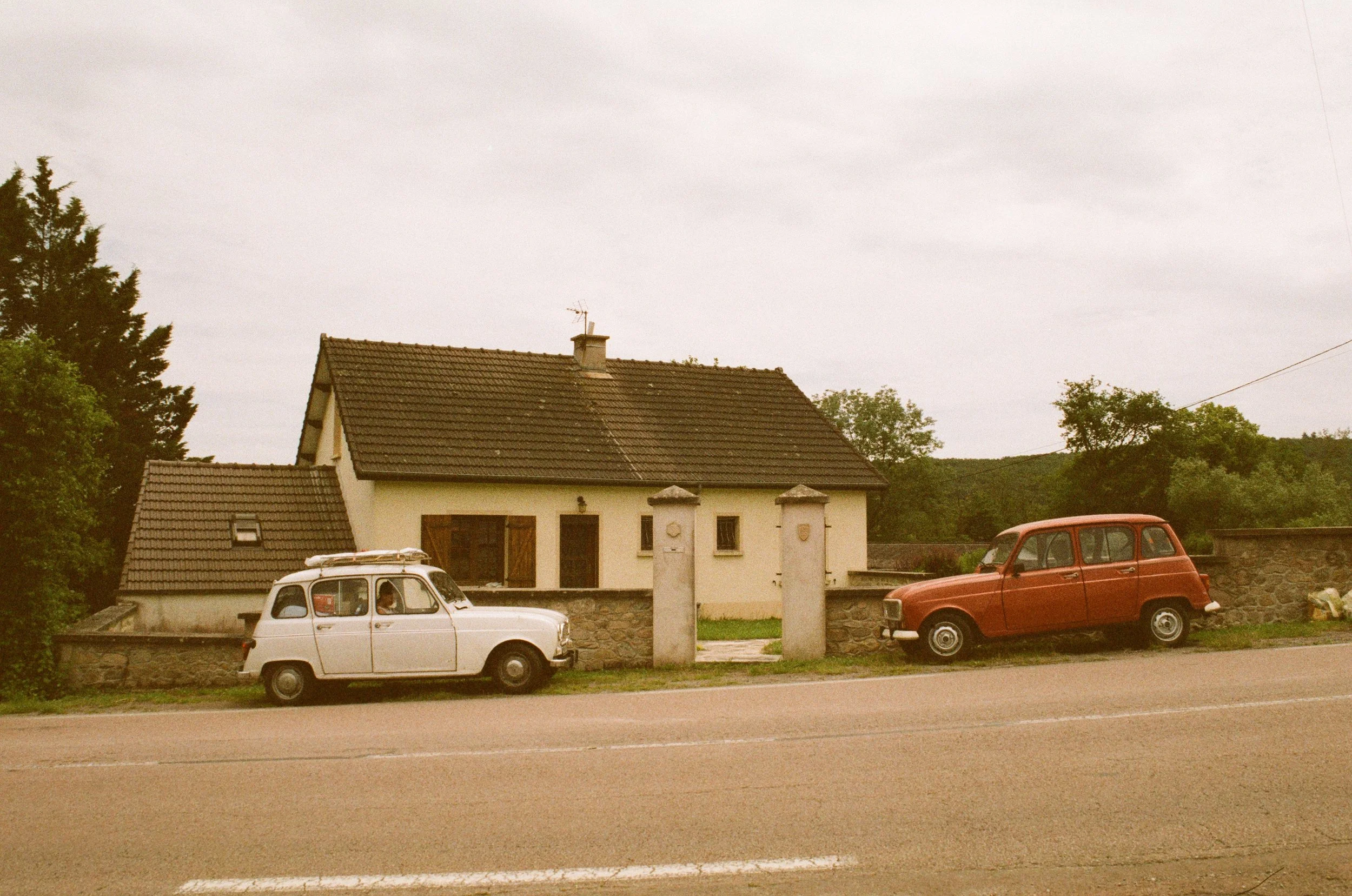
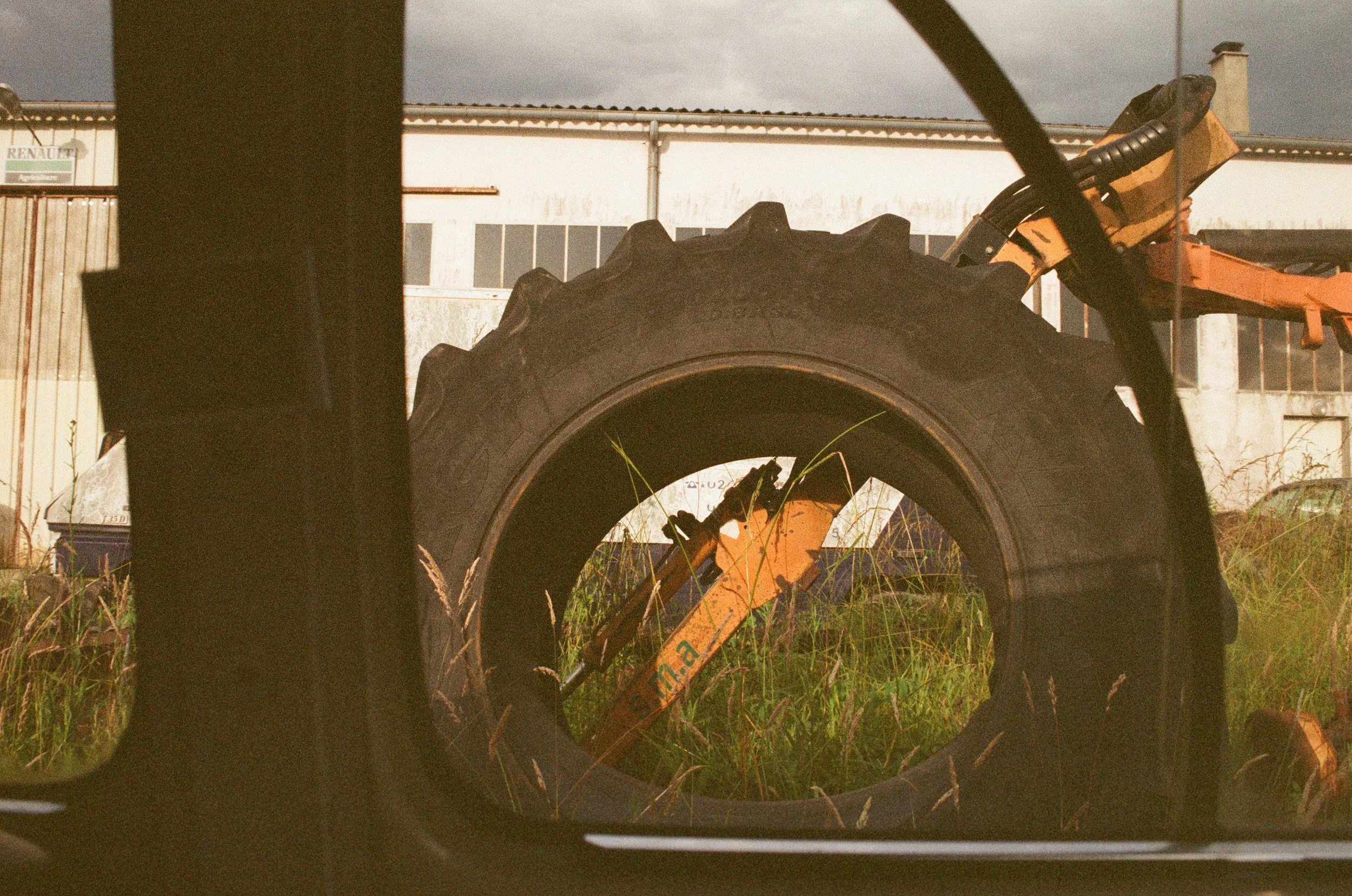
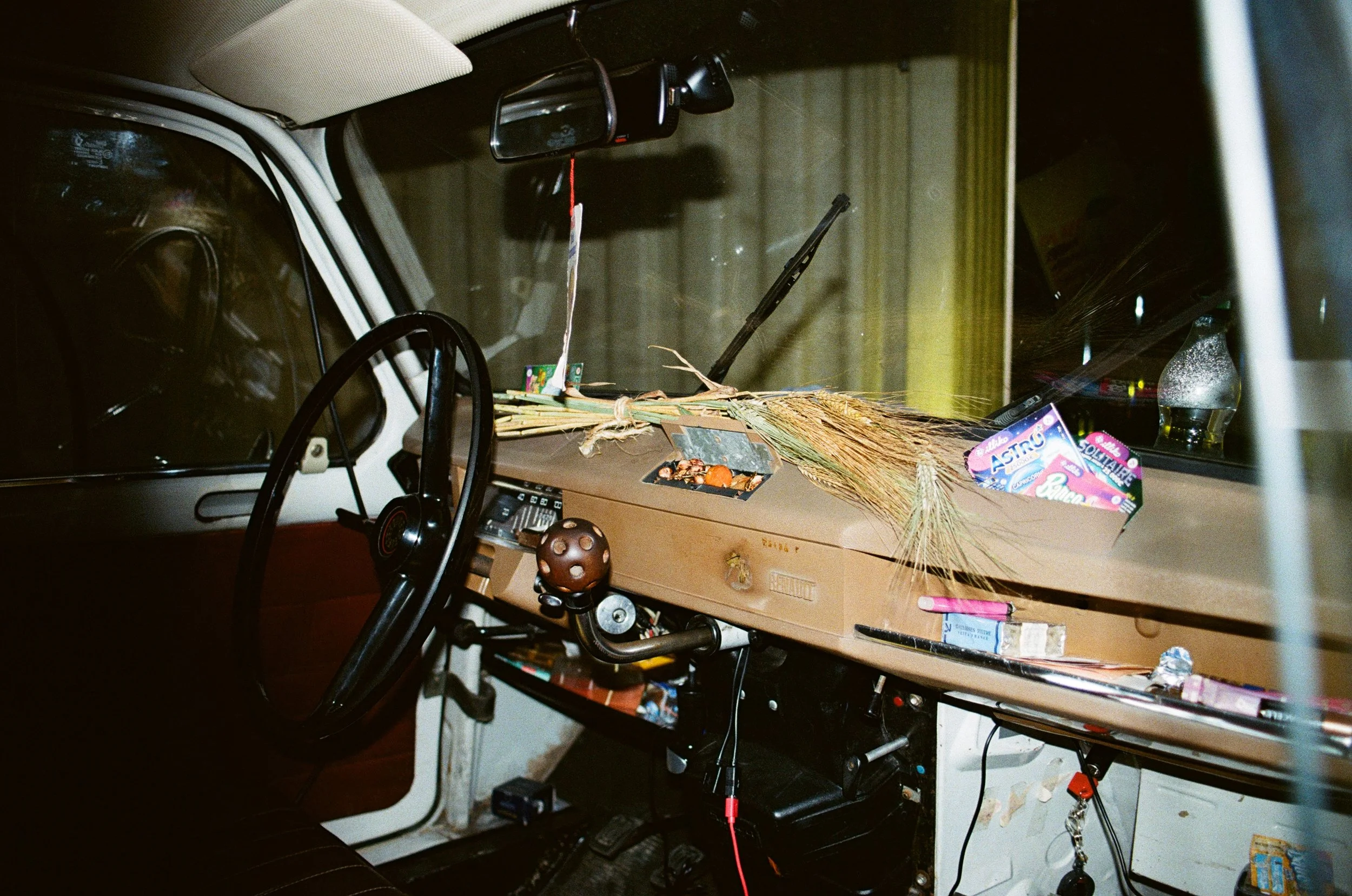
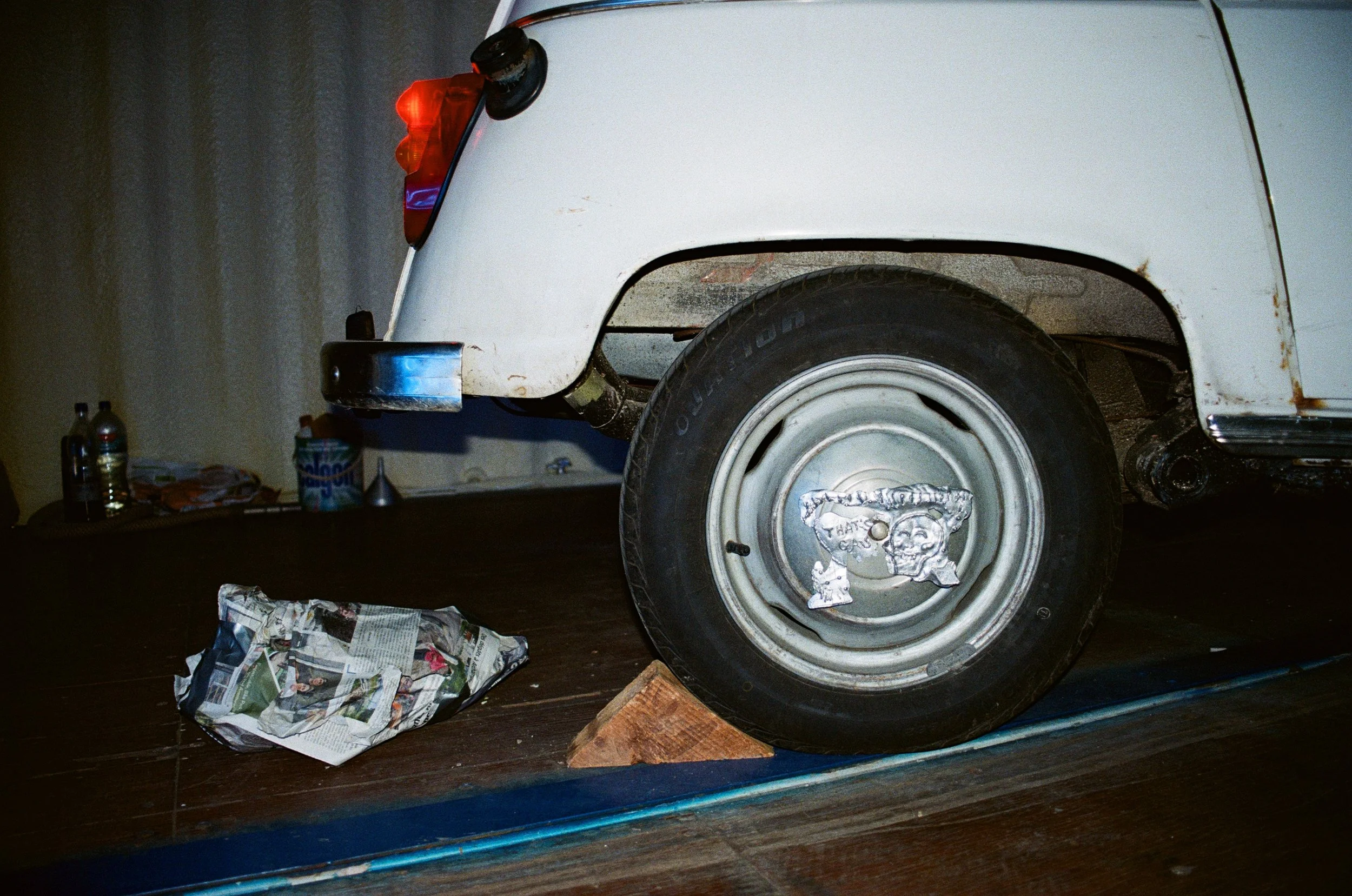
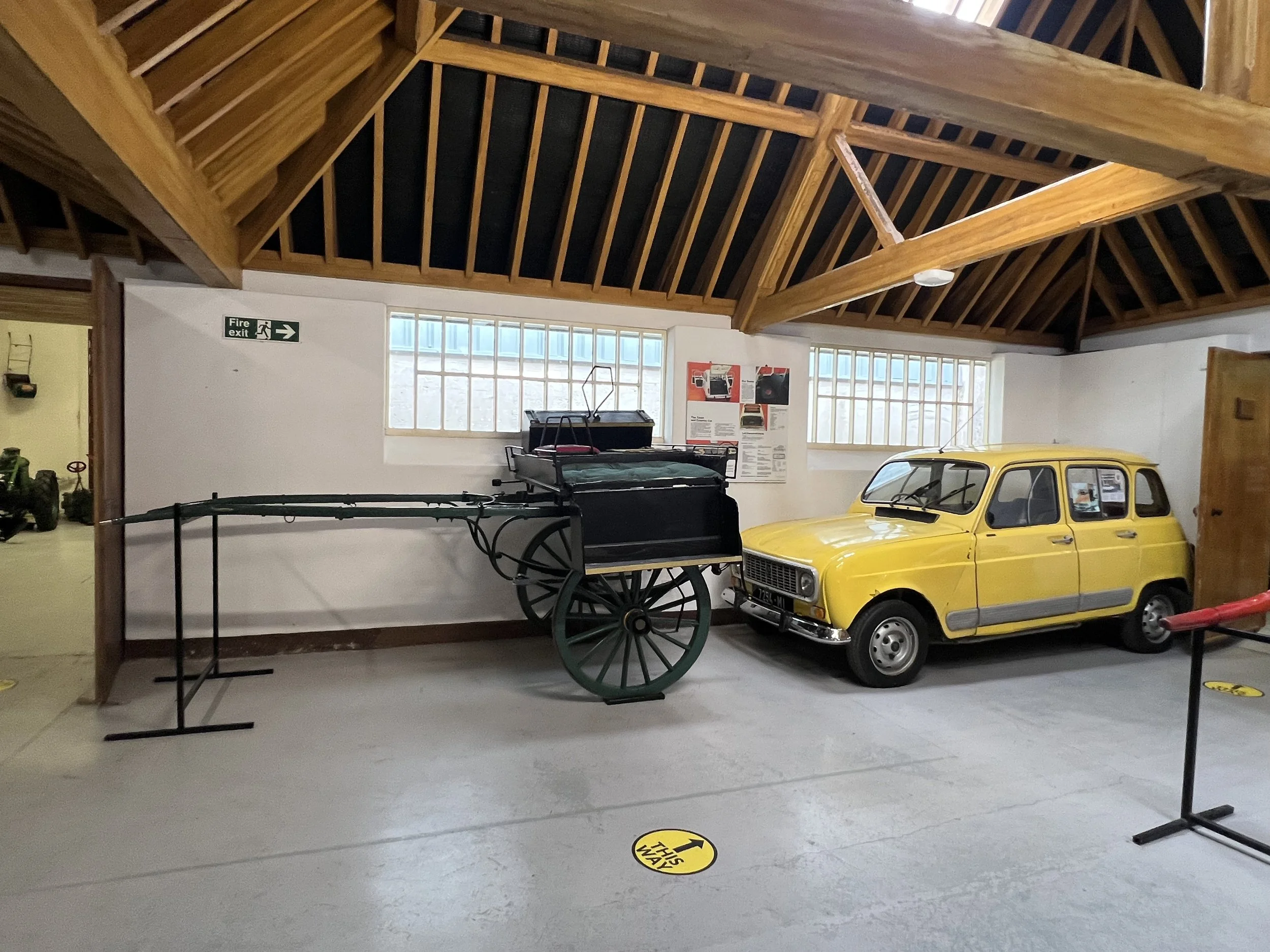
Our talk at the museum as tour de force, presented a sequence of images that showed the process of re-animating the Renault 4 and recounting stories from its first trip outside the remise in 30 years, from Liliane’s hometown in Haute-Savoie across France to Ireland…
18.07.2025
Even now there are places where a thought might grow —
Peruvian mines, worked out and abandoned
To a slow clock of condensation,
An echo trapped for ever, and a flutter
Of wildflowers in the lift-shaft,
Indian compounds where the wind dances
And a door bangs with diminished confidence,
Lime crevices behind rippling rain barrels,
Dog corners for bone burials;
And in a disused shed in Co. Wexford…
- From A Disused Shed in Co. Wexford By Derek Mahon
With the iconic car parked outside Wexford Arts Centre, this pitstop was a moment for Liliane and myself to talk about the origins of this joint adventure which started in summer ‘24 when Liliane fixed her late father’s Renault 4 with the help of mechanics; friends in her hometown of Haute-Savoie. Once the car was roadworthy, rodée, we began our journey, live streaming from the Renault 4, while driving across France and up through Ireland for Beep Beep, a major installation by Puthod curated by Temple Bar Gallery and Studios off-site at the Graving Docks, Dublin Port.
One of the defining factors of Beep Beep as an artwork, is its function as a transient museum and broadcasting unit, a touchstone for exchange. The car is an artwork that transports, shares and gathers other artworks. It’s on the move, circulating stories and in circulation itself - generating stories. On the roads less travelled, of intangible and material creative expression, the car is a portal into other worlds. It is this temporal and spatial fluidity that activates its meaning as an artwork. This is how, in essence Beep Beep became tour de force.
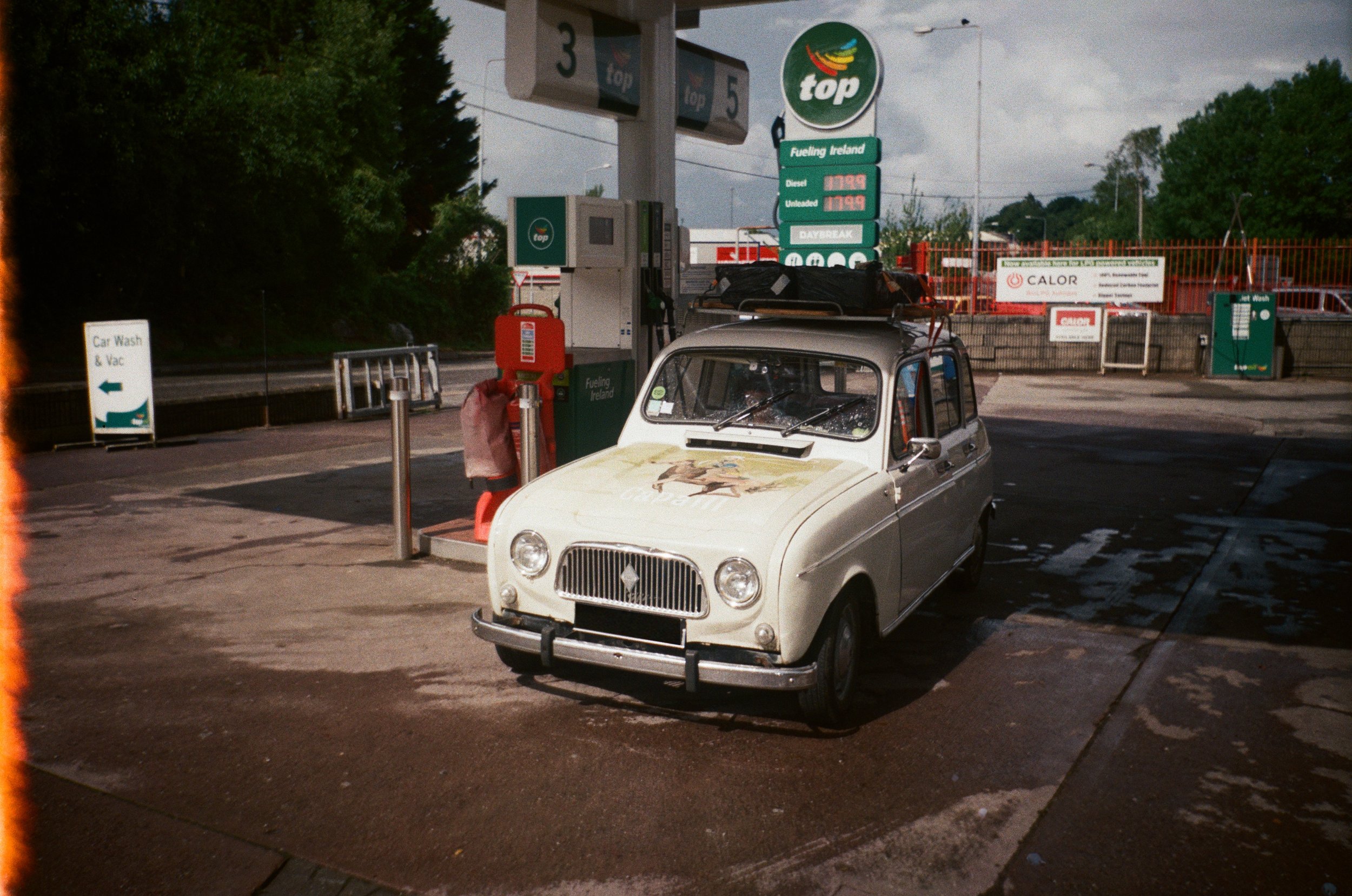
But back to the story, during our monumental journey from France to Ireland two years ago in summer 2024; just as the car reached Cherbourg - a crucial component that rotates the serpentine belt for cooling the engine snapped 200 meters from the ferry. As a queue formed to board the ferry; mechanics; aficionados, experts stopped to lend advice and practical help. We got the car onto the ferry and were assured that someone in Wexford would absolutely know how to fix a Renault 4. On the other side, at a Daybreak petrol station in Rosslare we immediately met Big Mick Hennessy; a mechanic, who drove an articulated lorry, bringing humanitarian aid from Wexford to former Yugoslavia in the 1990s. He was well known by truckers on that route; not only was he was an accomplished mechanic, not only did he carry spare truck parts for himself…BUT he also carried spare parts for others.
Big Mick Hennessy, having had one look under the bonnet, diagnosed the issue and called an old friend from the trucker days, local Renault 4 expert Michael Rice who miraculously fixed the part the following day (a Sunday) and got the car back on the road. Michael was also able to identify and fix a slight warp in the door that was letting in rain. Side note: Michael modified in his own Renault 4 in the 70s, installing six large speakers to create surly one of best mobile sound systems in Ireland at the time.
We were relieved to have met the right experts for the job, though Michael humbly suggested we were likely to have met another Renault 4 expert down the road anyway. Every second person in Wexford had worked at the factory at some point it seemed. Hundreds of local people formed the labour force that assembled imported Completely Knocked Down (CKD*) Renault 4s. CKD refers to an industrial loophole during a period of high import taxes in the 1970s, where the Renault 4 was made in Billancourt in France, broken down and shipped in parts to Wexford in huge crates where they were reassembled from the kits. This meant that the car could be sold much cheaper in Ireland, indeed it was many people’s first car – the first everyman car, for rural working classes. As such, the 4L is a vehicle for nostalgia and memory for this group. The car that brought people to their first dance, first job, first holiday. The car that folklorist and collector Tom Munnelly travelled around Ireland in during the 1970s documenting the songs, stories, melodies of Ireland.
When we arrived at the Wexford Arts Centre, Anthony the gentleman we’d met the previous day, was at the entrance beaming at us. We drove the car onto the courtyard and pulled up in front of him, he walked around the car, peering in the windows, taking it in before putting the photo book on the bonnet. Well that certainly brings back a few memories, he said. We hopped out of the car, eager to have a look at the photo album. Then a momentary comical interlude occurred when a children’s entertainer in an inflatable dinosaur costume on lunch break, came over to the three of us and asked to look the 4L. The dinosaur quizzed us on the nuts and bolts of the tour, the whys and hows, until we had to excuse ourselves to go inside for the talk.
During the coffee morning event, Anthony presented the photo book to the other attendees. It transpired, by sheer co-incidence, that the photo album featured a photograph of another man who was there. The retired engineer recognised himself, his friends and colleagues as the book landed on his lap after circulating around the room. This was a wonderful coincidence and stories of the factory were connected with faces and places in the album. Another beautiful moment occurred when Anthony showed us a photo of his childhood holiday home, made from CKD* crates. Liliane had been aware of a phenomenon in the 1970s whereby it became popular to repurpose the crates used to transport CKD* Renault 4s into garden sheds and beach huts, so we were on a quest to find a photo of one of those, or to chat to someone who still had one.
It would be incredible to find one in existence. Imagine there’s one person out there who has been repainting the wood each year, repairing it, protecting it from sea weathering, from haloclasty, crystal wedging. That there is a well-preserved CKD* still used shed in Co. Wexford…
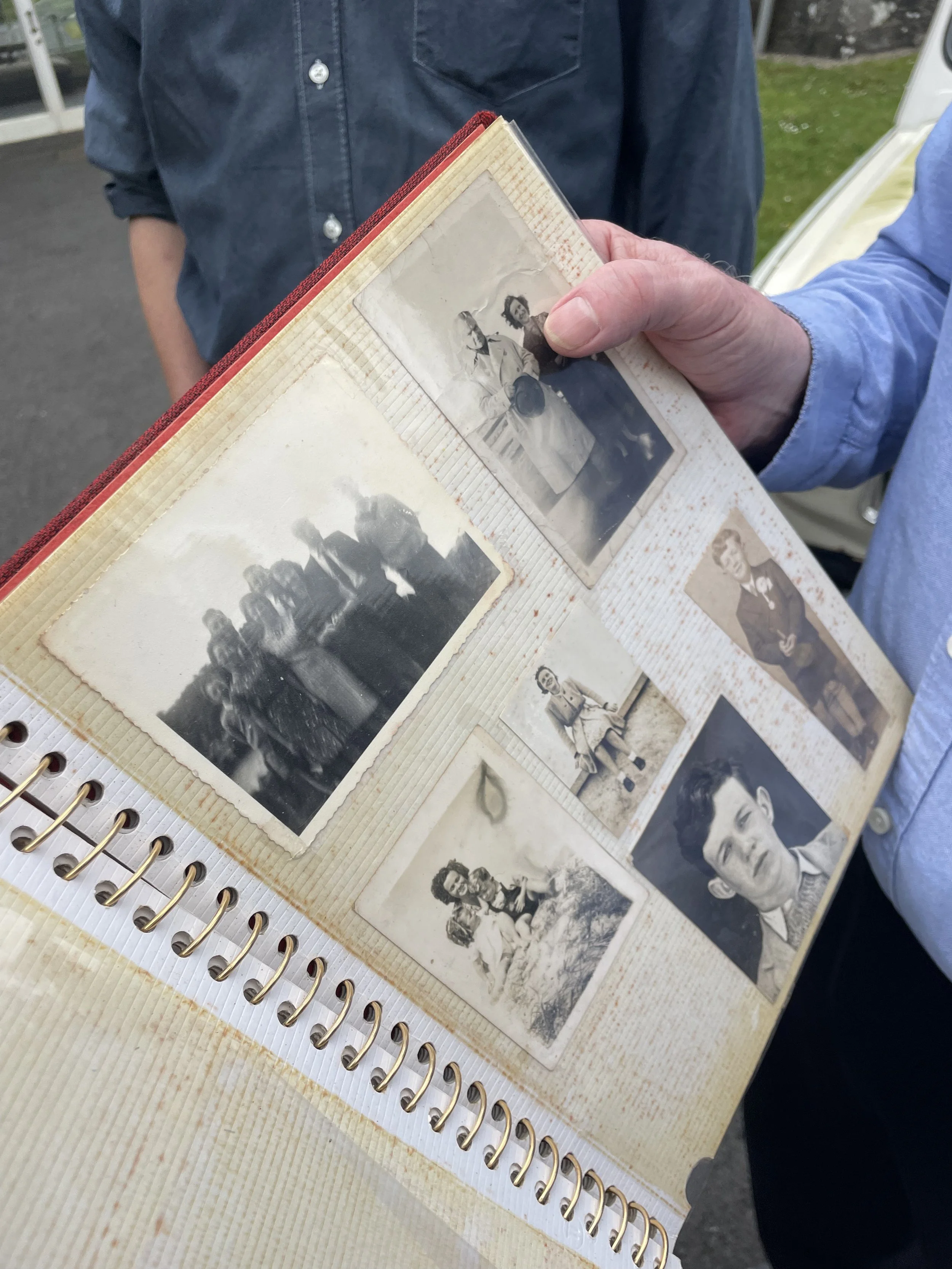
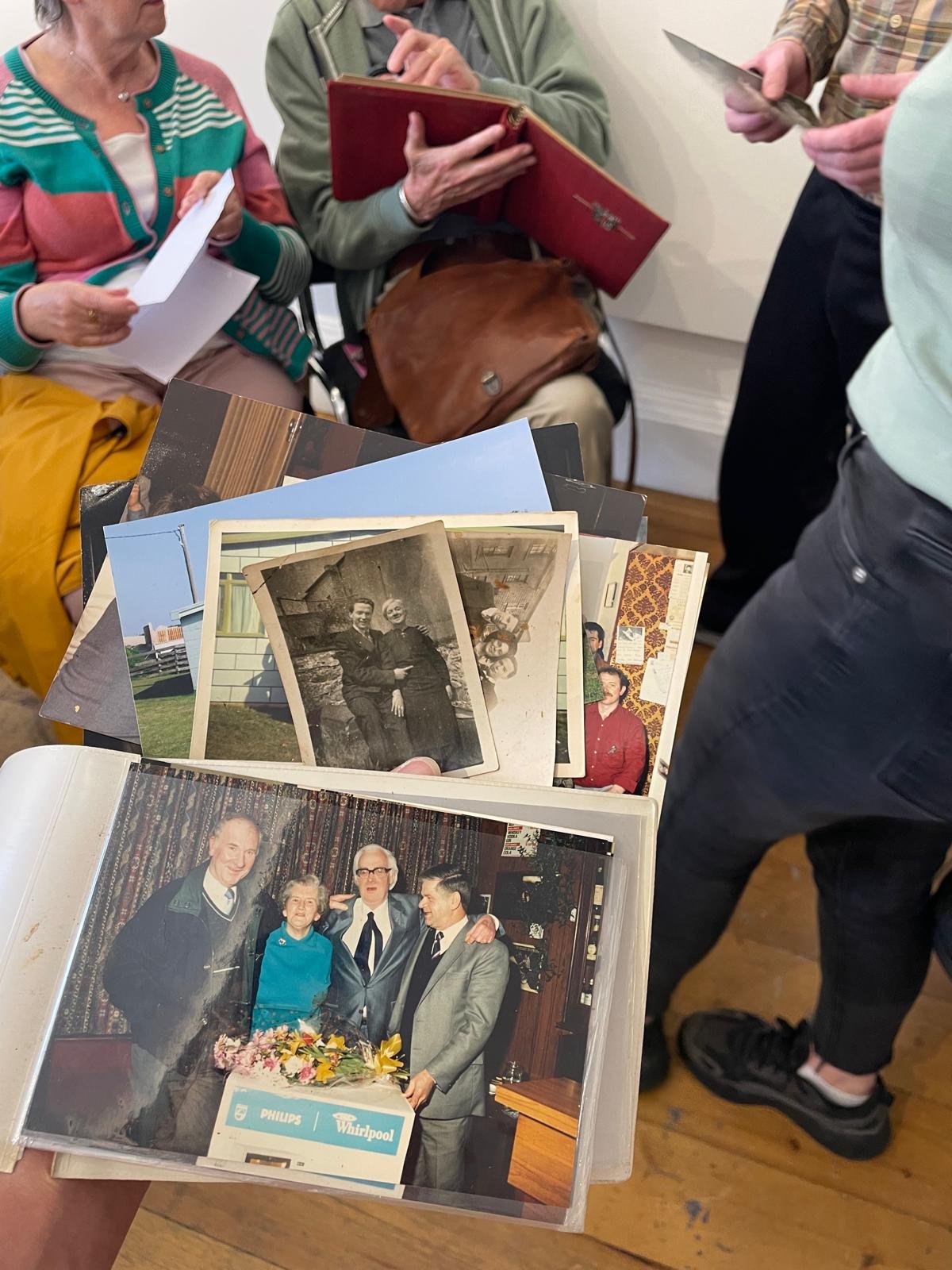
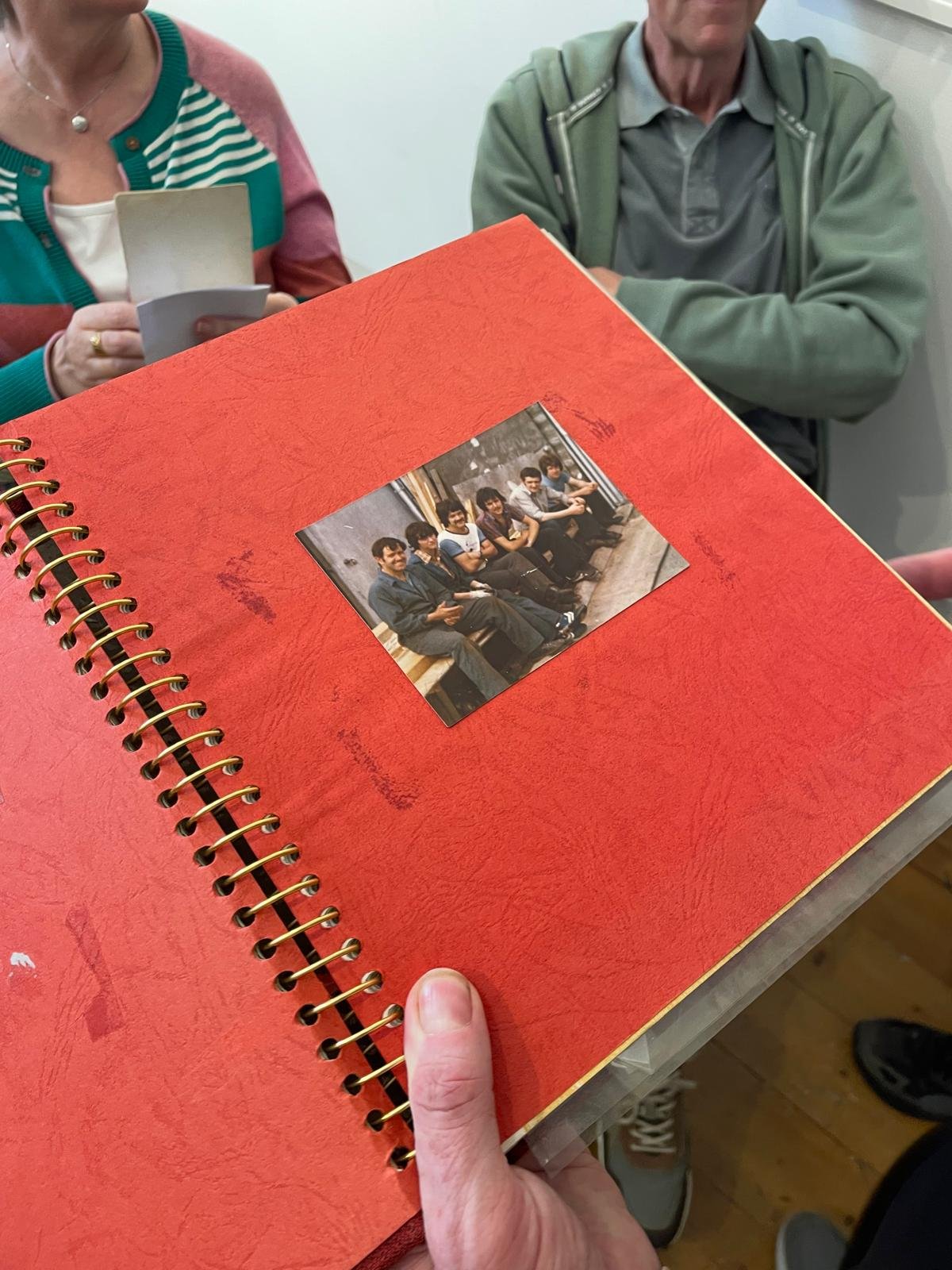
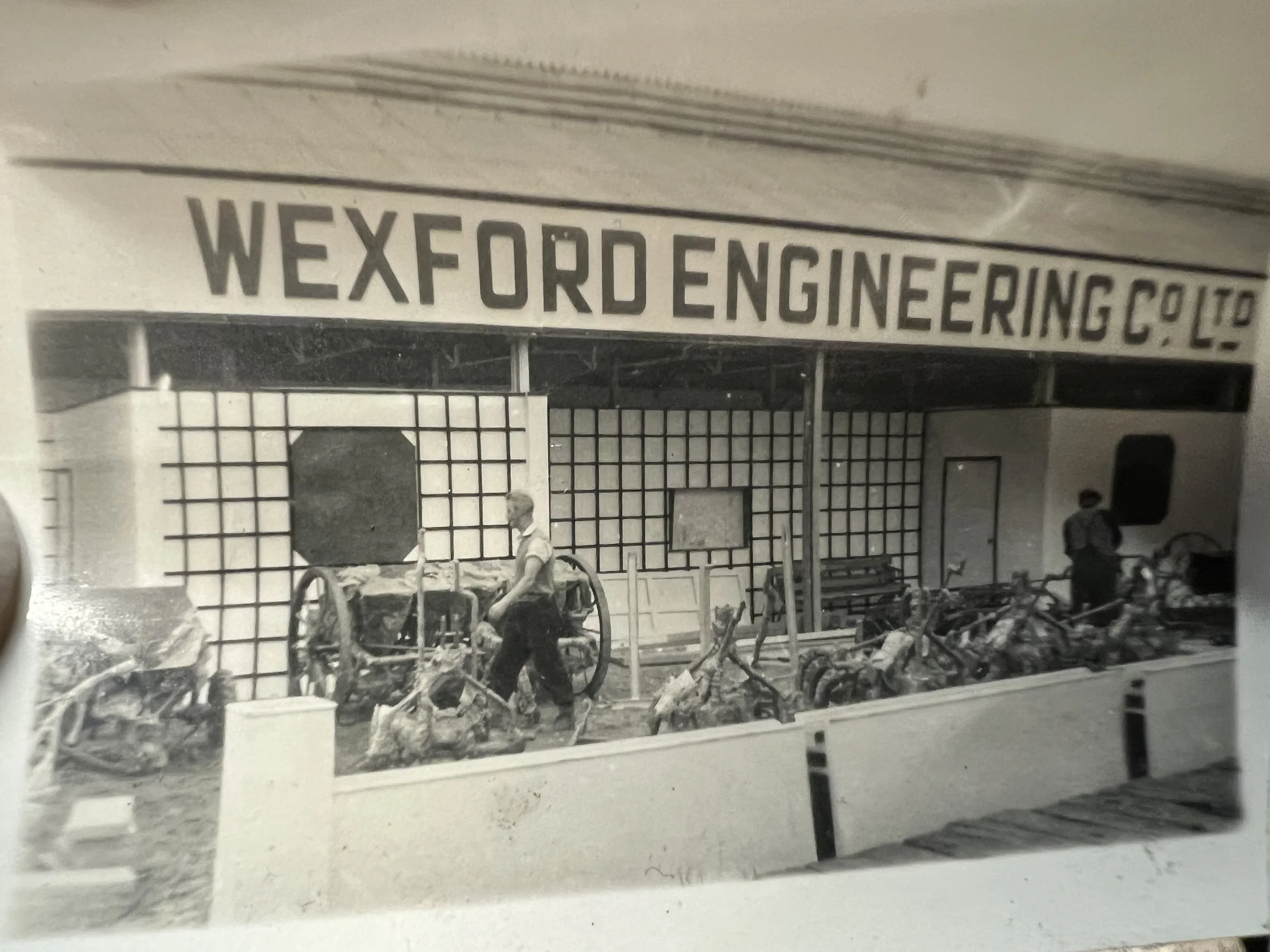
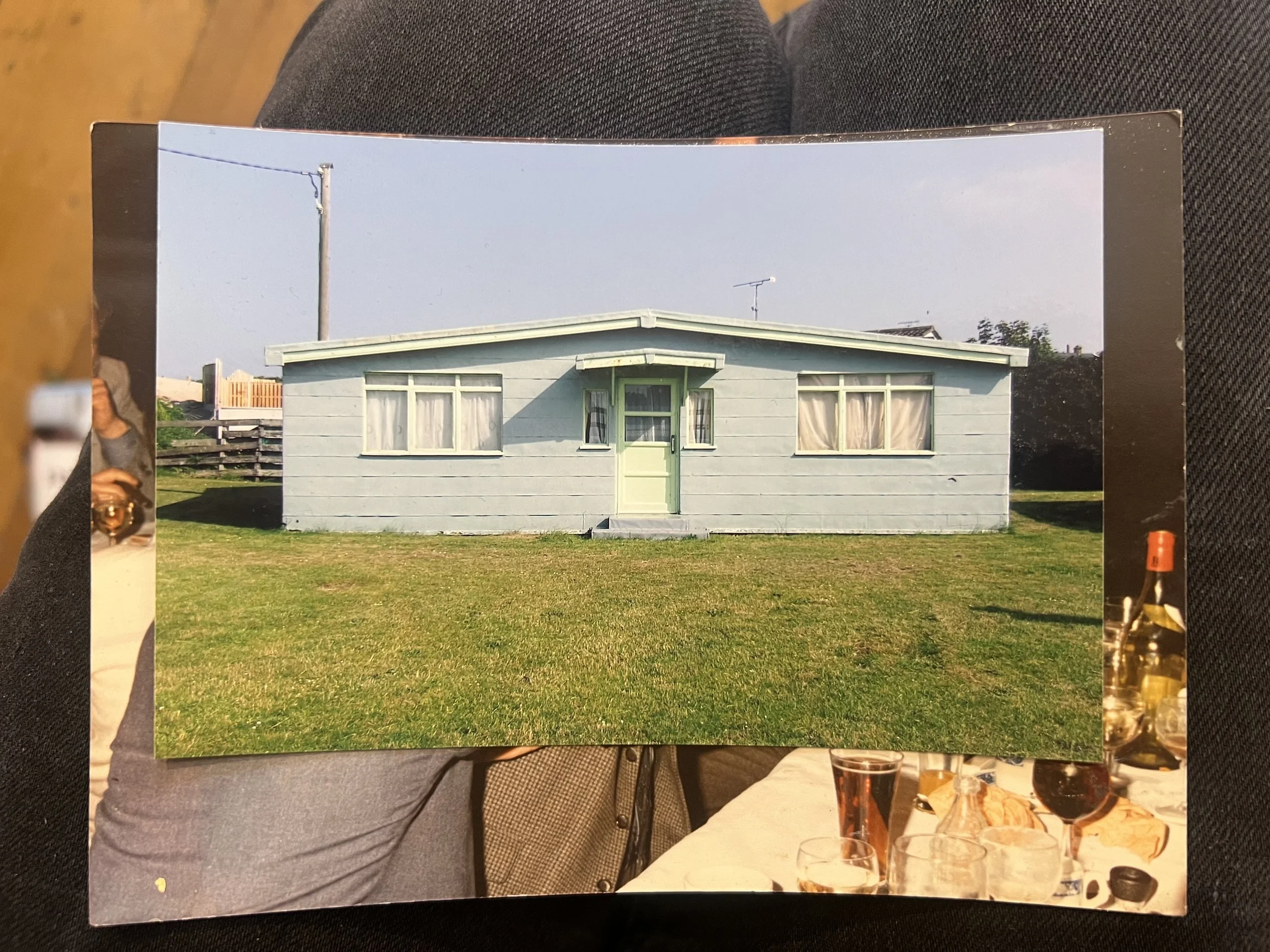
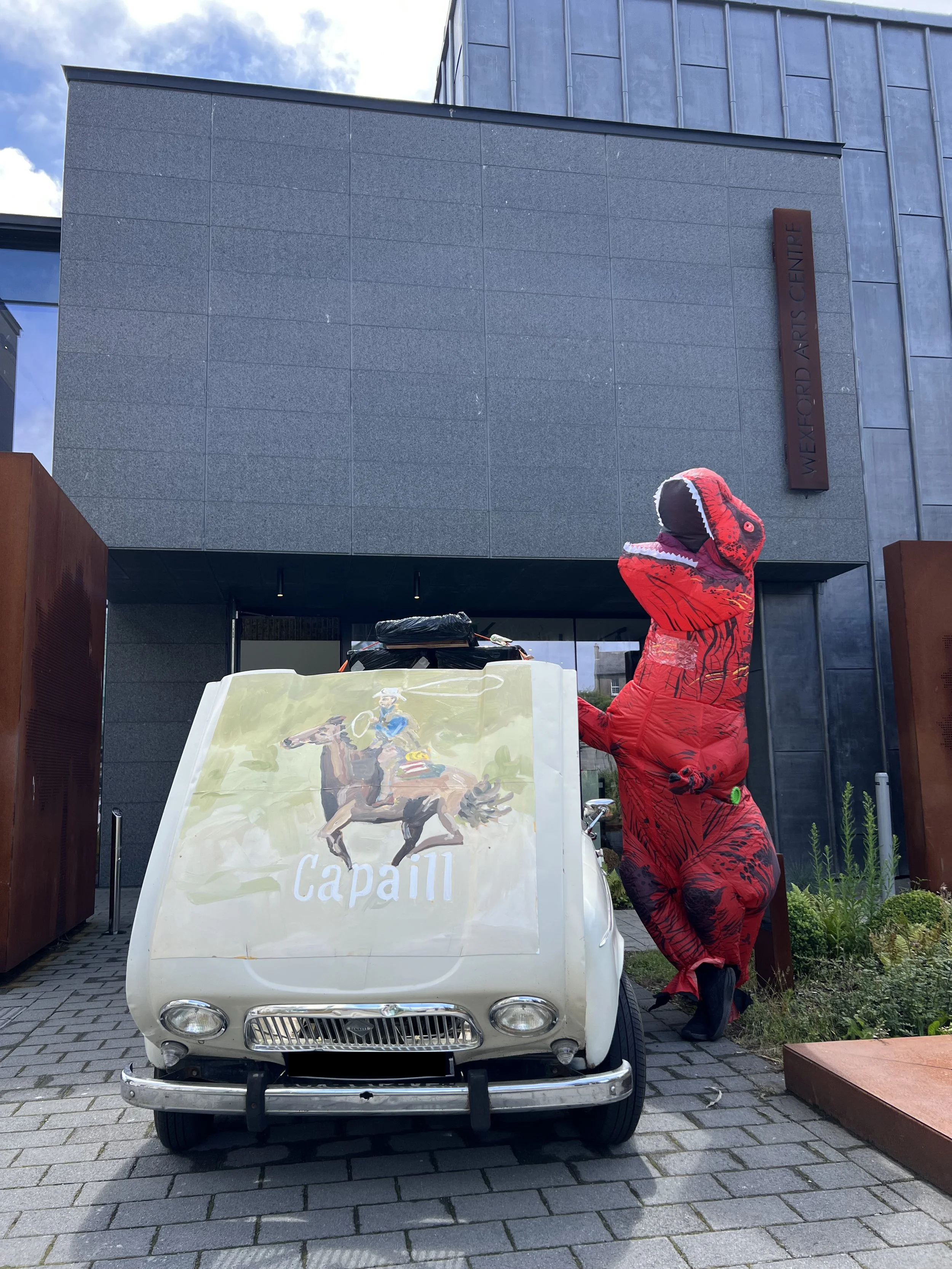
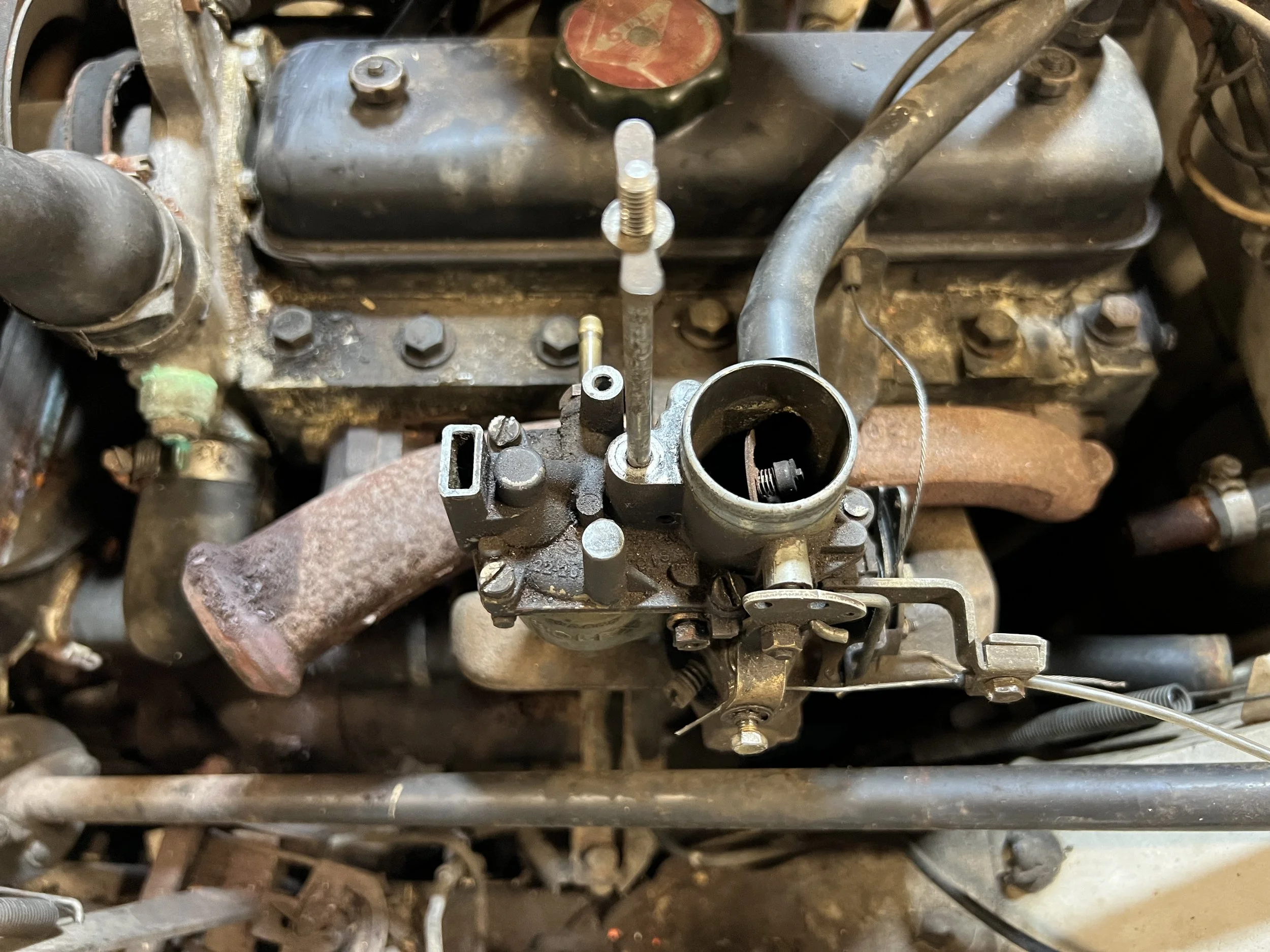
17.07.2025
During the incident with the bulls, the car seized up and we couldn’t move. We had to wait it out until all the animals had passed by; first the huge bull, two more bulls followed, then the heifers, and finally about four calves. The car eventually started after a few adjustments under the bonnet, but the initial cause of the stall wasn’t clear. Possibly the engine flooded momentarily from pumping gas in a panic, and the excess raw fuel wet the spark plugs…the ignition needs to send high-voltage electricity to the spark plug so that it can shoot an arc across a tiny gap. Maybe at this point the spark plugs were too saturated to fire. Although we would have smelled the petrol if this was the case, and the engine would have cranked without catching. Maybe stopping suddenly on a steep hill caused fuel starvation, where the old car’s mechanical fuel pump can’t pull fuel up at such a slant. Perhaps it was a vapor lock…heat soak…airflow over the engine stopping, and radiating heat from the exhaust boiling the fuel in the carburetor…?
The three bulls and the car adventure threw an extra couple of hours on the journey and it was late when we arrived in Wexford. Under the awning of a pub by a windy pier, we sat sipping salty pints, half sitting out in the rain by the sea, and planned our schedule for the following day. We’d have to be up early to check that the car was ok to get us to our interview on time. This day last year we had a slot with Alan Corcoran at South East Radio for his hugely popular Morning Mix programme. We wanted to reach as many people as possible in Wexford. On air, we invited people to a coffee morning at Wexford Arts Centre and a lecture at the the Irish Agriculture Museum in the coming days.
Wexford was a key pit stop on tour de force, for its industrial past and car assembly plant - a Renault factory opened in 1965 on a site between the Rosslare Road and the Wexford town waterfront. Hundreds of people from the area were employed at the factory which had been set up there because of the highly skilled local labour force. This was due to the fact that the plant had long been associated with motor assembly. We were hoping to meet people who had worked at the factory, and who might share their memories and experiences of driving, building or owning a Renault 4 over the years, or being a passenger in one. We wondered if anyone still owned a 4L, and if so - had they modified it. If they had one in the past - what happened it. So far, the people we’d talked to about owning a 4L often said the same thing; it was a great car, the rust got it, I drove it to the ground.
After the interview, we strolled around and met Anthony at a jumble shop where we went looking for cassettes. The Brass Fiddle all the way from south west Donegal with four of the great Donegal fiddlers from the older generation of players, James Byrne, Con Cassidy, Vincent Campbell and Francie Byrne. This was a brilliant find, even if the sleeve notes were fused together from the damp. Conversation sparked at the counter with the proprietor, due to the excitement of the cassette find and that’s when Anthony joined us. The two men were friendly, familiar with one another.
You never know what you’ll find in here, said Anthony. That’s it, said the proprietor - tell them about the book, he suggested. The photo book. That’s right, the photo book, nodded Anthony. A book of family photos and all the lads at the old car factory - who would throw that out. And do you know what, I found pictures of my own father in the book, said Anthony, with all the other men who worked at the factory. I don’t know who it belonged to but it must have been an old friend of my father’s. Ah it was a wonderful find. It’s funny what people throw out isn’t it, Anthony said to the proprietor
We asked Anthony to please join us the next day for our coffee morning and to bring the photo album if he felt like it…
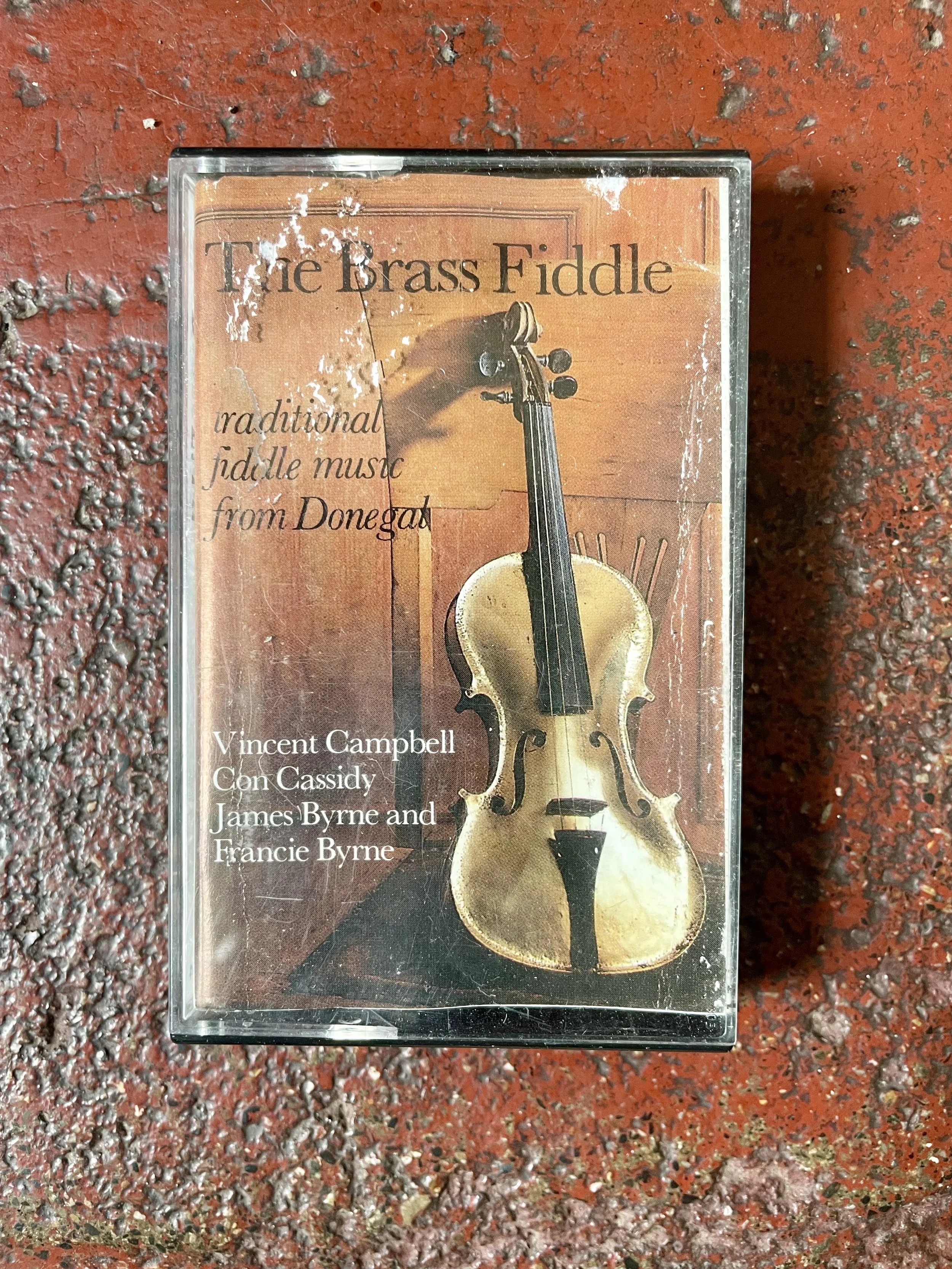
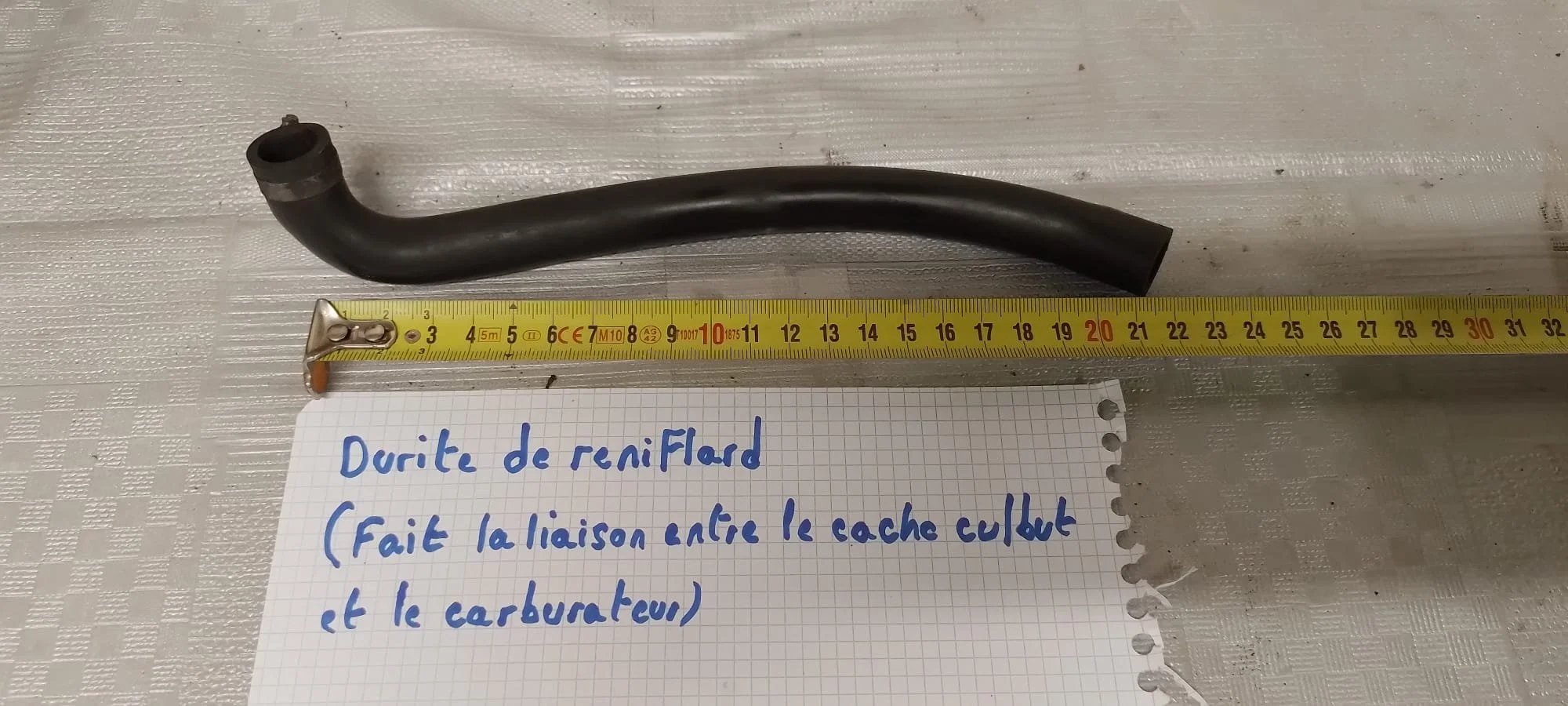
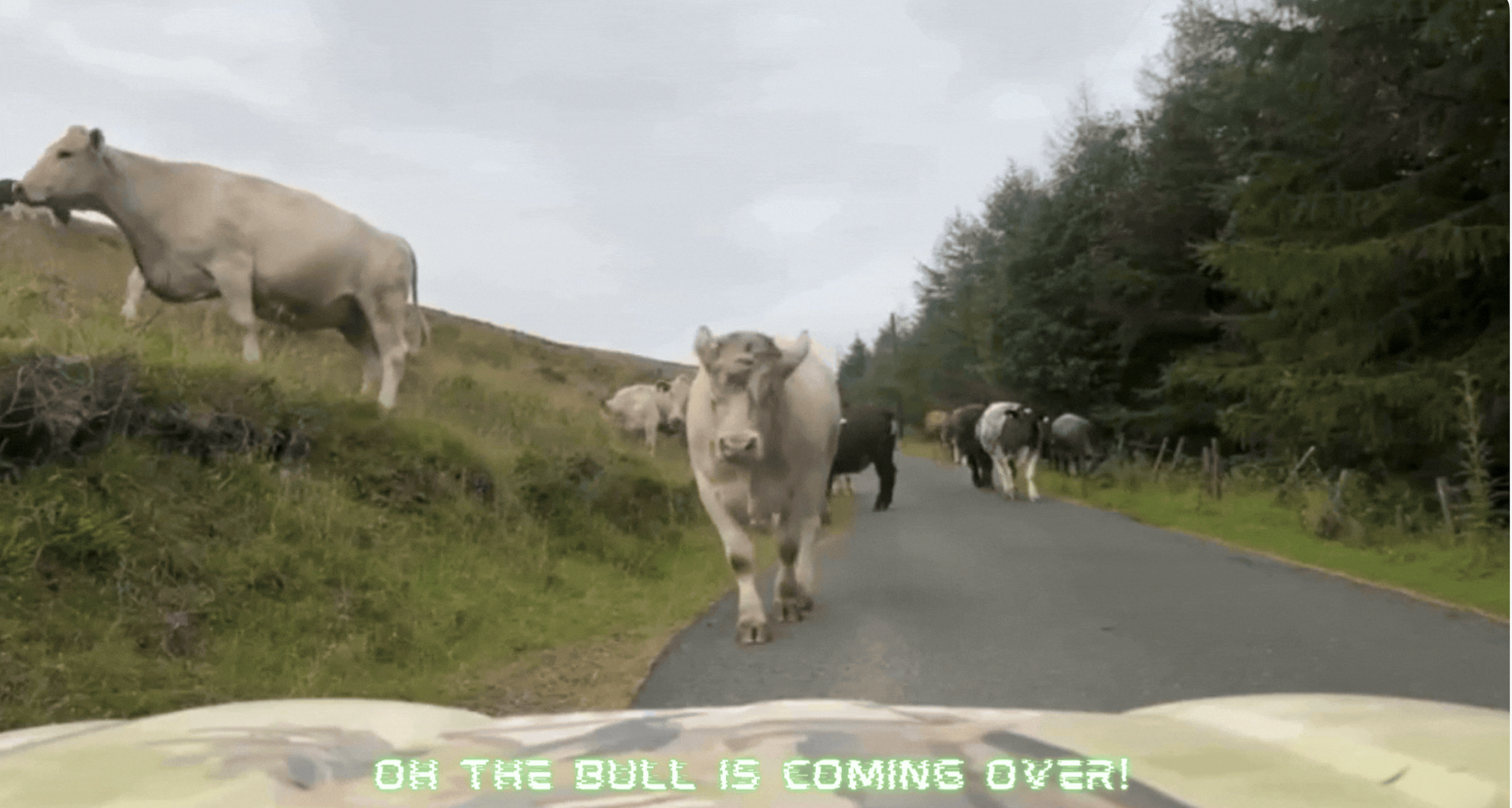
16.07.2025
News had travelled about the re-animated Renault 4 at Muine Bheag Community Hall and when we arrived early ahead of our talk, there was a fella waiting with his 2001 Subaru Impreza. Others had gathered to have a look at the two cars so we started revving and showing off the two models comparatively, to amuse the crowd.
This day last year we, as tour de force, gave a public talk about the tour and hosted writer and contemporary art theorist, Barry Kehoe to share his research; a psychogeographic meandering through the history of sport, medicine, media and graverobbing phenomena during the 1800s in Leinster. The main focus of Barry’s research was Dan Donnelly, born March 1788, a professional boxing pioneer and the first Irish-born heavyweight champion. Barry’s research centres on the expeditions that Dan Donnelly’s mummified arm made independently, after graverobbers removed the body from its resting place at Bully’s Acre, Kilmainham.
Part of the discussion, was about how the community and family, the custodians of the arm would like to see it re-interned at Bully’s Acre. Certainly a strange set of analogies to hear about at a community hall during an art/coffee morning, but the audience stayed with us as we discussed the line of demarcation between subject and object. Mummification of the arm, anthropomorphism of the car, incarnation, personification, degradation and re-animation. How do we collectively ascribe value to an artifact in the ground, how long must it be buried before we consider it an artifact, when is something a relic, what are the embedded belief systems we share; the ethics around burial customs, mounds and grounds that are omnipresent on this island. What about fragmentation, and deconstruction; when is an object considered a component of something else, and not its own thing. Does it have to do with the heart…? The engine…?....The soul…? We had a good crowd at the talk and honestly, fair play to them for staying with us while we went so abstract and deep that early in the day. There was plenty of follow up conversations afterwards too, with the talk having struck a chord.
After existential discussions drifted, when the tea and biscuits were finished, we distributed our leaflet; a map of pit stops, cultural events all around Ireland, before hitting the road towards Wexford for a long drive via the Borris Viaduct, a 16-arch limestone railway bridge.
Against the backdrop of the Blackstairs Mountains, from the foot of an arch, the view through the small, comically shaped R4 windscreen lent the viaduct a majestic and cinematic atmosphere; with the vast expanse of the landscape, we felt minuscule inside the tiny car, almost like it was a toy car. Apparently there was a great sense of pride for the viaduct when it was built in the 19th century, it was considered a monumental triumph of railway engineering in Ireland at the time. Originally constructed as part of the Muine Bheag to Wexford railway line, passenger trains crossed the bridge up until 1931 and commercial goods trains continued using it until 1947. It was decommissioned completely in 1963.
From the viaduct we continued along the L3006 – passing through Tomduff, in Irish Tuaim Dhubh, which translates to ‘the black mound’ or ‘black burial place’ as we climbed the saddle between Mount Leinster and Slievebawn, Sliabh Bán – ‘White Mountain’, towards The Nine Stones. Stories, theories, legends abound about the stones – their meaning and their contemporaneous significance. Conflicting information compelled us to visit the stones, to see if anything could be gleaned or deduced from direct interaction. We were climbing up a country lane ascending in the little car through the woods, happily listening to a tape, Chants Corréziens : French folk songs from Corrèze, and then it happened….
To the group of touring motor cyclists who met us coming in the opposite direction; why on earth did you not warn us?! How come not a single person in the gang thought to wave us down?!!.. and give us a heads up? Did not one of you have the realisation that we were headed for the danger you’d all just escaped?! The mind boggles.
Okay so on our way up, we turn a corner and suddenly find ourselves facing several huge bulls, heifers and their calves. Any farmer will tell you that heifers are just as aggressive as bulls when they are calving. Couldn’t tell you how many there were – we just seemed to be suddenly surrounded, and actually; because the verge rose up either side of the road – there was barely space for anything to pass, let alone the biggest bull you’ve ever seen. It's too intense to describe here. You’ll just have to watch the Twitch footage and I hope it does justice to the scale of that animal.
One little fleeting thought to mount the car or use it to scratch its rump, and the car would crumple like a tin can; we really thought we were done for….
I was like DRIVE Liliane,
But Liliane was like, NO! we’ll startle them and then what?! ONE’S LOOKING AT US!
Don’t look at them, don’t make eye contact! I said,
Why? Asked Liliane,
I heard it makes them feel threatened, I answered…OH THE BULL IS COMING OVER!
Liliane: How do you know it’s coming over if you’re not looking?
Me: Peripherally, I can see it peripherally
Liliane: Don’t look at themmmm…… DON’T LOOK AT THEMMMMM
Me: OH THEY’RE COMING!
Full Withnail and I, gone on holiday by accident. We were frozen with fear and then - you couldn’t make it up – as if the car was also in shock, it completely seized up and wouldn’t start either…
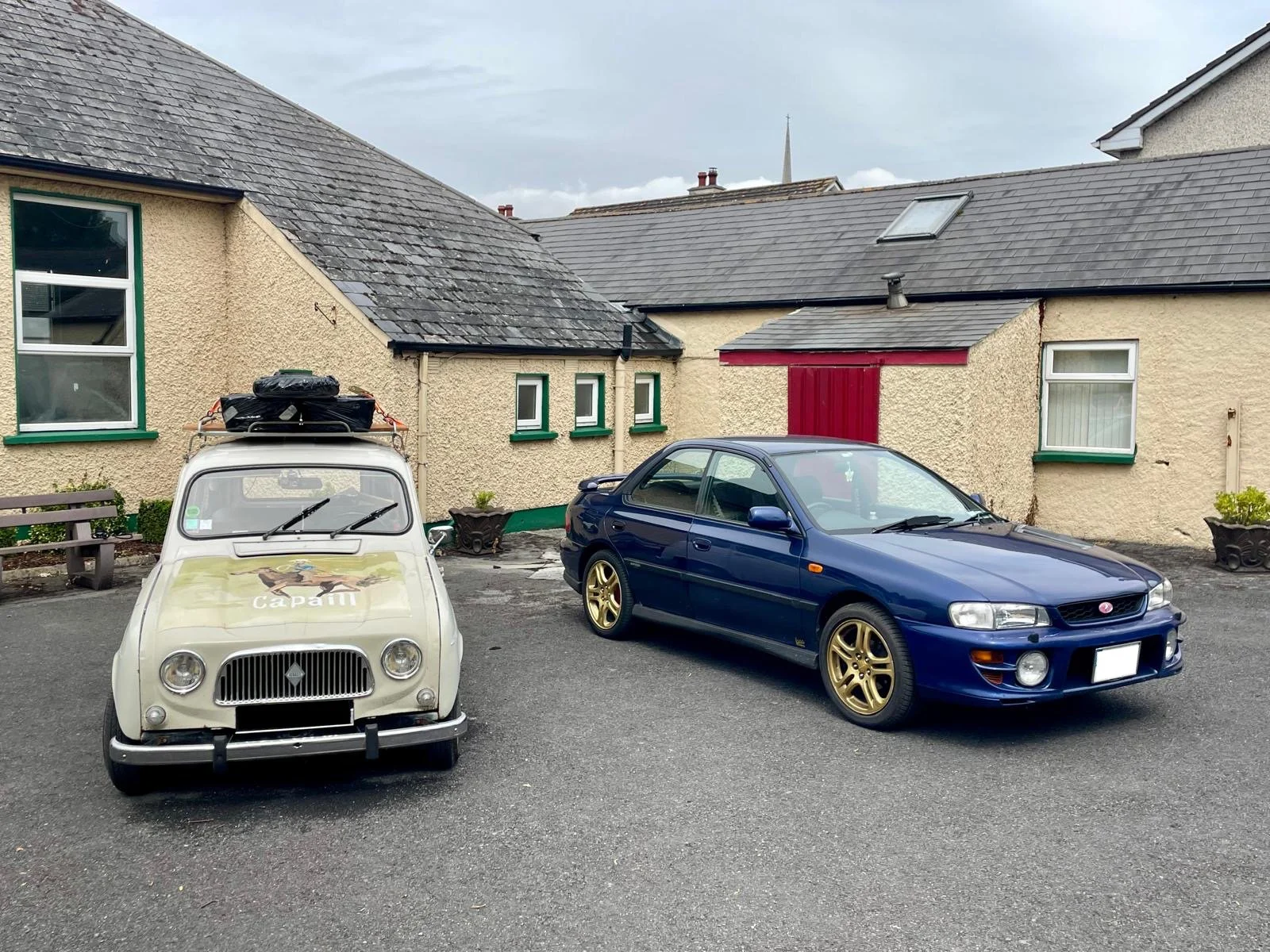
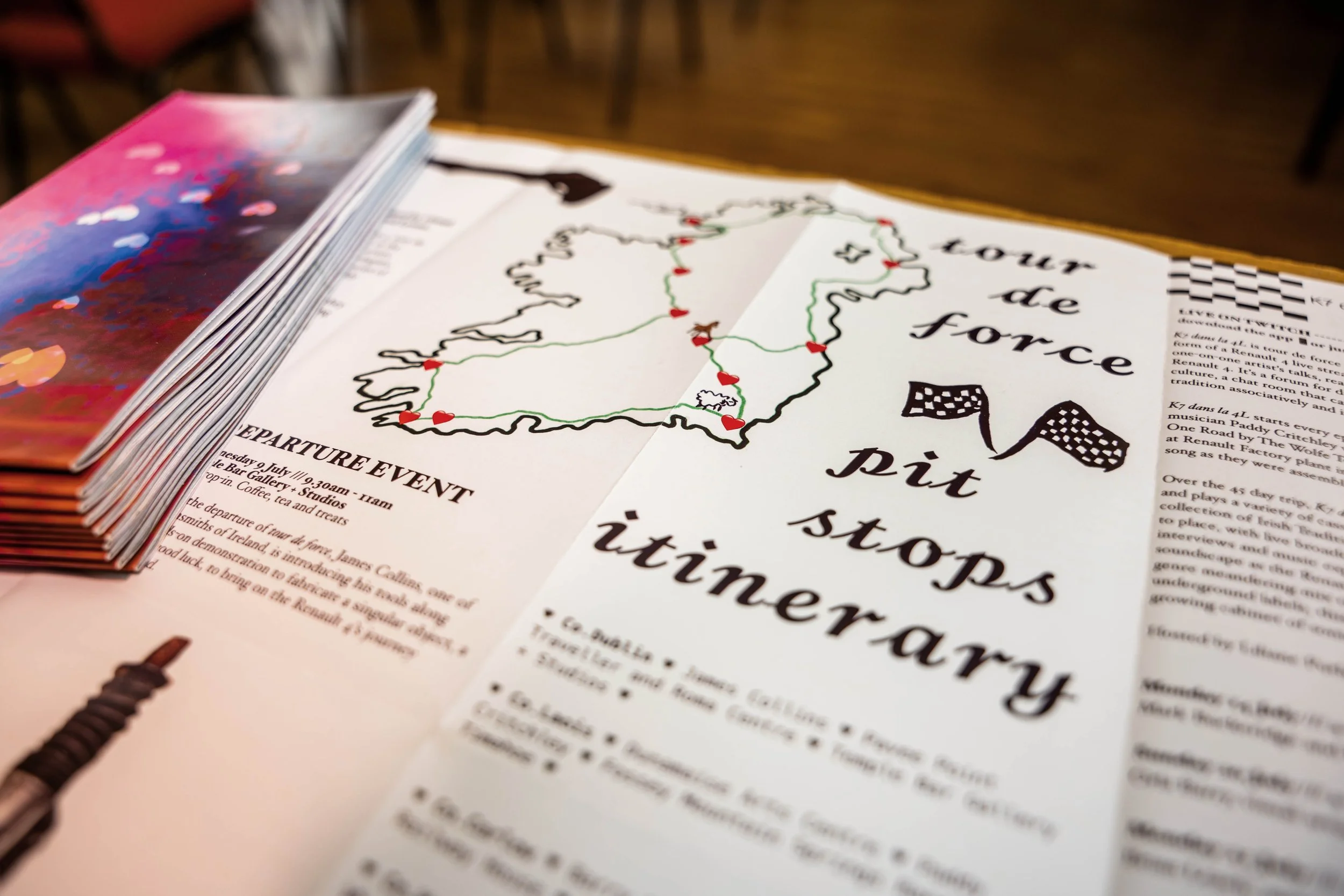
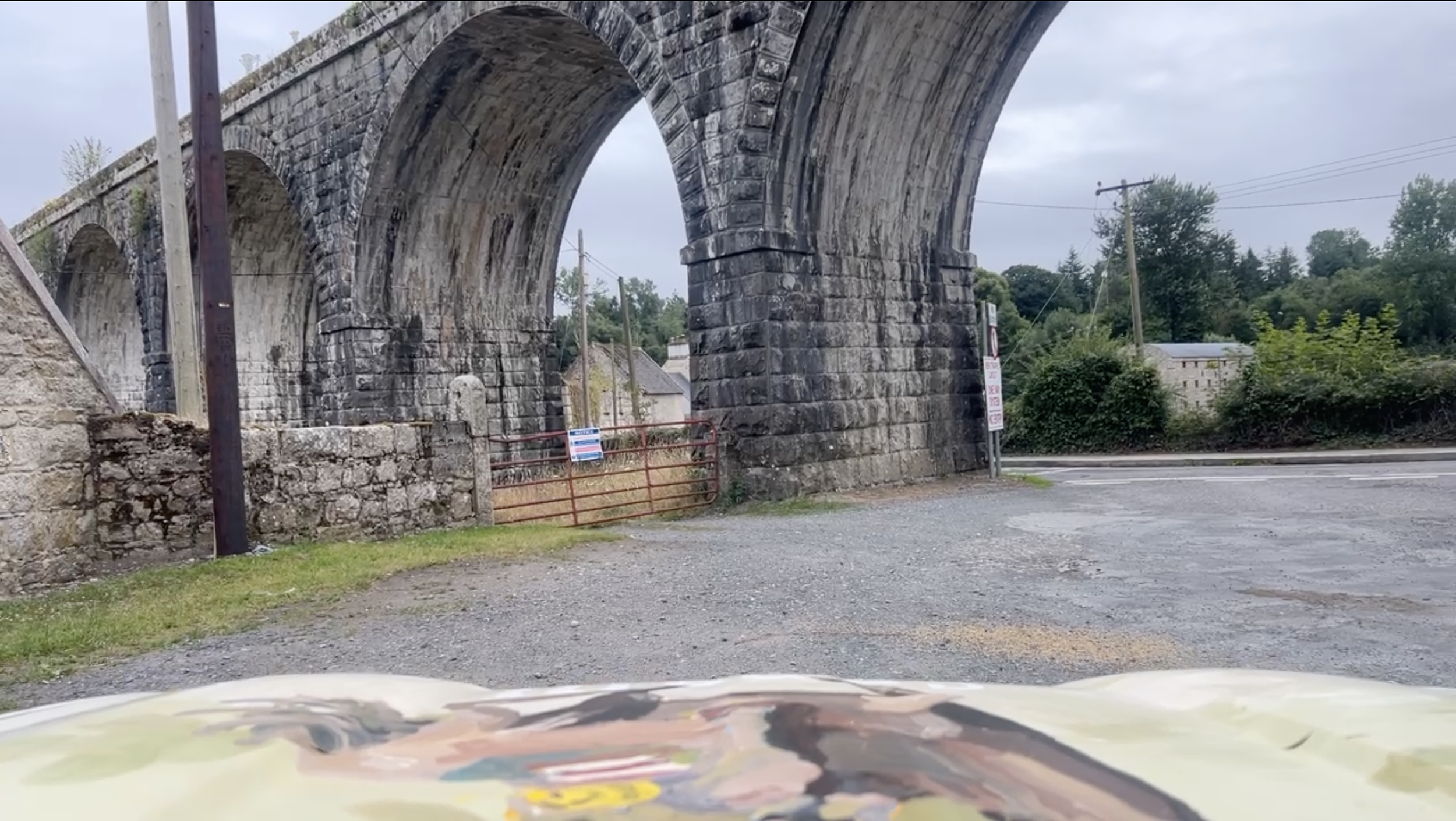
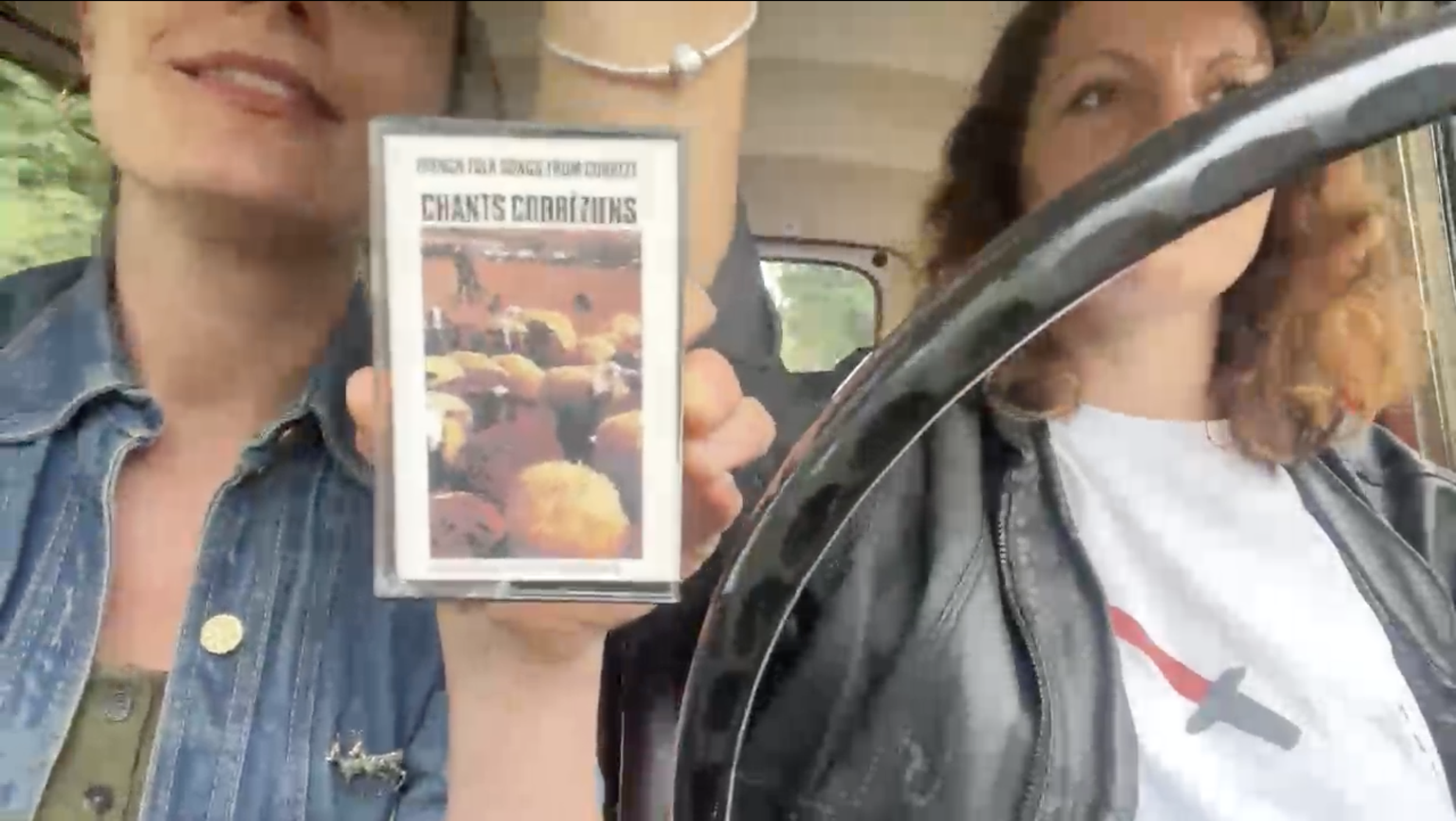
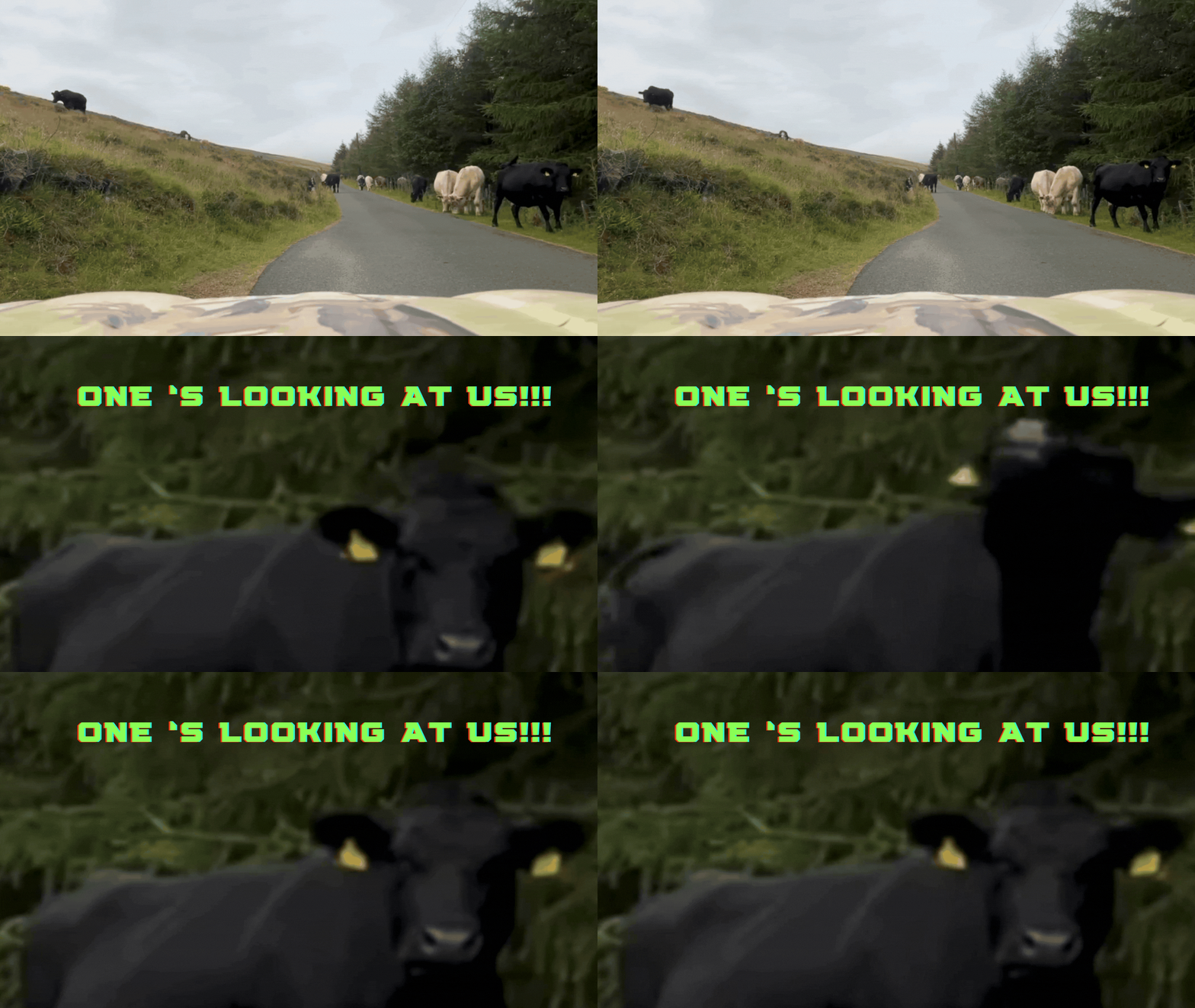
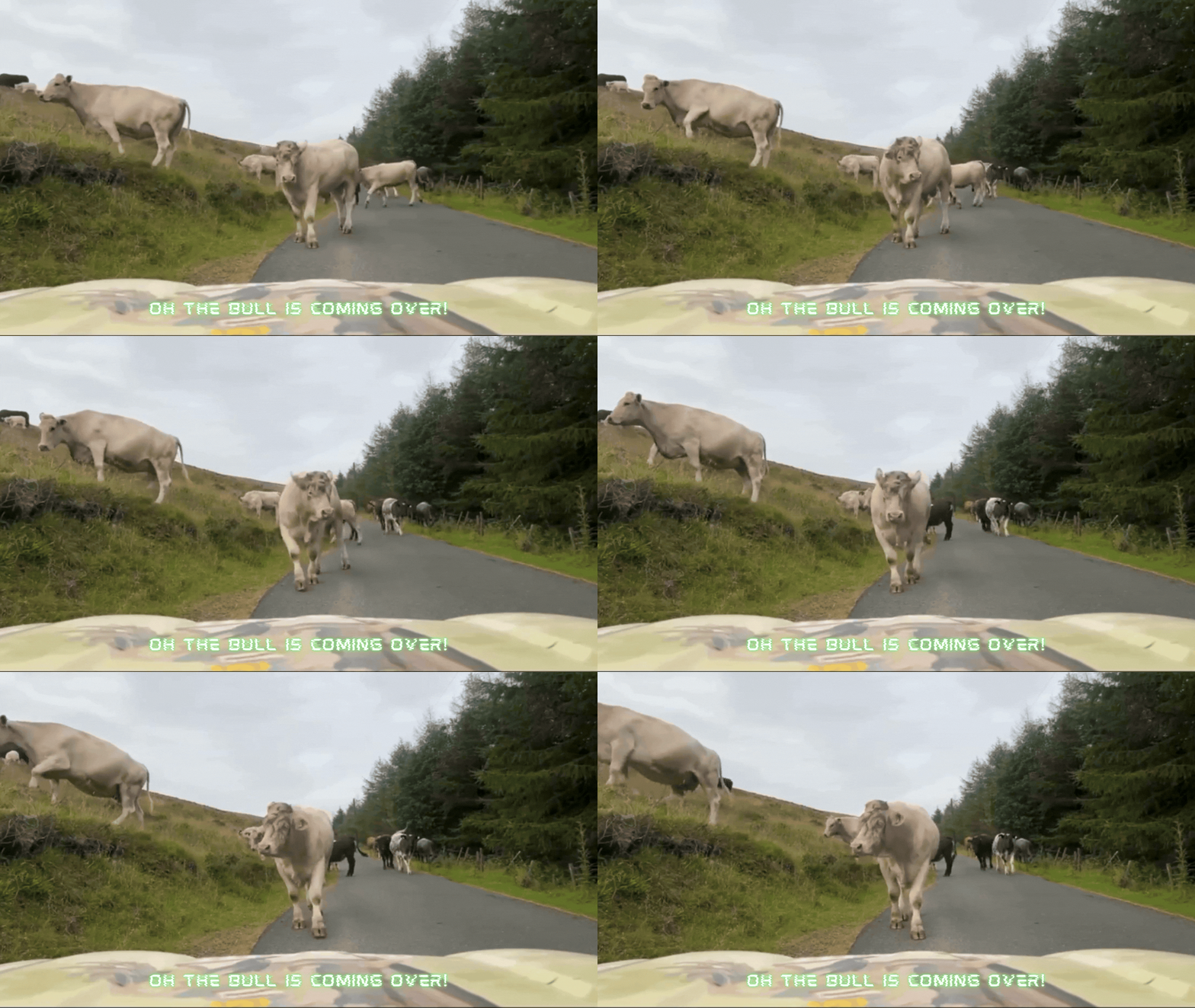
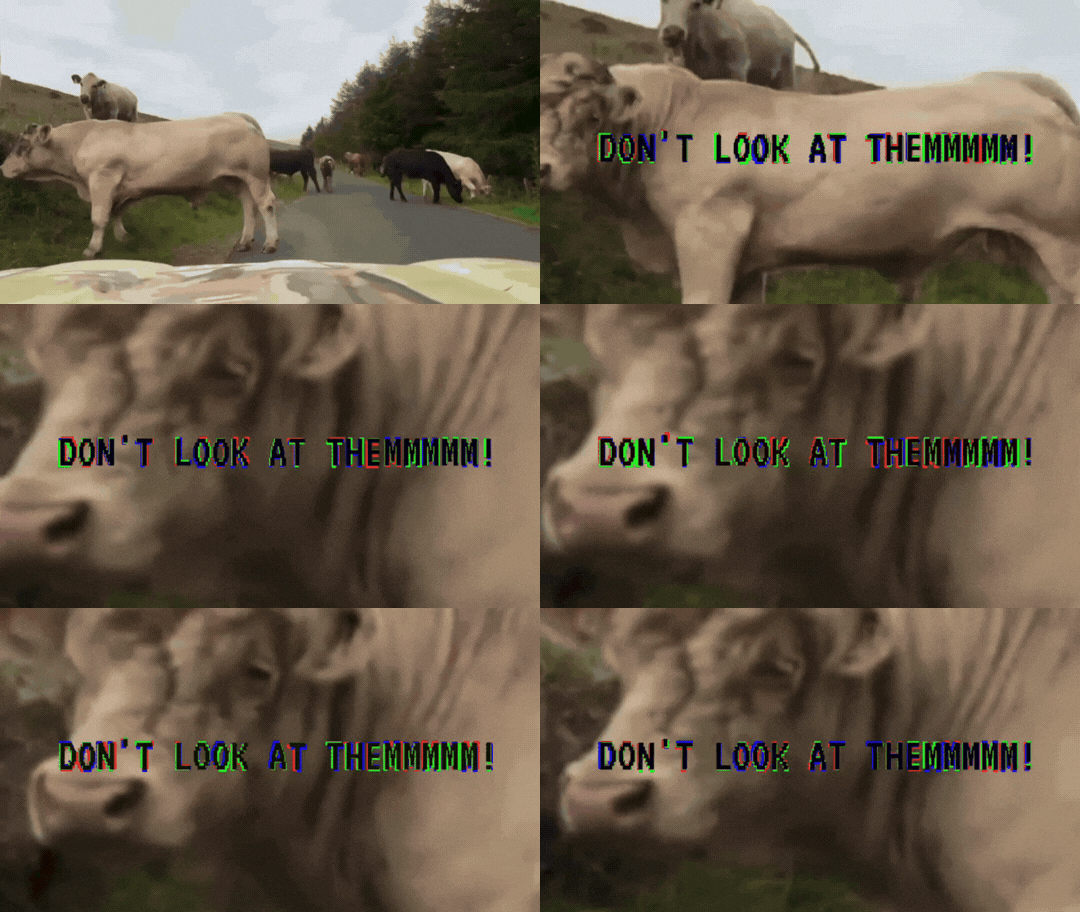

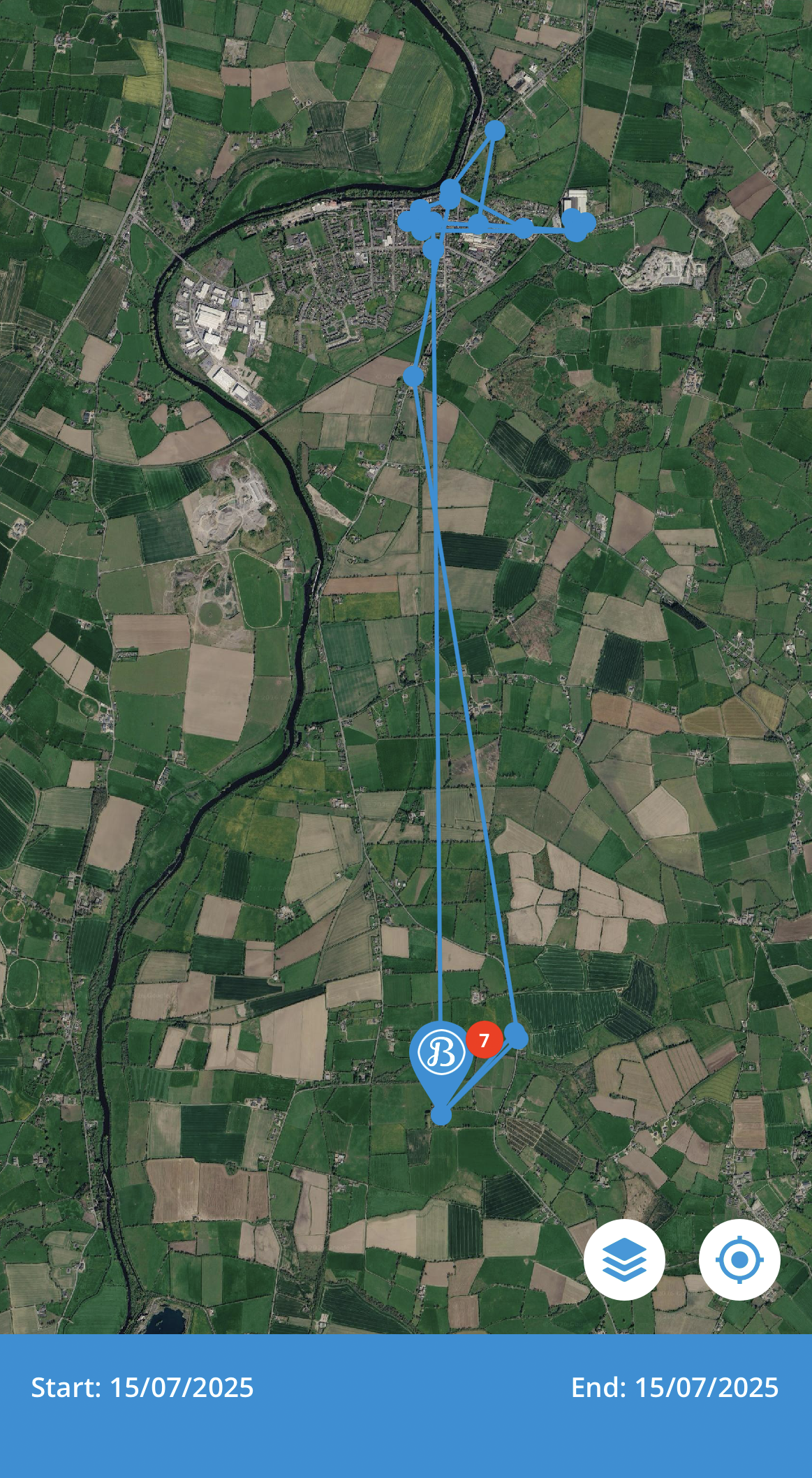
15.07.2025
At this point on tour de force, we’re still in Carlow, still in Muine Bheag; meeting Mark and Leah each day. You couldn’t ask for better guides. The storytelling and insight, the extensive historical knowledge, the innovation and ingenuity, levity and wit that comes with knowing a place like the back of your hand. This day last year we took a detour to visit Mark’s mechanic who was interested in seeing the Renault 4. Arriving at a large, busy garage with ample parking for vehicles of all sizes, we introduced ourselves and the bonnet of the Renault, the Quatrelle, the 4L was popped for engine chats. After that we were given a tour of some incredible restoration projects at varying stages of completion. One particularly meticulous and dedicated project; the construction of a set; the Fujiwara Tofu Store from Initial D, a Japanese cult classic manga series.
Bunta Fujiwara is the owner of this Tofu Store and every morning, before dawn, his son Takumi makes tofu deliveries from a mountain top in the Kantō region, to customers living in the surrounding cities and towns. Bunta is secretly a retired downhill street racer who is conditioning his son Takumi into becoming a racing prodigy. Throughout the series Takumi improves daily reaching higher speeds and taking sharper bends on his delivery routes, whilst never spilling the tofu water in the drinks holder of his father’s old Toyota Sprinter Trueno (AE86).
Each episode, Takumi faces challenges from rivals, racing them in the AE86, which becomes mythologised as he overcomes greater obstacles and beats faster opponents. While the characters are fictional, and loosely based on legendary Japanese racers of the past, the locations where races take place in the series are based on actual locations in Japan.
The Fujiwara Tofu Store set, outside a garage in Co. Carlow is a passion project in celebration of the AE86. Made especially for the enjoyment of a niche interest community of JDM (Japanese Domestic Market) enthusiasts. We didn’t get to see the completed set during this visit, but we were told it would be unveiled for fans of the AE86 so they could come and meet up, have a photo op, chat with one another, exchange parts, knowledge and so on.
The AE86 is incredibly popular in Ireland, particularly in Donegal where there’s an enduring subculture focused on modifying and tuning Japanese-market cars. And actually, Ireland is widely recognised by automotive historians as having the highest number of AE86 cars in the world outside of Japan. More on this in August, when we meet with visual artist, Cliodhna Timoney in Killybegs at a vintage car rally.
The encounter at the garage was not documented visually, however…Jack Corbett, a sound artist and musician working with Muine Bheag Arts created a beautiful radio show about the Muine Bheag x tour de force exchange. In this soundscape, document, artwork…you’ll hear more about our adventures in Muine Bheag and our detours that day…
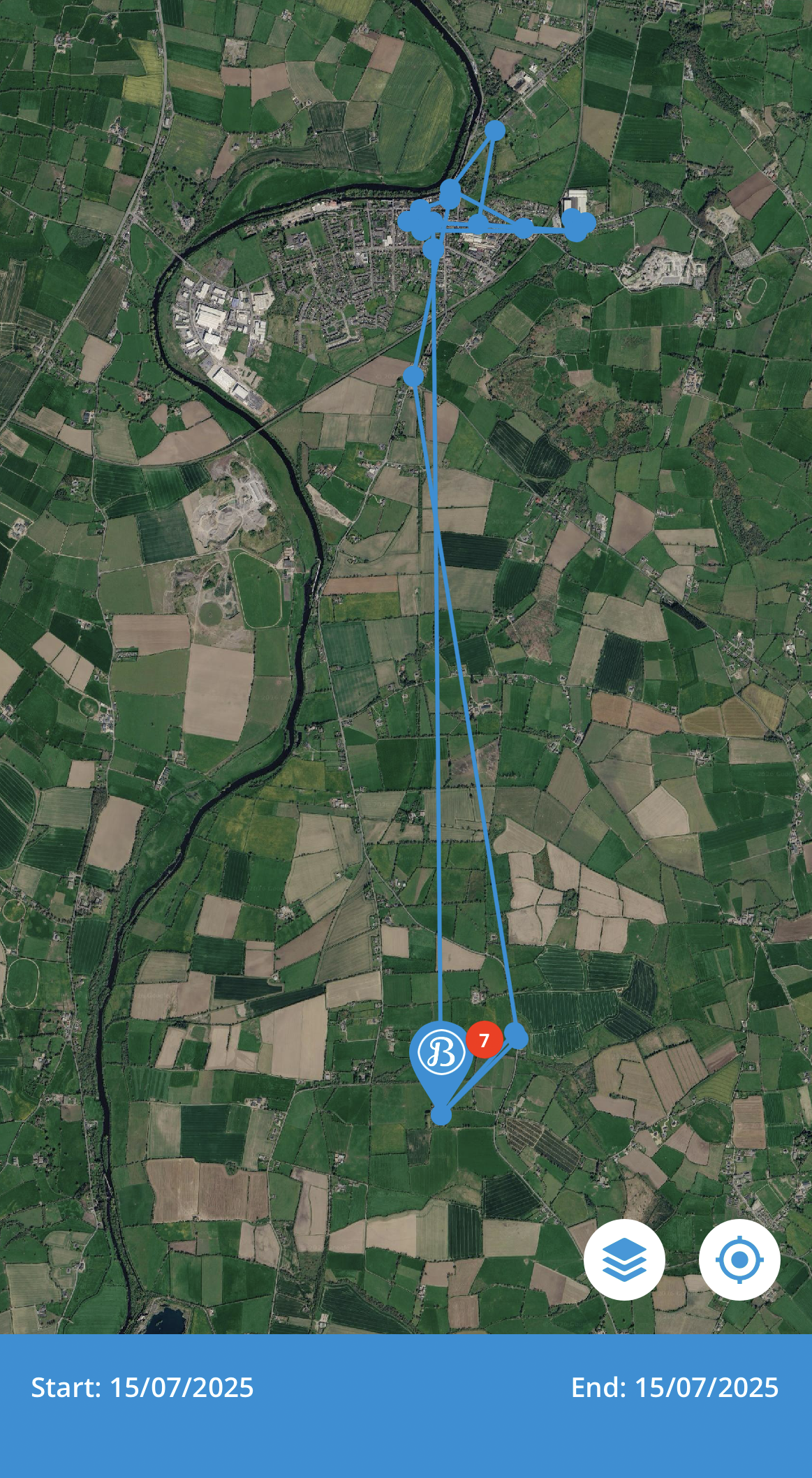
14.07.2025
We’d been having a heatwave for a couple of weeks but it had finally broken this day last year. It was lashing rain and fairly gusty by the time we got to Muine Bheag to interview visual artists Mark Buckeridge and Leah Corbett in the Renault 4 for an episode of K7 dans la 4L.
We’d arranged to meet Mark and Leah in a car park outside the swimming club on the River Barrow so we drove there early to get the Twitch set up. As the second longest river in Ireland, the River Barrow once served as a vital trade and transport route. From the 18th century onwards, 23 locks and lateral canals were built on the Barrow allowing horse-drawn barges to carry goods like sugar, stout and beet between Athy, Carlow and Waterford. And Muine Bheag, formerly Bagenalstown had once been a mill town, an important stop along the route.
Before the interview and between rain showers, objects, artworks and musical instruments that were stacked on the back seat had to be moved and reorganised, packed away ahead of the interview. Mark and Leah arrived, while we were making space for them in the back seat and we started chatting. We had the boot of the Renault 4 open and some things out on the tarmac, when a plastic bag that Liliane brought from her late father’s remise in France was suddenly whipped out from a cavity in the boot and taken up in the breeze. The bag, with the words thank you on both sides, seemed grateful for its freedom as it flitted up into the air on the gusts, thank you, thank you. The four of us watched it glide away from the river and up the Leighlinbridge road until a jeep rounded the corner and caught it underneath the chassis.
We’d been eager to meet with Mark and Leah to hear more about COMMUNE, about this project of establishing and circulating contemporary art in a rural area and creating a very buzzy and exciting grassroots, in situ platform for public sculpture.
COMMUNE has become a staple on the contemporary art calendar, drawing visitors from all over Ireland, and it is much anticipated by the residents of Muine Bheag. Unexpected art-works appear around the town each year for a week in August with a series of performances and talks inviting, ‘artists, community organisers, graduates-in-residence, gardeners, zine-makers, visitors and friends to contribute to an evolving and expanding programme’.
Below is an interview with Mark and Leah that took place this day last year in the Renault 4 while we drove to sites in the town associated with COMMUNE. Here, we chat about recent projects and initiatives focusing on COMMUNE which supports emerging and established artists by commissioning new works of art, and in collaboration with the local community, it promotes contemporary art outside the city context. This contemporary art mapping of Muine Bheag gives great insight into the types of projects Mark and Leah run, as well as some interesting side stories and background information about curating, making and installing artworks, utilising the infrastructure, historic sites and architecture of the town. The best way to describe COMMUNE is…, ‘Leah notes, ‘that it’sreally a culmination of projects we’ve been working on throughout the year, and then it has this public moment’.
Our first stop, an artwork by Cóilín O'Connell called, Counterfeit Coin. We parked opposite the mill, cut the engine and the got low down before heading to the next stops to reflect on artworks by Colm Keady-Tabbal, Rory Mullen, Mollie Anna King, Holly Pickering, Chloe Maguire, Lily O'Shea, Cian Lawler….amongst ruins, across the river, in a disused shed, on a public notice board, near the mill, by a neo-classical train station built in 1850, in the town hall.
At one stage, we passed by a hidden artwork by Michael Warren, a regarded sculptor from Gorey who produced site-specific public art, and sadly he had just passed away the previous week. While Michael Warren was well known for creating large-scale, site-responsive sculptures, the artwork Mark and Leah pointed out on the R448 (formerly the N9 National Primary road) was a peripheral experience in which the artwork blended with the roadside foliage, perhaps lending a more subliminal experience to road users.
After a lap of the town, Mark says, ‘let’s put the Joe Heaney on’ and for the rest of the interview we’re listing to tapes and shooting the breeze…